A New Legal Foundation for Assimilation
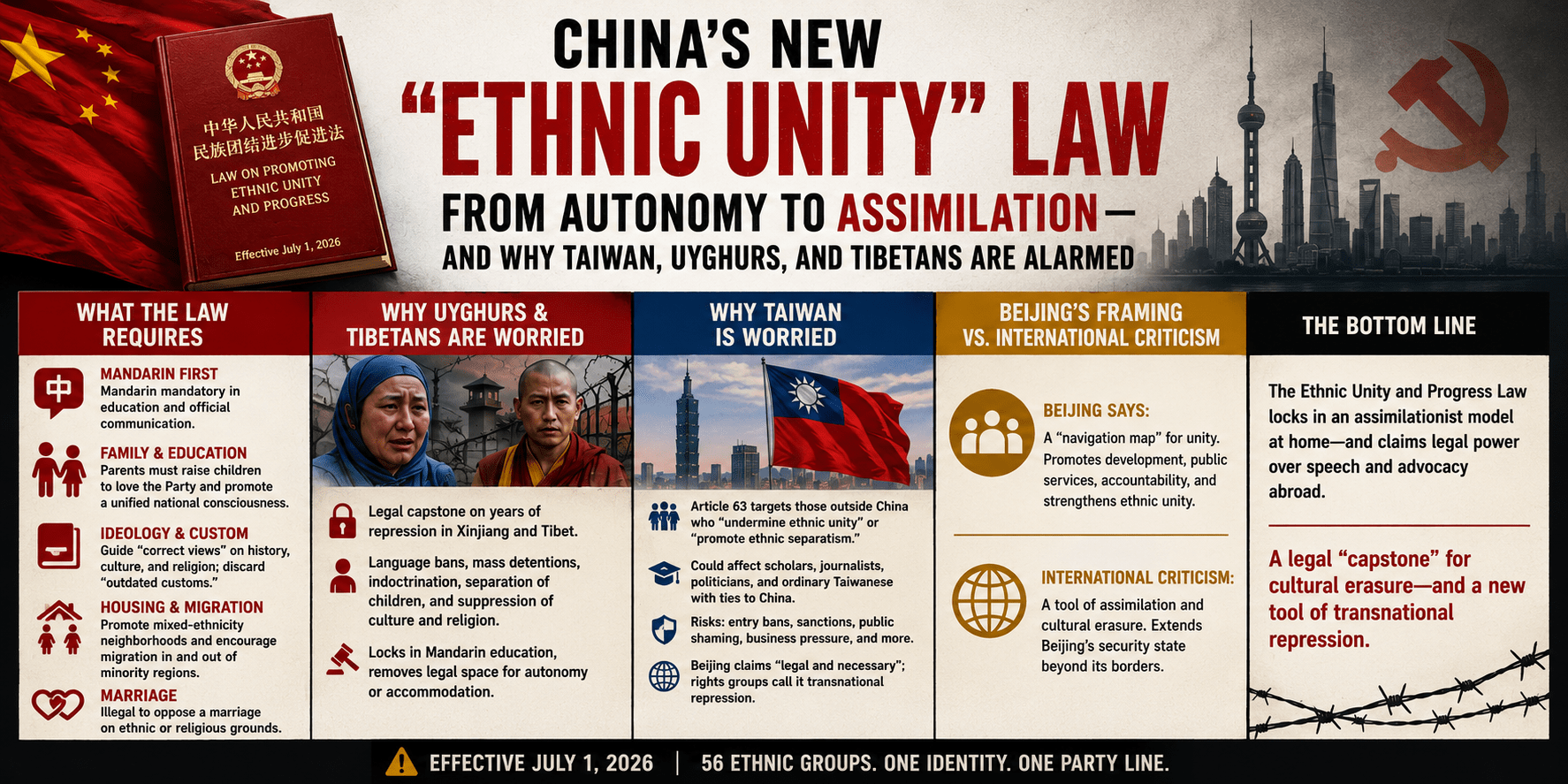
On March 12, 2026, China’s National People’s Congress adopted the Law on Promoting Ethnic Unity and Progress, a sweeping piece of legislation that takes effect July 1, 2026. The law codifies more than a decade of policy under Xi Jinping aimed at forging a single, Party-defined “Chinese national identity” out of the country’s 56 officially recognized ethnic groups.
The statute represents the culmination of a policy shift dating back to the 2014 Central Ethnic Work Conference, in which Beijing moved away from the Soviet-derived framework of nominal ethnic autonomy and toward what scholars call “second-generation ethnic policies” – an assimilationist approach prioritizing a unified national identity over accommodation of ethnic difference. Provincial governments in places like Xinjiang and Inner Mongolia had already passed local “ethnic unity” regulations in 2015 and 2021 respectively; the new statute elevates this approach into national law.
What the Law Actually Requires
The law touches nearly every aspect of public and family life:
- Language: Mandarin becomes the mandatory language of classroom instruction and official communication nationwide. Children must begin learning it before kindergarten, with the goal of basic fluency by the end of compulsory schooling. Where minority languages still appear alongside Chinese in official settings, Chinese must be displayed first and more prominently.
- Family and education: Parents are legally required to raise children to love the Communist Party, and “family education” work must promote a unified national consciousness.
- Ideology and custom: Authorities are directed to guide citizens toward “correct views” on history, culture, and religion, and to discard “outdated customs.”
- Housing and migration: The law promotes mixed-ethnicity neighborhoods and encourages migration into and out of minority regions, a policy critics argue is designed to dilute concentrated minority populations.
- Marriage: It is now illegal to oppose a marriage on ethnic or religious grounds.
The law’s central organizing concept is “zhulao” (铸牢) – to “forge” or “cast” metal – built around the idea that “forging the communal consciousness of the Chinese nation” is core to Party ethnic policy, language that was written into the Party Charter at the 19th Party Congress in 2017. Xi has used the image of a tree, with Chinese culture as the trunk and each ethnic group as a branch, and has described the goal as binding minorities together like pomegranate seeds – small, similar, and red, as one researcher summarized it.
Legal scholars have flagged the law’s unusual structure: it opens with a political preamble, a device used in only three other PRC statutes in four decades, and its chapters are organized around Xi’s own ideological slogans rather than the standard functional legal categories used in Chinese legislation – evidence, scholars argue, of Party doctrine increasingly merging into formal state law.
This marks a sharp break from the 1984 Regional Ethnic Autonomy Law, which had explicitly provided for minority-language education and warned against Han chauvinism. The new law contains no such warning.
Why Uyghurs and Tibetans Are Worried
For Xinjiang and Tibet, the law is widely seen as a legal capstone on policies already in place for years – language restrictions, mass detentions, political indoctrination, separation of children from families, and suppression of population growth, according to ethnic-policy scholar James Leibold – measures that have already eroded minority languages and religious and cultural traditions in those regions.
The precedent is recent and instructive: when Inner Mongolia rolled out Mandarin-medium instruction in 2020, it triggered widespread protests and boycotts, followed by a purge of ethnic Mongolian officials seen as insufficiently loyal to the new line. Critics say the national law now locks in that same approach everywhere, removing any remaining legal space for autonomy or accommodation. As one Human Rights Watch researcher described it, Beijing’s ideological demands are no longer confined to its own territory.
Why Taiwan Is Worried
Taiwan’s concern centers on the law’s extraterritorial reach. Article 63 states that individuals and organizations outside China who act to undermine “ethnic unity and progress” or who promote “ethnic separatism” can be held legally liable. Taiwanese officials and scholars warn this could be applied to:
- Scholars who argue Taiwan is not part of China
- Journalists covering human rights abuses in Xinjiang or Tibet
- Foreign politicians supporting Taiwan’s participation in international bodies
- Ordinary Taiwanese with business ties, family connections, or frequent travel to China
A Tunghai University scholar speculated the law could be used to justify entry bans, sanctions, public shaming, or business pressure, with cross-strait travelers, investors, and public commentators most exposed. Taiwan’s Mainland Affairs Council has noted that although the law is framed around domestic ethnic minorities, its references to national unification and its overseas-liability clause could spill directly into cross-strait politics. A coalition of pro-Taiwan civic groups has labeled the law a tool of “transnational repression.”
China has not been shy about defending this reach. On June 24, 2026, just before the law took effect, Vice Justice Minister Hu Weilie told reporters in Beijing that China has the right to hold people outside its borders legally accountable for undermining ethnic unity, calling the provision lawful, necessary, and consistent with international practice, and arguing that countries everywhere have the right to guard against separatist activity through domestic law. He pushed back against Western media criticism of the clause and insisted it would not affect normal academic exchange, trade, or people-to-people contact. Rights groups, however, point to China’s past use of Interpol “red notices” to pursue political dissidents abroad as a sign such assurances offer little practical protection.
Beijing’s Framing vs. International Criticism
Chinese state media has presented the law in starkly different terms – as a “navigation map” for ethnic work that formalizes decades of successful unity-building, clarifies development pathways for minority regions, and strengthens accountability and oversight mechanisms for implementing ethnic policy. Official coverage emphasizes economic development, cross-regional public services, and the law’s role as what one state outlet called a foundational, comprehensive piece of ethnic-affairs legislation.
International observers see something else: a transnational expansion of Beijing’s domestic security state, applied to an already vulnerable population of Uyghurs and Tibetans and now reaching, through its overseas clause, into the lives of Taiwanese citizens, foreign journalists, and academics who study or report on Chinese ethnic policy.
The Bottom Line
The Ethnic Unity and Progress Law does two things at once: it locks in, as binding national law, the assimilationist model already imposed in Xinjiang and Tibet over the past decade, and it extends Beijing’s claimed legal authority over conduct – speech, scholarship, advocacy – that takes place entirely outside China’s borders. That combination is what has alarmed Uyghur and Tibetan rights advocates, who see the legal “capstone” on a policy of cultural erasure, and Taiwanese officials and civil society groups, who see a new tool that could be turned against anyone Beijing decides has “undermined ethnic unity,” regardless of where they live.