Comprehensive Report : Link
Why the Next Global Financial Revolution Is Already Underway
For decades, the international financial system has been built upon institutions, currencies, and payment networks that emerged after the Second World War. The U.S. dollar became the world’s dominant reserve currency, global trade flowed through the SWIFT banking system, and central banks acted as the guardians of national monetary policy.
Today, that system is facing its most significant transformation in generations.
Cryptocurrencies, blockchain technology, Central Bank Digital Currencies (CBDCs), stablecoins, tokenized assets, decentralized finance (DeFi), and artificial intelligence are collectively reshaping how money is created, transferred, stored, and controlled. What began with the anonymous publication of Bitcoin’s whitepaper in 2008 has evolved into a geopolitical contest involving governments, intelligence agencies, central banks, multinational corporations, and global technology giants.
The debate is no longer simply about Bitcoin’s price or cryptocurrency investments. Instead, it has become a struggle over economic sovereignty, technological leadership, financial surveillance, sanctions resilience, cybersecurity, and the future architecture of global finance.
Our latest intelligence report explores this transformation through a geopolitical lens, examining how nations are positioning themselves for a future in which digital currencies may become as strategically important as oil, semiconductors, or artificial intelligence.
A New Era of Financial Competition
History has repeatedly shown that financial systems shape geopolitical power.
The British Pound dominated the nineteenth century before giving way to the U.S. Dollar after World War II. International payment systems, reserve currencies, and banking infrastructure have long provided states with economic influence extending far beyond their borders.
Digital currencies are now challenging many of those assumptions.
Unlike traditional banking networks, blockchain enables value to move globally without conventional intermediaries. Stablecoins have begun processing transaction volumes comparable to those of major payment networks. Governments are experimenting with programmable money capable of executing transactions automatically under predefined conditions.
This evolution has transformed cryptocurrency from a niche technological innovation into a strategic instrument of national policy.
China and the Cryptocurrency Paradox
Perhaps no country better illustrates this transformation than China.
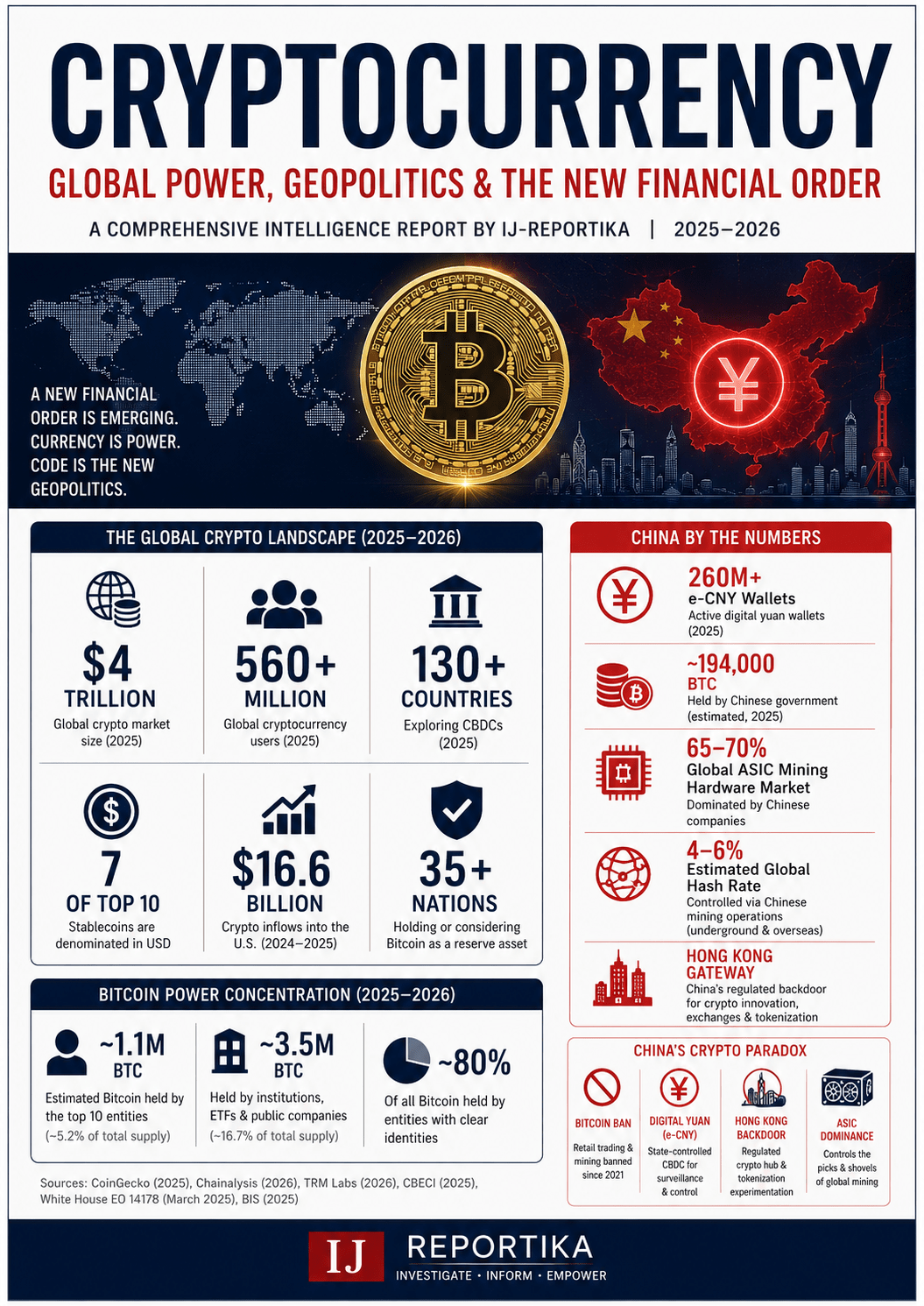
To many observers, China’s cryptocurrency policy appears contradictory. In 2021, Beijing intensified restrictions on cryptocurrency trading and mining, forcing many exchanges and industrial mining operations to relocate overseas. Yet, at the same time, China accelerated development of one of the world’s largest Central Bank Digital Currency projects—the Digital Yuan (e-CNY).
This apparent contradiction reflects a broader strategic objective.
Rather than opposing digital finance, China is reshaping it under state supervision.
While decentralized cryptocurrencies challenge centralized financial control, the Digital Yuan strengthens governmental oversight through programmable transactions, real-time settlement, and integration with China’s rapidly expanding digital economy.
China’s approach demonstrates that the competition is not necessarily between digital and traditional money—but between decentralized financial networks and state-controlled digital monetary systems.
Beyond the Ban
Despite restrictions on domestic cryptocurrency activity, China’s influence within the global digital asset ecosystem remains substantial.
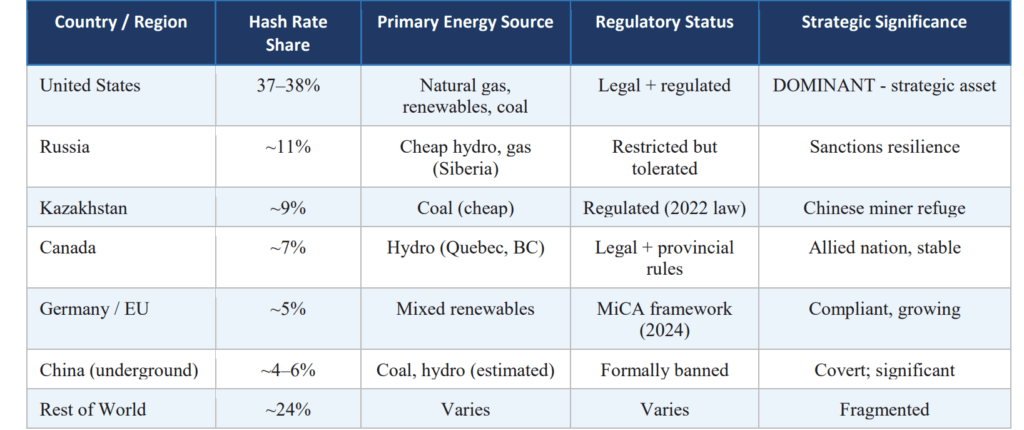
Chinese companies continue to manufacture a significant share of the world’s specialized cryptocurrency mining hardware. Hong Kong has emerged as an increasingly important regulated digital asset hub, attracting exchanges, investment firms, blockchain startups, and institutional capital.
Meanwhile, China’s research into blockchain infrastructure, digital identity, artificial intelligence, smart contracts, and cross-border digital payments continues at an extraordinary pace.
This report examines how these seemingly contradictory policies fit within Beijing’s broader long-term financial strategy.
Cryptocurrency Is Becoming a Strategic Asset
The conversation surrounding cryptocurrency has evolved dramatically over the past decade.
Initially viewed as an experimental technology or speculative investment, digital assets are increasingly being incorporated into national strategic planning.
Today, governments are examining cryptocurrency through multiple national security perspectives, including:
- Economic resilience
- Financial sanctions
- Cross-border payments
- Intelligence operations
- Cybersecurity
- Critical infrastructure protection
- International trade
- Monetary sovereignty
- Artificial intelligence integration
- Supply chain resilience
Financial technology has become an arena of strategic competition comparable to space technology, telecommunications, and semiconductor manufacturing.
The Global CBDC Race
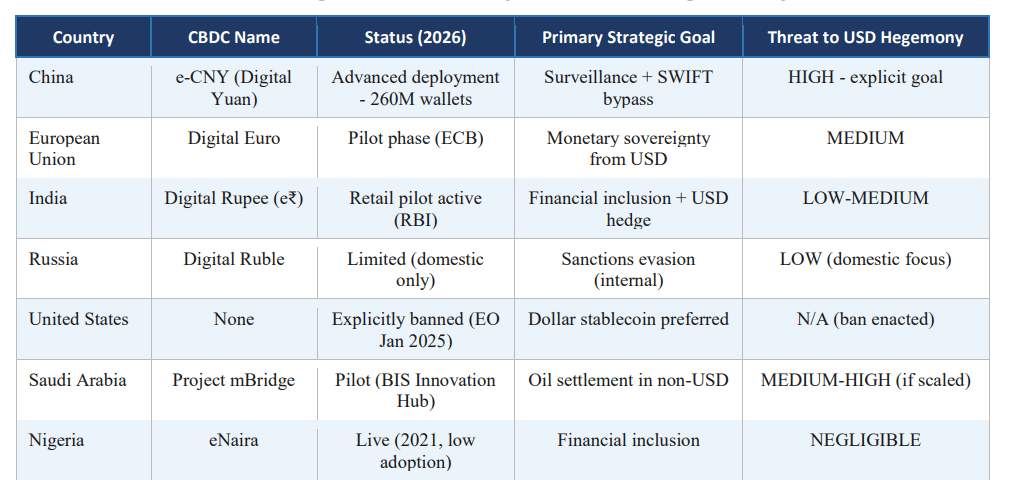
One of the defining themes of this report is the worldwide race to develop Central Bank Digital Currencies.
More than one hundred countries are now researching, piloting, or implementing CBDCs.
These initiatives seek to modernize payment systems, reduce transaction costs, improve financial inclusion, and maintain monetary sovereignty in an increasingly digital economy.
Yet they also raise profound questions.
How much financial privacy should citizens retain?
Can programmable money alter the relationship between governments and individuals?
Will competing CBDCs reshape global trade patterns?
Will reserve currencies evolve alongside digital monetary networks?
These questions extend well beyond economics and into the realm of geopolitics.
Financial Power Is Becoming Digital
The geopolitical implications extend far beyond central banks.
Stablecoins have become major components of global liquidity.
Blockchain-based settlement systems are reducing transaction friction.
Tokenization is transforming ownership of financial assets.
Artificial intelligence is accelerating algorithmic trading and financial risk analysis.
Digital identity platforms are becoming increasingly integrated with payment infrastructure.
Together, these technologies are creating an entirely new financial ecosystem whose influence will continue expanding throughout the coming decade.
Key Themes Explored in the Intelligence Report
This comprehensive report investigates:
- China’s Digital Yuan strategy and long-term objectives
- The future of Bitcoin in an increasingly regulated world
- Stablecoins and their impact on international finance
- The global competition to develop CBDCs
- Hong Kong’s emergence as a regulated cryptocurrency hub
- Blockchain diplomacy and international partnerships
- Cryptocurrency sanctions and sanctions evasion
- Digital finance and artificial intelligence
- National security implications of blockchain technologies
- Cryptocurrency mining and global supply chains
- Cybersecurity risks within digital financial infrastructure
- The evolving relationship between governments and decentralized finance
- The future of reserve currencies in the digital age
Each chapter combines geopolitical analysis, policy developments, market trends, technological advances, and strategic assessments to provide readers with a comprehensive understanding of the emerging digital financial order.
Why This Report Matters
The transition toward digital finance will influence governments, businesses, investors, financial institutions, technology companies, and ordinary citizens alike.
Countries capable of controlling next-generation payment infrastructure may gain strategic advantages in global commerce.
Those that fail to adapt risk becoming increasingly dependent upon foreign financial technologies and external digital ecosystems.
Understanding these developments is therefore essential not only for policymakers and economists but also for business leaders, researchers, journalists, investors, cybersecurity professionals, and anyone interested in international affairs.
The financial order that shaped the twentieth century is undergoing rapid transformation. Decisions made today regarding cryptocurrency regulation, digital currencies, blockchain infrastructure, and financial technology will influence global economic power for decades to come.
Read the Full Intelligence Report
This article presents only a selection of the findings from IJ-Reportika’s latest intelligence assessment.
- Detailed country profiles
- Exclusive geopolitical analysis
- Comparative CBDC assessments
- China-focused strategic intelligence
- Cryptocurrency market data
- Original infographics and statistical analysis
- Expert commentary
- Future scenario forecasting
- Policy recommendations
- Comprehensive references and sources
Whether you are a policymaker, researcher, journalist, investor, academic, or simply interested in the future of global finance, the full report offers an in-depth examination of one of the defining geopolitical and technological shifts of the twenty-first century.
📄 Access the Complete Intelligence Report: Link