Reporting carries high costs for RFA journalists in authoritarian Asian countries

To mark the 30th anniversary of the UN General Assembly’s proclamation of World Press Freedom Day on May 3, 1993, Radio Free Asia is highlighting the plight of its journalists and bloggers who have been jailed or detained in several of the Asia-Pacific region’s authoritarian states. This year’s theme, “Freedom of expression as a driver for all other human rights,”  highlights the relationship between threats to media freedom, journalist safety, and increasing attacks on other key human rights. The concerns are valid, as the jailing of RFA reporters and bloggers, and their BBC and Voice of America colleagues, occurred in countries and territories that have experienced a decline in broader freedoms–if they had such liberties to begin with. Edmund Wan Edmund Wan Yiu-sing, known by his DJ name “Giggs,” was sentenced by a court in Hong Kong in October 2022 to two years and eight months in prison for sedition and money laundering, charges he confessed to in a plea deal. Prior to his February 2021 arrest, he hosted programs that reported and commented on Hong Kong and Chinese politics for D100, an independent online radio station. Wan also hosted a program for Radio Free Asia’s Cantonese Service from 2017 to 2020. Authorities charged that Wan hosted programs that “incited others to resist or overthrow the Chinese Communist Party” and “promoted Hong Kong independence,” the Hong Kong Free Press independent news outlet reported. Wan had pleaded guilty to one charge of seditious intent for on-air comments he made in 2020, and three charges of money laundering related to crowd funding transactions. In exchange, six other charges were left on file, which means they cannot be pursued without the court’s permission. The charges come under a law, created when Hong Kong was under British rule, that defines sedition as “intent to arouse hatred or contempt of the Hong Kong [government] or to incite rebellion, and cause dissatisfaction with it.” The sedition law was revived by the Hong Kong government during the 2019 protest movement and has been used to arrest pro-democracy activists.In addition to the time in prison, the court also ordered Wan to hand over HK$4.87 million (about U.S. $620,000) in assets. Yeang Sothearin Former Radio Free Asia Khmer news anchor Yeang Sothearin was taken into custody in November 2017, along with Uon Chhin, an RFA photographer and videographer. They were charged with “illegally collecting information for a foreign source” after RFA closed its bureau in the capital of Phnom Penh in September of that year amid a government crackdown on independent media. They were slapped with additional charges for illegally produced pornography in March 2018. If convicted of the first charge, they could face a jail term of between seven and 15 years. Yeang Sothearin and Uon Chhin are out on bail, but they remain in legal limbo after several courts have rejected a series of appeals. In October 2022, Cambodia’s Supreme Court returned Yeang Sothearin’s passport, allowing him to visit his ailing father and sister in Vietnam. Cambodia ranks 140 out of 180 in the 2022 Reporters without Borders (RSF) World Press Freedom Index, between Equatorial Guinea and Libya. After Cambodia’s emergence from decades of warfare in the 1990s, the country’s press had “flourished until the long-serving Prime Minister Hun Sen launched a ruthless war against independent journalism before the 2018 elections,” RSF said. Uon Chhin Former Radio Free Asia Khmer photographer and videographer Uon Chhin and RFA news anchor Yeang Sothearin were taken into custody in November 2017, amid a gathering crackdown on independent media by long-ruling Prime Minister Hun Sen. The pair were charged with “illegally collecting information for a foreign source” after RFA closed its bureau in the capital of Phnom Penh in September of that year. They were slapped with additional charges for illegally produced pornography in March 2018. If convicted of the first charge, they could face a jail term of between seven and 15 years. Yeang Sothearin and Uon Chhin are out on bail, but they remain in legal limbo and their media careers frozen after several courts have rejected a series of appeals. Cambodia ranks 140 out of 180 in the 2022 Reporters without Borders (RSF) World Press Freedom Index, between Equatorial Guinea and Libya. “Hun Sen went after the press mercilessly ahead of parliamentary elections in July 2018. Radio stations and newspapers were silenced, newsrooms purged, journalists prosecuted – leaving the independent media sector devastated,” said RSF.  “Since then, the few attempts to bring independent journalism back to life have drawn the wrath of ruling circles.”   Htet Htet Khine Htet Htet Khine, a former BBC television presenter, was sentenced in September 2022 to three years in prison with hard labor for “incitement” and “illegal association” for her reporting work. The face of BBC Media Action’s national television peace program Khan Sar Kyi (Feel It) from 2016 to 2020, which documented the impact of war on Myanmar society, the freelance journalist and video producer had been in detention in Yangon’s notorious Insein Prison awaiting trial since Aug. 15, 2021, when she was arrested with fellow reporter Sithu Aung Myint. Htet Htet Khine was arrested six months after the Feb. 1, 2021 military coup by junta security forces, one of some 150 journalists detained by junta authorities. Family members expressed concern over Htet Htet Khine’s well-being in prison amid the COVID-19 pandemic and the prospect of physical abuse by jailers. Veteran journalists told Radio Free Asia that her case underscored the fact that reporters face serious personal risk to carry out their work under military rule in Myanmar. Sithu Aung Myint A special court in Yangon’s Insein Prison in December 2022 sentenced veteran journalist Sithu Aung Myint to seven years in prison, which came on top of two earlier sentences totaling five years for allegedly inciting sedition in the army, meaning he will have to spend 12 years in prison. The sentence by a court set up by the junta that took power in a Feb. 1, 2021, military coup…

Read More

Popular Lao activist who criticized government on Facebook shot and killed

A 24-year-old Lao activist who championed human rights and posted articles critical of the government was shot and killed in the capital by an unidentified gunman, according to video footage posted on a Facebook page he helped maintain. Jack Anousa, an administrator of a Facebook group that uncovered and denounced human rights abuses in Laos and called for the end of one-party rule, was shot at 10:26 pm on Saturday in the After School Chocolate & Bar shop in Vientiane’s Chanthabury district. He was pronounced dead at a nearby hospital at 4 am early Sunday, the Facebook page said. Black-and-white security camera footage shows a man wearing a cap coming to the door of the shop and appearing to ask a question of a woman standing in the kitchen area. He briefly closes the door before entering again, stepping inside and firing two shots at Jack, and leaves, prompting two women with him to scream, “Jack, Jack!” Separate color footage from a security camera outside the back door shows the assailant, wearing a gray cap and brown shirt, come to the back door and use a handkerchief to grab the doorknob, presumably to avoid leaving his fingerprints, before asking the question and then stepping inside to fire the gun. No arrests have been made. Phil Robertson, deputy Asia director of Human Rights Watch, strongly urged the government to investigate and reveal the facts for the public to know. “If they don’t do anything, people will think that state officials have a connection with the case,” he said. “Right now, we can’t say who did the killing.” Robertson said that those who have been critical of the government have paid a heavy price in the past, including getting kidnapped and disappearing. The most prominent example is the case of Sombath Somphone, an activist who was stopped at a police checkpoint in 2012, forced into a white truck and driven away. He hasn’t been seen since then. On his Facebook page, which has over 10,000 followers, Anousa recently posted comments saying that while the government has blamed thick haze on farmers burning forests and farmland, city dwellers have also burned lots of trash and Chinese and Vietnamese companies have burned toxic waste that has polluted the air. Last May, he published a post about how the Lao and Chinese governments helped each other get rich while Lao people have only grown poorer. Translated by Sidney Khotpanya. Edited by Malcolm Foster.

Read More

Myanmar’s military kills 3 civilians after raiding Sagaing region villages

Junta troops are continuing brutal raids on a township in Myanmar’s northern Sagaing region, arresting and killing three villagers this week, locals told RFA. A column of around 100 troops began raiding villages in Sagaing township again on April 30, according to residents speaking on condition of anonymity for fear of reprisals. They said the column swept up the Mu River, fighting local People’s Defense Forces along the way. They arrested civilians in three villages and killed them this week, one resident told RFA Tuesday. “A shepherd boy who was arrested in Maung Htaung village was shot dead this morning in Ma Au Pin village. It seems that he was being held hostage,” the local said.  “Two civilians from Htein Kone and Let Pan Thar villages were shot dead yesterday.” Last month troops beheaded a man, and burned down more than 50 homes and a Buddhist hall in Sagaing township’s Ta Pa Yin Kwe, the second raid on the village this year. Thousands of residents have fled their villages in the township over the past month, adding to Sagaing region’s growing humanitarian crisis. More than half a million people in Sagaing region have fled due to fighting, junta arson attacks and general insecurity since the February 2021 coup, according to independent research group Data for Myanmar. RFA called the junta spokesperson for Sagaing region, Aye Hlaing, seeking comment on the arrest and killing of civilians in Sagaing township but no one answered. Troops left Ma Au Pin village Tuesday morning, heading towards Myinmu township according to the villager who spoke to RFA on condition of anonymity. Sagaing District Battalion 8 Commander De Wa told RFA two of his soldiers were killed in a two-day battle this week. He said junta forces raided a PDF camp on Tuesday morning, taking weapons and ammunition. Translated by RFA Burmese. Edited by Mike Firn.

Read More

More opposition defections lift Cambodia’s ruling party ahead of July election

A string of recent defections and public apologies by opposition party officials and critics of Prime Minister Hun Sen has given the longtime leader a boost less than three months before July’s parliamentary elections. The high-profile defections to the ruling Cambodian People’s Party are just the latest – at least nine opposition party officials have switched their allegiance to the CPP since November 2022 as the party works to co-opt and silence opposition figures. On Sunday, the president of the little-known Khmer Win Party was appointed to be the secretary of state of the Council of Ministers. Suong Sophorn has been a fierce critic of Hun Sen and once served as the youth movement leader of the Cambodia National Rescue Party, the country’s main opposition party before it was banned in 2017. “I, Suong Sophorn, have made a clear decision to join my political life with the CPP,” he said in a pre-recorded video addressing both Hun Sen and the prime minister’s son and presumed successor, Hun Manet.  “I love my nation and love my people dearly. However, being in the opposition, I appear to think that I have contributed so little to the nation and our homeland, so I have made a clear decision to join the government so that I may use my abilities to serve our people directly.”  Cambodian army chief Hun Manet, center, a son of Prime Minister Hun Sen, attends a ceremony of the Royal Cambodian Armed Forces at the Defense Ministry in Phnom Penh, on April 20, 2023. Credit: Heng Sinith/AP ‘I was too young’ The video was posted on Hun Sen’s Telegram channel. On Monday, the prime minister posted on the same channel a handwritten apology letter and a pre-recorded video from the deputy chief of the opposition Candlelight Party’s organization in Takeo province. Ir Channa, a Norwegian citizen and a former outspoken border critic, was arrested last year after he returned from exile to support the Candlelight Party in last year’s local commune elections. Speaking from jail, he apologized for information he shared on Facebook in 2020 regarding the possible return to Cambodia of a top opposition leader.  “I admit all these mistakes and leniently beg you to accept my apologies,” he said. “I pledge to always comply with the national laws and the constitution of Cambodia.” He was released later on Monday, and Hun Sen posted another video clip in the evening of Ir Channa thanking him. Ir Channa did not mention whether he would defect to the CPP in exchange for his release. Another critic, Kean Ponlork, also issued a hand-written apology letter and a pre-recorded video on Monday in which he asked to join the CPP. The former CNRP official was in charge of the party’s training department and has also served as the secretary-general of the Federation of Cambodian Intellectuals and Students. “I, Kean Ponlork, would like to apologize to Samdech Hun Sen for having joined hands with the opposition and civil society, and for providing interviews to Radio Free Asia, Voice of Democracy and The Cambodia Daily to attack your leadership that causes confusion on your legitimate government,” he said. “I was too young to be able to fully understand the depth of Cambodian politics.”  Hun Sen responded on Telegram: “I warmly welcome Mr. Kean Ponlork. Since he is residing in Takeo province, the Takeo provincial CPP committee is requested to make proper arrangements for Mr. Kean Ponlork in accordance with the party procedures.” ‘Positions, benefits and titles’ Last month, former CNRP youth leader Yim Sinorn was appointed secretary of state for the Ministry of Labor and Vocational Training. Just weeks before that, he was in jail.  Yim Sinorn was arrested in March after posting a comment on Facebook that seemed to highlight the political powerlessness of King Norodom Sihamoni. Another opposition activist, Hun Kosal, was also arrested at the same time for similar remarks. They were both released after posting their own online apologies to Hun Sen. Afterward, Yim Sinorn met with the prime minister at his home in Kandal province, where he and his family posed for photos as Hun Sen sat at his desk.  Hun Kosal also recently received a government appointment – undersecretary of state at the Ministry of Land Management and Urban Planning. Um Sam An, a former CNRP member of parliament, said he’s not worried about the possibility of more opposition defections in the coming months. The politicians who share a genuine belief in the future of the nation won’t take Hun Sen’s bait, he said. “Both positions, benefits and titles will not be essential for us. What we really want is for a positive change in Cambodia, a true respect of human rights and democracy,” he said.  The recent defections will help clean the “rubbish” politicians away from the true democrats, said Seng Sary, a political commentator who lives in Australia. “I accept the fact that some defectors are successful in their political life after defections,” he said. “However, 95 to 99 percent among those defectors have lost their political lives and their reputations in Cambodian politics.” CNRP Vice President Eng Chhai Eang, who lives in the United States, told Radio Free Asia last week that Hun Sen has, in the past, made serious overtures to him about joining the CPP and the government.   But last week, the prime minister grew angry after Eng Chhai Eang made critical comments online following the news of the defections of Yim Sinorn and Hun Kosal. “He posted a comment to mock me,” Eng Chhai Eang said. “He said, ‘If you want to get the government positions, first you must join the opposition party. If you want, I will pardon you and appoint you to a position in the government.’” Translated by Keo Sovannarith. Edited by Matt Reed.

Read More

Myanmar, neighbors including Thailand hold Track 1.5 dialogue without ASEAN members

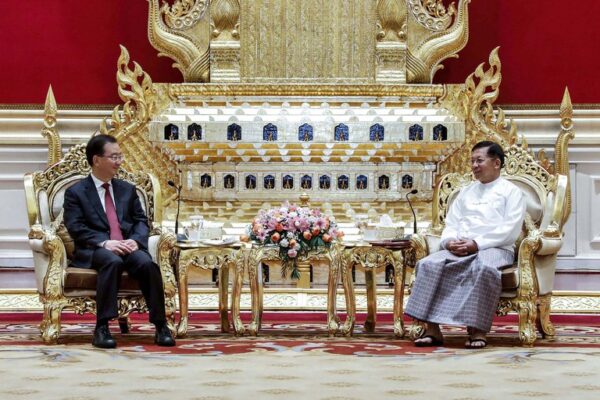
Two years ago this week, ASEAN negotiated a five-point consensus with the Burmese military that had seized power in a February 2021 coup and arrested many leaders of Myanmar’s elected government. The consensus was a roadmap for ending violence and starting a political dialogue, but the generals never intended to abide by it. The consensus called for an immediate end to violence; a dialogue among all parties; the appointment of a special envoy from the regional bloc; the provision of humanitarian assistance by the Southeast Asian bloc; and a visit to Myanmar by the special envoy to meet with all parties.  The Burmese junta has since steadfastly ignored the consensus and waged a multi-front war against Myanmar’s civilian population. The toll has been horrific – more than 4,000 people have been killed while the regime has arrested more than 17,000 and more than 150 people have been tortured to death or died in government custody.  ASEAN continues in vain to use the five-point consensus as the basis for all talks. Other than refusing to give the junta a seat at its meetings, ASEAN has done little else except let down the people of Myanmar.  In this handout photo released by Myanmar Military, junta chief Min Aung Hlaing, right, receives Wang Ning, Secretary of CPC Yunnan Provincial Committee of China in Nay Pyi Taw, April 4, 2023. Credit: Myanmar Military handout photo via AFP In March, Thailand did an end run around ASEAN when it held a Track 1.5 dialogue with a handful of like-minded member states and the junta. Those in attendance included the authoritarian states of Cambodia, Laos and Vietnam along with China, India, Bangladesh and Japan.  Malaysia, Indonesia, the Philippines and Singapore refused to attend and seemed genuinely angry at Thailand for having direct talks with the junta and denying Indonesia its prerogative as ASEAN’s 2023 chairman. Unbowed and unapologetic, Thailand argued that it was a Track 1.5 dialogue – meaning that government officials were present but not necessarily acting in their official capacity, along with a few non-governmental experts. But few bought that fig leaf interpretation, noting that Wunna Maung Lwin, the junta’s foreign minister, was clearly there in his official capacity, exactly as Bangkok had wanted. This week, India hosted the second Track 1.5 dialogue with Thailand, Cambodia, Laos, Bangladesh, Vietnam and China. Indonesia attended as an observer in its capacity as chairman of the regional bloc. The Thais were smart to let the Indians take over to deflect criticism that Thailand was trying to do an end run around ASEAN. Instead, the April 25 meeting could be billed as a gathering of neighboring countries who were directly impacted by the quagmire as well as other states searching for a solution. Craving legitimacy Yet it was another opportunity to give the junta the international legitimacy it so desperately craves. It follows another failed attempt at diplomacy by former United Nations Secretary-General Ban Ki-Moon.  Thailand sent its own foreign minister and special representative for Myanmar to meet with Senior Gen. Min Aung Hlaing in Naypyidaw. All of these serve to normalize ties with a regime that should be ostracized by the international community.   Moreover, it’s hard to take seriously the idea that the neighboring countries are not in the junta’s corner. India, is much less a champion of democracy under the increasingly illiberal government of Narendra Modi, whose control over the eastern portion of the nation is tenuous. India also fears a failing junta being even more dependent on China – the last thing that New Delhi wants is a greater Chinese presence on another part of its border.  Bangladesh is hoping to exchange normalized ties for the return of thousands of Rohingya to their homes in Myanmar’s Rakhine state.  Thailand, meanwhile, sees itself as a political model for the junta to hold elections and maintain power.  Not hedging bets China is no longer hedging its bets and has doubled down on the junta to protect its economic interests, pipelines and Belt and Road Initiative infrastructure projects. Lately, China has been applying pressure on Ethnic Resistance Organizations that are actively supporting the shadow National Unity Government (NUG) or quietly arming its People’s Defense Forces over fears they might be tilting the balance away from Naypyidaw.  As it increases air attacks, Myanmar’s Air Force has violated the airspace of Thailand, Bangladesh and India. None have lodged diplomatic complaints, a clear signal to the NUG.  Reuters reported that a topic of discussion at the Indian 1.5 talks was the possible inclusion of the opposition government. That seems far-fetched as the junta has steadfastly refused to talk with its NUG leaders, officially labeling them “terrorists.” It seems far more likely that this was an attempt to dampen the international criticism of holding such a meeting. While the junta is bogged down in a multi-front war that it can’t win, it does have a theory of victory.  The military has increased attacks on civilians to terrorize them into submission. There have been more beheadings and mutilations, rape, and the razing of homes. And they have stepped up their air assaults. The military has given itself the means to do so, with a 50% increase in its budget for 2023. The junta has stepped up attempts to deprive the NUG of funding, including a recent threat of even incarcerating children for having a game on their phones whose proceeds go to support the NUG.  The military, having recently disqualified a number of political parties for not registering under the new election law or having communications with “terrorist organizations,” continues to make plans for “elections.” More than 1,200 members of the overthrown National League for Democracy party are in jail, while the military has seized properties of more than 600 NLD members. Finally, the junta seeks to peel away ERO support from the NUG either by offering side deals, allowing China to pressure them or simply letting the traditional mistrust with the NUG manifest.  Junta members believe that time is on their…

Read More

Chinese visits to Myanmar sow influence, but may hinder interests

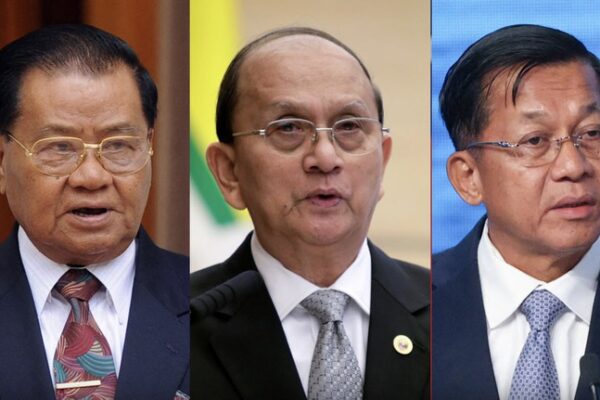
A slew of recent visits by top Chinese officials to Myanmar appears to be part of a bid by Beijing to counter U.S. influence on the nation, but rebel leaders warned that propping up the junta is a miscalculation, as there will be no stability while it remains in power. In the nearly 27 months since the military carried out a coup d’etat, China has been Myanmar’s staunchest ally. While most Western nations shunned junta chief Senior Gen. Min Aung Hlaing in the aftermath of the takeover and a violent crackdown on his opponents, Beijing stood by the general in Naypyidaw. While foreign investment has fled the embattled nation, Chinese investors have flocked there. And despite international sanctions leveled at the regime, trade between the two neighbors continues unabated. Support notwithstanding, Chinese officials have made multiple visits to Myanmar since the start of the year in what some analysts say is an influence peddling campaign by Beijing following U.S. President Joe Biden’s signing in late December of the National Defense Authorization Act, or NDAA, which will assist the country’s democratic forces. “China has increased its dealings with the military junta,” a China affairs expert told Radio Free Asia, speaking on condition of anonymity citing security concerns. “It seems to me that China is worried about the United States’ NDAA and Burma Act. That’s why it has tried to maintain its influence by having more dealings with the military leaders.” Among the provisions in the NDAA are programs designed to support those fighting the better-equipped military for democracy in Myanmar – including the country’s shadow National Unity Government, anti-junta People’s Defense Force paramilitary group, and various ethnic armies – with technology and non-lethal assistance. Slate of high-profile visits In the latest high profile visit, Peng Xiubin, the director of the International Liaison Department of the Communist Party of China, traveled to Naypyidaw on April 16 and secretly met with former junta leader Than Shwe, who ruled Myanmar from 1992 to 2011, and Thein Sein, the president of the country’s quasi-civilian government from 2011 to 2016.  Reports circulated that following Peng’s visit, Min Aung Hlaing met with the two former leaders to discuss the political situation in Myanmar. Peng’s trip followed visits in February and March by Deng Xijun, China’s special envoy for Asian Affairs, who met with the junta chief on both occasions. Only two months earlier, the Chinese envoy convened a meeting with several ethnic armies from northern Myanmar across the border in southwestern China’s Yunnan province. In this photo combo, from left: former General Than Shwe, former President Thein Sein, and current Myanmar junta leader General Min Aung Hlaing. Credit: AFP Thein Tun Oo, the executive director of the Thayninga Institute for Strategic Studies, which is made up of former military officers, described the uptick in meetings between the junta and Chinese officials as a bid by Beijing to “balance U.S. influence” in the region. “The U.S is no longer the only country influencing the world,” he said. “Among such changes in world politics, Myanmar and China – which share a very long border – need to cooperate more closely. The bottom line is that China-Myanmar relations will continue to develop based on this.” RFA emailed the Chinese Embassy in Yangon to inquire about the frequency of visits by top Chinese government officials to Naypyidaw in recent months and Beijing’s position on the political situation in Myanmar, but received no reply. At the Chinese government’s regular press briefing held in Beijing on March 17, Chinese Foreign Ministry spokesman Wang Wenbin called Myanmar a “good neighbor,” adding that Beijing is closely following the situation there and hopes for a resolution through dialogue and consultation among all stakeholders. Interests tied to peace Chinese affairs expert Hla Kyaw Zaw told RFA that China will only be able to realize its interests in Myanmar if the country is at peace. “China can only continue its investments and projects … if Myanmar is at peace,” he said. “The reason why China wants Myanmar to be peaceful is for its own economic interests.” Among the China-backed megaprojects in Myanmar are the New Yangon City urban planning project, the Mee Lin Gyaing Energy Project in Ayeyarwady region, the Letpadaung Copper Mine in Sagaing region, and the Kyauk Phyu deep sea port and special economic zone in Rakhine state. According to ISP-Myanmar, an independent research group, there are 35 China-Myanmar economic corridor projects underway in Myanmar that include railways, roads, special economic zones, sea ports and urban planning projects. Than Soe Naing, a political analyst, agreed that Beijing’s relations with the junta hinge on the furtherance of its strategic interests. “I see China cooperating with the military junta only to continue to maintain, implement and expand its economic interests in Myanmar, such as the strategic Kyauk Phyu deep sea port project, which is a bid by Beijing to obtain access to the Indian Ocean,” he said. In this handout photo Chinese foreign minister Wang Yi, center is welcomed at Myanmar’s Nyaung-U Airport to attend a foreign ministers’ meeting of the Lancang-Mekong Cooperation mechanism on July 2, 2022 Credit: Myanmar Military/AFP Than Soe Naing noted that China is trying to “divide the [ethnic armies] in northern Myanmar from the anti-junta resistance groups … under the pretext of peacemaking.” But he said that China is actually working to exploit Myanmar’s internal conflict by attempting to “hold all the keys to the situation.” No stability with junta Kyaw Zaw, spokesman for the National Unity Government’s presidential office, warned China that there will only be stability in Myanmar if the forces of democracy succeed in their fight against the junta. He said only with stability in Myanmar will China realize its economic goals in the country. “As long as there is a junta, Myanmar will not be at peace,” he said. “The junta will only terrorize the country with more violence and continue to torture the people. That’s why the country will remain destabilized under [the junta].” A lack of…

Read More

Myanmar’s western Chin state pummeled by junta’s air force in April

Myanmar’s junta carried out 47 airstrikes, killing at least 19 people and destroying multiple religious buildings and civilian homes in Chin state in April alone, a rights group said Thursday. The campaign, which saw an average of nearly two bombs dropped on the western state each day this month, comes as the Chin National Front claimed new territorial gains in the region, suggesting the military has stepped up air operations amid an increasingly stymied ground offensive. Since April 1, Myanmar’s air force has dropped more than 80 bombs on Chin state, according to the Chin Human Rights Organization. The attacks killed 17 civilians and injured 34 others, the group’s managing officer Salai Man Hre Lian told RFA Burmese, as well as two members of the armed resistance. “Most of the injured were civilians, as well,” he said. The worst loss of life occurred on April 10, when the junta launched three airstrikes on Falam township in a single day, dropping six bombs near Var village at around 9:00 a.m., four near a high school in Webula at 11:00 a.m., and six near Ramthlo village at 4:00 p.m. Residents said the attack on Webula killed nine civilians, including the school headmaster and his wife and son, and injured four others. Six days later, fighter jets attacked Pan Par village in Mindat township, killing three people – including a child – and injuring seven others. The CNF confirmed that two members of the armed resistance were killed and four others injured when the junta launched an airstrike earlier this month on a base operated by the 4th Brigade of the Chin National Army in Tedim township, near Myanmar’s border with India. Houses destroyed following Myanmar military junta’s airstrike in Webula town, Chin state, on April 10, 2023. Credit: Citizen Journalist CHRO said that multiple buildings – including a Buddhist monastery, a Christian church and at least 20 civilian homes – were destroyed in the April strikes. The carnage in April followed a March 30 airstrike on Thantlang township’s Khuafo village that killed 10 civilians and injured 20 others, residents told RFA. According to the CHRO, nearly 10,000 civilians have been forced to flee their homes due to junta airstrikes so far this month. The group said the junta has launched nearly 200 airstrikes and dropped more than 350 bombs on targets in Chin state since the military orchestrated a Feb. 1, 2021 coup d’etat. The strikes have killed 38 people and injured nearly 100. Fighting back against the junta The April bombing campaign comes amid growing success by anti-junta forces on the ground in Chin, according to CNF spokesman Salai Htet Ni. On April 23, a People’s Defense Force paramilitary unit attacked a junta military convoy of 30 vehicles, including two armored cars, near Hakha township’s Chuncung village, touching off an intense firefight.  Despite the military’s advantage in equipment, the PDF was able to rout its opponent and prevent the convoy from continuing on to the seat of Hakha, Salai Htet Ni said. “All of the military vehicles were destroyed by the resistance forces,” he said, adding that around 30 junta troops remain stationed in Chuncung. “We now have control over 70 out of 100 territories in nine [of 19] townships in Chin state.” Families sit next to the coffins of victims of Myanmar military junta’s airstrike in Webula town, Chin state, on April 11, 2023. Credit: Citizen Journalist Given the success of anti-junta forces on the ground in Chin, the military has stepped up its air attacks, and villagers have responded by digging trenches and other crude defenses. “Every village has built bomb defenses, such as trenches, to protect against the junta’s airstrikes,” said a Hakha resident who, like other inhabitants of Chin villages RFA spoke to, declined to be named for security reasons. “But with such unexpected attacks as these, it’s been very difficult for us to set up effective defenses.” The military has yet to issue any statements regarding the April airstrikes and attempts by RFA to contact Thant Zin, the junta’s social minister and spokesman for Chin state went unanswered Thursday. A legal expert, who also spoke on condition of anonymity citing fear of reprisal, noted that Myanmar is a signatory to and should be held accountable under the Geneva Convention, which lays out international legal standards for humanitarian treatment during conflict. “[The convention] prohibits all armed forces from attacking non-military or civilian targets during times of war,” he said. “It also restricts armed forces from using highly destructive airstrikes and dropping bombs in civil wars.” One resident of Thantlang called the junta’s unprovoked aerial attacks “cowardly.” “I think the junta attacks villages to terrorize the people,” he said. “If they are truly brave, they would only fight the armed groups. Targeting innocent people like us is extremely cowardly.” Translated by Myo Min Aung. Edited by Joshua Lipes and Malcolm Foster.

Read More

Junta raids force more than 7,000 villagers to flee Salingyi

More than 7,000 residents of villages in Sagaing region’s Salingyi township have fled their homes ahead of junta raids, according to a member of the pro-democracy Salingyi-Yinmarbin Strike Committee. The man, who didn’t wish to be named, said a column of 150 troops descended on the township on Thursday morning, leading residents of nine villages to flee. “Residents from those villages are still on the run,” he said. “There have been no arrests.” He said that the column of troops was made up of soldiers based in Salingyi town and others from a Chinese-owned copper project in the township. The Strike Committee member said troops had killed five civilians who they had brought with them from other villages. He didn’t know the names of the dead. Residents of Salingyi township, Sagaing region, crown into a truck as they flee ahead of junta raids on April 27, 2023. Credit: Facebook: Ah Nyar Pyit Taing Htaung Lay Myar Group  The military has intensified an already bloody campaign in Sagaing region this year, declaring martial law in 11 townships in February to try to wrest control of them from People’s Defense Forces and defend foreign-owned mining interests. This month alone, troops have torched hundreds of homes in Sagaing region, and killed around 200 civilians in the bombing of Pa Zi Gyi village. There were more than 1.8 million internally displaced persons across Myanmar as of April 10, 2023, according to the UN Office for the Coordination of Humanitarian Affairs. Nearly 1.5 million of them fled their homes due to fighting since the Feb. 1, 2021 coup. Translated by RFA Burmese. Edited by Mike Firn.

Read More

Hun Sen publicly threatens to fire relatives of popular Facebook activist

Prime Minister Hun Sen on Tuesday threatened to fire the relatives of a popular Cambodian online activist based in France who has been highly critical of the longtime leader and the government. Thousands of viewers watch Sorn Dara’s talk shows on Facebook during which he routinely attacks Hun Sen and calls for his removal from office. His father is a military officer and a longtime supporter of the ruling Cambodian People’s Party and and his sister-in-law works at the Ministry of Interior.  “You want to try me if your parents don’t teach you lessons. I will fire your parents – including your relatives – from their jobs,” Hun Sen said at a graduation ceremony in Phnom Penh. “You are so rude. I will invite your father and your sister-in-law to learn some lessons and don’t complain that I am taking your relatives as hostages,” an apparent reference to firing them. Sorn Dara lives in exile in France and is seeking asylum there. He most recently criticized Hun Sen for promising free admission to people and participants during the upcoming Southeast Asia Games, which are being held in Cambodia next month. The move has been criticized as a way to curry favor with voters ahead of July’s parliamentary election. Following his threats on Tuesday, Hun Sen posted videos of Sorn Dara’s mother and brother on Telegram saying they were disappointed that Sorn Dara hasn’t joined the CPP.  ‘You insult your parents’ Hun Sen also spoke publicly about Sorn Dara in February, saying that he wasn’t a good son because he didn’t listen to his parents. “You insult your parents to whom you owe gratitude saying they have less education than you,” he said. “Your parents gave birth to you. You still look down on them. How about the regular people? If you don’t recognize your parents, then you are not human.” Sorn Dara is a former official of the opposition Cambodia National Rescue Party, which was dissolved by the Supreme Court in November 2017. He said his father disowned him that same year because he had refused to join the CPP.   Sorn Dara’s father, Col. Sok Sunnareth, deputy chief of staff of the Kampong Speu Provincial Operations Area and a ruling party working group official, publicly implored his son on Feb. 22 to stop criticizing Hun Sen and his government, according to a Khmer Times report.  On Tuesday, Sorn Dara responded to Hun Sen’s latest angry threat with a Facebook post that said the prime minister should act in a more mature manner and lead the country with dignity. Speaking to Radio Free Asia, Sorn Dara noted that Hun Sen has recently been using threats and tricks against political opponents as the election looms.  “I don’t want to be associated with my family. They are different from me,” he said. “No one can stop me from doing something.” ‘I will try to advise my brother’ Sorn Dara’s parents appeared in a short video in February posted by the pro-government Fresh News, saying they had severed ties with their son. His brother, Sorn Saratt, told RFA on Tuesday that he has also cut ties with him. But he said he will try to convince his brother to defect from the opposition party and join the CPP. “I will try to advise my brother to stop attacking the King, the government and Samdech [Hun Sen], to stay away from traitors and return to the family and the country,” he said. Ros Sotha, executive director of the Cambodian Human Rights Action Committee, told RFA that Hun Sen’s threat isn’t legitimate. He urged the prime minister to be patient and to avoid violating human rights and the law. “As a leader, he shouldn’t be afraid of being criticized,” he said. “There is no law that [Sorn Dara’s relatives] will be fired because they are related to members of the opposition party.” Translated by Yun Samean. Edited by Matt Reed and Malcolm Foster.

Read More

Myanmar military beheads man in Sagaing region village

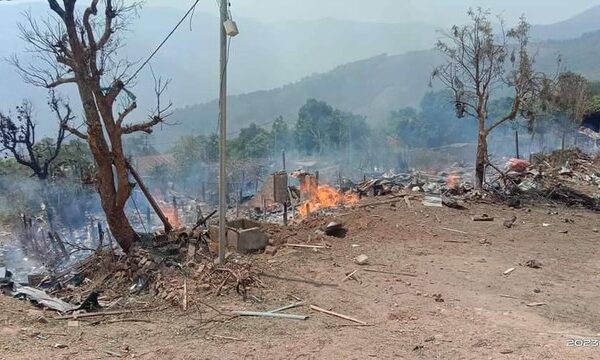
Junta troops tortured a man and cut off his head after raiding a village in Myanmar’s northern Sagaing region, locals told RFA. They said troops also burned down 53 houses and a Buddhist event hall in Ta Pa Yin Kwe village on Sunday morning. The victim, 44-year-old Tun Tun Win, was arrested when troops raided the village shortly after sunrise, according to a resident who didn’t want to be named for security reasons. “He was captured by an army column on his way back to his tent in the east of the village,” the local said. “He was interrogated and beaten. He did not know anything as he was a civilian. When he did not answer, the troops killed and beheaded him by a lake in the east of the village.” The local said Tun Tun Win was a farmer, who leaves behind a wife and three children. It’s the second time this year troops have raided and burned houses in the village, killing locals. In January, troops shot local Buddhist leader the Venerable Gandhasara, two civilians and a local anti-junta fighter, and set fire to 90 homes, residents told RFA. The junta stepped up its slash-and-burn campaign in Sagaing township this month. Residents said a column of more than 100 troops has been raiding and burning villages along the Mu River since April 20. They said 449 houses in six villages were destroyed between April 21 and 24. Troops arrested five people in those raids, according to one local who also wished to remain anonymous. The junta has not issued a statement on the raids and RFA’s calls to Sagaing region’s junta spokesperson Aye Hlaing went unanswered Tuesday. Junta chief Senior Gen. Min Aung Hlaing, and junta Deputy Information Minister Major Gen. Zaw Min Tun, have repeatedly denied that their troops burn civilian buildings, claiming all the arson attacks were carried out by anti-junta People’s Defense Forces. Nearly 48,000 homes in Sagaing region have been burned down since the February 2021 coup, according to independent research group Data for Myanmar. Translated by RFA Burmese. Edited by Mike Firn.

Read More