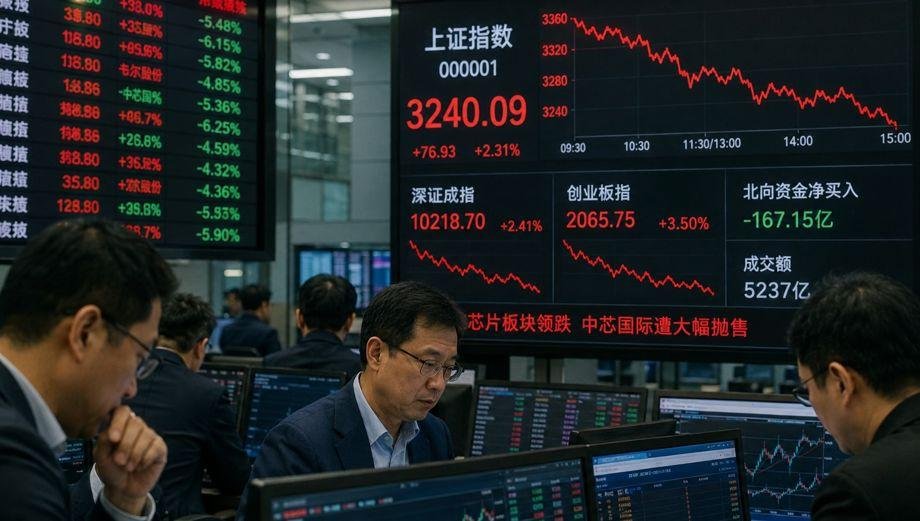
The global artificial intelligence boom is confronting its first serious test of financial sustainability. The final trading week of October 2026 brought a sharp sell-off in American technology shares, while China’s AI-heavy stock market continued to struggle with a correction that had already erased hundreds of billions of dollars in market value. The question is no longer simply who can build the most powerful AI systems, but who can afford to keep building them.
Introduction: When technological ambition meets financial reality
For several years, artificial intelligence has been presented as the defining technological and economic transformation of the twenty-first century. Governments have made it a national strategic priority, technology companies have committed hundreds of billions of dollars to computing infrastructure, and investors have poured capital into semiconductor manufacturers, cloud providers, data-centre operators and companies developing generative AI.
The underlying technology is real. Its potential applications in healthcare, manufacturing, education, scientific research, defence and business operations are substantial. But the financial markets have increasingly treated the promise of AI as though its commercial success were already guaranteed.
That assumption is now being tested.
The week of 26–30 October 2026 was particularly revealing. American semiconductor shares suffered substantial losses, Intel experienced an extraordinary single-day collapse, and concerns about the capital expenditure of Amazon, Alphabet and Meta intensified. Meanwhile, China’s technology-heavy STAR 50 index remained under pressure after a correction that had wiped out approximately $480 billion in market value from its July peak.
In China, the AI bubble has already burst. Our findings should be considered a warning for investors and policymakers across the world.
The central argument of this editorial is that the AI industry is not necessarily collapsing, but the financial bubble surrounding its expected returns is beginning to deflate. The distinction is critical: artificial intelligence can transform the world while many of the companies and investors financing its development still lose substantial amounts of money.
1. The final week of October: A warning from Wall Street
The American technology sell-off became particularly severe on Friday, 30 October.
According to our market analysis, the Nasdaq Composite fell 2.86%, its largest single-day percentage decline since June 5. The S&P 500 declined 1.82%, while the Dow Jones Industrial Average lost 1.09%.
The Nasdaq had also fallen 7.8% from its closing record reached on 6 October. Investing.com+1
What made the sell-off significant was not simply the decline in share prices. It was the reason investors were selling.
For much of the AI boom, expenditure on GPUs, data centres and cloud infrastructure was interpreted as evidence of future growth. By the final week of October, investors were increasingly questioning whether the expected returns could justify the expenditure.
Intel and Amazon’s quarterly results intensified these concerns. Intel’s forward outlook disappointed investors, while Amazon’s investment requirements raised further questions about cash generation.
The market was beginning to distinguish between companies that were investing in AI and companies that could demonstrate that AI investment was producing adequate financial returns.
2. The companies that suffered: Who lost the most?
The sell-off was not confined to one company or one segment of the technology industry. It spread across semiconductor manufacturers, data-centre equipment suppliers, cloud infrastructure businesses and major AI platforms.
Major American technology stocks
The following figures are the reported share-price changes on Friday, 30 October, not full-week returns. They provide a clear picture of the intensity of the final trading session.
| Company | Ticker | 30 October movement |
|---|---|---|
| Intel | INTC | −28.6% |
| AMD | AMD | −10.9% |
| Dell Technologies | DELL | −10.8% |
| HP Inc. | HPQ | −9.6% |
| Nvidia | NVDA | −4.2% |
US technology stocks: Friday’s sell-off
Share-price percentage change on 30 October 2026. Negative values represent declines.
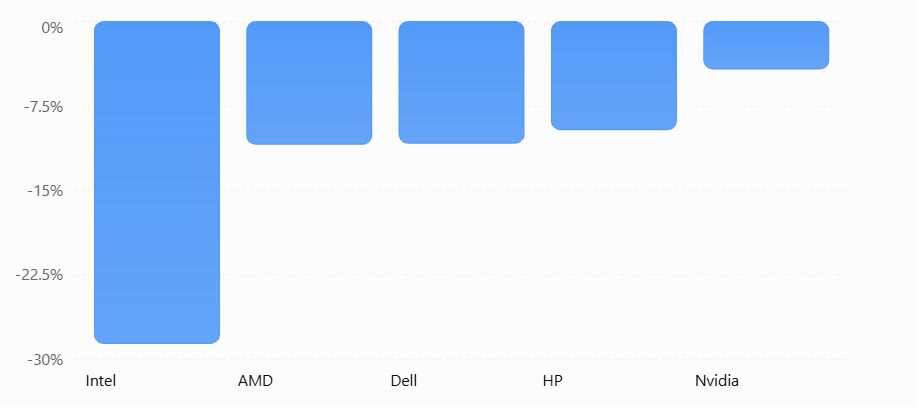
Intel’s collapse deserves particular attention. A decline of 28.6% in one trading session is an extraordinary repricing for a major semiconductor company.
AMD’s 10.9% decline and Nvidia’s 4.2% fall also demonstrate how concerns surrounding AI infrastructure can affect even companies that are central to the industry.
The market was not necessarily rejecting the need for AI computing. It was questioning the valuations and expectations attached to the businesses supplying it.
Alphabet, Amazon and Meta: The financial burden of AI
Alphabet (GOOGL)
More than −12%
(Thursday, 29 October)
Alphabet suffered a major repricing after its results and spending outlook intensified concerns about its cash requirements and the competitive pressure facing Google Search.
Alphabet’s free cash flow had turned negative and that it had raised capital through debt and share issuance. Its cloud business remained a significant strength, but investors were questioning whether the enormous cost of its AI expansion could be justified by future earnings.
Amazon (AMZN)
Significant Friday pressure
(Friday, 30 October)
Amazon’s capital expenditure was another major source of concern. Its third-quarter capital spending reached $75.9 billion, nearly 80% above the $42.4 billion generated by its operations.
The company also raised $48.1 billion in long-term debt during the quarter. Its full-year capital expenditure expectation was approximately $220 billion.
Meta Platforms (META)
Nearly −7%
Following increased spending guidance
Meta provided an early warning during the preceding earnings period. Its revenue growth and optimistic outlook were overshadowed by increased spending plans, with shares falling nearly 7% the following day.
This illustrates an important change in investor behaviour: even strong revenue growth may not be enough to support a share price when the anticipated cost of achieving future growth rises too quickly.
Microsoft and Oracle: Not every AI investment was punished equally
Microsoft and Oracle offered a contrasting picture. Investors showed greater willingness to reward companies demonstrating financial discipline and credible plans to fund their expansion.
Oracle gained nearly 11% in regular trading on Wednesday, 28 October, after outlining limits on external financing and expectations of positive cash flow in the second half of fiscal 2028.
Microsoft’s spending profile also appeared comparatively more manageable. Alphabet had spent 121.4% of its operating cash flow on capital expenditure in the September quarter, compared with 68% for Microsoft, excluding finance leases.
The lesson is important: the market is increasingly rewarding the ability to finance AI growth, not simply the announcement of more AI spending.
3. The financial evidence: Big Tech is spending more cash than it generates
Our investigation examined Microsoft, Alphabet, Amazon, Meta and Oracle and the findings were striking.
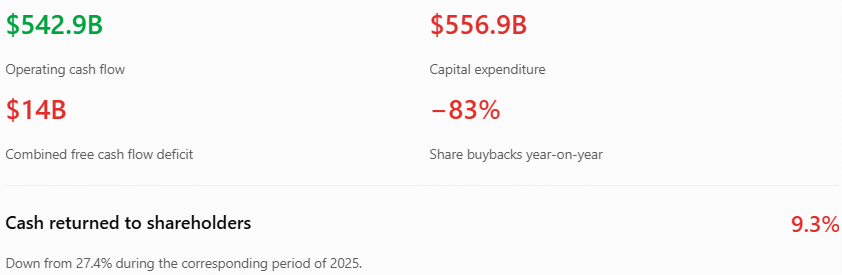
The five major technology companies: First nine months of 2026
The implications are significant.
Operating cash flow increased 29% to $542.9 billion, but capital expenditure doubled to $556.9 billion. For the first time in at least 15 years, the five companies’ combined capital spending exceeded the cash generated by their operations.
Their combined free cash flow shifted from a surplus of $143.5 billion a year earlier to a deficit of $14 billion.
Share repurchases fell 83%, from $81.8 billion to $13.6 billion.
Big Tech: Operating cash versus capital expenditure
First nine months of 2026, five companies combined, US dollars in billions.
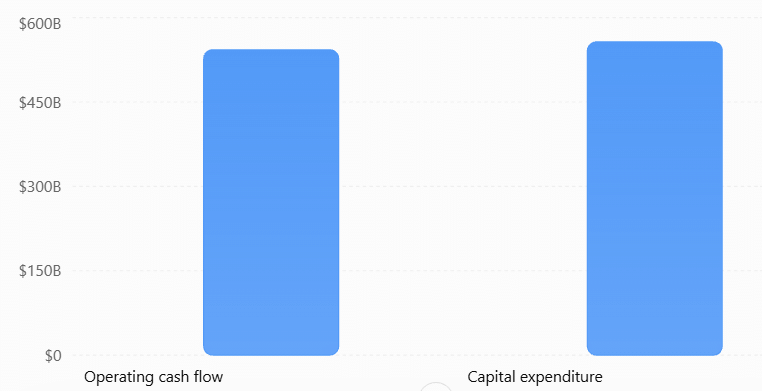
This is not evidence that these companies are insolvent. They remain among the world’s largest and most financially powerful businesses. But it is evidence that the AI infrastructure race is consuming an extraordinary proportion of their available resources.
It also raises questions about how long this investment model can continue without stronger monetisation.
4. China: The AI bubble has already suffered a much deeper correction
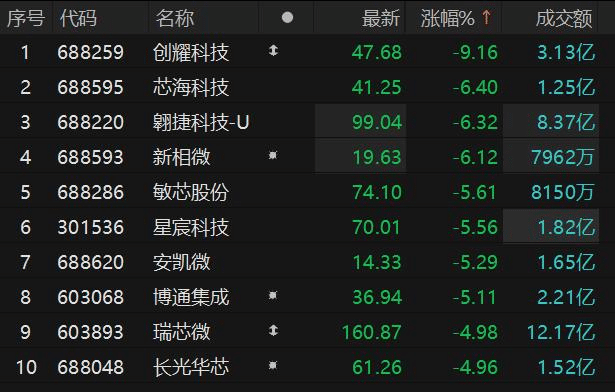
While American investors were debating whether the AI boom had become excessively expensive, China was already experiencing a much deeper correction in its technology stocks.
China’s STAR 50 index had lost approximately 40% from its July peak in less than four months.
The decline wiped out approximately $480 billion in market value.
The correction was not restricted to one or two companies. It affected semiconductor manufacturers, optical communications suppliers, robotics businesses and companies associated with China’s domestic AI computing ambitions.
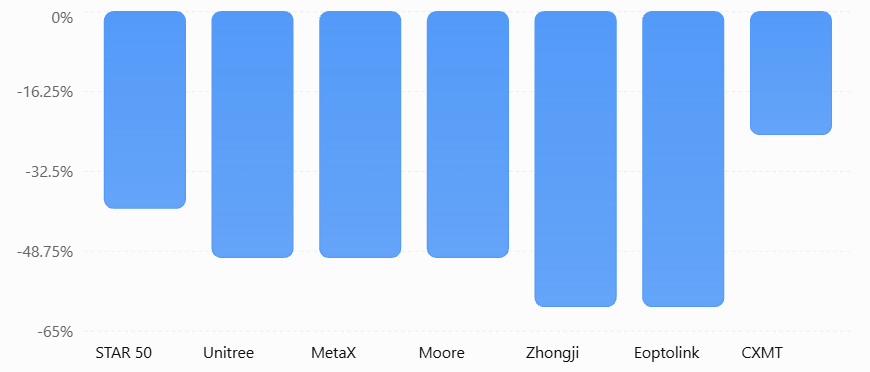
| Company | Reported decline | Measurement period |
|---|---|---|
| Unitree Robotics | Approximately −50% | Since August listing |
| MetaX | Approximately −50% | Since July |
| Moore Threads | Approximately −50% | Since July |
| Zhongji Innolight | Approximately −60% | From June/July highs |
| Eoptolink Technology | Approximately −60% | From June/July highs |
| CXMT | More than −25% | During the preceding month |
These are peak-to-date or monthly declines, not returns for the final trading week. The distinction matters because the Chinese correction had been developing for months.
The final week nevertheless brought additional weakness.
On Friday, 30 October:
- China’s CSI 300 was down approximately 0.9% for the week.
- The Shanghai Composite was down approximately 0.3% by the midday trading update.
- The STAR 50 declined approximately 1.8% in that session.
- Eoptolink fell nearly 8% and had lost approximately 46% during October.
- Hong Kong’s Hang Seng was up approximately 1.1% for the week, showing that not every Chinese-market segment moved in the same direction.
China’s AI and semiconductor correction
Approximate reported share-price drawdowns from earlier peaks or over specified periods. These periods are not identical.
Why China’s experience matters to the global AI industry
China’s AI investment boom has been closely connected to national ambitions for semiconductor independence.
Companies developing domestic GPUs, optical networking equipment and robotics technologies became attractive to investors partly because they were seen as beneficiaries of Beijing’s technological priorities.
But government support for an industry does not guarantee the profitability of every company operating within it.
The experience of Unitree is particularly revealing. Its shares were 8,000 times oversubscribed by retail buyers at listing, yet had subsequently lost approximately half their value.
MetaX and Moore Threads had also experienced extraordinary market debut gains before losing approximately half their value from July.
This demonstrates the danger of treating a national technological priority as an automatic investment success
5. The global market comparison: America and China are facing the same question
The American and Chinese corrections are not identical.
The United States has established global technology companies with large cloud businesses, enterprise customers and substantial recurring revenue. China has placed greater emphasis on domestic semiconductor substitution and building a technology ecosystem less dependent on foreign suppliers.
Nevertheless, both markets are confronting the same fundamental problem: the amount of money being invested in AI is growing faster than the certainty surrounding its eventual financial returns.
| Indicator | United States | China |
|---|---|---|
| Major market pressure | Nasdaq fell 7.8% from its 6 October record by 30 October | STAR 50 fell approximately 40% from July peak |
| Market capitalisation lost | Technology sell-off affected major US companies | Approximately $480 billion erased in STAR 50 correction |
| Semiconductor pressure | Intel, AMD and Nvidia suffered major declines | MetaX, Moore Threads and optical suppliers suffered major corrections |
| Infrastructure investment | Hyperscalers committing hundreds of billions | Domestic AI and semiconductor expansion |
| Major concern | Cash flow and monetisation | Valuations, demand and export restrictions |
| Key uncertainty | Return on AI infrastructure expenditure | Commercial viability and technological independence |
The contrasting scale of the AI market correction
Reported benchmark declines over different measurement periods. These are not directly comparable time windows.
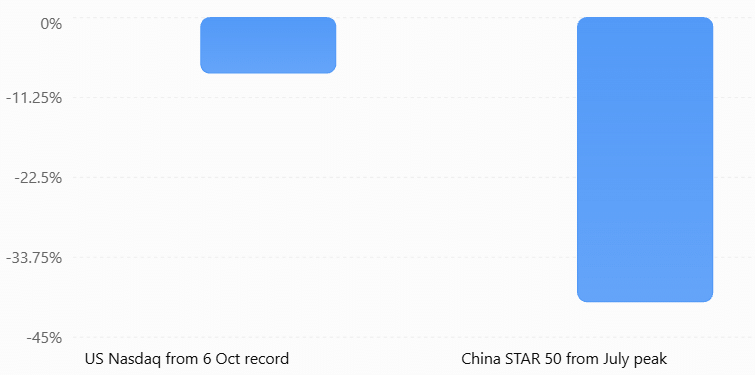
The comparison is revealing. China’s correction has been substantially deeper, but the American sell-off demonstrates that even the largest and most profitable technology companies are not immune to changing investor expectations.
The Chinese experience should therefore not be dismissed as an isolated domestic market problem.
6. The uncomfortable economics of AI: Who is actually making money?
An important question has received less attention than the development of new AI models: who ultimately captures the economic value created by artificial intelligence?
Consider the structure of the industry.
- Semiconductor companies manufacture the computing hardware.
- Cloud providers purchase and operate enormous quantities of computing infrastructure.
- Data-centre operators provide buildings, electricity, cooling and connectivity.
- AI laboratories develop models and applications.
- Businesses and consumers are expected to become the eventual paying customers.
Every stage requires capital, infrastructure and operating expenditure.
But the companies investing in the infrastructure cannot all assume that they will capture the same proportion of the eventual revenue.
This creates a potential mismatch between the enormous cost of building AI capacity and the amount of money customers are willing to pay for AI services.
The circular investment concern
Another issue deserving scrutiny is the financial relationship between AI developers, infrastructure providers and their investors.
Large technology companies invest in AI infrastructure, enter long-term computing agreements, purchase hardware and support the expansion of AI companies.
Those transactions generate revenue for suppliers and support the investment narrative surrounding the wider ecosystem.
However, the ultimate test is whether independent customers generate enough sustainable revenue to support the entire chain.
Revenue recorded by one company as expenditure by another does not automatically represent new economic value for the industry as a whole.
This is not evidence that all AI-related transactions are artificial or that companies are misreporting revenue. It is a reason to examine customer concentration, financing arrangements, contractual commitments and actual cash collection more carefully.
The industry must demonstrate that its growth is supported by sustainable end-user demand rather than an increasingly interconnected cycle of infrastructure commitments.
7. The energy problem: AI’s hidden infrastructure bill
The financial cost of AI is only one part of the problem. The physical infrastructure required to sustain the industry is becoming increasingly expensive.
AI data centres require:
- Large quantities of electricity.
- Advanced cooling infrastructure.
- High-performance semiconductor equipment.
- Fibre-optic communications networks.
- Large industrial sites and supporting power infrastructure.
The expansion of AI computing is therefore becoming an energy and infrastructure policy issue, not merely a technology-sector development.
The data-centre expansion was already facing public opposition over electricity bills, pressure on power grids and environmental impacts. This creates another financial vulnerability.
If electricity becomes more expensive, construction takes longer, borrowing costs rise or governments impose additional infrastructure requirements, the economics of AI computing could become less attractive.
The industry may eventually discover that access to computing power is not simply a question of purchasing more GPUs. It is also a question of financing the electricity, land, cooling and networks required to operate them.
8. Is AI demand actually disappearing?
It would be misleading to interpret the October correction as evidence that demand for AI technology has disappeared.
The commercial adoption of AI continues to expand, and major cloud providers have significant customer commitments.
As on 27 October, Amazon, Microsoft and Alphabet had nearly $1.7 trillion in combined backlogs and were planning capital expenditure of as much as $600 billion during 2026.
Strong expected cloud growth:
| Business | Expected September-quarter revenue growth |
|---|---|
| Google Cloud | 95.1% |
| Microsoft Azure | 47.7% |
| Amazon AWS | 38.2% |
These numbers complicate the argument that the AI industry is simply a speculative illusion.
There is genuine demand, genuine infrastructure expansion and genuine commercial adoption.
But there is a distinction between demand for AI and the ability of every company participating in the AI ecosystem to earn an attractive return.
A company can experience rapid revenue growth and still disappoint investors if the costs of producing that growth rise even faster.
That is precisely the distinction markets began to emphasise during the final week of October.
There are three conclusions worth drawing.
First, AI is not the same thing as AI profitability.
A technology can be revolutionary without every company associated with it becoming commercially successful. The internet transformed the global economy, but the dot-com boom also produced enormous financial losses.
The AI industry may experience a similar distinction between long-term technological success and short-term investor disappointment.
Second, infrastructure investment cannot grow indefinitely without adequate returns.
The largest technology companies have substantial resources, but their combined capital expenditure exceeding operating cash generation is an important warning. The next phase of the industry will require stronger evidence of monetisation.
Third, the AI race is becoming a geopolitical financial competition.
The United States and China are not simply competing to develop better algorithms. They are competing for semiconductor capabilities, computing infrastructure, energy resources, industrial capacity and technological independence.
China’s experience demonstrates that government-backed technological ambition does not protect investors from market corrections. The American experience demonstrates that even globally dominant technology companies can face severe repricing when investors question their spending.
The final verdict
The AI revolution is unlikely to disappear because stock prices have fallen. Its applications are too significant, and its technological development too deeply embedded in the strategies of major economies.
However, the assumption that every AI-related investment will eventually generate extraordinary profits is becoming increasingly difficult to defend.
The final week of October 2026 may therefore be remembered as an important turning point: the moment when financial markets began moving away from rewarding AI ambition alone and started demanding measurable economic returns.
The next phase of the AI race will not necessarily be won by the company spending the most money, purchasing the most GPUs or announcing the largest data-centre project.
It may be won by the company that can demonstrate something considerably more difficult: sustainable profitability.
IJ-Reportika’s position: The global AI race should be judged not only by technological breakthroughs and national ambitions, but also by financial sustainability, transparency, energy requirements and the actual economic value delivered to society. A technological revolution should not become an excuse for an unlimited financial gamble.