The controversy: From Nvidia’s inner circle to a suspected intelligence operation
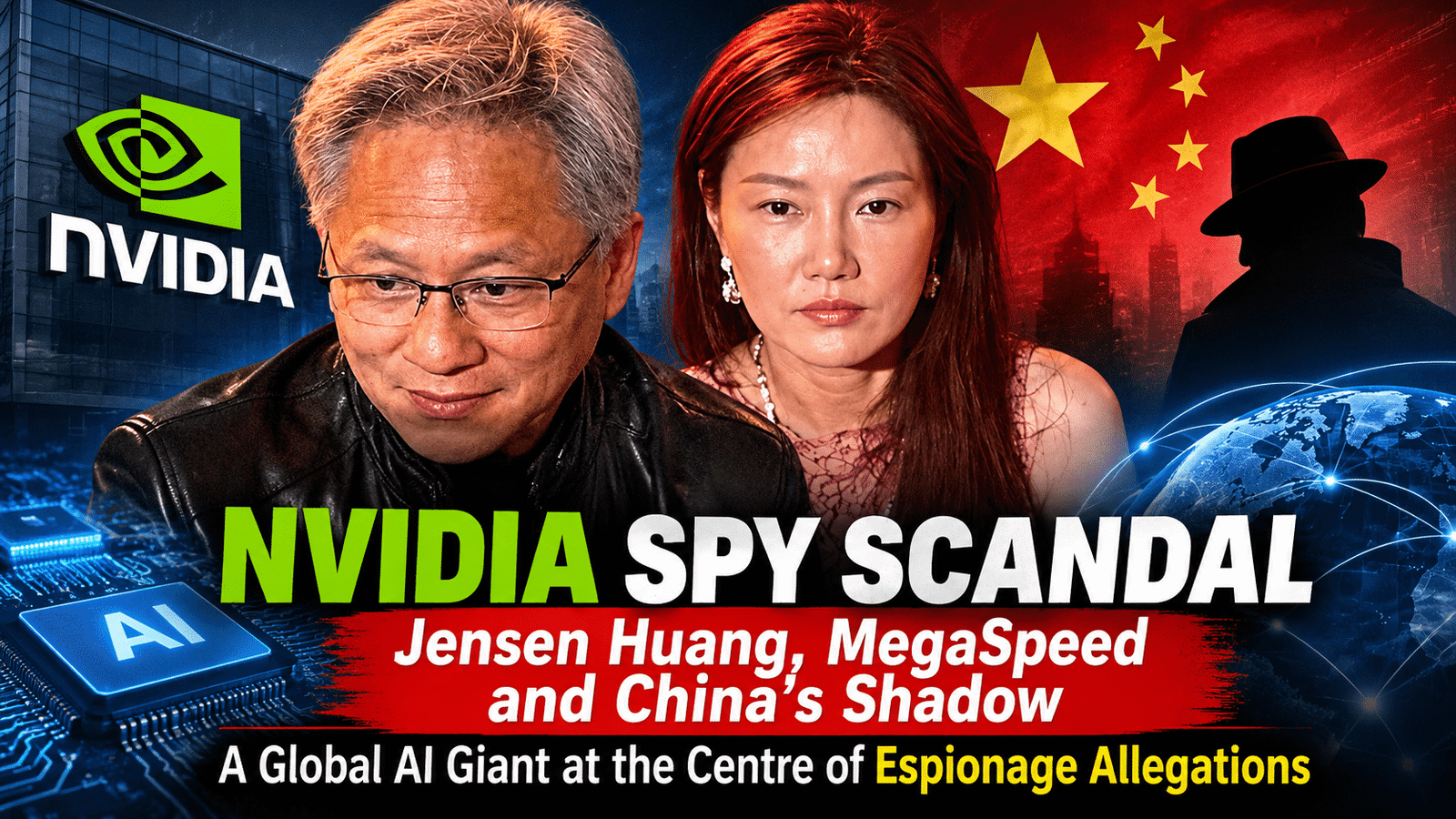
Nvidia CEO Jensen Huang is facing an unprecedented controversy after reports linked his personal relationship with a former executive of Singapore-based MegaSpeed International to an alleged Chinese intelligence operation targeting the semiconductor industry.
At the centre of the controversy is Alice Huang, also known as Huang Le, a businesswoman associated with MegaSpeed. According to reporting by The New York Times, US intelligence officials believe she was working for China’s Ministry of State Security (MSS), with the alleged objective of gathering information about Jensen Huang, Nvidia’s business relationships and sensitive American artificial intelligence technology.
The allegations have not been established through a publicly released criminal finding or judicial determination. Nevertheless, they have prompted an independent investigation by Nvidia’s board, bringing national security concerns directly into the leadership of the world’s most influential AI chipmaker.
The controversy has become particularly sensitive because Nvidia sits at the centre of the global AI industry. Its advanced graphics processing units (GPUs) power some of the world’s largest AI data centres, making access to its technology an important economic and strategic issue for Washington and Beijing.
Who is Alice Huang, and what is her connection to MegaSpeed?
Alice Huang, also identified as Huang Le, reportedly worked in several professional fields before becoming involved in the semiconductor and cloud computing business.
According to our investigation, she served as MegaSpeed’s managing director between March and November 2023 before handing the position to Singaporean executive Tan Yong Pong.
MegaSpeed subsequently emerged as a significant buyer of Nvidia-powered computing equipment in Southeast Asia. The company describes itself as a core business partner of Nvidia’s computing power cloud business in the Asia-Pacific region.
Its business model centres on providing access to high-performance computing infrastructure to companies that need substantial processing capacity for artificial intelligence projects.
This arrangement is commercially significant. Companies in China can, in certain circumstances, access computing resources located outside China. Consequently, the distinction between purchasing restricted physical chips for delivery into China and renting computing capacity from infrastructure hosted abroad has become an important issue in the enforcement of US export controls.
The US intelligence allegations raise a different question: whether a commercial relationship within the technology industry was allegedly being used to obtain information about one of America’s most strategically important technology companies.
Importantly, the alleged intelligence connection remains an allegation attributed to US intelligence assessments reported by the media, rather than an independently established fact.
Bloomberg’s investigation: Billions of dollars in Nvidia hardware under scrutiny
The controversy did not begin with Jensen Huang’s personal admission. MegaSpeed had already attracted scrutiny over its extraordinary purchases of Nvidia technology and questions about the ultimate destination of some of the equipment.
In December 2025, Bloomberg published an investigation titled Nvidia Partner Megaspeed Draws China Chip Smuggling Concerns in US.
The investigation examined trade records, corporate filings, company documents and interviews with people familiar with the industry and government inquiries.
Its findings raised several questions about the scale of MegaSpeed’s operations.
$4.6 billion
Value of Nvidia hardware imported by MegaSpeed and its affiliates, according to Bloomberg’s trade-record analysis through November 2025.
136,000+
Estimated Nvidia GPUs contained in the imported hardware.
One of the most significant findings concerned the difference between the volume of hardware recorded in import data and the equipment Nvidia reportedly identified during visits to MegaSpeed’s data centres.
More than half of the chips identified in its analysis belonged to Nvidia’s Blackwell generation. However, inventory information shared with US authorities reportedly showed that Nvidia officials had seen only a few thousand Blackwell GPUs at the data centres they inspected.
Nvidia subsequently said that it had also visited separate warehouses and confirmed that previously imported hardware had not been diverted to China. However, questions remained about the full inventory and the company’s infrastructure footprint.
Bloomberg did not establish that MegaSpeed had illegally diverted its Nvidia chips to China. Its investigation instead identified discrepancies and unanswered questions that attracted regulatory attention.
The relationship that triggered Nvidia’s internal investigation
The espionage allegations took on a new dimension following reports about Jensen Huang’s relationship with Alice Huang.
On November 8, 2026, Huang acknowledged in a message to Nvidia employees that he had been unfaithful to his wife. He apologised to his family and colleagues and accepted responsibility for his actions.
Although his personal admission did not itself establish any intelligence connection, it came amid reports that the woman involved was suspected by US intelligence officials of working for China.
Nvidia’s board subsequently announced an independent investigation.
In its November 8 statement, the board said:
“The NVIDIA Board is initiating an independent investigation in light of recent reporting that founder and CEO Jensen Huang has been the target of a foreign intelligence effort.”
Statement from NVIDIA Board of Directors
The board also made an important qualification: it said it had no reason to believe that US national security or Nvidia’s proprietary information had been compromised.
The investigation will be overseen by independent directors assisted by outside legal counsel. Huang has pledged full cooperation.
The distinction matters. Being the reported target of an intelligence operation does not establish that the operation succeeded, that confidential information was obtained or that Nvidia’s technology was compromised.
MegaSpeed denies wrongdoing and threatens legal action
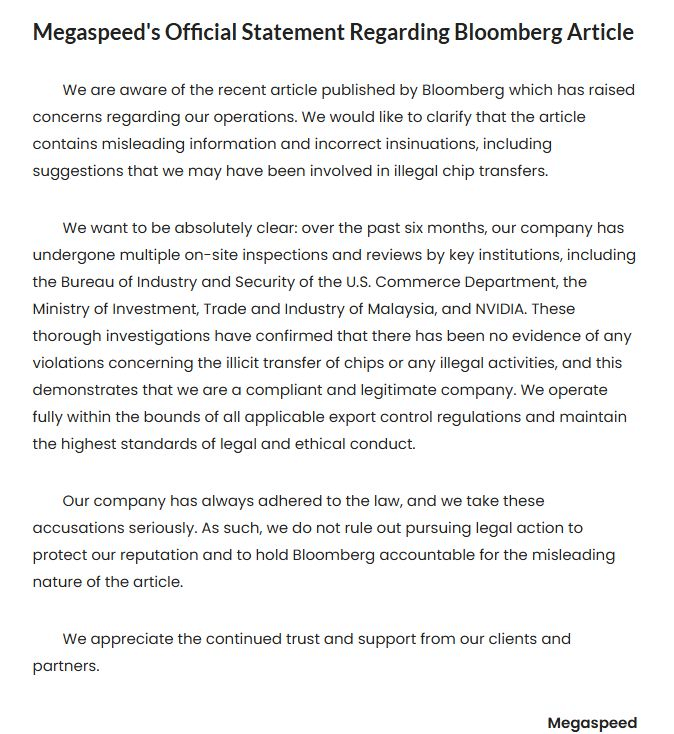
MegaSpeed has strongly rejected allegations that it participated in the illegal transfer of Nvidia chips to China.
In the official statement provided by the company, MegaSpeed described Bloomberg’s reporting as containing:
“misleading information and incorrect insinuations”
The company further claimed that, over the preceding six months, it had undergone multiple on-site inspections and reviews involving:
The US Department of Commerce’s Bureau of Industry and Security (BIS).
Malaysia’s Ministry of Investment, Trade and Industry (MITI).
Nvidia.
MegaSpeed maintains that these inspections found no evidence of illegal chip transfers or other unlawful activities.
Its statement declared:
“This demonstrates that we are a compliant and legitimate company.”
MegaSpeed AI Linkedin
The company also warned that it was considering legal action to protect its reputation and hold Bloomberg accountable for what it described as misleading reporting.
However, the company’s statement represents its own account of the inspections. The underlying inspection reports, their complete scope and the evidence examined have not been independently established through the material currently available.
This leaves an important question: what exactly did the inspections establish, and did they address every concern raised by investigators and journalists?
Jensen Huang previously defended MegaSpeed’s business relationship
The controversy also raises questions about Nvidia’s previous assurances concerning MegaSpeed.
In an October 29 Bloomberg report titled Nvidia’s Huang Defends Megaspeed Ties as US Probes China Spying Allegations, Jensen Huang described Nvidia’s dealings with the company as:
“normal and not unusual.”
Huang also said Nvidia had examined MegaSpeed’s GPU deployments and checked that its processors had not been illegally sent to China.
The continued business relationship is particularly relevant because Nvidia’s cloud partner ecosystem provides access to computing resources that are strategically important to the development of advanced AI systems.
The central issue is therefore not simply whether Nvidia sold chips to a foreign customer. It is whether the company had sufficient visibility into the ownership, financing, physical location and ultimate use of the computing infrastructure associated with that customer.
These questions become even more significant when the customer operates across several Southeast Asian jurisdictions and serves businesses with links to the Chinese technology market.
Washington steps in: Congressional scrutiny intensifies
The controversy has now moved beyond corporate investigations and media reporting.
On November 5, 2026, the US House Select Committee on China announced that its leadership had sought a briefing from Jensen Huang concerning his connections to the alleged Chinese intelligence asset.
The committee wants to establish the extent to which American national security and sensitive technology may have been exposed.
Huang has reportedly been asked to attend a November 18 briefing.
The development reflects broader concerns in Washington about China’s access to advanced American semiconductor technology, particularly as AI becomes increasingly important to economic competitiveness, military research and national security.
Meanwhile, China has rejected the espionage allegations. According to the Associated Press, Beijing described the accusations as unsubstantiated smears against China.
The allegations and denials have therefore opened another front in the wider US-China technology confrontation.
Why the MegaSpeed controversy matters beyond Nvidia
The MegaSpeed case highlights a growing challenge for American export-control policy.
Washington can restrict the direct sale of certain advanced Nvidia processors to Chinese customers. However, the international AI infrastructure market is increasingly interconnected.
A company may purchase computing equipment in one country, operate data centres in another and provide computing services to customers elsewhere.
This creates a complicated regulatory environment in which the physical location of a chip, the identity of its owner, the operator of the data centre and the ultimate user of computing capacity may all be different.
The controversy raises three particularly important questions:
1. The effectiveness of export controls: Can the US adequately monitor advanced AI hardware once it enters international cloud computing networks?
2. Corporate due diligence: How much responsibility should semiconductor manufacturers bear for monitoring the subsequent use and location of their products?
3. Foreign intelligence exposure: Can commercial relationships within the technology industry create opportunities for foreign intelligence services to obtain sensitive information about companies, executives and strategic technologies?
These questions extend well beyond Nvidia. They concern the entire global semiconductor supply chain, including equipment manufacturers, cloud providers, technology investors and governments.
The bigger picture: An intelligence controversy at the heart of the AI race
The allegations involving Alice Huang and MegaSpeed have arrived at a particularly sensitive moment in the global technology competition.
Nvidia is not an ordinary semiconductor manufacturer. Its processors have become essential infrastructure for the development of advanced AI models, data centres and high-performance computing systems.
The company also occupies an influential position in the US technology ecosystem, while maintaining commercial interests in international markets, including Asia.
The possibility that a senior executive could have been targeted by a foreign intelligence operation raises questions about how effectively corporate security, export-control compliance and national security oversight operate within the global AI industry.
For Washington, the issue is whether sensitive technology, commercial relationships or corporate information may have been exposed to a foreign intelligence effort.
For Nvidia, the challenge is to establish whether its internal controls were sufficient and whether any confidential information was compromised.
For MegaSpeed, the immediate task is to substantiate its claims of compliance and address the questions surrounding its procurement and infrastructure.
At present, there is no publicly established finding that MegaSpeed illegally transferred Nvidia chips to China, that Alice Huang successfully obtained Nvidia secrets or that Jensen Huang knowingly participated in any intelligence operation.
Nevertheless, the controversy has exposed a difficult reality of the AI era: technological competition is no longer confined to chip manufacturing, patents and computing performance. It increasingly involves control over infrastructure, access to information, corporate relationships and the security of international technology networks.
The outcome of Nvidia’s independent investigation, the congressional briefing and any further regulatory findings could have implications well beyond the company itself.
The question now is not simply who had access to Jensen Huang. It is whether the world’s most strategically important AI supply chains can remain secure when commercial relationships, international computing infrastructure and intelligence concerns intersect.