Compatriots on both sides of the Taiwan Strait, along with all Chinese people at home and abroad, must join hands to oppose the separatist forces seeking “Taiwan independence,” and work together for the peaceful development of cross-Strait relations and the complete reunification of the motherland. The tide of history is unstoppable; the complete reunification of the motherland must be achieved— and it will certainly be achieved. Looking toward the future, we remain committed to the principles of “peaceful reunification” and “one country, two systems.” On the basis of upholding the one-China principle and the 1992 Consensus, we are prepared to engage in dialogue and consultation with people of vision from all walks of life in Taiwan regarding cross-Strait relations and national reunification.
Xi Jinping’s statement on Taiwan reunification
12 November 2026 | Great Hall of the People, Beijing
Introduction: Beyond China’s Overseas Police Stations
China’s overseas influence operations may be entering a more sophisticated phase. What initially attracted international attention through the expose by Investigative Journalism Reportika as a network of unofficial Chinese police service stations has evolved, according to a new investigation, into something considerably broader: an international system of designated liaison points connecting Chinese police authorities, political-legal institutions, United Front organisations and overseas Chinese associations.
The scale is striking. Nearly 1,250 formally designated liaison points have been identified across at least 91 countries. These networks reportedly perform functions resembling China’s domestic grid-management system, which combines local information gathering, community monitoring, political supervision and administrative intervention.
The findings of Safeguard Defenders‘ November 2026 report, A Formula for Repression: China’s Global Grid for Community Control, together with the subsequent analysis published by Bitter Winter, suggest that the removal of visible police-station signs did not necessarily mean the disappearance of the underlying networks.
The timing deserves particular attention.
On 12 November 2026, Chinese President Xi Jinping reiterated that the complete reunification of Taiwan with China was an unavoidable historical objective of the Chinese Communist Party. He insisted that reunification would be achieved, while reaffirming Beijing’s preference for peaceful reunification under its proposed ‘one country, two systems’ framework.
Taken together, these developments raise an important question: Is Beijing building an increasingly comprehensive overseas political infrastructure that could help it mobilise supporters, influence international narratives, monitor opposition and apply pressure on people who challenge its position on Taiwan?
There is no publicly established evidence that the entire overseas liaison network was created specifically for a Taiwan operation. Nevertheless, its documented functions and Beijing’s increasingly assertive political messaging deserve to be examined together.
1. The Scale of China’s Overseas Network: 1,247 Liaison Points Across 91 Countries
The most significant finding of the November investigation is the reported expansion of China’s overseas liaison infrastructure.
According to Safeguard Defenders, researchers identified:
- 1,247 formally designated liaison points operating across at least 91 countries.
- More than ten Chinese police forces from five provinces participating in the wider system.
- 74 Chinese authorities meeting the report’s criteria for involvement in the domestic grid-management machinery.
- A network involving police, prosecutors, courts, justice bureaus and United Front-affiliated organisations.
The historical growth is equally significant. The report identifies approximately 73 liaison points by the end of 2015, compared with 1,178 by the end of 2025. The researchers warn that the figures for 2024 and 2025 are likely incomplete because some appointments and designations have yet to appear in publicly available Party and government records.
The figure of 1,247 should not, however, be interpreted as 1,247 independently verified, operational police stations. These are formally designated liaison points meeting the investigation’s criteria for performing specified grid-management functions. The report also identifies hundreds of points for which a named overseas location is unavailable.
The distinction is important, but it does not diminish the central concern.
Beijing previously faced international scrutiny after investigations exposed unofficial overseas police service stations. Several governments investigated their activities, and China maintained that certain facilities were voluntary service centres helping Chinese nationals with administrative matters.
The newer findings suggest that the system’s institutional connections may have survived the controversy through different organisational arrangements and designations.
In other words, the issue may no longer be limited to identifying buildings carrying Chinese police signs. It is increasingly about identifying the organisations, personnel, information channels and administrative relationships that allow state-linked activities to operate abroad.
2. Exporting China’s Domestic Surveillance Model
To understand the overseas network, it is necessary to understand how China’s domestic grid-management system operates.
China divides cities, towns and villages into relatively small administrative units, commonly covering approximately 300–500 households, or around 1,000 people.
Each grid is assigned a manager, supported by volunteers, community representatives and Party members. The system is intended to provide local authorities with continuous information about residents, neighbourhood developments and potential sources of social instability.
A 2017 national standard outlines ten responsibilities for grid managers. These include maintaining information about people, locations, organisations and incidents, identifying potential security concerns, resolving local disputes and monitoring individuals categorised by authorities as potentially problematic.
Although some responsibilities involve ordinary community administration and public services, the system also incorporates extensive political and security monitoring.
Information collected at the neighbourhood level is transferred to comprehensive management centres at the county level. These centres bring together different political-legal institutions, including police, prosecutors, courts and justice bureaus, under the leadership of the Communist Party’s Political and Legal Affairs Commission.
The system also connects with population databases and surveillance infrastructure, including the programme commonly known as Sharp Eyes.
Its ideological roots are associated with the Mao-era Fengqiao Experience, which promoted the mobilisation of local communities to identify and address perceived threats to political stability. Xi Jinping has elevated this approach as part of his broader emphasis on social governance and Party control.
The significance of this arrangement is that surveillance is not necessarily conducted exclusively by conventional security agencies. It can be distributed through local administrative structures and community relationships.
How the model translates overseas
The overseas adaptation reportedly follows a similar organisational logic, although the operating environment is different.
Instead of relying on formally established Chinese neighbourhood grids, the system can use diaspora associations, designated liaison officers, community leaders and informant networks.
These organisations can provide information about overseas Chinese communities, identify individuals considered politically sensitive and communicate concerns to Chinese authorities.
The investigation documents examples involving:
- Maintaining information files on overseas Chinese community leaders.
- Identifying and monitoring individuals considered politically sensitive.
- Establishing informant networks and direct reporting channels.
- Monitoring demonstrations and activities critical of Chinese leadership.
- Promoting Beijing’s political positions on Taiwan.
- Targeting groups categorised by the Chinese authorities as hostile or ideologically unacceptable.
One particularly revealing example concerns Qingtian police, whose officials reportedly described a network involving more than 1,000 overseas informants.
The report also identifies instances in which individuals faced threats involving their passports, their relatives in China or their ability to maintain connections with their country of origin.
These allegations raise serious questions about the distinction between legitimate consular assistance and activities that could amount to intimidation or interference within another country’s jurisdiction.
3. The United Front: The Institutional Backbone of Overseas Influence
An important element of China’s overseas architecture is the United Front Work Department (UFWD).
The United Front system is designed to build relationships with individuals, organisations and groups outside the Communist Party’s direct membership. It seeks to bring different social and political constituencies into relationships that support the Party’s objectives.
Overseas Chinese communities have long been an important target of this work.
A major institutional change occurred in 2018, when the Overseas Chinese Affairs Office was incorporated into the UFWD structure. This strengthened the Party’s centralised coordination of overseas Chinese affairs.
The All-China Federation of Returned Overseas Chinese (ACFROC) and its local branches also play an important role in maintaining relationships with overseas Chinese associations.
These organisations are frequently described in official Chinese language as bridges connecting the Party and government with overseas Chinese communities.
The concern raised by the new investigation is that these relationships can extend beyond cultural engagement, economic cooperation and community services.
They can also provide an organisational framework through which political-legal authorities communicate with diaspora associations and designated overseas representatives.
The report describes an architecture in which central Party institutions coordinate subordinate organisations, which then connect with police, prosecutors, courts, justice bureaus and overseas community networks.
Its description of the structure as a coordinated system is particularly important.
At a September 2025 forum in Fuzhou, a senior representative of the All-China Federation of Returned Overseas Chinese reportedly called for overseas Chinese communities to be managed as:
“One chessboard from top to bottom.”
The same official described the diaspora network as needing to operate in formation, like flying geese, at the same frequency.
Such language illustrates the Party’s preference for coordinated overseas mobilisation rather than independent community engagement.
The central concern is not that every Chinese association abroad is an instrument of state interference. Most overseas Chinese associations serve legitimate cultural, educational, social and community purposes. The concern is that some organisations may be incorporated into political or security-related networks without sufficient transparency or accountability.
4. The Red, Grey and Black Zones: How Beijing Categorises Overseas Chinese Communities
One of the more revealing aspects of the investigation concerns the ideological classification of overseas Chinese communities.
China’s leadership reportedly views more than 60 million people as overseas Chinese, using a broad definition that extends beyond Chinese citizens living abroad to include foreign nationals of Chinese origin, without a generational limit.
Within this enormous population, the Party’s approach distinguishes between individuals and groups according to their perceived political relationship with the Chinese Communist Party.
The report describes three zones:
Red Zone: Supporters and Mobilised Networks
Individuals and organisations considered supportive of the Party can be rewarded, encouraged and mobilised to promote Chinese political positions and interests.
Grey Zone: Influence and Co-option
Individuals who are not necessarily aligned with Beijing may be approached through cultural engagement, economic relationships, community activities and political persuasion.
The objective is to influence their positions and, where possible, bring them into the Party’s preferred political environment.
Black Zone: Coercion and Isolation
Individuals identified as opponents or perceived threats may face intimidation, pressure, isolation and attempts to silence their activities.
This category reportedly includes political dissidents, human-rights advocates, supporters of Taiwan’s independent political identity and religious or spiritual communities classified by Chinese authorities as xie jiao.
The important distinction is that these classifications reflect the Party’s reported political framework, not an objective classification of the people concerned.
The broader objective, as described in the investigation, is to influence what overseas Chinese communities think, say and do, irrespective of where they live.
This creates a serious challenge for democratic countries.
Citizens and residents of democratic states must be free to criticise foreign governments, participate in political debates, organise demonstrations and maintain their own cultural identities without fearing pressure from authorities in another country.
The protection of those rights must extend to people of Chinese origin just as it does to everyone else.
5. Taiwan: Xi Jinping’s Declaration on 12 November 2026
The latest development that makes these findings particularly significant is Xi Jinping’s statement on Taiwan delivered on 12 November 2026 at the Great Hall of the People in Beijing.
Speaking at a ceremony marking the 160th anniversary of the birth of Sun Yat-sen, Xi reaffirmed that achieving complete reunification with Taiwan remains an unwavering historical mission of the Chinese Communist Party.
His remarks included an unequivocal declaration:
“The tide of history cannot be stopped; the complete reunification of the motherland must be achieved, and it will certainly be achieved.”
Xi also called upon people on both sides of the Taiwan Strait, together with Chinese communities abroad, to oppose what Beijing describes as separatist forces seeking Taiwan independence.
He reiterated China’s commitment to peaceful reunification and the proposed ‘one country, two systems’ framework. He also expressed willingness to engage in dialogue with Taiwanese representatives on the basis of Beijing’s one-China principle and the 1992 Consensus.
However, there is a fundamental problem with Beijing’s proposal.
Taiwan is a self-governing democracy with its own elected government, military, legal institutions and political system. Its people have not accepted the authority of the People’s Republic of China. The ‘one country, two systems’ proposal has also failed to gain support from Taiwan’s major political parties.
For Taipei, accepting Beijing’s proposed arrangement would mean placing its existing democratic political system under the authority of the Chinese Communist Party.
Why Xi’s language deserves attention
Xi’s latest declaration is not an entirely new policy. Beijing has repeatedly described reunification as a historical objective and has never renounced the use of force against Taiwan.
Nevertheless, the political significance of his latest remarks lies in three areas.
First, the declaration reinforces the permanence of the reunification objective.
Xi did not present reunification merely as a diplomatic aspiration or an issue for future negotiations. He described it as an inevitable historical outcome and an enduring mission of the Communist Party.
Second, the speech explicitly incorporates overseas Chinese communities into the political mobilisation surrounding Taiwan.
This is particularly relevant when examined alongside the expanding liaison infrastructure. The overseas community is not simply being addressed as a cultural population. Beijing’s language also treats it as a potential source of political support for its national objectives.
Third, the emphasis on peaceful reunification does not eliminate the possibility of coercion.
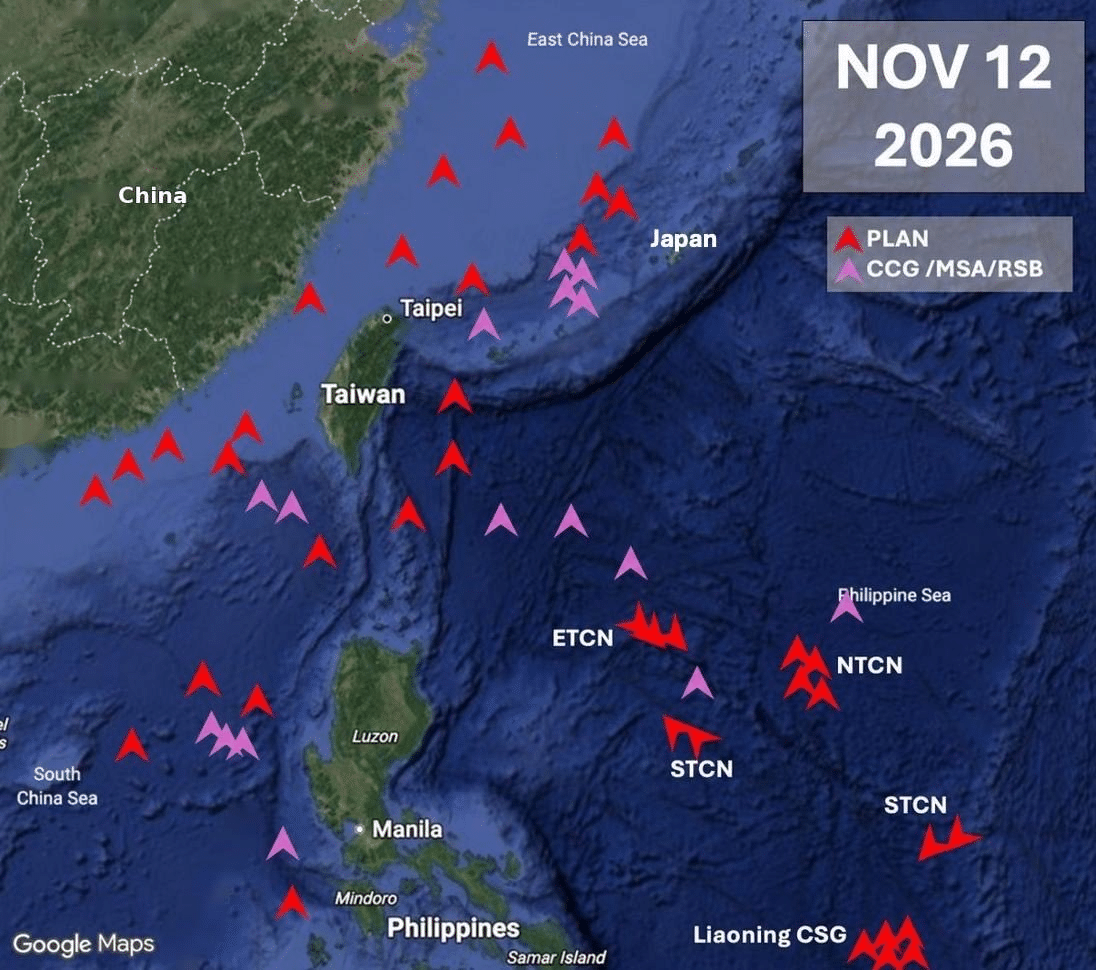
Beijing’s preferred public language continues to emphasise peaceful development and dialogue. However, China has retained the option of using force, while its military continues to operate around Taiwan.
The difference between diplomatic language and the broader range of instruments available to Beijing must therefore remain central to any assessment of cross-Strait developments.
6. The Overseas Chinese Network and Taiwan: A Potential Political Instrument
The most important question emerging from these developments is whether China’s overseas liaison infrastructure could contribute to a broader strategy concerning Taiwan.
A distinction must be maintained here: the available investigation documents overseas community-control and political-monitoring functions, but it does not establish that all liaison points have been assigned operational responsibilities relating to Taiwan.
Nevertheless, several possible strategic applications deserve examination.
A. Mobilising international support for Beijing’s Taiwan position
China has invested considerable effort in presenting Taiwan as an internal Chinese matter rather than an international security issue.
Overseas organisations that maintain close relationships with Chinese political institutions can provide platforms for promoting Beijing’s position.
They may participate in cultural events, public statements, political meetings and campaigns supporting the one-China principle.
A coordinated network could potentially make such messaging more visible and consistent across multiple countries.
B. Monitoring Taiwan supporters and political critics
The documented practice of identifying key individuals and maintaining information files raises concerns about the potential monitoring of people who publicly support Taiwan.
This could include Taiwanese expatriates, human-rights advocates, journalists, academics and political activists.
The objective of such monitoring, where it occurs, could extend beyond collecting information. It may also create an atmosphere in which individuals become reluctant to participate in political activities because of concerns about consequences for themselves or their relatives in China.
C. Influencing public opinion in democratic societies
Beijing has a strategic interest in shaping how international audiences understand Taiwan.
Its preferred narrative emphasises national unity, historical continuity and opposition to separatism.
An overseas network capable of coordinating community organisations and political messaging could help reinforce this narrative in countries where public opinion and parliamentary positions influence relations with Taiwan.
D. Disrupting demonstrations and organised opposition
The reported involvement of overseas liaison networks in monitoring or responding to planned demonstrations is another significant concern.
If such mechanisms are used to discourage protests, identify organisers or pressure participants, they could restrict the political freedom of people living outside China.
This would be especially consequential during visits by senior Chinese officials, international summits, Taiwan-related diplomatic events or public campaigns supporting Taiwanese democracy.
E. Applying pressure through family and administrative connections
Perhaps the most concerning aspect is the reported use of relatives in China and administrative services as potential sources of leverage.
People living overseas may still have family members, property, financial interests or official documentation connected to China.
If these connections are exploited to influence political behaviour abroad, the consequences extend well beyond conventional foreign influence activities.
They raise fundamental questions about sovereignty, individual liberty and the protection of residents under the laws of their own countries.
These five possibilities should be understood as potential applications of the documented network, not as proof that every liaison point is involved in a coordinated Taiwan-related operation.
7. Democracies Facing Their Own Political Challenges
The international environment in which these developments are taking place is equally important.
Several major democracies are dealing with domestic political pressures, economic difficulties, protests and increasingly polarised political environments.
France, Germany, the United Kingdom and India are each navigating domestic political priorities that compete for government attention.
France, in particular, has experienced significant public demonstrations over living costs, wages, public services and political dissatisfaction. The protests have placed additional pressure on an already divided political environment.
Germany is dealing with political competition, economic uncertainty and the challenges of maintaining support for its governing coalition.
The United Kingdom is managing its own domestic political and economic agenda, alongside international commitments.
India, meanwhile, faces substantial domestic political, economic and regional security priorities.
These developments do not mean that these governments are incapable of responding to foreign interference. Nor is there evidence that Beijing has timed its overseas expansion specifically to exploit these domestic challenges.
However, they illustrate a broader strategic reality: governments have limited political, administrative and diplomatic resources. When domestic pressures become dominant, sustained attention to long-term foreign interference risks becoming more difficult.
Washington: Iran and the midterm setback
The situation in the United States is particularly relevant.
The November 2026 midterm elections delivered a significant setback for President Donald Trump and the Republican Party, with Democrats gaining control of the House of Representatives.
The political consequences are considerable. A divided Congress can complicate the administration’s legislative agenda, increase political scrutiny and consume presidential attention.
At the same time, the continuing conflict involving Iran has placed additional pressure on Washington.
On 12 November, Trump indicated that the United States did not need a new agreement with Iran and that the naval blockade and economic pressure would continue. The conflict has also contributed to economic concerns, including higher energy and food costs.
These developments create a difficult political environment for the administration.
Washington remains capable of maintaining its security commitments in the Indo-Pacific. However, the combination of an international conflict, domestic electoral losses and congressional opposition could complicate the administration’s ability to sustain a consistent foreign-policy agenda.
For Beijing, this is a strategic environment worth observing.
China does not necessarily need a major diplomatic crisis in Washington to advance its own interests. Even prolonged uncertainty over American priorities could influence how regional governments assess their security options.
The important distinction is between an opportunity created by international circumstances and evidence of an intention to exploit it. The former can be analysed; the latter requires stronger evidence.
8. The International Warning: Taiwan and Democratic Governments Raise Concerns
The issue has already attracted attention from democratic institutions and governments.
On 6 November 2026, the Inter-Parliamentary Alliance on China (IPAC) issued a statement at its annual summit in The Hague warning about China’s expanding foreign interference and transnational repression.
Among its recommendations was a call for democratic governments to expand formal engagement with Taiwan’s representatives, alongside dissidents, human-rights defenders and diaspora organisations facing pressure.
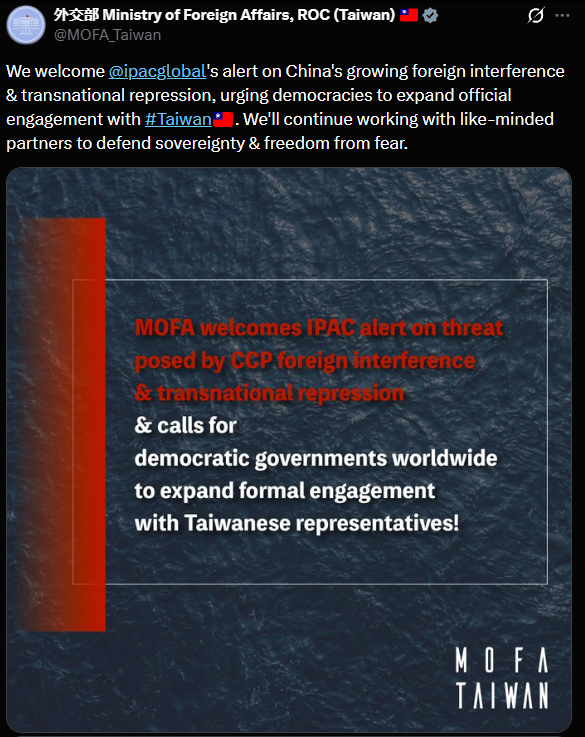
On 8 November, Taiwan’s Ministry of Foreign Affairs welcomed the statement.
Taipei specifically highlighted the concerns raised by the Safeguard Defenders investigation and called for greater cooperation among democratic partners to protect sovereignty, freedom and human rights.
This response is important because Taiwan is not treating transnational repression as an isolated human-rights issue. It increasingly views the problem within the wider context of national security and international political cooperation.
The concerns are also reflected in legal proceedings outside Taiwan.
In the United States, a federal jury convicted Lu Jianwang on 13 May 2026 of acting as an illegal agent of the Chinese government and obstruction of justice in connection with an overseas police station in Manhattan. His case demonstrated how activities presented through a community-service framework can become matters of serious national-security and legal concern.
The conviction does not establish that every Chinese community organisation operates under government direction. It does, however, illustrate why host countries must examine the actual activities and institutional relationships of organisations suspected of acting on behalf of foreign authorities.
Democratic governments face a difficult balancing act: protecting legitimate cultural associations and the rights of diaspora communities while ensuring that foreign governments cannot use those communities to conduct intimidation or unauthorised political operations.
9. What Could China Be Preparing For?
It would be premature to conclude that Beijing has decided upon a particular timetable for Taiwan or that the overseas liaison network is evidence of an imminent military operation.
However, China’s broader strategic direction can be examined through several interconnected developments.
Political preparation: Beijing continues to strengthen its argument that Taiwan’s future is inseparable from China’s national rejuvenation. Xi’s latest remarks reinforce this political objective.
Narrative preparation: Overseas Chinese organisations and international political networks can provide channels for promoting Beijing’s interpretation of Taiwan’s history, sovereignty and political future.
Community monitoring: The expansion of liaison networks creates the possibility of monitoring individuals and organisations considered politically hostile to the Party.
Diplomatic pressure: Beijing can use its international relationships and community networks to discourage governments from expanding formal engagement with Taiwan.
Strategic resilience: A coordinated overseas network may provide Beijing with additional channels of communication, political mobilisation and influence during periods of international tension.
There is also a wider strategic consideration.
A confrontation over Taiwan would not necessarily begin with a military conflict. It could involve diplomatic pressure, economic coercion, information campaigns, political influence and efforts to isolate Taiwan internationally.
The overseas network documented in the investigation could potentially contribute to some of these non-military dimensions.
This does not mean that it is an established component of a Taiwan blockade or military contingency plan. Such a conclusion would require evidence that has not been publicly demonstrated.
Nevertheless, the distinction between military preparation and the political environment surrounding a potential crisis is important. The latter can develop over many years, often without attracting the same level of international attention as military exercises.
10. The Challenge for Democratic Countries
The emerging picture presents democratic governments with a challenge that cannot be addressed simply by closing suspected overseas police stations.
A more comprehensive approach is required.
First, transparency must become a priority.
Foreign-linked community organisations should be subject to appropriate disclosure requirements where they conduct activities on behalf of foreign governments or political institutions. Ordinary cultural and community associations must not be indiscriminately treated as security threats.
Second, law-enforcement cooperation must improve.
Countries should strengthen mechanisms for exchanging information about suspected transnational intimidation, unlawful surveillance and coercion.
Third, diaspora communities must be protected.
People of Chinese origin should be able to participate freely in the political and social life of their countries without being treated as representatives of Beijing or subjected to pressure because of their ancestry.
Fourth, Taiwan’s democratic engagement should remain protected.
Democratic countries should be able to maintain legitimate parliamentary, economic, cultural and diplomatic exchanges with Taiwan without facing intimidation or political interference.
Finally, foreign interference must be treated as a long-term national-security issue.
Governments should not wait for a major diplomatic confrontation or a serious criminal incident before examining networks that may already be operating within their jurisdictions.
The challenge is to defend democratic institutions without undermining the freedoms they exist to protect.
Conclusion: The Network Beyond Borders
China’s reported 1,247 overseas liaison points represent a development that deserves considerably more international attention.
The central issue is not simply the existence of Chinese associations abroad, nor is it the legitimate provision of administrative services to Chinese nationals. It is the reported integration of overseas organisations into a broader structure involving political monitoring, information collection, coordination with Chinese authorities and, in some documented cases, alleged coercion.
Xi Jinping’s statement on 12 November adds another dimension to this debate.
By explicitly calling upon Chinese communities at home and abroad to participate in the effort to oppose Taiwan independence and achieve reunification, China’s leadership has reinforced the political importance it attaches to overseas Chinese populations.
The juxtaposition of these developments is significant, even though a direct operational connection between the entire liaison network and a future Taiwan contingency has not been established.
For democratic governments, the warning is straightforward: foreign interference does not always arrive in the form of military pressure, diplomatic threats or visible intelligence operations. It can also develop through seemingly ordinary community structures, administrative relationships and networks of personal influence.
The question facing the international community is whether it will recognise and address these developments before a major geopolitical crisis exposes their full implications.
As Taiwan remains at the centre of one of the world’s most consequential geopolitical disputes, democracies cannot afford to treat the political activities taking place within their own societies as separate from the wider struggle over regional security and political freedom.