Hong Kong police arrest Catholic Cardinal Joseph Zen over protester assistance fund

National security police in Hong Kong have arrested four people including Cardinal Joseph Zen and pop star Denise Ho on suspicion of “collusion with foreign powers” after they acted as trustees for a legal defense fund for democracy protesters. Hui Po-keung, another trustee of the now-disbanded 612 Humanitarian Relief Fund, which helped arrested protesters pay for their legal and medical bills, was arrested at Hong Kong’s international airport on Tuesday. Zen, a 90-year-old retired Catholic bishop who has long been an outspoken defender of human rights, democracy and civil liberties, Cantopop singer Denise Ho and barrister Margaret Ng were also arrested on the same charge. Some reports said former pro-democracy lawmaker Cyd Ho, who is currently on remand awaiting trial in a different case, and who was also a trustee, would also likely face the same charge. The national security police confirmed they had arrested two men and two women aged 45 to 90, on suspicion of “conspiracy to collude with foreign powers.” Zen was released after several hours of questioning, the Hong Kong Free Press said via its Twitter account. The Vatican said in a statement reported by the Catholic News Agency that it was following the case closely. “The Holy See has learned with concern the news of the arrest of Cardinal Zen and is following the development of the situation with extreme attention,” the Holy See press office said. The 612 Humanitarian Relief Fund was set up on June 15, 2019, at the height of the anti-extradition movement that broadened to include demands for fully democratic elections and greater official accountability. Its aim was to provide humanitarian relief in the form of funding for medical, psychological, legal and other necessary assistance to those injured or arrested during the police crackdown on the protest movement. The fund disbanded in August 2021 because it no longer had access to a bank account because the Alliance for Democracy that had processed its funding had been suspended. Both groups were later ordered to provide information to national security police on their sources of funding and their donors, under a draconian national security law imposed on Hong Kong by the ruling Chinese Communist Party (CCP) from July 1, 2020. Cardinal Joseph Zen attends the Episcopal Ordination of the Most Reverend Stephen Chow in Hong Kong’s Cathedral of the Immaculate Conception, Dec. 4, 2021. Credit: AFP. ‘Brutal crackdown’ The law criminalized calls on the international community for sanctions on Hong Kong and Chinese officials, overseas lobbying or fundraising on behalf of the pro-democracy movement, and criticism of the authorities deemed to incite public anger or “hatred” against the government. The U.K.-based rights group Hong Kong Watch said four trustees of the 612 Humanitarian Relief Fund had been arrested, naming Ng, Denise Ho, Cardinal Zen and Hui. “We condemn the arrests of these activists whose supposed crime was funding legal aid for pro-democracy protesters back in 2019,” the group’s chief executive Benedict Rogers said in a statement on the group’s website. “Today’s arrests signal beyond a doubt that Beijing intends to intensify its crackdown on basic rights and freedoms in Hong Kong,” the statement said. “We urge the international community to shine a light on this brutal crackdown and call for the immediate release of these activists.” The Inter-Parliamentary Alliance on China (IPAC) also hit out at the arrests, which came days after pro-Beijing security hardliner John Lee was anointed leader of Hong Kong in a one-candidate election that analysts said erased most significant differences between the once free city and the Communist Party-run mainland. “These arrests mark a new and deeply worrying phase in the crackdown upon what remains of Hong Kong’s civil society,” it said in a statement. “John Lee, Hong Kong’s new chief executive, is posing a direct challenge to the international community and the autonomy promised to Hong Kong under international law,” IPAC said, calling for the immediate release of those arrested. “Mere words are no longer enough,” it said. “We also call upon our governments to impose targeted sanctions on John Lee, and others involved in these persecutions.” New York-based Human Rights Watch (HRW) also called for the immediate release of those arrested, and for the charges against them to be dropped, China researcher Maya Wang said via her Twitter account. Meanwhile, a U.S.-based rights group went ahead with the 2022 Human Rights Press Awards after they were canceled by the Hong Kong Foreign Correspondents’ Club (FCC), citing legal risks under the national security law. “On #WorldPressFreedomDay, we declare that the freedom of the press will NOT be canceled,” Campaign for Hong Kong founder and president Simon Chu said via Twitter. “Help recognize journalists who told the truth courageously and those who can no longer report freely.” Hong Kong Cantopop singer, actress and LGBT activist Denise Ho posing for a photograph with protesters during a #MeToo rally calling on the Hong Kong police to answer accusations of sexual violence against pro-democracy protesters in Hong Kong, August 28, 2019. Credit: AFP Xi is a ‘pathetic coward’ A petition calling on FCC president Keith Richburg to have a more public conversation about the controversial decision had garnered some 170 signatures its organizers said were journalists, including many former winners of the awards. (Disclosure: Richburg is a member of RFA’s board of directors). “More than 170 journalists signed the petition, 25 are reportedly this years’ awardees & over 20 of us are the former winners of the Awards. We emailed the FCC on 29 April, 3 May and today,” a Twitter account called @lettertofcc said on May 10. “I think we need to at least acknowledge that there are still journalists in Hong Kong who stick to their day-to-day reporting, and say that we stand with them, that we take note of them and their work, and thank them for that,” Yuen Chan, a senior lecturer on London’s City University journalism program, told RFA. She said simply saying that press freedom was dead was too pessimistic an approach for people who are still working as journalists in the…

Read More

China deletes WHO chief’s criticism of zero-COVID policy from social media platforms

Ruling Chinese Communist Party (CCP) censors rushed to delete comments by the head of the World Health Organization (WHO) criticizing its zero-COVID policy as unsustainable from social media platforms in China on Wednesday. WHO chief Tedros Adhanom Ghebreyesus called on China to change its approach, saying CCP leader Xi Jinping’s favored policy “will not be sustainable” in the face of new fast-spreading variants of the virus. Tedros’ comments were deleted from Weibo and ignored by China’s tightly controlled state media. But foreign ministry spokesman Zhao Lijian hit back at a news conference on Wednesday. “We hope the relevant individual can view Chinese COVID policy objectively and rationally and know the facts, instead of making irresponsible remarks,” Zhao said. CCP commentator Hu Xijin said Tedros should “respect China.” “When he speaks specifically about China, he should think whether his words will have a positive effect on promoting solidarity in the fight against COVID-19 in China,” Hu, a former editor-in-chief of the CCP-backed Global Times, said via his Twitter account. Keyword searches on Weibo for “Tedros” in Chinese, as well as the equivalent abbreviation to WHO yielded no results on Wednesday, while users were unable to share an article about his comments from an official U.N. account, Agence France-Presse reported. Prior to their deletion, Tedros’ comments had drawn a number of positive responses, with people wanting to know if the government would listen. The censorship came as the majority of Shanghai’s 26 million residents remained under a grueling lockdown, walled into their apartment buildings and homes with steel fencing, with major transportation routes and services shut down, as many still struggled to access food, essential supplies and urgently needed medical treatment. China insists that its zero-COVID strategy is the only way to prevent a massive death toll from COVID, as has been seen in other countries. Researchers at Shanghai’s Fudan University published a paper in the scientific journal Nature on Tuesday saying that allowing the omicron variant to tear through the population would likely result in 1.6 million deaths and the collapse of rural healthcare systems. A worker disinfects the queue area of a swab test collection site for Covid-19 coronavirus in Beijing, May 11, 2022. Credit: AFP. Distancing from China But critics say the policy is the result of Xi wanting to boost his domestic image as a leader who can succeed by doing things differently from liberal democracies ahead of the CCP’s 20th National Congress later this year. Lee Lung-teng, a high-ranking health minister in Taiwan’s government during the 2003 SARS epidemic, said Tedros appeared to be distancing himself from his previously cozy relationship with Beijing. “He had been helping them clean up their image and acting as if they were doing it right, but maybe he is coming under pressure from someone else, who could be threatening to withdraw their support for him if he continues to be so biased in favor of China,” Lee told RFA. “Maybe he can’t bear [not to speak out] any longer.” “Everywhere else is gradually opening up, so isn’t it a bit strange that they are still talking about zero-COVID … when a situation with no infections would be impossible,” he said. Ren Ruihong, former head of the medical assistance department at the Chinese Red Cross, said Xi is keen to tout his “victory” over the COVID-19 pandemic when he seeks an unprecedented third term in office at the 20th party congress. “The 20th CCP National Congress is happening soon,” Ren said. “International focus is on whether or not Xi Jinping can get another term in office.” “If he abandons the zero-COVID policy now, it will be tantamount to abandoning his own political platform … basically everyone understands that it’s a political necessity [for Xi].” A Shanghai resident surnamed Ma agreed, saying the city’s officials seem to be constantly changing how they implement the zero-COVID directives from higher up. “The decrees are changing daily, sometimes twice a day,” Ma said. “Different instructions are coming from different leaders.” “Nobody can figure out the rules. There aren’t any,” she said. “First they said we have to do a PCR test every five days, then it was seven.” “We were supposed to be out of lockdown by May 1, but now it’s mid-May and we’re still not out of it; nobody knows when it will end now,” Ma said. Losing patience in Shanghai Shanghai residents are increasingly unwilling to toe the line on mass testing amid a string of false positives reported on social media. “People aren’t scared of the virus at all now, but the rule of law has been completely destroyed,” Ma said. “The law is what the officials say it is.” “There’s no humanity, even if you’re sick or elderly: I think it’s worse than during the Cultural Revolution,” she said. In one video clip uploaded to social media, residents of Beicai township in Shanghai’s Pudong New District yell at officials for trying to get them to go to a makeshift “hospital” that was actually rows of tents. “Is this a place to house human beings?” one person shouts. “These tents would blow over in a strong wind.” Social media reports said private taxis are currently charging 3,000 yuan per pickup; 12,000 for airport transfers, after the city’s subway network was shut down. People also posted video showing officials in full PPE removing food from a large refrigerator in an apartment they had allegedly come to “disinfect.” Many social media accounts have been shut down permanently during the Shanghai lockdown. Retired Shanghai teacher Gu Guoping said several of his accounts have been shut down after he criticized the government. “My WeChat account has been blocked by the internet police and Tencent six or seven times, even after I changed my phone number,” Gu told RFA. “This means that I have been cut of from various sources of information, and I have very limited access to information that is local to Shanghai,” he said. The shutdowns came as the Shanghai Cyberspace Administration repeated calls for social media content users…

Read More

US warship sails through Taiwan Strait after China drills

A U.S. warship has sailed through the Taiwan Strait, the second such transit in two weeks and only two days after a large Chinese military live-fire exercise, signaling increased tension in the strait. The U.S. Navy’s 7th Fleet said that its Ticonderoga-class guided-missile cruiser USS Port Royal “conducted a routine Taiwan Strait transit on May 10 (Tuesday) through international waters in accordance with international law.” “The ship transited through a corridor in the Strait that is beyond the territorial sea of any coastal State,” it said, adding that the transit “demonstrates the United States’ commitment to a free and open Indo-Pacific.” Exactly two weeks ago on April 26, the Arleigh Burke-class guided-missile destroyer USS Sampson, also from the 7th Fleet, made a similar transit. On both occasions, the Chinese People’s Liberation Army (PLA) “sent troops to track and monitor the U.S. warship’s passage,” according to a statement from the PLA Eastern Theater Command. Snr. Col. Shi Yi, spokesperson for the command, said China “firmly opposes” what he called “provocative acts” by the U.S. that sent “wrong signals” to Taiwan. The Taiwanese Ministry of National Defense, meanwhile, said Wednesday that the Taiwanese military closely monitored movements at sea and in the air around Taiwan as the U.S. warship sailed northwards in the strait and “the situation was normal.” Prior to that it warned that on the same day as the U.S. ship’s transit, a Z-10 attack helicopter and two Ka-28 anti-submarine warfare helicopters of the PLA entered Taiwan’s air defense identification zone (ADIZ). The Z-10 attack helicopter crossed the median line in the Taiwan Strait, apparently a step up from the PLA incursions that occur almost daily at present. This was only the second time this year a Chinese aircraft has crossed the median line, with the first occurring on Jan. 31. Imminent attack on Taiwan? Over the weekend, the PLA conducted three days of live-fire drills around Taiwan with the participation of “naval, air and conventional missile forces,” according to its website. The Liaoning carrier group, led by the PLA first aircraft carrier, has been operating in the area and conducted training with live munitions in the Philippine Sea, east of Taiwan and south of Japan from May 3 to at least May 9. A J-15 jet fighter takes off from China’s Liaoning aircraft carrier during military drills over the weekend. (Japan Ministry of Defense) The threat of a military action against Taiwan between now and 2030 is “acute,” U.S. Director of National Intelligence Avril Haines said during a hearing at the Senate Armed Services Committee on Tuesday. “It’s our view that (China is) working hard to effectively put themselves into a position in which their military is capable of taking Taiwan over our intervention,” she said without elaborating further. Haines and Defense Intelligence Agency Director Scott Berrier said that events in the Ukrainian war and how Beijing construes them could impact China’s timeline and approach to Taiwan but they believe that China prefers to avoid a military conflict over the island if possible. Grant Newsham, a retired U.S. Marine colonel turned political analyst, said that by his own estimate a PLA attack on Taiwan could happen “anytime from 2023 onwards.” “It much depends on the United States.  If America is distracted by domestic turmoil, is having financial troubles, and is focused on a war in Ukraine, I think Beijing just might make its move,” Newsham told RFA. “China has indeed been building a military force and capability designed to attack and subjugate Taiwan.  They have probably had the capability to move an assault force across the Strait since at least 10 years ago,” the analyst added. “We are in a dangerous time. “ China considers Taiwan a province of China and has repeatedly said that the democratic island of 23 million people will eventually be united with the mainland, by force if necessary. ‘One-China’ Policy On Tuesday, China reacted angrily after the U.S State Department updated its page on U.S.-Taiwan relations on May 5 and removed wordings such as “Taiwan is part of China” and “The United States does not support Taiwan independence.”   China’s foreign ministry spokesperson Zhao Lijian speaks during a news conference in Beijing, China March 18, 2022. (Reuters) Chinese Foreign Ministry spokesman Zhao Lijian told reporters in Beijing that the U.S. modification of the fact sheet “is a trick to obscure and hollow out the one-China principle.” “Such political manipulation of the Taiwan question and the attempt to change the status quo across the Taiwan Strait will hurt the U.S. itself,” Zhao warned. “There is only one China in the world. Taiwan is an inalienable part of the Chinese territory,” the spokesman said. “The U.S. has made solemn commitments on the Taiwan question and the one-China principle in the three China-U.S. joint communiqués,” he said, adding that Washington should abide by them. The U.S. State Department responded that “there’s been no change in our policy.” “All we have done is update a fact sheet, and that’s something that we routinely do with our relationships around the world,” spokesman Ned Price told a press briefing on Tuesday, pointing out that the fact sheet has not been updated for several years. “When it comes to Taiwan, our policy remains guided by the Taiwan Relations Act, the Three Joint Communiques and Six Assurances, as that very fact sheet notes,” Price said. The spokesman reconfirmed “our rock-solid, unofficial relationship with Taiwan,” and said the U.S. calls upon China to “behave responsibly and to not manufacture pretenses to increase pressure on Taiwan.” Under the U.S. policy, Washington has formal diplomatic relations with Beijing but retains a “robust unofficial relationship” with Taipei and is committed by law to make available to the island the means to defend itself.

Read More

Myanmar’s 4 strongest ethnic armies reject junta invitation to peace talks

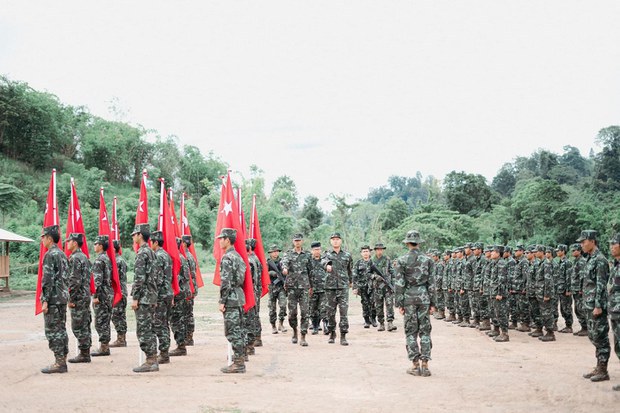
Myanmar’s four most powerful ethnic armed groups have rejected an olive branch from the junta, saying there can be no peace talks until the military regime allows the country’s shadow government and the paramilitary group that fights on its behalf to take a seat at the table. On April 22, junta chief, Snr. Gen. Min Aung Hlaing, called for negotiations that he promised to personally attend and gave the ethnic armies until Monday to accept the offer. But the Kachin Independence Organisation (KIO), the Karen National Union (KNU), the Karenni National Progressive Party (KNPP) and the Chin National Front (CNF) all rejected the invitation. They said that by not offering all stakeholders the chance to participate, the junta showed it is unwilling to meet halfway. “We recognize that political issues need to be addressed through a political dialogue,” KIA information officer, Col. Naw Bu, told RFA’s Myanmar Service, when asked about the decision not to register for the talks. “We are not attending the meeting this time because it’s clear to us that we will not be able to reach a point at which we can discuss real political issues.” The four ethnic armies are Myanmar’s largest, most experienced and best equipped, and together have accounted for some of the strongest resistance to military rule. KNU spokesman Padoh Saw Tawney said that in addition to refusing to allow the shadow National Unity Government (NUG) and the prodemocracy People’s Defense Force (PDF) paramilitary group to attend talks, the junta had failed to honor commitments it had made to his and other ethnic armies, such as reducing its troop presence in their territories in the country’s remote border regions. “If the talks are not held in an inclusive environment, the consequences will be indescribable for the country,” he said. The junta has rejected requests from ethnic leaders and the international community to let the NUG and PDF participate in the talks. Min Aung Hlaing has repeatedly said that the junta will not talk with “terrorists,” and vowed to continue to crack down on the groups. Padoh Saw Tawney said that if the military has good intentions, it should “leave politics” so that the rest of Myanmar’s stakeholders can form a federal democracy and begin the process of rebuilding the country. “We cannot go without these preconditions,” he said. Other ethnic leaders, such as KNPP First Secretary Khu Daniel, told RFA that peace talks without the NUG and PDF would be “meaningless,” and suggested that the junta peace offer was part of a bid to create a schism within the armed opposition. “The NUG formed political alliances with our ethnic groups,” he said. “The junta intends to separate them from these groups. But without them, there will be no solution to this problem.” Khu Daniel acknowledged that some ethnic armies had agreed to join in negotiations but noted that they have smaller forces and hadn’t made much headway in fighting against the military. “Our groups, which are really fighting, are not attending. So, nothing will come out of it,” he said. Myanmar’s Commander in-Chief Senior General Min Aung Hlaing (C) poses for a photo during the second anniversary of the Nationwide Ceasefire Agreement (NCA) in Naypyidaw, in a file photo. Credit: Reuters Armies that accepted In addition to the KIA, KNU, KNPP, and CNF, the other ethnic armies to reject the invitation were the All Burma Students Democratic Front and the Lahu Democratic Union — two of the 10 groups that have signed a Nationwide Ceasefire Agreement (NCA) with the government since 2015. The United Wa State Party, the Shan State Progressive Party, and the National Democratic Alliance Army (NDAA) have said they will attend the peace talks. So have the Arakan State Liberation Party, the Shan State Rehabilitation Council, the Karen National Peace Council, the Democratic Karen Army, the New Mon State Party, and the Pa-O National Liberation Organization — all of which are members of the Peace Process Steering Team (PPST) of NCA signatories. The 10 groups that signed the NCA have suggested that the deal remains in place, despite an already flailing peace process that was all but destroyed by the unpopular junta’s Feb. 1, 2021, coup. Previously, all 10 said they would not pursue talks with the military, which they view as having stolen power from the country’s democratically elected government. PPST spokesman, Col. Saw Kyaw Nyunt, said his group decided to accept the junta invitation with the hope that it would lead to broader negotiations. “It’s a start with the aim of finding a way to have inclusive talks,” he said. “We’ll try to determine how to create such an inclusive political environment, even though we have not yet held a political dialogue to build a federal democratic union.” The three northern alliances — the Kokang National Democratic Alliance, the Ta’ang National Liberation Army and the Arakan Army — have said they are still negotiating among themselves over Min Aung Hlaing’s offer. Speaking to RFA at the end of last week, junta deputy information minister, Maj. Gen. Zaw Min Tun, told RFA that “most” of the ethnic armed groups had accepted the invitation. On Monday, he said that “a total of nine groups” had confirmed they would attend talks — NCA signatories Democratic Karen Army, Karen National Peace Council, Pa-O National Liberation Organization, New Mon State Party, Arakan State Liberation Party, and Shan State Rehabilitation Council; and non-signatories United Wa State Party, Shan State Progressive Party, and National Democratic Alliance Army. “Some groups have issued statements saying they will not attend, and we are waiting for others to make their decision,” he said. Zaw Min Tun said the junta is committed to pushing the peace process forward, adding that it is willing to “openly discuss the establishment of a union based on democracy and federalism.” ‘Effort to buy time’ Naing Htoo Aung, permanent secretary of the NUG’s Defense Ministry, said that 15 months after seizing power, the junta has led Myanmar to ruin, and its rule is…

Read More

Hong Kong’s one-horse leadership poll marks end of city’s special status: analysts

Hong Kong’s one-horse leadership poll, which selected former security chief John Lee — the only candidate — for the city’s top job at the weekend, has wiped out any distinction between the city and the rest of mainland China, commentators said on Monday. Lee, a former police officer who oversaw a violent crackdown on the 2019 protest movement, was “elected” by a Beijing-backed committee under new rules imposed on the city to ensure that only those loyal to the ruling Chinese Communist Party (CCP) can hold public office. Ninety-nine percent of the 1,500-strong committee voted for Lee, who was the only candidate on the slate. Lee, who takes office on July 1, the anniversary of the 1997 handover to China, vowed to “start a new chapter” in Hong Kong, which has seen waves of mass, popular protest over the erosion of the city’s promised freedoms in recent years. He also denied that anyone had been detained or imprisoned for “speech crimes” under a draconian national security law imposed on the city by Beijing from July 1, 2020, saying that people were only taken to court because of their “actions.” Incumbent chief executive Carrie Lam said Saturday‘s “election” showed why a citywide crackdown on dissent and political opposition, which included the changes to electoral processes, was needed. “[The] chief executive election was very important, because … it meant we were able to fully implement a political system in which Hong Kong is ruled by patriots,” Lam told reporters. She thanked Beijing for restoring “stability” in Hong Kong with the national security law and the electoral changes. The national security law ushered in a citywide crackdown on public dissent and criticism of the authorities that has seen several senior journalists, pro-democracy media magnate Jimmy Lai and 47 former lawmakers and democracy activists charged with offenses from “collusion with a foreign power” to “subversion.” “National security education” — a CCP-style propaganda drive targeting all age-groups from kindergarten to university — is also mandatory under the law, while student unions and other civil society groups have disbanded, with some of their leaders arrested in recent months. Chan Po-ying (2nd R) of the League of Social Democrats waits as police question two of her colleagues before they hold a protest against the selection process of the city’s chief executive in Hong Kong , May 8, 2022. Credit: RFA. ‘Steady erosion of political and civil rights’ In a joint statement, the foreign ministers of Canada, France, Germany, Italy, Japan, the U.K. and the U.S. criticized Lee’s “election” as “part of a continued assault on political pluralism and fundamental freedoms.” “The current nomination process and resulting appointment … further erode the ability of Hongkongers to be legitimately represented. We are deeply concerned about this steady erosion of political and civil rights and Hong Kong’s autonomy,” they said. EU foreign policy chief Josep Borrell said Lee’s selection had “violated democratic principles and political pluralism in Hong Kong.” Chinese foreign ministry spokesman Zhao Lijian said Beijing believed that Lee would lead a new administration and the people of Hong Kong to “a new prospect of good governance.” A Taiwan-based Hongkonger who have only the surname Wong said the city had entered a “new era,” referencing the political ideology of CCP leader Xi Jinping. “What is this era? It is one of rule by a military regime and of white terror of a kind that Taiwan has seen before; an era of dictatorship,” Wong said. “I don’t think there is any more room for breakthroughs or changes to the way things are developing for civil society in Hong Kong, or to the system,” he said. “There’s no going back from this.” A former 2019 protester who gave only the nickname Joker said he had also left his home city for democratic Taiwan, and has no prospect of going back there any time soon. “It makes no difference to me whether John Lee comes to power or not; the government has had no respect for us since [the protests],” he said. “For me, Hong Kong is no longer the Hong Kong I once knew. It is no longer our home.” Former Causeway Bay bookstore manager Lam Wing-kei, also exiled in Taiwan, said the process had accelerated quicker than he had expected. “Things are worse in Hong Kong than I had previously thought they would get,” Lam told RFA. “It’s just like … [the rest of China] … The main thing now is obedience; obeying orders from central government,” ‘A tragedy for Hong Kong’ Taiwan-based current affairs commentator Sang Pu said Lee is likely to take an even harder line on matters deemed “national security” by Beijing than Carrie Lam. “John Lee is a security chief, not a decision-maker; he’s the white glove [concealing the iron fist] of the CCP,” Sang told RFA. “It’s clear from his record that he has a tough style, and may be even more vicious than either Carrie Lam or [her predecessor] Leung Chun-ying.” “[For example,] I understand that prisons in Hong Kong are becoming more and more indistinguishable from prisons in China,” he said. “I think CCP will seize even more control of Hong Kong in future, with religion, families and communities deeply impacted … no different from Xinjiang or the Soviet Union.” “This is a tragedy for Hong Kong.” Huang Chieh-chung, associate professor of international affairs and strategy at Taiwan’s Tamkang University, said Lee will also likely preside over even harsher national security legislation under Article 23 of Hong Kong’s Basic Law. He said it was a move in the wrong direction. “The best thing would be for Beijing to govern Hong Kong as little as possible, and let the people of Hong Kong decide what the [differences between Hong Kong and China are],” Huang said. “The more Hongkongers have a right to speak up, the better.” Fan Shih-ping, professor at the Institute of Politics at Taiwan Normal University, said any distinction between Hong Kong and mainland China has been eroded with Lee’s accession to power. “Hong Kong…

Read More

Police sent to Beijing university campus amid growing public anger over zero-COVID

Police were deployed to the campus of Beijing International Studies University at the weekend, as authorities in Shanghai step up forcible, mass isolation of residents in the wake of a top-down directive from ruling Chinese Communist Party (CCP) leader Xi Jinping. A post on the BISU leaders’ message board said restrictions on people entering and leaving the school campus and the fencing off of living areas to prevent the spread of COVID-19 had been implemented with no consultation, and before any official announcement had been made. It said workers sent in to implement the restrictions and carry out disinfection work weren’t wearing masks, and that the measures had done little to stem the spread of the virus. “Please could the leaders take charge on behalf of ordinary people,” the post said, adding that people were bound to gather in public spaces if they were prevented from moving around freely. A video clip apparently shot at the BISU campus over the weekend showed rows of uniformed police officers standing ready, while a law enforcement officer gave a warning by megaphone. “This is your first warning,” the officer says. “We hope you will cooperate with the school CCP committee … and disperse immediately.” “If you are still here after the third warning, then the police will take lawful action to clear the area,” the officer says. After an official tells them to use official channels to pursue complaints, one person shouts: “You’re crazy! What channels do I have?” The BISU website posted a call for the university to obey CCP leader Xi Jinping’s call on colleges and universities to take part in his zero-COVID policy, which has led to grueling lockdowns enforced by steel barriers, forcible transfers to isolation facilities and ongoing mass testing in major cities including Shanghai, affecting tens of millions of people. The BISU party committee said it viewed disease control and prevention as “the political priority for the present,” and would “resolutely implement” the policy, without need for local centers for disease control and prevention (CDCs) to get involved. City lockdown In Beijing’s Chaoyang district, residents of the Jiayuan residential compound were placed under lockdown by officials, who welded them into their apartment buildings with steel barriers. Beijing resident Wang Qiaoling said dozens of families were confined to their homes by the move. “These are 28-story high-rise apartment buildings, usually with three households to a floor, and sometimes four, so multiply 28 by three … it’s really scary,” Wang said. “Are any of them patients needing dialysis? Any who need to attend hospital or get out to buy medicines on a regular basis?” Shanghai’s lockdown has resulted in an unknown number of seriously ill patients dying due to lack of access to hospitals, which are insisting on negative PCR results, a test that can take up to 48 hours to return a result. “Is this what they mean by serving the people?” Wang said. “I bet the person giving this order didn’t have any family members in that block.” “We had the Wuhan lockdown of 2020, and they’re still locking cities down. Not just lockdowns, either, but welding people’s buildings shut.” Beijing-based current affairs commentator Ji Feng said Chaoyang is one of the most densely populated districts in Beijing. While most people in the city are currently going about their lives in a normal manner, the targeted lockdown in Chaoyang show how far local officials are willing to go to please those higher up. “It’s overkill at each level of the hierarchy,” Ji said. “If something gets said at the highest level, then every level below that overdoes the response, for fear of [spoiling their service record].” “If nothing bad happens, there are no bad consequences for overdoing things … in China, no questions get asked by leaders or those lower down about the process; only the result,” he said. ‘Many are resisting’ Since Xi’s speech reiterating his commitment to the zero-COVID policy, authorities in Shanghai have also stepped up lockdown measures, emptying entire residential buildings and taking residents away to isolation centers if only one person tests positive for COVID-19. “Please don’t go out,” a residential official is heard saying in one video posted to social media. “The entire building will be taken away if even a single person tests positive.” Other videos showed enforcement personnel in PPE white suits forcing their way in to people’s homes, spraying disinfectant all over their belongings, and separating a woman from her child. In one video, a resident refuses to leave with officials or to hand over the keys to her apartment. A Shanghai resident surnamed Chen said people are trying to resist. “Many people are resisting,” Chen told RFA. “I told them that it didn’t matter which leader came up with this idea; that it was totally unreasonable.” Signs of widespread dissent are also emerging online, only to be rapidly silenced. Chinese constitutional expert Tong Zhiwei had his Weibo account shut down after he wrote a post arguing that the forcible removal of residents to isolation centers, as well as the requisitioning of their homes for isolation purposes, is illegal in the absence of emergency legislation. “These agencies have no right to use coercive means to force residents to be quarantined in makeshift hospitals,” Tong wrote. “Public authorities at all levels and of all types in Shanghai have the responsibility and obligation to immediately stop the use of coercive means to send any residents other than patients, pathogen carriers, and suspected patients to isolation facilities.” He said the forcible requisitioning of people’s homes is also illegal. “Officials in Shanghai forcing residents to hand over their house keys, then sending people into their homes for ‘disinfection’, is trespassing illegally in citizens’ homes,” Tong wrote, adding, “this practice has already been implemented in some areas.” Translated and edited by Luisetta Mudie.

Read More

China steps up drills around Taiwan, Japan scrambles jets due to airspace intrusion

The Chinese military conducted live-fire drills around Taiwan over the weekend, its official website said Monday, while Japan reported scrambling fighter jets because of a suspected intrusion of its airspace over the East China Sea. In a short dispatch on Monday, the military’s website said “naval, air and conventional missile forces of the Chinese PLA Eastern Theater Command held drills in seas and airspace to the east and southwest of Taiwan Island from May 6 to 8, in a bid to test and improve the joint operations capability of multiple services and arms.” PLA stands for People’s Liberation Army. It didn’t provide further details. The Japanese Ministry of Defense’s (JMOD’s) Joint Staff also confirmed via its social media that from May 6 to 8, Japanese air force’s fighters “scrambled to cope with a suspected intrusion into Japan’s airspace over the East China Sea and the Pacific Ocean.” Before that on Sunday, the JMOD issued a press release saying that the Chinese aircraft carrier Liaoning and four other warships were spotted on May 7 in the waters about 150 kilometers (95 miles) south of Ishigaki Island, Okinawa Prefecture. On May 6, the number of ships in the flotilla was six, the ministry said. ‘Future operations against Taiwan’ The Chinese vessels were conducting live-fire drills with carrier-based fighters and helicopters, the JMOD said, adding that Japan’s Izumo light aircraft carrier was dispatched to monitor the situation. RFA has approached the Taiwanese Ministry of National Defense (MOND) for comment on the latest Chinese drills. Taiwan’s local media reported that he ministry has deployed Sky Bow III missiles, which have a maximum range of 200 kilometers (125 miles), to deal with threats to eastern Taiwan. F-16V fighter jets will be deployed at Taitung’s Chihang Base and a number of Hsiung Feng III and Harpoon missiles will also be moved to the east. Taiwanese people consider themselves citizens of a sovereign country but China claims the self-ruling, democratic island is a breakaway province of China and vows to unite it with the mainland, by force if necessary.   A file photo showing a rocket being fired from a Thunderbolt 2000 multi-rocket launcher during military exercises in Taichung City, central Taiwan, July 16, 2020. (AP Photo) Experts said that the appearance of the Chinese aircraft carrier Liaoning and aircraft near eastern Taiwan was a direct challenge to the island. Qi Leyi, a Taipei-based military analyst and commentator for RFA Mandarin, said that the PLA joint combat drills will escalate further in the future. “The sea and the airspace east and southwest of Taiwan will remain the focus of future operations against Taiwan,” Qi said. “Besides naval and air forces, the conventional missile force will be utilized, too, to attack Taiwan’s important political and military targets,” he said. Shen Ming-ShiI, acting deputy chief executive officer at Taiwan’s Institute for National Defense and Security Research, a government think-tank, said that in addition to demonstrating the capabilities of the aircraft carrier battle group, the Chinese drills around Taiwan also aim “to demonstrate the PLA blue water combat capabilities.” “It’s likely that one or two Chinese submarines have also conducted coordinated exercises underwater,” Shen said. The Taiwanese MOND said on May 6, 18 Chinese military planes entered the southwestern and southeastern parts of Taiwan’s air defense identification zone, the largest intrusion by Chinese military aircraft so far in May. Put on alert A week ago on May 2, the Japanese and Taiwanese militaries were put on alert after spotting a flotilla led by the Liaoning aircraft carrier sailing from the East China Sea towards the Pacific Ocean. On that day, the aircraft carrier was accompanied by seven destroyers and supply vessels, forming the largest Liaoning carrier group in recent voyages, according to the Chinese mouthpiece Global Times. Among seven warships in the Liaoning carrier group were the Type 055 large guided missile destroyer Nanchang, the Type 052D guided missile destroyer Chengdu, and the Type 901 comprehensive supply ship Hulunhu. The Liaoning – China’s first aircraft carrier – was seen carrying a number of J-15 fighter jets as well as Z-8 and Z-9 helicopters. The carrier group is on a “routine, realistic combat training mission,” said the hawkish newspaper. Last December, the aircraft carrier and five other vessels conducted drills in the Yellow Sea, the East China Sea and the West Pacific for 21 days in order to boost its combat capability. The Global Times quoted Shi Hong, the editor of a Chinese military magazine, as saying that the waters where the Liaoning carrier group is holding drills is “a vital sea region should a reunification-by-force operation take place.” “By moving in tandem with aerial and maritime forces from the Chinese mainland, the carrier group could completely cut off the routes foreign forces may take if they militarily interfere with the Taiwan question,” Shi was quoted as saying. Taiwanese military analyst Shen Ming-Shih however pointed out that the fact that China uses the Liaoning aircraft carrier as the flagship to command and the other active carrier Shandong is in port for maintenance, shows that “the PLA still has the problem of dual aircraft carrier maritime confrontation, and its navigation scope is also limited.” “It can try bullying Taiwan, but in the face of the U.S. naval and air superiority, China still has great concerns,” he said.  

Read More

Auction of activists’ homes seen as revenge for sale of junta assets

An announced plan to auction off the homes of anti-coup activists is the military regime’s bid for revenge after Myanmar’s shadow government began selling shares of assets appropriated by Snr. Gen. Min Aung Hlaing and other junta officials, according to analysts. On April 27, junta deputy information minister, Maj. Gen. Zaw Min Tun, told reporters at a press conference in the capital Naypyidaw that the sealed-off homes of detained activists had been “presented to the court” and would be sold at auction sometime in the future. When asked for clarification on Thursday, Zaw Min Tun told RFA’s Myanmar Service that the junta had obtained court permission to proceed with the sales. “You must present evidence according to court procedure,” he said. “Once the court has ruled on the evidence, there are certain procedures to follow. Right now, we have presented the evidence as needed.” The deputy minister provided no other details on the homes in question, including who they had belonged to or what the former owners are being charged with. Last week’s announcement came six days after National Unity Government (NUG) Minister for Finance and Investment Tin Tun Naing told RFA of plans to sell a number of properties he said were identified by the shadow government as having been illegally occupied by senior junta officials when the military seized power in a Feb. 1, 2021, coup. Among the properties is the former guesthouse of Myanmar’s military and accompanying two-acre plot of land at No. 14 Inya Road in Yangon, which now serves as Min Aung Hlaing’s home. Tin Tun Naing said the NUG plans to sell the estate for U.S. $10 million — about one-third of the property’s current value — in 100,000 shares of U.S. $100 each. On Thursday, Tin Tun Naing provided additional details of the sale, which he said involves 100,000 shares of the estate priced at U.S. $100 apiece. “Once we identified it as state property, we started to sell it to facilitate the end of the dictatorship and to raise funds needed for the success of the Spring Revolution, in the interest of the people,” Tin Tun Naing said. “As soon as it was announced that it would go on sale, there were several purchases. One single person has already bought shares worth U.S. $100,000.” The NUG’s Ministry of Finance and Investment said the sale will involve around 400 acres of land occupied by junta officials in Yangon, Mandalay, and Naypyidaw, which will be “confiscated and made available to the public in May on a pre-purchase basis.” The sale assumes that the NUG will claim control of the country from the junta, at which point it would deliver on the promised asset. Proceeds from the sale will be donated to the opposition movement and used to compensate victims of junta arrest and torture, rehabilitate members of the Civil Disobedience Movement who left state jobs in protest of the coup, and assist people whose homes have been burned in arson attacks by junta forces, the ministry said. The NUG said that its plan to seize junta assets “is to discourage likely dictators who want to abuse power from illegally taking over state-owned land and properties in the future.” ‘No legal right to confiscate’ Lawyers and political analysts told RFA that while the sale of the former military guesthouse involved returning public property to the people, the military has no legal right to confiscate and sell private assets. A spokesman for the Thailand-based Assistance Association for Political Prisoners (AAPP) called the junta’s announcement a form of “retaliation” against democracy and human rights activists, adding that many of the homes belong to people whose trials have not been ruled on by the courts. “The law does not allow for the confiscation of properties of innocent people,” they said, speaking on condition of anonymity. “Some of the houses they sealed off were not even owned by the person they arrested. Now we are seeing family-owned properties being confiscated too. It’s a form of revenge.” High Court lawyer Kyee Myint, who assists with human rights cases, told RFA that the junta plan to sell private property is in violation of the law. “I am very pleased that the NUG has said it will auction off the former military guesthouse on Inya Road, now taken over by Min Aung Hlaing. But how can it be legal for them to retaliate against us,” he asked. “They are robbers. The courts are now under their control. The chief justice is a military officer. The judiciary in our country has been destroyed for a long time. It is a violation of the law to seize properties of ordinary politicians.” Well-known singer Chan Chan, who has a warrant out for her arrest on charges of incitement, said in a May 1 post to her Facebook page that she heard the junta is preparing to sell her house in the port city of Thanlyin near Yangon and urged fans to protest. Other properties seized by the junta are owned by artists, anti-junta activists, members of the deposed National League for Democracy and paramilitaries with the prodemocracy People’s Defense Force. On May 3, authorities sealed off the family home of Myint Zaw Oo, an NLD member of Parliament in Sagaing region’s Kanbalu township. “They have no rules or laws. They just act blindly,” he said. “They think we may be demoralized if they do these things. It is seen as a kind of psychological warfare. But we have already thought of the consequences of our actions, so it doesn’t matter whether they seize our property or even burn it.” According to the AAPP, authorities have killed 1,825 civilians and arrested some 10,545 since February last year, mostly during peaceful anti-junta protests. The group said the junta has confiscated more than 570 homes and buildings since the coup. Translated by Khin Maung Nyane. Written in English by Joshua Lipes.

Read More

Russian arms sales to Southeast Asia have tanked, report finds

Russia’s arms sales to Southeast Asia have plummeted due to international sanctions imposed since the start of the Ukraine crisis in 2014 and the ongoing war will likely lead to a further decline, creating market opportunities for countries like China, a new report says. An article in the bulletin ISEAS Perspective published by the ISEAS –Yusof Ishak Institute, a Singapore-based research institution, has found that Russia’s defense industry has been hit hard, with export values reduced from $1.2 billion in 2014 to just $89 million in 2021. Cumulatively Russia has been on top of the list of arms suppliers to Southeast Asia over the last two decades but the sales are likely to fall further and regional countries will look to divert their weapons contracts to other countries, the report says. Data provided by the Stockholm International Peace Research Institute (SIPRI) show that in 2021 alone, Russia has already slipped behind the United States and China. According to the article’s author, academic Ian Storey, the biggest reason behind the fall is sanctions and export controls that the U.S. and Europe imposed on Russia’s defense industry since its annexation of Crimea from Ukraine in 2014. Those restrictions haven’t necessarily prevented Southeast Asian nations from buying Russian arms, but there is less on offer as Russian manufacturers face difficulties in conducting financial transactions and accessing technologies and critical components. It’s also ended defense industry ties between Russia and Ukraine. “The conflict brought to an abrupt end longstanding and extensive cooperation between Ukrainian and Russian defense companies, especially in the production of engines for surface ships, helicopters and aircraft,” Storey said. Military visitors of Vietnam observe a Russian T-90MS tank during the International Military Technical Forum Army-2020 in Alabino, outside Moscow, Russia, Aug. 23, 2020. (AP Photo) Another factor is a pause in the military modernization program in Vietnam, Russia’s biggest customer in Southeast Asia. Hanoi began the program in the late 1990s and in the period 1995-2021, it bought $7.4 billion worth of weapons and military equipment from Russia. That accounted for more than 80 percent of Vietnam’s total arms imports. “Vietnam has put the military modernization program on hold because of concerns over Moscow’s ability to fulfill orders but also due to an anti-corruption drive,” Nguyen The Phuong, lecturer at the Faculty of International Relations, Ho Chi Minh City University of Economics and Finance, wrote in July 2021 research paper. Hanoi will still have to rely on Moscow to maintain and operate its Russian-made arsenal of six Kilo-class submarines, 36 Sukhoi Su-30MK2 aircraft, four Gepard 3.9 class frigates and two Bastion mobile coastal defense missile systems, but experts say it has already been on the look-out for alternative supply sources including Israel, Belarus, the U.S. and the Netherlands. Downward trends In the light of the Ukraine war, the new report says will be difficult for Russia’s defense manufacturers to revive their sales due to “the imposition of tighter sanctions and export controls by a number of countries, the reputational damage caused by the poor performance of Russia’s armed forces in Ukraine, and its need to replenish battlefield losses.” Storey pointed out that the current sanctions on Russian banks, and their exclusion from the Society for Worldwide Interbank Financial Telecommunication (SWIFT) international payment network, “will make it harder for the country’s defense industry to conduct financial transactions with overseas clients.” Export controls imposed on Russia will also restrict Russian manufacturers’ access to advanced technologies critical in modern military hardware and components that Russia doesn’t possess. “As a consequence, foreign buyers may decide to switch to more reliable sources of military hardware.” People walk past the headquarters of Russian Agricultural Bank in downtown Moscow, Russia, on July 30, 2014. It was one of the Russian banks hit by Western sanctions. (AP Photo) Furthermore, losses suffered by Russian forces in Ukraine this year may have seriously damaged Moscow’s reputation as a military equipment powerhouse. “The problems facing Russia’s defense-industrial sector will create market opportunities in Southeast Asia for other countries, including China,” the report says. According to SIPRI data, China’s arms exports to Southeast Asia in 2021 totaled $284 million, up from $53 million in 2020. So far, China has refrained from condemning Russia’s invasion of Ukraine, and as the war drags on Moscow’s dependence on Beijing may deepen. In return, “China will seek increased access to Russia’s most sensitive military technology and even pressure Moscow to reduce military sales to Vietnam,” Storey said. A medium range surface-to-air missile weapon system is displayed during the 12th China International Aviation and Aerospace Exhibition in Zhuhai city, south China’s Guangdong province, on Nov. 6, 2018. (AP Photo) Ukraine’s arms sales That would be a blow for Russian exporters but also for Vietnam, which has competing claims against China in the South China Sea. The situation in Ukraine also disrupted the Ukrainian arms supply to Hanoi which totaled $200 million during 2000-2021. Ukraine was part of the Soviet and then Russian defense industries even after proclaiming independence. It has been a major supplier of aircraft and spare parts, as well as armored vehicles and munitions. During 2009-2014, up until the annexation of Crimea, Ukraine was among world’s 10 largest arms exporters, according to SIPRI. In 2012, it was in fact the fourth-largest arms exporter. Kyiv sold $1.3 billion worth of conventional arms that year. Ukraine’s state-owned exporter Ukrspecexport had contracts with nearly 80 countries. In its heyday, the company ran 100 arms-producing plants and factories, and employed tens of thousands of workers. Besides Vietnam, in Southeast Asia Thailand and Myanmar were also big customers that spent $479 million and $111 million on Ukrainian weapons respectively during 2000-2021. In 2011, Bangkok ordered 49 T-84 Oplot battle tanks and 236 BTR-3E armored vehicles from Ukraine. However the delayed deliveries of the Oplots due to the Crimea crisis forced Thailand to buy VT-4 main battle tanks from China instead. Bangladesh, Cambodia, Laos and Indonesia also bought weapons from Ukraine, though in much lesser quantities. A Bangladesh military officer, Brig (Rtd)…

Read More

North Koreans roll their eyes during May Day lectures about socialism’s superiority

Workers in North Korea ridiculed their government’s May Day propaganda which touted the superiority of socialism at a time when most of the people are struggling to put enough food on the table, sources in the country told RFA. May Day, or International Workers’ Day, is an annual celebration of the fight for labor rights and an important holiday in communist countries. The North Korean government held special lectures for factory workers ahead of the holiday, where they emphasized the evils of capitalism to show why North Korean socialism is better. At one such lecture at the Chongjin Steel Factory in the northeastern province of North Hamgyong, workers were not buying the party official’s argument. “They gathered workers into conference rooms, pointing out the problems of capitalism for a whole hour, and then rambled on and on about socialism and how it is superior,” a source working in the factory told RFA’s Korean Service on condition of anonymity for security reasons. “The workers scoffed at the message, saying that nothing could be further from the truth,” he said. They even openly objected while the lecturer was speaking. “When he said that all the workers under the socialist system live happily and receive many benefits from their government, the workers cried out, ‘How can he tell such a lie with a straight face, knowing all the hardships we are facing right now?’” the worker said. “This kind of propaganda that reinforces the superiority of socialism is offending the workers, and we can remain silent no more,” he said. In the northern province of Ryanggang, the subject of the lecture was how workers’ independence has been trampled in capitalist countries and they are not treated like people, a worker at a factory there told RFA on condition of anonymity to speak freely. “Most of the workers are well aware that the lecture was unrealistic,” he said. “These days, we all know about how the capitalist countries are the richest, and we know about the rights that workers have from foreign and South Korean movies and TV shows, and from overseas radio broadcasts,” the second source said. The workers therefore ignored the lecture completely. “The reality is that no matter how much the speaker stresses that workers are exploited, pressured, subjugated and repressed under the capitalist system, his words are not being heard,” the second source said. “In the past, during these kinds of lectures, there would be many who actually agree, but these days we just don’t respond to these empty words that declare this as the ideal society in which our independent rights are guaranteed and we are all equal under the socialist system. “Most workers feel like they are at a dead end in terms of their livelihoods, and they express their dissatisfaction by agreeing just for appearances sake.” Translated by Claire Lee and Leejin J. Chung. Written in English by Eugene Whong.

Read More