Op-ed by Dolkun Isa
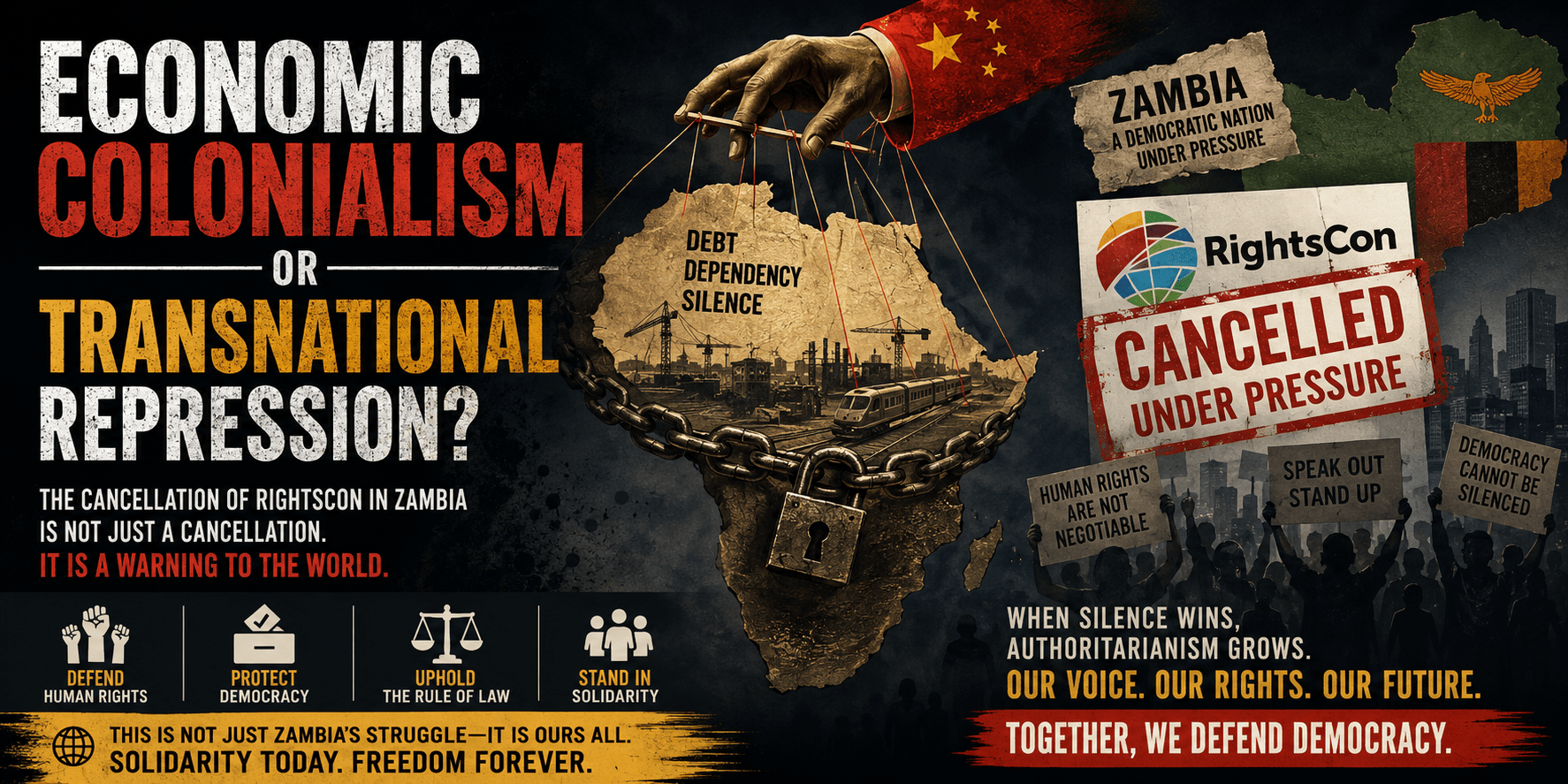
The recent shocking situation in Zambia, a seemly democratically governed country in Africa, highlights the continent’s fragile position in international relations. The Zambian government‘s cancellation of the RightsCon conference due to pressure from the Chinese government reveals the many dimensions of modern economic colonialism and Transnational repression. Let’s take a closer look at the background of this event and the current effects of economic colonialism.
The RightsCon conference, planned to be held in Zambia between 5 and 8 May, was an international platform that brought together human rights defenders, academics and activists. 3,000 participants were expected to attend.
However, 4-5 days before the conference started, the Zambian government announced its cancellation. This meant that many attendees had already made ticket and accommodation arrangements, and critical discussions about human rights were hindered. RightsCon cited pressure from the Chinese government as the reason for the cancellation.
This is a reflection not only of the political dynamics within a country, but also of how the international balance of power operates. China claims that by investing in African countries, it contributes to the economic development of the continent; However, the real purposes behind these investments need to be questioned more deeply.
Zambia’s independence from Britain in 1964 was an important part of the struggle decolonialization movement in Africa. The 1960s went down in history as a turning point when some African countries gained their independence. But these struggles have brought us face to face with economic colonialism, a renewed form of colonialism in the 21st century. China’s Belt and Road Initiative (BRI) includes investment and infrastructure development efforts in Africa; However, it is known that these projects often create debt and dependency in the long run. For example, during my visits to countries such as Gambia, Kenya and South Africa in last year, I observed China’s insidious exploitative policies in these countries. Initially, many countries saw China’s aid as a development opportunity; but over time it became clear that this was a strategy to create addiction
The Zambian government’s cancellation of the RightsCon meeting under pressure from China reflects not only a country’s internal dynamics but also international power relations. This situation shows how fragile human rights and democratic processes are. While the cancellation of the meeting was condemned by human rights organizations, activists and many media outlets around the world, the inadequate response from governments is worrying. This silence raises serious concerns about how far democracy and human rights have declined internationally. The failure of the world’s leading democracy advocates to provide an appropriate response raises questions, in particular, about the West’s commitment to human rights and democratic values. Does this mark the decline of the Western world? Or is it a challenge for countries to reshape international relations? In this situation, we must focus on how to defend democracy, human rights and the rule of law.

Ultimately, the cancellation of the RightsCon conference reveals how far modern economic colonialism and cross-border oppression have come.
If countries and societies do not speak out against these pressures, democratic values will be replaced by power and authoritarianism.
This is an extremely worrying situation for humanity. It is clear that we need to think and act more about whether these values can be preserved in the future and who will join this struggle. The need for human rights and democracy is essentially a common struggle of all societies, and continuing this struggle is a global responsibility in the modern age. Greater cooperation and solidarity among international communities against such pressures is vital for preserving the ideals of human rights and democracy.
About Dolkun Isa
Dolkun Isa is a prominent Uyghur human rights activist, co-founder, and former President of the World Uyghur Congress, serving in the role from 2017 to 2024. He is also the author of China Freedom Trap: My Life on the Run. In addition, he serves on the Advisory Board of the Asia Freedom Institute and is a Presidium member of the Unrepresented Nations and Peoples Organization (UNPO).
While studying at Xinjiang University, Isa emerged as a student leader advocating for democracy and Uyghur rights. Due to his activism, he was expelled from the university and later forced to flee China in 1994 amid threats of imprisonment. He subsequently sought asylum in Germany, where he continued his international advocacy for Uyghur human rights despite ongoing pressure and intimidation from Chinese authorities.
In 1997, at the request of the Chinese government, Isa was placed on Interpol’s Red Notice list, resulting in repeated detentions while traveling internationally. The notice was ultimately removed in 2018. Over the years, his work has received international recognition. In 2016, he was honored by the Victims of Communism Memorial Foundation. In 2019, he accepted the NED Democracy Award on behalf of the World Uyghur Congress, and in 2023, he received honorary membership from the Society for Threatened Peoples.