Introduction: A turbulent week for the Western alliance
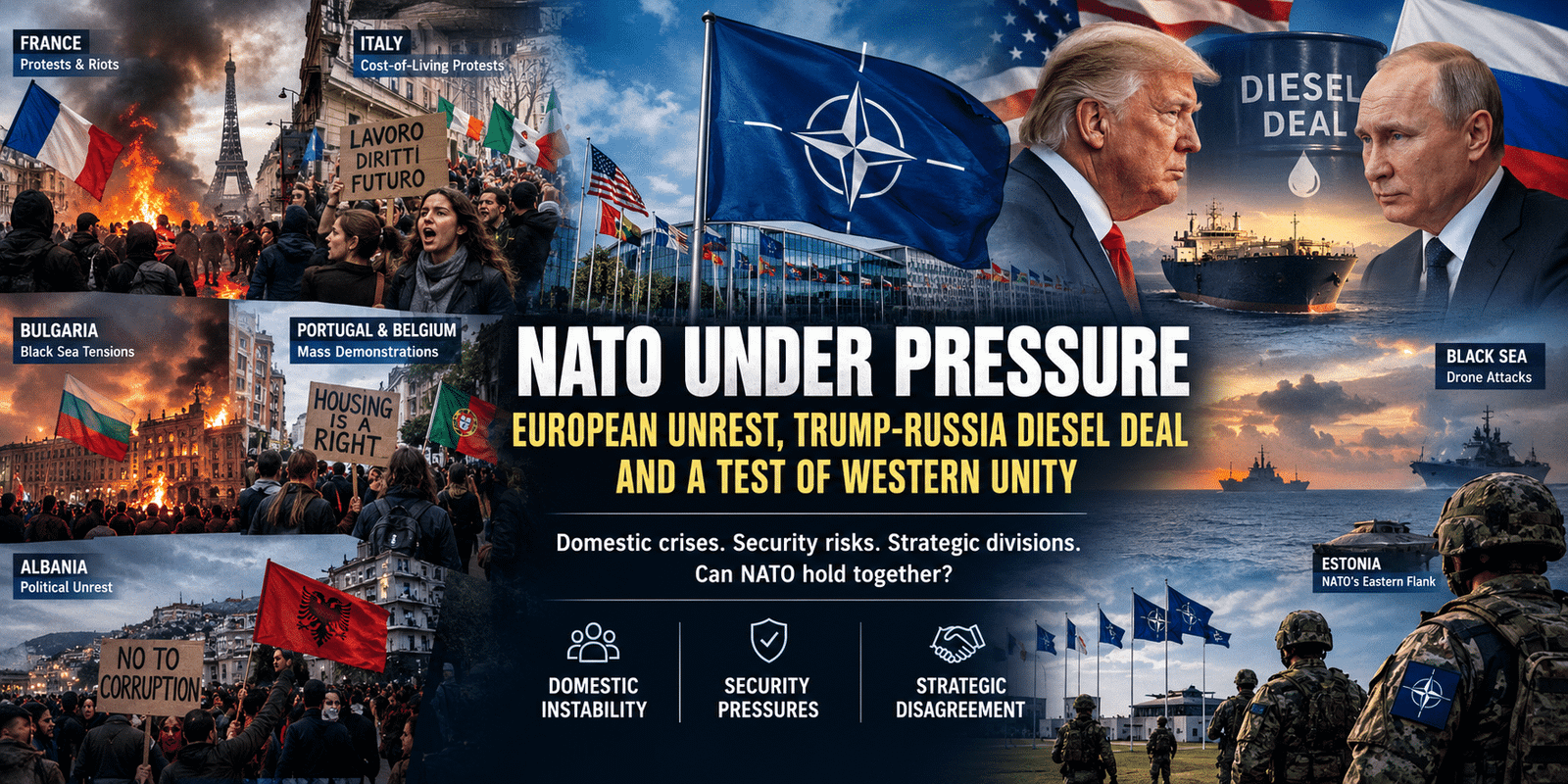
The North Atlantic Treaty Organization (NATO) is confronting a difficult combination of domestic unrest, regional security threats and political disagreements over the war in Ukraine. During the week of 13–20 October 2026, France experienced widespread demonstrations that escalated into rioting, Italy witnessed violent clashes during cost-of-living protests, Bulgaria faced renewed security concerns in the Black Sea, and authorities in several European countries investigated allegations involving NATO-linked procurement contracts. Meanwhile, US President Donald Trump’s reported arrangement with Russia to resume diesel exports has exposed a significant difference between Washington’s energy priorities and European concerns about Moscow’s continuing war against Ukraine.
These developments do not establish that NATO is collapsing. They do, however, illustrate the pressures facing Western governments as they attempt to preserve public confidence at home while maintaining a coherent approach to European security.
The central question is whether NATO’s members can manage their domestic political difficulties and strategic disagreements without allowing them to undermine collective deterrence.
1. France: Violent demonstrations expose a deepening political crisis
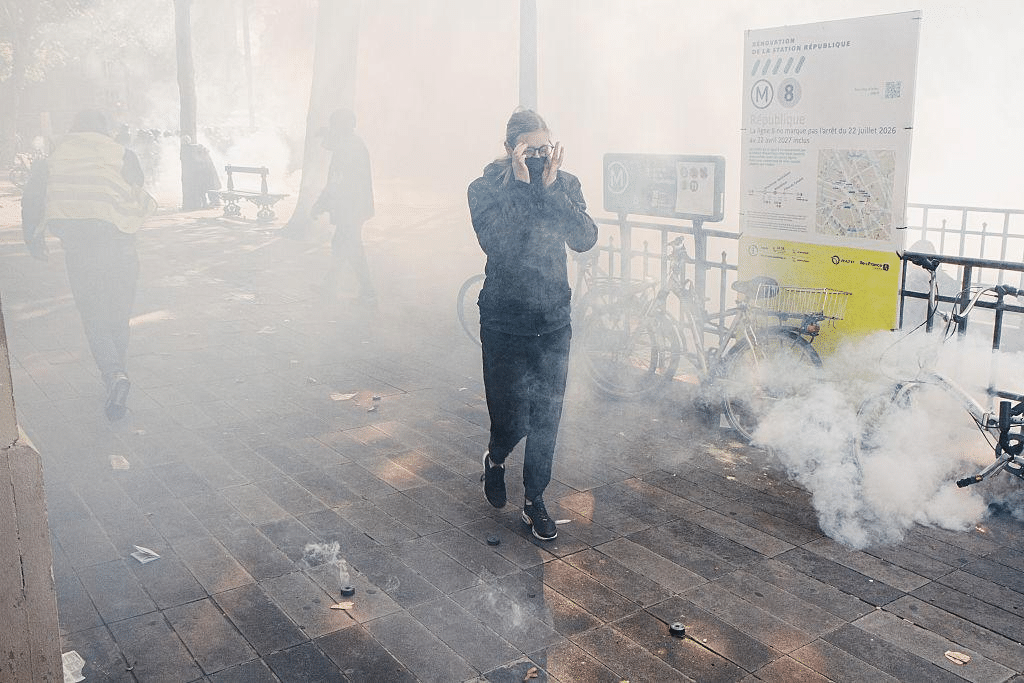
France experienced some of its most serious unrest in years during the weekend of 17–18 October. Demonstrations initially associated with student concerns, education funding, rising living costs and deteriorating public services expanded into a broader expression of dissatisfaction with the government.
Violent Student and Islamic groups clashed with police, while looting and fires caused extensive damage across the country. The government reported that more than 3,000 shops had been looted or damaged and that the town hall in Limoges had been set on fire. Authorities also considered local curfews in response to the disorder.
Associated Press reported that police imposed overnight curfews in two areas of Paris following the violence. The unrest placed President Emmanuel Macron and Prime Minister Sébastien Lecornu under renewed pressure to restore public order while addressing the grievances that had brought demonstrators onto the streets.
The political consequences could extend beyond immediate policing. France faces a divided political environment, fiscal constraints and growing competition between established parties and the far right. Marine Le Pen’s National Rally has sought to use the disorder to argue that the government has lost control of public security.
The protests should not be treated as a single movement with a single motive. Many people participated in peaceful demonstrations over education, public services and living costs, while a smaller number engaged in violence and looting. Distinguishing these groups is essential to understanding the crisis.
For NATO, France’s domestic instability matters because the country is a major military power, a nuclear-armed ally and an important contributor to European defence policy. Prolonged political turmoil could make it more difficult for the French government to build consensus on defence spending, support for Ukraine and the future of European security.
Nevertheless, the unrest does not itself demonstrate a reduction in French military readiness or an interruption of NATO operations.
Sources: Reuters, 19 October 2026; Associated Press, 19 October 2026.
2. Italy: Cost-of-living protests turn violent
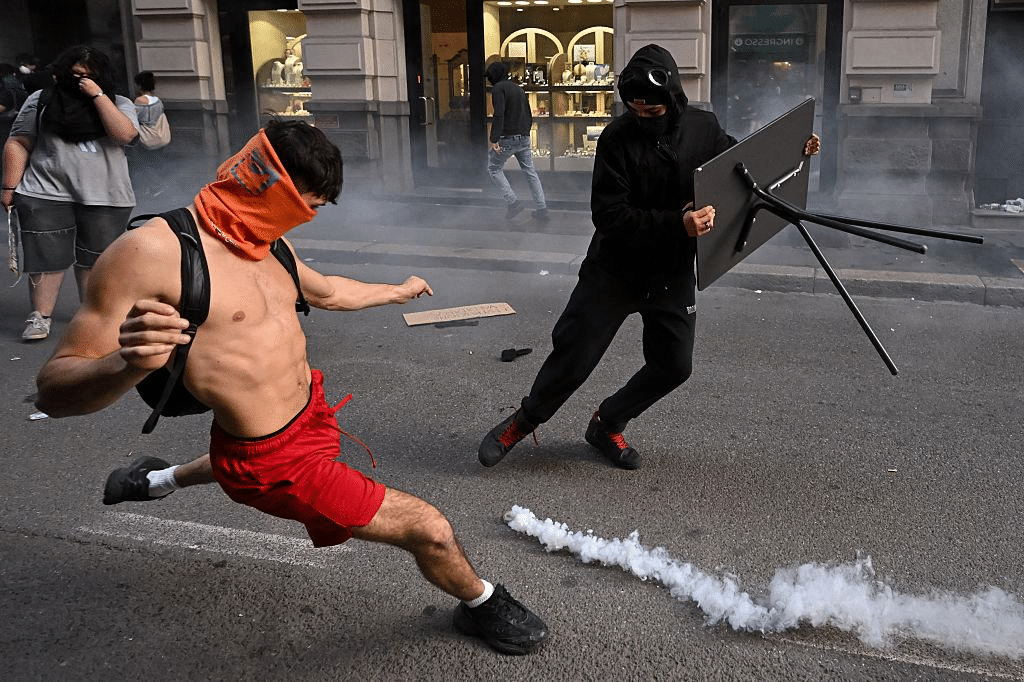
Italy faced another significant test of public order on 17–18 October, when demonstrations against rising living costs and declining public services escalated into clashes in several cities.
Reuters reported that police fired tear gas in Milan after protesters threw stones and other objects during demonstrations near the city’s cathedral. Some shops closed their shutters, the central Duomo metro station was temporarily closed, and injuries and arrests were reported.
In Bologna, police used water cannon to disperse crowds after a demonstration turned violent. Further clashes were reported in Milan on 18 October, when groups of protesters broke shop windows and set rubbish bins on fire. Reuters reported that 28 people had been arrested following clashes in several northern Italian cities on the preceding Saturday.
Prime Minister Giorgia Meloni condemned the violence and convened a government meeting to discuss the response. Her administration faces the difficult task of restoring public order without ignoring the underlying economic grievances.
Italy’s protests reflect broader dissatisfaction over purchasing power, wages, public services and economic opportunity. The disturbances have also increased political pressure on a government approaching another electoral test.
The distinction between peaceful protest and violence remains important. Public dissatisfaction with economic policy is not equivalent to support for rioting, and the conduct of violent individuals should not be used to dismiss the concerns of all demonstrators.
For NATO, Italy’s domestic difficulties are relevant because it is an important contributor to Mediterranean security and alliance operations. Political distraction could complicate debates over defence expenditure, assistance to Ukraine and the allocation of resources to European security. There is, however, no evidence in the reporting cited here that the Italian unrest has disrupted NATO’s military command.
Sources: Reuters, 17 October 2026
3. Belgium and Portugal: Different protests, similar public frustrations
France and Italy were not the only European countries to experience major demonstrations.
On 17 October, cost-of-living protests took place in Belgium and Portugal, alongside demonstrations in France and Italy. The protests reflected distinct national grievances, including economic pressures, public services, housing affordability and dissatisfaction with government policies.
In Portugal, housing costs and access to affordable accommodation remained prominent concerns. In Belgium, demonstrators raised concerns about living costs and government policy, although the scale and nature of the protests varied between locations.
These developments illustrate the breadth of public dissatisfaction across parts of Europe. They do not demonstrate that the protests were centrally organised or that the participating groups shared a common political programme.
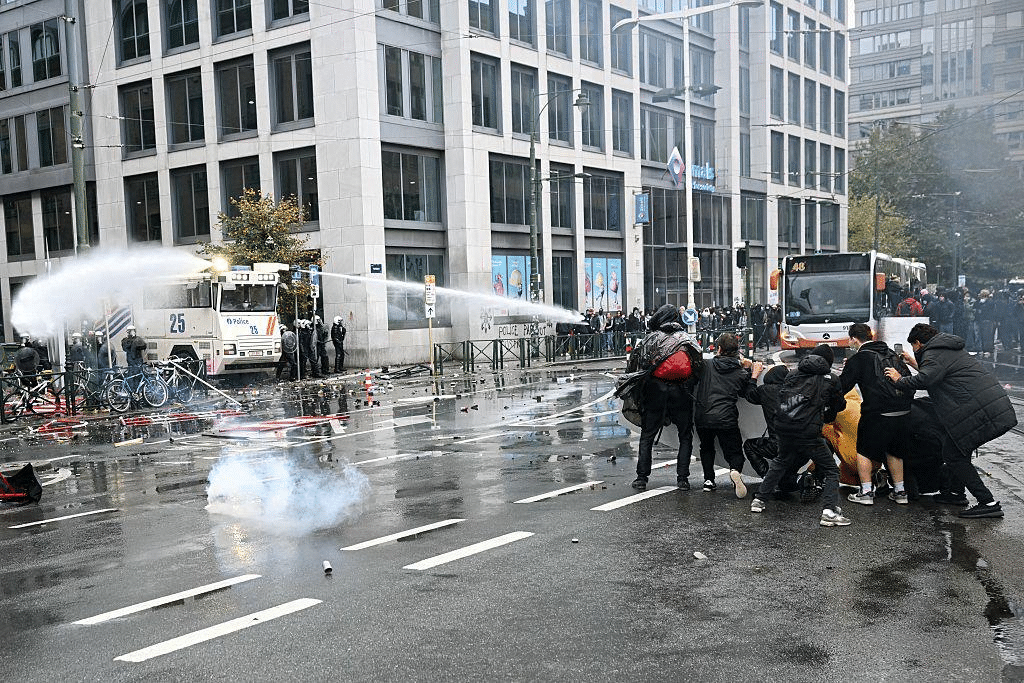
The political challenge is nonetheless significant. Governments facing public demonstrations must respond to economic grievances while maintaining public order and protecting peaceful assembly. Responses that focus exclusively on policing may leave the underlying problems unresolved, while costly economic concessions can create additional pressure on public finances.
Belgium has particular symbolic importance because Brussels hosts both NATO headquarters and the principal institutions of the European Union. However, demonstrations in the city should not be confused with a direct attack on NATO or evidence of a disruption to alliance operations.
Sources:The Guardian, 18 October 2026.
4. Albania: Anti-government unrest and allegations of foreign interference
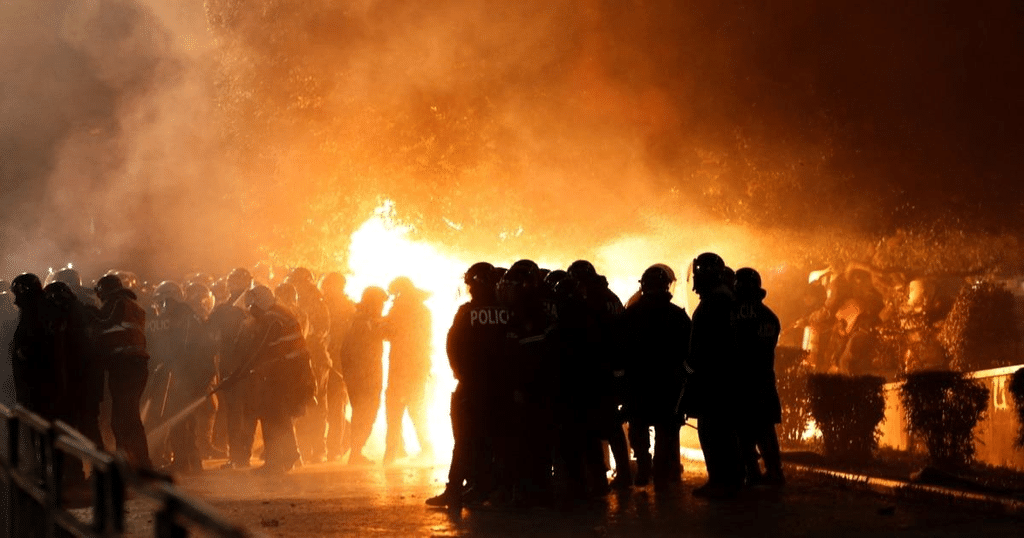
Albania, a NATO member, has also experienced prolonged political demonstrations.
Reporting published on 18–19 October described continuing protests associated with corruption allegations, inadequate public services and opposition to Prime Minister Edi Rama. Demonstrations linked to a proposed seaside development have also generated controversy because the project is associated with Jared Kushner, the son-in-law of US President Donald Trump.
Albanian authorities have alleged that Russia and Iran helped amplify unrest through social media. Those claims should be treated as allegations unless supported by independently established evidence. The existence of demonstrations, online amplification and foreign interference are separate questions that require separate proof.
The situation demonstrates how domestic political grievances can become entangled with international relationships and allegations of outside influence. It also highlights the need to distinguish legitimate political opposition from unlawful violence.
Albania’s unrest does not establish a NATO security emergency. Its significance lies in the political pressures facing another member of the alliance while European governments are already preoccupied with economic uncertainty and the war in Ukraine.
Source: The Guardian, 18 October 2026.
5. Bulgaria and Romania: Black Sea attacks raise security concerns
While domestic unrest has challenged several European governments, the Black Sea has presented a more direct security concern.
On 13 October, two merchant vessels were struck by drones off Bulgaria’s coast. One vessel sank, while another was struck and its crew was rescued. Euronews reported that at least 11 people were missing following the incidents.
Bulgarian authorities sought international assistance and raised concerns about the protection of commercial shipping. Prime Minister Rumen Radev summoned the Russian ambassador after the attacks, while Bulgarian officials pointed to Russia as a possible responsible party. However, responsibility was not conclusively established in the reporting available during the period.
The incidents highlight the growing risks to civilian shipping associated with the war in Ukraine. The Black Sea remains important for commercial trade, energy movements and agricultural exports. Attacks in the area can therefore have consequences extending beyond the immediate conflict.
Romania faces related exposure because of its Black Sea coastline and proximity to Ukraine. Any incident involving a vessel in Romanian territorial waters raises questions about maritime surveillance, emergency response and the protection of civilian infrastructure.
Bulgaria and Romania are NATO members, but an incident near their territory does not automatically trigger Article 5. Any decision would depend on the circumstances, the assessment of the allies and the relevant treaty provisions.
For NATO, the immediate challenge is to strengthen maritime awareness and coordinate responses while avoiding premature attribution of responsibility.
Source: Euronews
6. Norway, Germany and Romania: Investigation into alleged fraud involving NATO-linked contracts
A separate investigation has raised questions about the integrity of military procurement and logistical support.
On 14 October, Eurojust announced a coordinated investigation into suspected bribery and approximately €1 million in fraud involving services supplied to NATO military vessels. Five people were arrested in Norway, while searches were carried out in Germany and Romania.
Investigators were examining allegations that a company and its subcontractors submitted fraudulent invoices for shore-based support services provided to NATO military vessels during port visits in northwestern Europe. The case involved cooperation with the NATO Support and Procurement Agency.
The allegations have not been established as proven criminal conduct. The investigation must be allowed to proceed through the appropriate legal process.
Nevertheless, the case demonstrates why procurement oversight is important. NATO’s effectiveness depends not only on military equipment and personnel but also on reliable logistics, transparent contracting and the proper use of public funds.
The case is not evidence that NATO as a whole is corrupt or that its military operations have been compromised. It is a reminder that the alliance’s support systems require robust monitoring, particularly as governments allocate greater resources to defence.
Source: Eurojust, 14 October 2026.
7. The Trump–Russia diesel deal: Energy prices collide with Western policy toward Moscow
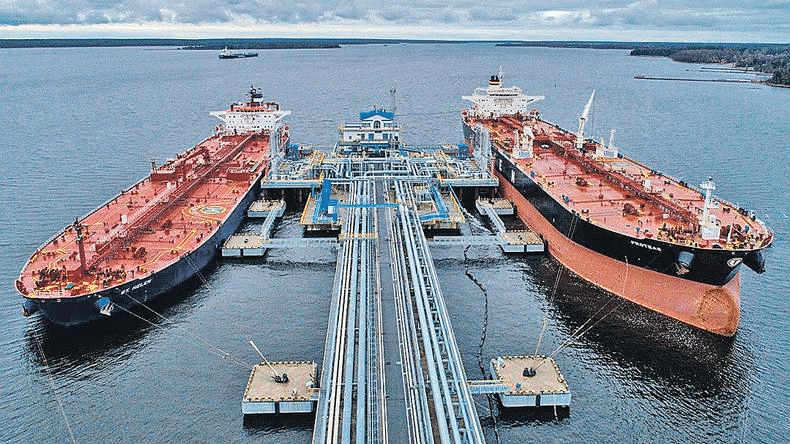
One of the most consequential developments for transatlantic relations has been the reported arrangement between US President Donald Trump and Russia concerning diesel exports.
According to Reuters, Russia partially lifted its diesel export restrictions from 10 October following the arrangement. On 15 October, Kremlin spokesperson Dmitry Peskov said Russian diesel had begun reaching international markets.
Shipping data cited by Reuters indicated that a tanker carrying approximately 40,000 metric tonnes of ultra-low-sulphur diesel had departed Russia’s Baltic port of Primorsk and was heading towards Morocco.
Trump said the arrangement was intended to increase fuel availability and help stabilise global prices. His administration is operating in a politically sensitive period ahead of the US midterm elections scheduled for 3 November, when fuel prices and household economic pressures are important domestic issues.
Trump announced an initial Russian diesel release exceeding 300,000 tonnes, followed by additional volumes of 500,000 tonnes in November and another 1 million tonnes thereafter. These were announced quantities, not proof that every shipment had already been delivered.
The initial volumes are relatively small compared with the scale of the US fuel market. The arrangement should therefore not be portrayed as sufficient by itself to transform global energy prices.
Why the deal has attracted criticism
The arrangement has raised concerns in Ukraine and among some European officials and US lawmakers because Russian energy exports can generate revenue for Moscow while its war against Ukraine continues.
The criticism centres on three issues.
First, the effect on economic pressure against Russia. Additional export revenue could support Russia’s economy, although the precise benefit depends on delivered volumes, prices, transport costs and applicable restrictions.
Second, the consistency of Western policy. European governments seeking to limit Russia’s financial resources must contend with a US administration pursuing an arrangement intended to increase fuel supplies and ease market pressure.
Third, the distinction between energy policy and security policy. Washington may regard additional fuel supplies as an economic measure, while Kyiv and European capitals may assess the same arrangement in the context of the wider war.
The legal and commercial structure matters. The resumption of Russian diesel exports to international markets is not automatically equivalent to authorising every form of direct US import. The scope of the arrangement and its interaction with existing restrictions should be assessed on the basis of the actual measures taken.
Trump’s position also cannot be reduced to a complete abandonment of Ukraine. Reuters reported that the US president maintained that intelligence sharing with Kyiv was continuing, even as his relationship with Ukrainian President Volodymyr Zelenskyy deteriorated.
The strongest conclusion is that the diesel arrangement creates a strategic tension between short-term energy-market objectives and the longer-term objective of limiting Russia’s resources for war.
Source: Reuters, 15 October 2026.
8. Trump and Zelenskyy: A growing divide over the war in Ukraine
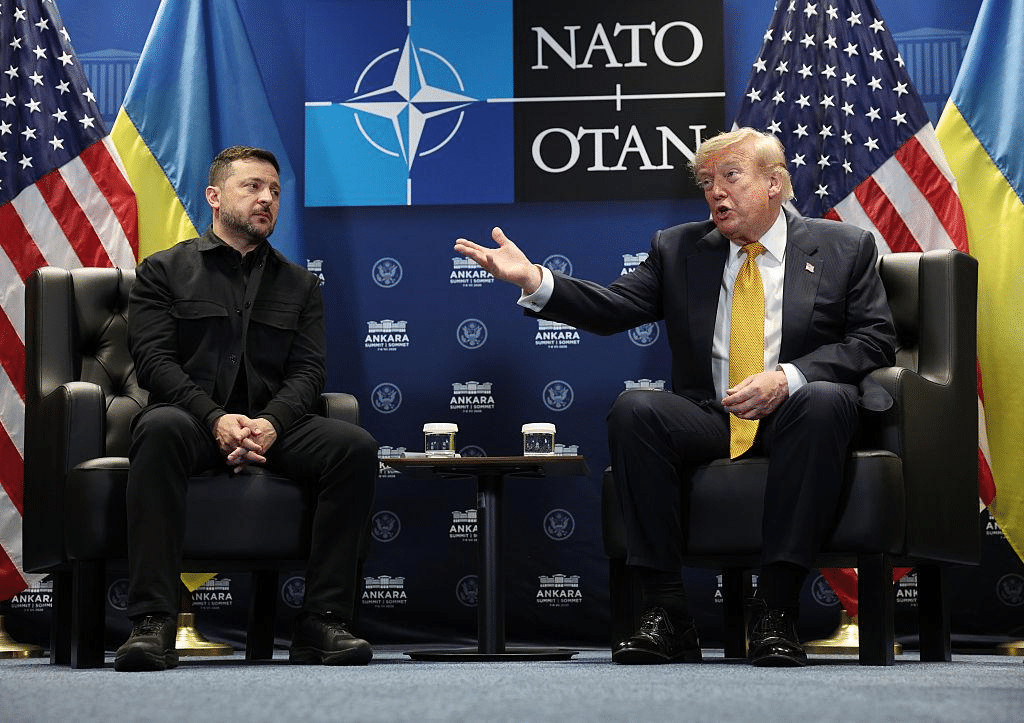
The diesel arrangement forms part of a wider disagreement between Washington and Kyiv.
On 19 October, Reuters reported that Trump’s public criticism of Zelenskyy had intensified the diplomatic rift between the two leaders. European leaders continued to express support for Ukraine, while Russian political figures watched the disagreement for signs of a lasting weakening of Western unity.
The dispute reflects differences over military operations, sanctions, energy policy and the conditions under which negotiations with Russia should proceed.
For Ukraine, continued access to Western assistance remains important to its ability to sustain its defence. For European governments, uncertainty about American policy creates pressure to maintain support for Kyiv while considering how to strengthen their own defence capabilities.
Ukraine is not a NATO member and does not fall under the alliance’s Article 5 collective-defence guarantee. However, the war has direct consequences for NATO’s eastern flank and for the security calculations of members such as Poland, Romania and the Baltic states.
The central risk is that disagreement between Washington and European capitals could make it more difficult to establish a common negotiating position. That would not automatically benefit Russia in every respect, but it could create diplomatic opportunities for Moscow.
At the same time, the available reporting does not establish that NATO has abandoned its support for Ukraine or that all allies have adopted the same position on the diesel arrangement.
Source: Reuters, 19 October 2026.
9. Estonia and NATO’s eastern flank: The alliance continues its deterrence mission
Despite the political disagreements, NATO’s institutional activities have continued.
On 14 October, Secretary General Mark Rutte visited Estonia and met President Ülle Madise, Prime Minister Kristen Michal and other senior officials. He also visited Ämari Air Base and discussed NATO’s continuing role in protecting Estonia.
The official NATO account highlighted allied fighter aircraft, the UK-led Forward Land Forces at Tapa, the First German-Netherlands Corps’ role in the region and the Baltic Sentry mission at sea.
Estonia is particularly sensitive to developments involving Russia because of its geographical position and historical security concerns. The visit demonstrated that NATO continues to maintain its eastern-flank commitments while political disputes elsewhere in the alliance attract attention.
It also provides an important counterpoint to the claim that NATO is simply in disarray. The alliance’s members continue to cooperate on defence planning, air policing and regional deterrence.
The challenge is to preserve that operational cooperation while managing disagreements over Ukraine, energy policy and the division of defence responsibilities.
Source: NATO, 14 October 2026.
10. Is NATO actually in chaos?
The developments of 13–20 October reveal three overlapping sources of pressure.
Domestic instability
France has faced serious rioting, Italy has experienced violent clashes during cost-of-living protests, and Belgium, Portugal and Albania have experienced significant demonstrations or political unrest. These developments show that economic dissatisfaction and public confidence are important challenges for several European governments.
However, the scale, causes and consequences of the protests differ by country. They should not be treated as one coordinated movement or proof that every NATO member is experiencing political breakdown.
Security pressures
The Black Sea incidents illustrate how the war in Ukraine can create risks for commercial shipping and civilian infrastructure near NATO territory. The investigation into alleged fraud involving NATO-linked services also demonstrates the importance of procurement oversight and institutional accountability.
Neither development, by itself, establishes a collapse of alliance readiness.
Strategic disagreement
The most consequential alliance-wide problem is the divergence between Washington and some European governments over Ukraine, Russian energy exports and the conditions for a settlement.
Trump’s diesel arrangement reflects a focus on energy-market stability and domestic economic pressures. European governments must weigh those objectives against concerns about Russia’s financial resources and the security consequences of the war.
This disagreement matters because deterrence depends not only on military capability but also on political credibility and coordination.
The evidence therefore supports describing NATO as under considerable political and strategic pressure. It does not establish that the alliance is disintegrating or that collective defence has ceased to function.
Conclusion: A test of Western unity
The week of 13–20 October 2026 has highlighted a difficult environment for Western governments. France and Italy have faced serious unrest, Belgium and Portugal have experienced major demonstrations, Albania has confronted prolonged political protests, and Bulgaria and Romania remain exposed to security risks associated with the Black Sea.
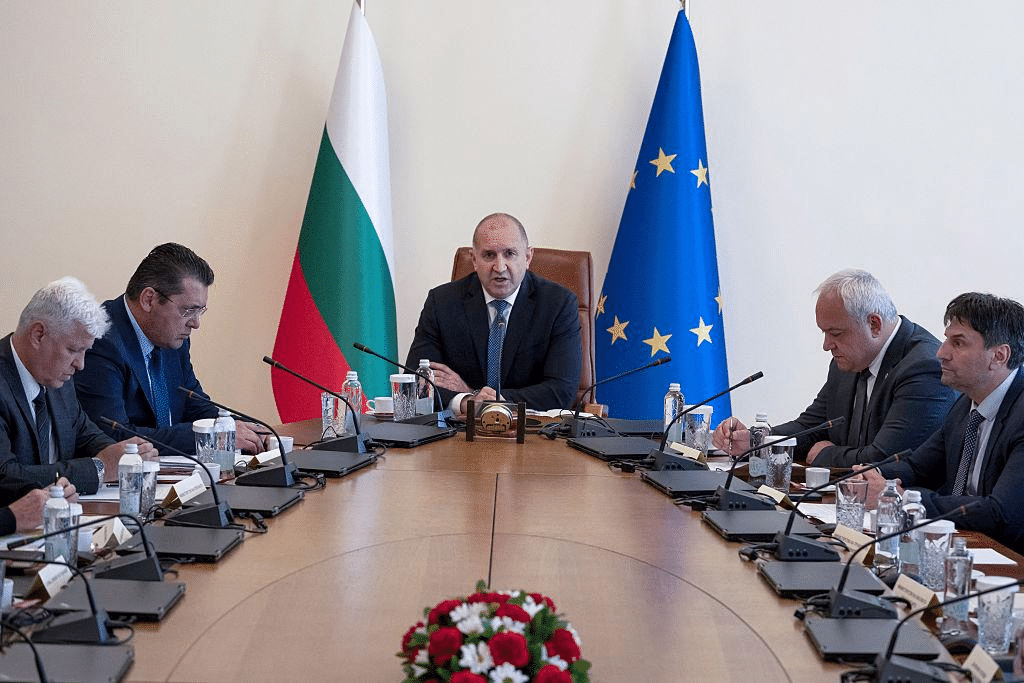
At the same time, the Trump–Russia diesel arrangement has revealed a tension between Washington’s short-term energy priorities and European concerns about Moscow’s continuing war against Ukraine. The growing dispute between Trump and Zelenskyy has added uncertainty to the future of American support for Kyiv.
These developments do not prove that NATO is on the verge of collapse. The alliance continues to operate, its secretary general continues diplomatic engagement, and members continue to cooperate on defence and security.
The deeper concern is whether political divisions, economic pressures and domestic unrest will make it harder for Western governments to maintain a coherent strategy.
For European leaders, the immediate task is to address public grievances without allowing violence to overwhelm democratic institutions. For Washington, it is to demonstrate that energy and diplomatic arrangements with Moscow can coexist with a credible commitment to European security. For NATO, the challenge is to preserve collective deterrence while its members disagree over how to manage the war and its economic consequences.
The decisive question is not whether the West is experiencing difficulties. It is whether its governments can manage those difficulties without allowing separate domestic and foreign-policy disputes to become a lasting strategic division.
NATO is not demonstrably collapsing, but its cohesion is being tested by a convergence of domestic unrest, regional security risks and disagreements over American policy toward Russia. The alliance’s ability to manage these pressures will shape the future of European security.