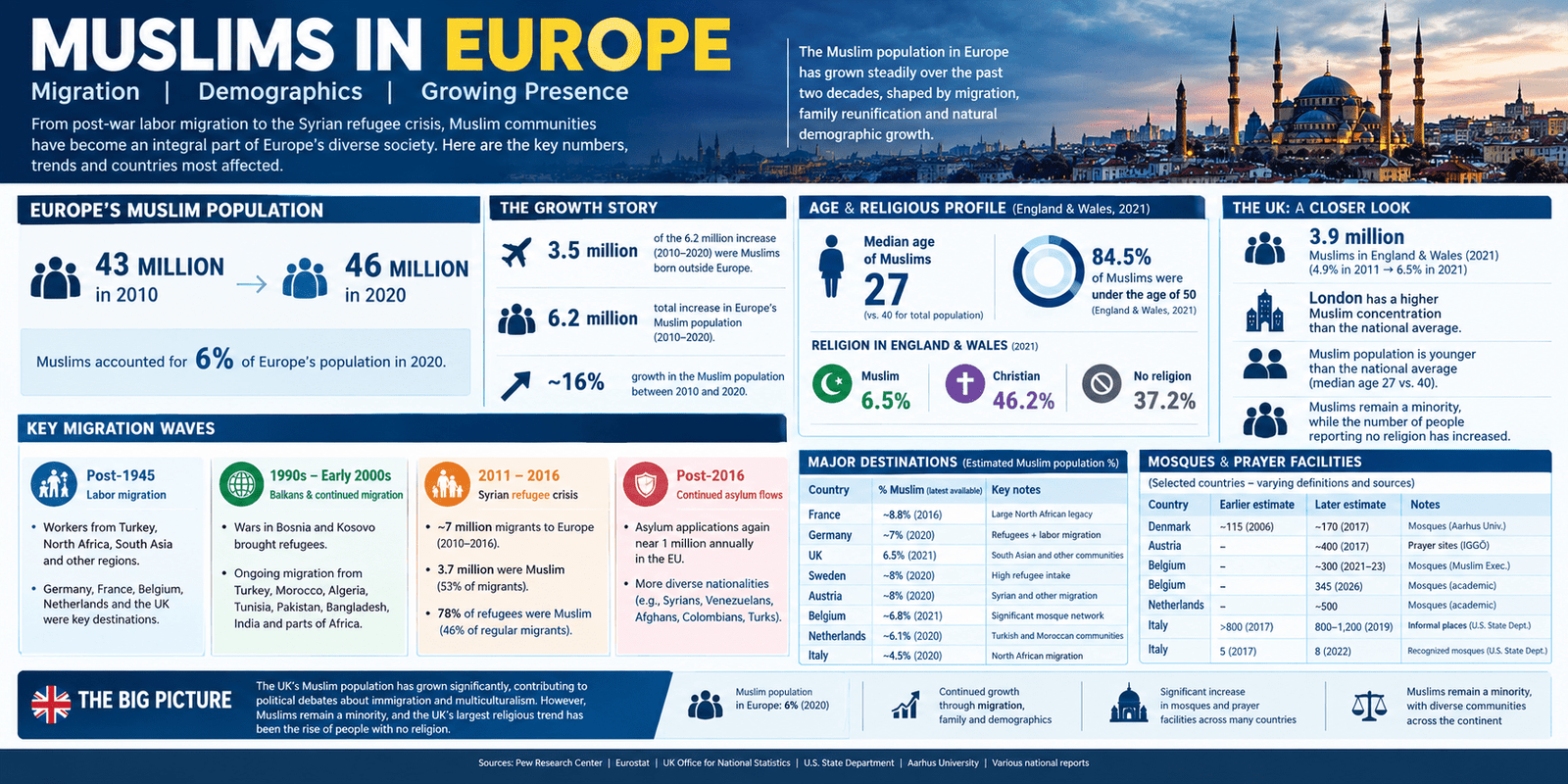
Europe has experienced a substantial increase in its Muslim population over the past several decades. The increase has been driven by several overlapping factors: post-war labor migration, family reunification, migration from former European colonies, asylum and refugee movements, and natural population growth among Muslim communities.
The most dramatic migration episode occurred during the 2014-2016 European refugee crisis, when conflicts in Syria, Iraq and Afghanistan generated exceptionally large asylum flows. More recently, asylum applications have again approached one million annually in the EU, although the composition of migrants is considerably more diverse than during the Syrian refugee crisis.
Pew Research Center estimates that Europe’s Muslim population increased from 43 million in 2010 to about 46 million in 2020, while Muslims represented approximately 6% of Europe’s population in 2020. Pew estimates that about 3.5 million of the 6.2-million increase between 2010 and 2020 consisted of Muslims born outside Europe, demonstrating the importance of migration in the change. (Pew Research Center)
The change is particularly visible in Sweden, Austria and Germany, which received substantial numbers of refugees during the Syrian conflict. Pew estimates that the Muslim share increased by about 4 percentage points in Sweden, 3 points in Austria and 1 point in Germany between 2010 and 2020. (Pew Research Center)
At the same time, it is important not to interpret all European population change as migration-driven. Fertility, age structure and religious switching also affect the numbers. Pew’s earlier demographic work found that even without further migration, Europe’s Muslim population would continue growing because of its comparatively young age structure. (Pew Research Center)
1. A history of Muslim migration to Europe
The Muslim presence in Europe is much older than the recent refugee crisis.
Muslim communities have historical roots in the Balkans, Iberian Peninsula, Cyprus and parts of southeastern Europe. In modern Western Europe, however, the major demographic transformation occurred after the Second World War.
Post-war labor migration
Western European economic expansion during the 1950s and 1960s generated demand for workers. Countries such as Germany, France, Belgium, the Netherlands and Britain recruited or received workers from Turkey, North Africa, South Asia and other regions.
Germany’s Turkish population is an important example. France developed large communities originating from Algeria, Morocco and Tunisia, while Britain received substantial migration from Pakistan and Bangladesh.
Initially, much of this migration was temporary or employment-oriented. Over subsequent decades, family reunification and the birth of children to migrant families transformed temporary migration into permanent communities.
This distinction is important because many Muslims living in Europe today are not recent migrants. They are European-born citizens.
2. The 1990s and early 2000s
The collapse of Yugoslavia generated another important migration wave.
Wars in Bosnia and Kosovo brought large numbers of refugees and migrants to Western European countries. Muslim communities from the Balkans therefore became established in countries including Germany, Austria, Sweden and Switzerland.
At the same time, economic migration continued from:
- Turkey
- Morocco
- Algeria
- Tunisia
- Pakistan
- Bangladesh
- India
- parts of the Middle East
- parts of Africa
By the beginning of the 21st century, Islam was therefore already a significant minority religion in several Western European states.
3. The 2011-2016 transformation
The Arab Spring, Syrian civil war, conflicts in Iraq and Afghanistan and instability in parts of Africa fundamentally changed the migration picture.
Pew’s analysis estimates that about 7 million migrants arrived in Europe between mid-2010 and mid-2016, excluding asylum seekers who were ultimately not expected to receive legal status.
Of those migrants, approximately:
- 3.7 million were estimated to be Muslim
- 3.3 million were non-Muslim
- Muslims therefore represented approximately 53% of migrants during this period.
However, the composition differed sharply between ordinary migration and refugee migration.
Approximately:
- 46% of regular migrants were Muslim
- 78% of refugees receiving or expected to receive refugee status were Muslim
This distinction demonstrates why describing the entire migration phenomenon simply as a “Muslim influx” is statistically misleading. Much of Europe’s Muslim population growth came through ordinary migration, family formation and demographic growth rather than asylum alone.
4. The Syrian refugee crisis
The Syrian civil war became the single most important source of refugee migration into Europe during the middle of the 2010s.
Pew estimated approximately 710,000 Syrian migrants to Europe between mid-2010 and mid-2016, of whom around 670,000 arrived seeking refuge.
Approximately 91% of Syrian migrants were estimated to be Muslim. (Pew Research Center)
Germany became the principal destination for Muslim refugees.
Between mid-2010 and mid-2016, Pew estimated:
| Country | Estimated Muslim migrants, mid-2010 to mid-2016 |
|---|---|
| Germany | ~850,000 |
| United Kingdom | ~690,000 |
| France | >500,000 |
| Italy | ~400,000 |
| Sweden | ~300,000 |
Germany’s figure included approximately 670,000 refugees and 680,000 regular migrants overall, although not all of the latter were Muslim.
Sweden was particularly affected relative to its population size. It received approximately 200,000 refugees during the period, with an estimated 77% Muslim, while another approximately 250,000 regular migrants arrived.
5. What happened after 2016?
The exceptional 2015-2016 migration surge declined substantially.
Eurostat records approximately:
| Year | First-time asylum applications in EU |
|---|---|
| 2015 | 1.217 million |
| 2016 | 1.167 million |
| 2020 | ~417,000 |
| 2022 | ~874,000 |
| 2023 | ~1.049 million |
| 2024 | ~912,000 |
The 2023 figure therefore came close to the 2015-16 peak, before applications fell by approximately 13% in 2024. (European Commission)
The 2024 figure is particularly important because it demonstrates that Europe continues to receive substantial asylum flows even after the Syrian refugee crisis.
But the composition has changed.
In 2024 the largest citizenship groups were:
- Syria: 148,000
- Venezuela: 72,800
- Afghanistan: 72,200
- Colombia: 50,300
- Türkiye: 46,800
Syrians remained the largest group, but almost half of the leading nationalities were from outside the Muslim-majority world. (European Commission)
6. Which European countries are most affected?
The impact is highly uneven.
Germany
Germany has been the most important destination for asylum seekers in the EU in recent years.
In 2024, Germany recorded approximately 229,700 first-time asylum applications, representing 25% of the EU total. It also granted protection status to approximately 150,500 people, around 34% of the EU total. (European Commission)
Pew estimated Germany’s Muslim population at approximately 5 million, or 6.1%, in 2016. Its 2020 estimate put the Muslim share at approximately 7%.
France
France has one of Europe’s largest Muslim populations, reflecting decades of migration from North Africa.
Pew estimated approximately 5.7 million Muslims in France in 2016, or about 8.8% of the population.
France’s Muslim population is therefore the product of several generations of migration, rather than primarily the Syrian refugee crisis.
United Kingdom
Britain’s Muslim population also has deep roots in earlier migration from South Asia, particularly Pakistan and Bangladesh.
The UK was one of Europe’s leading destinations for regular Muslim migration rather than refugee migration during 2010-2016. Pew estimated approximately 690,000 Muslim migrants arrived during that period. (Pew Research Center)
The 2021 UK Census subsequently provided substantially more direct information about religious affiliation than is available in many continental European countries.
Sweden
Sweden experienced one of Europe’s largest demographic effects from the Syrian refugee crisis.
Pew estimates that Muslims represented approximately 8% of Sweden’s population in 2020, compared with roughly 4% in 2010.
Austria
Austria also experienced significant growth connected to migration from Syria and other predominantly Muslim countries. Pew estimates that the Muslim share increased by approximately 3 percentage points between 2010 and 2020. (Pew Research Center)
Italy
Italy has received large numbers of migrants across the Mediterranean, particularly from North Africa.
However, its institutional Muslim presence differs from France or Germany because Italy historically has had relatively few formally recognized mosques and many informal prayer facilities.
7. Europe’s Muslim population: 2010 versus 2020
Pew’s latest comprehensive global religious estimates provide an important benchmark.
| Indicator | 2010 | 2020 |
|---|---|---|
| Muslims in Europe | ~40 million | ~46 million |
| Muslim share | ~5% | ~6% |
| Increase | — | ~16% |
| Muslims born outside Europe contributing to growth | — | ~3.5 million |
| Syrian-born Muslim increase | — | nearly 1 million |
Pew’s 2025 study estimates that Europe’s Muslim population increased by approximately 6.2 million during the decade, with around 3.5 million of the increase consisting of Muslims born outside Europe.
The remainder was largely associated with natural demographic change and the younger age structure of European Muslim populations.
8. Muslims remain a minority in Europe
This point is important for an accurate investigative report.
Despite substantial growth, Muslims remain a minority population across Europe as a whole.
Pew’s latest estimate places Muslims at approximately 6% of Europe’s population in 2020. (Pew Research Center)
The situation varies considerably by country.
France is estimated at approximately 9% Muslim, while Sweden, Germany and several other countries have lower shares.
Some European countries have historically large Muslim populations. Cyprus is an unusual case because its Muslim population includes the long-established Turkish Cypriot population and therefore cannot be treated simply as a recent migration phenomenon.
9. The growth of mosques and Islamic prayer facilities
The number of mosques is more difficult to measure than the number of Muslims.
There is no single European Union database counting every mosque.
The terminology also matters.
A country may distinguish between:
- purpose-built mosques;
- formally registered mosques;
- Islamic cultural centers;
- converted churches or commercial buildings;
- prayer rooms;
- informal Muslim places of worship.
Consequently, comparing “mosques” across countries can produce misleading results unless the definition is specified.
Nevertheless, available national research demonstrates considerable institutional expansion.
Denmark
A particularly useful long-term academic study comes from Aarhus University.
Researchers estimated that Denmark had approximately:
- 115 mosques in 2006
- approximately 170 by 2017
That represents an increase of approximately 48%. The same research estimated the Muslim population increased from approximately 200,000 to 300,000 during the period. (Open Books)
This is one of the strongest examples of a comparable 10-year mosque trend.
Austria
Research published in the Yearbook of Muslims in Europe reports an estimate from the Islamic Religious Community in Austria of approximately 400 Muslim prayer sites in 2017.
Importantly, this figure included prayer facilities and excluded some Alevi and other Muslim facilities, illustrating why “mosque” statistics must be treated carefully. (ResearchGate)
Belgium
Belgium provides another example of the difference between recognized and total facilities.
The U.S. State Department reported:
- 87 recognized mosques in 2021
- approximately 300 total mosques, according to the Belgian Muslim Executive. (State Department)
By 2023, the number of recognized mosques had risen to 91, while the Belgian Muslim Executive continued to estimate approximately 300 mosques overall. (State Department)
A 2026 academic study subsequently mapped 345 mosques in Belgium, illustrating how methodology and definitions can produce different totals. (ScienceDirect)
Italy
Italy demonstrates the opposite problem.
In 2017, the U.S. State Department reported only five officially recognized mosques, while there were more than 800 unofficial Muslim places of worship.
By 2022, eight mosques were recognized, while an estimated 800-1,200 unofficial Muslim places of worship remained. (State Department)
A 2021 academic dataset estimated approximately 820 Islamic places of worship, but only six were classified as mosques in the strict architectural sense. (MDPI)
Netherlands
Academic research has estimated approximately 500 mosques in the Netherlands, serving a Muslim population estimated at around 800,000. (Vrije Universiteit Amsterdam)
Denmark today
The Danish government’s official information portal states that Denmark has more than 100 mosques, while earlier academic mapping counted approximately 170 Muslim prayer sites depending on the definition used. (Denmark)
10. Mosque comparison
Because methodologies differ, the following table should be presented as reported estimates rather than a single standardized European dataset.
| Country | Earlier estimate | Later estimate | Approx. change | Source/qualification |
|---|---|---|---|---|
| Denmark | ~115, 2006 | ~170, 2017 | +48% | Aarhus University |
| Belgium | — | ~300, 2021-23 | — | Muslim Executive estimate |
| Belgium | — | 345, 2026 | — | Academic mosque mapping |
| Austria | — | ~400, 2017 | — | IGGÖ estimate; prayer sites |
| Netherlands | — | ~500 | — | Academic estimate |
| Italy | >800 informal, 2017 | 800-1,200 informal, 2019 | — | U.S. State Department |
| Italy | 5 recognized, 2017 | 8 recognized, 2022 | +60% | U.S. State Department |
11. What the statistics actually show
Several conclusions emerge from the available evidence.
First, Muslim migration to Europe is not a new phenomenon
The present Muslim population is the result of several generations of migration and demographic development, beginning well before the Syrian refugee crisis.
Second, 2014-2016 was exceptional
The Syrian conflict produced a historically unusual refugee movement.
Pew estimated that approximately 1.2 million refugees entered Europe between the beginning of 2014 and mid-2016, compared with approximately 400,000 during the preceding three-and-a-half years. Approximately 78% of refugees who received or were expected to receive refugee status during the wider 2010-2016 period were estimated to be Muslim. (Pew Research Center)
Third, migration is only part of the demographic story
Between 2010 and 2020, approximately 3.5 million Muslims born outside Europe contributed to Europe’s Muslim population growth, but the total increase was approximately 6.2 million. (Pew Research Center)
Consequently, births and age structure were also major factors.
Fourth, the impact is geographically concentrated
Germany, France, the UK, Sweden, Austria, Belgium, the Netherlands and Italy have particularly significant Muslim communities, but for very different historical reasons.
Fifth, current asylum flows are not synonymous with Muslim migration
In 2024, Syrians were the largest asylum-seeker nationality, followed by Venezuelans and Afghans. Colombia, Türkiye and other countries also contributed substantial numbers. (European Commission)
Therefore, it would be inaccurate to classify all current asylum migration as Muslim.
12. The UK Casestudy
The United Kingdom represents one of Europe’s most significant cases of long-term Muslim demographic growth, helping explain why Donald Trump and Benjamin Netanyahu have used the phrase “Islamic state” or similar language when discussing Britain’s changing society and politics.
The demographic shift is substantial: according to the UK Office for National Statistics, the Muslim population of England and Wales increased from 2.7 million (4.9%) in 2011 to 3.9 million (6.5%) in 2021, an increase of around 1.2 million people, or 44%, in a decade. The longer-term change is even more pronounced: Muslims represented about 1.5 million people, or 3%, in 2001, meaning the population more than doubled over two decades. The Muslim population is also considerably younger than the population as a whole, with a median age of 27 in 2021, compared with 40 for the overall population, and 84.5% of Muslims were under the age of 50.
London is at the centre of this transformation, with a particularly diverse population and a much larger Muslim presence than many other parts of Britain. Trump has repeatedly highlighted London’s demographic and cultural transformation, while Netanyahu recently referred to Britain in terms of an “Islamic republic” with nuclear weapons. The statistics, however, describe a rapidly growing Muslim minority rather than a Muslim majority: Muslims accounted for 6.5% of England and Wales in the latest census, while 46.2% identified as Christian and 37.2% reported no religion.
Britain’s case is therefore significant not because Muslims constitute the majority, but because the combination of immigration, younger demographics, higher population growth in some communities and concentration in major cities has made Islam an increasingly visible component of British society and politics.
13. The demographic outlook
Pew’s earlier projection model provides useful context, although its 2050 figures should not be presented as forecasts.
Using 2016 as the starting point, Pew modeled three scenarios:
| Scenario | Muslim share of Europe by 2050 |
|---|---|
| Zero future migration | 7.4% |
| Medium migration | 11.2% |
| High migration | 14.0% |
Under the zero-migration scenario, Europe’s Muslim population would still increase because of age structure and fertility.
Under the medium scenario, which assumed continued regular migration but no further refugee surge, the Muslim population was projected to reach approximately 58 million.
Under the high-migration scenario, it could exceed 75 million.
These are scenarios, not predictions, and actual migration patterns have already differed from the assumptions used in 2017. They should therefore be used to illustrate demographic sensitivity rather than to claim that Europe will necessarily reach a particular Muslim population in 2050.
14. Countries experiencing the greatest demographic impact
The evidence points to several distinct groups.
Germany: strongest impact from the 2015-16 refugee crisis and continued high asylum applications.
Sweden: one of the largest demographic effects relative to population size.
Austria: significant refugee intake and corresponding increase in the Muslim population.
France: very large established Muslim population, primarily resulting from decades of North African migration rather than recent refugee migration.
United Kingdom: large established South Asian Muslim population and substantial regular migration.
Belgium: relatively small country with a comparatively significant Muslim population and extensive mosque network.
Netherlands: substantial Turkish and Moroccan communities alongside newer migration.
Italy: significant migration from North Africa and other regions, but a much larger informal than formally recognized mosque network.
Conclusion
Europe’s Muslim population has expanded substantially over the past several decades, but the change is best understood as a long-term demographic process rather than a single “influx.”
The post-war labor migrations created the first large Muslim communities in Western Europe. Family reunification and European-born generations subsequently consolidated those communities. The wars in the Balkans added another wave, while the Syrian conflict and instability in Iraq and Afghanistan produced the exceptional refugee movement of 2014-2016.
The most recent evidence shows that the trend has continued, although asylum flows have fluctuated considerably. The EU recorded 912,415 first-time asylum applications in 2024, down from 1.05 million in 2023 and far below the 1.2-million peak reached during the 2015-2016 crisis. (European Commission)
Pew’s latest comprehensive religious estimates place Europe’s Muslim population at approximately 46 million in 2020, or around 6% of the continent’s population. Migration accounted for a substantial portion of the increase, while natural demographic growth accounted for the remainder. (Pew Research Center)
The expansion of mosques and Islamic prayer facilities is also real, but the available evidence is fragmented. Denmark’s academic mosque mapping, for example, documented a rise from roughly 115 facilities in 2006 to 170 by 2017, while Belgium had around 300 estimated mosques compared with 91 officially recognized facilities in 2023. Italy illustrates the opposite situation, with only a handful of formally recognized mosques but hundreds of informal prayer facilities. (Open Books)
The broader demographic picture is therefore more complex than either the claim that Europe is undergoing an unlimited Muslim “takeover” or the claim that migration has had little demographic effect. The data clearly demonstrate substantial Muslim population growth and significant migration-driven change in particular countries, while also showing that Muslims remain a minority of Europe’s overall population.