Diplomatic travel is never just travel. Where a head of state goes, how often, and in whose company reveals more about a country’s priorities than almost any speech. Xi Jinping’s itinerary since taking power in 2012 – more than 55 trips to over 70 countries – is a map of Beijing’s ambitions: a durable partnership with Russia, a firm grip on Central Asia, a long courtship of the “Global South,” and an increasingly assertive footprint in regions the United States once treated as its own backyard.
The Pattern: Who Gets the Most Visits, and Why
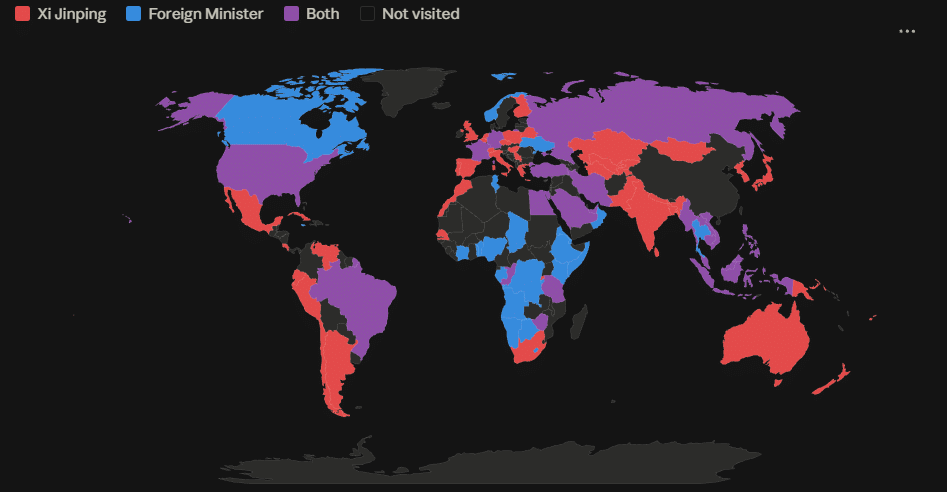
The frequency of Xi’s visits is itself a signal. He has now visited Russia eleven times – more than any other country by a wide margin – including a high-profile appearance at Moscow’s 2025 Victory Day parade even as the war in Ukraine ground on. This is not sentimentality; it reflects a “no-limits” partnership built on cheap Russian energy, a shared interest in weakening US-led alliances, and coordinated pushback against Western sanctions regimes. Every Xi-Putin meeting reinforces a message to Washington and Brussels: isolating Russia has not isolated it from China.
Kazakhstan comes second, with six visits – a reflection of Central Asia’s role as the literal starting point of the Belt and Road Initiative (Xi first unveiled the BRI concept in Astana in 2013) and as the overland energy and trade corridor that lets China reduce its reliance on sea lanes patrolled by the US Navy. Xi’s repeat trips to Uzbekistan, Tajikistan, and Kyrgyzstan follow the same logic: securing a stable, China-oriented periphery on its western border, partly to counterbalance Russian influence in a region Moscow has traditionally considered its own sphere.
The United States (five visits) and France, Vietnam, and South Africa (four each) point to a second priority: managing great-power relationships and international institutions. Visits to Vietnam are about controlling tension over the South China Sea and keeping a fast-growing neighbor inside China’s economic orbit rather than America’s. Visits to France are part of a long-running effort to court the EU’s most independent-minded member and drive wedges into transatlantic unity. Visits to South Africa are almost always tied to BRICS summits – the grouping China has used to position itself as leader of a “Global South” bloc that rejects a US-centered world order.
Where the Emphasis Truly Lies: The Global South Strategy
Strip away the headline-grabbing US and Russia visits, and a clear pattern emerges: China’s outbound diplomacy under Xi is disproportionately aimed at Africa, Latin America, and Southeast Asia – the developing world where Beijing believes it can build durable political capital, resource security, and market access that the West has neglected.
This is even more visible in the travel pattern of China’s Foreign Minister (Wang Yi, with a brief interruption under Qin Gang in 2022–23). Every January for 36 consecutive years, the very first overseas trip a Chinese foreign minister makes has gone to Africa – a tradition maintained through COVID, through leadership changes, and through economic slowdowns at home. It is one of the most consistent rituals in modern diplomacy, and it exists purely to send a message: Africa is not an afterthought for China, it is the starting point.
Latin America: China’s Expanding Foothold in “America’s Backyard”
Xi has visited Latin America repeatedly – Brazil four times, Peru and Argentina multiple times each – and the substance behind those visits has accelerated sharply in the past two years.
The investment picture. China’s infrastructure commitments in Latin America and the Caribbean are estimated at roughly $286 billion, spanning subway lines in Bogotá and Mexico City, dams in Ecuador, and lithium and copper extraction across Argentina, Chile, and Peru. The most emblematic project is Peru’s Chancay megaport, which Xi personally inaugurated in November 2024. Built and operated by China’s state-owned COSCO Shipping under a lease that can run up to 60 years, the roughly $3.5 billion port gives China a Pacific-facing gateway to South America that bypasses the US-influenced Panama Canal entirely, cutting shipping times to Asia by 10–20 days. More than 20 Latin American and Caribbean countries have now joined the Belt and Road Initiative, with Colombia the most recent addition in 2025.
The diplomatic price of entry. A recurring feature of China’s expansion in the region has been a wave of countries switching official diplomatic recognition from Taiwan to Beijing – Costa Rica in 2007, then Panama, the Dominican Republic, and El Salvador in 2017–18, Nicaragua in 2021, and Honduras in 2023. Each switch has come bundled with promises of loans, infrastructure, and market access, and each has further isolated Taiwan internationally, leaving it with formal ties to only a handful of mostly small states worldwide.
The friction points. Latin American governments have welcomed Chinese capital, but concerns are mounting on several fronts:
- Sovereignty and control: long-term leases and majority stakes (like COSCO’s 60% ownership of Chancay) raise questions about who ultimately controls strategically vital infrastructure.
- Debt quality and transparency: BRI loans are frequently criticized for opaque terms and for leaving recipient countries carrying the risk if projects underperform.
- Trade imbalance: much of the relationship still runs on China buying raw commodities (lithium, copper, soybeans, oil, iron ore) and selling back manufactured goods – a pattern critics say entrenches Latin America as a resource supplier rather than helping it industrialize.
- US pushback: Washington has grown increasingly vocal that Chinese-operated ports and telecom infrastructure (Huawei, ZTE 5G rollouts) in its own hemisphere pose long-term security risks, though this has so far done little to slow the trend.
Africa: The Largest, Longest-Running Relationship – and the Most Contested
Africa is the clearest expression of China’s “Global South” strategy, and it shows in the numbers. China is Africa’s largest trading partner, with bilateral trade reaching $167.8 billion in just the first half of 2024 alone. At the 2024 Forum on China-Africa Cooperation (FOCAC) summit in Beijing – attended by 51 African heads of state – Xi pledged roughly $50–51 billion in loans, investment, and aid over three years, elevated diplomatic relations with every African country that recognizes Beijing to “strategic” status, and promised zero-tariff access for goods from the continent’s least-developed nations.
Notably, this pledge was smaller than the $60 billion promised in 2018, and for the first time it was denominated in Chinese yuan rather than dollars – part of a broader push to internationalize the renminbi and reduce African economies’ exposure to US dollar swings. The stated focus has also shifted: away from the giant railway-and-stadium infrastructure deals of the 2010s and toward “small and beautiful” projects in green energy, electric vehicles, and digital infrastructure.
The issues African countries have raised or faced:
- Debt sustainability: China is Africa’s largest bilateral creditor. Zambia became the first African country to default on its debt during the pandemic, owing roughly $6 billion to Chinese entities; it later cancelled billions in undisbursed Chinese loans and halted several partly Chinese-funded projects as part of an IMF-backed restructuring.
- The “debt-trap” debate: Western officials and commentators have long argued China deliberately extends financing that recipient countries cannot realistically repay, then extracts strategic assets when they default – Sri Lanka’s 99-year lease of Hambantota Port to a Chinese state firm (after failing to service the underlying loan) is the most-cited example, even though it sits outside Africa and researchers disagree on how much of Sri Lanka’s crisis was actually caused by Chinese debt versus its far larger stock of international bond debt. China’s government rejects the “debt-trap” framing outright, calling it a myth manufactured by Western media and rival governments, and points out that Chinese lenders have written off or restructured billions in African debt in recent years.
- Trade deficits: many African governments want China to buy more of their finished and processed goods, not just raw materials – a 2018 pledge to import $300 billion in African goods was quietly dropped from the 2024 summit’s language.
- Labor and local benefit concerns: African labor groups and researchers have periodically raised complaints about working conditions on Chinese-run projects and the low proportion of skilled jobs going to local workers, prompting Beijing’s repeated (and so far only partly fulfilled) pledges to create “at least one million jobs” locally.
- Declining lending, rising collection: China has sharply cut new lending to developing countries in the past several years and is now, by some assessments, collecting more in debt repayments from poor countries than it disburses in new loans – a shift analysts say could squeeze government budgets in some of the same countries China spent the 2010s courting.
Illegal Fishing: The Hidden Cost of China’s Ocean Footprint
Beyond loans and infrastructure, one of the most persistent complaints against China involves its distant-water fishing fleet – by far the largest in the world, with estimates running to around 17,000 vessels, many of them state-subsidized.
An investigation by Ij-Reportika (Investigative Journalism Reportika) found that six West African nations – The Gambia, Guinea, Guinea-Bissau, Mauritania, Senegal, and Sierra Leone – together account for roughly 20% of all illegally caught fish worldwide, with Chinese trawlers identified as the dominant offenders in the region. The report documented the practice known as “saiko,” an illegal at-sea transshipment scheme in which small fish are transferred from industrial trawlers to local canoes to evade catch limits; a related 2017 investigation found saiko fishing alone removed roughly 100,000 tons of fish from Ghana’s waters in a single year. The report also found that overfishing has cut average income for artisanal fishing communities in Ghana by as much as 40% over 15 years, and noted that in Somalia, fishing access agreements signed with Beijing have often been negotiated with little input from the local fishing communities who depend on those waters to survive.
This pattern is not confined to West Africa. Separate research by the UK-based Environmental Justice Foundation found the Chinese fleet responsible for widespread illegal fishing and labor abuse in the Southwest Indian Ocean off East Africa – including routine shark-finning, the deliberate injury of protected marine species, and physical abuse of crew members – and similar controversies have flared for years around the exclusive economic zones of Ecuador (near the Galápagos Islands) and Argentina in Latin America. US government assessments, including from NOAA, have separately identified Chinese vessels as responsible for a disproportionate share of illegal, unreported, and unregulated (IUU) fishing worldwide, alongside findings of forced labor aboard some vessels. China’s foreign ministry has consistently rejected these characterizations, arguing that the illegal conduct of individual vessels should not be attributed to the Chinese state and describing some Western findings as politically motivated.
For coastal states already balancing the benefits of Chinese loans and infrastructure against concerns about debt and sovereignty, illegal fishing adds a third grievance: the depletion of a resource – fish stocks – that many of the same communities receiving Chinese investment depend on for food security and livelihoods.
The Other Side of the Argument
It’s worth noting that China and many of its partner governments push back hard on the “predatory lender” narrative that dominates Western coverage. Beijing’s position – echoed by many African and Latin American leaders – is that China offers financing with fewer political strings attached than Western or IMF lending, has built roads, ports, and power plants that Western donors were unwilling to fund for decades, and has itself absorbed real financial losses restructuring bad loans in Zambia, Sri Lanka, and elsewhere. Proponents of the relationship argue that framing every large infrastructure project as a “trap” ignores genuine demand from developing-world governments for capital that the US and its allies have largely failed to supply on comparable terms.
The Bigger Picture
Taken together, the travel map tells a consistent story: China under Xi treats personal diplomacy as an instrument of state strategy, not a courtesy. Repeated visits to Russia and Central Asia lock in energy security and a friendly periphery. Repeated visits to Vietnam, South Korea, and Southeast Asia manage a volatile, economically vital neighborhood. And the steady drumbeat of engagement with Africa and Latin America – reinforced every single January by the Foreign Minister’s Africa-first ritual – builds the coalition of developing nations China needs to reshape global institutions in its favor, even as it opens Beijing to real and recurring criticism over debt, transparency, and whether the relationship is as “win-win” as it claims to be.