Introduction: The threat beyond an invasion
The possibility of a conflict over Taiwan is frequently discussed in terms of a Chinese amphibious invasion. Yet an invasion is not the only way Beijing could attempt to compel Taiwan to accept its political demands. A blockade, a selective restriction of maritime and air traffic, or a law enforcement operation designed to control access to the island could create a serious crisis without an immediate attempt to occupy Taiwanese territory.
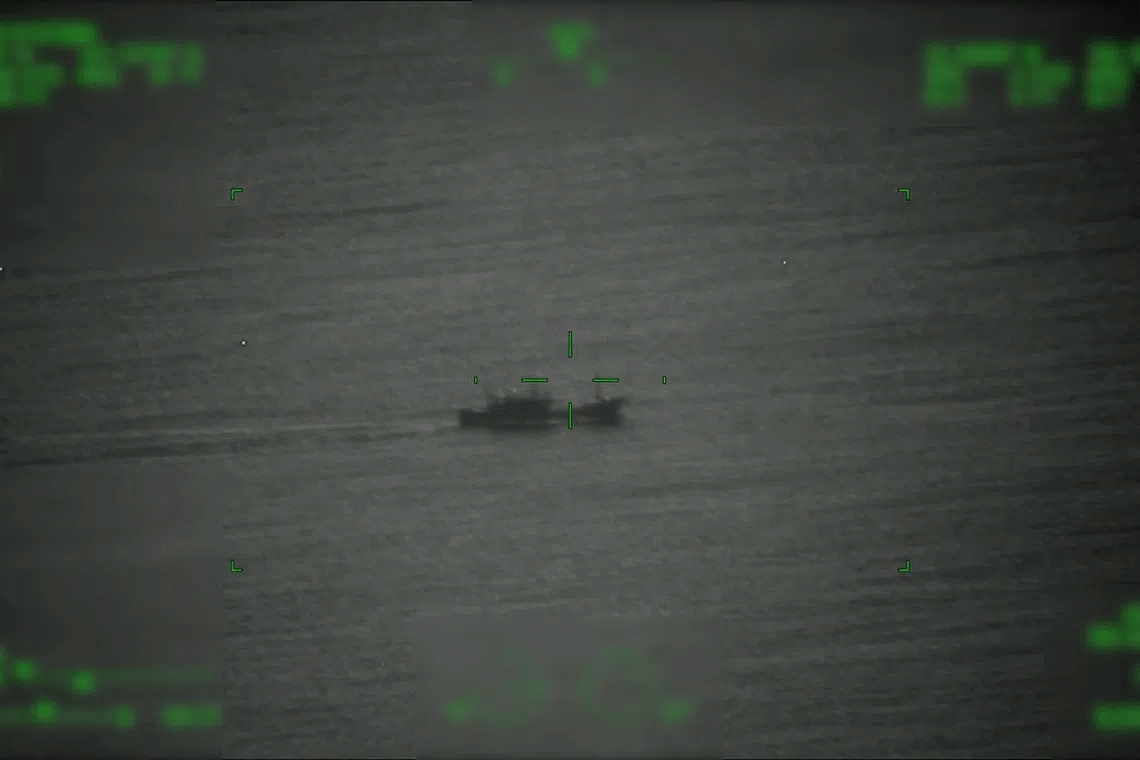
Developments reported in October 2026 have renewed questions about this possibility. Reuters reported on 8 October that a Chinese maritime militia vessel had been observed operating alongside a China Coast Guard cutter and a research vessel off Taiwan’s Pacific coast in August. The report described this as the first known sighting of such a vessel in that sensitive area. Reuters subsequently reported on 10 October that the United States had criticised Chinese maritime activity off Taiwan as deeply destabilising.
These reports do not establish that China has decided to impose a blockade. Nor does the presence of Chinese vessels off Taiwan, by itself, prove that a blockade operation is underway. They do, however, raise a legitimate strategic question: could Beijing be improving its ability to pressure, monitor, and potentially restrict Taiwan’s access to international shipping and air traffic through a combination of military and ostensibly civilian operations?
The distinction matters. A military invasion would represent a direct attempt to seize territory. A maritime quarantine or blockade could instead seek to impose controls, interrupt selected shipments, increase commercial risks, or demonstrate that Beijing can interfere with Taiwan’s external connections.
Research published by the Center for Strategic and International Studies (CSIS) has examined precisely this distinction. Its 2024 analysis of a potential Chinese quarantine concluded that an operation led by coast guard and other law enforcement forces could present a different challenge from a conventional military blockade. Its May 2026 study of Chinese maritime and air pressure also documented a substantial increase in reported coast guard activity around Taiwan between 2020 and 2025.
1. Why a blockade could appeal to Beijing
Beijing regards Taiwan as part of China and has not renounced the use of force to achieve unification. Taiwan, which has its own democratically elected government, armed forces and political institutions, rejects Beijing’s claim that the People’s Republic of China governs the island.
This dispute has produced decades of military tension, but the strategic choices available to Beijing extend beyond invasion.
A blockade would seek to restrict Taiwan’s access to external trade and supplies. Even without completely stopping every vessel or aircraft, measures that make shipping more expensive, delay cargo, or discourage commercial operators from entering the area could impose economic and political pressure.
A quarantine would be different in its presentation and potentially in its implementation. Beijing could claim that it was enforcing Chinese law, inspecting cargo, responding to a security incident, or controlling activities in waters it considers subject to Chinese jurisdiction. Taiwan and other governments could reject those claims and view the same actions as coercive interference with Taiwan’s autonomy and international commerce.
In its June 2024 analysis, CSIS distinguished a law enforcement-led quarantine from a blockade led primarily by military forces. The former could seek to impose controls without completely sealing Taiwan off from the outside world. Such an approach could allow Beijing to argue that it was conducting an administrative or law enforcement operation rather than beginning a war.
This distinction creates a strategic problem for Taiwan and its partners. If Chinese coast guard vessels attempt to inspect commercial ships, the response could involve maritime law enforcement, diplomatic protest, or military support. Each choice carries different risks.
An immediate military response might escalate a confrontation. Accepting the restrictions could weaken Taiwan’s practical ability to control its own approaches and could establish a precedent for further interference.
The central advantage of such an approach, from Beijing’s perspective, would be the possibility of exerting pressure while making it more difficult for other governments to agree on how to respond. Whether it would succeed is another question entirely.
2. What the October 2026 maritime reports reveal
The latest reporting deserves scrutiny because of the location and composition of the vessels involved.
In an exclusive report published on 8 October 2026, Reuters said a surveillance report reviewed by the news agency identified the Chinese fishing vessel Minfudingyu 07902 as a boat that also served as a maritime militia vessel. It had reportedly been observed off Taiwan’s Pacific coast in August alongside a Chinese coast guard cutter and a research vessel.
Taiwan’s defence ministry told Reuters that China was using law enforcement and scientific research as cover for harassment and an attempt to create an impression of de facto jurisdiction. China’s Taiwan Affairs Office and defence ministry did not respond to Reuters’ requests for comment on that report.
The attribution matters. The identification of the vessel and the interpretation of its purpose came from the surveillance report and Taiwanese authorities, as described by Reuters. It should not be treated as an independently established finding that the vessel was participating in a blockade rehearsal.
Nevertheless, the reported combination of vessel types is strategically significant enough to examine.
A coast guard ship operates in a law enforcement role. A research vessel may conduct scientific or other maritime activities. A fishing vessel may be an ordinary commercial craft or, where evidence establishes such a role, part of a maritime militia. Their presence in the same area does not automatically prove coordinated military activity. However, if different types of vessels are repeatedly operating together in strategically sensitive locations, the pattern warrants investigation.
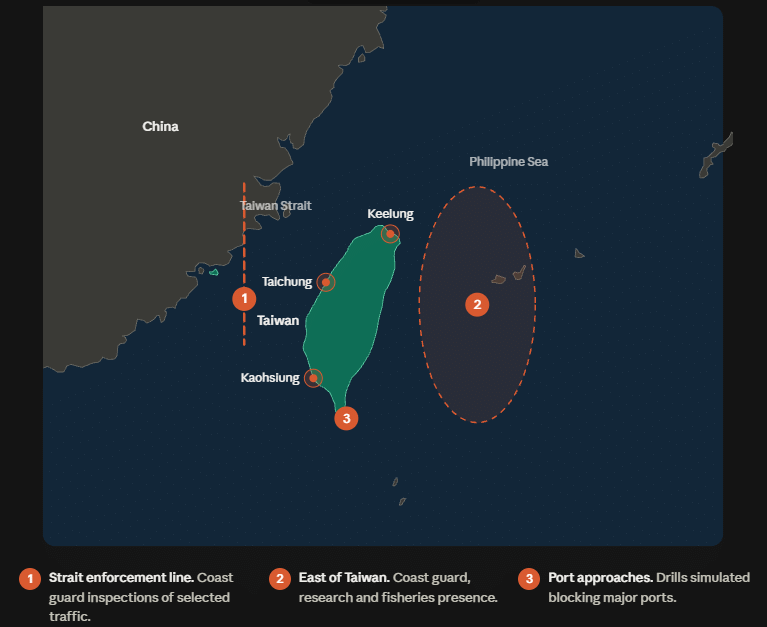
Reuters reported on 10 October that Chinese coast guard patrols off Taiwan’s east coast had increased since June. Taiwan views the waters on its Pacific side as important to supply routes that could be used by international partners during a conflict. The United States described the reported maritime activity as deeply destabilising.
The strategic issue is therefore not simply whether Chinese vessels are present. It is whether their activities, locations, coordination and frequency indicate a change in the way Beijing seeks to exert pressure around Taiwan.
Answering that question requires a sustained record of vessel movements, verified identities, activity patterns, official statements and comparisons with earlier deployments.
3. The China Coast Guard and the grey-zone approach
The China Coast Guard is an important part of this discussion because it operates at the intersection of maritime law enforcement and China’s broader security apparatus.
CSIS noted in its June 2024 analysis that the China Coast Guard had been placed under the People’s Armed Police in 2018. The analysis also examined China’s 2021 Coast Guard Law, including provisions concerning the protection of claimed maritime rights and the use of force under specified circumstances. These institutional arrangements are relevant to understanding how coast guard activity could intersect with military planning.
A grey-zone operation is an action designed to advance strategic objectives without crossing an obvious threshold into open armed conflict. Such activities can include persistent patrols, maritime pressure, administrative restrictions, information campaigns and actions that test an opponent’s response.
The significance of grey-zone pressure lies partly in repetition. An isolated patrol may attract limited attention. Repeated operations can require Taiwan to allocate resources to monitoring and response, complicate routine maritime activity and create uncertainty over where the next confrontation might occur.
A quarantine scenario could exploit this ambiguity. Chinese authorities might claim that selected ships require inspection or that a particular maritime area is subject to Chinese controls. Commercial operators would then have to assess whether to comply, challenge the restriction, reroute or wait for clarification.
This does not mean that any such operation would be lawful simply because China described it as law enforcement. Its legality would depend on the location, the specific measures taken, applicable international law and the competing maritime claims.
Nor would the use of coast guard vessels guarantee that a crisis remained below the threshold of armed conflict. Boarding attempts, collisions, detentions or the use of force could escalate rapidly.
The danger is that an operation presented as limited and administrative could create a confrontation with consequences far beyond the initial incident.
4. Military exercises are relevant, but they are not proof of an impending blockade
China’s military exercises around Taiwan provide another important part of the evidence.
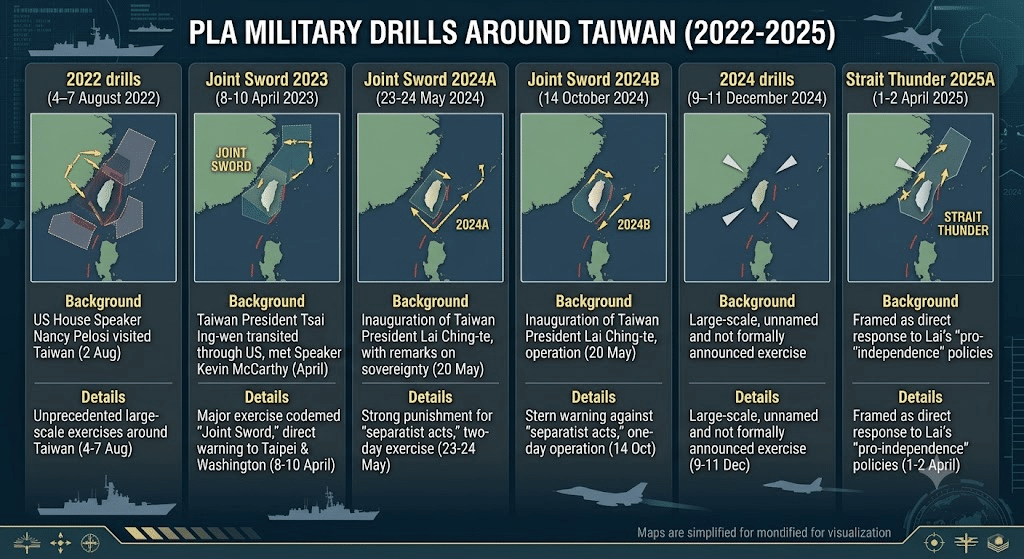
In April 2025, the People’s Liberation Army conducted the Strait Thunder-2025A exercise. According to reporting by the Associated Press, Chinese officials said the drills included identification and verification, warning and expulsion, interception and detention, area control, joint blockade operations and precision strikes. Taiwan reported the participation of 76 Chinese military aircraft and 19 naval or government vessels during the exercise.
The declared training objectives are directly relevant to the blockade question. They demonstrate that blockade-related capabilities and maritime control scenarios have featured explicitly in China’s military exercises, rather than appearing only in outside speculation.
The exercise also illustrated the relationship between military pressure and maritime access. A force capable of operating aircraft, naval vessels and other assets in coordinated patterns around Taiwan could seek to control or threaten important approaches to the island.
However, exercises serve multiple purposes. They can train personnel, improve coordination, signal resolve, deter perceived opponents, respond to political events or communicate opposition to foreign involvement. The presence of blockade-related training objectives does not establish that political leaders have authorised an actual blockade.
China’s Ministry of National Defense subsequently announced the Justice Mission-2025 exercises, which began on 29 December 2025. Its public description explicitly referred to blockading key ports and areas, joint operations and multidirectional military pressure around Taiwan.
These official descriptions are important primary evidence of what the Chinese military says it is practising. They should be separated from assessments about what Beijing might decide to do in a future crisis.
The strongest defensible conclusion is that Chinese military training has included scenarios relevant to restricting Taiwan’s access and controlling its surrounding approaches. The exercises increase the importance of assessing how those capabilities might interact with coast guard and other maritime operations.
5. The eastern coast: Why geography matters
Taiwan’s eastern coastline deserves particular attention because it faces the wider Pacific rather than mainland China.
Taiwan’s geography means that the Taiwan Strait is not the island’s only maritime approach. Its eastern waters are relevant to potential connections with partners across the Pacific, including routes that could become important during a crisis.
The reported presence of a Chinese maritime militia vessel alongside a coast guard cutter and a research vessel off the eastern coast therefore raises a question about the geographic scope of China’s maritime activity.
Could Beijing seek to exert pressure not only in the Taiwan Strait but also along routes connecting Taiwan to the wider Pacific?
That is a question for investigation, not a conclusion that can be drawn from one reported sighting.
A reliable assessment would need to establish whether similar vessel groupings have appeared repeatedly, whether their movements correspond with military exercises, whether they have approached or interfered with commercial shipping, and whether Chinese authorities have issued related navigation or enforcement notices.
The distinction between presence and control is critical. A vessel operating in an area does not, by itself, establish that the state controlling it can restrict that area’s commercial traffic. Enforcing a blockade across multiple approaches would present operational, legal and diplomatic challenges.
Nonetheless, monitoring the eastern approaches is essential to understanding the wider strategic implications of China’s reported maritime activity.
6. Could civilian-looking vessels complicate an international response?
The use of fishing vessels or other non-naval platforms in maritime disputes can complicate the interpretation of an incident.
A navy vessel is readily recognisable as a military platform. A fishing boat, research vessel or coast guard ship may operate in a different legal and operational context. The presence of a non-naval vessel does not establish hostile intent, and the status of any suspected militia vessel must be assessed on the evidence.
Where a vessel is demonstrably connected to state-directed maritime operations, however, its role could complicate the response of other governments. They may need to determine whether an encounter constitutes routine maritime activity, law enforcement, coercion or part of a wider military operation.
CSIS’s June 2024 quarantine analysis considered how China might use coast guard and other law enforcement forces to impose controls while attempting to avoid the political consequences of an overt military blockade. Its scenarios are analytical exercises, not proof that China has adopted a particular operational plan.
This is one reason why the classification of individual vessels and the verification of their activities matter.
A rigorous investigation should not assume that every Chinese fishing vessel is part of a militia or that every coast guard patrol is a rehearsal for war. It should instead look for evidence of repeated coordination, state tasking, unusual patterns of movement and connections to officially declared exercises.
Such an evidence-based approach would help distinguish genuine strategic patterns from isolated incidents or politically motivated claims.
7. Taiwan’s vulnerabilities extend beyond military defence
A blockade would not necessarily begin with an attempt to sink ships or destroy infrastructure. It could initially operate through restrictions, warnings, inspections, delays and uncertainty.
Those measures could affect commercial shipping and insurance decisions even before a physical confrontation occurred. If carriers judged a route too risky, they might delay voyages, seek alternative routes or demand higher premiums.
The economic consequences would depend on the scale and duration of restrictions, the goods affected, the availability of alternative supplies and the response of Taiwan’s trading partners.
Energy supply is one particularly important concern. Taiwan depends heavily on imported energy, making maritime access relevant to its economic resilience. A prolonged disruption could place pressure on electricity generation, industrial production and other essential activities.
In its July 2025 report, Lights Out? Wargaming a Chinese Blockade of Taiwan, CSIS presented findings from 26 blockade wargames. The researchers concluded that a blockade could inflict serious hardship, particularly on Taiwan’s energy sector, but would also be a high-risk strategy for Beijing. The report highlighted the potential for escalation into a much larger war.
These findings should not be interpreted as a forecast that a blockade will occur or that every scenario would produce the same outcome. Wargames test assumptions under specified conditions; they do not predict the future with certainty.
They nevertheless illustrate why the ability to withstand disruption matters alongside military deterrence. Energy reserves, alternative supply arrangements, port resilience, emergency planning and the ability to maintain essential services could all influence the effects of a crisis.
The issue is not merely whether China could apply pressure. It is whether Taiwan could withstand that pressure long enough to prevent coercion from achieving its political objectives.
8. Would a blockade succeed, or trigger a wider conflict?
A blockade could create serious difficulties for Taiwan, but it would not be a risk-free option for Beijing.
First, enforcement would be difficult. Commercial ships might refuse to comply with Chinese restrictions, while Taiwan and other governments could challenge attempts to interfere with international shipping. The effectiveness of a blockade would depend on the extent of the restrictions, the willingness of vessels to continue operating and the capacity of China to sustain enforcement.
Second, a blockade could trigger international economic and diplomatic consequences. Governments might impose sanctions or other countermeasures, while companies could accelerate efforts to diversify supply chains. The scale and timing of such responses would depend on the circumstances and the positions taken by individual countries.
Third, a blockade would create escalation risks. An attempt to board a ship, detain a crew or prevent a vessel from entering port could lead to a confrontation. If outside powers sought to protect shipping, a limited operation could become a direct military crisis.
The CSIS wargame report emphasises that a blockade could produce severe hardship but would not be a low-cost or low-risk option for China.
The political outcome would also be uncertain. Coercive pressure might encourage some Taiwanese citizens and political actors to seek compromise, but it could also strengthen opposition to Beijing, increase support for resilience measures or deepen international concern about China’s conduct.
A blockade would therefore represent more than a test of military capability. It would test China’s ability to manage escalation, absorb economic costs and persuade Taiwan that resistance was more costly than accommodation.
There is no reliable basis for assuming that Beijing would necessarily succeed.
9. What evidence would establish whether China is preparing for a blockade?
The central investigative challenge is to distinguish a general increase in pressure from evidence of preparations for a specific operation.
Several indicators deserve sustained examination.
Repeated maritime coordination. Verified patterns involving coast guard ships, suspected militia vessels, research vessels and naval units would be more informative than isolated sightings. Vessel identities and classifications should be independently checked wherever possible.
Exercise objectives and geographic patterns. Official announcements, navigation notices and verified exercise areas can establish what Chinese forces say they are practising. Their significance should be assessed against previous exercises rather than inferred from a single event.
Interference with commercial traffic. Documented inspections, detentions, diversions, threats or restrictions affecting commercial vessels would provide stronger evidence of attempts to exercise control than the mere presence of ships.
Activity around important approaches. Sustained and coordinated activity in the Taiwan Strait and eastern approaches could indicate a broader pattern of maritime pressure. Such a conclusion would require comparative data over time.
Changes in civilian maritime behaviour. Shipping delays, route changes, insurance costs and official warnings could help establish whether Chinese activity is affecting commerce. These changes would need to be distinguished from unrelated market conditions and wider regional risks.
Official legal and administrative measures. New enforcement announcements or navigation restrictions would warrant close scrutiny, particularly if they sought to apply Chinese authority to traffic travelling to or from Taiwan.
No single indicator would necessarily prove that a blockade had been authorised. A stronger assessment would combine multiple independent sources, establish a clear chronology and test alternative explanations.
It would also require examining evidence that might contradict the blockade hypothesis. If activity proved sporadic, unrelated to military exercises or consistent with established maritime patterns, that would weaken claims that a specific rehearsal was underway.
Investigative journalism must remain open to that possibility.
What IJ-Reportika’s Investigation Reveals About China’s Maritime Strategy
In its investigative report, An Investigation into the Dubious Chinese Distant-Water Fishing Fleet (DWF), IJ-Reportika examined the scale, opaque tracking practices and potential dual-use functions of China’s distant-water fishing fleet. The investigation documented concerns about vessels switching off their Automatic Identification System (AIS) transponders and examined how fishing fleets can intersect with maritime surveillance and territorial disputes. These findings provide relevant context for assessing China’s maritime activities around Taiwan, although they do not independently establish that fishing vessels are participating in a blockade rehearsal.
As IJ-Reportika’s reporting suggests, the key investigative question is whether ostensibly civilian maritime activity can also serve broader state interests, and whether verified patterns of coordination with coast guard or other government-linked vessels indicate an effort to increase Beijing’s practical influence over Taiwan’s surrounding waters. .
Conclusion: Preparation for pressure is not proof of a decision to blockade
China’s military exercises around Taiwan, its stated training objectives involving blockade-related operations and recent reporting on maritime activity off Taiwan’s eastern coast justify serious scrutiny.
The evidence establishes that blockade-related scenarios have featured in Chinese military training. It also establishes that recent reports have raised questions about the roles of coast guard, research and suspected maritime militia vessels near Taiwan.
What the evidence does not establish is that Beijing has decided to impose a blockade, that the reported eastern-coast activity constitutes a confirmed rehearsal, or that an operation is imminent.
The distinction between capability, preparation and political intent is essential. A country may develop and practise capabilities without deciding to employ them. At the same time, repeated exercises and maritime operations can increase the options available to its leaders during a future crisis.
For Taiwan, the challenge is to strengthen its ability to withstand coercion while maintaining channels that reduce the risk of accidental escalation. For the United States and other interested governments, the challenge is to deter unilateral restrictions on Taiwan’s external access without turning every maritime encounter into a wider confrontation.
For investigators, the task is more precise: determine whether Chinese maritime activity is becoming more coordinated, more persistent and more directly connected to attempts to control access to Taiwan.
The most defensible conclusion is that the possibility of a blockade deserves sustained attention. The available evidence supports investigating whether Beijing is building the capacity to apply maritime pressure below the threshold of open war. It does not yet justify claiming that a blockade decision has been made.
The critical question is not simply whether China can surround Taiwan with ships and aircraft. It is whether Beijing could use that presence to impose lasting restrictions on Taiwan’s external connections, and whether Taiwan and its partners could prevent such restrictions from becoming a new regional reality.