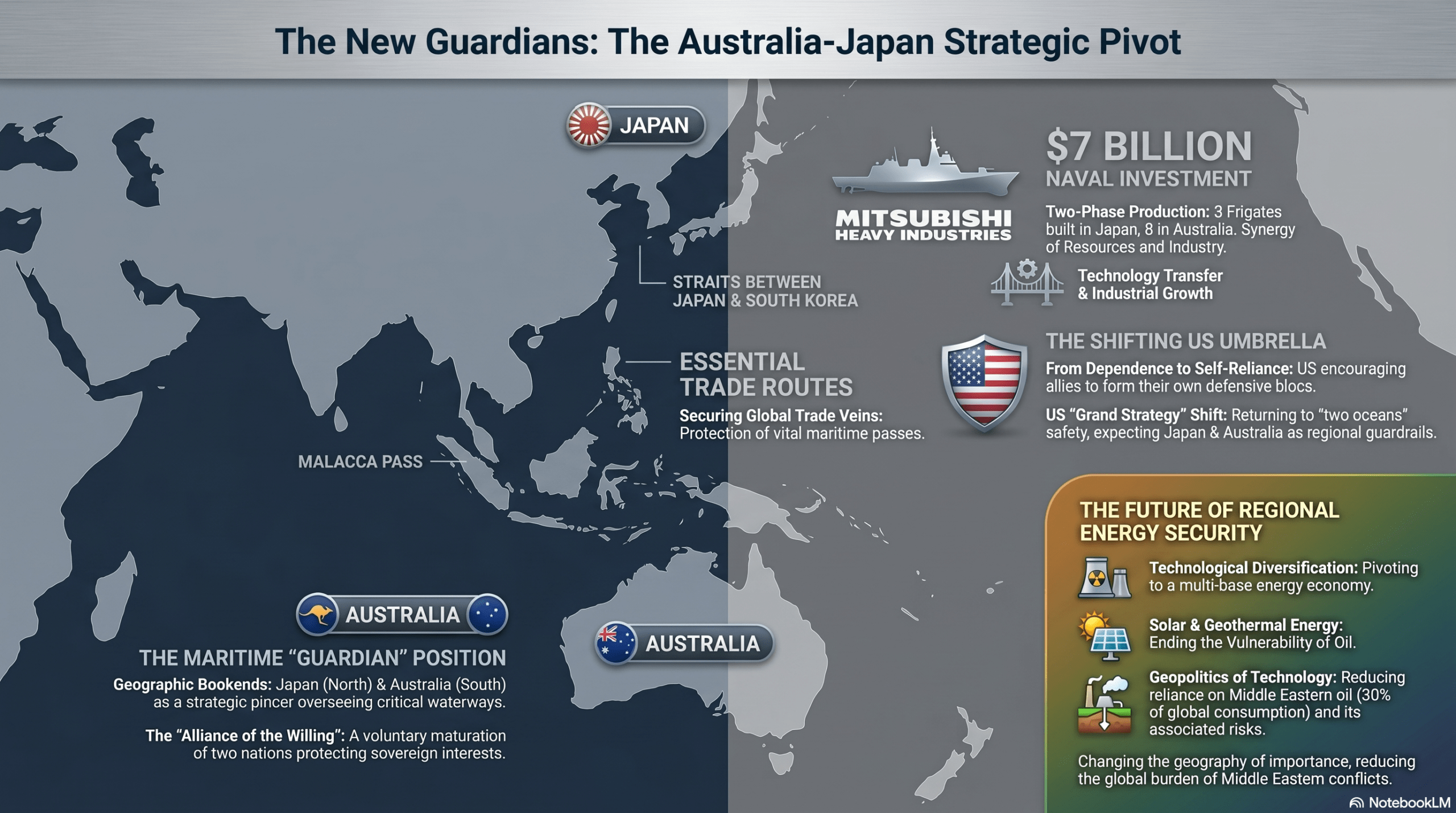
A significant shift is occurring in the geopolitical landscape of the Pacific, marked by a landmark $7 billion agreement between Australia and Japan. Under this deal, Japan’s Mitsubishi Heavy Industries will construct three stealth frigates for the Australian Navy, while Australia is slated to build an additional eight. This partnership signals a deepening “strategic alignment” between two of the region’s most prominent maritime powers.
A Maritime Necessity
Australia and Japan are fundamentally maritime nations—islands positioned at the southern and northern reaches of China, respectively. Their geographic locations mean that control of the oceans is essential for their survival as trading nations. Experts suggest that as the United States and China move toward a potential accommodation, the primary responsibility for defending the Pacific is increasingly falling to Australia and Japan.
This alliance is built on a “common fear” rather than mere sentiment. There is a shared concern that if the United States reduces its regional presence, China could expand its naval reach to surround and potentially isolate these island nations. By building fleets together, both countries not only reduce costs but also facilitate a transfer of technology and create a mutual defense capability where one could come to the rescue of the other if necessary.
The American Shift: From Protector to Partner
The evolution of this relationship reflects a changing American grand strategy. There is an increasing desire within the United States to reduce its global “burden” and exposure, encouraging allies to form their own defensive pacts. While the U.S. remains a close friend, both Australia and Japan have concluded that depending solely on the United States may no longer be a safe bet during a crisis.
The U.S. approach is shifting toward a form of modern isolationism, where it prefers to see “allies become allies with each other”—Asians with Asians and Europeans with Europeans. This allows the U.S. to step back and reduce its own vulnerability while maintaining a secure Pacific through a “guard rail” maintained by its partners.
An “Alliance of the Willing”
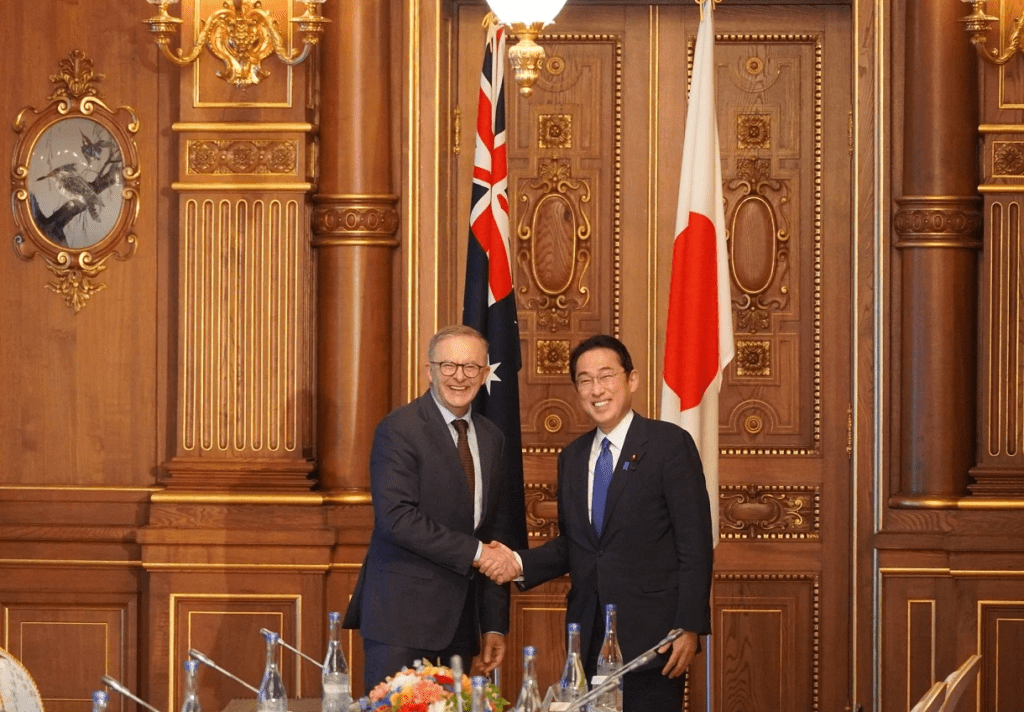
Unlike NATO, which was largely an alliance forced upon Europe by the threat of the Soviet Union and American imposition, the Australia-Japan partnership is viewed as an “alliance of the willing”. It has grown organically out of mutual interest rather than external pressure.
Furthermore, the history between these two nations is seen as “milder” compared to the centuries of conflict between European powers. While they clashed during World War II, a new generation in Japan—one that does not define itself by the defeat of the 1940s—is overseeing a massive defense enlargement. This has allowed for a relationship based on “good fences” and powerful militaries making “good friends”.
Beyond Defense: Economic and Energy Synergy
The alliance is as much about geoeconomics as it is about geopolitics. Australia possesses massive mineral resources that are essential for Japan’s industrial power, creating a natural common market.
This cooperation also extends to energy security. Both nations are currently vulnerable to instabilities in the Middle East, as they remain heavily reliant on oil imports. Analysts point out that 30% of the world’s oil comes from an extremely unstable region, putting the global economy at risk. This shared vulnerability is driving interest in a diversification of energy sources, including:
- Small nuclear reactors, which have evolved to be safer and more efficient.
- Solar and geothermal energy as viable alternatives to fossil fuels.
As the “age of oil” begins to wane due to the unreliability of major producers, the Australia-Japan alliance represents a proactive move to secure both the trade routes and the technological future of the Pacific. This low-key but significant development suggests that the two major non-continental Asian powers are ready to take their security into their own hands.