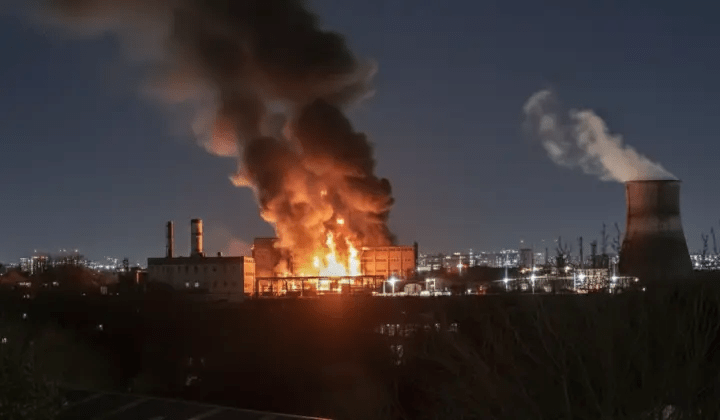
Over the past 45 days, an alarming pattern has emerged across the global energy sector: a sharp rise in fires and explosions at oil refineries and power plants spanning multiple continents. From South Asia to North America, Europe to Southeast Asia, more than 45 such incidents have been reported—an extraordinary spike compared to the usual annual average of fewer than 10 cases.
This sudden escalation, amounting to an estimated 1800% increase, has triggered concern among energy analysts, policymakers, and security experts, raising a critical question: are these incidents isolated industrial accidents, or do they point to a deeper, coordinated disruption?
A Pattern Across Continents
Recent incidents illustrate both the geographic spread and the severity of these events:
- In India, a fire erupted at the HPCL refinery’s Crude Distillation Unit just before its scheduled inauguration. Preliminary assessments suggest a hydrocarbon leak within the heat exchanger system.
- In Bucharest, an explosion at a combined heat and power plant knocked out hot water supply for nearly 40% of the city, after fires spread across multiple transformers.
- In Russia, key oil infrastructure—including the Tuapse and Yaroslavl refineries—has been targeted by drone strikes linked to the ongoing Russia-Ukraine War, forcing operational shutdowns.
- In Myanmar, a major fire at a river port destroyed dozens of fuel vessels, highlighting vulnerabilities in smaller-scale energy transport systems.
- In Texas, multiple incidents—including refinery fires and power plant explosions—have occurred within a compressed timeframe, suggesting systemic stress or operational risks.
- In Victoria, a prolonged blaze at the Geelong refinery reduced fuel output capacity significantly, affecting regional supply chains.
Coincidence or Coordinated Disruption?
The clustering of these incidents—both in time and across strategically important energy hubs—has fueled speculation about potential sabotage. Notably, several of these events have occurred far from active conflict zones, challenging the assumption that they are purely war-related.
However, alternative explanations cannot be dismissed. The global energy system is currently under immense strain, driven by:
- Increased demand amid geopolitical instability
- Aging infrastructure in several regions
- Operational overload as refineries push toward maximum capacity
Under such conditions, the probability of technical failures, such as leaks, transformer faults, and system overloads, naturally increases.
Strategic Implications: Who Benefits?
Regardless of cause, the consequences of these disruptions are clear: reduced refining capacity leads to tighter global supply and upward pressure on energy prices.
Two major actors stand to gain from such instability:
- The United States, where energy giants like Chevron and ExxonMobil are positioned to capture greater market share as global supply tightens.
- Russia, which could leverage supply shortages to increase its export influence, particularly in markets seeking alternatives amid sanctions and geopolitical fragmentation.
For Europe and parts of Asia, the impact is more adverse, greater dependency on external suppliers, increased costs, and heightened vulnerability to supply shocks.
The Transparency Gap
Despite the scale of these incidents, clarity remains elusive. Investigations are ongoing in most cases, but the absence of a unified international inquiry framework limits the ability to identify patterns or establish causation definitively.
In an era where energy security is deeply intertwined with geopolitical power, the lack of transparency only deepens uncertainty.
Conclusion
At present, there is no conclusive evidence to confirm whether the recent surge in refinery fires is the result of coordinated sabotage or a convergence of systemic vulnerabilities under stress. What is undeniable, however, is the strategic impact: a more fragile global energy network, susceptible to both disruption and manipulation.
For policymakers and industry leaders alike, the priority is clear—strengthening infrastructure resilience, enhancing monitoring systems, and improving international coordination before isolated incidents evolve into a sustained global crisis.