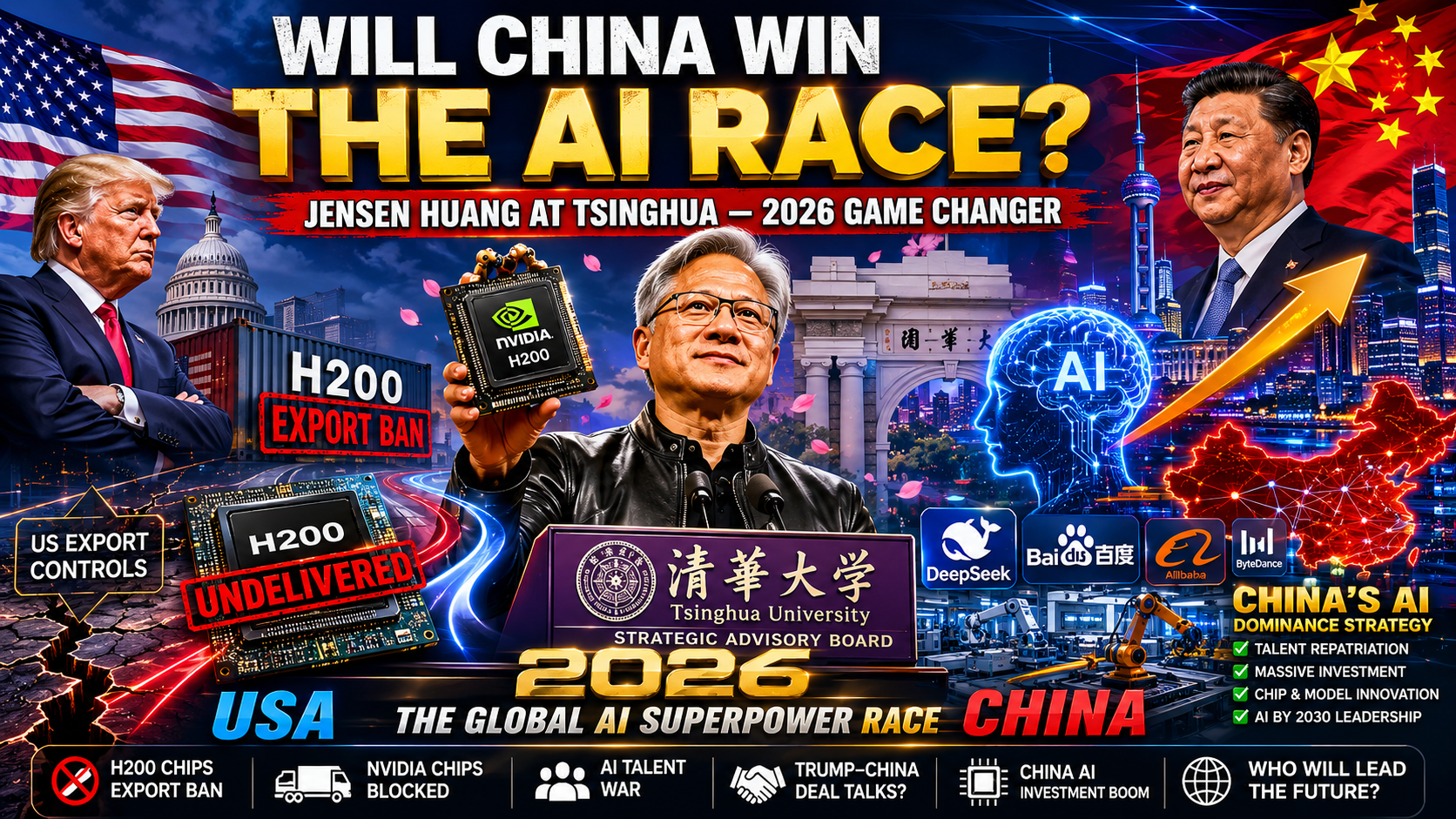
A chip deal frozen in bureaucratic ice. A tech CEO boarding Air Force One in Alaska. And behind it all, a single strategic ambition that Beijing has never tried to hide: global dominance in artificial intelligence.
The story of Nvidia’s H200 chips, cleared for sale to China yet undelivered, may seem on its surface like a tale of regulatory gridlock. But read between the lines and it reveals something far more consequential: a civilizational contest for technological supremacy, and growing evidence that China is playing the long game with remarkable patience. What it also reveals, however, is that both Washington and Beijing are making calculated bets that carry serious risks for the rest of the world.
The H200 Moment: A Deal Frozen, But Not Dead
The U.S. Commerce Department has approved approximately ten Chinese firms, including Alibaba, Tencent, ByteDance, and JD.com, to purchase Nvidia’s H200 AI chips. Distributors Lenovo and Foxconn have also received approval as intermediaries. Each approved buyer may purchase up to 75,000 chips under the licensing terms. And yet, not a single delivery has been made.
Why? Because Beijing itself has pulled back.
As Commerce Secretary Howard Lutnick told a Senate hearing, the Chinese central government has not yet permitted the purchases, as it is trying to keep investment focused on domestic industry. China’s State Council has issued new supply chain security regulations, prompting a government-wide effort to identify and reduce foreign technology dependencies. There are also practical concerns: the Trump administration’s arrangement requires chips to physically pass through U.S. territory before reaching China, a provision Washington devised as a legal workaround to collect 25% of revenues, raising Beijing’s fears about potential tampering or embedded vulnerabilities.
And yet Nvidia CEO Jensen Huang joined the White House delegation to Beijing, picked up by President Trump in Alaska en route to a summit with President Xi Jinping. The message was unmistakable: this deal is not dead. It is a negotiating chip in every sense of the word.
The stakes, as Reuters reported, are enormous. Before export curbs tightened, Nvidia commanded roughly 95% of China’s advanced chip market, and China once accounted for 13% of Nvidia’s total revenue. Huang has estimated China’s AI market alone would be worth $50 billion this year.
A Deal That Serves Neither Side Well
It is worth pausing here to be direct about something that enthusiasts on both sides tend to gloss over: this deal, in its current form, is a bad arrangement that satisfies no one and risks destabilizing the very competition it claims to manage.
From the American side, the concerns are not merely theoretical. As Foreign Affairs argued bluntly, the risks of selling H200 chips to China outweigh the benefits. Depending on the number of chips that ultimately reach China and how efficiently they are used, the United States could erode its massive advantage in compute capacity, which remains the bedrock of global AI leadership. The Council on Foreign Relations’ Chris McGuire put it plainly to Reuters: “Any deal that allows Nvidia to sell more chips to China means fewer Nvidia chips for U.S. firms, and a smaller U.S. lead in AI over China.” Critics have gone further, arguing it is “remarkable that President Trump keeps getting convinced to put Nvidia’s interest ahead of America’s.”
That criticism lands. The optics of a U.S. president personally escorting the world’s most powerful chipmaker CEO to Beijing for a commercial negotiation raise legitimate questions about whether U.S. trade policy is being shaped by strategic national interest or by the lobbying power of a single, extraordinarily valuable company. Nvidia’s stock price is not America’s AI strategy.
From the Chinese side, the picture is equally troubled. Beijing’s hesitation is framed as strategic independence, but it is also a form of self-imposed paralysis. Chinese AI firms, including some of the most sophisticated technology companies on earth, are sitting on approved purchase orders for world-class chips that could accelerate their capabilities significantly, and they are being told by their own government to wait. This is not the confident posture of a rising power. It is the anxiety of a government that knows its domestic chip alternatives are still not ready, but is unwilling to admit that dependency in public.
The arrangement itself, requiring chips to transit U.S. territory so Washington can collect a 25% revenue share, is a peculiar hybrid of commercial deal and sovereignty theater. It solves a legal constraint rather than a strategic one. It gives Beijing genuine reason to worry about hardware integrity. And it gives Washington the illusion of control over chips that, once delivered, will train AI systems on Chinese soil with no ongoing oversight whatsoever.
In short: this is a deal designed to make a photo opportunity possible, not to advance a coherent vision of how two rival superpowers should manage the most consequential technology in human history.
Jensen Huang, Tsinghua, and the Blurring of Lines
If the H200 deal raised questions about where Nvidia’s interests end and America’s begin, a new development reported by the Financial Times on May 27 has sharpened those questions considerably. According to people familiar with the matter, Jensen Huang has agreed to join the advisory board of Tsinghua University’s School of Economics and Management, one of China’s most politically significant elite institutions.
This is not a routine academic appointment. Tsinghua, sometimes dubbed “China’s Harvard,” counts President Xi Jinping among its undergraduate alumni, and is attended by China’s senior politicians across generations. The SEM advisory board, established in 2000 and currently 65 members strong, includes some of the most powerful names in global business: Elon Musk of Tesla, Michael Dell of Dell, Satya Nadella of Microsoft, Mark Zuckerberg of Meta, Jamie Dimon of JPMorgan, and Larry Fink of BlackRock. Tim Cook of Apple serves as its chair. Board members typically meet annually in Beijing.
Reuters was unable to independently verify the report. Nvidia declined to comment; Tsinghua did not immediately respond.
The timing, following Huang’s unprecedented inclusion in a presidential delegation to Beijing and the still-unresolved H200 chip negotiations, is difficult to read as coincidental. Whether this represents a genuine deepening of academic and commercial ties, a goodwill gesture toward Beijing, or a strategic positioning move by Huang ahead of future negotiations, the optics alone are significant.
Consider what this means in context. A sitting U.S. export control regime bans Nvidia from selling its most advanced chips to China on grounds that they could be used for military purposes. That same regime has placed Huawei and dozens of Chinese technology firms on restricted lists. And yet the CEO of the company those controls are designed to govern is simultaneously being welcomed onto the advisory board of an institution central to China’s political and academic establishment, one whose alumni populate the very agencies drafting China’s national AI strategy and military modernization plans.
The concern here is not that Jensen Huang is doing something illegal. It is that the entire architecture of U.S. technology competition policy is premised on the idea that there are meaningful walls between American commercial interests and Chinese state ambitions. Appointments like this make those walls look increasingly theoretical.
There is a harder question underneath this one: when the CEOs of the world’s most strategically important technology companies, across chips, software, finance, and social media, are simultaneously serving on the advisory board of an institution that trains China’s future political leadership, what does American technology independence actually mean? The board reads less like an academic committee and more like a who’s who of global capital that has collectively decided the U.S.-China rivalry is less important than market access.
Critics in Washington will note, fairly, that this is precisely the dynamic that allowed China to close the technology gap in the first place: American companies, individually rational in their pursuit of the world’s largest markets, collectively ceding the strategic high ground piece by piece, advisory seat by advisory seat.
Huang’s decision, if confirmed, will add fuel to an already combustible debate in Congress about whether U.S. technology executives should face stricter limits on their formal affiliations with Chinese state-linked institutions. That debate will not resolve itself quietly.
The Brain Behind the Dragon: China’s Talent Repatriation Strategy
The H200 saga does not exist in isolation. It is one thread in a much larger tapestry that our investigative team at IJ-Reportika documented in depth in our report, “The Chinese Global Brain Turning Back to Home“, a sweeping examination of how China has systematically repatriated some of the world’s most advanced AI and STEM talent.
Through initiatives like the Thousand Talents Plan and the “Made in China 2025” strategy, Beijing has created powerful incentives for Chinese-born scientists educated in the United States and Europe to return home. The results are now being felt in laboratories from Shenzhen to Shanghai.
The numbers are striking. In the first half of 2025 alone, around 50 tenure-track scholars of Chinese descent left U.S. universities for China, a figure that adds to more than 850 such departures since 2011, according to a tally by Princeton University researchers. At least 85 rising and established scientists working in the U.S. joined Chinese research institutions full-time since the start of 2025, according to CNN’s reporting, with more than half making the move in 2025 itself.
The pull factors are growing as fast as the push factors. China’s expanding investment in higher education has created new opportunities. Beijing’s new K Visa program now allows foreign science and technology talent to enter China without even needing an employer invitation, a curious inversion, as Rest of World observed, of a country once known for closed borders now actively poaching talent from an America that has grown more restrictive and suspicious.
A Hoover Institution and Stanford HAI study of DeepSeek’s 211 researchers found that the overwhelming majority were educated in China, and that only 24% had any U.S. experience, most of it brief. As the report noted, this represents a “strategic knowledge transfer” that is giving China’s AI ecosystem a major boost. The idea, long held in Washington, that the best minds will naturally stay in America is now an outdated assumption.
As our IJ-Reportika report documented in detail, these returnees bring cutting-edge expertise, international networks, and a drive to elevate China’s innovation ecosystem, often lured by lucrative opportunities and a sense of contributing to national revival. China’s leadership in fields like electric vehicles, drones, solar panels, and graphene, areas where Bloomberg notes it leads in five of thirteen critical technologies, has been driven substantially by such repatriated talent.
This is where the United States should be most alarmed. Not at the H200 deal, but at the quiet exodus of the very researchers whose work trained the models that made American AI dominance possible in the first place.
China’s Ambition Is Not a Secret
Make no mistake: China’s goal is not merely to be competitive in artificial intelligence. It is to be the dominant global power in AI, and its leaders have said so, repeatedly and explicitly.
China’s national AI strategy, first issued in 2017, set out a roadmap to become the world leader in AI by 2030. Every subsequent policy action has been consistent with that stated goal: the state-backed buildout of chip makers like Huawei and Cambricon; the aggressive push to develop homegrown large language models; the strategic deployment of DeepSeek as an open-source tool designed to capture global AI infrastructure; and now the calculated hesitation on the H200 deal, prioritizing long-term indigenous capability over short-term access to foreign chips.
As the Atlantic Council noted, China plans to double down on its open-source AI strategy in 2026 to exert influence over the world’s AI infrastructure. Where the U.S. sells access to closed frontier models, China increasingly offers free, deployable technology to the Global South and emerging markets, building dependence and goodwill simultaneously.
The Stimson Center has argued that China’s combination of manufacturing dominance, energy surplus, and the ability to coordinate state resources toward singular objectives creates an asymmetric advantage that Western competitors, even acting collectively, would find difficult to match. As analyst Dan Wang observed, China is run by engineers, while America is run by lawyers, a contrast that helps explain China’s superior capacity to integrate design and production within a single industrial ecosystem.
With 72% of Chinese people saying they trust AI, compared to just 32% in the U.S., China also holds a critical societal advantage: public acceptance.
Yet here too, a critical eye is warranted. China’s ambitions come with real contradictions. A government that restricts the free flow of information, operates the world’s most comprehensive digital surveillance state, and maintains tight ideological control over research institutions is also trying to cultivate the kind of freewheeling, risk-taking innovation culture that has produced Silicon Valley. These goals are not easily compatible. Researchers who return to China under the Thousand Talents Plan do so knowing that certain lines of inquiry, certain international collaborations, and certain published conclusions may carry political risk. Innovation thrives on the freedom to be wrong in public. That freedom is not guaranteed in Beijing.
The Global AI Race: Where Every Major Power Stands
The AI race is not simply bilateral. Other powers are advancing rapidly, each with distinct strategies and constraints. Here is where the key players stand today:
United States — The Incumbent Leader, Under Pressure
The U.S. remains the undisputed leader in AI by most measurable metrics. American private AI investment reached $285.9 billion in 2025, more than 23 times China’s private investment figure, according to the Stanford HAI 2026 AI Index Report. The U.S. controls roughly half of global AI compute through hyperscale cloud platforms and research supercomputers. Frontier models from OpenAI, Google, Anthropic, and Meta continue to set global performance benchmarks.
The U.S. government has made its intentions explicit. Its National Security Strategy frames AI, biotech, and quantum computing as areas where “U.S. technology and U.S. standards must drive the world forward.” The $500 billion Stargate partnership is the largest announced government AI commitment in history.
Yet cracks are visible. U.S. AI adoption among the working-age population sits at just 28%, placing it 24th globally, behind dozens of smaller and more digitally agile nations. The departure of Chinese and other foreign researchers, combined with restrictive visa policies and proposed research budget cuts, threatens the talent pipeline that has underpinned American dominance. GDP growth excluding data center investment was just 0.1% in the first half of 2025, raising questions about whether AI investment is yet translating into broad economic gains.
China — The Strategic Challenger, Playing the Long Game
China’s private AI investment was $12.4 billion in 2025 per Stanford HAI data, far below U.S. figures, but this metric severely understates China’s real AI expenditure, which flows heavily through state channels, military budgets, and state-owned enterprises. China’s AI strategy is characterized not by venture capital but by national mobilization.
China is testing autonomous vehicles in 16 cities, the highest number worldwide. It rose from 23rd to 8th place in the Oxford Insights Government AI Readiness Index in a single year. DeepSeek demonstrated that frontier AI performance can be achieved at a fraction of Western compute costs, produced almost entirely by researchers trained in China. In 2024, up to half of all accepted papers at the world’s five most prestigious AI conferences had at least one author affiliated with a Chinese institution.
Huawei’s Ascend chips are increasingly substituting for Nvidia hardware domestically. The country’s leaders have decided, for now, that the risk of foreign dependency outweighs the benefits of access to American chips, a position that reflects extraordinary long-term strategic confidence.
India — The Sleeping Giant, Awakening Fast
India is emerging as a genuine third force in global AI. The IndiaAI Mission, launched in 2024 with an investment of INR 10,371 crore, aims to deploy 38,000 GPUs and establish 600 AI Data Labs. The country now hosts an estimated 80,000+ total GPUs nationwide. Google recently broke ground on a landmark AI hub in Visakhapatnam, part of a $15 billion five-year investment. Microsoft pledged $3 billion for 2025-2026; AWS committed $12.7 billion through 2030.
India’s strength is in its human capital: a vast, English-speaking engineering talent pool, strong diaspora networks, and world-class institutions producing AI researchers. Its demographic dividend, a young and digitally literate population, gives it structural advantages that neither the U.S. nor China can replicate.
India’s challenges are real. Compute infrastructure still lags major powers, private AI investment remains modest, and the transfer from research to commercial deployment is uneven. But the trajectory is sharply upward.
Russia — The Military-Focused Outlier
Russia’s AI ambitions are real but narrowly focused. Putin called for a national task force to develop homegrown LLMs at the 2025 AI Journey conference, framing foreign AI dependency as a sovereignty threat. In February 2026, Presidential Decree No. 116 elevated AI governance to a direct presidential commission. Russia allocates 5% of its state scientific research budget to AI, with an additional 15% to research utilizing AI tools.
Russia’s AI investment is concentrated in military applications. Its invasion of Ukraine has functioned as a live testing ground for AI-enabled warfare, including drone systems, command-and-control automation, and AI-assisted targeting. But Russia faces severe structural constraints: international sanctions have restricted access to advanced semiconductors, and its tech talent pool is depleted by emigration. It is, in strategic terms, a militarily focused AI power unlikely to challenge U.S. or Chinese dominance in foundational AI.
Germany — Europe’s Industrial AI Powerhouse
Germany occupies an important but complicated position. One of the first countries to launch a national AI strategy in 2018, Germany has committed up to 5 billion euros in public AI investment through 2025, with a focus on establishing “AI Made in Germany” as a global quality standard, including over 100 new AI professorships.
Germany’s AI strength lies in applied, industrial AI, particularly manufacturing and supply chain optimization. But the crucial transfer from AI research to commercial products remains a significant gap. Regulatory caution under the EU AI Act, while principled, has slowed deployment. France’s announced 109 billion euro national AI plan dwarfs Germany’s commitment and may shift European AI leadership westward.
Japan — The “AI-Friendly Nation” Bet
Japan is attempting a strategic reset under the slogan of becoming the “world’s most AI-friendly country.” The government passed the AI Promotion Act in May 2025, which came into full effect in September, rapidly deregulating to remove barriers to AI deployment.
Japan’s demographic reality, a population projected to shrink by 30% by 2070 with four in ten citizens over 65, makes AI adoption an existential economic necessity. AI usage grew 34.1% between mid-2025 and Q1 2026, among the fastest rates globally. However, Stanford HAI data shows Japan has 388 newly funded AI companies but only $6 billion in total capital, suggesting ecosystem scale remains limited. Japan is betting that regulatory friendliness will compensate for limited capital and compute, a wager whose outcome remains uncertain.
Global AI Power Rankings: A Comparative Overview
| Country | Private AI Investment (2025) | AI Readiness Ranking | Key Strength | Key Weakness | Strategic Posture |
|---|---|---|---|---|---|
| USA | $285.9 billion (Stanford HAI) | 1st globally | Compute, frontier models, capital | Declining talent retention, low public adoption (24th) | Offensive + Commercial |
| China | $12.4B private + large state spend | 8th (up from 23rd) | State coordination, talent repatriation, open-source AI | Chip dependency, censorship culture limiting innovation | State-directed dominance |
| India | Modest private; $200B+ foreign investment pipeline | Rising rapidly | Talent pool, demographics, diaspora | Compute infrastructure, research-to-market gap | Inclusive, Global South leadership |
| Russia | ~5% of state science budget | Not in top tier | Military AI, battlefield testing | Sanctions, brain drain, no civil AI ecosystem | Military-sovereign |
| Germany | Up to 5 billion euros public by 2025 | Top 10 in Europe | Industrial AI, manufacturing automation | Research-to-market gap, fragmented EU regulation | Ethical-industrial |
| Japan | ~$6 billion private | Mid-tier, rising | Robotics, AI-friendly regulation, surging adoption | Small deal sizes, aging population limiting workforce | Deregulation-led deployment |
The Verdict: A Race Without a Clean Finish Line
The H200 saga will eventually resolve itself, one way or another. Either the chips will flow and American critics will be proven right or wrong about the compute risk, or they will not, and China’s domestic chip-building will quietly close the gap while the world watches Jensen Huang’s next press conference.
What is clear is that neither Washington nor Beijing is managing this competition with particular wisdom. The United States is simultaneously trying to contain China’s AI development and sell it the hardware to accelerate it, driven by a single company’s commercial interests and a president who appears to believe personal relationships can paper over structural rivalries. And while those negotiations play out, the CEO of that same company is reportedly accepting a seat on the advisory board of China’s most politically connected university, a development that captures the central absurdity of the current moment with almost uncomfortable precision. China is simultaneously declaring AI supremacy as a national goal and refusing to buy chips that would help it get there faster, driven by sovereignty anxieties and a distrust of foreign technology that its own strategic posture has helped create.
The country in this competition with the most coherent long-term strategy may not be either superpower. It may be India, quietly building infrastructure, training talent, and positioning itself as the trusted AI partner for the two-thirds of the world that does not want to be forced to choose between Washington and Beijing.
China’s ambitions are clear. Global AI dominance is the stated goal, and the systematic repatriation of talent documented in our IJ-Reportika investigation, the open-source infrastructure play, the domestic chip buildup, and the strategic patience on the H200 deal all point toward a country executing a multi-decade plan with unusual consistency.
Whether that plan succeeds will depend on whether Beijing can sustain genuine innovation inside a political system that is, by design, allergic to the kind of disruptive, boundary-pushing research that created the AI revolution in the first place. That is the question no amount of chip approvals, talent programs, or presidential summits can answer.
The race is not over. But it is no longer one that any honest observer would call America’s to lose.
For our full investigation into China’s AI talent repatriation strategy, see: The Chinese Global Brain Turning Back to Home.