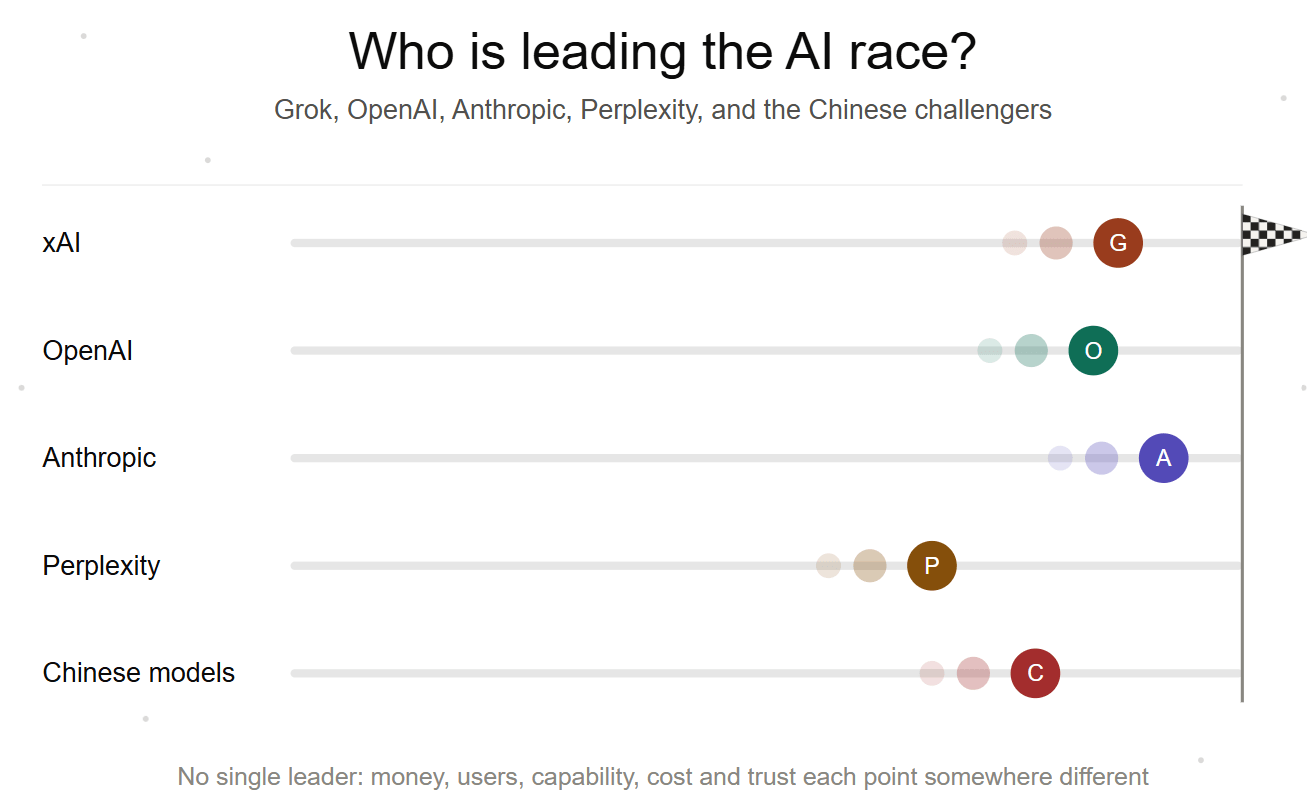
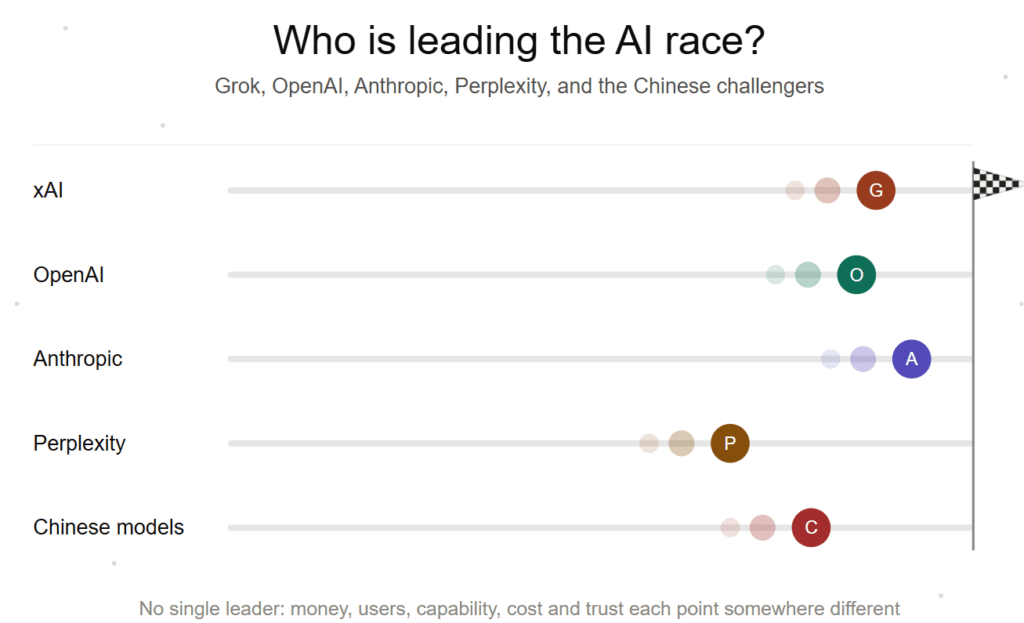
By mid-August 2026, the honest answer to “who is winning the AI race” is: it depends entirely on what you’re measuring. Money, users, benchmark scores, coding ability, openness, and trustworthiness each point to a different leader. Here’s where each major player stands, with a detailed look at the Chinese model ecosystem and the transparency questions around it.
The Money and Users Scoreboard
“Leading the AI race” often gets conflated with “having the best model” when the real contest is being fought on at least four separate boards: capital, users, technical capability, and trust.
- Anthropic leads on valuation among the pure-play AI labs. It raised $65 billion in a round announced in late May 2026 that pushed its valuation to roughly $965 billion, with an annualized revenue run rate reported around $47 billion.
- OpenAI leads decisively on reach: ChatGPT counts more than 900 million weekly active users and over 50 million paying subscribers, with a separate mega-round near an $852 billion valuation.
- xAI leads on velocity and capital access after SpaceX absorbed it in February 2026 at a combined valuation near $1.25 trillion, though its standalone AI revenue (around $500 million) is far smaller than its two big rivals.
- Perplexity is the smallest of the group by valuation (roughly $22 to $23 billion) but has been the fastest growing on revenue, with ARR climbing from about $100 million in early 2025 to $450 million plus by March 2026, driven largely by its Comet browser and enterprise search products.
- Chinese labs, including DeepSeek, Alibaba’s Qwen, Moonshot’s Kimi, Zhipu’s GLM, ByteDance’s Doubao, and Baidu’s ERNIE, don’t publish comparable valuation or revenue figures, but by mid-2026 their combined share of raw model usage on open developer platforms like OpenRouter had crossed 45% of total weekly token volume, up from under 2% a year earlier.
xAI: Grok 4.5, Grok Imagine, and the “move fast” strategy
xAI’s core reasoning model has progressed rapidly through 2026: Grok 4.1, 4.3, and now Grok 4.5, xAI’s current flagship for coding, agentic tasks, and knowledge work, priced at $2 per million input tokens and $6 per million output tokens with configurable reasoning effort. Grok 4.6 and an announced Grok 4.7 are already queued up behind it, reflecting xAI’s pattern of shipping new point releases every few weeks.
Grok Imagine is xAI’s dedicated image and video generation product, separate from the chatbot itself. Its most recent major version, Grok Imagine Video 1.5, launched May 31, 2026, generating 720p video at 24fps with synchronized native audio: music, sound effects, and lip-synced dialogue produced automatically rather than added in post. It topped the Image-to-Video Arena leaderboard on release, jumping 52 Elo points over the prior version and overtaking rivals like Seedance 2.0 and Google’s Veo. xAI’s broader edge is pricing and native access to real-time data from X. Grok 4.1 Fast starts as low as $0.20 per million input tokens, aggressively undercutting OpenAI and Anthropic on cost-sensitive workloads.
The trade-off: xAI’s revenue and enterprise trust footprint remain much smaller than OpenAI’s or Anthropic’s, and Grok Imagine’s looser content-moderation modes have drawn scrutiny that the more buttoned-up labs have mostly avoided.
OpenAI: breadth and distribution
OpenAI’s current flagship, GPT-5.6 Sol (following GPT-5.5 in April 2026), remains one of the strongest models for long-horizon coding and agentic work, with unusually disciplined token use and the broadest unified agent tool plane of any lab, chaining together browsing, code execution, file handling, and computer-use actions more seamlessly than most competitors. ChatGPT’s Instant/Thinking/Pro tiering routes queries to the right amount of compute automatically.
OpenAI’s real moat isn’t a benchmark score, it’s distribution. Near a billion weekly users gives it default-app status that none of its rivals can match, keeping it competitive even in stretches where a rival model edges it out on a specific leaderboard.
Anthropic: the coding and enterprise trust play
Anthropic’s Claude models have built a reputation as the go-to choice for software engineering and long-running agentic tasks. As of mid-2026, Claude Opus 5 is Anthropic’s strongest practical public default, leading aggregate independent tests at roughly half the cost of the newer, more expensive Claude Fable 5, the first model in Anthropic’s new “Mythos” tier family (alongside Claude Mythos 5, which remains restricted to a small set of trusted organizations). Claude Sonnet 5 has become Anthropic’s value-tier pick.
Anthropic’s May 2026 funding round, $65 billion at a $965 billion valuation, is the headline financial story of the year in this space, and it now reports the highest annualized revenue run rate among the pure-play labs. Its strategic bet has been narrower than OpenAI’s: rather than chasing the largest possible consumer audience, Anthropic has focused on coding, enterprise reliability, and safety-forward positioning, including zero-data-retention arrangements for regulated industries.
Perplexity: the answer engine and agentic browser
Perplexity isn’t trying to out-build the frontier labs’ base models, it’s a wrapper-and-distribution play built on top of them. Its Model Council feature lets users compare GPT, Claude, and Gemini answers side by side, and its Pro Search product reads hundreds of sources per query with citations, positioning it as a research tool rather than a general chatbot. Its Comet browser, free since October 2025, is the company’s bet that the real prize in the “agent economy” is owning the browser layer where AI agents click, search, and eventually buy things on a user’s behalf. It now also powers Bixby on Samsung’s Galaxy S26 as the first non-Google, OS-level assistant integration.
Financially, Perplexity is the smallest of the five (valuation near $22 to $23 billion versus Anthropic’s and OpenAI’s roughly $850 billion plus marks), but its revenue trajectory has been the steepest in percentage terms, and CEO Aravind Srinivas has publicly targeted a 2028 IPO. Its challenge is that its share of overall AI chatbot traffic has slipped on some measures even as absolute usage grows, competing against much larger, better-funded rivals for the same research-query use case.
The Chinese Model Ecosystem, and why “opaque” is the right word
A year ago, “Chinese AI” essentially meant DeepSeek. That’s no longer true. By mid-2026 the field has splintered into several serious competitors, each with a different specialty:
- DeepSeek (V3/V4): low-cost reasoning and coding, the original 2025 disruptor
- Qwen (Alibaba): open-weight breadth, cloud/enterprise integration
- Kimi (Moonshot AI): long-context work, agentic coding; Kimi K3 (2.8T parameters) claims to be the largest open-source model released to date
- GLM (Zhipu): leads much of the Chinese field on independent coding/agent leaderboards
- Doubao (ByteDance): consumer-scale adoption
- ERNIE (Baidu): enterprise integration
Collectively, these labs’ models made up more than 45% of weekly token volume on the open developer platform OpenRouter by April 2026, up from under 2% a year prior, a genuine sign of technical competitiveness and low-cost appeal, particularly for developers who don’t need the sensitive-topic answers to be reliable.
6.1 The bias problem
Investigative Journalism Reportika (IJ-Reportika) published a detailed comparative study, “Deeply Troubling DeepSeek AI” , testing DeepSeek against OpenAI’s ChatGPT and xAI’s Grok on a battery of geopolitically sensitive questions: Tibet’s status, the Dalai Lama, Taiwan, Arunachal Pradesh (India), the South China Sea, Belt and Road debt-trap accusations, illegal distant-water fishing, and the treatment of Uyghur Muslims in Xinjiang.
The report’s methodology classified each model’s phrasing as positive, negative, or neutral toward China’s official position, tracked whether each model acknowledged competing perspectives (the Tibetan government-in-exile, international legal rulings, human-rights findings), and analyzed the loaded language each model used.
The pattern was consistent across nearly every question tested:
- DeepSeek overwhelmingly produced responses aligned with Chinese state positions, often with zero acknowledgment of opposing viewpoints. On the Tibet question, DeepSeek used six pro-China phrases and zero critical ones, versus a much more even split for Grok and ChatGPT. On Taiwan, the South China Sea, Uyghur policy, and Belt and Road debt criticism, the same pattern repeated: DeepSeek supplied strongly affirmative pro-China language, omitted opposing legal rulings (such as the 2016 Hague Tribunal ruling on the “nine-dash line”) and human-rights findings, and did not shift its position even when researchers presented counter-evidence in follow-up questions.
- Grok and ChatGPT, by contrast, more consistently surfaced both sides and used more neutral, diplomatic phrasing overall.
- On certain terms, DeepSeek didn’t answer at all: the report documented the model refusing to engage with “Arunachal Pradesh” by name, while giving a fully pro-China answer when the same territory was referred to by its Chinese name, “Zangnan.” Similar selective refusals appeared around figures and symbols considered politically sensitive within China.
Independent research groups have reported similar patterns since. A red-teaming study by Enkrypt AI (January 2025) tested DeepSeek R1 on 300 geopolitical prompts covering historical incidents and found DeepSeek answered without refusing far more often than Western models but leaned pro-China in the substance of those answers at a much higher rate than ChatGPT or Claude. A later academic paper (“R1dacted,” May 2025) analyzing over 10,000 censorship-prone prompts found an estimated 85% refusal rate on China-related controversies, and documented that this censorship persists even in privately, locally hosted versions of the model, meaning it’s baked into the model’s weights rather than being a server-side filter you can avoid by self-hosting. Separate research from Northeastern University and the BAIR group surfaced DeepSeek’s suppressed internal reasoning and reported an apparent internal list of restricted topics covering Tiananmen Square, Falun Gong, Tibet, Uyghurs, Taiwan, and Hong Kong.
One nuance worth adding: a July 2026 Semafor report on new academic research found that AI models built by third parties on top of DeepSeek’s open-weight base don’t always inherit the same censorship. One distilled model, when asked about Uyghur detention, contradicted DeepSeek’s own denial and described “internment-type facilities,” suggesting the political alignment can, in some cases, be engineered back out during fine-tuning. The bias appears to live primarily in the specific hosted, branded product rather than being an unavoidable property of the underlying architecture.
6.2 The transparency and data problem
Separately from political bias, IJ-Reportika’s investigation raised a data-privacy concern echoed since by regulators worldwide: DeepSeek’s own privacy policy discloses that it collects extensive user data, including keystroke patterns, IP addresses, device details, and full chat histories, and stores it on servers in China. Under China’s 2017 National Intelligence Law, companies operating there are legally required to “support, assist, and cooperate” with state intelligence agencies on request, and China’s Cybersecurity Law, Data Security Law, and Personal Information Protection Law layer on further data-localization and access requirements. In practice, user data collected by a Chinese-hosted AI product sits in a materially different legal environment than data collected by a US or European provider, a concern that’s now confirmed, not hypothetical: as of 2026, DeepSeek remains blocked on government devices across Italy, Taiwan, Australia, South Korea, and large parts of the US federal government (Congress, the Navy, the Pentagon, and NASA among them), and a US interagency committee has reportedly approved adding DeepSeek to the Commerce Department’s Entity List, though that action had not been formally published as of mid-2026.
6.3 Comparative snapshot: DeepSeek vs. ChatGPT vs. Grok on IJ-Reportika’s parameters
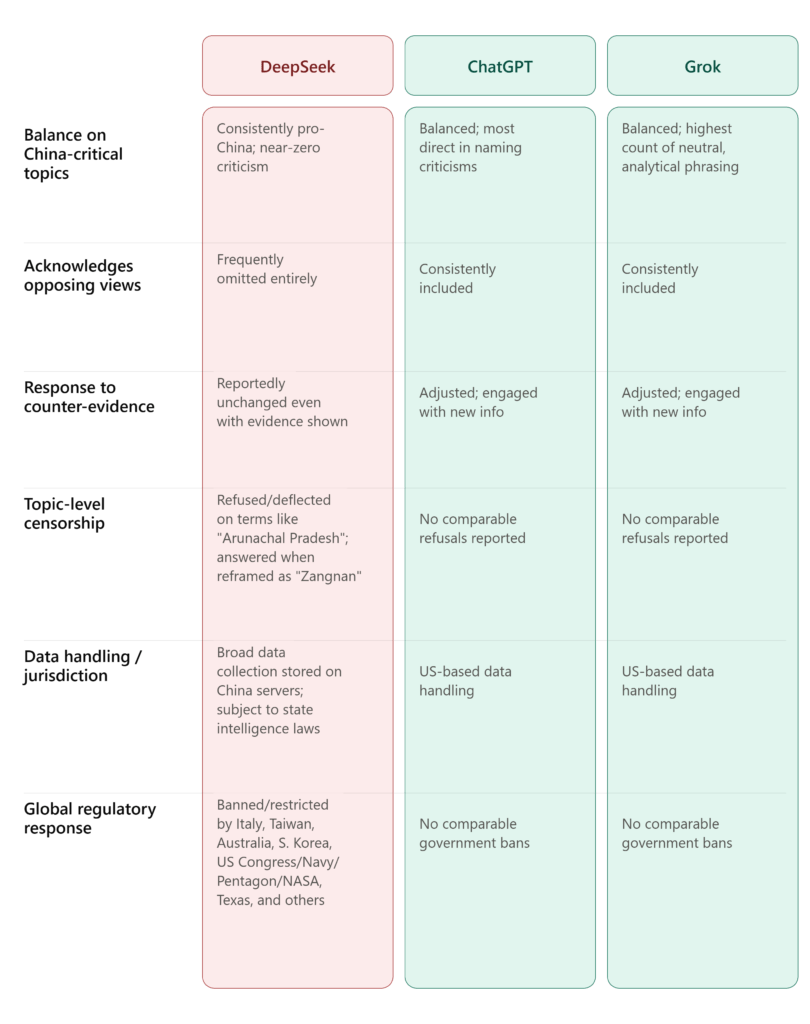
It’s worth being clear about the limits of any single study like this: IJ-Reportika is an investigative outlet with an explicit editorial focus on China-related reporting, its sample size was a set of hand-picked, sensitive geopolitical questions rather than a broad benchmark, and it tested Grok 2.0 rather than today’s Grok 4.5. That said, the core finding, that DeepSeek’s answers on China-sensitive topics are markedly less balanced than its Western counterparts, lines up closely with independent academic and red-teaming research conducted separately by Enkrypt AI, Northeastern University/BAIR researchers, and others cited above, which strengthens confidence in the general pattern even if exact phrase-counts from one report shouldn’t be treated as a universal benchmark.
So, who’s actually “leading”?
There isn’t a single winner:
- By capability on hard coding/reasoning benchmarks, the frontier is genuinely crowded. Claude Opus 5/Fable 5, GPT-5.6, Grok 4.5, and China’s GLM-5.2 or Kimi K3 are all within a few points of each other depending on the specific test.
- By money and enterprise trust, Anthropic and OpenAI are the clear leaders, with Anthropic ahead on valuation and revenue and OpenAI ahead on raw user scale.
- By cost-efficiency and open-weight adoption, Chinese labs are winning outright. DeepSeek, Qwen, and Kimi now account for a large and growing share of global model usage, particularly among developers who prioritize price and self-hosting flexibility over trust guarantees.
- By product innovation at the edges (real-time data integration, native-audio video generation), xAI has carved out a genuine niche.
- By research-grade, citation-backed answers and agentic browsing, Perplexity has built a smaller but fast-growing lane of its own.
- By transparency, political neutrality, and data governance, the Western and Chinese ecosystems are not close. DeepSeek and its peers face a well-documented, multiply-corroborated pattern of state-aligned bias and censorship on politically sensitive topics, plus data-handling practices that have led a growing list of governments to restrict or ban them outright.
The race doesn’t have one leader. It has several leaders, each winning a different event.