Why Taiwan’s Status Remains One of the World’s Most Misunderstood Questions
Few geopolitical questions are as frequently simplified as Taiwan’s relationship with China.
To Beijing, Taiwan is an inseparable part of the People’s Republic of China and reunification is a national objective. In Taipei, however, the situation is fundamentally different. Taiwan is governed by its own elected institutions, maintains its own military, currency, immigration system and legal order, and has developed a distinct political identity over decades.
The international community has deliberately avoided giving the dispute a simple answer.
Most countries do not formally recognise Taiwan as an independent sovereign state, but many maintain extensive unofficial diplomatic, economic, technological and security relationships with Taipei. At the same time, most countries recognise the People’s Republic of China as the government representing China and maintain some form of a “One China” policy.
This ambiguity is precisely why a recent statement by Malaysian Prime Minister Anwar Ibrahim has attracted attention.
Anwar told Al Jazeera on August 16 that, “I see Taiwan as part of China, period,” and when asked about Beijing’s willingness to use force, he drew a comparison with a Malaysian province attempting to separate from the federation. Beijing welcomed the remarks, while Taiwan condemned them as effectively legitimising the possibility of coercive reunification.
The controversy illustrates an important distinction: recognising Beijing as the government of China is not necessarily identical to endorsing every element of Beijing’s claim over Taiwan or supporting the use of force against Taiwan.
That distinction sits at the heart of the Taiwan question.
Taiwan Was Not Created in 1949
One of the most common misunderstandings is that Taiwan “was created” when the Chinese Communist Party established the People’s Republic of China in 1949.
Taiwan’s history is considerably older and more complicated.
The island was inhabited for centuries by Austronesian Indigenous peoples and later experienced successive waves of migration and settlement from mainland China and other parts of East Asia. The Qing dynasty established control over Taiwan in the late seventeenth century, but Taiwan’s political and social history was never simply identical to that of mainland China.
The decisive twentieth-century transformation came in 1895.
Following the First Sino-Japanese War, the Qing dynasty ceded Taiwan to Japan under the Treaty of Shimonoseki. Taiwanese resistance followed, including the short-lived Republic of Formosa, but Japan established colonial rule that lasted until 1945. Taiwan’s National Museum of Taiwan History records the Japanese colonial period as lasting from 1895 to 1945.
Japan surrendered at the end of the Second World War in 1945, after which the Republic of China assumed control of Taiwan.
But the most important political transformation came four years later.
1949: Two Governments, One Chinese Civil War
The Republic of China, established in 1912, was the government of China before the Communist victory on the mainland.
After years of civil war between the Kuomintang-led Republic of China and the Chinese Communist Party, Communist forces gained control of mainland China.
On October 1, 1949, Mao Zedong proclaimed the People’s Republic of China in Beijing.
The Republic of China government subsequently relocated its central institutions to Taiwan. Taiwan’s official historical records identify December 1949 as the point at which the ROC government moved to Taipei.
This produced the political reality that continues today:
The People’s Republic of China governed mainland China, while the Republic of China governed Taiwan and several surrounding islands.
Neither government originally accepted the idea that two separate Chinese states should permanently exist.
For decades, both sides claimed to represent China.
That historical dispute gradually changed.
Taiwan Changed While China Remained Under Communist Rule
The Taiwan of 2026 is very different from the Taiwan of 1949.
For decades after the ROC government relocated to Taiwan, the island was governed under authoritarian rule and martial law. Martial law was eventually lifted in 1987. Taiwan then underwent a gradual political transformation involving opposition parties, competitive elections, constitutional reform and democratic institutions.
Today, Taiwan is a pluralistic democracy with directly elected national leadership and a competitive political system.
This political evolution has profoundly influenced Taiwanese identity.
The central question for many people in Taiwan is no longer simply:
“Are we Chinese?”
Instead, it increasingly becomes:
“Who should decide Taiwan’s future?”
That distinction is critical.
How Do Taiwanese People See China?
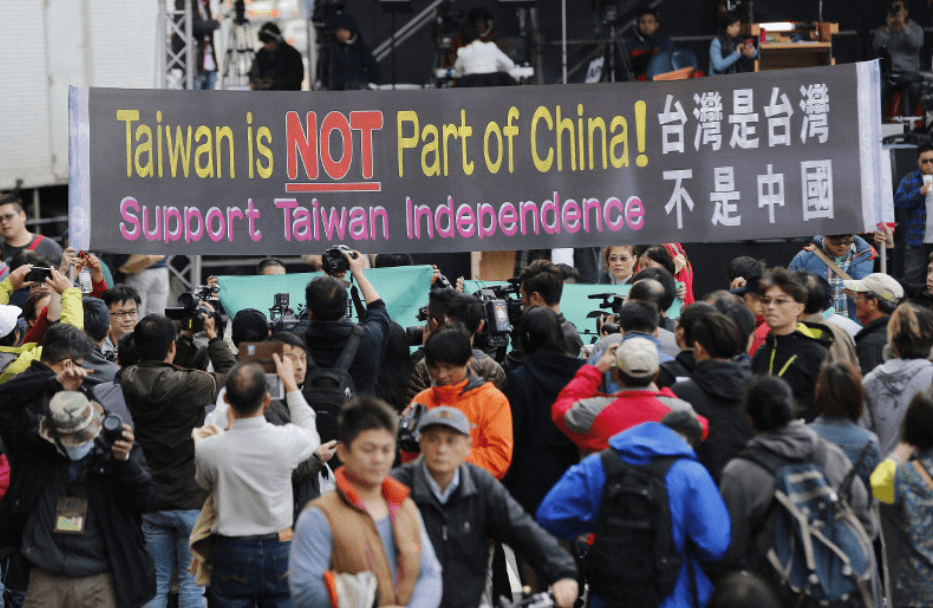
There is no single Taiwanese opinion.
Some Taiwanese identify primarily as Taiwanese. Others identify as both Taiwanese and Chinese. A smaller proportion identifies primarily as Chinese.
But long-term polling shows a dramatic transformation in identity.
The Election Study Center at National Chengchi University has maintained a major series tracking Taiwanese and Chinese identity since 1992, as well as attitudes toward independence and unification. The latest dataset runs through June 2026.
The broad trend is unmistakable: Taiwanese identity has become substantially stronger while exclusively Chinese identity has declined.
This does not mean that every Taiwanese person supports formal independence.
In fact, the political reality is more complicated.
Many Taiwanese prefer maintaining the existing situation rather than making a dramatic declaration of independence or accepting political unification with Beijing.
That position is often described as maintaining the status quo.
The Status Quo Is More Complicated Than “Independence”
Taiwan effectively governs itself.
It has:
- its own elected government;
- its own armed forces;
- its own currency;
- its own passport;
- its own courts;
- its own immigration controls;
- its own tax system;
- its own democratic elections;
- extensive international trade;
- and a population of more than 23 million people.
Yet Taiwan is not a member of the United Nations and is formally recognised as the Republic of China by only a small group of states.
This produces one of the world’s most unusual international situations.
Taiwan operates like a state in many practical respects while lacking broad formal diplomatic recognition.
How Many Countries Recognise Taiwan?
As of June 2026, Taiwan’s Ministry of Foreign Affairs lists 12 diplomatic allies. They are:
East Asia and Pacific
- Marshall Islands
- Palau
- Tuvalu
Africa
- Eswatini
Europe
- Holy See
Latin America and Caribbean
- Belize
- Guatemala
- Haiti
- Paraguay
- Saint Kitts and Nevis
- Saint Lucia
- Saint Vincent and the Grenadines
Taiwan’s Foreign Ministry lists these 12 governments as maintaining formal diplomatic relations with the Republic of China.
The United Kingdom similarly states that only 12 countries formally recognise Taiwan as the Republic of China.
But that number should not be confused with the number of countries that support Taiwan’s existence, democracy, security or participation in international organisations.
That group is much larger.
The United States: Recognition Without Formal Recognition of Taiwan
The United States is perhaps the clearest example of the international ambiguity surrounding Taiwan.
Washington switched diplomatic recognition from Taipei to Beijing in 1979.
The US recognised the government of the People’s Republic of China as the sole legal government of China and maintained unofficial relations with Taiwan.
At the same time, the Taiwan Relations Act created a legal framework for unofficial US-Taiwan relations and established US policy concerning Taiwan’s defensive capabilities and security.
This is not the same thing as formally recognising Taiwan as an independent country.
It is also not the same thing as accepting Beijing’s complete interpretation of the Taiwan question.
This distinction is the essence of what is often called strategic ambiguity.
What Does “One China Policy” Actually Mean?
The phrase “One China” is frequently treated as though it has a single universally accepted definition.
It does not.
There is an important distinction between:
Beijing’s One China principle
and
the individual One China policies adopted by foreign governments.
Beijing’s position is that there is one China, Taiwan is part of China, and the People’s Republic of China is the sole legal government representing China.
Individual governments have their own diplomatic formulations.
The US-China Joint Communiqué of 1979, for example, said that the United States recognised the PRC government as the sole legal government of China and that Americans would maintain unofficial relations with Taiwan. It also stated that Washington “acknowledges the Chinese position” that there is one China and Taiwan is part of China.
That wording is significant.
“Recognise the government of the PRC” and “acknowledge the Chinese position” are not necessarily identical to adopting every legal and political claim made by Beijing.
Other countries use their own formulations.
The United Kingdom, for example, explicitly says that it does not recognise Taiwan as a state and has no diplomatic relations with Taiwan, while maintaining a strong unofficial relationship with Taipei.
Why Does the World Avoid Recognising Taiwan?
The answer is largely geopolitical.
The People’s Republic of China is one of the world’s major powers and treats Taiwan as a core sovereignty issue.
Beijing has consistently opposed formal diplomatic recognition of Taiwan by other governments and regards moves toward Taiwanese independence as unacceptable.
For many countries, establishing formal diplomatic relations with Taipei would therefore mean risking their diplomatic relationship with Beijing.
Consequently, governments have developed an alternative model:
recognise Beijing diplomatically while maintaining substantial unofficial relations with Taipei.
This allows countries to trade with Taiwan, maintain representative offices, cooperate in technology and education, receive Taiwanese investment and support Taiwan’s participation in selected international institutions without formally recognising Taiwan as a separate sovereign state.
Taiwan’s International Presence Is Far Larger Than Its Diplomatic Allies
The number “12” can therefore be misleading if interpreted as the number of countries that have relations with Taiwan.
Taiwan has extensive unofficial relations with countries across Europe, North America and the Indo-Pacific.
The United Kingdom maintains an unofficial relationship.
The United States maintains extensive unofficial relations.
Japan maintains deep economic and people-to-people ties.
Australia, Canada, France, Germany and New Zealand are among countries that have publicly supported Taiwan’s meaningful participation in international organisations.
In May 2026, representative offices in Taiwan from the UK, Japan, Australia, Canada, Germany, France, New Zealand, Lithuania and Poland jointly reiterated support for Taiwan’s participation in the World Health Organization and World Health Assembly.
That is an important distinction.
Formal recognition is one measure of international support. It is not the only measure.
UN Resolution 2758 Did Not Resolve Every Question About Taiwan
Another frequently misunderstood element is United Nations General Assembly Resolution 2758.
In 1971, the United Nations recognised the People’s Republic of China as the representative of China at the United Nations and removed the representatives of Chiang Kai-shek’s government.
The resolution changed who represented China at the UN.
It did not create a universally accepted settlement of every question concerning Taiwan’s sovereignty.
This distinction has become increasingly important in international debate.
Taiwan is therefore outside the UN system while being economically and politically connected to a large part of the international community.
Malaysia’s Position and Why Anwar’s Statement Matters
Malaysia recognised the People’s Republic of China in 1974, establishing diplomatic relations under the framework of the Malaysia-China Joint Communiqué.
For decades, Kuala Lumpur has maintained a One China policy.
But Anwar Ibrahim’s recent remarks have attracted attention because they appear to go further than a simple statement that Malaysia recognises Beijing diplomatically.
According to the account published by The Rakyat Post, Anwar said he viewed Taiwan as part of China and accepted the possibility of force to prevent separation.
That distinction matters.
A country can maintain a One China policy while simultaneously opposing unilateral changes to the status quo or refusing to endorse the use of force.
Indeed, much of the international diplomatic language surrounding Taiwan deliberately leaves room for this distinction.
Anwar’s reported formulation therefore carries political significance beyond the existence of Malaysia’s longstanding One China policy.
Taiwan’s Economic Importance Makes the Debate More Than Diplomatic
Taiwan is not merely a geopolitical flashpoint.
It is one of the world’s most important technology economies.
Its semiconductor industry is deeply integrated into global supply chains, particularly through Taiwan Semiconductor Manufacturing Company and a broad network of electronics manufacturers and suppliers.
For Southeast Asia, Taiwan is also an important source of investment.
That is why statements about Taiwan can have economic consequences.
Taipei’s criticism of Anwar’s comments reportedly warned that political rhetoric portraying Taiwan exclusively through Beijing’s position could affect Taiwanese business confidence in Malaysia.
The issue is particularly sensitive for Malaysia because the country has become an important part of the global electronics and semiconductor supply chain.
The Taiwan question therefore connects sovereignty, democracy, economics, technology and regional security.
What Do Taiwanese People Actually Want?
The simplest answer is:
Most Taiwanese people do not want Beijing deciding their future.
That does not automatically mean that most want an immediate formal declaration of independence.
Recent Taiwanese government polling found that 84.7% supported maintaining the status quo in a broad sense and 83.9% agreed that Taiwan’s future should be decided by its 23 million people. The same survey found 79.5% disagreed with Beijing’s insistence on unification under its “one China principle.”
A 2025 Mainland Affairs Council survey similarly found that 86.4% supported maintaining the broader status quo, while 83.1% agreed that Taiwan’s future should be decided by its people.
These figures should be interpreted carefully because they come from Taiwan’s own government polling. Independent academic polling, particularly the long-running National Chengchi University series, provides an additional reference point for studying identity and unification-independence attitudes.
The larger picture is clear: Taiwanese society has developed a political identity that cannot simply be assumed to coincide with Beijing’s conception of Chinese national identity.
The Central Question Is No Longer Only “Is Taiwan Chinese?”
History makes the Taiwan question complicated because Taiwanese society contains multiple layers of identity.
Taiwan has Chinese cultural influences.
It has Indigenous peoples and traditions.
It experienced Japanese colonial rule.
It was governed by the Republic of China after 1945.
It became the stronghold of the ROC government after 1949.
And it subsequently transformed into a democratic society with its own political identity.
Therefore, asking whether Taiwanese people are “Chinese” can obscure the more important political question.
Who has the right to determine Taiwan’s political future?
Beijing answers:
The Chinese state and the principle of national reunification.
Taipei’s democratic system increasingly answers:
The people living in Taiwan must have the decisive voice.
Most governments deliberately avoid choosing one of these answers explicitly.
The World’s Deliberate Ambiguity
This is why Taiwan occupies such a peculiar position.
There are 12 formal diplomatic allies.
There are dozens of governments that do not formally recognise Taiwan as a sovereign state but maintain substantial unofficial relations with it.
There are countries that recognise Beijing’s government as the government of China but do not necessarily endorse every aspect of Beijing’s interpretation of Taiwan’s status.
There are governments that oppose unilateral changes to the status quo.
There are governments that support Taiwan’s participation in international organisations where statehood is not necessarily a prerequisite.
And there are governments that maintain strategic ambiguity because they want to discourage both Chinese coercion and unilateral Taiwanese moves that could trigger a wider crisis.
This is not diplomatic confusion.
In many cases, the ambiguity is deliberate.
It gives governments room to maintain relations with Beijing while preserving practical ties with Taipei.
Why Anwar’s Statement Is Significant
Anwar Ibrahim’s reported comments are therefore important not simply because Malaysia already has a One China policy.
The significance lies in the apparent movement from diplomatic ambiguity toward a more explicit endorsement of Beijing’s interpretation.
There is a major difference between saying:
“Malaysia recognises the People’s Republic of China as the government of China.”
and saying:
“Taiwan is part of China and force is justified to prevent separation.”
The first describes a diplomatic relationship.
The second moves toward a substantive position on Taiwan’s sovereignty and the legitimacy of coercion.
That distinction explains Taiwan’s strong reaction.
It also explains why Beijing welcomed the statement.
Taiwan in 2026: A State Without Broad Diplomatic Recognition
Taiwan’s position in the international system is therefore unusual but not meaningless.
It is not a member of the United Nations.
Only 12 governments maintain formal diplomatic relations with the Republic of China.
Yet Taiwan maintains extensive economic and unofficial diplomatic relationships throughout the world.
Its people elect their leaders.
Its government controls the territory it administers.
Its institutions operate independently of the People’s Republic of China.
Its economy is deeply integrated into global supply chains.
And its society has developed an increasingly distinct political identity.
The unresolved question is not whether Taiwan functions independently in everyday governance.
It clearly does.
The unresolved question is how the international community should describe that reality in legal and diplomatic terms.
Conclusion: Taiwan Exists in the Space Between Recognition and Reality
The Taiwan question cannot be understood through a single sentence such as “Taiwan is part of China” or “Taiwan is an independent country.”
Those statements represent competing political positions in a dispute that has remained unresolved since the Chinese Civil War.
Historically, Taiwan passed through Qing rule, Japanese colonial rule, post-war ROC administration, authoritarian government and ultimately democratic transformation. Since 1949, the People’s Republic of China has governed mainland China while the Republic of China has governed Taiwan.
The Taiwanese people have subsequently developed their own democratic political system and an increasingly distinct identity.
Most countries have chosen not to formally recognise Taiwan as a separate sovereign state because of their diplomatic relationships with Beijing.
But formal non-recognition does not mean that these governments regard Taiwan as politically irrelevant.
The opposite is often true.
The United States, Japan, European countries, Australia and many others maintain extensive unofficial relations with Taiwan while opposing coercive changes to the status quo.
That is the paradox at the centre of the Taiwan Strait.
Taiwan is diplomatically isolated but internationally connected.
It is formally recognised by only 12 governments but maintains substantial unofficial relations with many more.
Most Taiwanese prefer the existing status quo, while increasingly identifying primarily as Taiwanese.
And the international community continues to use carefully constructed language because the alternative could force governments to take a definitive position on one of the world’s most dangerous geopolitical disputes.
Anwar Ibrahim’s latest comments bring that ambiguity into sharp focus.
The question facing the world is therefore not simply whether Taiwan is “part of China.”
It is whether the future of 23 million people should ultimately be determined by the government in Beijing, by the people and democratic institutions in Taiwan, or through a negotiated settlement that neither side currently accepts.
Until that question is resolved, Taiwan will remain one of the world’s most consequential examples of the difference between de facto self-government, diplomatic recognition and contested sovereignty.