A new kind of alliance
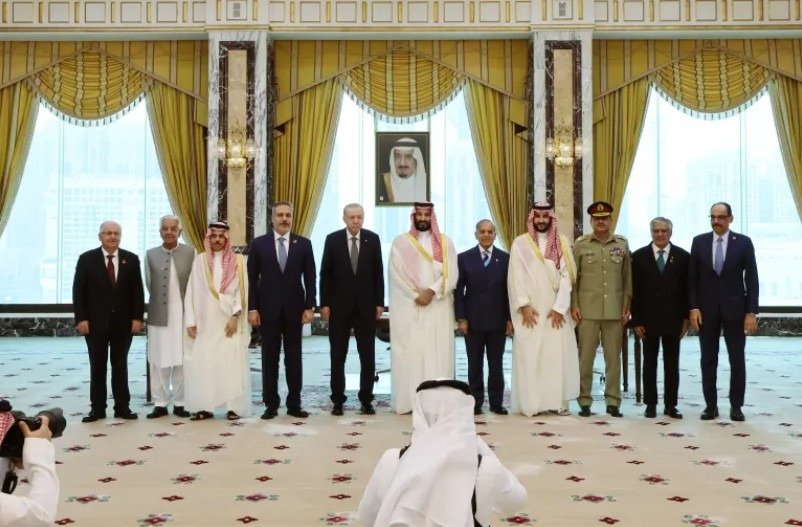
On August 7, 2026, three leaders stood beneath a portrait of the late Saudi King Salman in Mecca and signed a document that, on paper, looked modest: a promise that an attack on any one of Saudi Arabia, Turkey, or Pakistan would be treated as an attack on all three. In practice, the Makkah Joint Defence Agreement is one of the more consequential shifts in Middle Eastern security architecture in decades: a Gulf energy giant, a NATO member with the alliance’s second-largest military, and the Muslim world’s only nuclear-armed state binding themselves together outside Washington’s security umbrella.
The pact builds on a bilateral Saudi-Pakistan defense agreement from September 2025 and arrives against a grim backdrop: the 2026 Iran war, renewed fighting between Saudi-backed Yemeni forces and the Houthis, and, perhaps most tellingly, Israel’s missile strikes on Hamas leadership inside Qatar, a country that hosts the largest US airbase in the region. That strike, on a nominal American ally, did more than months of diplomatic hedging to convince Gulf capitals that Washington’s guarantees have limits.
All three signatories have gone out of their way to insist the pact isn’t a military bloc aimed at anyone in particular. Saudi and Turkish officials called it a deterrent, not an escalation, and left the door open for other Gulf Cooperation Council states, Qatar and Kuwait are seen as likely candidates, to join. Iran was unconvinced: a member of its parliament’s national security committee dismissed the agreement as a “paper” substitute for real security, arguing that decades of dependence on the US hadn’t kept the Saudis safe either.
Why this counts as a break from Washington
For half a century, the region’s defining bargain was simple: Gulf states got American protection and market access; the US got energy security, basing rights, and geopolitical leverage. That bargain is fraying for reasons only partly related to China. Successive US administrations have signaled fatigue with Middle East entanglements, the Qatar strike exposed the limits of extended deterrence even for treaty-adjacent partners, and the region’s own capabilities, Turkish drones, Pakistani nuclear weapons, Saudi financial muscle, have matured to the point where a self-help coalition looks plausible for the first time since the early Cold War.
That’s what makes the Mecca pact more than a regional curiosity. Independent, non-US-anchored defense pacts among middle powers have been rare for 70 years. If it holds and expands, it offers a template other US partners, in Asia, in Europe, might study when they, too, wonder how much they can rely on Washington.
Where China fits, and where it doesn’t
Beijing did not orchestrate the Mecca pact and has not endorsed it, but the agreement lands in the middle of a decade of steadily deepening Chinese engagement with the Gulf. China buys around 40% of its crude oil from the wider Middle East, with Saudi Arabia and the UAE its top two suppliers. Gulf-China trade topped roughly $300 billion in 2024, more than the region’s combined trade with the US and EU. China is Saudi Arabia’s largest trading partner, the UAE’s largest non-oil export market, and Iraq’s fastest-growing trade partner, with bilateral trade up nearly 80% between 2020 and 2024. Beijing has also sold combat drones to Saudi Arabia, the UAE, Egypt, Iraq, and Jordan, though its arms exports to the region remain a small fraction of America’s.
China’s most dramatic political intervention came in 2023, when it brokered the restoration of diplomatic ties between Saudi Arabia and Iran, a coup that let Beijing present itself as a serious diplomatic actor rather than merely an oil buyer. Analysts at Fudan University and elsewhere note that Riyadh’s current unease, following the Qatar strike and the wider regional turmoil, stems partly from a perception that Israel enjoys something close to a regional “nuclear monopoly”, a perception China has quietly avoided commenting on.
But there are real limits to how far Beijing wants to go. China has deep, competing relationships with both Saudi Arabia and Iran, and has historically avoided taking sides in their rivalry precisely to protect its access to both. The Saudi-Pakistan defense pact, with its unresolved ambiguity over whether it extends Pakistan’s nuclear umbrella to the Kingdom, puts Beijing in an awkward spot: it has civil nuclear cooperation with Riyadh and doesn’t want to be seen encouraging proliferation or provoking Washington, which watches Chinese-linked nuclear cooperation closely. Foreign policy analysts describe Beijing as lacking any real appetite to become a security guarantor in the Gulf at all; the chaos of the Iran war, if anything, reinforced China’s long-standing preference to stay out of hard-security commitments and let the US continue absorbing that cost and risk.
That has produced what analysts call a “division of labor” that suits Beijing well: the US remains the region’s security backstop, while China embeds itself ever more deeply as the top buyer of its oil and an increasingly important source of investment, infrastructure, and diplomatic cover. China gets the economic upside of Gulf hedging against America without having to write anyone a security guarantee it can’t easily walk back.
What Washington and others are watching
For the US, the Mecca pact is a warning sign more than an emergency. It doesn’t evict American forces from the region or terminate any formal alliance, but it signals that Gulf states are actively building insurance policies that don’t run through Washington, and that they’re comfortable doing so publicly. Combined with Gulf states’ accelerating economic tilt toward China (Saudi Arabia and the UAE have both joined BRICS, and talks continue on a long-stalled China-GCC free trade agreement), the pattern is one of diversification rather than defection: Gulf states aren’t abandoning the US relationship, but they’re no longer willing to rely on it exclusively.
India is watching closely too. New Delhi has previously said it would study the implications of Saudi-Pakistan defense cooperation for its own security, given Pakistan’s involvement, and the expanded trilateral pact raises the stakes further, potentially pushing India to reassess its own hedging between Washington, Moscow, and the Gulf.
The bottom line
The Mecca pact doesn’t hand China a security role in the Middle East. Beijing shows no sign of wanting one, and structurally isn’t positioned to provide one the way the US Navy or Air Force can. What it does is confirm that the old US-centered security bargain in the Gulf is weakening under its own strain, opening space for China to keep doing what it has done successfully for a decade: expand economic and diplomatic influence while leaving the expensive, risky business of regional security to somebody else. For now, that somebody else is still the United States: just a version of the United States that Gulf states trust considerably less than they used to.
Sources: South China Morning Post, Al Jazeera, CNN, Reuters/AFP via Gulf News, Foreign Affairs, CSIS, Middle East Council on Global Affairs, Asia Times, Wikipedia.