Introduction
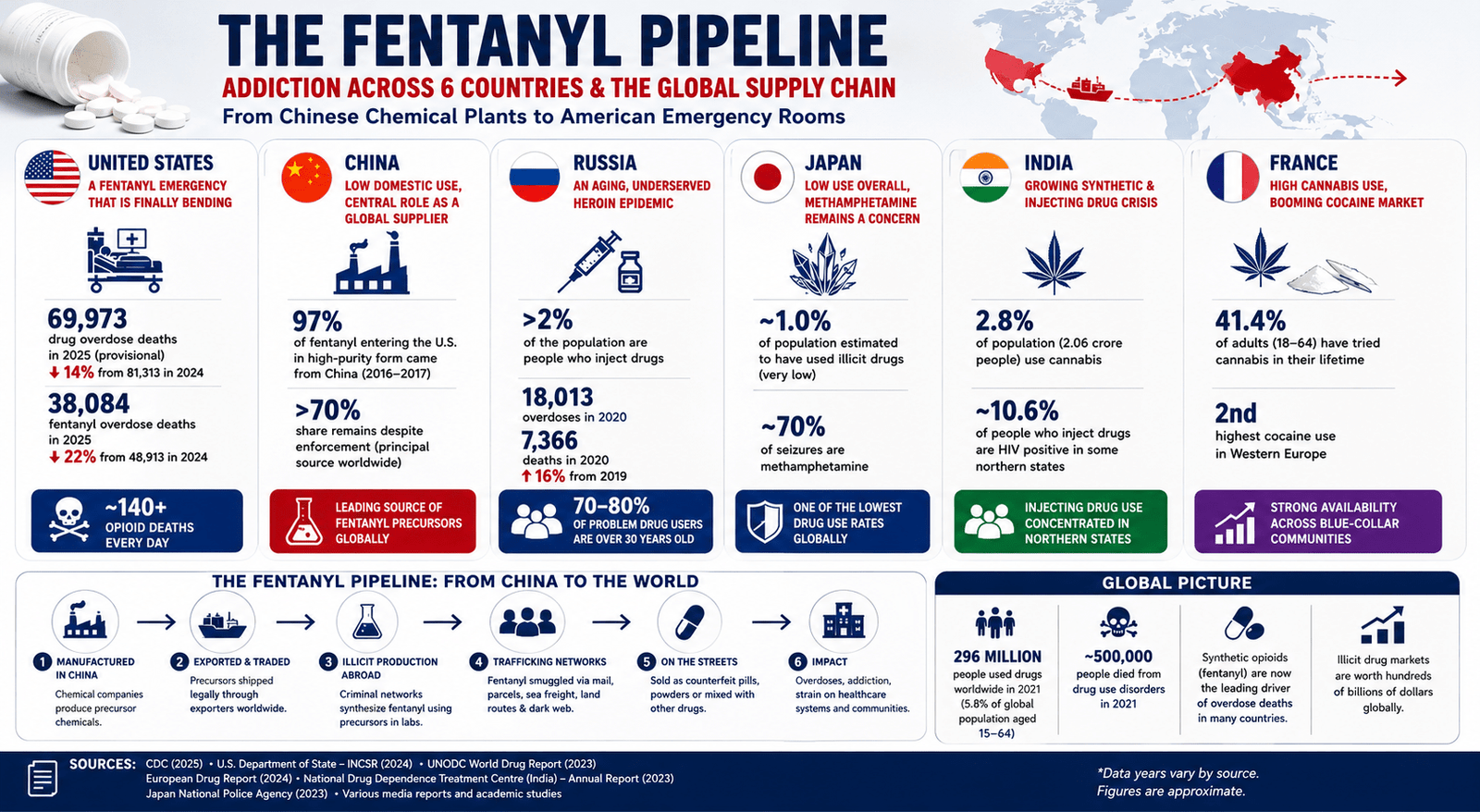
Drug addiction looks completely different depending on where you stand. In the United States it means fentanyl-laced pills and a decades-long opioid emergency. In China it means a state that has all but eliminated the heroin epidemics of the 1990s through mass surveillance and harsh enforcement, while its chemical industry quietly supplies the raw materials for other countries’ crises. In Russia it means an aging population of injecting heroin users cut off from harm-reduction support. In Japan it means one of the lowest drug-use rates on earth, offset by a stubborn methamphetamine subculture. In India it means a mostly licit-drug and cannabis problem layered on top of a fast-growing synthetic and injecting-drug crisis in the northern states. In France it means a booming, blue-collar cocaine market alongside Western Europe’s most entrenched cannabis use.
This article compares addiction patterns across these six countries and then walks through the single supply chain that connects two of them most directly: the fentanyl pipeline that begins in Chinese chemical plants and ends in American emergency rooms.
A note on the data: national drug statistics are collected through different surveys, different years and different definitions, so cross-country comparisons should be read as broad pictures rather than precise rankings.
United States: A Fentanyl Emergency That Is Finally Bending
The U.S. has the deadliest illicit drug supply among wealthy nations, driven almost entirely by illegally manufactured fentanyl, a synthetic opioid roughly 50 times more potent than heroin and 100 times more potent than morphine — a dose the size of a few grains of salt can kill. Drug overdoses became the leading cause of death for Americans aged 18–44, and deaths peaked at nearly 110,000 in 2022.
There is, however, genuinely encouraging recent news. CDC provisional data indicate there were an estimated 69,973 drug overdose deaths in the United States during 2025 — a decrease of almost 14% from the 81,313 deaths estimated in 2024, marking a third consecutive year of decline. Fentanyl overdose deaths specifically fell 22% between 2024 and 2025, dropping from 48,913 to 38,084. Researchers attribute the turnaround to several overlapping factors: a shrinking pool of people still vulnerable to opioid overdose after years of losses, wider distribution of the overdose-reversal drug naloxone, growing fentanyl-test-strip use, and possibly some disruption of supply.
Even with the improvement, the burden remains historic. Opioids were involved in roughly two-thirds of U.S. overdose deaths in the year ending March 2025, and synthetic opioids including fentanyl accounted for nearly 58% of all overdose deaths — more than 140 opioid deaths a day. Cocaine, methamphetamine and counterfeit prescription pills laced with fentanyl remain major secondary threats, and the crisis has left a lasting mark on life expectancy, foster-care systems and emergency medicine in the hardest-hit states (West Virginia, Ohio, and parts of Appalachia and New England).
China: Low Domestic Use, Central Role as a Global Supplier
China presents an almost inverted picture. Domestic illicit drug use is comparatively low and has fallen sharply since the early 2010s, the product of an intensely enforcement-driven system – mandatory drug testing, compulsory rehabilitation centers, the death penalty for large-scale trafficking, and a cultural memory of the 19th-century Opium Wars that shapes public attitudes toward narcotics. A Chinese psychiatry professor has noted that the Opium War remains “an eternal pain for the Chinese people,” and that doctors, families and patients alike stay vigilant about opioids as a result, keeping the country’s opioid-use levels extremely limited.
Where China matters most to the global drug story is on the supply side.
Its vast, loosely policed chemical and pharmaceutical manufacturing sector has made it the leading global source of fentanyl precursor chemicals – and, until Beijing tightened controls, of finished fentanyl itself. China supplied an estimated 97% of the fentanyl entering the United States in high-purity form during 2016–2017, a share that fell to over 70% in subsequent years as enforcement increased, though it remained the principal source worldwide. Vendors selling fentanyl and its precursor chemicals have clustered in China’s industrial interior, where local policing tends to be lighter; of dozens of such sellers identified with verifiable addresses, a large share were registered in the city of Shijiazhuang.
Beijing has taken some regulatory steps – scheduling fentanyl as a full drug class and controlling key precursors as early as 2019 – but U.S. officials have repeatedly described enforcement as inconsistent. The State Department’s most recent International Narcotics Control Strategy Report concluded that China’s enforcement of its own counternarcotics regulations “remains uneven and opaque,” and that Chinese authorities have often not acted against companies selling unscheduled precursor chemicals used to manufacture illicit drugs.
Russia: An Aging, Underserved Heroin Epidemic
Russia’s drug crisis is older and less visible internationally than America’s, but no less severe for those caught in it. Russia has for years suffered a widespread injecting-drug epidemic, with an estimated more than 2% of the population being people who inject drugs.
In 2020 alone, 18,013 people overdosed on illicit drugs in Russia and 7,366 died, a 16% increase over the prior year.
Most Russian drug use centers on opiates, historically heroin smuggled overland from Afghanistan. More than 90% of opiates entering Russia have been smuggled from Afghanistan and other Central Asian states, and availability remains high and prices low across virtually every region of the country. Russia’s response has leaned almost entirely on criminalization rather than treatment: opioid substitution therapy (methadone or buprenorphine maintenance), the standard harm-reduction tool used across Western Europe and North America, remains illegal in Russia, and needle-exchange and other harm-reduction programs have been curtailed under increasingly restrictive drug laws. Public health researchers and Russian outlets have also linked the war in Ukraine to worsening drug use, alongside poverty and depression, in Russian society since 2022.
Japan: One of the World’s Lowest Rates, With a Persistent Meth Problem
Japan is a global outlier for how little of its population uses illicit drugs – cannabis, opioids and cocaine use all sit at a small fraction of Western levels, reflecting intense social stigma, strict criminal penalties (including for simple possession) and limited availability. Where Japan does have a drug problem, it is heavily concentrated in one substance: methamphetamine.
Japan’s own treatment records – dated but illustrative – show methamphetamine as by far the leading drug among people entering treatment, followed by solvents and inhalants, a pattern that traces back to the drug’s post-war spread through Japanese society and its continued supply via organized-crime (yakuza) networks connected to production hubs in China and Southeast Asia’s Golden Triangle. Overdose deaths and mass fentanyl contamination of the kind seen in North America have not materialized in Japan, partly because its drug markets remain smaller, more tightly policed and less integrated into the fentanyl-driven supply chains reshaping North America and parts of Europe.
India: A Licit-Drug and Cannabis Baseline, With a Rising Opioid and Injecting-Drug Crisis
India’s drug landscape is shaped by its sheer population size and by a long history of licit opium and cannabis cultivation for traditional and pharmaceutical use. According to UNODC’s World Drug Report, cannabis remains the most widely used drug worldwide with 228 million users, followed by opioids at 60 million users, and India is a major contributor to both categories. National surveys put cannabis use in India at roughly 31 million people (about 2.8% of the population), while opioid use – spanning opium, heroin and diverted prescription painkillers – affects tens of millions more.
The more alarming trend is regional and specific: opioid dependence and injecting drug use concentrated in province of Punjab, and parts of the northeast India bordering Myanmar’s Golden Triangle. An estimated 11.8 million people in India are injecting drug users, a group at significantly elevated risk of HIV, hepatitis B and hepatitis C.
Treatment access lags badly behind need: of an estimated 22.6 million opioid users nationwide, only about 25% of those requiring treatment actually seek it, and fewer than 5% receive inpatient care. India’s Narcotic Drugs and Psychotropic Substances Act (1985) underpins a heavily enforcement-oriented system, but conviction rates in drug cases have stayed below 0.1% even as seizures and arrests have climbed sharply in recent years. India’s chemical and pharmaceutical manufacturing base – like China’s – has also drawn scrutiny as a potential alternative source of fentanyl precursor chemicals should Chinese supply tighten further.
France: Cannabis Dominance, and a Fast-Growing Cocaine Market
France’s drug-use profile looks distinctly Western European: cannabis is overwhelmingly the most-used illegal substance, but the standout recent trend is a rapid rise in cocaine use. Roughly 1.1 million people in France used cocaine at least once in 2023, according to the French Monitoring Centre for Drugs and Drug Addiction (OFDT) – nearly double the 600,000 users recorded a year earlier, and enough to put France in 7th place in Europe for cocaine consumption. Cannabis remains the most popular illegal drug overall, with about five million annual users in 2023.
OFDT researchers attribute cocaine’s rise to a mix of supply and demand forces: record-high global cocaine production and a shift in the drug’s image- no longer seen only as a recreational drug for the wealthy, but increasingly used to cope with intense workloads or physically demanding jobs in industries like fishing. On the supply side, the port of Le Havre has become one of Europe’s principal cocaine entry points, though enhanced security there contributed to a 16% drop in national cocaine seizures in 2023, to 23.2 tonnes. France has also seen rising drug-related violence as trafficking networks – increasingly organized through dark-web sales, Telegram and home delivery – compete for market share, spreading gang conflict beyond traditional hot spots into smaller towns. Heroin use, by contrast, has stayed low and geographically concentrated, and France has so far avoided the fentanyl contamination seen in North America.
The Fentanyl Pipeline: How a Chinese Chemical Becomes an American Overdose
Fentanyl’s journey from a Chinese laboratory to an American street pill runs through a well-documented, multi-stage smuggling network.
1. Precursor and finished-drug production in China. China’s enormous, only partially regulated chemical and pharmaceutical sector produces both the precursor chemicals needed to synthesize fentanyl and, in some cases, finished fentanyl or fentanyl analogs sold directly online. Vendors operating out of industrial cities market these products openly on business-to-business platforms and, increasingly, the dark web, often marketed as “research chemicals” to evade classification as controlled substances.
2. Diversion through South and Southeast Asia. From China, precursor chemicals and, in some cases, finished product move onward through countries including Myanmar, India and Vietnam – either as transshipment points or as locations where illicit labs process precursors into fentanyl or related synthetic opioids before the drugs continue toward final markets.
3. Transit to the Americas, Australia and Europe. From South and Southeast Asia, product and precursors reach Mexico, Australia and European markets through both formal shipping channels and informal smuggling routes, exploiting gaps in customs inspection at ports and international mail facilities.
4. Cartel processing and smuggling into the United States. In Mexico, powerful trafficking organizations – most notably the Sinaloa Cartel and the Jalisco New Generation Cartel (CJNG) – receive precursor chemicals and finished fentanyl from Chinese and Southeast Asian suppliers, press the drug into counterfeit prescription pills or mix it into heroin and cocaine, and smuggle it across the U.S. southern border. U.S. Drug Enforcement Administration intelligence has mapped these routes in detail, and both cartels are now considered the dominant fentanyl traffickers supplying the American market.
5. Retail sale, including via the dark web. Fentanyl and fentanyl-laced products reach American buyers through traditional street-level dealing and increasingly through dark-web marketplaces paid for in cryptocurrency, complicating law-enforcement efforts to trace transactions back to suppliers.
Seizure patterns highlight where this pipeline is most concentrated: land-border crossings account for the largest volume of fentanyl interceptions, while shipments through international mail and express-courier facilities — though smaller in volume — tend to be far higher in purity, often exceeding 90%.
The Diplomatic Dimension
Fentanyl has become one of the most consequential single issues in the U.S.-China relationship. Since 1999, drug overdoses have killed approximately one million Americans, with overdose lethality rising sharply after 2012 as Chinese-sourced synthetic opioids began supplying the American illicit-opioid market. In August 2022, a U.S.-China Economic and Security Review Commission report characterized bilateral cooperation on curbing fentanyl trafficking as “weak,” hindering U.S. crackdown efforts, and China suspended narcotics cooperation with Washington that year in protest of a congressional visit to Taiwan.
Cooperation has since been renegotiated repeatedly, largely tied to broader U.S.-China trade diplomacy:
- Formal counternarcotics cooperation resumed after a 2023 summit between then-President Biden and Xi Jinping, with China agreeing to schedule additional precursor chemicals.
- In 2025 the second Trump administration imposed tariffs on China explicitly justified by its role in the fentanyl trade, raising the rate to 20% before, following a China-U.S. summit in Busan, South Korea in October 2025, China agreed to tighten controls on 13 additional fentanyl precursor chemicals and the U.S. cut the tariff to 10%.
- In December 2025 the Trump administration designated illicit fentanyl and its core precursor chemicals as weapons of mass destruction by executive order.
- In February 2026 the U.S. Supreme Court ruled the fentanyl-linked tariffs unconstitutional in Learning Resources, Inc. v. Trump, and they were eliminated, even as the underlying precursor-control commitments from China remained in place.
- A May 2026 U.S.-China summit produced U.S. readouts describing “progress in ending the flow of fentanyl precursors,” and following that summit Chinese authorities issued a circular urging chemical companies to keep several additional unscheduled chemicals out of illegal drug-production channels.
Analysts remain skeptical that precursor-by-precursor scheduling can solve the problem on its own. Experts note that “constant innovations” in cooking fentanyl from non-scheduled precursor chemicals, combined with gaps in Chinese law around material-support and conspiracy offenses, mean chemical producers can often simply pivot to new, still-legal substances as fast as old ones are banned – a pattern some describe as regulatory whack-a-mole, with India’s less-regulated chemical industry flagged as one possible next source if Chinese controls genuinely tighten.
Comparing the Six Countries at a Glance
| Country | Dominant substance(s) | Defining feature |
|---|---|---|
| United States | Fentanyl, other synthetic opioids | Deadliest overdose crisis among wealthy nations; deaths falling but still historically high |
| China | Low domestic use overall; methamphetamine in some regions | World’s leading source of fentanyl and its precursor chemicals despite tight domestic drug laws |
| Russia | Heroin and other opiates | High injecting-drug prevalence; opioid substitution therapy remains illegal, limiting treatment |
| Japan | Methamphetamine | One of the world’s lowest overall drug-use rates; meth tied to organized-crime networks |
| India | Cannabis, opioids (opium/heroin/prescription) | Large population of users and injecting drug users; treatment access badly lags need |
| France | Cannabis, rapidly rising cocaine use | Western Europe’s classic profile, with cocaine use nearly doubling in a single year (2022–2023) |
Conclusion
No two of these six countries face the same drug crisis, and none of them can be reduced to a single statistic. The United States is fighting the deadliest synthetic-opioid epidemic in modern history, even as the numbers finally move in the right direction. China has largely contained domestic addiction through severe enforcement while becoming, almost as a byproduct of its industrial scale, the world’s principal source of the chemicals behind that American crisis. Russia’s opiate epidemic persists in the shadows of a health system that refuses proven harm-reduction tools. Japan shows what strict social and legal deterrence can achieve, at least on paper, though it hasn’t eliminated methamphetamine use. India’s enormous population conceals both a longstanding licit-drug culture and an under-resourced opioid and injecting-drug emergency. And France illustrates how quickly a market can shift — from a cannabis-dominated profile to one increasingly shaped by cocaine flowing through its Atlantic ports.
The fentanyl story that runs from Chinese chemical suppliers through Mexican cartels to American streets is the clearest example of how thoroughly globalized the drug trade has become — and how difficult it has proven for even the world’s two most powerful governments to fully contain a supply chain built on chemistry that keeps changing one molecule ahead of the law.
Sources: UNODC World Drug Report 2025 and UNODC Data Portal; U.S. CDC/National Center for Health Statistics; “Smuggling of the deadly Synthetic opioid FENTANYL,” Investigative Journalism Reportika (ij-reportika.com); PMC/Indian Journal of Community Medicine; French Monitoring Centre for Drugs and Drug Addiction (OFDT); White House and Congressional Research Service fact sheets on U.S.-China fentanyl cooperation; PIIE; China-US Focus; InSight Crime; Lowy Institute.
This is a sensitive public-health topic. If you or someone you know is struggling with drug use or addiction, support is available — in the U.S., the SAMHSA National Helpline is 1-800-662-4357.