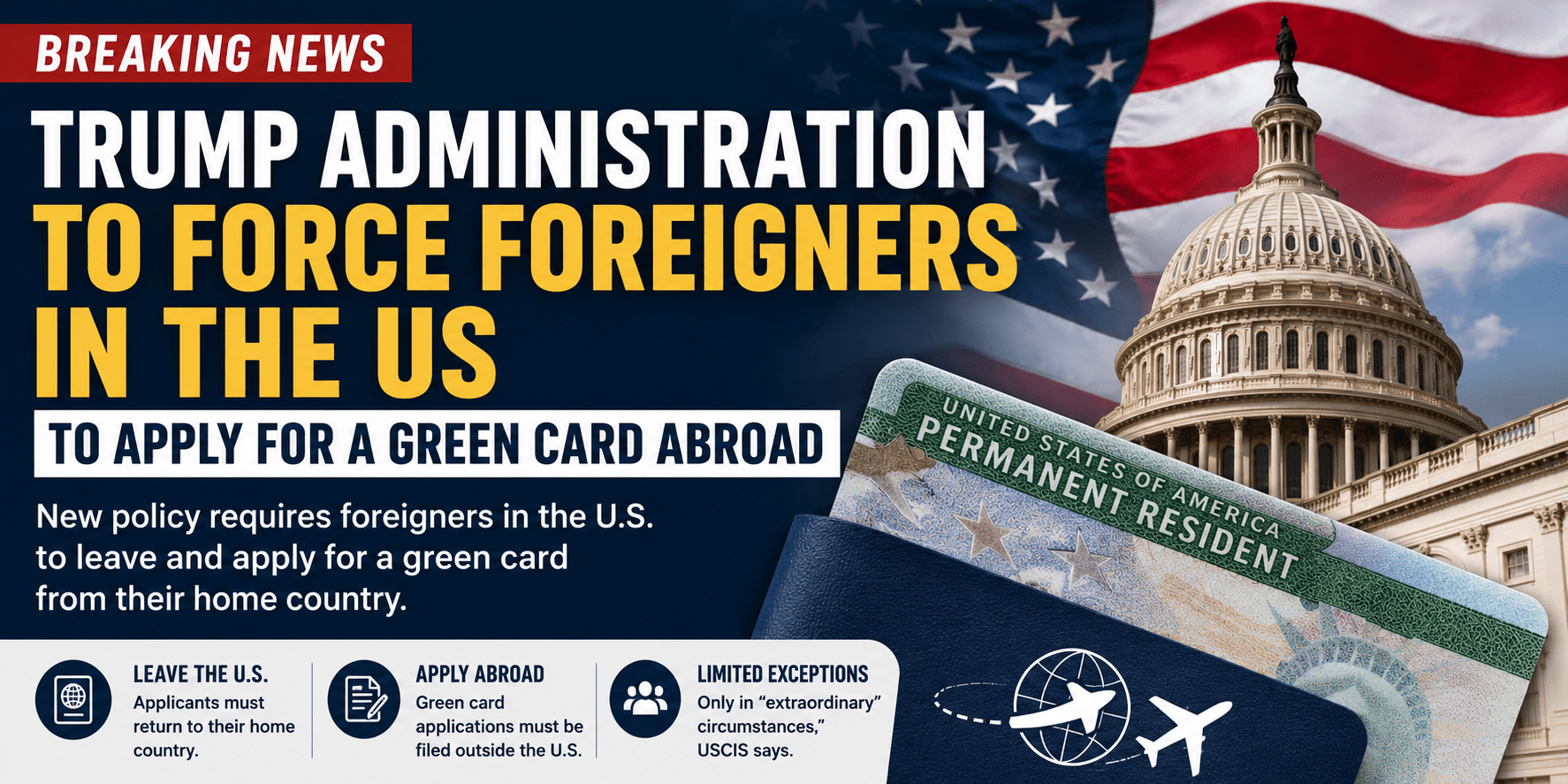
The administration of Donald Trump has announced a sweeping immigration policy change that would require many foreigners currently residing legally in the United States to leave the country and apply for permanent residency from their home nations.
The announcement, made Friday by U.S. Citizenship and Immigration Services (USCIS), marks one of the most significant shifts in U.S. immigration processing procedures in decades and has triggered concern among immigration lawyers, humanitarian organizations, and immigrant communities.
Under the new guidance, foreign nationals who are in the United States on temporary visas, including students, workers, tourists, and certain humanitarian entrants, would no longer be allowed to complete the green card process from within the country except in what USCIS described as “extraordinary circumstances.”
In a statement, the agency argued that temporary visas were never intended to serve as a pathway toward permanent residency.
“Nonimmigrants, like students, temporary workers, or people on tourist visas, come to the U.S. for a short time and for a specific purpose. Our system is designed for them to leave when their visit is over,”
USCIS stated
For more than 50 years, U.S. immigration law has allowed many eligible foreigners already in the country to “adjust status” and obtain lawful permanent residency without returning to their country of origin. The policy has commonly applied to spouses of U.S. citizens, employment-based visa holders, refugees, asylum seekers, and others with legal status.
Immigration analysts say the move could affect hundreds of thousands of people annually.
Doug Rand, a former senior adviser at USCIS during the administration of Joe Biden, estimated that around 600,000 people already in the U.S. apply for green cards each year.
“The goal of this policy is very explicit,” Rand said. “Senior officials in this administration have said repeatedly that they want fewer people to obtain permanent residency because permanent residency is a path to citizenship.”
USCIS has not clarified when the new rule will formally take effect or whether it will apply retroactively to applicants whose cases are already in progress. The agency also has not explained whether applicants forced to leave the U.S. would be permitted to return while their cases are pending.
In a statement to media outlets, USCIS suggested that individuals deemed beneficial to the U.S. economy or national interest could potentially remain in the country during processing.
The policy arrives amid broader immigration restrictions introduced by the Trump administration in recent months, including tighter visa scrutiny and travel limitations affecting multiple countries.
Immigration attorneys warned that the new system could create severe complications for families and vulnerable applicants, especially those from nations where U.S. embassies or visa processing operations are limited or suspended.
The closure of the U.S. Embassy in Afghanistan since the 2021 withdrawal remains one example frequently cited by critics. Advocacy groups argue that some applicants may effectively become stranded abroad indefinitely.
World Relief, a refugee resettlement and humanitarian organization, said the policy could separate families for prolonged periods if visa processing is unavailable in applicants’ home countries.
Immigration lawyers also expressed uncertainty over the scope of the policy and who exactly would be affected.
Shev Dalal-Dheini, senior director of government relations at the American Immigration Lawyers Association, said the guidance appears broad enough to potentially impact spouses of U.S. citizens, humanitarian migrants, employment visa holders, medical professionals, students, and religious workers.
“This all applies very broadly to anyone seeking a green card,” Dalal-Dheini said, adding that visa appointment backlogs at some U.S. consulates already exceed a year.
Legal aid groups reported receiving inquiries from anxious immigrants attempting to understand whether the change would affect their status or ongoing applications.
Jessie De Haven, senior staff attorney with the California Immigration Project, said the ambiguity surrounding implementation could discourage eligible immigrants from applying altogether.
“It’s really hard to tell how this is going to be applied,” De Haven said. “I do think it might have a chilling effect on people applying.”
The administration has defended the move as a restoration of what it describes as the original intent of immigration law and a measure to close what it calls a loophole in the adjustment-of-status system.
Critics, however, argue that the policy represents a major restructuring of legal immigration pathways and could deepen uncertainty for immigrant families already navigating lengthy and complex immigration procedures.