Czech venue pushes back against pressure from China to cancel Badiucao’s cartoons

Organizers of an exhibition by dissident cartoonist Badiucao in the Czech Republic have refused to cancel the event despite pressure from the Chinese embassy, who said his work “slanders Chinese leaders and hurts the feelings of the Chinese people.” Badiucao’s exhibit, which is touring the world under the title “MADe IN CHINA,” opened as planned on Thursday at the DOX Contemporary Art Center in Prague It includes works referencing the 1989 Tiananmen massacre, the 2019 protest movement in Hong Kong, Chinese support for the Russian invasion of Ukraine, the Chinese Communist Party (CCP)’s genocidal policies targeting Uyghurs and the ongoing COVID-19 lockdowns under CCP leader Xi Jinping’s zero-COVID policy. One work merges the faces of Xi and outgoing Hong Kong leader Carrie Lam, to express the erosion of Hong Kong’s freedoms under the CCP, while another merges Xi’s face with that of Russian president Vladimir Putin, the first work visitors see entering the exhibit. The works have clearly ruffled feathers in Beijing. On the afternoon of May 11, DOX Contemporary Art Center project director Michaela Šilpochová suddenly received a call from Hao Hong, a cultural affairs department official at the Chinese embassy, to her private cell phone. Hao Hong said they were calling on the order of the Chinese embassy, and accused Badiucao’s work of “smearing the image of China’s leaders” and “hurting the feelings of the Chinese people” and warned that the exhibition would “destroy the relationship between the two countries.” Šilpochová responded that the center wouldn’t cancel the show, with DOX Contemporary Art Center chief Leoš Válka saying that the Chinese embassy had tried to put pressure on him in the past, and his lack of cooperation was likely why they hadn’t called him again. He said DOX Art Center refused to tolerate “intimidation and threats.” Hao Hong confirmed she had made the call when contacted by RFA. “I expressed serious concern about this exhibition on behalf of the embassy, and told Šilpochová that they shouldn’t be putting on an exhibition that hurts the feelings of the Chinese people,” Hao said. “I heard that this exhibition had already been held in Italy, so we knew the content of this exhibition.” “So we just had to express our opposition,” she said, accusing Badiucao of using politics to attract attention to himself. “Do artists have to express their political views and become famous by hurting this country and its leaders? I think it may be in order to attract the attention of people who are less friendly to China, and to use art to achieve a political goal,” Hao told RFA. Badiucao said he was no stranger to Beijing’s ire. “The Chinese government regards all criticisms as smears,” he told RFA. “But all that stuff about hurt feelings and smears is just a pretext for them to avoid criticism and oversight.” “My exhibition criticizes the Chinese government, and also praises the resistance of Chinese people faced with political dilemmas,” he said, citing late whistleblowing doctor Li Wenliang and late Nobel Peace laureate Liu Xiaobo. “I am a Chinese person myself, and I have never discriminated against Chinese people or wanted to hurt the Chinese people’s feelings,” he said. “But this government doesn’t represent the people or speak for them, because it’s not democratically elected.” He said politics and art mix well together. “Art should intervene in politics,” he said. “I would rather a society where art interferes in politics than one where politics interferes with art.” He hit out at the attempts by the CCP to silence him overseas. “Stifling expression, censorship, and threats against artists are ridiculous in a democratic country,” Badiucao said. “The Czechs once also lived in an authoritarian society, and the memory of being censored is very strong for them. In doing this, the Chinese government is reactivating painful memories of their history,” He said the exhibit was more likely to encourage more people to understand contemporary China, and arouse empathy for the Chinese people, than to smear China. Zhou Fengsuo, chairman of Humanitarian China, was present during the phone call between Hao and Šilpochová. “The Chinese embassy in the Czech Republic had a strong response, saying that it would endanger the relationship between China and the Czech Republic,” he said. “I heard the same thing when a statue of Liu Xiaobo was erected here three years ago.” “On the one hand it is ridiculous, on the other hand it is hateful. The CCP is afraid of Badiucao’s work and tries to silence opposition anywhere in the world … but the Czech Republic has a tradition of supporting free expression and opposing authoritarian rule.” Known as “China’s Banksy, Badiucao, 36, emigrated to Australia in 2009, where he has continued to produce political cartoons taking aim at the CCP’s human rights record. Translated and edited by Luisetta Mudie.

Read More

China clamps down on dissident writer who criticized cult of personality around Xi

Despite asking for public input ahead of a key party congress later this year, Chinese authorities appear to be stepping up its clampdown on public dissent amid a growing cult of personality around ruling Chinese Communist Party (CCP) leader Xi Jinping. Retired writer and member of the Independent Chinese PEN Association Tian Qizhuang is apparently incommunicado after he submitted an “opinion” opposing the Xi personality cult, saying it was in breach of the CCP charter. In an open letter to CCP disciplinary chief Zhao Leji, Tian accused Guangxi regional party secretary Liu Ning of “serious violations” of the party charter in a speech he made in a recent communique. “We must work hard to forge our party spirit and loyalty to core [leader Xi Jinping] with a high degree of political awareness,” the communique read, after the regional party CCP conference elected Xi as a delegate after he was nominated by the CCP Central Committee, in an exercise aimed at requiring and demonstrating loyalty to Xi. “[We must] always support our leader, defend our leader and follow our leader,” the communique said. In his letter, Tian argued that the communique was in breach of a clause added to the CCP charter at the 12th Party Congress in 1982, forbidding personality cults around Chinese leaders. “The key point about cults of personality is that they privilege personal power over the constitution and the law, violating the republican principle that everyone is equal before the law,” Tian wrote. “The Guangxi Zhuang Autonomous Region party committee has blatantly issued this communique in violation of the CCP charter,” he said. “This denial of the basic policy of sticking to the rule of law also shows that the cult of personality [around Xi] has already reached a dangerous level,” Tian wrote, calling on the Central Commission for Discipline Inspection (CCDI) to “investigate and deal with the matter promptly, and make the results and punishment known to the whole party … to prevent such corrupt thoughts and culture from making a comeback.” The CCP, instructed by Xi, has said it is soliciting online opinions and suggestions ahead of the party congress from April 15 through May 16, in a bid to “brainstorm and promote democracy.” But several days after the letter was published, Tian received a visit from local state security police, who swept his home for “evidence,” confiscating his cell phone and computer. Paeans to Xi The Guangxi communique came after outgoing Shenzhen party secretary Wang Weizhong lauded Xi to the skies in his valedictory speech, listing five of the leader’s attributes for which he would remain “eternally grateful.” Current affair commentator Wei Xin said paeans to Xi are likely to become even more frequent in the run-up to the 20th CCP National Congress later this year. “On the one hand, we have a wave of populism, accompanied on the other by structural changes in the highest echelons of the CCP Central Committee, which is inclining itself more and more towards individual totalitarianism,” Wei told RFA. “The party constitution isn’t enough to rein in the cult of personality or the centralization of power in one individual in the face of those changes,” he said. “[These tendencies within] the CCP will get stronger and stronger in the next six months as we approach the 20th party congress, and will likely peak in the fall.” Wei’s warning harks back to a 2010 essay by Chengdu party school professor Liu Yifei titled “Never forget to oppose personality cults.” In it, Liu warns that a lack of clear understanding in party ranks of the dangers led to disaster in the absence of strong institutional constraints, resulting in “a leader who couldn’t be curbed” by his own party: late supreme leader Mao Zedong. Feng Chongyi, a professor of Chinese Studies at the Sydney University of Technology in Australia, said the emerging personality cult around Xi is linked to the CCP leader’s successful removal of presidential term limits via China’s rubber-stamp parliament, the National People’s Congress (NPC), in 2018. “After the Cultural Revolution [1966-1976] ended, the party line was against individual autocracy, and the abolition of lifelong leadership was part of that,” Feng said. “No leader from Hu Yaobang, to Zhao Ziyang, to Jiang Zemin and Hu Jintao, served more than two terms in office, but he is now breaking that rule and bringing back lifelong tenure.” “To achieve that, he needs a deification campaign and a personality cult; it’s all part of the same operation,” he said. Distractions from bad news Feng said there is plenty of bad news from which Xi needs to distract people through populism. “There is trouble at home and abroad, with a constantly weakening economy, and worsening confrontation with developed countries,” he said. “This has created a lot of dissatisfaction within party ranks, but China doesn’t have … democratic elections or any political process.” “So, as long as they can suppress people like this writer, he will get his re-election,” Feng said. Tian’s silence came as online platforms including Weibo, Douyin and WeChat began requiring users to supply their IP address, making it easier to locate people when they comment or post. WeChat said it will begin displaying the location of users when they publish content, using their IP address, with domestic accounts showing the user’s province, autonomous region or directly governed municipality, and overseas accounts showing their country. Hebei-based political scientist Wei Qing said the move feeds into the growing use of “grid management,” which divides localities up into grids, giving officials responsibility for the actions of anyone living in their square. “The goal is grid management, which is central government policy, and the Cyberspace Administration is implementing that central policy,” Wei said. “Controlling the movement of people is the biggest characteristic of an autocratic society.” “Now that China is heading back to the Cultural Revolution, the movements of people both in physical space and in cyberspace, will be one of the most important goals.” He said local officials’ knowledge of who is posting from where…

Read More

Vietnam protests as China declares annual South China Sea fishing ban

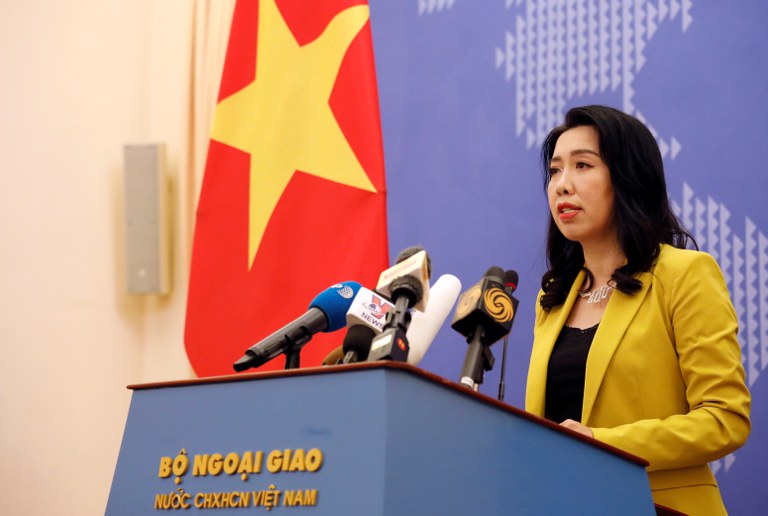
China has once again announced a unilateral fishing moratorium in the South China Sea, to vigorous protests by Vietnam but the Philippines has so far not reacted. The three-and-half-month ban began on Sunday and covers the waters north of 12 degrees north latitude in the South China Sea which Vietnam and the Philippines also call their “traditional fishing grounds.” Hanoi spoke up against the fishing ban, calling it “a violation of Vietnam’s sovereignty and territorial jurisdiction.” The moratorium applies to part of the Gulf of Tonkin, and the Paracel Islands claimed by both China and Vietnam. The Vietnamese Foreign Ministry’s spokeswoman said: “Vietnam requests China to respect Vietnam’s sovereignty over the Paracel Islands, sovereign rights and jurisdiction over its maritime zones when taking measures to conserve biological resources in the East Sea (South China Sea), without complicating the situation towards maintaining peace, stability and order in the East Sea.” Spokeswoman Le Thi Thu Hang said Vietnam’s stance on China’s fishing ban “is consistent and well established over the years.” Meanwhile the Philippines, which holds a presidential election next weekend, hasn’t responded to the moratorium. In the past, Manila has repeatedly protested and even called on Filipino fishermen to ignore the Chinese ban and continue their activities in the waters also known as the West Philippine Sea. Vietnamese foreign ministry spokeswoman Le Thi Thu Hang speaks at a news conference in Hanoi, Vietnam July 25, 2019. Credit: Reuters. Risks of overfishing China has imposed the annual summer fishing ban since 1999 “as part of the country’s efforts to promote sustainable marine fishery development and improve marine ecology,” Chinese news agency Xinhua reported. A collapse of fishery stocks in the South China Sea due to overfishing and climate change could fuel serious tensions and even armed conflict, experts said.  “Overfishing is the norm in open-access fisheries, so restrictions on fishing represent a sensible policy,” said John Quiggin, professor of economics at the University of Queensland in Australia. “But China’s decision to impose such restrictions implies a claim of territorial control which other nations are contesting,” Quiggin told RFA. “The best outcome would be an interim agreement to limit over-fishing, until boundary disputes are resolved, if that ever happens,” he added. China’s fishing ban in the South China Sea is expected to end on Aug. 16. It also covers the Bohai Sea, the Yellow Sea, the East China Sea, with a later end-date. Chinese media said this week that the South China Sea branch of the Coast Guard and local authorities will patrol major fishing grounds and ports “to ensure that the ban will be well observed.” At the end of last year, Beijing issued a new regulation threatening hefty fines of up to tens of thousands of dollars on activities of foreign fishermen in China’s “jurisdictional waters.” The self-claimed “jurisdictional waters” extend to most of the South China Sea but the claims are disputed by China’s neighbors and have been rejected by an international tribunal. Rashid Sumaila, a professor at the University of British Columbia in Canada and author of a 2021 report on the fishery industry in the East and South China Seas, said in an interview with RFA that “the simmering conflict that we see in the South China Sea is mostly because of fish even though countries don’t say it out loud.” “Fishery is one of the reasons China’s entangled in disputes with its neighbors in the South China Sea,” Sumaila said. A file photo showing Chinese fishing boats docked in Jiaoshan fishing port in Wenling city in eastern China’s Zhejiang province on July 12 2013. Credit: AP. Distant-water fishing Meanwhile, China’s distant-water fishing causes serious concerns across the world, mainly because of the size of the Chinese fleet and its “illegal behavior,” according to a recent report. The report released in March by the Environmental Justice Foundation, a U.K. non-profit organization, traces “China’s vast, opaque and, at times illegal global fisheries footprint,” using mainly China’s own data. It found that China’s distant-fishing fleet that operates on the high seas and beyond its exclusive economic zone is “by far the largest” in the world. The number of Chinese distant-water fishing boats is unknown, but could be around 2,700, according to some estimates. China is responsible for 38 percent of the distant-water fishing activities of the world’s 10 largest fleets in other countries’ waters, the report said. Chinese fishing vessels operate “across the globe in both areas beyond national jurisdiction and in the EEZs of coastal states.” Researchers who worked on the report have identified “high instances of illegal, unreported and unregulated (IUU) fishing, destructive practises such as bottom trawling and the use of forced, bonded and slave labour and trafficked crew, alongside the widespread abuse of migrant crewmembers.”

Read More

Japan PM begins SE Asia trip, urges open seas, response on Ukraine

Japan’s leader made a veiled but strong statement against Chinese assertiveness as he met Indonesia’s president on Friday at the start of a trip to Southeast Asia and Europe to promote a free and open Indo-Pacific and rally a regional response to the Ukrainian crisis. Tokyo is also considering giving Indonesia patrol boats so its coast guard could strengthen maritime security, Prime Minister Fumio Kishida said, amid Chinese pressure on Jakarta over its oil and gas drilling operations in its own exclusive economic zone in the South China Sea. “I expressed a strong sense of protest against efforts to change the status quo unilaterally and economic pressures in the East China Sea and South China Sea,” Kishida said, after meeting with President Joko “Jokowi” Widodo in Jakarta. The Japanese premier’s remarks were a pointed reference to concern over Chinese activities in the region. Kishida’s eight-day tour will see him visiting “strategic ASEAN partners,” including Vietnam and Thailand. The prime minister will then proceed to Europe, with stops in Italy and the United Kingdom, both members of the G7 grouping of industrialized countries that also comprises Japan. Before embarking from Tokyo on his trip, Kishida said at the airport that he would like to “exchange frank opinions on the situation in Ukraine with each of the leaders and confirm their cooperation.” Indonesia is host of this year’s Group of 20 summit in November, an engagement that has placed Jakarta in a diplomatic bind, amid opposition to the participation of Russia because of its invasion of Ukraine and alleged war crimes there. On Friday, Jokowi confirmed that Indonesia had invited Ukraine’s president as a guest to the G-20 summit in Bali and that Russian leader Vladimir Putin would also attend. Kishida said he and Jokowi “exchanged views openly” on the Russian invasion, “which is a clear violation of international law and which we say has shaken the foundations of the international order, including Asia, and must be strongly condemned.” “Keeping in mind the U.N. resolutions agreed upon by the two countries, I and the president discussed this issue. We have one understanding that a military attack on Ukraine is unacceptable. In any area, sovereignty and territorial integrity should not be interfered with by military force or intimidation,” the Japanese leader said. Jokowi, for his part, called for all countries to respect sovereignty and territorial integrity. “The Ukraine war must be stopped immediately,” he said. A regional ‘reluctance to take sides’ The war in Ukraine has been a divisive issue among members of the Association of Southeast Asian Nations, or ASEAN. “Across the region there is a reluctance to take sides and an ambivalence about the concert of democracies lining up in support of Ukraine,” said Jeff Kingston, a professor and director of Asian Studies at Temple University in Tokyo. Most Southeast Asian countries – Singapore being an exception – have been hesitant to condemn Russia or join international sanctions against Moscow. Japan hopes to consolidate their responses during the prime minister’s visit. “Kishida will [also] seek to gain understanding of what is at stake and the potential implications for Asia in terms of China’s hegemonic aspirations,” Kingston said. China’s increasing assertiveness in the East China and South China seas will be high on the agenda, and Kishida said he would discuss with Southeast Asian leaders further cooperation “toward realizing a free and open Indo-Pacific,” and maintaining peace and order. Stops in Hanoi, Bangkok In Vietnam, where Kishida will spend less than 24 hours over the weekend, he will meet with both the Vietnamese prime minister and president. Bilateral talks will focus on post-COVID-19 and security cooperation, Vietnamese media said. Vietnam shares interests with Japan in safeguarding maritime security in the South China Sea where China holds expansive claims and has been militarizing reclaimed islands. In Thailand, Kishida will hold talks with Thai Prime Minister Prayuth Chan-o-cha. Thailand is the host of the Asia-Pacific Economic Cooperation (APEC) forum summit in November. Bangkok and Tokyo are celebrating the 135th anniversary of diplomatic ties this year, and the two sides are seeking to sign an agreement on the transfer of defense equipment and technology to strengthen cooperation in the security field, according to the Bangkok Post. Government spokesman Thanakorn Wangboonkongchana said it would be the first official visit of a Japanese prime minister to Thailand since 2013. In March, Kishida visited India and Cambodia, his first bilateral trips since taking office in October 2021. Later in May, he will host a visit by U.S. President Joe Biden and a summit of the Quadrilateral Security Dialogue, or Quad. The White House announced on Wednesday that President Biden would visit South Korea and Japan May 20-24 to advance a “commitment to a free and open Indo-Pacific and to U.S. treaty alliances” with the two countries. The trip will be Biden’s first one to Asia as president. “In Tokyo, President Biden will also meet with the leaders of the Quad grouping of Australia, Japan, India, and the United States,” the statement said without disclosing the date. The Quad is widely seen as countering China’s weight in the region. China has been sneering at the formation of the Quad, calling it one of the “exclusive cliques detrimental to mutual trust and cooperation among regional countries.” On Thursday, Chinese Foreign Ministry’s spokesman Wang Wenbin said that the Quad “is steeped in the obsolete Cold War and zero sum mentality and reeks of military confrontation.” “It runs counter to the trend of the times and is doomed to be rejected,” he said. Dandy Koswaraputra in Jakarta contributed to this report for BenarNews, an RFA-affiliated online news service.

Read More

Henan court jails dissident for nearly three years after Jiang Tianyong visit

Authorities in the central Chinese province of Henan have handed down a two-year, 11-month jail term to dissident Xing Wangli, after he visited a prominent rights attorney. Xing was sentenced by the Xi County District People’s Court, which found him guilty of “defamation,” following a trial by video link to the Xi County Detention Center earlier this month. His attorney received the sentencing decision on April 25. The case against Xing rested on an open letter he wrote laying responsibility for serious head injuries he received in the detention center at the door of three local government officials. The letter, dated March 5, 2021 and titled “To netizens and people from all walks of life,” accused local officials of attacking and retaliating against him for standing up for his family’s rights and interests. It accuses local officials and law enforcement of covering up after his son suffered massive injuries in a traffic accident at the age of 5, requiring treatment in intensive care and details a self-immolation attempt by his wife Xu Jincui on Tiananmen Square, after which Xu was jailed for three years and Wang sent to labor camp for one year. “During my detention in the Xi County Detention Center, I was subjected to inhuman treatment, hunger strike, shackles, handcuffs, and physical and mental torture,” the letter reads. Xi’s mother-in-law He Zeying and his mother Xing Jiaying were jailed for three years for “picking quarrels and stirring up trouble,” it said. “While I was detained in the Xixian Detention Center, the deputy county magistrate of Xi county, Li Xuechao, came up with a plan and the county party secretary Jin Ping nodded along, so police chief Liu Yang arranged for the detention center to carry it out,” the letter said. “I was beaten with blunt instruments, and was later diagnosed by Xinyang Central Hospital with comminuted fracture of the brain, contusion of the lower lobes of both lungs, and bilateral pleural effusion,” it said. “I was illegally detained, sent to illegal re-education through labor, and sentenced to jail for a total of nine years and nine months,” the letter said. ‘Rotten apples’ Xing’s wife, mother-in-law and mother and other family members have served a total of 26 years behind bars, it said, calling on CCP leader Xi Jinping to “investigate these rotten apples.” The letter said some of the retaliation was linked to Xing’s refusal to stay quiet about the deaths of two petitioners in suspicious circumstances. The court decided that the letter had been commissioned by Xing’s son Xing Jian, while the officials named in it took the witness stand to say it wasn’t true. It accuses Xing of instructing his son to post the letter “containing fabricated claims” to WeChat groups, after which it garnered more than 12,000 page views. It said Xing’s “defamation of public officials” had violated the officials rights and affected their mental health. Xing Jian, now living in New Zealand, said the trial was entirely biased in favor of the officials. “The witnesses they found were all public officials, and they all had a relationship to the [case],” he said, adding that what his father posted was in the public interest. “Government officials are public figures, and they need to be supervised under the law and by the public,” Xing Jian said. “Yet, if a member of the public questions, criticizes, or makes accusations against them, they put them in jail.” Canada-based dissident artist Hua Yong said Xing Wangli and his family had tried to take on the government and lost. “This kind of thing happens so often in China,” Hua said. “The lower rungs of government are willing to kill [to prevent criticism].” “If attempts to call them out get a lot of public attention, they may get out of the starting gate, but if there is no-one paying attention, they will be attacked in retaliation … it’s all a power game,” he said. Xing Wang Li’s son Xing Jian. Credit: Xing Jian. Tortured by cellmates Xing’s sentence was just one month below the maximum of three years for “defamation,” and commentators have said this is likely because he tried to visit prominent rights attorney Jiang Tianyong, who is under house arrest at his Henan home after serving a jail term during a nationwide crackdown on rights lawyers. Xing was originally detained on suspicion of “picking quarrels and stirring up trouble” in May 2021 after he tried to visit Jiang, who remains under house arrest, in April 2021. He was formally arrested in June 2021, but for “defamation,” and indicted by the county prosecutor in January 2022. While defamation cases in China have previously been private prosecution cases, new guidelines issued in 2013 paved the way for it to be brought as a criminal charge against people accused of “spreading disinformation or false accusations online can constitute criminal acts. If a post deemed to contain disinformation or false accusations accrues more than 5,000 views or 500 reposts, then it is considered a “serious circumstance,” according to the U.S.-based rights group, the Duihua Foundation. Jiang was “released” from prison in February 2019 at the end of a two-year jail term for “incitement to subvert state power,” a charge often used to imprison peaceful critics of the government. He was allowed to return to his parents’ home in Luoyang, but remains under close surveillance and heavy restrictions. Jiang’s U.S.-based wife Jin Bianling has repeatedly expressed concern for her husband’s health after he was tortured by cellmates during his time in detention. Translated and edited by Luisetta Mudie.

Read More

US vows to respond to any Chinese military base in Solomons

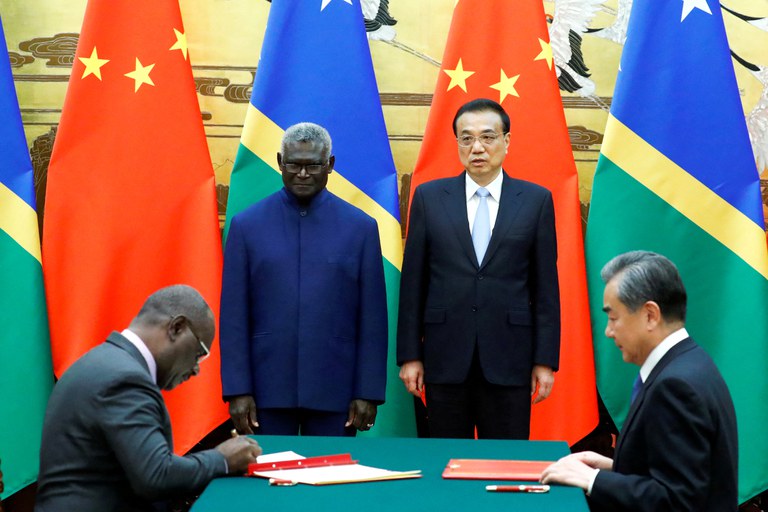
The United States voiced concerns Tuesday over a “complete lack of transparency” surrounding a new security deal between the Solomon Islands and China and vowed to respond to any attempt to establish a Chinese military base in the island nation. A draft copy of the security pact leaked onto social media in late March but neither party has made public the deal, reportedly signed by Chinese Foreign Minister Wang Yi and his Solomon Islands counterpart Jeremiah Manele. The deal has drawn expressions of deep concern from U.S. allies Australia and New Zealand that it could enable China to extend its military reach in the Pacific. It also prompted a hasty visit to the Pacific by two top U.S. diplomats. U.S. National Security Council Indo-Pacific Coordinator Kurt Campbell and Assistant Secretary of State for East Asian and Pacific Affairs Daniel Kritenbrink led a U.S. delegation to Honiara late last week where they held a 90-minute “constructive and candid meeting” with Prime Minister Manasseh Sogavare. Kritenbrink told journalists at a teleconference on Tuesday that the lack of transparency of the security agreement was “our fundamental concern.” “I think it’s clear that only a handful of people in a very small circle have seen this agreement, and the prime minister himself has been quoted publicly as saying he would only share the details with China’s permission, which I think is a source of concern as well,” the U.S senior diplomat said. “Of course we have respect for the Solomon Islands’ sovereignty, but we also wanted to let them know that if steps were taken to establish a de facto permanent military presence, power-projection capabilities, or a military installation, then we would have significant concerns and we would very naturally respond to those concerns,” Kritenbrink said. A file photo showing Solomon Islands Prime Minister Manasseh Sogavare, Solomon Islands Foreign Minister Jeremiah Manele, Chinese Premier Li Keqiang and Chinese State Councillor and Foreign Minister Wang Yi at a signing ceremony at the Great Hall of the People in Beijing, China Oct. 9, 2019. Credit: Reuters. ‘Red line’ The assistant secretary of state declined to elaborate on possible responses to security implications caused by the new agreement but said that Prime Minister Sogavare gave the U.S. three specific assurances that “there would be no military base, no long-term presence, no power-projection capability.” In Washington, during a Tuesday hearing of the Senate Foreign Relations Committee, Republican Sen. Mitt Romney called the agreement “alarming.”  In response, U.S. Secretary of State Antony Blinken said he shared the senator’s concern. He reiterated the assurances the U.S. delegation had gotten from Sogavare, adding: “We will be watching that very, very closely in the weeks and months ahead.” Sogavare’s words have done little to calm Solomon Islands’ neighbors. Australian Prime Minister Scott Morrison said that a military base would be a “red line” for Canberra. The Solomons occupies a remote but strategic location in the western Pacific, about 1,700 kilometers (1,050 miles) from the northeastern coast of Australia. Malcolm Davis, a senior analyst at the Australian Strategic Policy Institute (ASPI), said: “I think now that the security agreement has been officially signed, there is little the U.S. or Australia can do to reverse it. The key question now is how fast will China move to establish a permanent presence, leading to a base, in the Solomon Islands.” “Australia and the U.S. can try to use diplomacy to convince the Sogavare government to not allow this base to be established quickly, or to constrain its size and function, but there is little chance that these efforts will succeed, as it’s clear that Sogavare has aligned with China,” Davis said. “They can also try to contain Chinese influence in the region further by ‘stepping up’ the ‘Pacific Step Up’ and making it more effective,” he said, referring to the Biden administration’s push to increase U.S. engagement in the region. He added: “This has greater chance of success given the regional concern about the agreement signed between Solomon Islands and China.” Norah Huang, associate research fellow at Prospect Foundation, a Taiwanese think tank, described the deal as “opportunism” by the Solomons prime minister. She said the best response might be “candid talks with the governing parties in private to walk it back or at least neutralize the deal.” “But Australia, the U.S. and New Zealand should be careful not to reward those who play opportunism,” Huang said. A file photo showing Australian Navy officers from the HMAS Canberra arriving at the Tanjung Priok port, as part of the military exercise Indo-Pacific Endeavour 2021, in Jakarta, Indonesia, Oct. 25, 2021. Credit: Reuters. Regional efforts Japan became the latest regional power to send a representative to the Solomon Islands to express concern over the security pact. According to Japanese Foreign Minister Yoshimasa Hayashi, the Solomons prime minister repeated assurances to Japanese officials on Tuesday that he had no intention of allowing China to build military bases in his country, Reuters reported. Davis at ASPI said the China-Solomons deal could presage a move by Beijing to extend its reach in the South Pacific. “I think the greatest risk is that China would choose to extend its influence into Papua New Guinea, where it already has substantial investment, and is openly talking about a ‘fishing facility’ at Daru Island, which could ultimately be the basis for a port that could support Chinese Coast Guard vessels,” he said. “The U.S. and Australia, as well as New Zealand, will now need to adjust their defense policies with the prospect of a forward Chinese military presence in the Southwest Pacific that certainly dramatically increases the military threat to the Australian eastern seaboard, but also severs the sea lane of communication between Australia and the United States,” the defense analyst said. ‘Too little, too late’ There have been calls in Australia’s political and defense circles to “prepare for war,” and Davis said there should be some review of Australian defense force posture, and greater investment into air, sea, and space capabilities across…

Read More

Cambodian activist safe in Thailand after 6-day flight through jungle

A prominent Cambodian activist who fled her country in a six-day journey through the jungle safely arrived in Thailand, where she plans to seek asylum with the U.N. In Cambodia, meanwhile, government officials said they would not call foreign officials as witnesses in a “treason” case against another critic of the country’s ruling party. Sat Pha, who has supported the now-banned Cambodia National Rescue Party (CNRP), told RFA that she fled after a hand-written threat, which she believed was from the government of Prime Minister Hun Sen, saying she could be “disappeared” was tacked to her door. “Authorities know how to assault, arrest and imprison [activists],” she told RFA’s Khmer Service. Opponents of the ruling Cambodian People’s Party (CPP) have been targeted in a 5-year-old crackdown that has sent leaders of the CNRP into exile and landed scores of its supporters in prison. Cambodia’s Supreme Court dissolved the CNRP in November 2017 in a move that allowed the CPP to win all 125 seats in Parliament in a July 2018 election. Sat Pha is one of the many Cambodians who has become disenfranchised in land disputes with the government or developers. She has also protested the detention of former CNRP politicians, and, she says, been beaten by governmental officials. “The authorities attacked me until my legs were injured. Has the govt. arrested any authorities? As a leader [Hun Sen] he doesn’t protect citizens. He knows how to assault, arrest and imprison. Killers are never brought to justice,” she said. Sat Pha said she became ill in her journey but is now in a safe location in Thailand. She said she is in the country illegally and is running low on food. She plans to request asylum from the U.N. Refugee Agency (UNHCR) office in Thailand. Sat Pha was released from prison in Cambodia six months ago after serving a year in detention for inciting social unrest during a peaceful protest in front of Chinese Embassy in Phnom Penh.  RFA was unable to contact Phnom Penh Municipal Police spokesman San Sok Seiha for comment.  However, Cambodian People Party spokesman and lawmaker Sok Ey San told RFA that he believes Sat Pha fabricated her story to earn sympathy. “Police have a duty to look for the suspects. There is a need for cooperation between the victim and the police. It might be a personal dispute,” he said. Sok Ey San previously denied that the threat came from CPP leadership. Sat Pha has the right to ask NGOs for help when she doesn’t have any confidence in the authorities, Soeung Seng Karuna, spokesperson for the Cambodian Human Rights and Development Association told RFA. “It is normal for a victim who is threatened to seek asylum,” he said. Kem Sokha Trial In the treason trial of CNRP former leader Kem Sokha in Phnom Penh, prosecutors on Wednesday refused to summon representatives of any foreign governments that he is accused of colluding with.  The prosecution citied the Vienna Convention on Diplomatic Relations, an international agreement that codifies diplomatic immunity. Defense lawyer Ang Odom told RFA after Wednesday’s session that the convention does not forbid representatives of foreign governments from testifying, adding that the prosecution told the defense they could ask the foreign governments to testify. “They need to do it, but they asked us to instead,” he said, adding that the defense plans to officially request that the prosecution summon foreign government representatives to testify in next week’s session, scheduled for April 27. “All relevant parties will help the court seek the truth. They need to speak the truth about the alleged collusion to commit treason,” he said. The government claims Kem Sokha was in league with Indonesia, Yugoslavia, Serbia, Australia, the United States, Canada, the European Union, Taiwan and India in plots to commit treason against Cambodia. The government may have a legitimate point regarding the Vienna Convention, Cambodian American legal analyst Theary Seng, who is herself on trial in Phnom Penh for treason and incitement, told RFA. “Rarely do I have the opportunity to agree with this regime’s political tool [the court], but in this instance it is right to deny the defense’s request. First, there is clear international custom and provision enshrined in Article 31 of the Vienna Convention on Diplomatic Relations that gives diplomats immunity from criminal proceedings as a charged person or a witness,” she said. “Second, it is not politically feasible that any country, especially a superpower, would give way to an incendiary charge as ‘treason’ in another country’s court system, as that carries countless criminal and political implications,” she said. Theary Seng said that putting a diplomat on trial would be a loss of face for the country he or she represents. “It is understandable that Kem Sokha’s lawyers will look to influential figures or countries to come their client’s defense in denying this most serious charge of treason. But it is a dead-end road. Rather, the defense lawyers should place the onus on the prosecutors and court in demanding why the regime did not expel the diplomats or close down the embassy, making the diplomat persona non grata or communicating to the sending state the extremely serious nature of the change,” she said. Translated by Samean Yun. Written in English by Eugene Whong.

Read More

Concerns remain over pro-CCP stance of U.K.-based Chinese community organizations

Hong Kong activists based in the U.K. have repeated warnings that community groups in the county may have been infiltrated by people loyal to the Chinese Communist Party (CCP), posing potential threats to incoming migrants from Hong Kong under the British National Overseas (BNO) visa scheme. Former Hong Kong lawmaker Nathan Law said via his Twitter account on April 19 that most the of 100,000 people who have left the city following the imposition of the draconian national security law to make new lives in the  U.K. support the 2019 mass protest movement, which called for fully democratic elections and greater official accountability. “HKers are anxious and insecure. Most of them are in support of the pro-democracy movement, therefore they left Hong Kong with trauma and worries of persecution,” Law wrote. “They fear that Chinese agents in the UK would send their activity records back to Hong Kong, thus endangering them.” Law voiced his concerns as The Times reported that pro-CCP figures appeared to have infiltrated large Chinese community organizations in Southampton and Birmingham, both of which have received tens of thousands of pounds in government funding to help newly arrived Hongkongers integrate into British society. Law added: “The Chinese govt is a dictatorial regime that destroyed our home. Many Chinese community organizations in the UK support the political lines of CCP. More than 200 of them endorsed the National Security Law,” he said, adding that Hongkongers would feel “scared and unwelcome” if government funds were awarded to such groups. According to The Times, two of the Birmingham center’s directors worked with the British Chinese Project, a scheme founded by Christine Lee, a lawyer who MI5 warned was trying to influence parliamentarians on behalf of Beijing in January 2022. A patron of the center, James Wong, has visited China on a trip sponsored by the Overseas Chinese Affairs Office, part of the CCP’s outreach and influence operation known as the United Front Work Department. The Birmingham Chinese Community Center denied it was under CCP influence, saying it had no wish to be drawn into the politics of the Hong Kong protest movement, and had no wish to become involved with such “toxicity.” A screenshot of former Hong Kong lawmaker Nathan Law’s Twitter account where he raises concerns that Chinese agents in the UK have infiltrated large Chinese community organizations in British cities. Allegiances hard to trace Meanwhile, U.K.-based activist Ping Hua, who has termed reports of the mass incarceration of Uyghurs in Xinjiang “appalling lies and fabrication,” founded the Southampton group, which told the paper she is no longer part of the organization. Law tweeted a day after being quoted in the article: “We must know more about the infiltration activities of the Chinese govt and prevent these mistakes from happening. The best way is to engage with the UK-based Hong Kong community and conduct thorough background checks on the org’s connection to the Chinese embassy.” U.K. activist and former consular worker Simon Cheng said that while the links between Wong and Ping and the CCP were fairly clear, many other Chinese community organizations have made statements that suggest where their allegiances lie, even if connections with the CCP are harder to trace. “They want to carefully blunt our democratic consciousness and fighting spirit,” Cheng said. “For example, they could, once people have settled in, encourage them to move on from the past.” “If they really have a pro-CCP agenda, or are United Front, the most important concern is that they could report people’s personal information to the national security police [in Hong Kong],” he said. “Then, you could run into problems if you go back to Hong Kong, or to any country that has a current extradition treaty with either China or Hong Kong.” According to a 2017 report by New Zealand political science professor Anne-Marie Brady, Chinese leader Xi Jinping is leading an accelerated expansion of political influence activities worldwide, much of which rely on overseas community and business groups, under the aegis of the United Front Work Department. Some 100,000 Hongkongers have emigrated to the U.K. under a pathway-to-citizenship visa scheme aimed at around three million people eligible for the BNO passport. Overseas properties Community groups have sprung into action to offer career, job-hunting and taxation workshops to new arrivals, provide entertainment and social opportunities and to offer advice on education, mental health and starting a new business. Meanwhile, the U.K.-based rights group Hong Kong Watch said nine high-ranking Hong Kong officials and 12 lawmakers elected under Beijing’s approval to the city’s legislature hold property overseas, including in the U.K., Canada, the U.S., Australia, Japan, and France. In a new report, the group lists health secretary Sophia Chan as owning or co-owning three properties in London, civil service secretary Patrick Nip as owning a flat in Islington, and former University of Hong Kong senior leader Arthur Li as owning two west London properties. All are members of chief executive Carrie Lam’s cabinet, the Executive Council, and are collectively responsible for implementing the national security law, which bans public criticism of the government and criminalizes acts of political opposition, journalism and online dissent. All of the officials and lawmakers in question have pledged allegiance to Beijing and expressed their public support for the national security law, the report said. “The report recommends that like-minded countries consider auditing the assets of Hong Kong officials and introducing a Hong Kong specific sanctions list covering those named,” it said. The group’s senior policy adviser Sam Goodman said: “The Hong Kong officials and lawmakers who are complicit in the ongoing human rights crackdown in Hong Kong are more than happy to continue to use the West as a safe haven for their hidden wealth.” Translated and edited by Luisetta Mudie.

Read More

China, Solomon Islands confirm they have signed security pact

China and the Solomon Islands have both confirmed they signed a controversial security pact that has sparked concerns about China’s rising influence in the Pacific region. The confirmation came as a U.S. delegation led by the National Security Council Indo-Pacific coordinator Kurt Campbell was heading to Honiara to discuss regional security issues. Solomon Islands Prime Minister Manasseh Sogavare told parliament on Wednesday that the agreement with China was to help with the country’s “internal security situation,” referring to recent unrest that saw businesses and buildings burned and looted. The prime minister said the decision “will not adversely impact or undermine the peace and harmony of our region.” Hours before that, a Chinese government spokesman said that the pact is “part of normal exchanges and cooperation between two sovereign and independent countries” and does not target any third party. Chinese Foreign Ministry spokesperson Wang Wenbin told reporters in Beijing that Chinese Foreign Minister Wang Yi and his Solomon Islands counterpart Jeremiah Manele officially signed the document “the other day.” China did not offer an explanation about whether the signed document is the final agreement. Neither party has revealed any details of the deal, with Sogavare saying it would be disclosed after a “process.” Kurt M. Campbell, the Biden administration’s coordinator for the Indo-Pacific, pictured official at the China Development Forum in Beijing, China March 23, 2019. At the time, Campbell was chairman and CEO of a consultancy, the Asia Group. Credit: Reuters. Lack of transparency Solomon Islands’ neighbors Australia and New Zealand have repeatedly voiced concerns since a copy of the draft agreement was leaked online in March. On Tuesday, Australian Foreign Minister Marise Payne and Pacific Minister Zed Seselja issued a joint statement saying “Australia is deeply disappointed by the signing” of the pact. “We are concerned about the lack of transparency with which this agreement has been developed, noting its potential to undermine stability in our region,” the statement reads. Seselja traveled to Honiara last week to urge the Solomon Islands prime Mminister not to sign the deal with Beijing, without success.  New Zealand’s Foreign Minister Nanaia Mahuta said her country was “saddened” that the Solomon Islands had made the pact. The U.S. also expressed concern over “the lack of transparency” in China’s security pact with the Solomon Islands, calling it part of a pattern of Beijing offering “shadowy” deals to countries, Reuters news agency reported. Two top U.S. officials for the Indo-Pacific region – Kurt Campbell and Daniel Kritenbrink, the assistant secretary of state for East Asian and Pacific affairs – are currently in Fiji before traveling to Honiara to meet with the island nation’s leaders. Campbell said in January that the U.S. has “enormous moral, strategic, historical interests” in the Pacific but had not done enough to assist the region. Their trip has been criticized by China as having “ulterior motives.” “Several senior U.S. officials now fancy a visit to some Pacific island countries all of a sudden after all these years,” said Chinese Foreign Ministry’s Wang Wenbin, pointing out that the U.S. Embassy in Solomon Islands has been closed for 29 years. This February, U.S. Secretary of State Antony Blinken traveled to Fiji to meet with Pacific island leaders, and announced that the embassy in Honiara would be reopened. The Chinese national flag flies outside the Chinese Embassy in Honiara, Solomon Islands, April 1, 2022. Credit: AP. Military presence China has maintained that Pacific island countries need to diversify their cooperation with other countries and “have the right to independently choose their cooperation partners.” “China is always a builder of peace and a promoter of stability in the South Pacific region,” Wang said. A draft copy of the security pact leaked onto social media in late March suggested there would be Chinese logistical hubs or bases in the island nation. One of the clauses says: “China may, according to its own needs and with the consent of Solomon Islands, make ship visits to, carry out logistical replenishment in, and have stopover and transition in Solomon Islands.” David Capie, director of the Centre for Strategic Studies at the Victoria University of Wellington in New Zealand, told RFA that the security pact would allow Beijing to set up military bases and deploy troops in the Pacific island nation, “marking the start of a much sharper military competition than anything we’ve seen in the region for decades.” Capie said that the agreement “would allow the People’s Republic of China to deploy police and military personnel to Solomon Islands with the consent of the host government, and potentially provide for refueling and support of Chinese ships.” U.S. State Department Spokesperson Ned Price said earlier this week that the U.S. is concerned that the agreement “leaves the door open for the deployment of Chinese forces on the Solomon Islands.” “We believe that signing such an agreement could increase destabilization within the Solomon Islands and will set a concerning precedent for the wider Pacific island region,” Price added. Analysts say a presence of Chinese troops in the Solomon Islands could raise the risk of confrontation between China and the U.S. and its allies, as well as challenge the U.S.-led vision of a “Free and Open Indo-Pacific.”

Read More

Russia says military drills planned with Vietnam

As fighting rages across Ukraine, Russia and Vietnam are planning to hold a joint military training exercise, Russian state media reported Tuesday, a move that analysts described as “inappropriate” and likely to “raise eyebrows” in the rest of the region. It comes amid international outrage over Russia’s invasion of Ukraine and the mounting civilian death toll there. It also coincides with U.S. preparations to host a May 12-13 summit in Washington with the Association of Southeast Asian Nations, including Vietnam. Russian state-run news agency RIA Novosti said the initial planning meeting for the military training exercise was held virtually between the leaders of Russia’s Eastern Military District and the Vietnamese army. The two sides “agreed on the subject of the upcoming drills, specified the dates and venue for them” and “discussed issues of medical and logistic support, cultural and sports programs,” the news agency reported without giving further details. Col. Ivan Taraev, head of the International Military Cooperation Department at the Eastern Military District, was quoted as saying that the joint exercise aims “to improve practical skills of commanders and staffs in organizing combat training operations and managing units in a difficult tactical situation, as well as developing unconventional solutions when performing tasks.”  The two sides also discussed what to call the joint exercise. One of the proposed names is “Continental Alliance – 2022.” Russian Defense Minister Sergey Shoigu, right, and his then-Vietnamese counterpart Ngo Xuan Lich, left, reviewing an honor guard in Hanoi, Vietnam, Tuesday, Jan. 23, 2018. Shoigu was on a visit to Vietnam to boost military ties between the two countries. Credit: AP ‘Inappropriate decision’ Vietnamese media haven’t reported on the meeting, nor the proposed exercise. Vietnamese officials were not available for comment. “This is a totally inappropriate decision on Vietnam’s part,” said Carlyle Thayer, professor emeritus at the New South Wales University in Australia and a veteran Vietnam watcher. “The U.S. is hosting a special summit with Southeast Asian leaders in May,” Thayer said. “How will the Vietnamese leader be able to look Biden in the eye given the U.S. clear stance on the Ukrainian war and the Russian invasion?” “This is not how you deal with the world’s superpower,” he said. Earlier this month, Vietnam voted against a U.S.-led resolution to remove Russia from the U.N. Human Rights Council. Before that, Hanoi abstained from voting to condemn Russia’s invasion of Ukraine at the U.N. General Assembly. “As Russia’s closest partner in the region, Vietnam wants to demonstrate that it still has a firm friend in Southeast Asia,” said Ian Storey, senior fellow at the ISEAS-Yusof Ishak Institute in Singapore. “But this joint exercise is likely to raise eyebrows in the rest of the region,” Storey said. Vietnam and Russia have a long-established historical relationship that goes back to the Soviet era. Russia is Vietnam’s first strategic partner, and one of its three so-called “comprehensive strategic partners,” alongside China and India. Moscow was also Hanoi’s biggest donor until the collapse of the Soviet Union and the Eastern Bloc. “Vietnam’s nuanced approach to the Russia-Ukraine war and its refusal to single out Russia’s invasion suggest introspection in Hanoi over its foreign and defense policy calculations,” wrote Hoang Thi Ha, a Vietnamese scholar at the ISEAS – Yusof Ishak Institute. The Russia-led war in Ukraine “presented a hard choice for Hanoi between preserving the fundamental principle of respect for a sovereign nation’s independence and territorial integrity and maintaining its good relations with Russia — a key arms supplier and a major oil and gas exploration partner in the South China Sea,” Ha said. Political message That explains Vietnam’s moves but there are distinctions between casting votes at the U.N. and holding joint military activities. The latter would send a wrong message about Vietnam’s intention to work with the West and raise its profile among the international community, analysts said. In particular, the past decade or more has seen a notable growth in ties between the U.S. and Vietnam, which share a concern over China’s assertive behavior in the South China Sea. Details of the proposed Russia-Vietnam exercise have yet to be made public, and already some observers are expressing doubts that it would take place. A Vietnamese analyst who wished to stay anonymous as he is not authorized to speak to foreign media said the Russian side announced similar exercises in the past which didn’t materialize. The Press Service of Russia’s Eastern Military District also said back in 2015 that the first bilateral military drill between Russia and Vietnam would take place in 2016 in Vietnamese territory. The supposed drill was rescheduled to 2017 but in the end didn’t happen at all. Vietnam has, however, taken part in a number of multilateral military exercises with Russia. The latest was the first joint naval exercise between Russia and countries of the Association of Southeast Asian Nations last December. The Eastern Military District, headquartered in Khabarovsk, is one of the five operational strategic commands of the Russian Armed Forces, responsible for the Far East region of the country. The district was formed by a presidential decree, signed by the then-President Dmitry Medvedev in September 2010.

Read More