Jet attack kills 3 civilians in Myanmar’s Chin state

Junta jets dropped bombs on a village in Chin state, in the west of Myanmar, killing three people including a nine-year-old girl, the Mindat township People’s Administration Group told RFA Monday. Group spokesman Yaw Man said jets attacked Vung Khung village repeatedly on Saturday morning. “They shot three times with fighter jets, dropped two 500-pound bombs, and fired with other weapons, sending the villagers running like the world was about to end,” he said.  “There was a nursing mother who had left her baby behind and fled to another place. She was killed by a bomb that was dropped on the place where she was sheltering on the way home to pick up her baby. Her neighbor’s nine-year-old child died next to her.  “The locals don’t dare to live in the village anymore, so they are fleeing to their hill farms and other villages.” Yaw Man said a 65-year-old woman was also killed and a 50-year-old man injured in the attacks. Locals said there was no reason for the raids because the junta had not been fighting with the Chinland Defense Force. As well as attacking by air, infantry regiment 274, based in Mindat, fired long-range artillery at the village destroying the school and damaging 10 homes. The junta has released no statement on the attack and junta Deputy Information Minister Major Gen. Zaw Min Tun did not answer his phone when called by RFA on Monday. Last month air attacks on Mindat and Thantiang townships destroyed a monastery and four houses. RFA data show that 44 civilians have been killed by junta air attacks in Chin state since the February 2021 military coup. Translated by RFA Burmese. Edited by Mike Firn.

Read More

Chinese authorities monitor Tibetans to prevent communication with outside world

Chinese authorities in Tibet have intensified monitoring of Tibetans, and continue to interrogate them in the regional capital Lhasa to prevent communication with people outside of Tibet, RFA has learned. The Chinese government has been intensifying its monitoring of Tibetans and maintained their interrogations of Tibetans living in Lhasa to determine if they have contacted people outside Tibet and stepped up surveillance measures to prevent such communication. Now the Chinese authorities are interrogating Tibetans in Lhasa specifically targeting and warning them to stop communication.  In March, two major anniversaries prompted police to step up surveillance. The month marked the 15th anniversary of a 2008 riot, and the 64th anniversary of the 1959 uprising against Chinese troops that had invaded the region a decade earlier. But the heightened security from March has continued well into June, and police have continued closely monitoring residents in Lhasa and random searches of their cell phone and online communications to discover whether they had communicated abroad. A police officer searches a Tibetan woman’s cell phone on a street in Lhasa, capital of western China’s Tibet Autonomous Region, March 11, 2023. Chinese authorities in Tibet have intensified monitoring of Tibetans, and continue to interrogate them in the regional capital Lhasa to prevent communication with people outside of Tibet, RFA has learned. Credit: Chinese State Media The police were particularly concerned that the Lhasa residents might be in contact with journalists or researchers outside of Tibet, a Tibetan resident told RFA’s Tibetan Service.  “Tibetans are warned not to contact people outside and those who have, have been summoned and interrogated,” the source said. “Their cell phones are confiscated and they are under constant scrutiny.” The source was among those who had contacted people outside of Tibet, and was summoned for interrogation along with some friends. “They gave us warning to not ever contact people on the outside, especially researchers on Tibet and journalists,” said the source. “I also know that so many other Tibetans who contacted people outside Tibet were interrogated by the Chinese authorities too.” Another resident said that people could be summoned even for casual conversations with outsiders. “I was summoned two times already this year for interrogation and one of my friends had to bribe the authorities to release me the second time around,” the second resident said. “My name is now listed amongst those interrogated, therefore I have to get permission from the local police if I need to travel outside Lhasa.”  Translated by Tenzin Dickyi. Edited by Eugene Whong.

Read More

Myanmar junta uses Telegram as ‘military intelligence’ to arrest online critics

Telegram is becoming the messaging platform of choice for fans of Myanmar’s junta, who are using it to report on critics – some of whom have gotten arrested or even killed. For example, actress Poe Kyar Phyu Khin recently posted a video entitled “Daw Aung San Suu Kyi (Our True Leader)” to the TikTok social media platform ahead of the jailed former state counselor’s June 19 birthday, prompting several users to post photos of themselves bedecked in flowers and express their best wishes. Incensed by the post, supporters of the military junta – which took control of the country in a February 2021 coup – took toTelegram to demand that Phyu Khin and those who responded to her be arrested. On the night of Suu Kyi’s birthday, junta security personnel showed up at the door of Phyu Khin’s home in Yangon and took her into custody. Pro-junta media reported the arrest and said that some 50 people had been detained that week alone for “sedition and incitement.” This is the new reality in post-coup Myanmar, where backers of the military regime regularly scour the internet for any posts they deem critical of the junta before using Telegram to report them to the authorities, activists say. Telegram has become a “form of military intelligence,” said Yangon-based protest leader Nang Lin. “It may look like ordinary citizens are reporting people who oppose the military, but that’s not true,” he said. “It’s the work of their informers. It’s one of the junta’s intelligence mechanisms. In other words, it’s just one of many attempts designed to instill fear in the people.” ‘Online weapon’ In a similar incident, rapper Byu Har was arrested on May 24, just days after being featured on pro-military Telegram channels for a video he published on social media in which he complained about electricity shortages and said that life was better under the democratically elected government that the military toppled. Pro-junta Telegram channels published a photo of hip hop singer Byu Har in handcuffs after he was arrested and allegedly beaten by military authorities on May 25, 2023, Credit: Myanmar Hard Talk Telegram Additionally, authorities arrested journalist Kyaw Min Swe, actress May Pa Chi, and other well-known personalities after pro-junta Telegram channels posted information about them changing their Facebook profiles to black to mourn the more than 170 people – including women and children – killed in a military airstrike on Sagaing region’s Pazi Gyi village in April. “Military lobbyists and informers go through these comments and … report the owners of the accounts to Han Nyein Oo, who is a major pro-junta informer on Telegram,” said an activist in Yangon, who declined to be named out of fear of reprisal. “Then, because of a small comment, the poster and their families are in trouble.” London-based rights group Fortify Rights also recently reported on the junta’s use of Telegram as an “online weapon” against its critics. “We can say that they are increasingly using Telegram channels as an online weapon as one of various ways of instilling fear in the people so that they dare not speak out,” the group said in a statement. RFA sought comment from Telegram’s press team but was forwarded to an automated answering system, which said that the company “respects users’ personal information and freedom of speech, and protects human rights, such as the right to assembly.” The answering system noted that Telegram “plays an important role in democratic movements around the world,” including in Iran, Russia, Belarus, Hong Kong and Myanmar. The founder of the Telegram channel is Russian-born Pavel Durov. In 2014, he was forced to leave the country and move to Saint Kitts and Nevis, a small Caribbean island nation, because he refused to hand over the personal information of Ukrainian users to Russian security services during the Crimea crisis in Ukraine.  Myanmar authorities arrested journalist Kyaw Min Swe [left] and actress May Pa Chi after pro-junta Telegram channels posted information about them changing their Facebook profiles to black to mourn Pazi Gyi victims in April. Credit: RFA and Facebook Telegram headquarters is located in Dubai, United Arab Emirates. Attempts by RFA to contact junta Deputy Information Minister Major Gen. Zaw Min Tun regarding the regime’s use of pro-military Telegram accounts to arrest people went unanswered Wednesday. Arrests violate constitution Thein Tun Oo, the executive director of the Thayninga Institute of Strategic Studies, which is made up of former military officers, told RFA that claims the junta uses Telegram to track down its critics are “delusional.” “If you feel insecure about Telegram, just don’t use it,” he said, adding that “such problems” are part of the risk of using the app. But a lawyer in Yangon, who spoke on condition of anonymity citing security concerns, told RFA that even if the junta isn’t gathering information about its opponents on Telegram, arresting and prosecuting someone for posting their opinions on social media is a blatant violation of the law in Myanmar. “It’s not a crime to post birthday wishes for someone on Facebook, whether it’s for Daw Aung San Suu Kyi or anyone else,” he said. “These arrests are in violation of provisions protecting citizens’ rights in the [military-drafted] 2008 constitution.” Pro-junta newspapers often state that action will be taken against anyone who knowingly or unknowingly promotes or supports Myanmar’s shadow National Unity Government, the Committee Representing the Pyidaungsu Hluttaw made up of deposed lawmakers, and any related organization under the country’s Counter-terrorism Act, Electronic Communications Law, and other legislation. According to a list compiled by RFA based on junta reports, at least 1,100 people have been arrested and prosecuted for voicing criticism of the junta on social media or sharing such posts by others since the military’s Feb. 1, 2021, coup d’etat. Translated by Myo Min Aung. Edited by Joshua Lipes and Malcolm Foster.

Read More

Monk killed in Myanmar junta air raid on Sagaing region monastery

Junta air raids on two Sagaing region villages killed 12 civilians including a monk, locals told RFA Wednesday. They said 11 people from Pale township’s Nyaung Kone and one from Pi Tauk Kone village died in Tuesday’s attack. A school teacher from Nyaung Kone, who didn’t want to be named for security reasons, told RFA the air force dropped three 500-pound bombs around the village monastery, killing one monk and 10 locals. “It happened when I was teaching children at school,” the teacher said. “I used to hear the plane approaching but this time I didn’t hear it until the bomb exploded. The bomb’s fragments and dust flew towards our school. Some people were already dead when I arrived at the scene of the explosions. Some are injured and receiving emergency medical treatment.” The monk was named as 55-year-old Kay Mar. Six men and two women, aged between 41 and 70, died on the spot. Four of the dead were relatives of the monk. An 18-year-old woman and a 48-year-old man were critically injured and died in Pale Township Hospital on Tuesday night. All the bodies were cremated on Tuesday night. Residents said six more people were injured and receiving treatment in the village. The aftermath of a junta airstrike on Nyaung Kone village, Pale township, Sagaing region Jun 27, 2023. Credit: Pale township People’s Defense Force A member of the People’s Administration Group of Pale township said that the junta attacked the village with Russian-made Yakovlev Yak-130 jet, destroying the monastery and 13 houses. Locals said a woman died and another was injured in a separate air raid on Pi Tauk Kone village on Tuesday night. The names and the ages of the dead and injured are not yet known because it is difficult to contact Pi Tauk Kone by phone. RFA called Sagaing region junta spokesperson Aye Hlaing on Wednesday but nobody answered. There were 454 airstrikes across Myanmar between January and April 2023, according to independent research group Nyan Lynn Thit Analytica, resulting in 292 deaths. Translated by RFA Burmese. Edited by Mike Firn.

Read More

‘I will never forget the pain of being beaten’

She knew she was being sought by authorities for reporting on anti-junta protests.  In the seven months since the military had carried out a coup d’etat in February 2021, Myanmar had descended into chaos, Her husband, a former journalist, had been detained for four days before being released. Fearing for her safety, Thuzar San decided to buy a bus ticket from Yangon for the Thai border town of Mae Sot, due to depart on Sept. 2, 2021. But two days before she was to leave, she was arrested by police while her taxi was stopped at a traffic light by plain clothes police officers. “We were asked to put our hands on our heads on the side of the road while they searched the car and then they handcuffed us, forced us to get into a truck at gunpoint, and blindfolded us,” she told Radio Free Asia.  Thuzar was one of the locally-hired reporters at RFA Burmese Service’s Yangon office from 2013-2014. “There was another woman with us. When we arrived at the [interrogation] center, they said, ‘Let the lady exit first,’ so I asked if it was me they were talking about. All of a sudden, they slapped me in the face.” During that first night, Thuzar’s interrogators subjected her to brutal mental and physical abuse in a bid to learn what she knew about the junta opposition and other journalists who had covered the protests. “Four guys circled me and whipped me with a bundle of three [bamboo] canes bound together,” she said. “They asked me the names of the two young men I met during the protest. I was friends with them on Facebook, but I didn’t know much about them.” Her captors beat her five times with a bamboo sapling that evening and said the wounds on her thighs took “more than a year” to heal. “I will never forget the pain of being beaten with the bamboo sapling,” she said. Ruthlessly whipped Later, she was taken from her cell, blindfolded and led outside, where she was made to kneel on the pavement. Again, her captors beat her, demanding to know how she planned to travel to Thailand, which organizations she had ties to and which reporters planned to flee along with her. “Three guys circled me and whipped me with canes – it was so painful,” she said. “This time, they pierced my flesh with the [sharpened] tip of the bamboo sapling and it was agonizing.” Myanmar freelance journalist Thuzar San was tortured after being arrested. Credit: A Hla Lay Thuzar Facebook When Thuzar told the men that she had nothing to divulge about her fellow reporters, they threatened to videotape her forced confession as “evidence” that she was a junta informant and hold her daughter hostage. “They told me that they could make me talk and said, ‘We’ll bring in your daughter and beat her in front of you,” she said. “After that, I couldn’t stop crying. Finally, they sent me back to my cell.” Over the course of several days, Thuzar was interrogated by several people.  On the ninth day of her detention, her captors took her fingerprints and sent a statement to the local police station, saying that she took part in anti-junta protests while covering the event as a reporter. To Insein Prison She was kept in police custody for nearly a month on charges of reporting fake news and inciting the public against the government. On Nov. 22, 2021, she was sentenced to two years in Yangon’s notorious Insein Prison with hard labor. Thuzar described life at Insein Prison as a constant violation of her human rights. “I stayed in Female Ward No. 9, which was like a hall with closed circuit cameras installed in it,” she said. “We had to change our clothes and use the toilet there [in front of the cameras]. The prison officials regularly scolded us and used harsh words. Our rights were severely violated.” Thuzar was released as part of a general amnesty on Jan. 4, 2023, after spending 15 months in prison.  As she was no longer safe in Myanmar, she fled to Thailand along with her family in March. While she feels unmoored as a refugee in a foreign country, Thuzar said she stays strong thinking about the sacrifices of those who have given their lives in opposition to junta rule. She vowed to return to Myanmar as soon as possible so that she can join together with those fighting for democracy and a better future in her home country. Translated by Htin Aung Kyaw. Edited by Joshua Lipes and Malcolm Foster.

Read More

Junta announces deaths of 5 people accused of attacking police station

Junta authorities have announced the deaths of four men and a woman, arrested in connection with an attack on a police station in Myanmar’s central Bago region, a local People’s Defense Force militia group told RFA this week. They were among 34 locals arrested on suspicion of involvement in the April 27 attack on the police station in Waw township’s Nyaung Khar Shey village. On Monday, an official of the Waw township People Defense Force told RFA that families had been notified of the deaths of 53-year old Tin Myo Khaing; 52-year-old Win Zaw Htay; 45-year-old San Shey; 60-year-old Mya Thein; and 35-year-old Kyaw Myint Thein, all from villages in the township.  They were told to hold funerals but did not receive the bodies. “Family members were called to see the body of Myint Thein from Kyon Par village last month,” said the official, who declined to be named for security reasons.  “He was shot and caught as he tried to flee from the roof of his house … We don’t know when the other people arrested died and did not see their bodies.” The official added that two other men, San Shey and Kyaw Myint Thein, were shot before their arrests. RFA tried to contact the families but they didn’t want to talk because of safety concerns. Calls to the junta spokesperson for Bago region, Tin Oo, seeking information on the deaths went unanswered. People’s Defense Joint Forces attacked the police station in April, leading to a police roundup of locals over several days. They took in 20 people for questioning on April 27 and 28 and another 14 on May 1. Locals said they don’t know if those arrested will be charged or released and RFA has been unable to contact the local police. Translated by RFA Burmese. Edited by Mike Firn.

Read More

Junta pilot and trainee killed in Myanmar military helicopter crash

A junta helicopter crashed near an air force base in Myanmar’s capital Naypyidaw, killing the pilot and a trainee, local media reported Friday. The military confirmed Thursday’s crash, thought to have been caused by sudden engine failure, but did not give the names and ranks of the dead. Local news reports, quoting anonymous military sources, named the pilot/instructor as Maj. Min Thu Aung but only said the trainee was a woman without naming her. One local told RFA the army sent an investigation team to the site of the helicopter crash on the Bago mountain range. “It crashed on the Bago Plateau on the edge of Lewe township [in Naypyidaw] and bordering Taungdwingyi township [in Magway region],” said the resident who didn’t want to be named for security reasons.  “Military vehicles came to the area but could not reach the crash site. We saw a lot of helicopter traffic.” The junta said in a statement that they were working to transport the bodies to the nearest military hospital. In March last year, a military helicopter crashed during bad weather in a forest in Chin state’s  Hakha township, injuring some military council air force officers and some education workers. That helicopter was Russian-made and Thein Tun Oo, the executive director of the Thayninga Institute for Strategic Studies, a think tank group made up of former military officers, said at the time it was a durable design but probably crashed due to bad weather. The make of the helicopter that crashed this week is not yet known. Russia is the biggest arms supplier to Myanmar, selling U.S.$406 million worth of military equipment to the junta since the Feb. 1, 2021 coup, according to a report last month by Tom Andrews, the United Nations Special Rapporteur on the situation of human rights in Myanmar on May 17. China, Singapore and India sold at least a combined $600 million-worth of weapons to Myanmar over the same period, he said. Translated by RFA Burmese. Edited by Mike Firn.

Read More

Myanmar military burns houses, captures villagers in Sagaing region

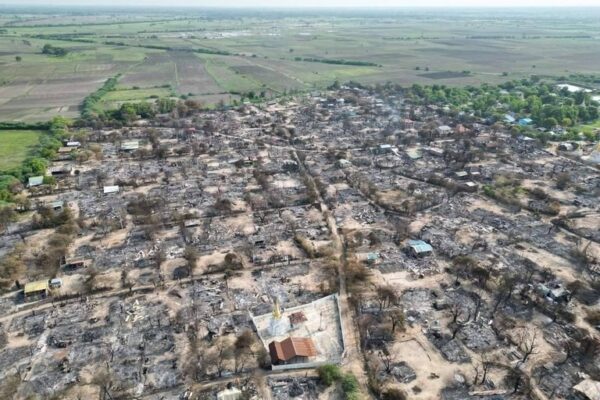
A woman was burned to death in her home when junta troops raided her village in Myanmar’s northern Sagaing region, residents told RFA Thursday. The 60-year-old was unable to flee when soldiers torched around 700 houses in Sagaing township’s Thar Zin village on Tuesday, they said. Troops captured residents of Thar Zin and nearby villages in a series of raids this week, although it was unclear whether they were being used as human shields or suspected of aiding anti-junta militia. “Some 25 people were arrested in Thar Zin village, and more were arrested in other villages,” said a local who didn’t want to be named for safety reasons. “So far, about 40 people have been arrested and all were taken along with the military column. No one has been released.” The local said nearly three quarters of Thar Zin’s buildings had been burned down, leaving more than 3,000 people homeless. After Tuesday’s raid on Thar Zin, residents said troops torched 10 houses in Aing Dan Ma village the following day and burned homes in Pauk Ma on Thursday. The burned shells of homes in Thar Zin village seen in an aerial photograph taken on June 15, 2023. Credit: Citizen journalist On June 6, junta Deputy Information Minister Major Gen. Zaw Min Tun told RFA that junta troops do not set fire to civilians’ homes. RFA called the junta’s Sagaing region spokesperson, Aye Hlaing, Thursday but nobody answered. More than 53,800 homes have been burned down by junta troops and affiliated militias since the Feb. 1, 2021 coup, according to independent research group Data for Myanmar. A total of 765,200 people have been forced to flee their homes in Sagaing region due to fighting and arson attacks since the coup, according to a United Nations Office for the Coordination of Humanitarian Affairs (UNOCHA) report on Tuesday. Translated by RFA Burmese. Edited by Mike Firn.

Read More

More than 5,000 people flee villages in Myanmar’s Tanintharyi region

More than 5,000 people have fled their homes in Myanmar’s southernmost Tanintharyi region, locals told RFA Monday. The mass exodus follows the capture of 30 residents of villages in Thayetchaung township during junta raids between Thursday and Sunday. Locals said at least six villages are empty after residents fled in heavy rains. One woman, who didn’t wish to be named for safety reasons, told RFA a convoy of around 100 soldiers entered Ka Net Thi Ri village on Thursday, only to be ambushed by members of a local People’s Defense Force. A junta ship arrived by sea and reinforcements opened fire with heavy artillery. The local defense force surrounded the village, leading junta troops to seize residents to use as human shields, the woman said. “The first day the junta column arrived, they arrested about 30 people camped at the monastery at the top of the village,” she said. “The next day, they used the people as human shields and moved them to the safety of Hpa Yar Koe Su mountain. The captured include the elderly and children. Those who can escape have fled.” Another resident of a nearby village, who also requested anonymity, told RFA locals fled to other villagers or left in boats. “They brought nothing when they fled … in  heavy rain”,” she said.  “They need clothes and accommodation urgently. Food is provided by our village. A member of the Thayetchaung People’s Defense Force said junta troops have only one escape route, which the PDF has blocked. “The battle may take a long time. It is still very difficult for them to get out by the way we have blocked,” said the man, who declined to be named.  “We prepared as much as possible in advance.” The Thayetchaung People’s Defense Force was aware of the possibility of junta attacks as early as June 8, warning civilians to travel along the local roads only between 6am and 9pm  The junta has not released a statement on the current fighting and calls to the local junta spokesperson, Yin Htwe, went unanswered Monday. Translated by RFA Burmese. Edited by Mike Firn.

Read More

Witty folk rant on the dark side of the news goes missing from China’s internet

A song by veteran Chinese folk-rock act Slap referring to numerous darker news events has disappeared from Chinese social media amid an ongoing crackdown on public performances and growing controls on cultural content. Slap, a prominent part of the festival circuit in recent year, released “Red Boy’s 18 Wins” in January 2023, with lyrics detailing the exploits of a fictitious hero – Red Boy – and a series of challenges he encounters. It refers to a woman found chained by the neck, the breakout by employees at Foxconn’s Zhengzhou factory during the COVID-19 restrictions, the death of high-schooler Hu Xinyu and attacks on women eating at a restaurant  in the northern city of Tangshan. “A mother of eight children with a chain around her neck,” the lyrics read. “Vicious scum who burned his wife is sentenced to death.” “Don’t tell me Tangshan is just like Gotham City, which at least had Batman,” the song says, picking up on several scandals of the three-year “zero-COVID” policy, where “everyone is obsessed with negative and positive [tests].” Huge following among youth The band has generally operated on the fringes of mainstream culture in mainland China, and has a huge following among young people today due to their songs’ criticism of the political system, and of society as a whole. Delivered in the style of a Chinese folk opera ballad, the 14-minute banned song has a laid-back accompaniment from a regular rock band, with Red Boy generally understood to represent the Chinese Communist Party. The lyrics and saga-like quality of the track, which is still available on YouTube, recall a classic of Chinese literature as Red Boy goes to war against Sun Wukong the Monkey King from “Journey to the West,” yet their gritty and often horrific content is drawn straight from recent headlines. A screenshot from surveillance video shows four women being attacked by a group of men at a late-night barbecue restaurant in Tangshan, China, in the early hours of June 10, 2022. Credit: RFA “We’re lucky to be born in the New Era,” it concludes in a reference to the political ideology of President Xi Jinping, after commenting that “everyone’s got Stockholm Syndrome.” “Hard work will win out in the end,” says the last line, referencing a 1980s TV theme tune from the now-democratic island of Taiwan, which was under the authoritarian rule of the Kuomintang and its hereditary leader Chiang Ching-kuo at the time the song was released. It was unclear whether the band has been caught up in a recent clampdown on public performances by government officials across China. A May 26 Weibo post from the band listed several June gigs in different cities, with the comment: “Let’s wait and see.” ‘Boldy crossed’ lines Akio Yaita, Taipei bureau chief for Japan’s Sankei Shimbun and an expert on China, paid tribute to the band in a recent Facebook post, saying it had “boldly crossed into restricted areas,” and became hugely popular online as a result. “A lot of people online commented that they feared for the safety of the band,” he wrote. “This is the first time I heard of them … Founded in Baoding, Hebei in 1998, they have five members and … use very down-to-earth language to comment on the topics of the day.” While the band may have flown under the radar until now, “Red Boys 18 Wins” had overstepped a red line, he said. “I think there will be a ban on performances coming soon, and maybe someone will go to jail,” Yaita wrote. People with suitcases and bags leave a Foxconn compound in Zhengzhou in central China’s Henan province on Oct. 29, 2022, in this photo taken from video footage and released by Hangpai Xingyang. Credit: Hangpai Xingyang via AP Taiwan-based Chinese feminist author Shangguan Luan told Radio Free Asia, who has seen the band perform live in the southwestern city of Chengdu, said they are well-known for their stinging social criticism. “They have been doing songs with the same kind of social criticism in them for years,” she said. “Every time they do a gig, they’ll have a song summarizing recent events, based on a familiar tune.” “They go for the hot topics – it’s kind of a tradition for them – integrating all of the news from the past few months or the past year,” she said. “Bands in China have always been somewhat underground, and many have been banned over the years,” Shangguan Luan said. “Basically, all the bands I like have been banned, so they can’t perform in mainstream venues.” One of few channels Ren Ruiting, who fled to the United States with her family following the banning of the Early Rain Covenant Church in Chengdu, said Slap’s songs could actually be the first place that many young Chinese people encounter such biting commentary on current events. “They’re very critical and very gutsy,” Ren said. “There aren’t that many channels through which the younger generation can learn the truth, because they don’t read books any more.” “But they love music and talk shows, so it’s a good way to get them to think [differently],” she said. Blogger YYQ described the band’s lead singer Zhao Yuepeng, who pens the songs, as “an observer who uses postmodernism to deconstruct reality.” “Rock music that isn’t critical is itself in need of criticism,” the blogger wrote in a recent post on the band. “Borrowing the narrative structure of traditional folk … it offers open-minded and insolent accusations and humble words, without shame,” the post said.  “The deliberate structures and rhythms enhance the weight of what is being said, but also give a sense of absurdity.” Translated by Luisetta Mudie. Edited by Malcolm Foster.

Read More