
Category: East Asia
Tsai talks in US – behind closed doors
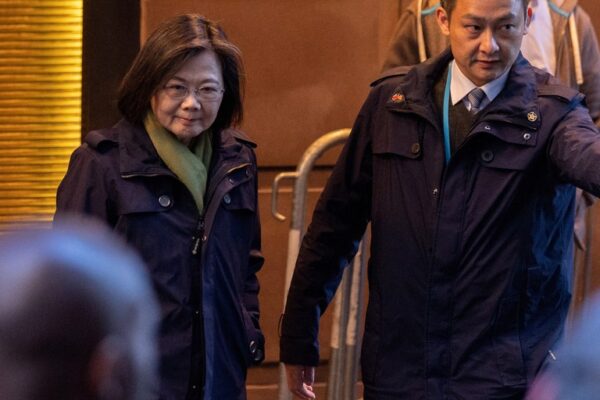
Taiwanese President Tsai Ing-wen has wasted little time since touching down in New York on Wednesday, delivering one speech shortly after her arrival with a second set for Thursday night. But it’s been hard to nail down the details. The controversial “transit” through America’s biggest city – en route, apparently, to official visits in Taiwanese allies Guatemala and Belize – is in part taking place behind closed doors, with press not invited. “They are very serious about keeping this a private event,” said Patrick Cronin, the Asia-Pacific security chair at the Hudson Institute, which is hosting Tsai’s speech at the Intercontinental Hotel. Taiwanese officials, Cronin told Radio Free Asia, did not want to create “unnecessary pressure and dissent” with a public speech, with Tsai also set to be presented with a global leadership award. “TECRO set the rules,” he said, referring to the Taipei Economic and Cultural Representative Office, Taiwan’s de facto embassy. “It’s not Hudson setting the rules,” he said, but “the Taiwan government.” Careful diplomacy Tsai appears to be walking a fine line, advocating Taiwan’s case against Beijing during her trip while avoiding prodding it too much. Chinese officials have already warned of “countermeasures” after the visit, and even of a “serious, serious, serious confrontation.” Each of Tsai’s previous six “transits” through the United States – one in 2016, two in 2017, another in 2018, and two in 2019 – attracted far less attention, coming at times of relative calm in U.S.-China relations. Dennis Wilder, research fellow with the U.S.-China Dialogue on Global Issues at Georgetown University and a former CIA deputy assistant director for East Asia and the Pacific, told RFA on Tuesday that the “kind of events” Tsai holds this time would shape Beijing’s reaction. “For example,” Wilder said, “if she were to give speeches where there would be live coverage of the speech, that would be a new kind of step; were she to give speeches that were incendiary in some way from Beijing’s point of view … we could see a harsh reaction.” The few snippets of Tsai’s visit that has taken place in the public eye so far have largely been tame, avoiding Taiwanese independence and other themes that could complicate U.S.-China relations. In an earlier speech to supporters after arriving Wednesday, Tsai thanked the United States for its support and vowed to continue working with Taiwan’s partners in the face of threats from Beijing. “At this juncture, our partnerships with the United States and other democracies are more critical than ever,” Tsai said in the speech. “We know that we are stronger when we stand together in solidarity with fellow democracies. Taiwan cannot be isolated.” Thawing relations Her trip comes at a fraught time for ties between Washington and Beijing, with U.S. Secretary of State Antony Blinken canceling a trip to Beijing at the last minute on Feb. 4 after an alleged Chinese spy balloon was discovered floating across the United States. However, U.S. officials insist the trip was only “postponed,” and there are already signs Beijing and Washington are seeking a new date. Taiwan’s President Tsai Ing-wen departs the Lotte Hotel in Manhattan in New York, Thursday, March 30, 2023. (Reuters) Rick Waters, deputy assistant secretary of state for China and Taiwan and the head of the State Department’s “China House,” last week paid a visit to China, meeting Chinese counterparts in Beijing, Shanghai and Hong Kong, department spokesman Vedant Patel said on Tuesday. “It was a working-level discussion,” Patel said, “about a wide range of issues that we have as it relates to our bilateral relationship.” Such a thawing gives U.S. officials reason to avoid an incident. In a call with reporters about Tsai’s trip on Thursday morning, Daniel Kritenbrink, the assistant secretary of state for East Asian and Pacific affairs, said U.S. officials had offered guidance to their Taiwanese counterparts about Tsai’s “transit” through the United States. But he declined to say if they had advised against public speeches. “We are committed to making sure that President Tsai’s seventh transit of the United States is conducted smoothly and successfully, and we have worked closely with many of our Taiwan friends and counterparts to ensure that that is the case,” Kritenbrink said. “If you have any questions on the specifics of any event that will take place during President Tsai’s transits,” he said, “I would refer you to the Taiwan authorities and to those associated with the event itself.” Cutting room floor Even with the private nature of Tsai’s speeches, attacks from Chinese officials about the visit have continued since her arrival. Chinese Foreign Ministry spokesperson Mao Ning told reporters at a press briefing in Beijing on Thursday that the trip “gravely undermines China’s sovereignty and territorial integrity and sends a seriously wrong message to ‘Taiwan independence’ separatists.” Chinese Foreign Ministry Spokesperson Mao Ning [shown in this file photo] said Thursday that Taiwan President Tsai Ing-wen’s trip “sends a seriously wrong message to ‘Taiwan independence’ separatists.” (Reuters) “This once again shows that the fundamental cause of the new round of tensions in the Taiwan Strait is the Taiwan authorities’ repeated attempt to solicit U.S. support for Taiwan independence and the fact that some in the U.S. intend to use Taiwan to contain China,” Mao said. “The Taiwan question is the very core of China’s core interests,” she added, “the bedrock of the political foundation of China-U.S. relations, and the first red line that must not be crossed in the relationship.” Xu Xueyuan, charge d’affaires at the Chinese embassy in Washington, also reportedly said Tsai’s visit could cause a “serious confrontation.” “The so-called ‘transit’ is merely a disguise to her true intention of seeking breakthrough and advocating Taiwan independence,” Xu was quoted as saying by Axios. Tsai’s trip, he added, “could lead to serious, serious, serious confrontation in the U.S.-China relationship.” Return ticket The worst from Beijing may be yet to come. Tsai departs New York for Guatemala at 11 a.m. on Friday and returns Tuesday to Los Angeles, where…
Junta jets bomb village in western Myanmar, killing 10
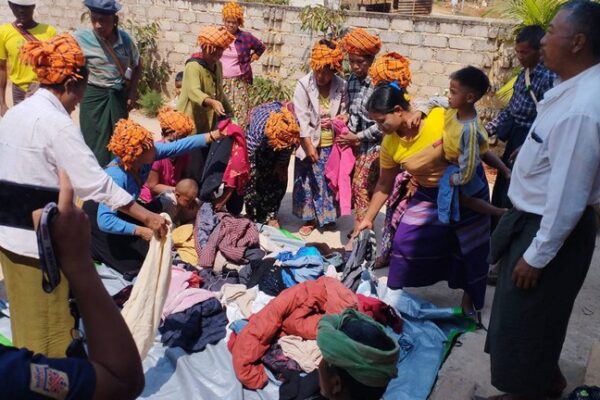
Two Myanmar military jets bombed a village in western Myanmar on Thursday where there was no fighting, killing at least 10 people and injuring 20 others, according to ethnic rebels and residents. The seemingly unprovoked attack on Khuabung village in Thantlang township in Chin state, near the Indian border, is the military’s latest use of air power in its sprawling offensive against anti-junta People’s Defense Force paramilitaries and ethnic armies. It’s a tactic that has become increasingly common as the country’s armed resistance makes greater gains. Such attacks are typically undertaken by the military to support troops fighting anti-junta forces with devastating effect. Chin National Front spokesman Salai Htet Ni told RFA Burmese that the strike by the two jets was unprovoked and clearly targeted a civilian population. However, Thantlang is one of several townships under martial law that the junta has targeted with multiple airstrikes since the start of the year. “They attacked this morning [at around 10:00 a.m.] without any battles happening,” Salai Htet Ni said. “They dropped bombs into a civilian village.” At least 10 residents were killed and 20 injured, he said. The airstrike set many of the village’s houses on fire, residents said. Khuabung, around 5 miles (8 kilometers) from the seat of Thantlang township, is home to more than 230 people living in 53 households. Increasing airstrikes According to the Chin Human Rights Organization, the military launched at least 53 airstrikes, dropping more than 140 bombs, on the townships of Mindat, Hakha, Matupi and Thantlang in the first two months of 2023 alone. The strikes killed five members of the Chin National Front and three members of local anti-junta People’s Defense Force, and also injured six civilians. In addition to the strike on Khuabung village on Thursday, the military also used Mi-35 aircraft to bomb areas it suspected were occupied by local PDF groups, the Chin National Front said. The military has yet to issue any statement regarding the bombing of Khuabung and attempts by RFA to reach Thant Zin, the junta’s spokesperson for Chin state, went unanswered on Thursday. A report issued by the U.N. human rights agency earlier this month said that junta airstrikes in Myanmar had more than doubled from 125 in 2021 to 301 in 2022. The report followed a joint statement on March 1 by Amnesty International, Global Witness, and Burma Campaign (U.K.) urging governments to sanction companies that sell jet fuel to the junta to limit the country’s air force. While international sanctions have limited the air force to some extent, former military officials in Myanmar have said they will never be fully effective while powerful countries, such as Russia and China, are backing the junta. Deaths and displacements in Shan state News of the airstrikes on Thantlang came as RFA learned that at least 33 civilians were killed and more than 5,000 displaced from southern Shan state’s townships of Pinlaung, Pekon and Mobye during the first three months of the year alone. Yin Lianghan, a spokesperson for the Shan Human Rights Foundation, said his organization had compiled the statistics after interviewing Buddhist monks displaced by the violence, as well as aid workers in the region. “These people have been severely displaced because of the junta’s heavy artillery shelling and a massacre in the Nam Neint village,” he said, referring to an incident on March 11, in which junta troops killed 21 civilians, including three monks, in a dawn raid on a monastery in Pinlaung before setting fire to the village. “The main reason why they have become refugees is because of the junta’s extrajudicial killing of innocent civilians,” he said. Residents who fled villages in southern Shan state, Myanmar, are seen in the town of Pinlaung, Sunday, March 26, 2023. Credit: Comet social group Junta Deputy Information Minister Major Gen. Zaw Min Tun has told pro-junta media that the Karenni National Defense Army committed the massacre in Nem Neint village, but the KNDF claims that it was the handiwork of the military. According to Shan Human Rights Foundation, at least two children were among those killed by the military shelling in Pinlaung and Mobye townships since the start of the year.. Tensions rising Khun Bwe Hone, the information officer for the ethnic Pa’O National Defense Force, told RFA that the deaths and displacements occurred amid rising tensions between the military and the ethnic Karrenni Nationalities Defense Force in the three townships, as the junta is preparing a major offensive in the area. “The junta is reinforcing its troops,” he said, noting that most villagers have already left the area in anticipation of the fighting. “Our defense forces have warned them to flee to safety. That’s why they left. This battle is likely to be drawn out because we are determined to fight against the military dictatorship … to the end and the enemy is going to do what it has set out to do, too.” A woman who fled fighting in the area told RFA on condition of anonymity that civilians are pouring into the seat of Pinlaung township from nearby villages to take refuge in camps for the displaced. A monastery and residential homes burn in Nam Neint village, Pinlaung township on March 11, 2023, following a raid by Myanmar junta forces. Credit: Inn Sar Kuu The exact number of refugees is unknown, said aid worker Khun Kyaw Shwe. While the refugees are receiving assistance from social support groups and area residents, they are in “desperate need of medicine,” as well as food and access to clean water, he said. “At the moment, local medical teams are taking care of them with what little medicine they have,” Khun Kyaw Shwe told RFA. “The demand for medicine is quite severe. The refugee camps are dealing with outbreaks of malaria, influenza and respiratory infections.” Only around 20 days of food stores remain for the camps in Pinlaung, he said, urging international donors to help fill the gaps. RFA was unable to reach Khun Thein Maung, the junta’s…
Countries ask UN court to issue opinion on responsibility for climate change
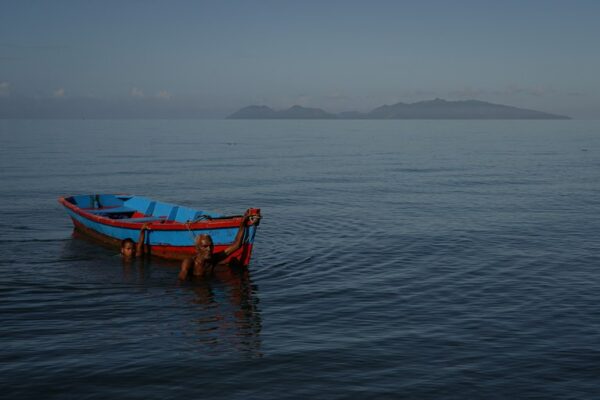
Should governments be sued for the consequences of human-driven climate change? That, in essence, was the question hatched by law students from Pacific island countries in 2019. Four years later, in what could prove to be a landmark decision, the United Nations General Assembly on Wednesday asked the U.N.’s judicial arm, the International Court of Justice, to give an opinion on states’ legal obligations to combat climate change. The ICJ’s view, though nonbinding, would “carry enormous legal weight and moral authority,” Vanuatu Prime Minister Alatoi Ishmael Kalsakau said in a speech before the ICJ resolution championed by his country was adopted. More than two thirds of countries had signed up as sponsors of the resolution. “We believe the clarity it will bring can greatly benefit our efforts to address the climate crisis and could further bolster global and multilateral cooperation and state conduct in addressing climate change,” Kalsakau said. Pacific island nations such as Vanuatu are among the countries most vulnerable to the extreme weather and sea-level rise that is projected to occur this century as a result of higher average global temperatures. Low-lying atoll nations such as Tuvalu and Kiribati are particularly at risk. At a conference in Fiji last year, officials from 15 low-lying Pacific island nations agreed that climate change was their “single greatest existential threat.” More than 130 nations sponsored the U.N. resolution with several including Indonesia, a major polluter, joining in at the last minute. The world’s two largest carbon polluters, the United States and China – rival superpowers that are vying for influence among Pacific island nations and pouring aid money to states in the vast oceanic region – were not among the sponsors. The resolution asks the international court to issue an advisory opinion on the obligations of governments to protect the “climate system” and the environment from global warming, which is driven by human activity. It also wants the court to offer an opinion on what legal consequences stem from those obligations, for countries that cause significant harm to the climate and environment, particularly in relation to small island states. An opinion from the International Court of Justice could add weight to the arguments for developed nations to take more action to reduce reliance on fossil fuels and for compensation for countries worst affected by a warmer climate. It could also be incorporated into national laws or influence courts when they consider lawsuits related to climate change. “If and when given, such an opinion would assist the General Assembly, the U.N. and member states to take the bolder and stronger climate action that our world so desperately needs,” United Nations Secretary-General António Guterres said. The latest yearly report from the U.N.’s Intergovernmental Panel on Climate Change, released earlier this week, said greenhouse gasses released by fossil fuels and other human activity had “unequivocally caused global warming.” The average temperature between 2011-2020 was 1.1 degrees Centigrade higher than 1850-1900. It said the increase in average surface temperature was already contributing to climate and weather extremes around the globe such as heatwaves and droughts and the intensity of rains and tropical cyclones. The internationally agreed goal of limiting the temperature increase to 1.5 C is still achievable though time is running out, the report said. Roemoni Tubivuna and his grandson Roemoni Tubivuna Jr., 10, prepare for a fishing outing at Veivatuloa village, Fiji, July 16, 2022. Leaders of 15 low-lying Pacific island nations declared climate change their “single greatest existential threat” at a mid-July summit in Fiji’s capital, Suva. Facing some of the most direct effects of climate change, they want developed nations, who contributed the most to global warming, not only to curb their emissions but to pay for the steps that islanders must take to protect their people from rising sea levels. Credit: Loren Elliott/Reuters Kalsakau and Guterres, in their speeches to the General Assembly on Wednesday, acknowledged the law students who provided much of the initial impetus for the effort to seek the ICJ opinion. “We are just ecstatic that the world has listened to the Pacific youth and has chosen to take action. From what started in a Pacific classroom four years ago,” Cynthia Houniuhi, one of the students and now president of the group, said in a statement. A decade earlier, the Pacific island nation of Palau had indicated it would ask the General Assembly to seek an ICJ advisory opinion but its initiative didn’t advance. The 27 students, from numerous Pacific island countries, were studying law at the University of South Pacific campus in Vanuatu’s capital, Port Vila, when they developed the idea, according to Lavetanalagi Seru, regional policy coordinator at the Pacific Islands Climate Action Network based in Suva, Fiji. They formed a civil society organization, Pacific Islands Students Fighting Climate Change, whose main goal was to convince governments to seek the advisory opinion, based around a question that would develop new international law combining climate change and legal obligations stemming from environmental treaties and basic human rights. The effort reflected frustration that the pledges made by countries to reduce emissions that cause higher global temperatures were “utterly insufficient,” according to the group’s campaign materials. Seru said it would likely take two to three years for the world court, based in The Hague, to issue an opinion. “It’s not really to push the blame,” he told BenarNews, “but to strengthen the understanding of what exactly is the role of states to protect the rights of current and future generations and what is the basic minimum that countries must do in order to protect those rights.” BenarNews, an online news service affiliated with Radio Free Asia (RFA), produced this report.
Tsai arrives in US amid Beijing’s protests
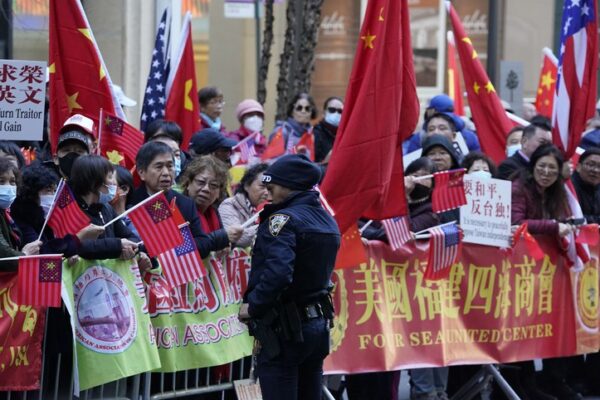
Taiwanese President Tsai Ing-wen arrived in New York on Wednesday amid a war of words between Washington and Beijing about her visit and threats of unspecified “countermeasures” from a Chinese official. Tsai touched down just before 3 p.m. at John F. Kennedy International Airport and was ushered by security into the Lotte New York Palace hotel on Madison Avenue – past throngs of tussling protesters and supporters being watched closely by police – shortly after 4 p.m. Armed with banners and loudspeakers, protesters led by the New York Alliance for China’s Peaceful Reunification, a local pro-Beijing group, had arrived early in the day and set up positions along the street. By the time of Tsai’s arrival, the group easily outnumbered Tsai’s supporters, most of whom did not arrive until about half an hour before the Taiwanese president, and though arguments broke out amid a tense mood, police kept the two groups separate. A member of the local Chinese community who requested anonymity due to safety concerns told Radio Free Asia he had received a telephone call from the Chinese Consulate in New York asking him to attend the protest to “safeguard the unity of the motherland.” Travel itinerary Tsai spends two nights in New York, delivering a speech and receiving a leadership award at the Hudson Institute on Thursday, before departing Friday for official visits to Guatemala and Belize. She returns on Tuesday to Los Angeles for two more nights in the United States, where she will deliver a speech to the Ronald Reagan Presidential Library and meet House Speaker Kevin McCarthy. Protestors look on as Taiwan’s President Tsai Ing-wen, not pictured, arrives at her hotel in New York City on Wednesday, March 29, 2023. (AFP) The trip comes amid tensions between China and the United States over Taiwan in the past year, with U.S. officials accusing Beijing of preparing to invade the self-governing island in the coming years and former House Speaker Nancy Pelosi last year visiting the island. It’s not the first time a Taiwanese leader has “transited” the United States, with the practice starting in the 1990s, but Beijing appears irked by Tsai’s plans to deliver two speeches and meet McCarthy, who has himself suggested he could repeat Pelosi’s visit to Taiwan. Countermeasures The response from Beijing – which views Tsai’s trip as part of a growing effort by Taiwan to assert independence – has already been vexed, with a particular fury reserved for the McCarthy meeting. During a press conference on Wednesday, Zhu Fenglian, spokesperson for the Taiwan Affairs Office of China’s State Council, threatened “countermeasures” if Tsai meets with McCarthy. “If she has contact with U.S. House Speaker McCarthy, it will be another provocation that seriously violates the ‘One China’ principle, harms China’s sovereignty and territorial integrity, and destroys peace and stability in the Taiwan Strait,” Zhu said before Tsai’s departure. “We firmly oppose this and will take resolute countermeasures.” Supporters look on as Taiwan’s President Tsai Ing-wen, not pictured, arrives at her hotel in New York City on Wednesday, March 29, 2023. (AFP) But U.S. officials say the “transit” – Tsai’s seventh time in the United States as Taiwan’s leader – does not constitute an official visit. Instead, they insist that Taiwan’s leader is visiting in a private capacity, and say it’s a standard practice for leaders of the democratic island. Beijing, though, regards Taiwan a renegade province and has threatened to forcibly “reunite” it with the mainland, and says American relations with Taiwan violate a 50-year-old agreement. Chinese officials also deny that such “transits” are standard. Foreign Ministry spokesperson Mao Ning said Wednesday that the United States was “hollowing out the ‘One China’ principle” and that “past mistakes do not justify any new mistake.” “The ones who are creating the problem and making provocations is not China, but the U.S. and the ‘Taiwan independence’ separatists,” Mao said. “We urge the U.S. to abide by the ‘One China’ principle.” Mao called on the United States to “earnestly deliver on its leaders’ commitment of not supporting ‘Taiwan independence’ or ‘two Chinas’ or ‘One China, one Taiwan,’ stop all forms of official interaction with Taiwan,” and to stop “upgrading” its relationship with Taiwan. ‘External pressure’ Leaving Taiwan on Wednesday, Tsai pledged not to be swayed. “I want to tell the whole world democratic Taiwan will resolutely safeguard the values of freedom and democracy, and will continue to be a force for good in the world, continuing a cycle of goodness, strengthening the resilience of democracy in the world,” Tsai said. “External pressure,” she added, in reference to the backlash from Beijing, would not “obstruct” Taiwan’s engagement with the world. Taiwanese President Tsai Ing-wen waves to the media before her departure for New York at Taoyuan International Airport in Taoyuan, Taiwan, Wednesday, March 29, 2023. (Reuters) U.S. officials say Tsai will not meet with anyone from the Biden administration during her six days in total on American soil. State Department principal deputy spokesperson Vedant Patel reiterated Wednesday that Tsai’s trip was “consistent with our unofficial nature of relations with Taiwan” and did not alter “our ‘One China’ policy,” which diverges from Beijing’s “One China” principle. “There is no reason to take countermeasures; there’s no reason for Beijing to turn this transit, which is consistent with long-standing U.S. policy, into something it’s not, or to overreact,” Patel told reporters. “We oppose any unilateral changes to the status quo, from either side. We don’t support Taiwan independence and we continue to expect that cross-strait differences be resolved through peaceful means.” But Patel declined to comment on McCarthy’s plans, saying they were his prerogative as a leader of a “co-equal branch of government.” Edited by Malcolm Foster
Interview: Indonesian special office to ‘steer ASEAN’s efforts’ on Myanmar
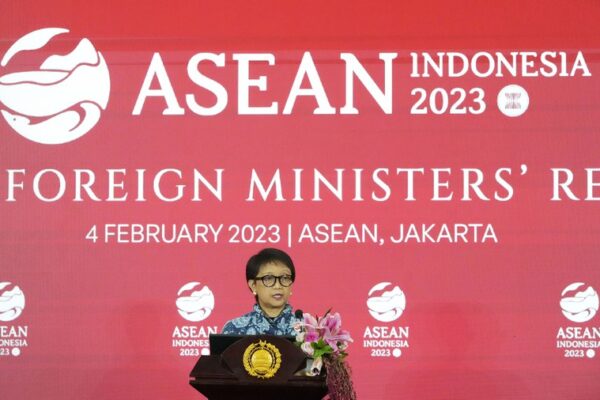
U.S. State Department Counselor Derek Chollet recently returned from a trip to Southeast Asia with stops that included Bangkok and Jakarta. During his visit to Indonesia, Chollet spoke with officials about their country’s role as this year’s chair of the Association of Southeast Asian Nations, or ASEAN, and the establishment of a special office within its foreign ministry to focus on the political crisis in fellow bloc member Myanmar. At the end of January, Chollet described Washington’s goal as being to “foster conditions that end the current crisis” in Myanmar and return the country to “the path of inclusive, representative multiparty democracy.” Amid frustration over the lack of progress in Myanmar and ASEAN’s handling of the crisis, Chollet claimed that sanctions leveled against the junta for its violent repression of the opposition “have had some effect,” reducing its sources of funding. But he acknowledged that more needs to be done, including ending the “steady pipeline of arms” that continues to enter the country and which the junta has used against its people. Chollet sat down with RFA Burmese’s Ye Kaung Myint Maung on Monday to discuss how the United States is working to achieve its goal in Myanmar both unilaterally and through cooperation with partners in the region. The following interview has been edited for length and clarity. RFA Burmese: What can you tell me about your trip to Southeast Asia last week? Chollet: I was able to talk to our partners in Indonesia about their ASEAN chair year and some of their aspirations for that year. They have established a special office inside the foreign ministry to focus on the crisis in Myanmar and help steer ASEAN’s efforts when it comes to addressing the crisis in Myanmar. They have named a very senior diplomat to lead that office. Someone who is very well known to us here in the United States … I had a chance to speak with him as well as Foreign Minister [Retno] Marsudi about the situation in Myanmar. And some of their thinking about how they’re going to try to achieve some results. So we talked about all sorts of issues related to the crisis, whether it’s our work to help provide humanitarian assistance to the refugees in and across the border from Myanmar into Thailand to ways that we’re going to work together with ASEAN to try to continue to pressure the junta, to further isolate them and to do what we can to support the democratic opposition inside Myanmar. RFA Burmese: So what would be the [role] of that office in Indonesia? Chollet: They are looking to help coordinate efforts on behalf of Indonesia for ASEAN in this chair year and it’s including trying to lead the diplomatic efforts that ASEAN is undertaking and implement the five point consensus [agreed to in April 2021 at an emergency meeting to end violence in Myanmar], to setting up a process to provide greater humanitarian assistance through the [ASEAN Coordinating Centre for Humanitarian Assistance] into Myanmar, to coming up with a work plan for how to use the coming year with key leadership meetings with ministers meetings and, of course, eventually with the summit later this year to try to get some important decisions made through ASEAN about Myanmar – all in the service of trying to implement the five point consensus. Indonesian Foreign Minister Retno Marsudi, shown in this file photo, spoke with US State Department Counselor Derek Chollet about the situation in Myanmar. Indonesia is the current chair of Association of Southeast Asian Nations (ASEAN). Credit: Associated Press RFA Burmese: What updates do you have on U.S. assistance for the people of Myanmar as mandated by the Burma Act? Chollet: We are working every day to implement the measures of the Burma Act. And we are one of the largest, if not the largest, donor of humanitarian assistance to Myanmar. We work intensively through our embassy in [Yangon] to provide humanitarian assistance and also to provide non-lethal assistance to the pro-democratic opposition and help them on everything from planning to budgeting to administration, particularly in areas which are now about 50% of the country that fall outside the [junta’s] control. So we find it very important that we have this support, bipartisan support, on Capitol Hill and are regularly in touch with our Congress on the way forward in implementing the Burma Act. RFA Burmese: The establishment of the special office – do you think it’s significant and why? Chollet: Previous chairs of ASEAN, Brunei and Cambodia, [have acted as] foreign ministers and special envoys … They were worried about managing the ASEAN agenda across the board. They have to participate in many meetings all around the world, in addition to their ASEAN duties and in addition to their concerns about Myanmar. So I think it makes a lot of sense to have this special office. It’s ensuring that there is high-level focused attention on the situation inside Myanmar. And they’re good partners of the United States. Russian and Chinese influence RFA Burmese: You said, during your trip, that Russian arms support for the junta is destabilizing the entire region. So what can you tell me about what the U.S. is doing to counter that Russian support? Chollet: We are making very clear to all of our partners that that support is unacceptable. We are also trying to make it harder for the junta to get the resources to acquire weapons that are fueling its war machine. Just last week, on Friday, when I returned from the trip, the United States announced another round of sanctions against several individuals and entities inside Myanmar that are associated with its acquisition of arms and particularly air power. Because what we’re seeing is the junta is increasingly using air power to go after the opposition because they’re finding that they’re less successful when they’re using ground forces. Myanmar junta leader Snr. Gen. Min Aung Hlaing sits in the cockpit of a newly acquired Russian SU-30 SME…
Congressional hearing examines Chinese repression in Tibet
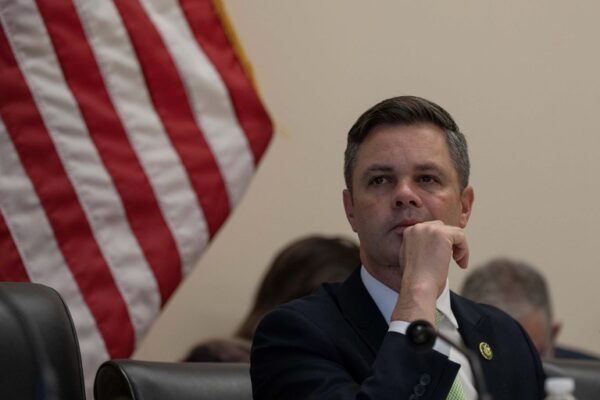
During a congressional hearing Tuesday on China’s growing repression in Tibet, U.S. Rep. Zach Nunn likened Beijing’s policy to an idea from an ancient Chinese essay about political strategy – sacrificing the plum tree to preserve the peach tree. “What they mean by this is that you can sacrifice in the short-term those who are the most vulnerable for the strength of those who are in power,” said Nunn, a Republican from Iowa, referring to a phrase from Wang Jingze’s 6th-century essay, The Thirty-Six Stratagems. “We are seeing this played out constantly in the autonomous state of Tibet today by the Chinese government,” said Nunn, a former intelligence officer. The hearing examined China’s increasing restrictions on linguistic and cultural rights in Tibet, its use of what commission members call “colonial boarding schools” for Tibetan children and attempts to clamp down on Tibetans abroad. It was held as both houses of Congress consider legislation that would strengthen U.S. policy to promote dialogue between China and Tibetan Buddhists’ spiritual leader, the Dalai Lama, or his representatives. The Dalai Lama and the Central Tibetan Administration, Tibet’s government-in-exile in Dharamsala, India, have long advocated a middle way approach to peacefully resolve the issue of Tibet and to bring about stability and co-existence based on equality and mutual cooperation without discrimination based on one nationality being superior or better than the other. There have been no formal talks between the two sides, and Chinese officials have made unreasonable demands of the Dalai Lama as a condition for further dialogue. Chinese communists invaded Tibet in 1949, seeing the region as important to consolidate its frontiers and address national defense concerns in the southwest. A decade later, tens of thousands of Tibetans took to the streets of Lhasa, the regional capital, in protest against China’s invasion and occupation of their homeland. People’s Liberation Army forces violently crackdown on Tibetan protesters surrounding the Dalai Lama’s summer palace Norbulingka, forcing him to flee to Dharamsala, followed by some 80,000 Tibetans. U.S. bill on Tibet The Promoting a Resolution to the Tibet-China Conflict Act, introduced in the House in February and in the Senate in December 2022, also direct the U.S. State Department’s Special Coordinator for Tibetan Issues, currently Uzra Zeya, to ensure government statements and documents counter disinformation about Tibet from Chinese officials, including disinformation about the history of Tibet, the Tibetan people and Tibetan institutions. In recent years, the Chinese government has stepped up its repressive rule in Tibet in an effort to erode Tibetan culture, language and religion. This includes the forced collection of biometric data and DNA in the form of involuntary blood samples taken from school children at boarding schools without parental permission. Penpa Tsering, the leader, or Sikyong of the Central Tibetan Administration, testified virtually before the commission, that reports by the United Nations and scholarly research indicates that the Chinese government’s policy of “one nation, one language, one culture, and one religion” is aimed at the “forcible assimilation and erasure of Tibetan national identity.” Rep. Zach Nunn participates in a congressional hearing on Tibet in Washington, D.C., Tuesday, March 28, 2023. Credit: Gemunu Amarasinghe/RFA As examples of the policy, Tsering pointed to the use of artificial intelligence to surveil Tibetans, the curtailing of information flows to areas outside the region, interference in the selection of the next Dalai Lama, traditionally chosen based on reincarnation, the forced relocation of Tibetans to Chinese developed areas inside the region and “unscrupulous” development that damages the environment. “If the PRC [People’s Republic of China] is not made to reverse and change its current policies, Tibet and Tibetans will definitely die a slow death,” Tsering said. American actor and social activist Richard Gere, chairman of the International Campaign for Tibet, told the commission that the United States must “speak with a unified voice” and engage European like-minded partners against China’s repression in Tibet. China’s pattern of repression in Tibet “gives reason for grave concern and it increasingly expands to match the definition of crimes against humanity,” Gere said. Forced separation China’s assault on Tibetan culture includes the forced separation of about 1 million children from their families and putting them in Chinese-run boarding schools where they learn a Chinese-language curriculum and the forced relocation of nomads from their ancestral lands, he said. Lhadon Tethong, director of the Tibet Action Institute, an organization that uses digital communication tools with strategic nonviolent action to advance the Tibetan freedom movement, elaborated on the separation of school children from their families. Agents of the Chinese government are using manipulation and technologies of oppression “To bully, threaten, harass and intimidate” members of the Tibetan diaspora into silence, said Tenzin Dorjee [right] a senior researcher and strategist at the Tibet Action Institute. Richard Gere, chairman of the board of the rights group International Campaign for Tibet [left] and Lhadon Tethong, director of the Tibet Action Institute, also spoke at the congressional hearing in Washington, D.C., Tuesday, March 28, 2023. Credit: Gemunu Amarasinghe/RFA “[Chinese President] Xi Jinping now believes the best way for China to conquer Tibet is to kill the Tibetan in the child,” she told the commission. “He’s doing this by taking nearly all Tibetan children away from their families and from the people who will surely transmit this identity to them — not just their parents, but their spiritual leaders and their teachers — and he’s handing them over to agents of the Chinese state to raise them to speak a new language, practices a new culture and religion — that of the Chinese Communist Party.” Tethong’s colleague, Tenzin Dorjee, a senior researcher and strategist at the Tibet Action Institute, discussed how China has extended its repressive policies beyond Tibet to target Tibetan diaspora communities in India, Nepal, Europe and North America through surveillance and harassment. Formal and informal agents of the Chinese government use manipulation and technologies of oppression “To bully, threaten, harass and intimidate” members of the diaspora into silence, he said. “The best way to counter China’s transnational repression is to…

U.S. sanctions two people, six entities for supplying Myanmar with jet fuel
The United States Treasury Department has announced additional sanctions on Myanmar to prevent supplies of jet fuel from reaching the military in response to airstrikes on populated areas and other atrocities. The sanctions came just days before Myanmar celebrated its 78th Armed Forces Day on Monday. The announcement on Friday targeted two individuals, Tun Min Latt and his wife Win Min Soe, and six companies including, Asia Sun Trading Co. Ltd., which purchased jet fuel for the junta’s air force; Cargo Link Petroleum Logistics Co. Ltd., which transports jet fuel to military bases; and Asia Sun Group, the “key operator in the jet fuel supply chain.” The statement said that since the Feb. 1, 2021 coup that overthrew the country’s democratically elected government, the junta continually targeted the people of Myanmar with atrocities and violence, including airstrikes in late 2022 in Let Yet Kone village in central Myanmar that hit a school with children and teachers inside, and another in Kachin state that targeted a music concert and killed 80 people. According to a March 3 report by the Office of the United Nations High Commissioner for Human Rights, junta-led airstrikes more than doubled from 125 in 2021 to 301 in 2022. Those airstrikes would have been impossible without access to fuel supplies, according to reports from civil society organizations, Friday’s announcement said. “Burma’s military regime continues to inflict pain and suffering on its own people,” said Under Secretary of the Treasury for Terrorism and Financial Intelligence Brian E. Nelson. “The United States remains steadfast in its commitment to the people of Burma, and will continue to deny the military the materiel it uses to commit these atrocities.” Helicopters and other aircraft are displayed at the Diamond Jubilee celebration of Myanmar’s air force, Dec. 15, 2022. on diamond Jubilee celebration of the Military Air Force. Credit: Myanmar military The announcement named Tun Min Latt as the key individual in procuring fuel supplies for the military, saying he was a close associate of the junta’s leader Sr. Gen Min Aung Hlaing. Through his companies, he engaged in business to import military arms and equipment with U.S. sanctioned Chinese arms firm NORINCO, the announcement said. “The United States continues to promote accountability for the Burmese military regime’s assault on the democratic aspirations of the people of Burma,” said U.S. Secretary of State Anthony Blinken in a separate statement. “The regime continues to inflict pain and suffering on the people of Burma.” The additional sanctions by the U.S. aligned with actions taken by Canada, the United Kingdom and the European Union, Blinken said. Cutting bloodlines “I am very thankful to the United States for these sanctions,” Nay Phone Lat, the spokesperson for Myanmar’s shadow National Unity Government, told Radio Free Asia’s Burmese Service. “I know that sanctions are usually done one step after another. It’s like cutting the bloodlines of the military junta one after another.” He said that the shadow government was trying to cut each route of support for the junta, including jet fuel, one after another. “[The junta’s] capability of suppressing and killing innocent civilians will be lessened,” he said. Banyar, the director of the Karenni Human Rights Group, which was among 516 civil organizations that made a request in December to the United Kingdom to take immediate action to prevent British companies from transporting or selling jet fuel to the Myanmar military junta, told RFA that the U.S. sanctions would have many impacts. “If you look at the patterns, the number one thing is that taking action against these companies that provide services to the junta directly discredits the military junta,” he said. “And the sanctioned companies are also punished in some ways. We can say that this is also a way to pressure other companies to not support the military junta.” But Myanmar has been sanctioned before to little effect, said Thein Tun Oo, executive director of Thayninga Institute for Strategic Studies, which is made up of former military officers. “No matter what sanctions are imposed, there will not be any major impact on Myanmar as it has learned how to survive through sanctions. There may be a little percentage of economic slowdown but that’s about it,” he said. The military has many options when it comes to buying jet fuel, said Thein Tun Oo. “We are not buying from just one source that they have just sanctioned, we can buy from all other sources. Jet fuel is produced from not just one place,” he said. “If we want it from countries in affiliation with the United States, we may have problems but the United States is not the only country that produces jet fuel, so there is no problem for the Myanmar military.” The military could look to China, Thailand, India or Russia for jet fuel if necessary, political analyst Than Soe Naing told RFA. “The sanctions imposed against the Myanmar military are little more than an expression of opinion, in my point of view, as they cannot actually restrict the junta effectively from getting what it needs,” said Than Soe Naing. “The reason is that the three neighboring countries and Russia can still supply the junta with the jet fuel from many other routes.” Ze Thu Aung, a former Air Force captain who left the military to join an armed resistance movement after the coup, told RFA that U.S. sanctions are not enough to stop the junta. “Whatever sanctions [Washington] imposes, the military junta can still survive as it is still in control of its major businesses such as the jade, oil and natural gas industries,” he said. “They have enormous funds left. They have Russia backing them as well. China is supporting them to some extent, too.” Translated by Myo Min Aung. Edited by Eugene Whong and Matt Reed.

Hong Kong police force protesters to wear numbered badges, march in cordon
Participants in the first public protest in Hong Kong since a draconian national security law took effect were forced to wear badges and walk within a police cordon last weekend. A few dozen people protesting a proposed land reclamation project and garbage processing facility marched in the eastern district of Tseung Kwan O on Sunday, wearing numbered lanyards and walking within a security ribbon in a manner reminiscent of an elementary school outing. The protest was the first to go ahead since the ruling Chinese Communist Party imposed a national security law on Hong Kong in July 2020, ushering in a citywide crackdown on public dissent and peaceful opposition that has seen dozens of former opposition lawmakers and pro-democracy activists stand trial for “subversion” for holding a primary election. But protesters said the restrictions imposed on them weren’t acceptable. “To be honest, a lot of people including myself feel that wearing numbered lanyards and walking inside a security tape is actually pretty humiliating,” political activist and former Democratic Party member Cyrus Chan told Radio Free Asia at the protest. “A lot of us have years of experience as marshals in the [formerly annual] July 1 demonstrations and the [now-banned] Tiananmen massacre vigils,” he said. “I’ve never seen anything like this before.” “We feel as if we are living in a whole new world,” Chan said. “As to whether that’s a brave and beautiful new Hong Kong in which we are free, or one in which we are subject to all manner of restrictions, I hope the government will consider this question.” Protesters had to wear these numbered lanyards during their march in Hong Kong on March 26, 2023. Credit: AFP Dragged around ‘like livestock’ Police earlier gave permission – via a “letter of no objection” – for a women’s rights march in honor of International Women’s Day, but organizers later canceled the event amid threats from police that they would arrest key activists. Sunday’s protest also received a letter of no objection after organizers applied for permission to hold a march of up to 300 people, but with a number of conditions attached, including individually numbered lanyards for each participant and a cordon preventing anyone from joining the protest if they hadn’t been there from the start. “Some lawbreakers may mix into the public meeting and procession to disrupt public order or even engage in illegal violence,” the police letter said by way of explanation. Participants were also told they couldn’t wear masks or cover their faces. “I really don’t like wearing a number, being numbered,” one participant told Radio Free Asia. “It really places limits on the spontaneity of the event, and makes people wary of taking part.” “We were dragged around inside this cordon the whole time like livestock,” they said. “It was really strange.” Former pro-democracy lawmaker Ted Hui, now living in Australia, said the mask bans first emerged as part of “emergency measures” taken to curb the 2019 protest movement, which had massive popular support for its resistance to the erosion of Hong Kong’s promised freedoms, and its demand for fully democratic elections. Protesters walk within a cordon line wearing number tags during a rally in Hong Kong on March 26, 2023. Credit: Associated Press Color revolution fears Beijing has dismissed the protest movement as the work of “hostile foreign forces” who were trying to foment a “color revolution” in Hong Kong through successive waves of mass protests in recent years. The government last week ordered the takedown of a digital artwork bearing some of the protesters’ names. “There was a lot of opposition [to the mask ban] back then,” Hui said. “Yet they are still using this law three years later, which tells us that the Hong Kong government hasn’t learned any lessons [from the 2019 protest movement].” Hui said the new system is similar to “real-name” requirements typically used to track people’s activities in mainland China, and will likely put participants at greater risk of official reprisals. “The Hong Kong government will definitely be retaliating against participants,” he said. “They may or may not prosecute them, or they could investigate them, or confiscate their travel documents.” “That’s the sort of thing people have been accustomed to seeing in Hong Kong over the past three years,” Hui said, adding that the freedoms of association, assembly and expression enshrined in the city’s mini-constitution, the Basic Law, now exist in name only. A spokesperson for the Democratic Party said the whole point of a protest is to allow for the airing of public opinion, so the number of participants shouldn’t be limited. The government-run Independent Police Complaints Council said the conditions placed on protesters were “understandable,” and said not every demonstration would necessarily be subject to the same restrictions in future. Translated by Luisetta Mudie. Edited by Matt Reed.
For founder’s birthday, North Korean cities ordered to decorate streets with flowers
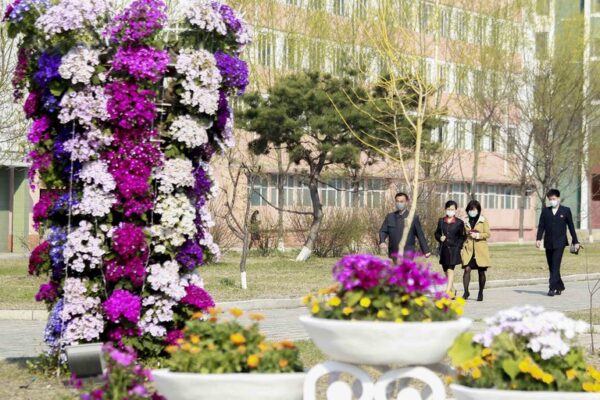
To celebrate the April 15 birthday of North Korea’s founder Kim Il Sung, authorities have ordered cities and towns to decorate the streets with flowers for the first time in three years, two sources in the country told Radio Free Asia. The holiday is a big deal in North Korea, where it is known as the “Day of the Sun.” Together with the “Day of the Shining Star,” the Feb. 16 birthday of his son, Kim Jong Il, the holiday perpetuates the personality cult surrounding the Kim family, which has ruled the country for three generations. Normally, the capital of Pyongyang and other major cities are decorated with flowers and new propaganda paintings and slogans are splashed across the cities ahead of the Day of the Sun, but that stopped about three years ago in most places due to the COVID-19 pandemic. Authorities want to bring the flowers back this year, even in rural towns and villages, a company official from Pochon county in the northern province of Ryanggang told RFA’s Korean Service Wednesday on condition of anonymity to speak freely. “It seems like an attempt to change the mood in the province, which has gone sour due to ongoing food shortages and a lack of daily necessities,” the source said. North Korea’s food situation was already dire prior to the pandemic but it got worse when authorities shut down the Sino-Korean border and suspended all trade for more than two years. Although rail freight between the northeast Asian neighbors has resumed, North Korea has not yet fully recovered. Flowers play an important role in the Days of the Sun and Shining Star because both of the late leaders have flower species named after them, a strain of orchid named Kimilsungia, and a strain of begonia named Kimjongilia, although it wasn’t clear if this year’s decoration orders called for either species. People walk in the street decorated with colorful flowers on the occasion of the 110th birth anniversary of late North Korean leader Kim Il Sung, in Pyongyang, April 15, 2022. Credit: Associated Press Paper flowers to make up for shortfall To adorn the streets of Pochon county with flowers, the landscaping management office has had to get creative, making paper flowers to make up for a shortfall of real ones, the source said. “They are growing as many fresh flowers as possible to decorate the center of the town and supplement them with paper flowers if they don’t have enough,” said the source. “The landscaping management office operates a small vinyl greenhouse but it is difficult to keep the temperature constant, so they have not been able to grow many flowers.” The greenhouse’s temperature is maintained by firewood brought in by employees from the mountainside, it hasn’t been working well. “The office therefore distributed five flower pots to each employee who lives in decent conditions to grow the flowers in their homes,” the source said. Chongjin scramble In Chongjin, one of the country’s largest cities, authorities are scrambling to grow flowers fast enough. They haven’t had to prepare flowers for the Day of the Sun in three years, and the order took them by surprise, a resident there told RFA on condition of anonymity to speak freely. “This year the Central Committee issued instructions to decorate the roads with flowers to create a festive atmosphere, so the landscaping management office of each district of the city, as well as the city’s flower office are struggling to prepare fresh flowers,” the second source said. “Keeping the right temperature inside the greenhouse is key to growing flowers quickly so that they can be ready for April 15th,” the second source said. “Currently, landscaping management offices and flower offices are spending money that they barely have to buy firewood from the market to maintain the temperature.” This could turn out to be problematic down the road, as the central government has not told the local office that they would finance their firewood purchases, the second source said. Most residents could care less about the festivities or the flowers, the second source said. “[They] are busy making a living every day have no time to appreciate or think about flowers,” he said. “The authorities’ order to set the holiday atmosphere with flower decorations for the ‘Day of the Sun’ is just a makeshift measure to try to end the dark atmosphere caused by hardships in life.” Translated by Claire Shinyoung Oh Lee. Edited by Eugene Whong and Malcolm Foster.
Chinese coast guard ship chased out of Vietnam waters
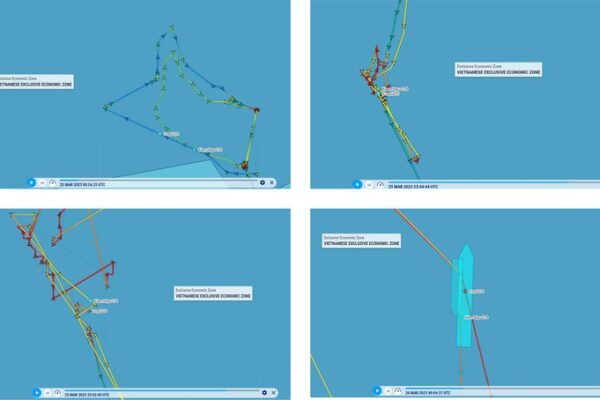
A Chinese coast guard ship and a Vietnamese fisheries patrol boat apparently had a tense encounter during the weekend in the South China Sea, coming as close as 10 meters to each other, according to data from Marine Traffic, a ship-tracking website. The data, based on the ships’ automatic identification system (AIS) signals, shows that the China Coast Guard ship, CCG5205, and Vietnam’s Kiem Ngu 278 came “crazy close” to one another at around 7 a.m. on Sunday local time (midnight UTC), said a researcher based in California. As of Monday afternoon (local time), the CCG5205 was operating in Malaysia’s exclusive economic zone after it left Vietnam waters where the Kiem Ngu 278 had been pursuing the considerably larger Chinese ship since March 24, tracking data showed. At one point the two ships were less than 10 meters (32.8 feet) apart, according to Ray Powell, the Project Myoushu (South China Sea) lead at Stanford University, who first spotted the incident at sea. “The Vietnamese ship was pretty bold given the difference in size – the Chinese ship is twice the size of the Vietnamese ship,” Powell said. “It must have been a very tense engagement.” The incident occurred some 50 nautical miles (92.6 kilometers) south of Vanguard Bank, a known South China Sea flashpoint between Vietnam and China. About 90 minutes later, the Chinese ship left Vietnam’s exclusive economic zone (EEZ) where it had been since Friday evening. An EEZ gives a state exclusive access to the natural resources in the waters and in the seabed. Ship-tracking data shows Vietnam’s Kiem Ngu 278 was closely following the Chinese coast guard vessel CCG5205. [Marine Traffic] Last month, the same China Coast Guard ship was accused of approaching about 150 yards (137 meters) from a Philippine Coast Guard ship and pointing a laser at the crew, causing temporary blindness to them. On Feb. 6, the Philippine Coast Guard said that the Chinese ship had “directed a military-grade laser light” twice at the BRP Malapascua, which was on its way to deliver food and supplies to the troops stationed at the Second Thomas Shoal in the South China Sea. Manila lodged a diplomatic protest and the U.S. State Department issued a statement supporting “our Philippine allies.” Beijing rejected the allegation, saying the Philippine ship had “intruded into the waters” off the Spratly Islands “without Chinese permission” and the Chinese coast guard ship had “acted in a professional and restrained way.” ‘Too close for comfort’ In the Sunday encounter, Marine Traffic’s past track showed the Chinese CCG5205 and the Vietnamese Kiem Ngu 278 were so close that they could have collided. “Ten meters between ships is really too close for comfort,” said Collin Koh, a Singapore-based regional maritime analyst. “Depending on the sea state, the risk of collision is fairly high,” Koh told Radio Free Asia (RFA). A retired Vietnamese Navy senior officer, who spoke to RFA on condition of anonymity because of the sensitivity of the topic, said the two ships must have narrowly escaped a collision because they were sailing in opposite directions and at a very slow speed. “If they were heading to the same direction a collision would have not been avoidable as the distance is too close and too dangerous,” he said. Chinese ships had deliberately rammed Vietnamese patrol ships in the past, he added, but not in recent years. The CCG5205 left Sanya, in Hainan island, for the current mission on March 11 and entered Vietnam’s EEZ the first time on March 12. It then moved to the overlapping area between claimant states in the South China Sea and Malaysia’s EEZ before entering Vietnam’s EEZ again on March 21 for a couple hours and for the third time on March 24 when the Kiem Ngu 278 chased it. At around midnight UTC on March 26, Vietnam’s Kiem Ngu 278 and China’s CCG5205 were dangerously close. [Marine Traffic] The Kiem Ngu 278, officially named Vietnamese Fisheries Resources Surveillance ship KN-278, is homeported in Vung Tau, south of Ho Chi Minh City. It left base on March 13 and had been following the Chinese vessel closely since. In July 2021, the Kiem Ngu 278 was following another Chinese coast guard ship, the CCG5202, which Vietnam accused of harassing its gas-exploration activities. Six parties hold claims to parts of the South China Sea and its natural resources but China’s claim is the biggest and Beijing has been trying to hinder other countries’ oil and gas activities in the waters inside its self-claimed nine-dash line. A 2,600-ton Chinese survey vessel, the Haiyang Dizhi Si Hao, had lingered inside Vietnam’s EEZ from March 9 until March 25, when it switched off its AIS, according to data from Marine Traffic. Its whereabouts are currently unknown.
