1. How Korea Got Divided
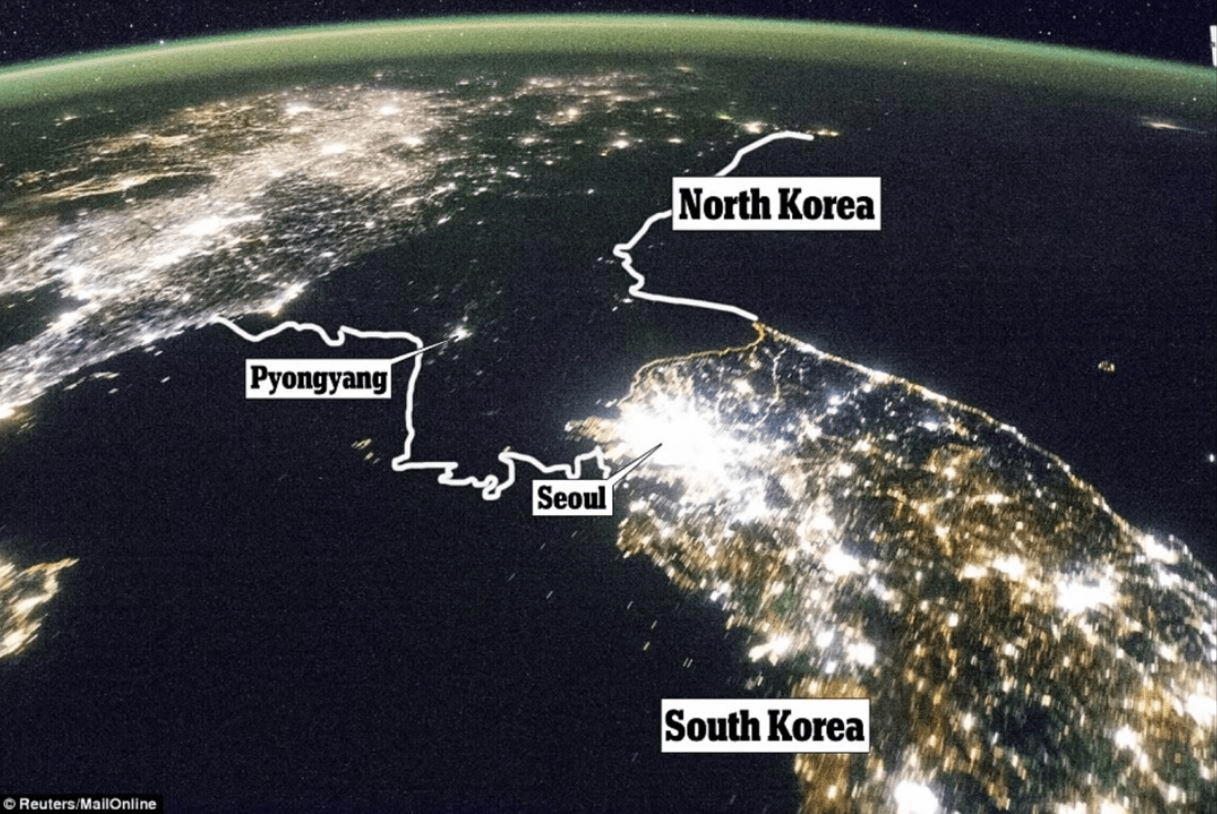
Korea existed as a single, unified nation for over a thousand years before it was split in the aftermath of World War II. The key stages:
- Japanese colonial rule (1910–1945): Korea was annexed by Japan and remained a Japanese colony until Japan’s defeat in WWII.
- The 38th Parallel (August 1945): As Japan surrendered, the United States and the Soviet Union hastily agreed to divide the Korean peninsula for the purpose of accepting the Japanese surrender: Soviet forces would take the surrender north of the 38th parallel, and American forces south of it. This was meant to be a temporary administrative arrangement, not a permanent border.
- Cold War hardening (1945–1948): As US–Soviet relations broke down, each power built up a rival government in its zone. In 1948, two separate states were formally declared: the Republic of Korea (South Korea) under Syngman Rhee, backed by the US, and the Democratic People’s Republic of Korea (North Korea) under Kim Il Sung, backed by the USSR.
- The Korean War (1950–1953): North Korea invaded the South in June 1950, aiming to reunify the peninsula under communist rule. A US-led UN coalition intervened for the South; China intervened for the North. The war ended in a stalemate near the original dividing line.
- The Armistice (July 27, 1953): An armistice agreement, not a peace treaty, halted the fighting and created the Demilitarized Zone (DMZ), a 4 km-wide buffer roughly along the 38th parallel. Because no peace treaty was ever signed, the two Koreas remain technically at war to this day.
The division was therefore never a natural or ethnic split. It was a Cold War accident of geopolitics that calcified into one of the world’s most fortified borders.
2. How the Two Countries Are Faring: Key Comparisons
| Parameter | South Korea | North Korea |
|---|---|---|
| System | Democratic republic, multi-party elections | Single-party totalitarian state (Kim family dynasty) |
| Population | ~51.7 million | ~25–26 million |
| GDP (nominal) | ~$1.87 trillion (13th largest economy globally) | Estimated $18–35 billion (highly uncertain; figures largely come from South Korean/CIA estimates since North Korea doesn’t publish reliable data) |
| GDP per capita | Roughly 40–50 times higher than North Korea’s | Among the lowest in the world |
| International memberships | UN, OECD, G20, IMF, WTO | UN only; largely excluded from global financial and trade institutions |
| Human Development Index | Ranked around 25th globally (Very High Human Development) | Not ranked due to lack of reliable data; believed to sit near the bottom tier |
| Internet access | Among the fastest and most widespread in the world | No public internet; only a tightly state-controlled intranet (“Kwangmyong”) for a small elite |
| Press freedom | Free press, though the National Security Act creates some limits on pro-North speech | State controls all media; no independent press exists |
| Military | ~500,000 active troops; advanced conventional forces; backed by ~28,500 US troops | Estimated 1.2 million active troops (one of world’s largest militaries), nuclear weapons and ballistic missile program, but conventional equipment is dated |
| Economy type | Export-driven, high-tech capitalist economy (semiconductors, shipbuilding, autos, K-pop/entertainment) | Centrally planned “command economy,” heavily sanctioned, reliant on China/Russia trade, smuggling, and cybercrime for hard currency |
| Recent economic trend | Mature, developed economy (slower ~2% growth, aging population) | Contracted through 2020–2022 under COVID-era border lockdowns, then returned to growth in 2023 (about 3%) as border controls eased and trade picked up |
| Trade | Global trading powerhouse (chips, cars, ships, phones) | Total external trade was roughly $2.8 billion in 2023, up sharply from about $1.6 billion the year before, still a tiny fraction of South Korea’s trade volume |
| Food security | Food secure | Chronic food shortages; periodic famine risk; UN estimates a large share of the population is undernourished |
| Life expectancy | ~83–84 years | Roughly 10 years lower than the South |
| Freedom of movement | Citizens free to travel/emigrate | Citizens forbidden from leaving without state permission; unauthorized border crossing is a serious crime |
Bottom line: the two Koreas started from the same peninsula and population in 1945 but have diverged into one of the starkest development gaps between any two neighboring countries on Earth. The South is a wealthy, globally integrated democracy; the North remains an isolated, impoverished, nuclear-armed dictatorship.
3. Things Banned in North Korea (that are normal elsewhere, including South Korea)
North Korea enforces strict controls to block “capitalist” and foreign cultural influence:
- Foreign media – South Korean dramas, American films, foreign radio/TV broadcasts are all illegal. Owning a radio or TV that can tune into non-state channels is a crime; watching smuggled South Korean or Western content can lead to labor camp sentences, and reportedly capital punishment for large-scale distribution.
- Internet – No open global internet for ordinary citizens; only a state-run intranet with government-approved content.
- Foreign fashion – Skinny/blue jeans (associated with “American imperialism”), dyed hair, piercings, and other Western-style clothing or hairstyles are banned or heavily restricted; violators can face public criticism, fines, or detention.
- Foreign phones/consumer brands – Products like Coca-Cola, Nike, Adidas, and other Western brands are effectively unavailable/banned.
- Bibles and religious material – Practicing organized religion (especially Christianity) is treated as a threat to the state; owning a Bible is considered a serious political offense.
- Unauthorized travel – Citizens cannot freely travel abroad or even move between provinces without state permits.
- Political dissent – Criticizing the ruling Kim family or state ideology (Juche) is criminalized, often severely.
- Mobile phones with international access – Ordinary citizens’ phones cannot make international calls or access outside networks.
4. Things Banned in South Korea Regarding North Korea (and vice versa)
South Korea is a free, democratic country, so its restrictions are narrower and specifically tied to national security rather than everyday life:
- Under the National Security Act (1948): it has historically been used to prosecute people for making favorable comments about North Korea or spreading North Korean propaganda. This includes:
- Blocking access to pro-North Korean websites and propaganda. Over 220,000 websites or pages were blocked in 2023 alone for various legal violations, including this one.
- Prohibiting the spread of material that praises, encourages, or promotes North Korea, with penalties of up to seven years in prison.
- In 2024, regulators banned a viral North Korean propaganda video after intelligence authorities determined it violated the law as psychological-warfare content aimed at the South.
- Sending materials into North Korea: a 2020 revision to the Development of Inter-Korean Relations Act bans scattering leaflets, goods, money, or other items across the border, and restricts loudspeaker propaganda broadcasts, with violators facing up to three years in prison or a fine of around 30 million won (roughly USD 25,000). This law targeted activist groups who flew balloons carrying anti-Kim leaflets and USB drives into the North.
- Joining/supporting North Korea’s ruling party or acting as an agent for it is illegal (espionage/anti-state activity laws).
Meanwhile, from North Korea’s side toward South Korea (and the outside world generally):
- All South Korean media, products, currency, and cultural exports (K-pop, K-dramas) are banned for ordinary citizens.
- Contact with South Koreans (letters, calls, unauthorized meetings) is illegal.
- Defectors caught trying to reach South Korea face imprisonment, labor camps, or execution; those who do escape and reach the South generally cannot return without risking imprisonment or death.
5. Geopolitical Alliances
South Korea’s Allies
- United States – South Korea’s most important ally. A Mutual Defense Treaty (1953) underpins the relationship, with roughly 28,500 US troops stationed in South Korea and a combined military command structure.
- Japan – Historically tense but increasingly cooperative on security matters, especially trilaterally with the US, due to shared concerns over North Korea and China.
- NATO-adjacent partnerships – South Korea isn’t a NATO member but has become a close partner, attending NATO summits and cooperating on arms production/support for Ukraine-related supply chains.
- Broader Western/democratic bloc – Strong economic and diplomatic ties with the EU, Australia, and other US-aligned democracies; member of the G20, OECD, and a major global arms/tech exporter to Western-aligned nations.
North Korea’s Allies
- China – North Korea’s most important economic lifeline and longtime ally since the Korean War (China intervened militarily in 1950). China remains its top trading partner and buffer against total isolation, though the relationship is often described as cautious and transactional rather than warm. In mid-2026, North Korea and China held a summit that restored their traditional bilateral relationship and raised North Korea’s profile as a partner for Beijing on the world stage.
- Russia – Ties have deepened dramatically since Russia’s invasion of Ukraine. Putin’s June 2024 visit to Pyongyang produced a comprehensive strategic partnership treaty with a mutual-defense clause committing each side to assist the other militarily if attacked. By late 2024, an estimated 11,000+ North Korean troops had been sent to Russia’s Kursk region to help repel Ukrainian forces, and North Korea has since become a major supplier of artillery shells, missiles, and manpower to Russia’s war effort. North Korean troops took part in Moscow’s Victory Day parade for the first time in 2026, and the two sides have discussed a further military cooperation plan covering 2027–2031.
- Limited others – North Korea maintains diplomatic relations with a small number of other states (e.g., some non-aligned or sanctioned nations) but has no formal Western allies and is subject to extensive UN sanctions over its nuclear weapons program.
The Bigger Picture
The peninsula today reflects two competing blocs: South Korea anchored firmly within the US-led alliance system (alongside Japan), and North Korea increasingly bound to a China–Russia axis, with the Russia relationship in particular evolving from transactional support into what Kim Jong Un himself has called an “alliance.” Analysts increasingly frame the challenge for US and allied planners not just as deterring North Korea alone, but as deterring a Korean conflict that could draw in China and Russia together.
Summary
Korea’s division was a temporary Cold War administrative line that hardened into a permanent, heavily militarized border after a war that never formally ended. Eight decades on, the two states, sharing the same language, history, and ethnicity, have produced almost opposite societies: South Korea a wealthy, high-tech democracy tightly bound to the US and Japan; North Korea an isolated, impoverished, nuclear-armed dictatorship increasingly leaning on China and, especially since 2024, a newly militarized alliance with Russia. Each side restricts its citizens’ exposure to the other, though the scale and severity of restriction differs enormously. North Korea polices everyday life and culture with harsh penalties, while South Korea’s restrictions are narrower, security-focused laws around pro-North propaganda and cross-border materials.