Half a year after President Donald Trump launched what he called “major combat operations” against Iran, the conflict that many predicted would end in weeks shows no sign of slowing. Instead, it has entered a dangerous new phase: a tanker war in the Strait of Hormuz, one of the world’s most critical energy chokepoints, that both sides are treating as a test of who will crack first.
How We Got Here
The war began on February 28, 2026, when the United States and Israel launched coordinated strikes on Iranian military, government, and infrastructure sites. Trump framed the campaign as a decisive blow meant to eliminate Iran’s nuclear program, dismantle its missile and drone arsenal, cripple its defense industry, dismantle its regional proxy networks, and, implicitly, threaten the survival of the regime itself.
None of that has happened.
A June ceasefire attempt, built around a US-Iran memorandum of understanding, collapsed within weeks. Since then, the two countries have settled into a grinding cycle of strikes, retaliation, and failed diplomacy. Six months on, Senate Armed Services Committee ranking member Jack Reed delivered a blunt verdict: not a single one of Trump’s stated war objectives had been achieved.
The Tanker War Heats Up
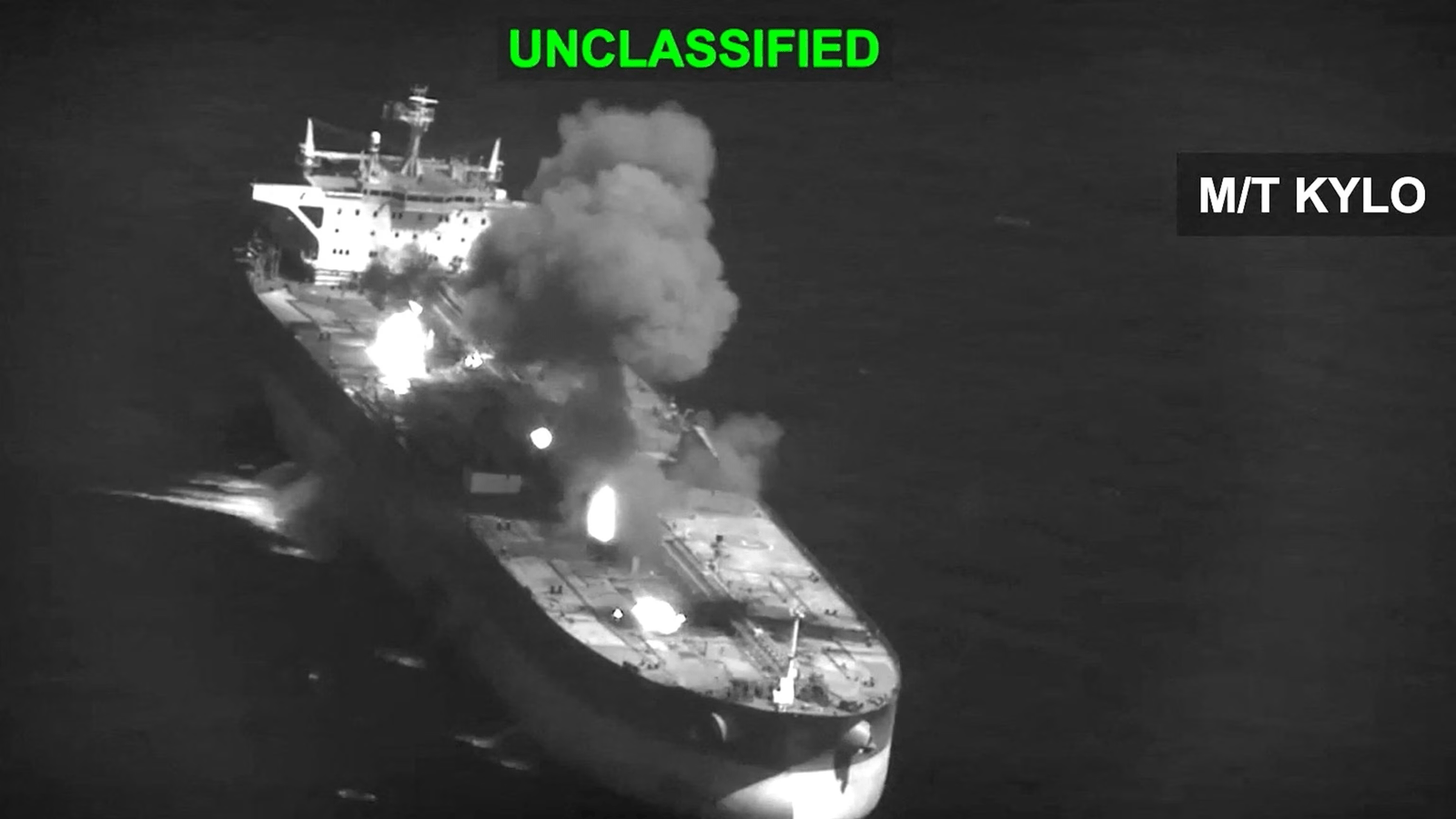
The most dangerous escalation yet has unfolded in just the past few days. US Central Command said its forces struck three Iranian vessels: a tanker near Kharg Island, the hub that once handled 90% of Iran’s crude exports; another near the port of Jask; and an unladen ship in the Gulf of Oman, whose crew was ordered to abandon ship before the strike.
CENTCOM said those attacks followed something far more provocative: Iran’s Revolutionary Guard Corps (IRGC) launching ballistic missiles directly at a US aircraft carrier and a navy destroyer patrolling near the Strait of Hormuz. Both ships evaded the missiles, and no American personnel were hurt, but the message was unmistakable. As one defense analyst put it, Iran didn’t just target “ordinary warships,” it targeted the aircraft carrier that forms “the backbone of the American campaign against Iran.”
CENTCOM commander Admiral Brad Cooper’s response left little room for ambiguity about what comes next: “If you shoot at two of our ships, we will impose an even higher economic cost, taking out three of yours.”
Iran didn’t stand down. Its forces went on to strike three more oil tankers it accused of sailing an “unauthorised route” through the Strait, plus three additional US-linked vessels elsewhere in the Gulf. Iran’s navy issued a warning to all shipping in the region: avoid “suspicious movement” near unauthorized waterways, or be targeted.
The Strait of Hormuz: A War Over a Waterway
At the center of it all is the Strait of Hormuz, a chokepoint that once carried roughly 20% of the world’s oil supply, some 20 million barrels a day. Iran effectively closed it in retaliation for the initial February strikes, and it has remained the conflict’s primary battleground ever since.
The two sides can’t even agree on basic facts about the Strait’s status. Trump has claimed the US is in “total control” of the waterway, and Treasury Secretary Scott Bessent has said roughly 17 million barrels a day are moving through it. But independent ship-tracking data from the analytics firm Kpler paints a starkly different picture: just six vessels crossed the Strait on one recent Wednesday, 11 the day before, and five the day before that, for a 10-day average of only 13 vessels daily, a fraction of pre-war traffic.
The Economic Toll Is Becoming Impossible to Ignore
The war’s costs are showing up everywhere from oil futures to gas station price boards. Brent crude closed recently at $96.28 a barrel, its highest level in over a month, and a sharp jump from roughly $70 a barrel before the war started. In the US, diesel hit a record average of $5.85 a gallon.
Washington, meanwhile, has widened its economic offensive. Last month, Bessent announced a new round of sanctions aimed at cutting off all of Iran’s revenue streams, particularly oil exports, and pressuring other countries and companies to stop doing business with Tehran. Iran’s foreign ministry has denounced the sanctions as “economic terrorism” and a violation of the UN Charter.
Tehran, for its part, appears to be preparing to push back harder rather than fold. One Iranian analyst told reporters that Iran is actively working to break the naval blockade, and has plans in motion to drive oil prices above $100 a barrel as a form of economic retaliation against Washington.
A War Even the White House Can’t Agree on Naming
Adding to the confusion is a semantic dispute at the heart of the US government itself. Vice President JD Vance has said he doesn’t consider the conflict a “war,” while Trump has brushed the distinction aside entirely: “I would say it’s a military conflict if you want. Some people could call it [a war].” The Pentagon, too, has been inconsistent: an internal directive reportedly told service members to stop referring to the operation by its original codename after the campaign quietly outlasted its initial framing.
The ambiguity isn’t just rhetorical. It reflects a war that has dragged on far longer than its architects anticipated, without a clear endpoint or a settled description of its own scope.
Other Fronts Are Opening Up
The conflict is no longer confined to direct US-Iran exchanges:
- The Houthis have entered the fray, with at least four civilians reported killed in a Houthi missile strike near Taiz, Yemen, raising fears of a wider regional front that could drag in Saudi Arabia.
- Cyberwarfare is escalating quietly. Analysts at the Center for Strategic and International Studies say it’s highly likely Iran is behind a string of cyberattacks on US water systems, describing the goal as psychological disruption rather than physical damage, an attempt to “sow fear, chaos, and division.”
- Diplomatic channels haven’t fully closed. Iranian Foreign Minister Abbas Araghchi met his Qatari counterpart to discuss reopening the Strait, following a week of talks with Oman and Pakistan. But Araghchi warned that the US’s current strategy of economic pressure “will not work.”
- Iran’s tone is hardening, not softening. Parliament speaker Mohammad Bagher Ghalibaf declared that “the era of ‘proportionate responses’ is over,” a signal that Tehran may be preparing to escalate rather than negotiate.
The Political Cost at Home
The war is becoming a genuine liability for Trump domestically. A Reuters/Ipsos poll from late August found just 31% of Americans support the war, while 63% oppose it. Trump’s approval rating has slipped to 33%, down from 40% when the fighting began, a warning sign ahead of November’s midterm elections, especially as gas and diesel prices climb heading into the vote.
Where Does This Go From Here?
Middle East analysts see little reason to expect de-escalation soon. Sina Azodi, director of the Middle East studies program at George Washington University, argues that neither Washington nor Tehran can afford to visibly back down: doing so “will not look good,” leaving escalation as the only face-saving option for both sides. Absent a genuine political settlement, he expects continued clashes, with real risk of miscalculation and rising civilian casualties, particularly on the Iranian side.
Tehran-based analyst Ali Akbar Dareini offered a similarly grim assessment: the US strikes on Iranian tankers are damage Iran “cannot afford to let go unanswered.” Rather than pushing Iran toward surrender, he argues, the pressure is more likely to provoke harsher retaliation.
Six months into a war meant to last weeks, the fundamental question hasn’t changed. It’s simply gotten more expensive to answer: which side can absorb more pain before the other does?