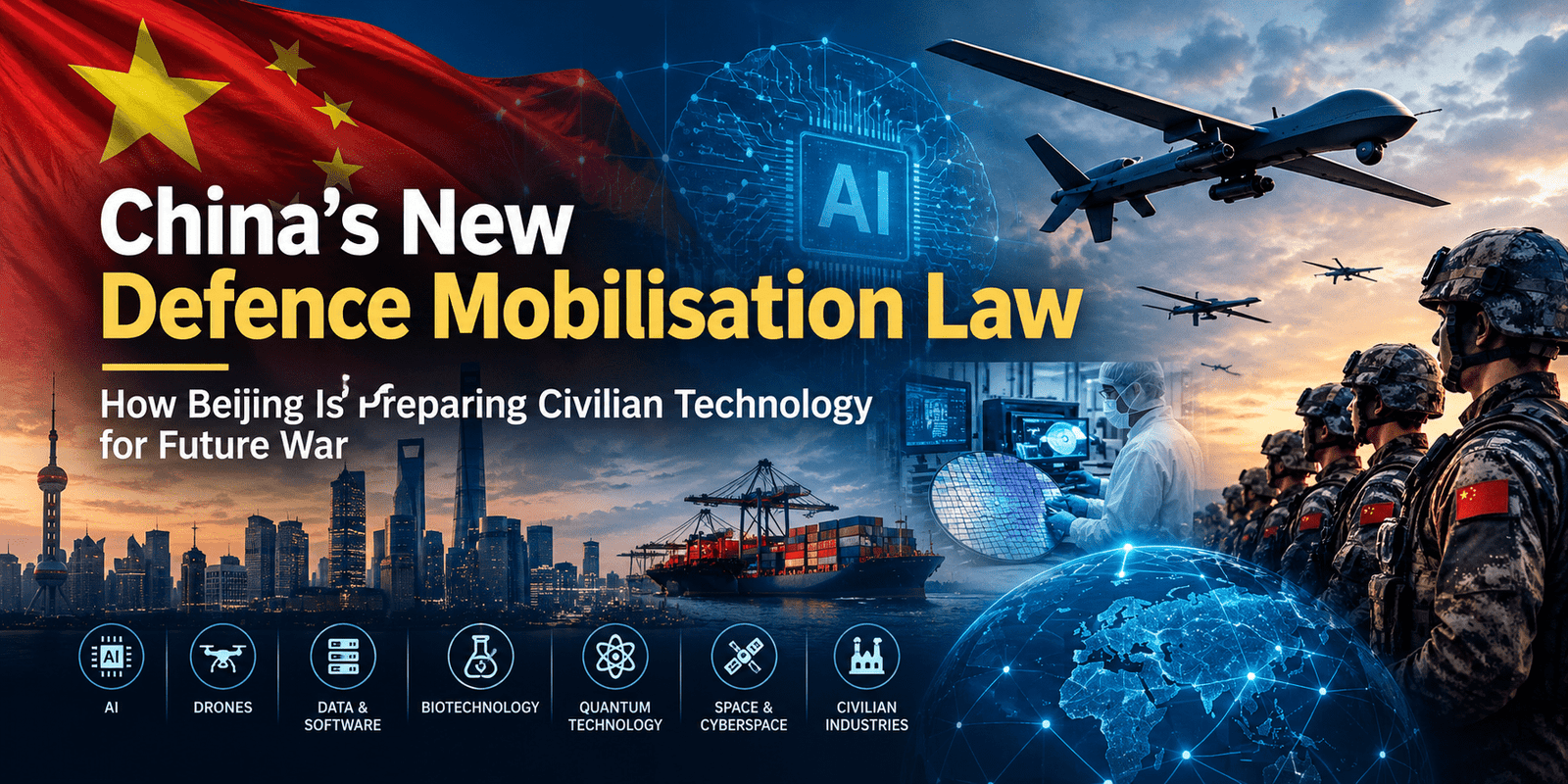
China’s first major revision of its national defence mobilisation law in 16 years signals a significant shift in how Beijing intends to prepare for modern conflict. The revised framework expands the concept of military preparedness beyond conventional weapons and government stockpiles, bringing artificial intelligence, drones, data, software, civilian technology companies, specialised talent and private logistics networks into the country’s potential wartime mobilisation system.
China has spent years building a closer relationship between its civilian technology sector and the military. The latest revision to its defence mobilisation law provides a legal framework that could make that relationship considerably more systematic.
The amendment, passed by China’s top legislature and scheduled to take effect on October 1, places new emphasis on advanced technologies and emerging fields. While the law does not provide an exhaustive list of technologies, analysts cited in the source material say its scope is expected to encompass artificial intelligence, unmanned systems, cyberspace, biotechnology, quantum technology, electromagnetic-spectrum capabilities, navigation and surveying, maritime technology and space systems.
The significance is not simply that China is adding technology to a military law. The deeper change is that Beijing is redefining what constitutes a national defence resource.
In earlier models of military mobilisation, the emphasis was largely on personnel, weapons, industrial production and strategic reserves. The revised framework reflects a battlefield in which software, algorithms, communications networks, data, autonomous systems and resilient supply chains can be as important as traditional military hardware.
From military reserves to a national technology reserve
The revised law formally defines national defence mobilisation as a process designed to enable a rapid transition from peacetime to wartime and transform economic and social capabilities into national defence strength.
That definition is important because it places the wider economy and society inside the mobilisation equation.
Under the revised framework, data and software are recognised alongside conventional equipment and products as part of military reserve capacity. This reflects an increasingly digital battlefield in which intelligence, command, surveillance, targeting, logistics and communications depend heavily on information systems.
The implication is that civilian technological infrastructure can have strategic value even when it was not originally designed for military purposes.
A software company, an artificial intelligence laboratory, a drone manufacturer, a mapping company or a logistics operator may therefore represent more than an ordinary commercial asset. In a national emergency, their technological capabilities could potentially become part of a wider mobilisation system.
This is particularly significant for China because of the scale of its technology and manufacturing ecosystem.
Rather than maintaining completely separate civilian and military technological systems, Beijing has long promoted closer links between the two. The revised mobilisation law appears designed to strengthen the legal foundation for bringing those capabilities into a wartime framework.
Ukraine has demonstrated the changing character of warfare
The Russia-Ukraine war has provided a powerful real-world demonstration of how rapidly military technology is changing.
Drones have become central to reconnaissance, surveillance and battlefield operations. Commercial technologies have been adapted for military purposes, while satellite communications, software, digital mapping, electronic warfare and data analysis have become increasingly important.
The conflict has also demonstrated that military effectiveness depends not only on weapons themselves but on the ability to manufacture, replace, transport and integrate them at scale.
Chinese military law expert Xie Dan, cited in the source material, argued that the Russia-Ukraine conflict reinforced the importance of unmanned, intelligent and cyber technologies and demonstrated the need for legislation capable of incorporating them into national mobilisation.
For Beijing, the lesson appears broader than simply acquiring more drones or developing better artificial intelligence.
The real challenge is creating a system capable of converting China’s enormous civilian technological and industrial capacity into military capability when required.
The drone lesson
Unmanned systems are among the clearest examples of this transformation.
Modern drones can be produced through supply chains involving commercial electronics, software, sensors, batteries, communications equipment and manufacturing facilities that may have extensive civilian applications.
This makes the boundary between military and civilian production increasingly difficult to maintain.
China is already one of the world’s largest drone manufacturing centres. A legal framework that allows civilian industrial capacity and technical expertise to be incorporated into defence mobilisation could give Beijing greater flexibility in expanding production or supporting military operations during a crisis.
The revised law therefore matters not because it creates China’s drone industry, but because it potentially provides a mechanism for mobilising the industry more efficiently.
That distinction is crucial.
The objective appears to be less about keeping massive quantities of every possible military system in government warehouses and more about ensuring that China’s civilian production ecosystem can be identified, organised and redirected when necessary.
Data becomes a strategic military resource
Perhaps one of the most consequential aspects of the revision is the explicit recognition of data and software as reserve capabilities.
This reflects a fundamental change in warfare.
A modern military requires enormous quantities of information. Forces need maps, satellite imagery, communications data, logistical information, intelligence feeds, navigation systems and software capable of processing and distributing information rapidly.
The military value of data can therefore extend far beyond information traditionally collected by armed forces.
Commercial mapping, telecommunications, cloud computing, artificial intelligence and other digital industries can potentially contribute to the information infrastructure on which military operations depend.
The revised framework places greater emphasis on collecting and organising such resources during peacetime so they can be allocated quickly during wartime.
This suggests that mobilisation is increasingly being understood as an information-management problem.
The question is no longer simply whether China possesses resources.
It is whether the government knows what resources exist, where they are located, who controls them, what capabilities they possess and how quickly they can be brought into a national mobilisation system.
Bringing private companies into wartime planning
Another major change concerns the role of non-government entities.
The revised law encourages enterprises, public institutions and social organisations to increase preparedness in technology and production capacity. Non-government organisations and individuals may also participate in areas such as storage, transport and distribution of strategic materials.
This expands the concept of defence mobilisation beyond the traditional state apparatus.
China’s private-sector economy contains enormous manufacturing, logistics and technological capabilities. Integrating those capabilities into a national emergency system could provide Beijing with a much larger mobilisation base than government-owned entities alone.
In practical terms, the approach seeks to ensure that warehouses, factories, transportation networks and technological infrastructure already operating during peacetime can become part of the national defence system when required.
This could be particularly important during a prolonged conflict.
A military cannot sustain operations indefinitely simply by drawing on government stockpiles. Ammunition, spare parts, electronics, batteries, vehicles, food, fuel and other supplies must continually move through production and distribution networks.
A resilient civilian supply chain can therefore become an extension of military power.
The real target may be mobilisation speed
The most revealing aspect of the debate surrounding the law may be the emphasis on speed.
A Beijing-based defence think tank, Dong Fang Hong, described the revision as a systematic adjustment to war preparation and argued that the central problem of modern mobilisation is not necessarily the availability of resources but the ability to mobilise them rapidly.
That distinction could shape China’s military planning for years to come.
China possesses enormous economic resources and a huge industrial base. But economic scale does not automatically translate into military capability.
A factory cannot contribute to a military operation if the state does not know what it can produce. A warehouse cannot serve a military supply chain if its inventory is not identified. A technology company cannot immediately support defence requirements if its capabilities have never been mapped or integrated into mobilisation planning.
The revised framework appears intended to close that gap.
It seeks to turn potential national resources into identifiable and legally mobilisable resources.
Artificial intelligence could become part of mobilisation infrastructure
Artificial intelligence occupies a particularly important position in this emerging system.
AI is increasingly embedded in civilian industries ranging from manufacturing and logistics to communications and data analysis. At the same time, militaries are exploring its applications in intelligence processing, autonomous systems, decision support, surveillance and command.
A legal framework that incorporates civilian AI capabilities into national defence mobilisation could allow China to draw on a much wider technological ecosystem during a crisis.
That does not mean every Chinese AI company would automatically become a military contractor or that civilian AI systems would instantly become weapons.
The more significant point is structural.
Beijing is creating a legal environment in which advanced civilian capabilities can potentially be incorporated into national defence preparedness.
This could give China an advantage in mobilisation if the country enters a prolonged technological or industrial competition.
Quantum, biotechnology and space capabilities
The law’s potential reach also extends beyond immediately visible battlefield technologies.
Analysts cited in the source material identify biotechnology, quantum technology, maritime systems and space technologies among the fields likely to fall under the broader category of advanced technologies.
These areas could become increasingly important in future strategic competition.
Quantum technologies could influence sensing, communications and computing. Biotechnology could have implications for military medicine, biological research and human performance. Space infrastructure is already central to navigation, communications and surveillance.
By including emerging technological sectors within the broader mobilisation framework, China is effectively acknowledging that future wars may be shaped by technologies that are still developing.
That gives the legislation a longer-term character.
It is not simply responding to today’s battlefield. It is attempting to build a mobilisation system capable of incorporating tomorrow’s technologies.
A broader military-civilian ecosystem
The revised law also fits into a wider pattern of changes to China’s defence and military legislation.
In recent years, Beijing has revised or introduced legislation involving national defence education, military installations, military service, the People’s Armed Police, the coastguard and reservists.
Taken together, these developments suggest an effort to build a more interconnected legal architecture around national defence.
The latest amendment adds another layer by strengthening the relationship between military preparedness and the civilian economy.
This is especially relevant to China’s long-running effort to integrate civilian technological development with defence objectives.
The result is a model in which national defence cannot be viewed solely through the size of the People’s Liberation Army or the number of missiles, aircraft and warships it possesses.
Industrial capacity, software, data, logistics, research institutions and private-sector expertise increasingly become components of national power.
What this means for China’s potential adversaries
For other major military powers, the development presents a complicated challenge.
Traditional assessments of military strength often focus on defence budgets, active personnel, weapons inventories and military platforms.
But China’s revised mobilisation framework points toward a broader measure of military capacity.
A more comprehensive assessment would need to examine China’s commercial drone production, semiconductor and electronics industries, artificial intelligence capabilities, shipping and logistics networks, software sector, satellite infrastructure, telecommunications systems and manufacturing capacity.
The critical question would be how quickly these civilian capabilities could be redirected toward national defence objectives.
This matters particularly in any conflict expected to last months or years rather than days.
A country with the ability to continually convert civilian production into military support may possess a substantial strategic advantage in a prolonged confrontation.
The Taiwan dimension
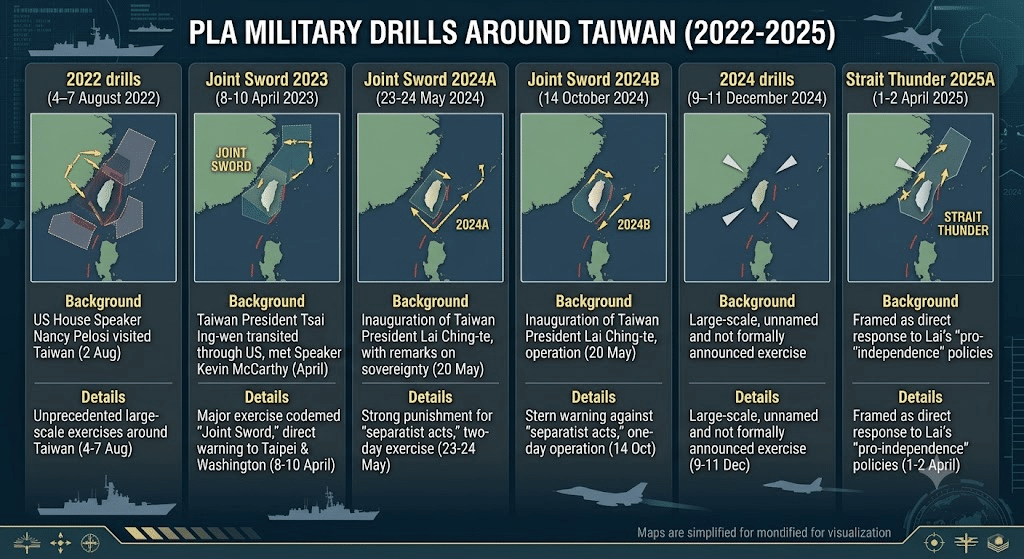
Although the revised law does not specifically identify Taiwan in the material provided, its emphasis on rapid mobilisation, emerging technologies, civilian production and logistics has obvious relevance to any future regional crisis involving China’s territorial claims.
A conflict across the Taiwan Strait would likely require far more than conventional military platforms.
Drones, electronic warfare, cyber capabilities, satellite communications, artificial intelligence, maritime logistics, industrial production and data systems could all play important roles.
A mobilisation system designed to connect civilian capabilities with national defence could therefore become a significant component of China’s broader preparations for high-intensity conflict.
However, legislation alone does not guarantee successful mobilisation.
The effectiveness of such a system would ultimately depend on implementation, coordination, industrial resilience, technological reliability and the ability of civilian organisations to respond under wartime conditions.
The hidden challenge: turning capacity into capability
China’s greatest strength in this model may also present its greatest challenge.
The country possesses a huge industrial and technological ecosystem. But scale creates complexity.
Millions of companies, factories, warehouses, logistics providers and technology professionals cannot simply be transformed into a coherent military support network overnight.
The revised law therefore appears to address an organisational problem as much as a technological one.
Beijing wants to know what resources are available before a crisis begins.
It wants those resources connected to government planning.
And it wants a legal mechanism for rapidly allocating them if national security conditions deteriorate.
That represents a significant evolution in the concept of defence preparedness.
Preparing for a different kind of war
China’s revised defence mobilisation law reflects a battlefield in which the distinction between civilian and military technology is becoming increasingly blurred.
The next major conflict may not be determined solely by who possesses the most advanced fighter aircraft, missiles or warships. It may also depend on who can process information faster, produce autonomous systems at scale, maintain supply chains under pressure, replace damaged equipment and convert civilian technological capacity into military support.
China’s latest legal revision appears designed with that reality in mind.
By formally recognising emerging technologies, data and software while expanding the role of civilian enterprises, organisations and logistics networks, Beijing is attempting to transform the country’s enormous economic and technological base into a more readily mobilisable strategic resource.
The significance of the law will ultimately depend on how it is implemented.
But the direction is unmistakable: China’s concept of military preparedness is expanding from the armed forces themselves to the wider technological, industrial and social infrastructure of the country.
In the wars of the future, the decisive question may not simply be who has the strongest military.
It may be who can mobilise an entire national ecosystem fastest.
China’s revised defence mobilisation law is an attempt to ensure that Beijing is ready for precisely that contest.