Vietnamese journalist in failing health after 2 years in prison

A Vietnamese journalist is in failing health after serving two years of a prison sentence for criticizing the country’s one-party communist government, RFA has learned. Prison authorities have rejected requests he be allowed to seek medical treatment outside his jail. Le Huu Minh Tuan, a member of the Vietnam Independent Journalists’ Association, was arrested on June 12, 2020, on a charge of “conducting propaganda against the state,” and is now serving an 11-year term at the Bo La Detention Center in southern Vietnam’s Binh Duong province. Tuan had been held first at another detention center in Ho Chi Minh City’s Binh Thanh district, where harsh conditions behind bars caused his health to deteriorate, his sister Na told RFA after speaking with Tuan on May 26 in the first family visit allowed to him since his arrest. “My brother is in very bad health. I couldn’t recognize him,” Na said, describing Tuan as emaciated and hard of hearing. “He has scabies, and he’s also malnourished as the food and living conditions where he’s being held are so tough.” Detention center officials have refused Tuan’s request to get medical care at an outside facility, though family members are allowed to send medicine to him inside the jail, Na said. Tuan had been kept in his cell all day while serving the first two years of his sentence at the Phan Dan Luu Detention Center in Binh Thanh, but now is allowed outside for 15 to 30 minutes each day at his new jail in Binh Duong, Na said. “However, the food there is horrible and has no nutrition at all,” she said. “They feed him only rice and a poor quality of soup without salt or other spices, and the rice itself is only half-cooked and mixed with sand.” The number of family visits allowed to prisoners at the Bo La Detention Center is restricted, and relatives can bring in only limited amounts of food, Na said. “For example, when Tuan ran out of milk and wanted to have some fruit, I went to the prison cafeteria to register to buy some for him, but was told I couldn’t do it,” she said. Tuan’s family had heard no news of him for the first two years following his arrest, not knowing whether he was alive or dead. They were finally told that he had been sent to the Bo La facility in Binh Duong on April 14, Na said. “Now we feel relieved, because we know we can visit him occasionally from now on.” Vietnamese independent journalist Pham Doan Trang is shown in an undated photo. Photo: icj.org Mother of jailed writer accepts award Another jailed Vietnamese writer, Pham Doan Trang, this week was awarded the 2022 Martin Ennals Award for Human Rights Defenders, with her mother, Bui Thi Thien Can, accepting the honor in Geneva, Switzerland, on her behalf. Speaking at the presentation ceremony, Can said she was proud of her daughter, who is now serving a nine-year sentence in Vietnam for “spreading propaganda against the state.” “[Trang] has been determined and persevering in pursuing a path that she fully understands is a dangerous and arduous journey,” Can said. “She has dedicated herself and fought tirelessly for democracy and human rights in Vietnam and for the freedom and happiness of the Vietnamese people.” Accompanying Can to Geneva were Tran Quynh Vi — codirector of the California-based NGO Legal Initiatives for Vietnam and owner of Luat Khoa (Law) Magazine — and democracy activist Will Nguyen. Independent journalists in Vietnam are still working but face massive challenges, Vi said in remarks following the award ceremony. “The good news is that in spite of Ms. Trang’s arrest, our newspapers are still published regularly and we have more and more contributors,” she said. “And the more they prohibit us, the more we want to work in the area.” Also speaking in Geneva, activist Will Nguyen called on citizens of Switzerland and other developed countries to alert their lawmakers and diplomats to Vietnam’s ongoing abuses of human rights. “I think we have a lot of leverage,” said Nguyen, a Vietnamese-American who was arrested for taking part in public protests in Vietnam in 2018 and then deported from the country by a Ho Chi Minh City court. “The more we look into this issue, the more likely it is that the Vietnamese government will treat its citizens with more respect,” he said. A prominent human rights activist and blogger, Trang was arrested on Oct. 6, 2020, and sentenced to nine years in prison on Dec. 14, 2021, on a charge of disseminating anti-state propaganda. The indictment against Trang also accused her of speaking with two foreign media outlets — Radio Free Asia and the British Broadcasting Corporation — “to allegedly defame the government of Vietnam and fabricate news,” according to a letter sent by 25 human rights groups calling for her release ahead of her trial. In addition to the Martin Ennals Award, Trang has also received the 2017 Homo Homini Award presented by the Czech human rights organization People in Need, and the Press Freedom Prize in 2019 from Paris-based media watchdog Reporters Without Borders. Translated by Anna Vu for RFA’s Vietnamese Service. Written in English by Richard Finney.

Read More

China rounds up dissidents, activists ahead of Tiananmen massacre anniversary

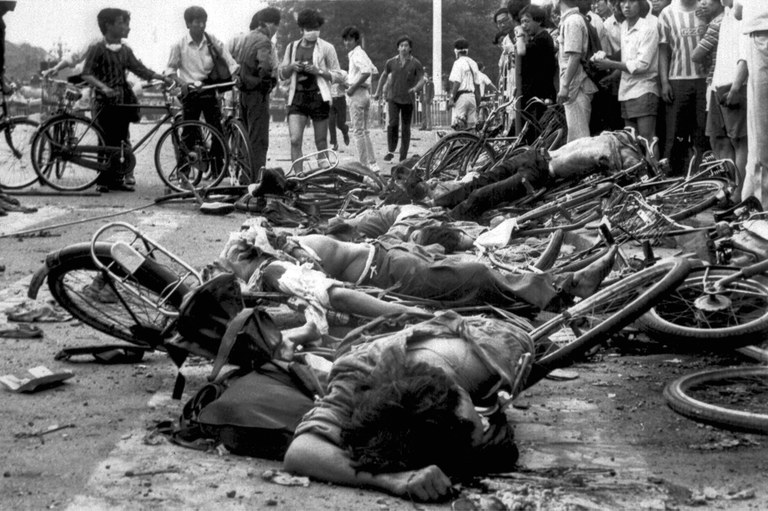
Authorities in China have ordered dozens of pro-democracy activists and dissidents into house arrest or other forms of restriction ahead of the 33rd anniversary of the Tiananmen massacre on June 4. Dissident political commentator Zha Jianguo and veteran journalist Gao Yu are under house arrest at their Beijing homes, while rights lawyer Pu Zhiqiang and his wife have been taken on a forced “vacation” out of town. Security is tighter than usual for this year’s anniversary of the bloody crackdown that ended weeks of student-led peaceful protests on Tiananmen Square, as the authorities tighten their grip ahead of the 20th congress of the ruling Chinese Communist Party (CCP) later this year. “The police have set guard detail and a car [outside my home] to watch me,” Gao told RFA on Friday. “If I want to go anywhere, they have to take me in their car.” “Also, my landline and mobile phone are no longer acceptable international calls, including calls from Hong Kong,” she said. Dissident commentator Zha Jianguo, who was among the founding members of the long-banned China Democracy Party (CDP), said he is in a similar situation. “They’re stationed [outside],” Zha told RFA. “They do this every year from June 1 to June 5.” “I went out on the morning of June 1 and saw them setting out stools and sitting themselves down outside our home,” he said. “The district police department said they would be sending some people round today as well.” “As far as I know, about seven, eight, maybe 10 people are under house arrest like this in Beijing,” he said. Zha said police have also warned him not to speak about the anniversary in media interviews. “They called me yesterday and said I wasn’t to discuss June 4 with anyone, not in posts, nor in media interviews,” he said. “I told them, it’s been 33 years since June 4, and you’re still doing this?” Sources said fellow Beijing-based dissidents Hu Shigen, He Depu, massacre survivor Qi Zhiyong and others were also under some form of restriction. Construction workers stand next to Chinese characters reading “cold blood” on the ground as they use metal sheeting to cover up one of the last public tributes in Hong Kong to the deadly 1989 Tiananmen Square massacre which has adorned a campus footbridge at the University of Hong Kong (HKU) for over three decades, Jan. 29, 2022. Credit: AFP. Noticeably tighter security You Weijie, spokesperson for the Tiananmen Mothers victims group that campaigns for compensation, redress and transparency of information around the massacre, said she couldn’t talk when contacted by RFA on Friday. “It’s not convenient for me to talk to you right now,” You said, her response suggesting that the authorities were monitoring her communications. Asked if she had been banned from giving media interviews, You replied: “Yes, yes.” She said she and the other Tiananmen Mothers members were being escorted to Wan’an Cemetery on Saturday to make offerings for those who died in the crackdown. “I’ll go tomorrow; the car has been arranged. It’ll be the same families going,” she said. Zhou Xiang, a dissident scholar in the central province of Hunan, said security was particularly tight this year. “Several people in Zhuzhou city have been contacted [by police]. He Jiawei was the first, and they have taken away his mobile phone,” Zhou said. “I also got a call. They told me not to speak out, not to upload photos or text [relating to June 4, 1989], etc.” “As far as I know, maybe seven or eight people received these warnings in Zhuzhou city.” Dissidents in the southwestern megacity of Chongqing reported similar treatment. Democracy advocate Xu Wanping, who served 23 years in jail for trying to set up an opposition party, said he is being taken out of town by police. “They made a point of contacting me and emphasizing that I wasn’t to speak out on anything today or tomorrow,” he said. “They’re taking me out of town for a couple of days; I’ve just gotten ready to leave.” Hong Kong park closure Asked if police were present as he spoke, Xu laughed and replied: “I wish you a healthy Dragon Boat Festival.” He said many others in Chongqing were also being escorted away from their homes. According to Zhou, the moves are part of a nationwide coordinated effort by police to prevent any form of public commemoration of the June 4, 1989 bloodshed, whether through in-person meetings or online. He said the level of security was “unprecedented” for a June 4 anniversary, and was likely linked to political jitters ahead of the 20th Party Congress later this year. Meanwhile, authorities in Hong Kong, where a once-annual candlelight vigil for massacre victims is being banned for the third year running, announced the partial closure of Victoria Park, the venue where it once took place. “In view of the police’s observation that some people are using different channels to incite the participation of unauthorized assemblies in the Victoria Park and its vicinity which may involve the use of the venue for illegal activities, the Leisure and Cultural Services Department (LCSD) [is closing] part of the Victoria Park … until 12.30 a.m. on June 5, in order to prevent any unauthorized assemblies in the Park,” an LCSD spokesperson said in a statement on Thursday. The closed area will include the soccer pitches where the vigils once took place, it said. Police senior superintendent Liauw Ka-kei warned the public not to “test” the force’s willingness to enforce the law on June 4. He warned that solo candlelight vigils will be treated in the same way as gatherings, and that anyone wearing black clothing or carrying candles would be regarded as suspect. He cited recent court precedents as establishing that people could be guilty of “illegal assembly” even if they weren’t present at the scene, if it could be shown that they had in some way promoted such assemblies. “If the purpose of the person’s appearance at the scene makes it seem that he is inciting others to participate in an illegal assembly, the police will definitely search for evidence, and the specific law enforcement action will…

Read More

US report on international religious freedom cites genocides in China and Myanmar

China and Myanmar feature prominently in the U.S.’s latest report on global restrictions on religious rights and practices, which singles out the two countries for their repression of mostly Muslim Uyghurs and Rohingya. “We have seen to genocides of religious minority communities in recent years in China and Burma,” said U.S. Ambassador-at-Large Rashad Hussain of the Office of International Religious Freedom during a press conference Thursday to release the report. The State Department is required to submit its assessment of religious freedom across the globe to Congress each year. Witnesses and experts provided grim testimony in the report about torture, rape and other human rights violations in the Xinjiang Uyghur Autonomous Region (XUAR). “It comes as no surprise that the People’s Republic of China is a glaring example” of a government that represses citizens who practice certain religions, said Hussain, who serves as an advisor to the President Joe Biden on religious freedom conditions and policy. “The PRC government continues to commit genocide and crimes against humanity against Uyghurs who are predominantly Muslim and members of other ethnic and religious minority groups,” he said. Hussain noted China’s continued use of technologies, including artificial intelligence and facial recognition, “to surveil and maintain control of its open-air prison in Xinjiang.” Human rights groups and Uyghur advocacy organizations have amassed credible evidence of the severe abuse Uyghurs in Xinjiang have suffered, from mass incarcerations and the destruction of mosques to torture, rape and forced sterilizations. Beijing has angrily denied the accusations, calling them the “lie of the century.” “China continues its genocide of predominantly Muslim Uyghurs and other religious minority groups,” said U.S. Secretary of State Blinken at the press conference. “Since April 2017, more than 1 million Uyghurs, ethnic Kazakhs, Kirghiz and others have been detained internment camps in Xinjiang.” RFA has reported that up to 1.8 million Uyghurs and other Turkic minorities have been detained in China’s vast network of hundreds of internment camps throughout Xinjiang. Chinese officials have said that the camps are vocational training centers designed to offer an alternative path away from terrorism and religious extremism. Dolkun Isa, president of the World Uyghur Congress in Germany, said the comments by Hussain and Blinken show that the U.S. stands with Uyghur Muslims and will hold China to account for the Uyghur genocide. “Their powerful words should encourage the international community to act to end the Uyghur genocide,” he said. “China wants to eradicate Islam because it believes Islam is a cancer. China is committing genocide against Uyghur people precisely because we are Muslims.” Rushan Abbas, executive director of the Washington, D.C.-based Campaign for Uyghurs, said she was pleased that Blinken called out China’s gross violations of human rights, genocide and crimes against humanity. “Blinken’s words reveal to the world that China is like the emperor’s new clothes, hiding behind lies,” she said. There was no immediate comment from the Chinese government about the U.S. report. The report also noted Myanmar’s repressive treatment of members of the Rohingya ethnic and religious minority group.  Violent clearance operations of Rohingya communities in western Myanmar by the country’s military in 2017, including arbitrary killings, torture and mass rape, drove more than 740,000 people to neighboring Bangladesh, where they now living in sprawling refugee camps.  “In March, based on extensive legal review of the evidence, I made the determination that Burma’s military committed genocide and crimes against humanity with the intent to destroy predominantly Muslim Rohingya in 2017,” Blinken said, citing evidence of attacks on mosques, use of religious and ethnic slurs, and the desecration of Korans. The military junta that seized power from the democratically elected government in February 2021 had confined 144,000 Rohingya in internal displacement camps in Rakhine state by the end of 2021, the report says, citing information from the United Nations High Commissioner for Refugees.  The junta also continues to restrict where Rohingya are allowed to travel in Myanmar and has made no efforts to initiate the return of Rohingya refugees from Bangladesh, the report says.

Read More

Warships arrive in Kyauk Phyu township as tensions rise in Myanmar’s Rakhine state

Myanmar’s military is sending more troops into Rakhine state amid fears that an informal ceasefire with the Arakan Army (AA) is about to collapse. A submarine arrived at Kyauk Phyu township on May 31, after sailing through the Bay of Bengal and traveling up the Than Zit river, according to locals. They said a warship arrived the following day. A resident, who declined to be named for safety reasons, told RFA’s Burmese Srrvice the ship was equipped with heavy artillery and helicopter landing pads. “The warship is huge,” the resident said. “It docked at Number Three Port in Kyauk Phyu and I saw soldiers disembark. I don’t know how many there were but I estimate that hundreds of soldiers were on board.” The two vessels moved to Number 15 Port at the Thit Pote Taung Naval Base in Kyauk Phyu after the troops disembarked. The township is home to one of China’s largest infrastructure projects in Myanmar, including the Kyauk Phyu Deep Sea Port. The resident speculated that the troop reinforcements were sent to protect China’s business interests amid fears of further clashes between the military and the AA. “There are a lot of Chinese projects here,” the local said. “The construction of deep-sea ports for docking submarines was also done by Chinese companies. So if the fighting intensifies I think the military is being deployed to protect China’s economic projects.” Some locals told RFA they were concerned about being able to get hold of basic supplies such as rice, cooking oil and salt as a result of the military reinforcement. When contacted by RFA, a junta spokesman denied that more troops had arrived on May 31. At a news conference on May 19 he said that the military could not be blamed if fighting breaks out in Rakhine state. Military tensions between the military council and the AA have been high since early May, with locals and Rakhine politicians concerned that fighting will soon intensify. An NGO which is monitoring the crisis released a report on Wednesday urging both sides to refrain from fighting. International Crisis Group (ICG) said people in Rakhine state would suffer if the war between the army and the AA breaks out again. Renewed clashes could impact 3 million Rakhine residents The AA began as a resistance group in 2009 and grew into a powerful ethnic army. It fought a two-year war with Myanmar’s military, which ended with an informal ceasefire in November 2020. The ceasefire has still not been formalized and the AA says it remains committed to establishing an independent state for ethnic Rakhines. Clashes between AA fighters and the military in two villages near Paletwa township on May 26 have raised fears the uneasy truce is about to crumble. The resumption of full-scale conflict between the military and the Arakan Army could put the lives of millions of ethnic minority residents of Rakhine State at risk, according to ICG. It said AA moves to gain territory in the north are likely to affect the lives of as many as 3 million ethnic Rakhines and Rohingyas. ICG senior adviser on Myanmar Tom Kean told RFA the humanitarian consequences would probably be worse than during the two-year war. Myanmar’s shadow National Unity Government (NUG) has invited the AA to join an alliance of regional armies to fight the military, which IGC said could also lead to an escalation in violence in Rakhine state.

Read More

Canada protests after aircraft ‘buzzed’ by Chinese jets

China’s People’s Liberation Army Air Force (PLAAF) fighter jets have repeatedly “buzzed” a Canadian reconnaissance aircraft on a U.N. mission in East Asia, with over two dozen intercepts deemed dangerous, a media outlet in Canada reported. “Buzzing” means flying extremely close and fast. On these occasions the Chinese jets came as close as 20 to 100 feet (six to 30 meters) to the Canadian plane, according to a report Wednesday in Canada’s Global News. The network quoted anonymous sources in the Canadian government and military as saying the government lodged “multiple” diplomatic complaints with Beijing for what they called the “unsafe and unprofessional conduct” of the Chinese pilots. The Canadian maritime patrol aircraft CP-140 Aurora, manned by rotating crews, is currently taking part in U.N. Operation NEON to monitor sanctions against North Korea. A spokesperson for the Canadian Department of National Defence was quoted as saying that the incidents are “of concern and of increasing frequency.”   There have been around 60 such incidents since December with the planes sometimes coming so close the pilots could make eye contact with each other, risking a mid-air collision, the report said. The Chinese government is believed not to have responded to Canada’s complaints, the report said. The Lockheed CP-140 Aurora is similar to the Lockheed P-3C Orion which is used by the U.S. Navy for anti-submarine and maritime surveillance.  The Aurora is “Canada’s primary airborne intelligence, surveillance, and reconnaissance aircraft,” according to the Canadian government website. It “provides a full range of maritime, littoral and overland surveillance capabilities for domestic and deployed missions.” It is unclear which type of Chinese aircraft were involved in the “buzzing” incidents.  Close encounters continue There have been a number of close encounters between Chinese and foreign military airplanes in recent years.  The latest incident took place in March when U.S. Lockheed Martin F-35 fighters had at least one close contact with China’s J-20 stealth fighters over the East China Sea. A U.S. Navy P-3C Orion surveillance aircraft and a Chinese military surveillance aircraft came within 1,000 feet (305 meters) of each other in the skies over the South China Sea in 2017. The worst incident occurred in April 2001 when a Chinese F-8 fighter jet collided with a U.S. Navy EP-3 Aries II surveillance plane over the South China Sea, killing the Chinese pilot. The U.S. airplane had to make an emergency landing on China’s Hainan island and its 24 crew members were detained for 11 days before being released.  Strained relationship Canada-China relations have been strained after Canada arrested Meng Wanzhou, a senior executive at the Chinese telecommunications company Huawei in 2018 at the request of the U.S. China retaliated by arresting two Canadian citizens, Michael Spavor and Michael Kovrig.  The two Canadians were released last September after Meng was allowed to return to China. Relations between the two countries soured again last month after Canada banned Huawei and another Chinese telecom company, ZTE, from taking part in its 5G network development.

Read More

Resumption of conflict would put millions at risk in Myanmar’s Rakhine state: report

A resumption of a full-scale conflict between Myanmar’s military and Arakan Army (AA) insurgents could result in the worst violence Rakhine state has seen in years and put the lives of millions of ethnic minorities in the region at risk, according to a new report by an international NGO. In a report released Wednesday, the International Crisis Group (ICG) said AA moves to gain territory in central and northern Rakhine state since it agreed to an informal ceasefire with the military in the latter part of 2020 are likely to prompt intense fighting in the region. It warned that up to 3 million ethnic Rakhines and Rohingyas would be severely affected by the violence and called for the ceasefire to be formalized, despite the AA’s declared goal of establishing an independent state for ethnic Rakhines and a bid by Myanmar’s shadow National Unity Government (NUG) to have the AA join a coalition of anti-junta armed groups. “A resumption of war in Rakhine state would have significant impacts for the 2-3 million people in the state, both Rakhine and Rohingya, who have so far been spared the post-coup violence that has engulfed the rest of Myanmar,” the ICG’s senior adviser on Myanmar, Tom Kean, told RFA’s Burmese Service in an email prior to the release of the report. “The humanitarian consequences would likely be devastating — almost certainly worse than during the two-year war from December 2018 to November 2020, which the state has still not recovered from.” Kean said that in researching the ICG’s report, both Rakhine and Rohingya interviewees expressed fear of conflict resuming, adding that while many believed such a conflict is inevitable, it is something they neither wanted nor supported. And while many in Myanmar would welcome a partnership against the junta between the AA and the NUG-led opposition, the report suggested that such an arrangement could spark violence that would significantly worsen the living situation for civilians in Rakhine state, which is already reeling from a battered economy and years of communal violence. Instead, Kean urged the AA to secure a formal ceasefire with the military, adding that while the insurgent army must decide for itself how best to achieve its political goals, a renewed war is “not the best option.” However, he suggested that the AA “work closely” with the NUG to choose a way to avoid the risk of a recurrence of conflict in Rakhine state. Refugees at a camp in Rakhine state’s Ponnagyun township, Jan. 21, 2022. Credit: RFA ‘The view of the people’ The ICG report follows a recent uptick in tensions between the two sides after the Arakan Army commander-in-chief, Gen. Tun Myat Naing, issued a warning to the military’s Western Commander Htin Latt Oo on Twitter. On May 26, the military and AA fighters clashed near the villages of Abaung-thar and Yote-wa, about six miles from the center of Rakhine’s Paletwa township, and residents have told RFA they are worried that the two-year-old ceasefire had been broken. Nyo Aye, the chairwoman of the Rakhine Women’s Network, called for calm between the two sides in an interview with RFA, noting that it is largely civilians who bear the brunt of armed conflict. “When tensions grow, there is a likelihood for more fighting,” she said. “We find this very worrying. It is our people who suffer because of the fighting. Tensions need to be reduced and I’m not talking about one side. I mean both sides need to compromise. That’s the view of the people.” An ethnic Rohingya Muslim from a village in northern Rakhine’s Buthidaung township told RFA that people there do not want fighting to resume. “Our only desire is to live in peace,” he said, speaking on condition of anonymity. “If there is fighting, there will be hardship. I am worried about the lives of refugees. We just want the fighting to stop.” He said fighting appears likely to resume as the military is regularly entering Muslim villages in Buthidaung, watching for AA movements. Attempts by RFA to reach AA spokesman Khaing Thukha for comment went unanswered Wednesday, but the junta’s deputy information minister, Maj. Gen Zaw Min Tun, responded to inquiries saying that the military is not deploying troops to Rakhine state and is trying to maintain peace in the region. “We only have local security forces who were there [from the previous conflict],” he said, adding that the AA claims the military is sending reinforcements to the area “to frighten the people.” “We are committed to the development of Rakhine state, and we are continuing to work for peace and stability. … If they want to say the [military] is expanding its presence or launching an operation, they should provide some evidence.” Military ‘directly responsible’ for violence Meanwhile, the ICG’s Kean said that if the junta truly hopes to establish peace in Rakhine state and other parts of Myanmar, it must stop oppressing its own people. “The military regime is directly responsible for the violence in Myanmar because it launched the [Feb. 1, 2021] coup and refuses to respect the will of the vast majority of Myanmar people,” Kean said. “Instead, it is using extreme violence to try and cower them into submission,” he said of the junta’s ensuing crackdown that rights groups say has led to the deaths of at least 1,878 civilians and the arrest of 13,915 more, mostly during peaceful anti-coup protests. Kean noted that despite the military’s brutal tactics, resistance to its rule — both armed and non-violent — “remains strong across much of the country.” “The military should of course stop abusing its own people, but this alone is unlikely to end the conflict because most people in Myanmar do not seem willing to accept any form of military government,” he said. “The path to stability is to hand back power to a civilian administration that has the support of the people.” Translated by Khin Maung Nyane. Written in English by Joshua Lipes.

Read More

Cambodian diplomat’s club stake to be examined by English Football League

The English Football League says that it will be making enquiries with Birmingham City Football Club following the revelation by RFA earlier this week that Cambodian diplomat Wang Yaohui secretly controls an eighth of the club’s shares. Under English Football League regulations, Birmingham City is obliged to disclose both to the league and publicly the identity of any person who directly or indirectly holds “any Significant Interest in the club.” Birmingham’s ownership disclosure does not name Wang, something that could cause problems for the club. Contacted on Tuesday, the English Football League’s communications manager Billy Nickson indicated in an email that the league was looking into the issues raised in RFA’s report. “All Clubs are aware of their obligations in respect of providing the appropriate and necessary disclosures in accordance with EFL Regulations,” Nickson wrote. “The EFL will take the matter up with the Club.” The EFL Championship is English soccer’s second highest division.  Born in China in 1966, Wang Yaohui is a naturalized Cambodian citizen and minister counselor at Cambodia’s embassy in Singapore. He has extensive business ties to one of Cambodia’s most powerful families, headed by ruling party Sen. Lau Ming Kan and his wife Choeung Sopheap. The couple are allies of Prime Minister Hun Sen. Wang’s stake in the soccer club is held through a company listed on the Hong Kong stock exchange called Birmingham Sports Holdings Limited, which owns 75 percent of the club. In December 2017, Wang acquired 8.52 percent of Birmingham Sports Holdings through a British Virgin Islands company called Dragon Villa Ltd. In the years since, filings with the Hong Kong stock exchange show he increased his stake to 17.08 percent, giving him a 12.8 percent interest in the club itself.  In its own disclosure statement, Birmingham City identifies Dragon Villa as being owned by a Chinese citizen named Lei Sutong. However, documents seen by RFA suggest that he is owner in name only. Corporate secrecy laws in the British Virgin Islands make it virtually impossible for members of the public to ascertain who the true owner of Dragon Villa is. However, filings lodged with the Singapore High Court reveal that it is in fact Wang. Gold Star Aviation Pte Ltd is a wholly owned subsidiary of Dragon Villa involved in the owning and operation of private jets. It is currently the defendant in a civil action in Singapore. Among its co-defendants is a Taiwanese-American named Jenny Shao, who Wang has granted power-of-attorney over his affairs since at least 2009. In a sworn affidavit submitted by Shao’s lawyers on her behalf and dated October 2020, she describes herself as Dragon Villa’s “authorized signatory.” She adds that Dragon Villa “is beneficially owned by Mr. Wang.” A beneficial owner is a person who enjoys the benefits of owning a company, even if it is held in someone else’s name. Former associates of Wang, who asked not to be identified citing security concerns, confirmed to RFA that Wang was Dragon Villa’s beneficial owner. The statement is also echoed in other affidavits lodged as part of the Singapore court case. Records also show that Dragon Villa has been involved in the ownership networks of several other Wang-linked enterprises. Should the EFL find the club violated regulations by failing to disclose Wang’s control of Dragon Villa – and therefore 12.8 percent of the club – then Birmingham City could face sanctions from the league. Wang Yaohui’s first Cambodian diplomatic passport bearing his Khmer name Wan Sokha. The passport was granted to him in 2015 in recognition of his role as an advisor to Prime Minister Hun Sen. Absentee owners Birmingham City fan Daniel Ivery has been raising concerns over Wang’s possible association with the club for years. He wrote on his blog Almajir on Tuesday that he had, “repeatedly attempted to raise this issue of Wang Yaohui with the EFL since December 2017.” Each time he raised the issue, he writes, the league refused “to even acknowledge that there may be an issue.” While it seems the league is now taking notice, it remains to be seen what, if anything, they will do about it. Ivery is not the only one who has been sounding the alarm over Birmingham City’s ownership. Local member of parliament Shabana Mahmood wrote to the UK Minister of Sport in January decrying “financial and professional mismanagement of absentee owners” at the club. For its part, Birmingham City has so far remained silent. The club acknowledged RFA’s enquiries for the first time on Wednesday when media manager Dale Moon promised to raise the issue with the club’s board and senior management – although he did not expect a statement to be forthcoming. “In all honesty,” Moon wrote, “given their historical stance on ownership, I don’t expect they will want to make any comment.” As of publication, no statement had been issued by the club.

Read More

Military carried out ‘collective punishment’ on ethnic civilians in eastern Myanmar

Myanmar’s military has subjected ethnic civilians in Kayin and Kayah states to “collective punishment” through aerial and ground attacks, detentions that lead to torture or extrajudicial executions, and the razing of villages, according to a new report by London-based rights group Amnesty International. The report, entitled “‘Bullets rained from the sky”: War crimes and displacement in eastern Myanmar’” and published Wednesday, found that clashes between the military and armed groups in the two regions reignited in the wake of the military’s February 2021 coup and worsened significantly from December to March this year. Hundreds of ethnic Karen and Karenni civilians have been killed in the fighting and more than 150,000 people have been displaced. “The world’s attention may have moved away from Myanmar since last year’s coup, but civilians continue to pay a high price. The military’s ongoing assault on civilians in eastern Myanmar has been widespread and systematic, likely amounting to crimes against humanity,” Rawya Rageh, senior crisis adviser at Amnesty International, said in a statement accompanying the report. “Alarm bells should be ringing: the ongoing killing, looting and burning bear all the hallmarks of the military’s signature tactic of collective punishment, which it has repeatedly used against ethnic minorities across the country.” Amnesty based its report on research it carried out in March and April this year, including interviews dozens of eyewitnesses and survivors of attacks as well as three defectors from the military. The group analyzed more than 100 photos and videos related to rights violations, in addition to satellite imagery, fire data and open-source military aircraft flight data. Amnesty said that since the coup, the military “has relentlessly attacked civilians” to punish those who purportedly support a particular armed group or the wider anti-junta uprising, while at other times “fir[ing] indiscriminately into civilian areas” where there are also military targets. “Direct attacks on civilians, collective punishment and indiscriminate attacks that kill or injure civilians violate international humanitarian law and constitute war crimes,” the group said. “Attacks on a civilian population must be widespread or systematic to amount to crimes against humanity; in Kayin and Kayah States, they are both, for crimes including murder, torture, forcible transfer and persecution on ethnic grounds.” Amnesty said it documented two dozen attacks by artillery or mortars between December and March that killed or injured civilians or that destroyed civilian buildings, adding that eyewitnesses said some of the attacks lasted “days at a time.” The group also documented eight air strikes on villages and camps housing refugees fleeing clashes in the first quarter of 2022 that killed nine civilians and injured at least nine others. Eyewitnesses described the attacks on locations where “only civilians appear to have been present” as extremely traumatic, leaving many unable to sleep or unwilling to return to their homes out of fear that they would be targeted again. A school destroyed by a military airstrike in Lay Kay Kaw, April 11, 2022. Credit: KNLA Cobra Column Extrajudicial executions, looting and burning Additionally, Amnesty’s reporting found that the military regularly carried out arbitrary detentions of civilians based on their ethnicity or because of their suspected support of an anti-junta group. Detainees “were tortured, forcibly disappeared or extrajudicially executed,” Amnesty said. The group specifically pointed to an incident that drew international condemnation in Kayah state’s Hpruso township on Christmas Eve last year, when the military stopped at least 35 women, men and children in multiple vehicles, killed them, and burned their bodies. An examination found that many of the victims had been tied up and gagged and were likely shot or stabbed to death. Amnesty has called for an investigation into the incident as a case of extrajudicial executions which, during armed conflict, constitute war crimes, the group noted. Other incidents mentioned in the report were related to what Amnesty called the military’s “systematic” looting and burning of villages in Kayin and Kayah state. Together, violence in the two regions has displaced more than 150,000 people, the group said, “including between a third and a half of Kayah state’s entire population.” The victims of this displacement are forced to shelter in “dire conditions,” it said, while aid workers are obstructed by the military from providing them access to much-needed food and health care. “Donors and humanitarian organizations must significantly scale up aid to civilians in eastern Myanmar, and the military must halt all restrictions on aid delivery,” said Matt Wells, Amnesty International’s crisis response deputy director for thematic issues. “The military’s ongoing crimes against civilians in eastern Myanmar reflect decades-long patterns of abuse and flagrant impunity. The international community — including ASEAN and U.N. member states — must tackle this festering crisis now. The U.N. Security Council must impose a comprehensive arms embargo on Myanmar and refer the situation there to the International Criminal Court.”

Read More

Myanmar’s junta shuts down publisher for distributing book on Rohingya genocide

Myanmar’s military regime has shut down a well-known publishing house in Yangon for importing and distributing a book on the 2017 Rohingya genocide, junta-controlled state newspapers said Wednesday. The regime accused Lwin Oo Sarpay Publishing House of violating the country’s 1962 publishing law by distributing and selling the book titled Myanmar’s Rohingya Genocide: Identity, History and Hate Speech by Ronan Lee, an Irish-Australian researcher at Loughborough University London. The junta shuttered the company’s book distribution center on May 28. State-owned media reported said Lwin Oo Sarpay was closed because it was distributing the book via Facebook. Since taking over Myanmar in a February 2021 coup, the junta has shut down media outlets critical of its regime and shuttered publishers that distribute books not in line with its own narrative. In recent weeks, the junta has shut down two other publishing houses, Shwe Lat and Yan Aung Sarpay, and the Win To Aung printing press. Human rights groups have produced a trove of credible reports based on commercial satellite imagery and extensive interviews with Rohingya about the military’s clearance operations in Rakhine state in 2017, including arbitrary killings, torture and mass rape. The violence drove more than 740,000 people to neighboring Bangladesh where they now living in sprawling refugee camps. Lee, a former member of Parliament for Queensland state, Australia, researched Rohingya refugees, including through field work in Bangladesh, Myanmar and Thailand, as part of his doctoral studies. His book, published in 2021, presents new evidence that the government of Myanmar enabled a genocide in Rakhine state and the surrounding areas, where most of the country’s Rohingya live. Drawing on interviews and testimony from the Rohingya, it assesses the full scale of the genocide of the Muslim minority group, including human rights violations, forced migrations and extrajudicial killings in 2017 under the previous leadership of Nobel Peace Prize laureate Aung San Suu Kyi. In March, U.S. Secretary of State Anthony Blinken issued an official determination that Myanmar’s military committed genocide against the Rohingya in 2017, going a step further than the U.S. government’s previous findings that the military had committed ethnic cleansing. A resident of Yangon who reads books distributed by Lwin Oo Sarpay told RFA that the closure of the publishing house was politically motivated because the junta does not want citizens to know what really happened to the Rohingya. “Lwin Oo Sarpay has been distributing books on politics and history by local and foreign authors,” said the resident who did not want to be named for safety reasons. “Now that it is closed down and its [operating] license has been withdrawn, people will not learn what they should know.” The military has accused Lwin Oo Sarpay of violating Section 8 of the Printing and Publishing Law, which imposes restrictions on the content of publications and websites run by publishers and bans the import or distribution of foreign publications that contain banned content. In this case, the prohibited content was deemed as causing harm to an ethic group or among ethnic groups. RFA could not reach Lwin Oo Sarpay for comment.  Translated by Khin Maung Nyane for RFA Burmese. Written in English by Roseanne Gerin.

Read More

Chinese forces step up exercises around Taiwan, South China Sea

China’s People’s Liberation Army (PLA) has intensified activities around Taiwan and in the South China Sea in an apparent response to the U.S. commitment to a free and open Indo-Pacific, as well as its support for Taipei. The PLA’s Eastern Theatre Command recently conducted a multi-force patrol “in the waters and airspace around the Taiwan Island,” said an army spokesman. This is the third large-scale military exercise around Taiwan in the past 30 days. Senior Colonel Shi Yi, spokesperson for the PLA Eastern Theater Command, said the joint combat-readiness security patrol involved “multiple services and arms,” but did not specify the date. “These actions are a necessary response to the collusion activities between the U.S. and the ‘Taiwan independence’ forces,” Shi said. He added that the U.S. “has been making frequent moves on the Taiwan question recently,” and warned that by emboldening and supporting Taiwan, Washington “will put Taiwan in a dangerous situation and bring serious consequences to itself.” Last weekend two U.S. aircraft carriers – the USS Abraham Lincoln and the USS Ronald Reagan – reportedly conducted dual-carrier exercises in waters to the southeast of Okinawa, according to the South China Sea Strategic Situation Probing Initiative (SCSPI), a Beijing-based think tank. Chinese analysts say the area could be a main maritime battlefield if the U.S. militarily intervened in a possible conflict across the Taiwan Strait. A U.S. delegation led by Senator Tammy Duckworth has just completed a three-day visit to Taipei to “talk about our support for Taiwan security.” The U.S will also make sure Taiwan “does not have to struggle alone,” Duckworth told Taiwanese President Tsai Ing-wen, who said that a cooperation plan between the U.S. National Guard and Taiwan’s armed forces was in the works. On the day of her arrival, 30 Chinese aircraft flew into Taiwan’s air defense identification zone (ADIZ), making it the second-highest number of daily incursions since the beginning of the year. The senator’s visit has infuriated Beijing. A Chinese Foreign Ministry spokesman said China “deplores and rejects this and has lodged solemn representations with the U.S. side.”  South China Sea drills On Wednesday morning the PLA conducted a military exercise in waters south of Hainan island in the South China Sea, according to a navigation warning issued by the Hainan Maritime Safety Administration. A navigation warning is a public advisory notice to mariners about changes to navigational aids and current marine activities or hazards including fishing zones and military exercises. The warning did not specify what kind of military exercise took place but the coordinates provided indicate the location was just south of Hainan, not far from the Gulf of Tonkin that China shares with Vietnam. Meanwhile on Wednesday Taiwan’s Ministry of Foreign Affairs (MOFA) condemned the harassment by the Chinese Coast Guard of a joint Filipino-Taiwanese research vessel in the South China Sea in April, calling it “a breach of a United Nations convention.” A day earlier, the Philippines summoned a senior Chinese diplomat to protest over the incident. From late March to early April, the China Coast Guard (CCG) tailed the Legend, a Taiwanese research vessel with Filipino scientists, as it mapped undersea fault lines in the waters northwest of Luzon Island in the South China Sea.

Read More