Rights groups call on UN secretary general to urge Vietnam to free 4 activists

On the eve of U.N. Secretary-General António Guterres’ trip to Vietnam, 14 international and local rights organizations called on him to urge Hanoi to release four environmental activists imprisoned in what they called a “new wave of repression” that threatens progress in addressing climate change and protecting human rights. Guterres’ visit on Friday and Saturday commemorates the 45th anniversary of Hanoi’s membership in the United Nations. Earlier this month, Vietnam was elected to a three-year term on the U.N. Human Rights Council despite critics pointing to its track record of rights abuses. In a joint open letter penned Thursday, Human Rights Watch, Amnesty International and the other organizations demanded the release of Nguy Thi Khanh, director of the Green Innovation and Development Centre; Dang Dinh Bach, director of the Research Center for Law and Policy for Sustainable Development, Mai Phan Loi, chairman of the Committee for Science Affairs at the Center for Media in Educating Community; and Bach Hung Duong, MEC’s director.  The four were sentenced to two to five years in prison in separate trials earlier this year.   “These political prisoners are emblematic victims of a new wave of repression in Vietnam which, through a combination of threats and judicial harassment, is threatening progress in combating climate change, protecting human rights and achieving the Sustainable Development Goals,” the letter said. “We call on you to remind Vietnam that, as a newly elected member of the U.N. Human Rights Council, it has an obligation to uphold the highest human rights standards,” it said. U.N. agencies in Vietnam must be more transparent and proactive in urging the country to improve its human rights record, said Jessica Nguyen, advocacy officer from the Illinois-based 88 Project, which maintains a database of imprisoned political activists in Vietnam, and was one of the 14 signatories of the joint letter.  “To do so, the U.N. agencies themselves have to improve their accountability in human rights issues in Vietnam, particularly [making themselves more accountable] to civil society organizations,” she said. Environmental protection is on the agenda for Guterres’ trip, presenting a seeming contradiction in a country where the four environmental activists are in prison on “bogus ‘tax evasion’ charges,” Phil Robertson, deputy head of Human Rights Watch’s Asia-Pacific Division, told RFA. “The U.N. leader wants to talk in Hanoi about climate change policies, but how can Vietnam really move forward when it is busy jailing key civil society partners who are critical to national efforts to stop global warming?” Robertson said. This contradiction cannot stand, and the U.N. needs to tell the Vietnamese government that it must end its repression of civil society organizations and NGO leaders.”  “Every day Vietnam is defying its obligations to uphold human rights, and we’re demanding that the U.N. call them out on it, and press Hanoi to do much better,” he said, adding that the international community seemingly has not noticed that Vietnam’s jails are filled with people who dared to criticize the government.  Guterres needs to state clearly that “Vietnam’s continued repression of activists and civil society groups will jeopardize the country’s ability to meet the SDGs that are so near and dear to the U.N.’s heart,” he said. Translated by Anna Vu. Written in English by Eugene Whong.

Read More

Hun Sen threatens to dissolve political parties that associate with Sam Rainsy

Cambodian Prime Minister Hun Sen on Thursday said he would dissolve any political party that dares to associate with Sam Rainsy, a threat that opposition party officials believe indicates he is still afraid of the exiled opposition leader’s political clout ahead of the 2023 general elections. Sam Rainsy was a co-founder of the now banned opposition Cambodia National Rescue Party, or CNRP. He fled to France in 2015 to avoid various political charges his supporters say are politically motivated. In 2017, Cambodia’s Supreme Court dissolved the CNRP, a move that allowed Hun Sen’s ruling Cambodian People’s Party, or CPP,  to capture every seat in the National Assembly in 2018 general elections. Hun Sen said he was not afraid of bloodshed and would beat down anyone who dared to stand up against him. “I succeeded in destroying the Khmer Rouge,” he said at a press conference in Kandal province, vowing to do the same to Sam Rainsy. “Now I appeal to the Khmer people who believe in this traitor – and any parties that want to associate with Sam Rainsy – we will file complaints against them to dissolve those parties,” he said. “The law states that we need to dissolve parties that commit crimes.”  A former Khmer Rouge member himself, Hun Sen defected to Vietnam with a battalion under his command in 1977 and returned during that country’s 1979 invasion of Cambodia. Following the defeat of the Khmer Rouge government, Hanoi installed him as deputy prime minister. He then rose to become prime minister in 1985 and has ruled the country ever since. Leader of the Cambodia National Rescue Party (CNRP) Sam Rainsy [center] arrives at a Paris courthouse for proceedings in a defamation lawsuit filed by Cambodia’s Prime Minister Hun Sen, Sept. 1, 2022. Photo: AFP Hun Sen said he supported Wednesday’s decision by the Phnom Penh court to sentence Sam Rainsy to a life sentence and strip him of all political rights, on charges of conspiring to hand over Cambodian territory to a foreign state. “Cambodia doesn’t have a law to execute prisoners, otherwise the court would have ordered the execution of Sam Rainsy,” he said. “People must understand this traitor’s behavior. People who are involved with these traitors will be punished, so please stay away.”  Hun Sen’s threats reveal that he himself still feels threatened by Sam Rainsy’s popularity, Um Sam An, a senior CNRP official, told RFA’s Khmer Service. “People, including the armed forces, continue to support Sam Rainsy, so Hun Sen is afraid of Sam Rainsy’s influence after he urged voters for a change in the 2023 election,” said Um Sam An. The court’s ability to dissolve a political party is an incorrect interpretation of the law, Kang Savang, an election monitor with the independent Committee for Free and Fair Elections in Cambodia (Comfrel), told RFA. “Political parties are facing difficulties because of the law,” he said.  “Their interpretation of the law is not clear, specifically over issues of national security and foreign collusion.”   Translated by Samean Yun. Written in English by Eugene Whong. 

Read More

Myanmar’s junta bans family visits, food deliveries to seven prisons after bomb blast

Myanmar’s military junta on Thursday banned family visits and delivery of food and other necessities to inmates in seven prisons across the country after an explosion at Yangon’s Insein Prison killed eight people the day before, relatives and lawyers of the prisoners said. Many prisoners in Myanmar rely on food from families and friends to supplement their poor prison diet. One woman said her sister, locked up in Insein Prison after the February 2021 coup for setting off explosives, suffers from a stomach disease they believe was caused by prison food.  “She can’t eat it – horrible quality of rice and tasteless meals. That’s why we cook and send her plenty of food every 15 days,” said the woman, who asked that she remain anonymous. “Now that we can’t send any food, I can’t even imagine how difficult their lives inside the prison could be.” In addition to Insein Prison, the junta indefinitely banned family visits and sending food to prisons in Pyay, Thayarwaddy, Obo (Mandalay), Taungoo, Thayet and Bago. RFA Burmese was unable to reach prison department officials for comment, and no official statement confirming the ban was released. The ban is likely to take a psychological toll on inmates, said Tun Kyi, a former political prisoner. “The prisoners who usually receive food and mental support from family and friends now feel both physically and mentally discouraged, and that can lead to bodily and mental illness as a consequence,” Tun Kyi said. Trials at secret courts within Insein Prison were also suspended, a lawyer with knowledge of the prisons courts told RFA.  “Family visits, sending parcels to the prisoners, the prison courts are all suspended,” he said. “When we ask how long this ban is going to be in effect, they say they can only answer when they get the order from the Ministry of Interior.” A parcel-reception location at the entrance of Insein Prison was damaged by an explosion in Yangon, Myanmar, Oct. 19, 2022. Credit: Military True News Information Team via AP Shadowy Group A little-known rebel group named Special Task Agency of Burma, or STA, claimed responsibility for the bombing. Efforts to reach the group were unsuccessful. Anti-junta groups in Yangon said STA was not linked to them, and that they knew little about the group, which has operated independently in the past. Myanmar’s shadow National Unity Government and various anti-junta groups condemned the attacks and called for those responsible to be held to account. In fact, the NUG also issued a statement saying it would take legal action against any attack that leads to civilian casualties, regardless of who or which group performs it.  After the blast, a member of the STA confirmed via social media that their group was responsible for Wednesday’s bombing, which killed eight and injured 18. “Yes, we are the ones who did the attack,” the statement said. “We targeted the prison warden. We can confirm at least three prison employees, including the prison warden, were killed by the blast.” RFA could not verify the STA’s claim of the death of the warden in the blast. The military junta’s press statement said five prison employees were killed. One of the dead was 54-year-old Kyee Myint, the mother of a political prisoner named Lin Htet Naing, said a parliament lawyer with knowledge of the case. The family visit ban is a great loss for the prisoners and those who planned the attack should not have targeted the places where civilians could be victimized, a regular volunteer visitor to Insein Prison told RFA.  “It’s a loss of prisoners’ rights. The attackers should have thought of that in the first place. They said they targeted the prison chief,” he said, “but the civilian visitors have to suffer firsthand and all prisoners throughout the country have to suffer, too.”  Translated by Myo Min Aung. Written in English by Malcolm Foster.

Read More

Cambodia sentences Sam Rainsy to life in prison, concludes trial of Kem Sokha

UPDATED at 7:31 p.m. EDT on 10-19-2022 A court in Cambodia sentenced exiled opposition leader Sam Rainsy to life in prison on the same day that it concluded two years of proceedings in the trial of his apparently estranged former ally Kem Sokha. The two opposition politicians in 2012 co-founded the Cambodia National Rescue Party, or CNRP,  which had been the country’s main opposition to Prime Minister Hun Sen’s ruling Cambodian People’s Party, or CPP, before it was legally dissolved in 2017. Sam Rainsy has lived in self-exile in France since 2015. Kem Sokha, who was arrested in 2017, has been on a trial that started in January 2020 in what critics say is the government’s attempt to keep him out of politics. Their time apart has apparently taken their toll on their relationship. Kem Sokha in June declared during a session of his trial that his alliance with Sam Rainsy was over, although Sam Rainsy was quick to dismiss the comments as the result of legal pressure. Wednesday’s life sentence against Sam Rainsy, handed down in absentia, was a result of his conviction in August, also in absentia, for trying to cede four Cambodian provinces to a foreign state. In addition to adding life to the 47 years he has already racked up in prior convictions, the court also removed all his political rights.  Sam Rainsy’s defense lawyer, Yong Phanith, said the latest verdict was based on insufficient evidence. The conviction and sentence are in connection with Sam Rainsy’s meeting in the United States in 2013 with the Montagnard Foundation, an organization that works to protect the rights of indigineous minorities in Vietnam, the Bangkok Post reported. Sam Rainsy promised to defend the rights of Cambodian indiginous people during the meeting. Speaking from France on Wednesday, Sam Rainsy told RFA that the sentence is an example of Hun Sen’s regime attempting to exact revenge on him for his acquittal earlier this month from defamation trials that Hun Sen and another Cambodian official filed in France. Both sides claimed victory in the defamation trials, with Hun Sen saying that they absolved him of crimes that Sam Rainsy alleged he committed. Sam Rainsy dismissed the charges and sentence as bogus. “I have not ceded territory to any country. I only recognized the rights of the indigenous people we call Khmer Leu in the Northeast of Cambodia,” he said of his 2013 meeting. “I just took the 2007 U.N. statement on the rights of indigenous people, and I said that in the future, when the country is a true democracy, we will respect the rights of indigenous people,” Sam Rainsy said. RFA was unable to contact the presiding judge of the case, Sin Sovannaroth, for comment. The sentence is politically motivated, social development monitor Seng Sary told RFA. “Hun Sen has been doing all this because he wants to kick Sam Rainsy out of politics,” He said. “That court case in France was like pouring gasoline on a fire.” The conviction and sentence were to be expected from the Cambodian legal system, veteran political analyst Lao Mong Hay told RFA. Authorities use the courts as tools for their political purposes. End in sight Kem Sokha on Wednesday asked the court during the 63rd session of his treason trial to issue a verdict and put an end to his suffering. He was previously under house arrest, but was released from that prior to this trial starting. He was arrested in 2017 after the CNRP performed well in local commune elections, and charged with treason. Cambodia’s Supreme Court dissolved and outlawed the party, which paved the way for the CPP to snag every seat in the country’s National Assembly in the 2018 general election.  The ban on the CNRP kicked off a five-year crackdown on political opposition, with many of those affiliated with the party arrested and detained on charges like conspiracy, incitement, and treason. While the court finally decided to end questioning, it asked that any final submissions be made by Dec. 21. Defense lawyer Chan Chen welcomed the end of the proceedings but expressed regret that the 2-year-long would drag on another two months – and five years since his client’s arrest.  Now that the trial has a definite ending date, national reconciliation is necessary, Yi Soksan, a senior official of the local Cambodian Human Rights and Development Association (Adhoc) told RFA. “Both sides should find a common ground to negotiate an end to this political matter,” he said. Translated by Samean Yun. Written in English by Eugene Whong. CORRECTION: An earlier version of this report listed Sin Sovannaroth as the president of the Phnom Penh Municipal Court. He is is the presiding judge in the case.

Read More

Rebel group claims responsibility for blasts at Myanmar’s Insein Prison

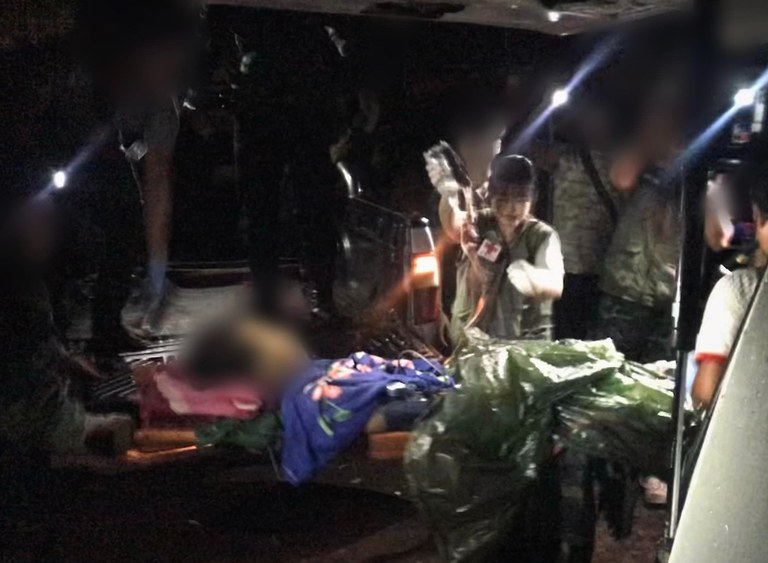
An anti-junta group claimed responsibility for bomb blasts at a colonial-era prison in Myanmar’s commercial hub Yangon on Wednesday morning that killed eight people and injured 18 others.  The Special Task Agency of Burma, an urban rebel group fighting the military dictatorship, announced that it had carried out the attack in which two bombs in parcel packages exploded at Yangon’s notorious Insein Prison. The blasts occurred near an area for receiving packages delivered by the family members of political detainees and were followed by gunfire by junta soldiers. The explosions killed three prison employees and five visitors, the ruling military junta’s State Administration Council said. Among the 18 injured were five prison staffers and 13 civilians, including two children aged 9 and 17. The blasts were the latest attack by groups seeking to remove the junta from power following a February 2021 coup in which the military seized control of the democratically elected government. Security forces have fired on and used excessive force to disperse and harm protesters in their widespread assault on civilians who oppose the regime. Local People’s Defense Force, or PDF, militias have teamed up with ethnic armies to fight the junta forces. To date, more than 2,370 civilians have been killed and 15,901 arrested since the coup took place, according to figures from the Assistance Association of Political Prisoners, a human rights group founded by Burmese former political prisoners living in exile in Thailand. Myanmar’s shadow National Unity Government, the Yangon-based anti-junta protest group General Strike Committee and other activist groups condemned the attacks and called for those responsible to be held to account. “Whoever did this must be held accountable,” said Kyaw Zaw, a spokesman for the NUG’s Presidential Office, told RFA. “It is completely unacceptable for the family members of political prisoners to set off bombs in the prison while they are in prison. Civilians should not be targeted for any attacks at all.”  Myanmar junta chief Snr. General Min Aung Hlaing inspects local products after meeting with representatives of small manufacturing businesses in Mawlamyine, southeastern Myanmar’s Mon state, Oct. 18, 2022. Credit: Myanmar military Rebels attack junta convoy The explosions at the prison came two days after PDF militia members and Karen rebels attacked a military convoy on Monday that was providing security for junta chief Snr. General Min Aung Hlaing, killing 11 regime officials, militia officials and local residents said. The junta chief was visiting local businesses in Hpa-An, in Kayin state, and Mawlamyine, in Mon state. “They were returning from Mawlamyine, [and] we attacked with landmines followed by a direct assault when they arrived in the Bilin area,” said a Thaton PDF battalion commander who declined to be identified for security reasons.  San Myint, spokesman for Thaton KNLA Battalion No. 2, said the forces targeted the vehicles carrying high-ranking officers, killing nine junta soldiers at the scene and injuring two others who died at a hospital.  But Aung Kyi Thein, the junta’s spokesman for Mon state and minister of natural resources and environmental conservation, said only two people died. He said rebels attacked the convoy by detonating handmade landmines and shot 40-millimeter missiles and small arms at the vehicles at the former Shwe Than Lwin toll gate. RFA has not been able to independently establish the number of casualties.  A resident who lives near the area where the attack took place told RFA that locals frequently hear battle sounds and fear for their safety. Other residents said battles break out often between the junta and Karen rebels in the Bilin area and that some civilian adults and children have died as a result.  “I am praying that the battles will not move to our location because many of us work on rubber and betel nut plantations, and we have to go into the woods a lot,” said one resident who requested anonymity for safety reasons. “We are too scared to go there. It’s also dangerous to pass between Thaton and Bilin in the evening from 6 p.m. or 7 p.m. The situation is too risky even to go onto the betel plantation.” Translated by Myo Min Aung for RFA Burmese. Written in English by Roseanne Gerin.
Read More

Wife of Cambodian opposition supporter mulls compensation to drop murder case

The wife of a slain supporter of Cambodia’s Candlelight Party said Tuesday she has rejected a compensation offer of U.S. $7,000 from the alleged assailant in exchange for dropping the criminal case, but has said she would consider accepting a larger sum because she doesn’t have money for her husband’s funeral. Wen Kimyi also urged police to arrest the suspect who shot dead her husband, 49-year-old Po Hin Lean, early in the morning of Oct. 16 while he was on his way to go fishing. She told RFA that police in Ou Reang Ov district of Chak commune in Tbong Khmum province, where her family lives, summoned her to the police station and told her that the suspect offered to pay her if she would drop charges.  The widow said she wants the money, but that her family also wants justice. “The police said there were two suspects, one of whom had the gun that killed him,” Wen Kimyi said. “I didn’t get a chance to see the suspect to ask [the reasons]. I will accept the compensation because I don’t have money for the funeral. But I won’t accept $7,000; I will need $15,000.” Police told her that the suspect is a “security guard” or “neighborhood watchman” for the commune, but declined to disclose where he put the weapon or his motive for the shooting. Cambodia’s Ministry of the Interior established a network of such local guards to provide security to villagers in communes and districts, though they are not supposed to carry weapons.  RFA could not reach Vong Sophy, the police chief of Ou Reang Ov district, or On Sam On, police chief of Chak commune for comment on Tuesday. ‘Embarrassing for the authorities’ Leng Seng Han, a provincial coordinator for the Cambodian Human Rights and Development Association, also known as ADHOC, said the murder cannot be resolved through compensation and that the suspect must be brought to justice. “It is wrong for [police] to be involved in meditation outside the court,” he said.   Eng Sroy, a Police Academy lecturer and president of the Candlelight Party​ working group in Tbong Khmum province, said he is dismayed that authorities have not yet apprehended the suspects and urged them to conduct a transparent investigation to show they are providing good security.  “It is embarrassing for the authorities if they can’t arrest the suspects,” he said. “The authorities must differentiate between black and white and remain neutral during the investigation.”  There have been numerous physical attacks this year on activists and supporters of the Candlelight Party, an opposition party that emerged from the ashes of the opposition Cambodian National Rescue Party (CNRP), which was banned and dissolved by Cambodia’s Supreme Court in November 2017. This April, Candlelight Party candidate Khorn Tun was attacked by unidentified men who threw rocks at her home in Tbong Khmum province during the campaign period for local elections held in June. Prak Seyha, a party youth leader for Phnom Penh’s Kamboul district, was attacked and beaten by a mob. Those incidents followed the death of Phnom Penh Candlelight candidate Choeun Sarim, who was attacked from behind and killed in traffic while riding a motorbike, following threats and assaults. The killing of the man in this case, Po Hin Lean, came a day before Prime Minister Hun Sen threatened to arrest Sam Rainsy, head of the banned CNRP, who has lived in exile in France since 2015, if he returns to Cambodia.  Sam Rainsy, 73, was sentenced in absentia in March 2021 to 25 years in jail for what supporters say was a politically motivated charge of attempting to overthrow the government. Hun Sen, who has ruled Cambodia since 1985, made the comment at a graduation ceremony where he spoke, in response to recent remarks by Sam Rainsy criticizing the strongman’s plans to appoint his son, Hun Manet, as his replacement. Translated by Samean Yun for RFA Khmer. Written in English by Roseanne Gerin.
Read More

Cambodia opposition supporter shot as Hun Sen threatens to jail opponent

A supporter of Cambodia’s Candlelight Party was shot dead in Tbong Khmum province over the weekend, the latest in a series of attacks on the opposition in a year of local elections and campaigning for 2023 parliamentary voting, his wife and supporters said Monday. Candlelight Party’s vice-chairman Thach Setha told RFA that he could not yet conclude whether the killing Sunday of Po Hin Lean, a 49-year-old father of three, was a political assassination. He urged authorities in the province’s Orang Ov district to conduct a prompt investigation. “A clear investigation must be conducted to catch the perpetrators and bring them to justice, to stop such killing whether it happens to political activists or [ordinary] people,” said Thach Setha. Police chief On Sam On of Chak commune, where Po Hin Lean lived,  refused to provide any details on the case when contacted by RFA Khmer. Orang Ov authorities were not available and provincial police chief Mon Meakara hung up the phone after receiving a call from RFA. “Who shot my husband?” asked Wen Kimyi, the victim’s wife.  “The police officer said the village security guard was the shooter. I said it was not the village security guard who fired, because the village security guard did not have a gun. The policeman said he had a gun, so he did not talk to me further,” she added. This year has seen a rise in violent attacks targeting activists and supporters of the Candlelight Party, an opposition party that emerged this year from the ashes of the Cambodian National Rescue Party (CNRP), which was banned and dissolved by the country’s supreme court in 2017. In April, during campaigning for June local elections, Candlelight Party candidate Khorn Tun was attacked by unidentified men who threw rocks at her home in Tabaung Khmom province, while Prak Seyha — a party youth leader for Phnom Penh’s Kambol district — was attacked and beaten by a mob. Those incidents followed the death of Phnom Penh Candlelight candidate Choeun Sarim, who was attacked from behind and killed in traffic while traveling by motorbike, following threats and assaults. The latest attack came a day before Prime Minister Hun Sen threatened to arrest opposition leader Sam Rainsy, who has lived in exile in France since 2015, the moment he returns to Cambodia. Sam Rainsy, 73, was sentenced in absentia in March 2021  to 25 years in jail for what supporters say was a politically motivated charge of attempting to overthrow the government. Speaking at a graduation ceremony for students at a university in Phnom Penh on October 17. Hun Sun said he would “eliminate the three generations of the ideology of the contemptible traitor [Sam Rainsy]…but I will not kill you.”  Hun Sen, who has ruled Cambodia since 1985, was responding to recent remarks by Sam Rainsy  criticizing the strongman’s plans to appoint his son, Hun Manet, as his replacement. “I believe there will be strong opposition to Hun Sen’s transfer of power to his dynasty. We want a succession of young Cambodians who are capable and accomplished, but we do not want a succession of clans in a family that is above everyone else and that has the right to rule Cambodia forever, ” Sam Rainsy said in a video. Sam Rainsy and other exiled members of the CNRP have tried to return to Cambodia on several occasions.  The acting CNRP leader tried to return on Nov. 9, 2019 to lead nonviolent protests against Hun Sen, urging Cambodian migrant workers abroad and members of the military to join him. However, his plan to enter Cambodia from Thailand was thwarted when he was refused permission to board a Thai Airways plane in Paris. Score of CNRP activists were arrested and jailed in the aftermath. “The CNRP is still determined to return to Cambodia as long as there is an opening from Hun Sen, but in fact he does not dare to open up the way for Sam Rainsy and CNRP leaders to return to Cambodia as he did in the past,” said Oum Sam An, a former CNRP lawmaker. Translated by Sok-Ry Som. Written by Nawar Nemeh.

Read More

Journalists go into hiding after threats by Myanmar’s military junta

Local reporters from two media outlets in Myanmar went into hiding after the country’s ruling military junta threatened to sue the news agencies for reporting that regime troops killed three civilians and wounded 19 others near a Buddhist pagoda in Mon state last week. BBC Burmese and The Irrawaddy online news journal reported that military soldiers allegedly fired random shots into crowds at the Kyaiktiyo Pagoda in Mon state, one of the most famous Buddhist sites in Myanmar, on Oct. 12.  The regime blamed the attack on an anti-junta People’s Defense Force (PDF) allied with the Karen National Liberation Army’s (KNLA) Brigade 1, the civilian National Unity Government (NUG) and its parliamentary wing. It said three were killed and 19 injured in the incident. Irrawaddy and BBC reporters went into hiding after the junta issued a statement on  state-controlled Myanmar Radio and Television (MRTV) at 8 p.m. on Oct. 14, threatening to take action against their news outlets for “incorrectly” reporting on the incident.  “It is reported that The Irrawaddy and BBC Burmese news agencies, the blatant liars and the pessimist’s stooges, are going to be sued under the Electronic Communications Law, News Media Law, and the state defamation law for their accusation that the security forces randomly fired shots into crowds of pilgrims, a shameless act of violating media ethics,” the junta said in the broadcast. A relative of a BBC Burmese reporter told RFA that all local BBC journalists, including the head of the news agency, are in hiding because of the junta’s threat.   “He [the reporter] won’t be able to stay here anymore since the junta started threatening to sue them all,” said the relative, who declined to be named for safety reasons. “He is afraid of being arrested, so he had to run away and hide.” The reporter’s family members also went into hiding out of fear that the junta would hold them accountable, she said. Three civilians were killed and more than 10 others were wounded when fighting broke out at a junta inspection station at the foothill of the Kyaiktiyo Pagoda on the morning of Oct. 12, local social workers and aid groups said.  Members of an unidentifiable armed group dressed in civilian clothes attacked the facility, which is part of the Myanmar military’s 44th Light Infantry Division in the Kin Mun Chaung village, they said.   “At this moment, they are all in the hospital, three dead bodies included,” said one aid worker who declined to be named for safety reasons. “We cannot go near them. I heard 13 were wounded.” More than 100 bullets and five artillery shells were fired during the battle which lasted over an hour, a local told RFA. He also said that there were casualties on both sides. After the fighting, pro-military channels on the Telegram instant messaging service accused the PDF and KNLA of being responsible for the attack.  RFA has not been able to independently identify or confirm which forces were involved in the incident and was unable to reach for comment the leaders of the Karen National Union (KNU), the KNLA’s political wing, in Kyaikto township. Devotees pray before a huge rock covered with layers of gold at the Kyaiktiyo Pagoda on Mt. Kyaiktiyo, a popular Buddhist pilgrimage site and tourist attraction in southeastern Myanmar’s Mon state, in a file photo. Credit: AFP ‘Threats have worsened’ In a public letter to senior officials of BBC Burmese, the junta’s Ministry of Information said their Oct. 12 report on the shootings intentionally attempted to defame the military by alleging that security forces shot civilians.  A senior official at BBC World News headquarters in London said the head office was “aware of the Burmese authorities’ concerns, and we have been in contact with them to discuss this.” The Irrawaddy reported on Monday that an Oct. 14 statement from the KNU said the deaths were caused by random fire from junta forces responding to a PDF attack, citing testimony from a resident of the village where the fighting occurred.  Ye Ni, an editor at The Irrawaddy, said his news outlet’s coverage of the shooting was based on three sources.   He said that freedom of the press has been under attack since the February 2021 coup in which the military seized power from the democratically elected government. “Threats by the junta against the news media have worsened, and [we’re] already at the brink of total collapse with their brutal persecution of reporters and unlawful abolishment of news agencies since the coup,” he said.  Ye Ni also questioned why the junta threatened to sue only The Irrawaddy and BBC Burmese when several news agencies also issued similar reports on the shooting.  Kyee Myint, a high court lawyer and legal expert who lives in Myanmar, said the rule of law had disappeared under the junta. “The junta itself are the rebels who broke the law to seize power,” he said. “These rebels kill, sue and do anything else to stay in power. It’s no surprise. Since they are on the wrong side, they try to find fault with those who stand with the righteous people against injustice.” Myint Kyaw, former secretary of the Myanmar Press Council, told RFA that it is getting more difficult for journalists in Myanmar to do their jobs. “In this difficult time of collecting news, to sue a news agency only because what it covers is considered untruthful is the junta’s direct threat against the media,” he said. He also said that because The Irrawaddy is no longer based inside Myanmar, the junta’s threat would not have a serious impact on the news organizations.  “As for BBC Burmese, this is the junta’s act to pressure the BBC to self-censor and adjust its editorial policy in favor of [the junta], Myint Kyaw said.  The junta has abolished 15 news agencies, four book publishers and two printing presses in the more than 20 months following the coup. Translated by Myo Min Aung for RFA Burmese. Written in English by Roseanne Gerin.

Read More

Business bad for Bagan’s buggy drivers as pandemic and coup keep tourists away

For 50 years, Maung Maung has been a horse-and-buggy driver in the ancient city of Bagan, ferrying tourists around to its soaring spires and iconic Buddhist pagodas and temples.  But tourists have dwindled to a trickle, thanks to the combination of the Covid-19 pandemic that reached Myanmar in March 2020 and military coup the next February. “Recently, a few tourists came back but not as many as before,” said Maung Maung, who’s 70. “Now there are very few. Some days, I don’t make a single dime (what word did he use?). Others, I make only a little money.” Making matters worse, rising inflation has eroded his spending power.  When business was good, he typically made 20,000-30,000 kyats (U.S. $6-10) a day, but that’s dropped sharply. He said he charges 1,300 kyats (about U.S. $0.40) per hour for pleasure rides around Bagan and dedicated prices to specific temples pilgrims want to visit. Since the junta took power, a year-and-a-half ago, Myanmar’s economy has tumbled. Last year, its GDP contracted by 18 percent, and the International Monetary Fund estimates that 1.6 million jobs were lost in 2022, or around 7% of the workforce.  Economic growth estimates for 2022, including the World Bank’s forecast of 3% growth, seem overly optimistic now that about 40 percent of the population is living under the poverty line. Soaring Inflation, Plunging Currency Inflation was 14 percent in mid-2022 and accelerated to more than 18 percent by mid-September, with rice prices up 35-50% and gas prices spiking amid shortages. That‘s impacted all kinds of businesses, as many rely on generators due to frequent electricity shortages.  Myanmar’s currency, the kyat, lost 60 percent of its value against the dollar in 2022. The kyat briefly traded at a record low, below 4,000 kyat to the U.S. dollar, while the official conversion rate is 2,100. The son of farmers, Maung Maung’s father bought him a buggy when he was just 20 years old. He told RFA Burmese that the vehicle had provided him with a steady stream of income for many years behind a mare named Mi Chaw. Bagan, in Myanmar’s central Mandalay region, has long been a cultural capital and a major tourist hub that’s home to the remains of more than 2,200 Buddhist temples and pagodas, mostly dating from between the 11th and 13th centuries. The former capital of the Bagan kingdom that would unify the regions that collectively became known as Myanmar, the city was officially recognized as a World Heritage Site by UNESCO in 2019.  Despite dwindling income and few visitors, Maung Maung continues running his business because driving horse-drawn buggies is what he knows, and is one of the few jobs he can do at his age. When he was younger, Maung Maung would farm during the tourism off-season, but he no longer has the strength for agricultural labor. Kyi Kyi Swe, Maung Maung’s daughter, told RFA that he cares deeply about the horses he has bred and taken care of their whole lives, and would never think of abandoning them. “Before, he asked his son to drive the buggy while he worked on the farms,” she said. “As he has grown old, he can’t do farm work and is back in buggy driving.” “He takes good care of [Mi Chaw]. He doesn’t want to see her lean. He feeds her all the time. Even at night, he gets up to feed her,” she said. “The horse also knows him well. She whinnies for more food at night. My dad leaves home around 5:30 a.m. every morning to drive to the buggy station and wait for his turn to drive.” Dwindling tradition Other buggy drivers in Bagan told RFA that the city council has granted licenses to around 300 people to operate horse-drawn carts, but only around 100 of them are actively working due to the decrease in tourism. One driver, named Soe Tint, said horse drawn buggies are as much a symbol of Bagan as the landscape and temples, and are often seen together in promotional material for tourists. But even prior to the pandemic and the coup, the number of buggies in Bagan had declined as they were replaced with modern vehicles. “I want to sell my horse since I have farm work. I paid around 1,500,000 kyats for them, but now they are worth only 700,000-800,000 kyats. I would even sell them for 600,000 kyats only, he said. “If things get better and the visitors return, the buggy business would grow again. Touring Bagan is most enjoyable by horse-drawn buggy. But they won’t come back if the good times don’t return.” Maung Maung acknowledged that if business conditions don’t improve, he will have to give up his business and depend on his family. “My business is so bad that I have been struggling to make ends meet. I just want to make enough for food and other necessities, like rice, cooking oil or salt,” he said. “If I get just a few more visitors [than average], I can make just enough to cover necessities. If I don’t have any, I have to buy them on credit. If the business doesn’t improve, I will have to sell my horses and live on my children’s income.” Translated by Ye Kaung Myint Maung for RFA Burmese. Written in English by Joshua Lipes.

Read More

Riverboat ferrying students home from school in Cambodia sinks, killing 10

Ten students drowned and another remains missing after a boat ferrying them home from school sank Thursday in the Khouk River in Cambodia’s southern Kandal province, sources in the country told RFA. The Kandal police confirmed Friday that authorities rescued four students from the Khouk, a tributary of the Mekong River, and are still searching for the missing student. They found the bodies of the other 10 students who drowned and estimated that they were all about 10 years old. Kandal Provincial Police Commissioner Chhoeun Socheat told RFA’s Khmer Service that the boat was very small and that it sank at around 7 p.m. on October 13. According to preliminary conclusions, the boat likely sank due to overcrowding, he said. Prime Minister Hun Sen expressed his condolences over the incident on Facebook, but stopped short of calling for an investigation. “The relevant authorities must continue to search for the victims and help with the victims’ funerals and offer services needed,” he said.  “To those who live along the rivers, please be vigilant, especially during flooding.” Cambodia is in the final weeks of its rainy season, which lasts from May to October. Coffin of a child, a victim of a boat accident, is transported in a ferry during a funeral procession in Koh Chamroeun village, east of Phnom Penh, Friday, Oct. 14, 2022. Ten students drowned and another remains missing after a boat ferrying them to school sunk in a river in Cambodia’s southern Kandal province, sources in the country told RFA. Photo:AP Kandal Provincial Governor Kong Sophoan told RFA that as of Friday night, the missing victim has not yet been found. He blamed the boat operators for their carelessness and said the boat was very old. “The boat operators lack experience, he said. “Authorities are investigating the incident.” Though authorities must ensure a boat is in good condition in order for owners to legally operate it, he acknowledged that loopholes exist. The 10 students were kind, smart and diligent, and were working hard to learn both in Khmer and English, Rong Chhun, the former president of the Cambodian Independent Teachers Association and president of the Cambodian Trade Union Confederation, told RFA.  “Those were active children who really paid attention to their studies. They had to cross the river from their houses to study on the other side,” he said. “They were dedicated hard-working kids. I am deeply saddened.” UNICEF wrote a message of condolence on Facebook that also called on the public to refrain from sharing pictures and video of the incident on social media because it could cause distress for friends and family. Translated by Samean Yun. Written in English by Eugene Whong.

Read More