

Category: East Asia
Pakistani police crack down on Uyghurs at risk for deportation
Pakistani authorities began conducting unexpected house raids on the homes of Uyghurs living in Rawalpindi just before a government order to expel all illegal migrants who had not left the country by the start of November took effect, according to Uyghurs involved in the matter. Officials issued a warning in early October, stating that migrants without a legal residence permit in Pakistan had to leave by Nov. 1 or face deportation. The measure affects nearly 20 Uyghur families — or about 100 individuals — living in Rawalpindi, the fourth most populous city in Pakistan. Pakistani officials issued the expulsion order after dozens of people were killed in two suicide bombings in late September. Though they said that most such bombings this year were conducted by Afghan nationals, they decided to expel all migrants without a valid residence permit – including 1.73 million Afghan refugees – if they didn’t leave on their own. Most of the affected Uyghurs are descendants of individuals who migrated decades ago from Xinjiang to Afghanistan and later to Pakistan. They lack Afghan or Chinese passports and Pakistani residence permits. The Uyghurs, who have been living in a state of uncertainty in Pakistan for the past month, said authorities began sudden house raids at midnight on Oct. 31. “They are raiding homes at midnight or at 1 or 2 o’clock,” said a Uyghur man named Turghunjan who is married and has two daughters and a son. “The landlords are also telling us to leave, but we will have nowhere to sleep.” Landlords who rent homes to the Uyghurs reported some of them to the authorities, and on Nov. 1, a man named Amanullah was detained during a house search by police as part of the effort to investigate illegal migrants, the Uyghurs said. Police released Amanullah on bail five hours later. It remains unclear if authorities will deport the Uyghur families. Stopped by police Turghunjan, a relative of Amanullah, said he was abruptly stopped by police on his way home from work on the evening of Oct. 31, during which the officers checked his identity and warned him of a potential search the following day. “While I was on my way home, the police stopped me and asked me questions,” he said. “They slapped me on the face three or four times and said they would search me after Nov. 1.” “We are not Afghan, and if they deport us, where will we go?” he asked. RFA could not reach police in Rawalpindi for comment. The Uyghur families are concerned that their safety will be at risk under current Taliban control if Pakistani authorities deport them to Afghanistan. They also fear being forced back to China, where Uyghurs in the far-western Xinjiang region face repression and are subjected to severe rights abuses. “They are not leaving their homes, [and] the landlords are reporting them to the police,” said Omer Khan, founder of the Pakistan-based Omer Uyghur Trust, who has been assisting the families. Though police have threatened some Uyghurs over the past days, they have not yet arrested or deported anyone, he said. The Uyghurs sought help from the U.N. refugee agency’s office in Pakistan for years without success. But this October, the agency collected their names, addresses, and details about their families, following an early October report about their plight by Radio Free Asia. At the time, the agency also said it was investigating the situation of the Uyghur families facing deportation if they failed to comply with the government order expelling all illegal migrants. Khan said he received a reassuring call from a representative of the U.N. refugee agency, officially the U.N. High Commissioner for Refugees, or UNHCR, on Nov. 2 while the Uyghurs faced harassment by police. “We didn’t ask them to come and take us,” he said. “We just need a response and decision from the U.N. about refugee status.” Neither the U.N.’s refugee agency in Geneva, Switzerland, nor its office in Pakistan responded to inquiries from RFA. Translated by RFA Uyghur. Edited by Roseanne Gerin and Malcolm Foster.
Ethnic armed alliance captures 3 cities on China-Myanmar border
Allied ethnic armed groups captured three cities in northeastern Myanmar in a six-day battle, a representative of one of the groups told Radio Free Asia on Thursday. Junta troops were forced to abandon their posts on Friday when allied soldiers attacked three cities in northern Shan State, the military confirmed in a statement released Wednesday. The Ta’ang National Liberation Army, Myanmar National Democratic Alliance Army and Arakan Army gained control of the cities in an operation called 1027. Fighting took place in several townships until Monday, when the military gave up the cities of Chinshwehaw, Hpawng Hseng and Pang Hseng near the China-Myanmar border, according to junta spokesman Maj. Gen. Zaw Min Tun. “Here we see all kinds of propaganda that almost all the cities in northern Shan state have been controlled [by ethnic armed groups], and about where they will continue after that,” he said on junta-controlled television channel MRTV. “At this time, there are places where our government and administrative organizations and security forces have failed.” The northern allied groups have started implementing administrative systems, Myanmar National Democratic Alliance Army spokesperson Yan Naing told RFA. “Right now, we have full control over Chinshwehaw and Hpawng Hseng. The administrative mechanisms have been restored,” he said. “Chinshwehaw township was reformed by our administrative team. We are working to restore electricity and everything. We are working hard to make people’s lives comfortable.” Myanmar National Democratic Alliance Army forces gained control of Theinni on Friday, but have not yet been able to seize the military’s camps on the other side of the town, he added. The group seized Hpawng Hseng on Monday and Pang Hseng in Muse township on Wednesday. The alliance claimed they captured nearly 90 junta army bases during the battle, but RFA has not been able to independently confirm this number. Conflict in Pang Hseng ended on Wednesday afternoon, said a local woman asking to remain anonymous for fear of reprisals. “Now, the situation has gone quiet. We stay at home and do not dare to go anywhere. If people go to market, they trade early in the morning and return home,” she said. “I heard the sounds of gunfire and small ammunition yesterday evening, not the heavy artillery anymore. If the sounds of heavy weapons are close, we run to the houses with basements.” During a routine briefing on Thursday, China’s foreign affairs ministry spokesperson Wang Wenbin called for an immediate ceasefire. China tightened border security when the fighting began, locals said. “The Chinese side opens the gate if there is an emergency patient, but it is said that the war refugees are not allowed to get in,” the woman from Pang Hseng said. RFA contacted the Chinese Embassy in Myanmar, but did not receive a reply by the time of publication. Translated by RFA Burmese. Edited by Mike Firn.
Junta battalion surrenders amid Shan state ethnic offensive
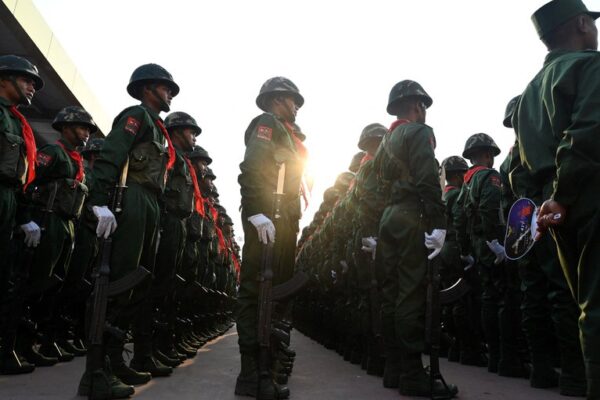
An entire military battalion has surrendered to rebel forces amid an offensive by an alliance of three ethnic armies in northern Myanmar’s Shan state, according to sources with the armed resistance who called the capitulation the first of its kind in the region. All 41 members of Light Infantry Battalion 143, including a deputy commander and two company commanders, agreed to lay down their arms on Monday following talks with the Northern or “Three Brotherhood” Alliance a day earlier, Yan Naing, information officer of the Myanmar National Democratic Alliance Army, or MNDAA, told RFA Burmese on Wednesday. “It is true that the 41 [troops] surrendered – it happened on [Oct.] 30,” said Yan Naing, whose MNDAA, based in Shan’s Kokang region along the border with China, is one of three members of the ethnic army alliance along with the Arakan Army and the Ta’ang National Liberation Army. Representatives of the Three Brother Alliance had urged commanders of the Kunlong township-based battalion to give up on Oct. 28, a day after it launched “Operation 1027” – named for the Oct. 27 date of the offensive – and simultaneously struck junta positions in the strategic Shan cities of Kunlong, Hseni, Chin Shwe Haw, Laukkaing, Namhkan, Kutkai, and Lashio, the state’s largest municipality. The MNDAA’s information department said Monday’s surrender marked the first time that a whole battalion had capitulated during an operation in northern Shan state, adding that the alliance had also confiscated a weapons cache as part of the agreement. It said 15 pro-junta militia fighters had also surrendered with their weapons on Tuesday. As part of a deal to entice junta forces to surrender, the MNDAA paid 1.5 million kyats (US$715) to each soldier from the battalion and pro-junta militia fighters that lay down their arms and escorted them to territory under their control, the group said. Operation 1027 making gains The MNDAA claims that more than 100 junta troops and pro-junta militia fighters have surrendered during Operation 1027, although its claims could not be independently verified. The Irrawaddy online journal cited the Three Brotherhood Alliance as saying that, from Oct. 27-31, it took control of 87 Myanmar military camps and three towns in Shan state – Chinshwehaw, Nawngkhio, and Hseni. In a statement issued on Tuesday, the alliance urged junta troops to give up their camps and outposts or face attack. It said those who surrender will be guaranteed safety, medical care, and other assistance that will allow them to return to their families “with dignity.” United Wa State Army soldiers participate in a military parade in Myanmar’s Wa State, in Panghsang on April 17, 2019. Credit: Ye Aung Thu/AFP The junta has yet to release any information about the surrender of its troops. Calls to junta Deputy Information Minister Maj. General Zaw Min Tun went unanswered Wednesday. Local resistance groups – including the anti-junta People’s Defense Force, or PDF – have joined in Operation 1027, which the Three Brotherhood Alliance says was launched to stop military attacks on ethnic armies in the region, get rid of online scamming rings in Kokang, and build a federal union. UWSA staying ‘neutral’ One group that will not be joining the operation is the ethnic United Wa State Army, or UWSA, which confirmed it was staying out of the campaign in a statement on Wednesday. Wa troops will “adopt a principle of neutrality” and avoid armed conflict in the Kokang region, but will retaliate against military intervention of any kind in its region, the statement said. A UWSA official confirmed to RFA that the information contained in the statement was correct. The UWSA said that the troops involved in the current conflict should “exercise restraint and pursue negotiations aimed at reaching a ceasefire.” It also said that humanitarian assistance had been provided to displaced persons who fled into the region due to the fighting. On the day Operation 1027 was launched, Kokang forces attacked Chin Shwe Haw, which was controlled by the United Wa State Army. The fighting forced some 10,000 residents of the town to flee to nearby Nam Tit for shelter, the UWSA official said. Another ethnic armed organization called the National Democratic Alliance Army, or NDAA, based in eastern Shan state has said it will not take part in the offensive and was adopting a principle of neutrality, but would “continue to maintain peace and stability” in the border region. The Three Brotherhood Alliance armies are also members of the Federal Political Negotiation and Consultative Committee, or FPNCC, led by the UWSA. The seven-member coalition also includes the Shan State Progressive Party, the Kachin Independence Army, and the NDAA. Translated by Htin Aung Kyaw. Edited by Joshua Lipes and Malcolm Foster.
Manila rejects Beijing’s account of sea encounter
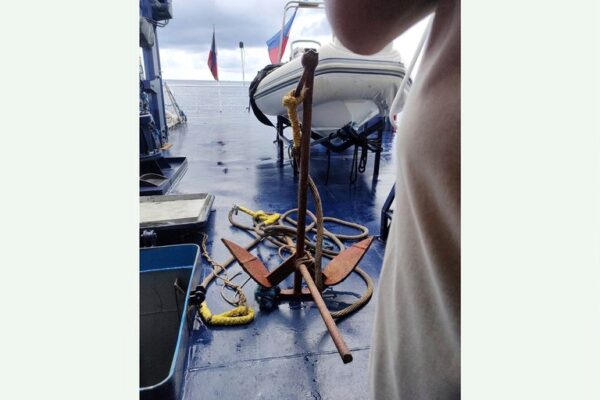
Manila for the second time this month has dismissed China’s version of a military encounter near the disputed Scarborough Shoal in the South China Sea. On Monday the Chinese military said it had monitored and warned off a Philippine warship that it accused of “trespassing” into the waters around the Scarborough Shoal. Senior Col. Tian Junli, the spokesperson for China’s Southern Theater Command, said in a statement that the Philippine frigate “intruded into the waters adjacent to China’s Huangyan Dao without the approval of the Chinese government,” referring to the shoal by its Chinese name. He said the naval and air forces of the Command “tracked, monitored, warned, and restricted the Philippine military vessel according to law.” On Tuesday, Philippine authorities responded with their own version of the incident. National Security Adviser Eduardo M. Año said the Navy’s BRP Conrado Yap (PS-39) “conducted routine patrol operations in the general vicinity of Bajo de Masinloc (Scarborough Shoal) without any untoward incident.” “China is again over hyping this incident and creating unnecessary tensions between our two nations,” Año said. This is the second time in three weeks that China claimed that Manila “violated China’s sovereignty over the reef” and that Chinese law enforcement forces drove Philippine ships away. Both times, the Philippines dismissed China’s claims and insisted that under international law, the Philippines had every right to patrol the area. Test of U.S. commitment “Such incidents will re-occur with increased frequency,” said Carlyle Thayer, a veteran political analyst based in Canberra, Australia. China seized Scarborough Shoal after a standoff with the Philippines in 2012 and has maintained control over it since. Manila brought Beijing to an international tribunal over its claims in the South China Sea, including of the islands, and won but China has refused to accept the 2016 ruling. “China considers Philippine vessels’ activities near the shoal a violation of China’s sovereignty and will react strongly every time,” said Thayer, adding “Beijing doesn’t want to be seen as weak.” This undated photo provided on Sept. 26, 2023, by the Philippine Coast Guard shows the anchor used to hold the floating barrier which was removed by a coast guard diver, in the Scarborough Shoal. Credit: Philippine Coast Guard via AP Another South China Sea scholar, Hoang Viet from the Ho Chi Minh City University of Law, said that the recent rapprochement between the Philippines and the United States under current Philippine President Ferdinand Marcos Jr. has also contributed to China’s ramped up response. In February, Manila granted the U.S. access to four more military bases in the country. “China wants to warn those countries which, in its opinion, are seeking to move closer to the U.S.,” Viet said. “With such incidents, Beijing also wants to test Washington’s commitment in the region, especially as the U.S. is being drawn into so many global conflicts and crises,” the analyst said. The U.S. has repeatedly stated that Article IV of the 1951 U.S.-Philippines Mutual Defense Treaty extends to armed attacks on Philippine armed forces, public vessels, and aircraft – including those of its Coast Guard – anywhere in the South China Sea. For its part, Manila has “embarked on a tactic of assertive transparency,” as noted by Ray Powell from Stanford University’s Gordian Knot Center for National Security Innovation. That means incidents in disputed waters are being reported in a timely and transparent manner. In late September, the Philippines said China had installed a 300-meter (984-foot) floating barrier to block Philippine fishermen from accessing the waters around the shoal. The Philippine coast guard carried out a “special operation” to cut the barrier and remove its anchor. Jason Gutierrez in Manila contributed to this article. Edited by Mike Firn and Taejun Kang.

Patriotic flag ceremonies at Hong Kong mosque ‘shock’ believers
Muslims at Hong Kong’s biggest Kowloon Mosque raised the Chinese national flag in formal ceremonies in July and October this year, to mark the city’s 1997 handover to China and China’s Oct. 1 National Day. The move has prompted shock and disappointment among some believers, who see it as a challenge to the Islamic doctrine of the supremacy of God, yet few feel safe enough to speak out for fear of political reprisals or community pressure, according to a Hong Kong Muslim who spoke to Radio Free Asia on condition of anonymity. The ceremonies come as the ruling Chinese Communist Party steps up control over religious venues across China, requiring them to support the leadership of the Communist Party of China and leader Xi Jinping’s plans for the “sinicization” of religious activity. Muslim leaders in Hong Kong have spoken to RFA Cantonese of “a developing relationship” with Chinese officials over the past 18 months, who have “suggested” they begin ceremonial displays of patriotism like flag-raising ceremonies. The ceremonies have been fairly high-profile affairs, attended by community leaders and imams, officials from Beijing’s Central Liaison Office in Hong Kong, as well as high-ranking police and local government officials. At a recent ceremony filmed by RFA, the officials stood impassively as mosque-goers performed the ceremonial movements designed to show the highest respect to the flag, then sang the Chinese national anthem, while plainclothes police observed from the sidelines. Representatives of the Liaison Office of the Central People’s Government, Hong Kong government officials, and major Islamic leaders took a group photo in front of the national flag in the Kowloon Mosque. Credit: Tianji An anonymous Hong Kong Muslim said some believers are very unhappy with the move, which they say undermines the crucial Islamic principle that God is supreme, forcing them to choose between their religion and political “correctness” under the atheist ruling Chinese Communist Party. “Allah is the only highest principle there is,” said the woman, who gave only the pseudonym Miriam for fear of pressure from within her own community and of prosecution under a draconian security law imposed on Hong Kong by Beijing. “I don’t understand how people can see room for compromise here and try to argue that it’s not an issue,” she said. “I am truly and utterly shocked by this. It’s unthinkable.” Miriam said she was “deeply disappointed” in particular by the attendance of the local imam. ‘The flag of an atheist country’ The organizers said the events, which come after a number of gatherings between Muslim community leaders and Chinese officials, are indeed a nod to Beijing’s “sinicization of religion” program, and are likely to continue. “Before we didn’t have the idea to raise a flag,” Hong Kong Muslim community leader Saeed Uddin said. “Then, during the last one-and-a-half years, our relationship developed.” The Chinese national flag flies in front of the Kowloon Mosque. Credit: Screenshot from RFA video “There was a suggestion, ‘why not have [flag-raising],’” he said. “I think this is not a bad idea, to let people be more patriotic to China. They enjoy it. It’s no problem.” Yet, asked about dissenting voices among Hong Kong Muslims, he admitted to differences of opinion within the community. “We have to respect the differences of opinion,” Saeed Uddin said. But he added: “We will try to convince them.” “There was a suggestion, ‘Why not have [flag-raising],’” says Hong Kong Muslim community leader Saeed Uddin. “I think this is not a bad idea, to let people be more patriotic to China. They enjoy it. It’s no problem.” Credit: Tianji While Muslims must necessarily co-exist with secular power, they are expected to keep a certain distance, never lose sight of the supremacy of God in their actions, and avoid idolatry at all costs. Non-Islamic images and human likenesses are avoided, particularly in sacred places like mosques. For Miriam, the Chinese flag represents a totalitarian and atheist state that sees its own power as supreme, and should never be seen in a mosque. “There’s no issue with having the flag of a Muslim country in a mosque, because that country already recognizes no higher authority than God,” she said. “The country itself will be founded on Islamic precepts.” “But I’ve never seen the flag of an atheist country blatantly on display in a mosque,” she said. “Perhaps they’re using people’s lack of understanding of Islam to force this on them.” The Kowloon Mosque is seen in Hong Kong’s tourism district Tsim Sha Tsui, Oct. 21, 2019. Credit: Ammar Awad/Reuters Rizwan Ullah, honorary adviser to the Islamic Community Fund of Hong Kong, supports Beijing’s attempts to boost patriotism in the community. “We’re not raising the Chinese flag or singing the national anthem at a time of prayer,” he told RFA Cantonese in a recent interview. “So it has no effect on our beliefs, or our customs.” “History will show that this has been a correct first step,” he said, using phrasing similar to that of Chinese officials. ‘Two things can coexist’ China’s “sinicization of religion” policy, which has led churches in mainland China to display portraits of Communist Party leader Xi Jinping and prompted local officials to forcibly demolish domes, minarets and other architectural features in mosques around the country, sometimes in the face of mass protests. The Communist Party now requires all religious believers to love their country as well as their religion, and claims that patriotism is a part of Islam. Riswan Ullah agreed with this view. “I don’t see a conflict. I pray five times a day,” he said. “I raise the flag at different times of the day.” “I don’t see why being a patriot somehow makes me a bad Muslim – It’s not a zero sum equation: the two things can coexist,” he said. “I don’t see why being a patriot somehow makes me a bad Muslim – It’s not a zero sum equation: the two things can coexist,” says Riswan Ullah. Credit: Tianji But for Hong Kong’s Muslims, loving one’s country –…
Migration throws Laos’ communist government a lifeline
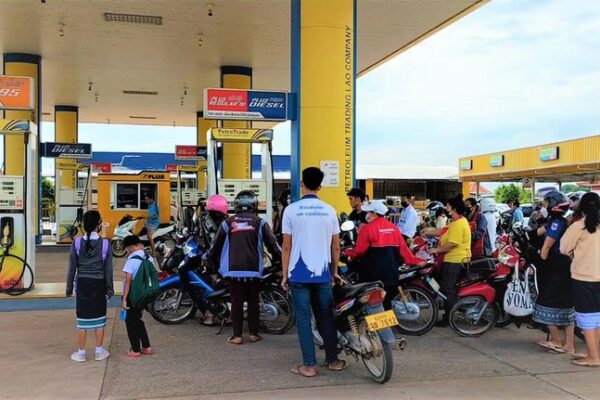
In a rare moment in the international spotlight, Laos was the topic of two articles published by major world media outlets in early October, although not with the sort of headlines the ruling communist party wanted to read. The BBC ran a piece on October 8 under the banner: “’I feel hopeless’: Living in Laos on the brink”. Days later, the Washington Post went with “China’s promise of prosperity brought Laos debt — and distress”, presumably because the editors thought Laos isn’t interesting enough unless tales of Chinese debt traps are also included. But both gave an accurate sense of the grim situation most Laotians, especially the young, now find themselves in. As the BBC report began: “Confronted with a barren job market, the Vientiane resident holds no hope of finding work at home, and instead aims to become a cleaner or a fruit picker in Australia.” Laotians are leaving the country in droves. My estimate is that around 90,000, perhaps more, will have migrated officially by the end of the year, joining around 51,000 who left last year and the hundreds of thousands who have moved abroad earlier. Laos has had a horrendous last few years. The landlocked Southeast Asian nation didn’t do particularly well during the COVID-19 pandemic. Since the early months of 2021, it has had one of the worst inflation rates in Asia, peaking at 41.3 percent in February and still hovering at around 25 percent. The kip, the local currency, is collapsing; it hit an all-time low in mid-September when it was trading in commercial banks at 20,000 to the U.S. dollar, compared to around 8000 (US$44) in 2019. An acquaintance in Vientiane tells me that it used to cost 350,000 kip to fill up his car with diesel in 2019; today, it’s closer to 1.2 million kip (US$58) and the price keeps rising—and bear in mind that the minimum wage is now just 1.6 million kip (US$77), per a tiny increase in October. Another correspondent of mine, a foreigner, says he’s now leaving: “It’s got to the point where I’m just… done!” Motorcyclists line up for gas in Laos amid shortages, May 10, 2022. Credit: RFA The communist government is hopeless in responding, and not even the rare resignation of a prime minister last December has added any vitality to its efforts. Worse, far larger structural problems remain. The national debt, probably around 120 percent of GDP, puts Laos at risk of defaulting every quarter. It cannot continue to borrow so the authorities are jacking up taxation, and because of flagrant corruption, the burden falls more heavily than it should on the poor. Looking ahead, what is the national debt if not a tax deferred on the young and yet-to-be-born? There are not enough teachers in schools and not enough schools for students. Attendance rates have plummeted. Public expenditure on education and health, combined, has fallen from 4.2 percent of GDP in 2017 to just 2.6 percent last year, according to the World Bank’s latest economic update. More than two-thirds of low-income families say they have slashed spending on education and healthcare since the pandemic began, it also found. According to the BBC report, 38.7 percent of 18-to-24-year-olds are not in education, employment or training, by far the highest rate in Southeast Asia. A Laotian youth told me that few people want to waste money on bribes to study at university when they can quickly study Korean and try to get a high-paying factory job in Seoul. In June, an International Labour Organization update gave a summary of the numbers of Laotians leaving by official means, as estimated by the Ministry of Labour and Social Welfare: Thailand 2022: 51,501 (29,319 women) 2023, up until 30 June: 42,246 (23,126 women) Malaysia 2022: 469 men Japan 2022: 312 (122 women) 2023, up until 30 June: 289 (120 women) South Korea, long-term (3 years contract) 2022: 796 (194 women) 2023, up until 30 June: 389 (54 women) South Korea, short-term seasonal workers (5 months contract) 2022: 1,356 (598 women) The first thing to note is that this is emigration by official channels. To Japan and South Korea, that official process is arduous and involves a lengthy contract procedure before leaving the country. However, the workers in South Korea can earn in a day what they would earn in a month in Laos. It’s less strenuous getting to Thailand although a considerable number of Laotians emigrate there by unofficial means, hopping across the border and not registering that they’ve left. In 2019, the Thai authorities estimated that there were around 207,000 Lao migrants working legally and 30,000 illegally, but the actual number of legal and illegal workers could have been as high as 300,000. (No one really knows how many Laotians work illegally in Thailand.) Also, consider how many Laotians have left the country so far this year compared to 2022. If we assume that emigration flows keep the same pace in the last six months of 2023 as they did in the first six, around 84,000 Laotians will have officially emigrated to Thailand by the end of this year, up from 51,000 in 2022. In April, a National Assembly delegate castigated the government for the fact that “workers have left factories in Laos for jobs in other countries because the wages paid by factories here are not keeping pace with the rising cost of living…As a result, factories in Laos are facing a labor shortage.” Saving grace? But isn’t this actually a saving grace for the communist Lao People’s Revolutionary Party (LPRP), at least in the short term? Much woe betide is made of Laos’ land-locked geography but it is rather convenient to border five countries, four of which are wealthier, if you want to avoid a situation of having disaffected, unemployed or poorly paid youths hanging around doing nothing but getting increasingly angry at their dim prospects. Conventional wisdom holds that authoritarian regimes constrain emigration as it can lead to mass labor shortages, one reason…
Ethnic alliance launches offensive on junta in eastern Myanmar
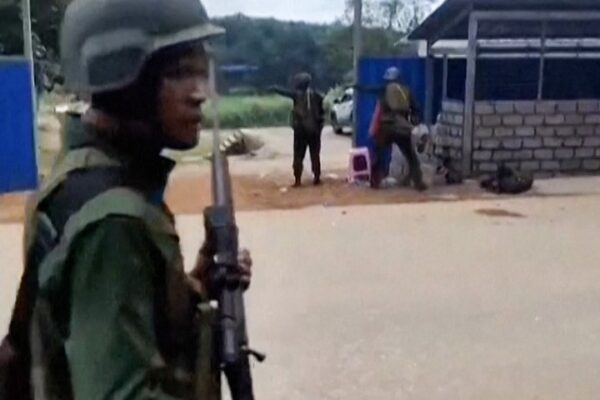
An alliance of three ethnic armies opened an offensive against Myanmar’s military regime on Friday, launching attacks on outposts in seven different locations in Shan state, in the east, including the headquarters of the junta’s Northeastern Command. At around 4:00 a.m., the Northern Alliance made up of the Ta’ang National Liberation Army, Myanmar National Democratic Alliance Army and the Arakan Army simultaneously struck junta positions in the strategic Shan cities of Kunlong, Theinni, Chin Shwe Haw, Laukkaing, Namhkan, Kutkai, and Lashio – the state’s largest municipality. In a statement, the alliance said “Operation 1027” – named for the Oct. 27 date of the offensive – was initiated to protect the lives and property of civilians, defend its three member armies, and exert greater control over the self-administered regions within their territories. It said the operation was also part of a bid to reduce the junta’s air and artillery strike capabilities, remove the military regime from power, and crack down on criminal activities – including online scam operations – that have proliferated along the country’s northeastern border with China. Residents of Shan state told RFA Burmese that at least eight civilians were killed in Friday’s fighting, including three children. The number of combatant casualties was not immediately available, as the clashes were ongoing at the time of publishing. Pho Wa, a resident of Hopang, near Chin Shwe Haw in Shan’s Kokang region, said there were “many casualties” among junta troops and civil servants, and that key infrastructure, including bridges, had been destroyed, slowing the flow of goods in and out of the area. “Since multiple checkpoints … were raided, many customs agents, police officers and soldiers were killed,” he said. “The residents of Chin Shwe Haw have fled to [a region] administered by an [ethnic] Wa force called Nam Tit. Many are still trapped in Chin Shwe Haw city.” Residents said Myanmar National Democratic Alliance Army, or MNDAA, troops raided the downtown area of Chin Shwe Haw on Friday afternoon. They said inhabitants of Laukkaing were urgently preparing to flee the area ahead of an anticipated raid on the city by the armed group Kutkai and Lashio clashes In Kutkai township, Ta’ang National Liberation Army, or TNLA, soldiers attacked a pro-junta Pan Saye militia outpost on Friday morning, leading to fierce fighting, residents said. Myanmar National Democratic Alliance Army soldiers seize Myanmar military security gate near Laukkai city in Northern Shan state, Friday, Oct. 27, 2023. Credit: Screenshot from AFP video A woman from Kutkai said that junta troops based in nearby Nam Hpat Kar village counterattacked with artillery fire, drawing the village into the battlezone. At least two civilians – a man and a child – were killed and five others wounded, she said, speaking on condition of anonymity due to fear of reprisal. “I think there were more than 30 artillery strikes this morning,” the woman said. “Clashes broke out when the TNLA attacked the [junta’s] outposts … That’s why they counterattacked with artillery from Nam Hpat Kar, but many of the shells fell on Nam Hpat Kar village.” A 40-year-old man was also killed in a military air strike amid fighting near Kutkai’s Nawng Hswe Nam Kut village, residents said. In Mong Ko township, fighting between junta forces and MNDAA troops has been fierce since Friday morning, and at midday the junta sent two combat helicopters to attack, residents said. Junta outposts near villages of Tar Pong, Nar Hpa and Mat Hki Nu in Lashio township, which is the seat of the military’s Northeastern Command, as well as a toll gate in Ho Peik village, were attacked Friday morning. Lashio residents said they heard the sound of heavy weapons until 7:00 p.m. on Friday and that all flights out of the city’s airport had been suspended amid the clashes. Due to the complicated and fast-moving situation in the villages around Lashio, the exact number of casualties is not yet known, but a rescue worker said that two people had been injured and sent to the hospital. Fighting in the area was tense until noon on Friday. ‘Strategic shift’ for region RFA reached out to TNLA spokesperson Lt. Col. Tar Aik Kyaw regarding the alliance operation, but had yet to receive a response by the time of publishing. Attempts to contact the MNDAA and Arakan Army, or AA, went unanswered Friday. Myanmar’s shadow National Unity Government’s ministry of defense welcomed the operation in a statement. RFA was unable to reach junta Deputy Information Minister Major Gen. Zaw Min Tun for comment, but he confirmed to local media that fighting had taken place in Chin Shwe Haw, Laukkaing, Theinni, Kunlong and Lashio townships. He said that the military and police had “suffered casualties” in attacks on outposts at Chin Shwe Haw’s Phaung Seik and Tar Par bridges. Chinese foreign ministry spokesperson Mao Ning told reporters at a regularly scheduled press conference that Beijing is “closely following” the latest fighting along its border and called for dialogue between all parties to avoid escalation of the situation. Speaking to RFA on Friday, military commentator Than Soe Naing said that the alliance operation was retaliation for recent junta attacks on the headquarters of their ally, the Kachin Independence Army, in Lai Zar, a remote town in Kachin state on the border with China. “I consider this to be a strategic shift for the entire northern region, centered on Shan state,” he said. Translated by Htin Aung Kyaw. Edited by Joshua Lipes and Malcolm Foster.
Ailing rights lawyer Li Yuhan jailed for 6 ½ years
Chinese authorities have given a six-and-a-half year prison term to human rights lawyer Li Yuhan for “fraud” and “picking quarrels and stirring up trouble” – a charge often used to target peaceful critics of the ruling Communist Party. The Heping District People’s Court in Shenyang, in northeastern China’s Liaoning province, imposed the sentence at a hearing on Oct. 25 amid tight security and a large police presence in the streets outside, a family member told Radio Free Asia on Thursday. Li, who is in her 70s and needs assistance to walk, has spent the past six years in a detention center, so would be freed in April. Still, she said she will appeal the sentence. For her brother, Li Yongsheng, it was the first time he had seen her since her trial two years ago – after which no verdict was rendered. “She has aged significantly,” he said. “Two police officers had to assist her to walk; she was no longer able to walk normally.” He said there are also signs that her long incarceration has taken a toll on Li’s mental state. “Her thinking is confused, and her reactions are slower, and she has muddled logic,” he said. Her brother said the court building was cordoned off on all sides with iron barriers, with dozens of police and security personnel in the area. No passers-by were allowed through, and no other business was conducted in the court that day, he said. Defended rights lawyer Li is widely believed to have been targeted for her defense of prominent rights lawyer Wang Yu, who was among the first people to be detained in a nationwide operation targeting rights lawyers and activists in July 2015. “Another reason is that before her arrest, my sister had been handling other sensitive cases, various complaints and accusations, which had caused a lot of trouble for local governments,” Li Yongsheng said on Thursday. Li is being held in the Shenyang No. 1 Detention Center, where she has reportedly spent some time on hunger strike. Lawyers say China’s police-run detention centers are often overcrowded and lack facilities to ensure adequate medical care for inmates. Li has been hospitalized at least twice and given a number of medications, but applications for medical parole have been denied. A legal expert who asked to remain anonymous for fear of political reprisals told Radio Free Asia that the long delay in Li’s case was likely because the authorities were trying to elicit a “confession” from her, which she has repeatedly refused to give. He said the authorities had to sentence her for at least as long as she has already spent behind bars, but said the April 2024 release date was still a “relatively good outcome” for such a politically sensitive case. “The authorities can’t afford to admit to any error; now that they’ve detained her for that long, they have to sentence her accordingly,” the expert said. She paid ‘a huge price’ Li initially went missing on Oct. 9, 2017, and has been “at risk of torture and other ill-treatment” in the detention center, London-based Amnesty International said at the time. The group called for her immediate release. Li has paid “a huge price” for her defense of individuals unjustly accused of wrongdoing, said Amnesty International’s Deputy Regional Director for China Sarah Brooks. “She should be released immediately and unconditionally, and the multiple allegations of her ill-treatment in detention independently investigated,” Brooks said. “Lawyer Li has been arbitrarily detained for six years [and] should be at home with her family, not in prison for merely doing her job to defend peoples’ human rights,” she added. Li Yongsheng, her brother, said the family has made written complaints over the authorities’ handling of the case, in particular questioning why it was given to the Heping district court in the first place. “Heping district isn’t her place of residence, nor where her household registration is, and it’s not where the alleged ‘crimes’ occurred, either,” he said. “So there are indeed questions about its jurisdiction here.” But he said that despite “brilliant arguments” from Li’s defense team, “we can’t influence this kind of trial.” Translated by Luisetta Mudie. Edited by Malcolm Foster.

China urges ‘fair’ investigation into Baltic pipeline damage
China has said it will stand “ready to provide necessary assistance” to the investigation into Finland’s claims a Hong Kong vessel may have damaged a natural gas pipeline. Finnish police said on Tuesday the Balticconnector pipeline between Finland and Estonia was likely damaged by an anchor as “on the seabed, a 1.5 to 4 meter-wide dragging trail is seen to lead to the point of damage in the gas pipeline.” The investigators said they found the anchor just a few meters from the gas pipeline damage point. They said the anchor may have belonged to the Chinese container vessel Newnew Polar Bear which was sailing through the area at around 1:20 a.m. local time on Oct. 8, 2023 when the pipeline was reported damaged. The police focused their suspicion on the ship as until now, they “could not visually confirm that both front anchors of the vessel were in their place.” Newnew Polar Bear is a Chinese-owned and Hong Kong-registered commercial ship. The vessel “was contacted several times, but they were not willing to cooperate,” they said, adding that help is needed from the Chinese authorities for the investigation to continue. A graphic obtained by Reuters on October 13, 2023, shows where the Balticconnector pipeline between Finland and Estonia was damaged on October 8, by an unknown reason. Credit: NORSAR/Handout via Reuters In Beijing, a Foreign Ministry spokesperson said China maintains “unimpeded communication with parties including Finland” over the incident, which is still under investigation, and “stands ready to provide necessary assistance in accordance with international law.” Mao Ning told reporters on Wednesday that the Chinese government hopes “relevant parties will follow the principles of being objective, fair, just and professional and find out what happened soon.” Earlier this week, Mao said the Chinese vessel was “sailing through relevant waters normally when the incident occurred. Due to the rather bad conditions at sea, it didn’t detect anything abnormal.” Finland’s National Bureau of Investigation has published a photo of the broken anchor that investigators retrieved from the seabed. The next step would be to confirm that it came from the Chinese container vessel and determine if the damage was an accident or intentional, said Carl Schuster, a retired U.S. Navy captain turned maritime analyst. “If evidence of the Newnew Polar Bear’s involvement surfaces, then the captain will try to claim it was an accident but that is not likely unless the evidence is conclusive,” Schuster told RFA. Cable cutting The Estonian government has said it is investigating two incidents that might also be linked to the Newnew Polar Bear, in which a telecoms cable connecting Finland and Estonia and another between Sweden and Estonia, were damaged. Estonian Prime Minister Kaja Kallas was quoted in the domestic media as saying that there are reasons to believe that the three incidents are related, but “it is too early to reveal sensitive information.” Some observers recall that Chinese ships were accused of damaging communications cables before. In April, Taiwan’s National Communications Commission blamed two Chinese ships for cutting two undersea internet cables connecting Taiwan island and the outlying islands of Matsu, leading to 50 days of no, or very limited internet access, there. The same cables have been damaged 27 times since 2017 by Chinese sand dredging and fishing boats, some cut by ships’ anchors, Taiwanese authorities said. RFA analyzed automatic identification system data provided by ship-tracking website MarineTraffic and found that at around 1:00 a.m. on Oct. 8, the Newnew Polar Bear was approaching the site of the Balticconnector pipeline. During the course of one hour or so, the Newnew Polar Bear slowed down to under 11 knots before picking up again, but did not stop. Besides the Chinese ship, a Russian flag bearer – the nuclear-powered cargo ship Sevmorput – was also seen at the scene, sailing at a higher speed. Norwegian seismology institute NORSAR reported blast-like waves near the pipeline at the time. What does Russia say? NewNew Polar Bear was renamed and registered in Hong Kong in June. Immediately prior to this, the ship sailed under the name Baltic Fulmar flying the Cypriot flag. Newnew Polar Bear and four other ships owned by China’s Hainan Yangpu Newnew Shipping Co. began transporting cargo between Russia and China using the Northern Sea Route along Russia’s Arctic coast in July. The route was previously not operational because of the ice. The Newnew Polar Bear made a port call in Baltiysk, Russia, on Oct. 6. Credit: Anton Alikhanov’s Telegram Russian state nuclear corporation Rosatom is believed to assist the Chinese shipping line with nuclear-powered icebreakers, reducing the transit time between Russia’s St Petersburg and China’s Shanghai to less than a month, compared to 45-50 days if using the route through the Suez Canal. Sevmorput is part of the Rosatom-owned nuclear icebreaker fleet, the only such fleet in the world. The Northern Sea Route is one of the strategic priorities of cooperation between the Russians and the Chinese, and Newnew Polar Bear reflects this close collaboration. But Russian netizens have posted photos of the vessel flying the Russian flag at port calls, such as on Oct. 6 in Baltiysk, Kaliningrad’s region. This left watchers puzzled. “It is not legal under international law for the ship to fly a Russian flag unless its registration was changed to Russia. There is no evidence it has changed its registration,” said maritime analyst Carl Schuster. “A commercial vessel must fly the flag of its country of registration although it may have a logo of its country of ownership painted on its superstructure,” he added, So far, as the suspicion is not directed at Russia, Russian official channels have yet to comment on the case. Yet on social media platforms, Russian analysts and observers have been talking about what they call “the West attempting to block traffic from China to Russia and Europe.” “Perhaps the West understands that this traffic can increase massively in the near future – both from the Baltic and along the Northern Sea Route,” one…
Lao officials, villagers in the dark about impacts of new railway
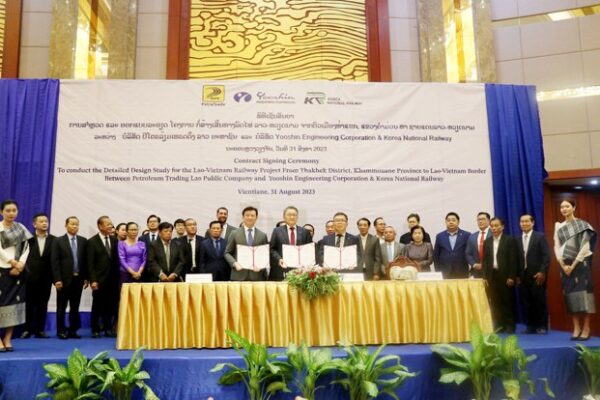
Construction of the Laos-Vietnam high-speed railway is expected to begin in early 2024, but its potential impacts on villagers who live along the planned route through Laos’ Khammouane province have not yet been made public, provincial officials and residents said. The US$6.3 billion, 555-kilometer (345-mile) railway is being built under a public-private partnership and will connect Laos’ capital Vientiane to the Vietnamese seaport of Vung Ang in Ha Tinh province. The cross-border railway is a joint venture between Petroleum Trading Lao Public Company and Vietnam’s Deo Ca Group Joint Stock Company. The project is part of a larger plan by the Lao government to build several new railroads to increase trade in the mostly poor, landlocked country. The 150 kilometers (93 miles) of railway built during the first phase of construction in Laos will run from the Lao-Thai border in Khammouane province’s Thakhek district to the Lao-Vietnamese border. During phase two, 313 kilometers (194 miles) will be built from the Laos-Thai border to Vientiane. The project survey and design for this phase has yet to be completed. The project’s environmental impact assessment and an environmental and social impact assessment have been completed but not disclosed to the public, the sources said. An official from the province’s Department of Natural Resources and the Environment told Radio Free Asia that he didn’t know how many Lao residents would be affected by the construction because the companies involved have not shared the information with him. “Everything has to be based on the information from the companies,” he said Monday. “I have not seen any reports about how many families and villages will be affected. The district has not been informed.” Major infrastructure projects in Laos, such as hydropower dams and other railways, have caused the forced relocation of villagers and the loss of land they use along with their planted crops. Those affected have complained of being shortchanged on monetary compensation offered by the companies involved in the projects. An official from Khammouane province’s People’s Council told RFA on Monday that he has not seen the assessments either, so he doesn’t know how many villagers will lose their land or be relocated. Representatives of companies involved in the Laos-Vietnam railway sign the contract for the project in Vientiane, Laos, Aug. 31, 2023. Credit: Vientiane Times Villagers express concern Some residents who believe they may be affected by the project said they have not received any information, and there is no relevant office they can go to for information about the project’s impacts. A villager in Thakhek district said he has not received any information about the railway construction project and that provincial administrators have not informed villagers because they are afraid that some will oppose the project and demand fair compensation. With other development projects in the province, some affected residents complained about receiving low compensation, he said. The villagers were not happy about receiving compensation that was less than the market value of land they lost, he said. “The Lao government rarely reports on this via state media,” the villager added. Another villager in Mahaxay district said she learned about the railway project via social media, but officials have yet to inform villagers about the potential impacts. The signing ceremony for the construction took place in Vientiane in late August between Petroleum Trading Lao Public Company, South Korea’s Yooshin Engineering Corporation, and Korea National Railway, which were tasked with conducting a detailed design study of the railway before construction began. Chanthone Sitthixay, chairman of Petroleum Trading Lao Public Company, told Lao Star Channel on Aug. 31 that phase one of the railways in Laos was expected to take a little over two years to complete. In Vietnam, the railway will span 103 kilometers (64 miles) from the Laos-Vietnam border to Vung Ang seaport. The Laos-Vietnam railway is expected to be completed and enter into operation by 2028. Translated by Phouvong for RFA Lao. Edited by Roseanne Gerin and Matt Reed.
