
Category: East Asia
China warns Tibetans not to post birthday wishes online for exiled abbot
The Chinese government has ramped up restrictions ahead of the birthday of a preeminent Tibetan Buddhist spiritual leader, calling on local leaders in two Tibetan regions to prevent people from posting his photo or well wishes online, sources with knowledge of the situation said Thursday. Authorities have threatened to arrest Tibetans in the Ngaba and Dzoge regions who defy the order by posting messages on Aug. 8, the 80th birthday of the 11th Kyabje Kirti Rinpoche (honorific) Lobsang Tenzin Jigme Yeshe Gyamtso Rinpoche. Rinpoche is the chief abbot in exile of the Kirti Monastery, one of the most important and influential monasteries in Tibet. “The government has warned of such activity by Tibetans, and individuals will be arrested and severely punished if found defying it,” said a Tibetan source inside Tibet who declined to be identified so as to speak freely. Chinese authorities restricted monks from the Taktsang Lhamo Kirti Monastery in Dzoge county and the Kirti Monastery in Ngaba county, both in Sichuan province’s Ngaba Tibetan Autonomous Prefecture, from celebrating Rinpoche’s birthday in 2021. The areas are heavily populated with ethnic Tibetans. Monks were not allowed to leave their monasteries, and gatherings were not permitted during that time. “Last year Tibetans inside Tibet anticipated restrictions and scrutiny from the Chinese government on celebrating the 80th birthday of the Kriti Rinpoche, so they held back,” said a Tibetan who lives in exile. “But this year, Tibetans living in exile and inside Tibet are looking forward to celebrating Rinpoche’s birthday and offering tenshug,” the source said, referring to a long-life prayer offering made to spiritual teachers. “But we are seeing restrictions and scrutiny in Ngaba and Dzoge.” The Kirti Monastery has been the site of the majority of self-immolations by monks who oppose China’s repressive policies in Tibet. “In one post circulating among some online Tibetan chat groups, members have been warned not to talk about the Kirti Rinpoche or his birthday and to be careful,” the source in exile said. Restrictions are greater in the Ngaba region now also because of the upcoming 20th National Congress of the Chinese Communist Party later this year, said the Tibetan in exile. Rinpoche was born in Thewo Takmoe Gang in the Amdo region of Tibet on the northeastern part of the Qinghai-Tibet Plateau. When he was a child, leading lamas recognized him as the reincarnation of 10th Kirti Rinpoche, and he was placed at Taktsang Lhamo Kirti Monastery in 1946. Rinpoche went with the Tibetan spiritual leader, the Dalai Lama, into exile to Dharamsala, India, in 1959, following the invasion of Tibet by China a decade earlier. He undertook advanced studies in Buddhist religion and philosophy in India, and took higher vows of Buddhist monkhood from the Dalai Lama in 1962. From the late 1980s onwards, Rinpoche held various positions in the Central Tibetan Administration, the Tibetan government in exile. Translated by Tenzin Dickyi for RFA Tibetan. Written in English by Roseanne Gerin.

Hong Kong toes party line on Taiwan as Chinese diplomat threatens ‘re-education’
Senior officials in Hong Kong’s new administration have been lining up to show their loyalty to the ruling Chinese Communist Party (CCP) by condemning U.S. House Speaker Nancy Pelosi’s visit to Taiwan, as U.K. lawmakers were reportedly planning their own Taiwan trip. “The Hong Kong … government has unwavering determination in and a clear stance against any advocacy of ‘Taiwan independence’, and fully supports the central government’s resolute determination in safeguarding national sovereignty and territorial integrity,” Hong Kong chief executive John Lee said in a statement on the government’s website. He said Pelosi’s visit had gambled with the well-being of Taiwan’s 23 million nationals, calling it “extremely selfish.” A government spokesman echoed the phrasing used by Chinese officials all over the world. “Pelosi’s visit to Taiwan constitutes gross interference in China’s internal affairs, seriously undermines China’s sovereignty and territorial integrity [and] greatly threatens the peace and stability across the Taiwan Strait,” the spokesman said. The statements were rapidly followed by similar statements from the city’s justice secretary Paul Lam, who said it was the “sacred duty” of all Chinese nationals to ensure Taiwan — which has never been ruled by the CCP nor formed part of the People’s Republic of China — to “unify” with China. Lee’s second-in-command Chan Kwok-ki called Pelosi’s visit “wanton,” and vowed to lead the administration “to fully support and facilitate the country in safeguarding its national sovereignty and territorial integrity, and resolutely handle Taiwan-related matters.” Chiang Min-yen, a Taiwanese citizen who was a student in Hong Kong during the 2014 Umbrella movement, said the statements from the government marked a new low in relations between Hong Kong and Taiwan, which has been a vocal critic on an ongoing crackdown on dissent in Hong Kong under the national security law. “The Hong Kong government has to go a step further and make a positive effort [through these statements] to show loyalty to Beijing,” Chiang told RFA. “This is actually a very dangerous sign, because it shows that Xi Jinping’s wolf warrior diplomacy directly affects and extends to Hong Kong’s handling of foreign relations, including those with Taiwan.” “[This] will actually damage Hong Kong’s reputation as an international financial center … something that Beijing is very afraid of.” Former Uyghur student leader Wuer Kaixi, shown in this May 2019 photos, said “China today is not only not worried about going against the values shared by the rest of the world, but is proud of it and normalizes bullying, which is incredible.” Credit: AP Global offensive Chinese officials and pro-CCP commentators have launched a global media offensive around Pelosi’s Taiwan visit, claiming that the island is an “inseparable” part of Chinese territory. The Chinese ambassador to France, Liu Shaye, warned that the CCP may need to impose “re-education” on the island following “unification,” suggesting that China is already planning to export its repressive form of ideological brainwashing beyond its borders. In an interview with France’s BFM TV, Lu blamed the lack of receptiveness to China’s insistence on “unification” among Taiwan’s 23 million people on “extreme propaganda” by its ruling Democratic Progressive Party (DPP). Kazakh citizen journalist Mirbek Serambek, who is currently in exile in France, told RFA that “re-education” likely refers to the mass internment camps used to “re-educate” Uyghurs in the northwestern region of Xinjiang. That policy is part of a CCP assimilation program in Xinjiang that has been branded genocide by some Western governments and legal experts. “It shows that the Chinese government’s re-education policy is unlikely to change for the time being, and that it was likely on strict orders from [CCP leader] Xi Jinping,” he said. “Xi Jinping will take a more radical approach following the Pelosi incident, both internally and externally.” “The Chinese government may set up re-education centers in or near Hong Kong over the next few years,” Serambek said. “It will keep on oppressing other groups if Western countries don’t step up sanctions.” Wuer Kaixi, the Uyghur former student leader of the 1989 pro-democracy movement on Tiananmen Square, said Liu is in the mold of a “wolf warrior” diplomat, and is reacting against Washington’s new-found determination not to appease China over Taiwan. “China today is not only not worried about going against the values shared by the rest of the world, but is proud of it and normalizes bullying, which is incredible,” Wuer told RFA. “It’s gotten to the point where … one of its ambassadors has spoken with pride of this domineering approach.” Zheng Zeguang, the Chinese ambassador to the UK, warned Britain not to “play with fire” with the U.S. amid reports British MPs plan to visit Taiwan, adding that “those who play with fire will set themselves on fire,” in file photo. Credit: Screengrab from the official website of the Chinese Embassy in the UK UK MPs to visit Taiwan An employee who answered the phone at the Chinese embassy in France declined to comment on Thursday. “I can’t answer you because I can’t get a hold of my superiors; you need to go through the proper channels,” the employee said. The embassy press office asked for questions to be emailed, but no reply had been received by the time of writing. Meanwhile, the Chinese ambassador to the U.K. warned members of parliament not to visit Taiwan, following a media report that there are plans in the pipeline for such a trip. “We call on the U.K. side to abide by its own commitments and not to underestimate the extreme sensitivity of the Taiwan issue or follow in the U.S.’ footsteps and play with fire,” Zheng Zeguang told reporters. “Remember: those who play with fire get burnt,” he said. The Parliamentary Foreign Affairs Committee had originally planned to visit Taiwan in February this year, but the trip was postponed because a member of the delegation tested positive for COVID-19. In a report published on Aug. 3, Taiwan’s Central News Agency (CNA) quoted sources as saying that the delegation is expected to travel this fall Translated and edited…

Taiwan warns citizens to be cautious of going to China after activist arrest
Authorities in Taiwan on Thursday warned the democratic island’s 23 million citizens not to travel to China unless absolutely necessary, after police in China’s Zhejiang announced the arrest of a Taiwanese national for “separatism.” Taiwan’s Mainland Affairs Council (MAC), which handles ties with China “urged Taiwanese citizens to assess the risks of visiting China,” following the arrest of Taiwanese activist Yang Chih-yuan on charges of “separatism,” the Central News Agency (CNA) reported. Yang, a 32-year-old pro-democracy campaigner and vice chairman of the independence-leaning Taiwanese National Party, was taken into custody by state security police in Zhejiang’s Wenzhou city on Aug. 3 on charges relating to his activities in support of Taiwanese independence, state broadcaster CCTV reported. “Taiwanese nationals should exercise caution when traveling to China given the potential risks to their personal freedom and security,” CNA quoted the MAC as saying. The MAC has called on China to stick to a cross-straits anti-crime agreement, but has yet to receive notification of his arrest through official channels, CNA said. “Yang’s arrest has been viewed in some quarters as retaliation for U.S. House of Representatives Speaker Nancy Pelosi’s recently concluded trip to Taiwan,” the agency reported. Seeing Pelosi’s visit to Taiwan as a threat to China’s sovereignty claims, Beijing has taken a number of countermeasures, including banning the import of certain food from Taiwan and scheduling live-fire drills in six maritime areas in the vicinity of the island from Aug. 4-7, it said. Tourists look on as a Chinese military helicopter flies past Pingtan island, one of mainland China’s closest points to Taiwan, in Fujian province on August 4, 2022. Credit: AFP ‘Irrational actions’ by the PRC It said at least two Taiwanese nationals, retired National Taiwan Normal University academic Shih Cheng-ping and independent scholar Cheng Yu-chin are currently also imprisoned in China on national security and espionage charges. Taiwan’s ruling Democratic Progressive Party (DPP) condemned Yang’s arrest as “a serious human rights violation.” “China, which claims to be a great power, has repeatedly abused its judicial system to detain Taiwanese people on the grounds of national security,” the party said in a statement widely reported in local media. “The CCP has resorted to a series of irrational actions in the past couple of days to exert extreme pressure on Taiwan via malicious bullying behavior, in a bid to sow fear among the Taiwanese people and force Taiwan to submit,” the DDP said. “Today they have stooped to using the personal freedom of a Taiwanese national for political blackmail … meaning that Taiwanese people in China could be arrested at any time as part of this red terror campaign,” it said. The Taiwan National Party was set up in July 2011 by former national policy adviser to the president Huang Hua, independence activist Kao Kin-lang, scholars Liu Chong-yee, Yang Chih-yuan and others. Exiled Chinese dissident Guo Baosheng, who is acquainted with Yang, said he was shocked by the news of his arrest. “I was shocked because he hated the CCP and swore that he would never go back to China unless it was China free,” Guo told RFA. Taiwanese activist Yang Chih-yuen, who was arrested by state security police in Zhejiang’s Wenzhou city on Aug 3, 2022. Credit: Yang Chih-yuen Ammunition in dispute over Pelosi Gao said the last contact he had with Yang was in May this year, adding that Yang had been less politically active since losing his bid for a New Taipei legislature seat in 2020. “He probably thought there was no risk and just went on over there,” Guo said. “Also, I am guessing some spy agents tricked him [to go there] by pretending to be [fellow activists] persecuted by the Chinese Communist Party (CCP).” “He likes to befriend these dissidents,” he added. Guo said Yang could have been arrested a while ago, but Beijing is now using his case as ammunition in the row over Pelosi’s Taiwan visit, which has also prompted live-fire military exercises by the People’s Liberation Army (PLA), and the firing of missiles across the island. Another friend of Yang’s, Wang Yikai, said on his personal Facebook page that he knew that Yang had recently signed up for a Go tournament in Wenzhou. Aside from the military response, several government websites in Taiwan were attacked during Pelosi’s visit, with cybersecurity research institutes saying the attacks were likely launched by Chinese hackers. Beijing has slapped import bans on thousands of Taiwanese food products, while its Taiwan Affairs Office has sanctioned four Taiwanese companies labeled by Beijing as “pro-independence diehards.” Chen Kuide, executive chairman of the Princeton China Society, said all of these reactions were predictable. “For Pelosi to make this visit in such a formal and high-profile way has angered the CCP and caused a great loss of face,” Chen told RFA. “All of these things are being done to save face for the country and to restore the [Chinese] public’s good impression of their country,” he said. “They’ll do it for a while, and do it like they mean it, but really starting something with the U.S. military wouldn’t be a good idea, although possible.” Little Pinks a diversion A Shanghai resident surnamed Liu said that Pelosi’s visit had mobilized strong nationalistic sentiment among CCP supporters online, known as Little Pinks, with many calling for Pelosi’s plane to be shot down. But he said much of the online hype was a distraction technique designed to whip up populist support ahead of the 20th party congress later in the year. “Without such hot topics to divert public attention from domestic social conflicts, how can [CCP leader Xi Jinping] smoothly achieve another term at the 20th National Congress?” Liu said. Another Shanghai resident surnamed Wang agreed. “Most people know they wouldn’t start a war, but they were enjoying the excitement,” Wang said. “In the end, [China] softened its stance, and got a lot of online ridicule for that.” “Now, the topic has been banned from the internet.” MAC spokesman Chiu Chui-cheng said: “The people of…

China fires ballistic missiles into the sea off Taiwan
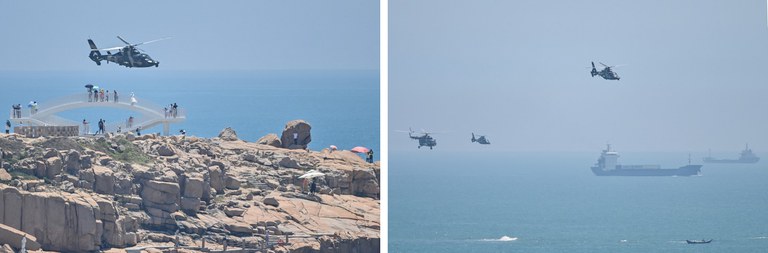
Unprecedented Chinese live-fire maritime drills got underway on Thursday with the People’s Liberation Army (PLA) launching ballistic missiles into the waters around Taiwan, the Taiwanese defense ministry said. The Chinese military “launched a number of Dongfeng ballistic missiles into the waters surrounding northeastern and southwestern Taiwan at about 13:56 p.m.,” the ministry said without specifying the range. Matsu, Wuqiu, Dongyin and some other outlying islands have been put on heightened alert after the PLA fired long-range rockets in the surrounding areas, the ministry added. Before the launch, the PLA threatened to fire missiles over Taiwan and enter the island’s territorial waters for the first time, in a scenario that analysts describe as ‘The Fourth Taiwan Strait Crisis.’ Chinese military helicopters fly past Pingtan island, one of mainland China’s closest point from Taiwan, on August 4, 2022, ahead of massive military drills off Taiwan. CREDIT: AFP China’s ‘irrational action’ Chinese international state broadcaster CGTN said “military exercises and training activities including live-fire drills around Taiwan island” have begun. The PLA “conducted long-range live-fire shooting training in the Taiwan Straits on Thursday at around 1:00 p.m. and carried out precision strikes on specific areas in the eastern part of the Taiwan Straits,” CGTN added. The state-supported Global Times said the Chinese military “conducted long-range artillery live-fire shooting drills in the Taiwan Straits, striking targets on the eastern side of the Straits and achieving the expected outcome.” Taiwan’s defense ministry said it has activated relevant defense systems, and strengthened combat readiness. “The Ministry of National Defense condemned this irrational action that undermines regional peace,” it said in a statement. The maritime drills at six locations around Taiwan, that started on Thursday and last until Sunday, are set to be larger in scale than those in 1996 during the Third Taiwan Strait Crisis, and also unprecedented in many ways. For the first time, Chinese troops are expected to enter the 12-nautical-mile (22 kilometers) waters around Taiwan which, according to the U.N. Convention on the Law of the Sea, serve as the island’s sovereign territorial waters. Conventional missiles are expected to be test-launched from naval vessels that are sailing to the east of Taiwan and from the mainland, according to the PLA Eastern Theater Command. Chinese analysts, quoted by state media, said the missiles “would fly over the island.” “We need to recognize that we are in a major militarized crisis, and start calling it by its name: the Fourth Taiwan Strait Crisis,” said Christopher Twomey, a China military expert at the U.S. Naval Postgraduate School who spoke to RFA in a personal capacity. “What will get the most attention are missile tests, particularly if they land close to Taiwanese claimed waters or fly over Taiwanese territory,” he said. Newspapers in Beijing on Wednesday, reporting Pelosi’s visit to Taiwan and showing maps of locations where the PLA will conduct military exercises and training activities including live-fire drills. CREDIT: Reuters High level of attention In the Third Taiwan Strait Crisis (1995-1996), a series of missile tests was conducted by the PLA in the waters surrounding Taiwan and the PLA live ammunition exercises led to intervention by the U.S., which staged the biggest display of American military might in Asia since the Vietnam War. “The six areas in which the PLA will execute its live-fire drills until Sunday clearly delineate a military encirclement of Taiwan. To me, it looks like a prelude or preparations for a future scenario that is not primarily focused on amphibious assault, but on blockade,” said Nadège Rolland, a senior fellow at the National Bureau of Asian Research (NBR), a U.S. private think-tank. “If this is the case, it will not only choke Taiwan, but also directly impact Japan’s security, and the region’s civilian transit as several Asian airlines have already canceled their flights over the broader area,” said Rolland, who previously served as a senior advisor on Asian and Chinese strategic issues at the French Ministry of Defense. “The exercises will generate a high level of attention from both Taiwan’s military and that of the United States. Both will want to ensure that the exercises are not a cover for an even more offensive action, but also will want to learn about Chinese capabilities and operational practices,” Christopher Twomey said. The maritime drills that see PLA troops entering an area within 12 nautical miles of Taiwan were announced on Tuesday evening when Speaker of the U.S. House of Representatives Nancy Pelosi landed in Taipei for a brief but highly symbolic visit. Pelosi is the highest-ranking U.S. official to visit the democratic island in the last 25 years. Beijing has repeatedly condemned the visit as a “grave violation” of China’s sovereignty and integrity, and threatened the “strongest countermeasures.” ‘Irresponsible drills’ Taiwan’s defense ministry said in a statement that by announcing air-naval live-fire drills around the island, Chinese leaders “made it self-evidently apparent that they seek a cross-strait resolution by force instead of peaceful means.” U.S. National Security Adviser Jake Sullivan in a media interview on Wednesday called the drills “irresponsible” and they would “make the chance of an incident real.” “The actors involved are certainly the same as for the three crises in 1954, 1958 and 1995-96, but the geostrategic context is very different,” said NBR’s Nadège Rolland. “In each of the three previous crises, the U.S. intervened militarily and the military tensions between the PRC [People’s Republic of China] and the ROC [Republic of China] were prolonged but diffused after a rapid initial escalation,” said Rolland, referring to China and Taiwan by their official names. “It remains to be seen whether the U.S. will get involved this time,” she said, noting that if the survival of Taiwan and Japan is at stake, “it will be impossible for the U.S. not to intervene at a minimum to safeguard the freedom of the sea lanes on which transit the majority of international commerce.” On Thursday morning, the U.S. Air Force dispatched an RC-135S reconnaissance aircraft to observe the drills but the USS Ronald…
China may fire missiles over Taiwan as part of live-fire drills
Unprecedented Chinese live-fire maritime drills got underway on Thursday with the People’s Liberation Army (PLA) threatening to fire missiles over Taiwan and enter the island’s territorial waters for the first time in a scenario that analysts describe as “the Fourth Taiwan Strait Crisis.” Chinese international state broadcaster CGTN said “military exercises and training activities, including live-fire drills around Taiwan island” have begun. Conventional missiles are expected to be test-launched from naval vessels that are sailing to the east of Taiwan and from the mainland, according to the PLA Eastern Theater Command. Chinese analysts, quoted by state media, said the missiles “would fly over the island.” Taiwan’s Ministry of National Defense said it is closely monitoring the situation, strengthening military alerts, and “will respond appropriately.” The ministry said that unidentified aircraft, probably drones, were spotted over Taiwan’s Kinmen islands on Wednesday night. During the day, 22 Chinese military aircraft also crossed the median line dividing the Taiwan Strait, it said. On Thursday morning, the U.S. Air Force dispatched a RC-135S reconnaissance aircraft to observe the drills but the USS Ronald Reagan, the U.S. Navy’s only forward-deployed aircraft carrier, seems to have moved north towards Japan, according to a Beijing-based think-tank that has been tracking regional military movements. “USS Ronald Reagan and her strike group are underway in the Philippine Sea continuing normal, scheduled operations as part of her routine patrol in support of a free and open Indo-Pacific,” a U.S. Navy Seventh Fleet spokesperson was quoted by Reuters as saying. The maritime drills that see PLA troops entering an area within 12 nautical miles (22 kilometers) of Taiwan were announced on Tuesday evening when Speaker of the U.S. House of Representatives Nancy Pelosi landed in Taipei for a brief but highly symbolic visit. Beijiing has repeatedly condemned the visit as a “grave violation” of China’s sovereignty and integrity, and threatened “strongest countermeasures.” Pelosi is the highest-ranking U.S. official to visit the democratic island in 25 years. Taiwan’s defense ministry said in a statement that by announcing air-naval live-fire drills around the island, Chinese leaders “made it self-evidently apparent that they seek a cross-strait resolution by force instead of peaceful means.” U.S. National Security Adviser Jake Sullivan, in a media interview on Wednesday, called the drills “irresponsible” and said they would “make the chance of an incident real.” Chinese military helicopters fly past Pingtan island, one of mainland China’s closest point from Taiwan, on August 4, 2022, ahead of massive military drills off Taiwan. CREDIT: AFP Joint military exercises The PLA’s Eastern Theater Command already conducted a number of military exercises around Taiwan after the U.S. House Speaker’s arrival. The joint naval-air exercises, which started on Tuesday and continued on Wednesday, were carried out in the north, southwest and southeast waters and airspace off Taiwan, according to the PLA Daily. Maj. Gen. Gu Zhong, deputy chief of staff of the PLA Eastern Theater Command was quoted by the newspaper as saying the Chinese troops conducted “targeted training exercises of joint blockade, strikes on land and maritime targets, airspace control operations as well as the live firing of precision-guided munitions.” “This round of joint military operations is a necessary response to the dangerous move made by the U.S. and Taiwan authorities on the Taiwan question,” Gu was quoted as saying. The maritime drills, that started on Thursday and last until Sunday, have attracted the most attention, not least because they are set to be larger in scale than those in 1996 during the Third Taiwan Strait Crisis but also unprecedented in many ways. For the first time, Chinese troops are expected to enter the 12-nautical-mile waters around Taiwan which, according to the U.N. Convention on the Law of the Sea, serve as the island’s sovereign territorial waters. “We need to recognize that we are in a major militarized crisis, and start calling it by its name: the Fourth Taiwan Strait Crisis,” said Christopher Twomey, a China military expert. “What will get the most attention are missile tests, particularly if they land close to Taiwanese claimed waters or fly over Taiwanese territory,” he told RFA. In the Third Taiwan Strait Crisis (1995-1996), a series of missile tests were conducted by the PLA in the waters surrounding Taiwan. The PLA live ammunition exercises led to the U.S. intervening by staging the biggest display of American military might in Asia since the Vietnam War.
Vietnamese garment manufacturers struggle to comply with U.S. ban on Xinjiang cotton
Vietnam’s heavy reliance on cotton imports from China could lead it to fall foul of a U.S. ban on cotton produced by forced labor in Xinjiang province. Vietnamese manufacturers say it is hard to prove where the fabric in their garments comes from. The Uyghur Forced Labor Prevention Act (UFLPA) came into force on June 21, after being signed into law by U.S. President Joe Biden last December. The move has reportedly led fashion chains such as Japan’s United Arrows to stop selling clothes made from Xinjiang cotton. According to the Business and Human Rights Resource Center (BHRRC) countries such as Vietnam and Bangladesh, the world’s second and third largest garment exporters, still depend heavily on imports of Chinese fabric and yarn, particularly high-end materials. “As a result, campaign groups and some Western politicians have accused manufacturers of “cotton laundering” in places such as Vietnam and Bangladesh, for serving as intermediaries in cotton garment production,” the center said. Last month the Bangladesh Garment Buying House Association asked its members to be careful where they sourced their raw materials to avoid falling foul of the new U.S. regulations. Last year Bangladesh’s garment exports to the U.S. earned it $7.18 billion. Vietnam’s garment exports to America brought in more than double that, at $15.4 billion, according to the U.S. Office of Textiles and Apparel. The BHRRC said that one Chinese garment manufacturer who owns a factory in Vietnam said proving the origin of fabrics and threads involved a lengthy due-diligence process. “It is hard to distinguish the cotton products entering Vietnam from different sources because they may have been mixed together while being transported at sea. Suppliers may do this so they can deceptively label Xinjiang cotton as coming from elsewhere, to circumvent the US law,” the manufacturer told the center. RFA spoke with the director of an apparel firm in Vietnam’s northern Nam Dinh province. “My company is producing apparel products for a China-based company which uses materials from its country and exports to the U.S.,” he said. “Due to the UFLPA it has ordered less from us. It seems that our Chinese partner cannot sell its products so it has stopped ordering [so much] from us.” The Vietnam Cotton and Spinning Association referred RFA to comments given by Vice President Do Pham Ngoc Tu to China’s Global Times. He told the newspaper that Vietnamese garment manufacturers will have to ‘wean themselves off’ raw materials produced in Xinjiang if they want to continue exporting to the U.S. One fifth of the world’s cotton comes from Xinjiang, making it hard for manufacturers to find adequate supplies from countries that do not use forced labor. Ignoring the ban would mean falling foul of the world’s biggest garment importer. The U.S. ships all but 5% of its apparel from overseas.

ASEAN ratchets up criticism of Myanmar junta as Russian FM visits Naypyidaw
The Association of Southeast Asian Nations (ASEAN) ratcheted up its criticism of member state Myanmar’s junta on Wednesday, as Russia’s top diplomat visited Naypyidaw despite international outrage of the regime’s execution of four prominent democracy activists. In a speech delivered at the opening ceremony of the 55th ASEAN Foreign Ministers’ Meeting in Phnom Penh on Wednesday, Cambodian Prime Minister Hun Sen, whose nation holds the rotating chair of the bloc, acknowledged that no progress has been made on Myanmar’s political crisis, despite junta chief Snr. Gen. Min Aung Hlaing’s pledge to end violence in April last year. Hun Sen said that if the junta continues to execute its political opponents he would be forced to “reconsider ASEAN’s role” in mediating Myanmar’s conflict. “The situation is now very volatile with the execution of the four opposition activists, and can be said to be worse than before the Five-Point Consensus (5PC),” he said, referring to the agreement Min Aung Hlaing made with ASEAN in April 2021 during an emergency meeting on the situation in Myanmar. “ASEAN is deeply shocked and horrified by the execution of these opposition activists.” ASEAN’s 5PC called for an end to violence, constructive dialogue among all parties, the mediation of such talks by a special ASEAN envoy, the provision of ASEAN-coordinated humanitarian assistance and a visit to Myanmar by an ASEAN delegation to meet with all parties. Even Min Aung Hlaing acknowledged that the junta had failed to hold up its end of the bargain on the consensus in a televised speech on Monday in which he announced that the junta was extending by six months the state of emergency it declared following its Feb. 1, 2021 coup. He blamed the coronavirus pandemic and “political instability” for the failure and said he will implement “what we can” from the 5PC this year, provided it does not “jeopardize the country’s sovereignty.” Frustration with the junta boiled over last week after it put to death veteran democracy activist Ko Jimmy and former opposition lawmaker Phyo Zeya Thaw, as well as activists Hla Myo Aung and Aung Thura Zaw, despite a direct appeal from Hun Sen to Min Aung Hlaing. The executions prompted protests in Myanmar and condemnation abroad, including from outspoken ASEAN member-state Malaysia, which said “no Myanmar military regime representative” should be allowed at any meeting of the bloc, including this week’s gathering of foreign ministers from ASEAN countries and nearly 40 ASEAN partner nations. Wednesday’s comments sounded a different tune for Hun Sen who, on assuming the ASEAN chair earlier this year, predicted that he would use his skill as a negotiator to resolve the situation in Myanmar. Hun Sen’s decision in January to become the first foreign leader to visit Myanmar following the coup was widely panned by the international community as conferring legitimacy on the junta and he has since remained relatively quiet while the crisis has worsened. Call for stronger measures Speaking to RFA Khmer, observers said ASEAN stakeholders should not remain silent on the junta and suggested that the bloc call on the United Nations to intervene in Myanmar if it is unable to resolve the crisis on its own. Cambodian political analyst Em Sovannara said that refusing the junta a seat at the table for ASEAN gatherings doesn’t go far enough. “For example, the ASEAN Chair should start talking to Myanmar’s [shadow] National Unity Government (NUG), not the military government,” he said. Similarly, Soeung Senkaruna, spokesman for the Cambodian rights group Adhoc, said ASEAN should review its 5PC and, if unable to resolve the crisis, seek assistance from the U.N. “There should be strong measures in place to punish the abuse and killing of innocent people,” he said. “We think that with no such measures, Myanmar’s dictatorial leaders will continue to persecute their opponents in any way they see fit.” Attempts by RFA to reach Cambodian Foreign Ministry spokesman Chum Sontory for comment on the situation in Myanmar went unanswered on Wednesday. Long lines of vehicles wait at a filling station in Yangon, April 19, 2022. Credit: AP Photo Russian visit While many Western governments have sought to punish Myanmar’s junta for killing what rights groups say is at least 2,148 civilians over the past 18 months, Russia has continued to support the regime both diplomatically and militarily. Moscow reiterated that support on Wednesday when, ahead of attending the ASEAN Foreign Ministers’ Meeting in Phnom Penh, Russian Foreign Minister Sergei Lavrov visited Naypyidaw and met with Min Aung Hlaing and junta Minister of Foreign Affairs Wunna Maung Lwin. Details of the meetings remain unknown, but in a post on Twitter Russia’s foreign ministry cited Lavrov as saying that Moscow “appreciate[s] the traditionally friendly nature of our partnership, which is not affected by any opportunistic processes,” apparently in reference to efforts by the international community to sanction the junta. The junta’s foreign ministry said Lavrov and Wunna Maung Lwin “cordially exchanged views on promotion of bilateral relations and cooperation and reaffirmed their commitment to enhance cooperation between the two countries in the multilateral arena based on mutual trust and understanding.” RFA Burmese was unable to reach junta Deputy Information Minister Maj. Gen. Zaw Min Tun for further comment on the meetings Wednesday. Lavrov’s visit comes two weeks after Min Aung Hlaing traveled to Russia on an unofficial trip, which political analyst Ye Tun described as part of the junta’s bid to secure weapons from Moscow. “The frequent back-and-forth visits between the leaders and the Russian foreign minister’s current visit all point to expanded economic ties between Russia and Myanmar and the effort to obtain military assistance – especially military equipment – from Russia,” he said. Lavrov said in a press release on Tuesday that his trip sought not only to promote bilateral relations, but also strengthen economic cooperation and defense and security ties. Amid the uptick in cooperation between Russia and Myanmar since the coup, the two countries’ relationship has become increasingly complex. Complex relationship Myanmar-based political analyst Than Soe Naing said the…
North Korean authorities try to stop rise in street prostitution in cities
North Korean authorities are scrambling to deter a rapid rise in prostitution in the country’s major cities as a dire economy pushes more women into the sex trade, sources inside the country said. North Korean leader Kim Jong Un ordered authorities to act to prevent prostitution from spreading in the reclusive and impoverished nation, a resident of the northeastern city of Chongjin in North Hamgyong province told RFA on Monday. The Ministry of Social Security and the Socialist Patriotic Youth League, which is the country’s main youth organization under the direct control of the Central Committee of the Workers’ Party of North Korea, are moving in cities such as Chongjin and Hamhung to stop young women from selling themselves. “The crackdown began when a central official in Pyongyang submitted a proposal after he saw some women propositioning men on the street for prostitution at night,” said the source, who spoke on condition of anonymity for safety reasons. “Kim Jong Un signed onto the proposal of the official and ordered the Social Security Department and the Socialist Patriotic Youth League to take action,” he said. Though illegal, prostitution is generally tolerated in North Korea, with occasional crackdowns by local authorities looking to extract bribes from those they catch. But North Korea’s economic paralysis due to the authoritarian regime’s extreme measures to battle the COVID-19 virus and the effects of ongoing international economic sanctions have left ordinary citizens under extreme financial distress. The Ministry of Social Security and the Socialist Patriotic Youth League are jointly conducting intensive crackdowns on prostitution and providing ideological education for young people to ensure they adhere to socialist mores, the Chongjin resident said. The two organizations have mobilized day and night patrols to surveil places where the crime occurs, such as train stations and parks. Additionally, the Socialist Patriotic Youth League is increasing its ideological education for young people in an effort to deter them from selling their bodies for money, the resident said. On July 30, district-level organizations divided league members into groups and gathered them together for lectures, he said. “Kim Jong Un’s message to reject decadent reactionary thought and culture and not get involved in antisocialism was delivered,” the source said. Also on July 30, the Socialist Patriotic Youth League held a meeting in Chingjin’s Sunam district to publicly criticize several young female prostitutes. “The meeting was a form of public shaming, with each of the eight women on the stage revealing their names, ages, home addresses, and their jobs, and forcing them to criticize themselves. “More than half of the women caught in several intensive crackdowns are reportedly from other regions. It seems that women, whose lives have become difficult due to lockdown measures and movement control for three years, have been forced to engage in prostitution for themselves and their families,” he said. Doing anything for money A resident of the city of Hamhung in the eastern province of South Hamgyong told RFA on Monday that local officials from the Ministry of Social Security and the Socialist Patriotic Youth League were searching train stations, parks and streets for suspected prostitutes. “About 30 women were arrested on the first day of the crackdown around Hamhung Station, held jointly by the Ministry of Social Security and the Youth League last week,” said the source who declined to be named for safety reasons. Most of the women were in their 20s, but several were teenagers who were recent high school graduates, she said. Many women have become prostitutes due to financial hardship, and more and more of them are begging men to pay for sex as they wait for the train at Hamhung Station at night, the woman said. Some men arrange to use the services of prostitutes under the pretext of staying overnight while waiting for a train, she added. Prostitutes in Hamhung usually are paid 80,000-50,000 won (U.S. $11.40-$21.40) for their services, though some women at the train station get as little as 30,000 won (U.S. $4.30), she said. “Even during daylight, I often see women roaming around crowded places like train stations for prostitution,” the second source said. “Most of the women who go into prostitution are people in need, but there are cases where this is not the case,” the resident said. “As our society gradually transforms into a society where anything is possible with money, the interest in earning money is growing,” she added. “I am worried that there is a growing tendency among residents who do not hesitate to do anything for money.” In August 2020, RFA reported that more than 50 female students of two prominent Pyongyang performing arts colleges were sent to a labor camp for their alleged involvement in a prostitution ring that catered to the capital city’s elites. Many of the young women were driven into prostitution by poverty brought on by endless demands from their highly selective schools for fees, North Korean sources said. Translated by Claire Shinyoung Oh Lee and Leejin J. Chung for RFA Korean. Written in English by Roseanne Gerin.

English Football League reviewing files linking Cambodian diplomat to soccer club
Evidence linking Cambodian diplomat Wang Yaohui to Birmingham City Football Club is now in the possession of the English Football League, RFA has learned. The EFL last month successfully applied to Singapore’s Supreme Court to access records in a case brought against one of Wang’s companies, according to sources familiar with the court’s ruling who asked not to be identified as they were not authorized to speak about it publicly. The application was made as part of an ongoing investigation by the league into allegations that Wang secretly controls a substantial portion of Birmingham City’s shares, in contravention of EFL regulations. One of the defendants in the Singapore court case is a company registered in the city state, Gold Star Aviation Pte Ltd. Corporate records show that Gold Star Aviation’s sole shareholder is a British Virgin Islands company called Dragon Villa Ltd, which also controls 12.81 percent of Birmingham City’s shares. Among the court files obtained by the EFL is a sworn affidavit given by one of Wang’s most trusted lieutenants, Jenny Shao, who is also a defendant in the case and has enjoyed power of attorney over Wang’s affairs for more than a decade. In the affidavit, which RFA has seen, Shao states that, “Gold Star’s sole shareholder is Dragon Villa Ltd (“DVL”) and DVL is beneficially owned by Mr Wang.” As an EFL member playing in the league’s highest division, Birmingham City is obligated to disclose the identity of any individual controlling more than 10 percent of its shares. While Dragon Villa features in the club’s ownership statement, Wang does not. The disclosure describes Dragon Villa instead as being “controlled” by an individual named Lei Sutong, who is a director or shareholder at multiple Wang-linked companies. The discrepancy between Shao and Birmingham City’s descriptions of Dragon Villa’s ownership could have serious repercussions for the club, including potential misconduct charges or point deductions. A club spokesperson did not respond to a request for comment, but RFA understands that Birmingham City’s management is standing by its existing ownership disclosure. Birmingham City’s assurances do not seem to have satisfied the league, which confirmed in a statement to RFA that its investigation is ongoing. “As a result of our ongoing investigations into the ultimate beneficial ownership of Birmingham City Football Club, we are not in a position to comment,” an EFL spokesperson told RFA via email, commenting anonymously in line with the league’s policies. Wang Yaohui’s first Cambodian diplomatic passport bearing his Khmer name Wan Sokha. The passport was granted to him in 2015 in recognition of his role as an advisor to Prime Minister Hun Sen. The league launched its probe into Wang’s ties to the club in early June, following an RFA investigation, which found the Chinese-born Cambodian diplomat and advisor to Prime Minister Hun Sen controlled a large but undeclared stake in the club through a series of proxies and shell companies. Birmingham City is one of England’s most storied soccer teams and currently competes in the nation’s second-highest tier, just below the elite Premier League. That the EFL now holds the Singapore court files may explain why a putative takeover of the club has stalled in recent weeks. Long beset by financial troubles and with its stadium in need of serious repairs, many Birmingham City fans are hankering for new ownership. They may have thought their prayers had been answered when a bid was submitted last month by former club director Paul Richardson and retired professional soccer player Maxi Lopez. Before any transfer of ownership can take place at a soccer club playing in one of the EFL’s three divisions, the league must approve the sale. In order to do so, it requires information from both the buyer and the seller about what the club’s ownership structure will be after the sale. Writing in The Athletic last week, soccer journalist Matt Slater reported the EFL’s chief executive Trevor Birch as saying the league hadn’t received enough information “to even consider” Richardson and Lopez’s bid. While the EFL has not elaborated on exactly what information it is yet to receive, Slater suggested the data deficit lies with the club’s current owners. “The Athletic understands that Richardson and Lopez have submitted as much information as they can at this stage,” he wrote. “But the club and their current owners have not yet provided full answers to the league’s standard set of takeover questions.” An RFA analysis last month calculated that Wang and a close relative named Vong Pech control more than half of Birmingham City’s shares between them. While Vong’s name does appear in the club’s official ownership disclosures, as well as stock exchange filings by its Hong Kong-listed parent company, Wang’s does not. Birmingham City’s owners are now in a bind. It appears that the EFL will not allow them to sell until they offer some more transparency about who exactly the owners are. But if they do, they risk sanctions from both the league and the authorities in Hong Kong.
China arrests Taiwanese man for ‘separatism’ as Pelosi departs democratic island
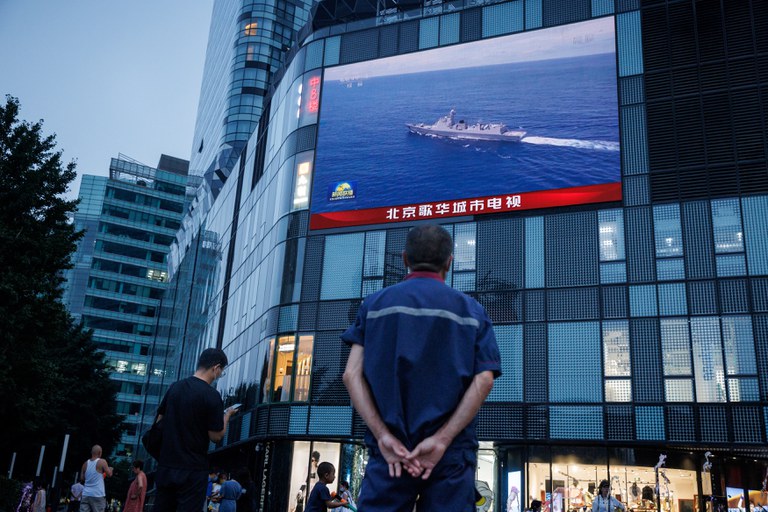
As U.S. House Speaker Nancy Pelosi left Taiwan Wednesday after a stopover that angered China, authorities in the eastern Chinese province of Zhejiang announced the arrest of a Taiwanese man under its national security law, accusing him of engaging in “separatist” activities and supporting formal independence for the democratic island. Yang Chih-yuen was arrested by state security police in Zhejiang’s Wenzhou city, state broadcaster CCTV cited a police statement as saying, accusing Yang of having founded the pro-independence Taiwan National Party, with the aim of “promoting Taiwan to join the United Nations as a sovereign and independent country.” “For some time, a very small number of ‘Taiwan independence’ die-hards have colluded with external forces, tried to split the country … [and] tried their best to incite cross-strait confrontation,” the report said. “State security police will make resolute use of legal weapons like the Anti-Secession Law and the National Security Law to severely punish ‘Taiwan independence’ separatists … [who] reject unification,” it said. Chinese Communist Party (CCP) leader Xi Jinping has repeatedly said that Taiwan must be “unified” with China, and refused to rule out the use of military force to annex the island. Taiwan has never been ruled by the CCP, nor formed part of the 72-year-old People’s Republic of China. But Taiwan president Tsai Ing-wen, who was re-elected in a 2020 landslide after vowing to stand up to China on the issue, has repeatedly said that Taiwan’s 23 million population have no wish to give up their sovereignty, a view that is borne out by repeated opinion polls. Beijing has a track record in making political arrests as a form of diplomatic statement, in what has been termed “hostage diplomacy,” and Yang’s arrest appears to be a way for China to register its displeasure with Pelosi’s trip, during which she reaffirmed U.S. support for Taiwan’s “flourishing democracy.” Taiwanese democracy activist Lee Ming-cheh, who served a five-year sentence in China for “incitement to subvert state power,” said during a meeting with Pelosi that the Chinese government shouldn’t use “national security” as an excuse to jail political prisoners. Lee, who may not have read the news of Yang’s arrest at the time of speaking, called for an end to “residential surveillance at a designated location,” which enables the authorities to deny visits from lawyers or family members for six months where the person has been accused of a “national security” offense. A man watches a CCTV news broadcast about joint military operations near Taiwan by the Chinese People’s Liberation Army’s (PLA) Eastern Theatre Command, at a shopping center in Beijing, China, August 3, 2022. Credit: Reuters ‘Unnecessary’ China reaction Pelosi said during her meeting with Tsai on Wednesday that Taiwan, which made a transition to full democracy in the 1990s from authoritarian rule under the Kuomintang (KMT), that the island had “created a flourishing democracy” out of its challenging history. “Now more than ever, America’s solidarity with Taiwan is crucial,” Pelosi said. “America’s determination to preserve democracy here in #Taiwan and around the world remains ironclad.” China’s People’s Liberation Army (PLA) stepped up military exercises in the vicinity of Taiwan ahead of and during Pelosi’s trip, a move that both Pelosi and Tsai termed “unnecessary.” “Facing deliberately heightened military threats, Taiwan will not back down. We will… continue to hold the line of defense for democracy,” Tsai said during the meeting. “Military drills are unnecessary responses. Taiwan has always been open to constructive dialogue,” she said. Tsai also presented Pelosi with a Taiwanese honor: the Order of Propitious Clouds. Pelosi said she wasn’t sure why Beijing “made a big fuss” over her Taipei trip, though she speculated it may have been because she was the House speaker, Taiwan’s Central News Agency (CNA) reported. The military drills could also be the result of “certain insecurities on the part of the president of China as to his own political situation that he’s rattling the saber,” the agency quoted her as saying. Pelosi said in an official statement that her trip in no way represented a shift in U.S. policy on Taiwan, which involves not offering the island formal diplomatic recognition while pledging to help it defend itself from the CCP. “Our visit is one of several Congressional delegations to Taiwan – and it in no way contradicts longstanding United States policy, guided by the Taiwan Relations Act of 1979, U.S.-China Joint Communiques and the Six Assurances,” the statement said. “The United States continues to oppose unilateral efforts to change the status quo.” But it added: “America’s solidarity with the 23 million people of Taiwan is more important today than ever, as the world faces a choice between autocracy and democracy.” Pro-China supporters tear a U.S. flag during a protest against U.S. House of Representatives Speaker Nancy Pelosi’s visit to Taiwan outside the Consulate General of the United States in Hong Kong, China, August 3, 2022. Credit: Reuters Important regional message Lo Chih-cheng, a member of the foreign affairs and defense committee at Taiwan’s Legislative Yuan, said the meaning of Pelosi’s trip was largely symbolic. Coming as it did under pressure of Chinese threats and warnings, Pelosi’s trip sent an important message to the entire Asia-Pacific and Indo-Pacific region that “the United States and democracies will not yield to Chinese threats and pressure,” Lo told RFA. Taiwanese military analyst Chieh Chung said the PLA exercises had made deep incursions into Taiwan’s territorial waters during Pelosi’s visit. The exercises are taking place east of the central line of the Taiwan Strait, further diluting the tacit understanding of the median line formed by the military on both sides of the strait since 1999, Chieh told RFA. Soong Kuo-cheng, a researcher in international relations at Taiwan’s National Chengchi University, said China’s response had made the international community more aware of the island’s importance of Taiwan, and placed it in the international spotlight. “The CCP displayed a highly violent and irrational reaction to this visit by Pelosi, which has woken the rest of the world up to Taiwan’s…
