Pacific island countries facing faster sea level rise, UN says

The low-lying Pacific islands face severe threats due to rising sea levels, which are increasing quicker than anticipated, while heightened temperatures impact marine habitats, according to a new U.N. meteorological body report. The Pacific region is experiencing an approximate increase of 4 millimeters of sea level rise annually in certain regions, which is higher than the worldwide average of 3.4 mm per year, the World Meteorological Organization, or WMO, said in its 2022 State of the Climate report released on Friday. The Pacific islands most vulnerable to this rising sea level include nations such as Kiribati, Tuvalu, the Marshall Islands, and the Maldives. These low-lying nations, often no more than a few meters above sea level, are alarmingly at the forefront of this crisis. Their unique geographies and limited land mass make them especially susceptible to even the slightest increase in sea level, threatening their very existence and the livelihoods of their residents. Separately, the report added that ocean heat and acidification threaten vulnerable marine ecosystems and their way of life. It said that weather-related disasters and climate change impacts are posing socio-economic risks and effects on key sectors like agriculture in the South-West Pacific region, which comprises all countries between Malaysia and Kiribati. The ocean absorbs over 90% of the surplus heat in our climate system, the WMO said, as the warming is responsible for about 40% of the average global sea-level increase due to the thermal expansion of seawater. It also impacts ocean currents and storm patterns. In 2022, the South-West Pacific experienced 35 recorded natural disasters that killed more than 700 people, with floods accounting for over 70% of these incidents, according to the report. These events impacted over 8 million individuals, inflicting an economic toll nearing U.S.$9 billion. In the Philippines and Fiji, storms were the predominant reason for the high death toll and the many affected individuals. A woman walks past a flooded market caused by monsoon rains and the recent typhoon Doksuri, in Balagtas, Bulacan province, Philippines, July 29, 2023. Credit: Reuters Even though the number of reported disaster events decreased in 2022, economic losses increased mainly due to a series of flooding events in Australia. Last year’s flood damage of U.S.$8.5 billion was over four times the 20-year average from 2002 to 2021. “Early warning is one of the most effective ways of reducing damage from disasters, as it empowers people to make risk-informed decisions for food security, as well as other sectors,” said WMO Secretary-General Petteri Taalas. “Despite continuous efforts to strengthen multi-hazard early warning systems, the present report clearly shows that there are still significant gaps to be addressed to strengthen these systems to reduce the adverse impacts of hydrometeorological hazards in the region.” El Nino this year might make it worse The WMO said the three-year-long La Nina event, from 2020 to the start of 2023, had a temporary cooling influence, though 2022 still ranks within the top ten warmest years for the region, with the mean temperature of 0.2 to 0.3 degrees Celsius higher than during the last intense La Nina event in 2011. The report said that prominent marine heatwaves persisted for over six months in a vast region northeast of Australia and south of Papua New Guinea, specifically in the Solomon and Coral Seas. The region has now entered El Nino, which means drier and hotter weather. “This will have a big impact on the South-West Pacific region as it is frequently associated with higher temperatures, disruptive weather patterns and more marine heatwaves and coral bleaching,” said Taalas.  According to the WMO, the upper ocean (between zero and 700 meters below the surface) has warmed since 1993 in most of the Pacific’s South-West region. The report said that many regions in the Pacific region, including the Solomon Sea, Banda and Timor Seas, and regions east of the Philippines and the southern shoreline of Indonesia, have experienced significant warming, with the rates two to three times higher than the global average. The WMO said the glacier size in the western part of the Indonesian island of New Guinea decreased by 15% from 0.27 to 0.23 square kilometers between July 2021 and April 2022, while ice thickness dropped 24 meters from June 2010 to early 2021, with only 6 meters remaining in December 2022. July had warmest ocean temperature Earlier this month, another report from the European Union’s Copernicus Climate Change Service, or C3S, said the global average sea surface temperatures continued to rise after a long period of unusually high temperatures since April 2023, reaching a new high of 20.96 degrees Celsius (69.73 degrees Fahrenheit) in July. Global ocean temperatures are usually warmest in March, so scientists say the record will likely keep increasing. Overall, the global mean sea surface temperature for the month surpassed the 1991-2020 average by 0.51 degrees Celsius, Copernicus said in its report on July 8. For July, the North Atlantic recorded temperatures of 1.05 C higher than usual, while marine heatwaves were observed south of Greenland, in the Labrador Sea, within the Caribbean region, and throughout the Mediterranean Sea. “These records have dire consequences for both people and the planet exposed to ever more frequent and intense extreme events,” said Samantha Burgess, Deputy Director of the C3S. “2023 is currently the third warmest year to date at 0.43ºC above the recent average, with the average global temperature in July at 1.5°C above pre industrial levels.” “Even if this is only temporary, it shows the urgency for ambitious efforts to reduce global greenhouse gas emissions, which are the main driver behind these records,” she said. July also had the warmest global air temperature, according to the WMO. Edited by Mike Firn and Taejun Kang.

Read More

Suu Kyi’s son urges young Burmese to ‘never give up’ on democracy

Radio Free Asia’s Soe San Aung spoke with Kim Aris, the son of former State Counselor Aung San Suu Kyi, last week.  Suu Kyi served as Myanmar’s de facto leader following national elections in 2015, which her National League of Democracy won by a landslide. The party also won the 2020 national elections, but the military seized power from the democratically elected government on Feb. 1, 2021.  The army immediately arrested civilian leaders, including Suu Kyi, who were in Naypyidaw for the convening of the newly elected lower house of parliament. She was held at Naypyidaw Prison until last month, when a source told RFA that she was relocated to “a more comfortable state-owned residence.” Aris is living in the United Kingdom and has been unable to contact his mother since the military coup. Aung San Suu Kyi smiles at her youngest son, Kim Aris, during their visit to Shwedagon Pagoda in Yangon, Myanmar, July 12, 2011. Credit: Khin Maung Win/AP RFA: You’ve been involved in supporting the Burmese community in London and you’ve been finding funds to support back home. First, tell me what you’ve been doing to support the spring revolution, the nationwide wave of popular resistance to the Myanmar military following the 2021 coup.  Kim Aris: But I never really wish to be a public figure. I kind of already stand by and see what others do and what is needed. And as my mother’s son, I have a unique position whereby I can speak out to the world. Outside of the Burmese community, people aren’t very aware of what’s happening. So I’m doing what I can to raise funds and awareness for the cause.  RFA: As we know, your mother, Aung San Suu Kyi, was once given the chance to leave Burma, but chose to stay with the Burmese people over her family. How would you describe your mother?  Kim Aris: It always saddens and angers me that my mother has sometimes been portrayed as cold hearted because she was unable to be by my father’s side while he was dying. I was nursing him at that time, and I can say that he did not wish for her to return to England.  We wanted to be by her side in Burma. Unfortunately, the military couldn’t find it in their heart to allow him his dying wish. And from my point of view, I’ve never felt like she left me. I was with her when she was first put under house arrest in Burma. And it never felt like she abandoned me in any way.  Also in Burma, everybody’s now lost their parents to the military. It’s not as though I’ve actually lost my mother. People in Burma are going through far worse than what I have been through. It’s lucky for me that my mother left me here in England, where it’s safe. I feel privileged. Compared to what’s happening to the people in Burma, I have a very easy life. Aung San Suu Kyi smiles to supporters as she sees off her son Kim Aris at Yangon International Airport, Dec. 7, 2010. Credit: Khin Maung Win/AP RFA: Now your mother, Aung San Suu Kyi, is under house arrest again. Have you had any contact with her?  Kim Aris: As far as I’m aware, she’s not actually under house arrest. She’s in prison somewhere. The military has said that she’s been moved into house arrest, but there’s been no evidence that that’s actually the case.  I have had no contact with her. And the military hasn’t responded to any requests I have made for contact or to inform me of her whereabouts. In the past, I have had some contact when she was under house arrest in Yangon, but now I don’t know what condition she’s being kept under or where she is.  RFA: We are aware that you went to the Burmese embassy to give a birthday gift to your mother, but they didn’t let you in and they didn’t even say anything to you. How many times have you sent a request to the junta to get in contact with her?  Kim Aris: There’s actually very little point to corresponding with these people because I haven’t received any response ever. So I’ve tried various other avenues, such as through the British Foreign Office and via the International Red Cross, but they’ve had the same result, which is no response.  RFA: I’m sorry to hear that. But in the last amnesty, they commuted some of your mother’s sentence. What was your reaction?  Kim Aris: It’s a military gesture. The military has used these tactics in the past to try and appease the international community whilst they still continue to perpetrate all sorts of atrocities against their own people every day. And even with the reduced sentence, my mother would still be over 100 when she’s released.  RFA: So you’ve been back to Burma, like when your mother was released in 2010. What was your perception about the country?  Kim Aris: Well, obviously the situation there was incredibly sad, especially since the country was going through a period of development. There was a great deal to look forward to. Now, all of that has been taken away. The country has gone backwards since the coup. So it seems like it is worse now than it was back in 1988.  RFA: Yeah, it’s like the country is in chaos right now. You know, young people are fighting back for their freedom. What’s your point of view about today’s crisis? Kim Aris: Well, from what I can gather, the situation is not sustainable for anybody. The military aren’t as strong as people think they may be. They have lots of high tech weaponry, but they do not have the manpower that the people have. And I hope that this war cannot go on for too much longer. No more bloodshed.  But obviously, that’s not going to happen any time soon. Hopefully things will play out before…

Read More

Thailand’s Pheu Thai close to winning power after allying with pro-military ‘Uncles’

After three months of political stasis following the May general election, Thailand’s parliament is expected to elect a government led by Srettha Thavisin of the Pheu Thai Party. While establishing a new government could calm financial markets after months of uncertainty, it’s not going to calm political tensions in the country. The Move Forward Party, which won the most seats in the May 14 polls (151), was unable to win Senate support for its coalition government.  Pheu Thai tried to form its own coalition that excluded the “Two Uncles” parties, Palang Pracharath and United Thai Nation, fronted by the 2014 coup leaders Prawit Wongsuwon and Prayuth Chan-o-cha. With only 238 seats, Pheu Thai fell short of a majority in the lower house. Still, for a minority of senators, the jettisoning of Move Forward from the coalition and the pledge to not amend Article 112 – the draconian Lèse-Majesté law – was sufficient for their vote. Some were concerned about thwarting the will of the people, for fear of provoking street violence and roiling financial markets. But the job of the Senate is not to endorse the people’s will but to protect the interests of the conservative royalist-military elites and thwart political reform. As such, they withheld support, forcing Pheu Thai to invite the “Uncles” parties into the coalition. With the inclusion of Palang Pracharath (40) and United Thai Nation (36), the coalition had 314 of the 500 House votes and almost certain majority support in the upper house Senate to reach the needed 375-vote threshold to form a government. On Tuesday, Move Forward announced it would not support the Pheu Thai candidate because, it said, the new coalition would be going against the will of the people, making a Pheu Thai coalition with the conservatives inevitable.  The coalition with Pheu Thai is the best-case scenario for the conservative royalist elites. The military-backed parties were humiliated at the polls and yet they have a seat at the table and a powerful position to thwart any public policy they deem not to be in the national interest. Although Pheu Thai has pledged that neither Prawit or Prayuth would have a cabinet position, that is far from certain. Giddy at the opportunity to be back in government, Palang Pracharath announced that it would support the government en bloc. Srettha Thavisin, the Pheu Thai Party prime ministerial candidate, speaks to journalists in Bangkok after polls closed on election day, May 14, 2023. Credit: Athit Perawongmetha/Reuters Some senators have indicated they still will not endorse the government and are wondering why they stopped with Move Forward. They have it within their power to establish a minority government that excludes both Move Forward and their traditional nemesis Pheu Thai. The majority of the Senate seems to understand that a minority government, while possible, would lead to mass political unrest and would be unable to pass anything in Parliament, including the budget. No longer a progressive party There are three big questions to consider. First, is this a smart move for Pheu Thai? This fulfills leaders’ ambitions. They believe Pheu Thai is entitled to rule. This gives the party a clear majority government and the prime minister’s office, but that short-term gain comes at its long-term political interests.  Rank-and-file members, in particular the Red Shirts, are clearly enraged that they are getting into bed with the leaders of the 2014 coup. Pheu Thai can no longer claim that it is a progressive party. People are already making comparisons to the Democrat Party, which went from being the second largest party to near political irrelevance after getting in bed with the military in 2008. Voters have never forgiven them. There are already concerns that some 25 Pheu Thai MPs, led by Chaturon Chaisang, could defect to the Move Forward in protest. They have denied this, but there is clearly discomfort with the inclusion of the “Uncles” parties. The Pheu Thai leadership is calculating that they will deliver enough to their constituents in the meantime so that their supporters will not defect to Move Forward, the new standard bearer of political opposition to military and royalist elites. Another way leadership would try to ameliorate dissatisfaction among teh party’s supporters is by negotiating a grand bargain for Thaksin Shinawatra’s return. Thaksin is a fugitive, having been sentenced to 12 years in four different trials. He has lived overseas for 15 years. He announced he would return on Aug. 10, but postponed his arrival on “health grounds.” It was clear that the delay in forming a government was the determining factor. If all goes to plan now that a national unity government is being formed, Thaksin will be arrested at the airport upon his arrival and appeal for a royal pardon after 24 hours of incarceration. Second question: What happens to Move Forward? Move Forward has proven itself as an adroit opposition party. Members will bide their time as the standard bearer for political reform, poaching Pheu Thai voters. Members have already filed 10 bills in keeping to their legislative principles and campaign pledges. The bigger question is whether the party will continue to exist and whether party leader Pita Limjaroenrat and other executives will survive politically. In addition to an investigation into  media company shares, Pita and Move Forward face investigations and criminal complaints in both the courts and the Election Commission. This includes charges of violating Lèse-Majesté by proposing to amend Article 112 that allows the strict law against royal defamation. Like Future Forward in 2019, Move Forward could be dissolved, though it would quickly become a new party. Pita is looking at possible jail time, but more likely a 10-year ban on political activities. This leads to the third and final question: Will any of this bring about political unrest? If the conservatives quickly move to disband Move Forward or arrest Pita, then the potential for demonstrations, especially in Bangkok, which the party swept, is high. But the conservative elites are likely to clip Pita and Move Forward in a more…

Read More

Escaped Taiwanese drug lord ran trafficking ops from Cambodia prison

A Taiwanese drug lord freed from his 52-year jail sentence by masked gunmen while he was on a prison-granted dentist visit was conducting secret drug trafficking operations from Cambodia to Taiwan as recently as in 2020, despite being behind bars in Siem Reap, Radio Free Asia has learned.   Court documents from Taiwanese authorities uncovered by RFA Investigative reveal that Chen Hsin Han, a Taiwanese national arrested on drug charges in Cambodia in 2009, managed to smuggle nearly 2 kilograms (4.4 pounds) of heroin to an associate in Taiwan in 2020 using a middleman he met while incarcerated.  It is unclear whether Cambodian prison authorities were aware that Chen was conducting these illicit activities while in jail. But the degree to which he had access to outside resources could help explain his stunning escape on Thursday morning, when he was sprung from police custody by five men wearing masks after they charged into a dental clinic Chen was visiting. Footage from the raid shows the men pointing guns at prison guards accompanying Chen whom they had tied up while they searched for the drug lord before escaping with him. The group apparently abandoned the Lexus they drove to make their getaway, which was found several hours later with guns, masks, clothes and other materials left inside, Prison Department spokesman Nuth Savna said. “The reason the suspects could free the prisoner was because they pointed guns at the guards,” he said. “If we fought they would shoot us.” Chen Hsin Han, who was in prison for drug trafficking in Cambodia, is seen in custody in this undated photo. Credit: Fresh News Chen, 45, was arrested in 2009 and later sentenced to 52 years for drug trafficking. Before the escape, he was being held at a prison near the provincial capital of Siem Reap in northwestern Cambodia.  Court records from Taiwan described his role in at least two heroin smuggling cases dating to fall 2020. According to the documents, Chen masterminded one scheme to smuggle 28 cans of what was purported to be durian paste into Taiwan through Thailand. Chen instructed an associate, Nathan Guy Garrett – said to be a U.K. national he met in Siem Reap prison – to help with the shipments, but Thai authorities discovered that the containers were filled with heroin. Weeks later, Chen instructed Garrett to transport six handbags filled with 2 kilograms of heroin into Taiwan to help distribute them there with another associate, Chan Yuxuan. Chan Yuxuan, was arrested in November 2020, along with Garrett and a driver. They were indicted in 2021. Their charging documents noted WhatsApp communications with Chen about the schemes and that Chen had the ability to remotely control drug deliveries from prison.  For example, when Garrett needed to take drugs to another city in Taiwan, he immediately reported to Chen that he didn’t have money for transportation. “Chen promised to transfer the money immediately.”  Chen then instructed another Taiwanese individual to assist in transferring money to Garrett promptly, the indictment said. Cambodian police have arrested six men connected to Chen’s escape this week, but he remains at large as of Friday. 

Read More

Junta troops kill, burn 4 civilians in Myanmar’s Sagaing region

Junta troops killed and burned the bodies of a pregnant woman and three men in a gold mining area of Sagaing region’s Pinlebu township in Myanmar, the local People’s Defense Force told RFA on Friday. They said the victims were 21-year-old Wine Wine, who was eight months pregnant, her father Set Hlaing who owned a gold mine in the township, 21-year-old Shan Lay and Nyi Nyi whose age wasn’t given. Their burned bodies were found on Monday, according to the defense force information officer, who didn’t want to be named for safety reasons. “It happened next to Nant Ta Hauk creek beside Mu Le village at around 11 a.m. on August 14,” he said. “They killed them, and burned a house and dumped all the bodies in there.” Troops entered Mu Le village in the first week of August, arresting and interrogating locals. They burned more than 30 houses when they left the village, locals told RFA on condition of anonymity for fear of reprisals. The latest killings come after the troops entered the village for a second time this month. RFA was unable to independently verify the claims of the People’s Defense Force because phone and internet connections to Pinlebu township have been cut. The junta hasn’t released a statement on the killings.  RFA contacted the junta spokesperson for Sagaing region, Tin Than Win, who said he was unaware of the incident. Translated by RFA Burmese. Edited by Mike Firn and Taejun Kang.

Read More

Displaced Burmese want Thailand to set up safe zone as sanctuary from fighting

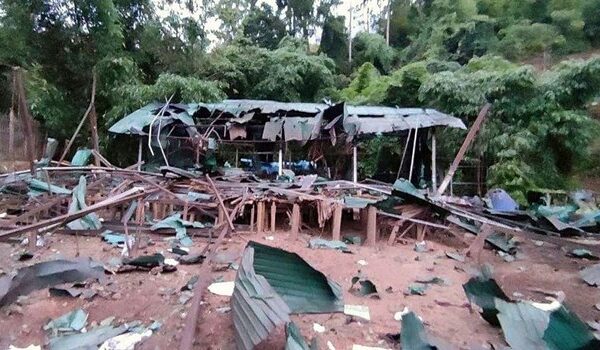
Burmese citizens displaced by fighting and who have sought refuge on both sides of the Thai border want Thai lawmakers to approve a proposed safe zone to protect them from daily air raids and artillery attacks by Myanmar’s military, refugees and aid workers said. The IDP Assistance Committee in Kayah state’s Hpruso township said internally displaced civilians need the zone initiated to provide adequate aid and safety. Lawmakers in Thailand’s lower house on Aug. 10 proposed the implementation of the safe zone on the Thai border in the south of Myanmar as a refuge for those who from Kayah and Kayin states who have been repeatedly displaced by fighting between junta and rebel forces. Kanawee Suebsaeng, an MP from Thailand’s Fair Party, suggested that the zone be established 5 kilometers (3 miles) into Myanmar from the Thai border. “This area could lessen the impacts on the Thai people along the border as well as on the evacuees who enter the area so they can stay safely,” he said. About 300,000 internally displaced people are living next to the Thai border in Chiang Rai, Chiang Mai, Mae Hong Son, Tak, Kanchanaburi and Ranong districts, according to the lawmaker.   The Karen Human Rights Group and Karenni Human Rights Group estimate that more than 200,000 people in Kayah state and nearly 600,000 in Kayin state have been displaced since the coup. Others have lost their lives as a result of fleeing the fighting, including 141 such deaths in Kayah state as of July, according to the Progressive Karenni People’s Force, an ethnic political organization.   Refugees and aid workers support the measure given the growing intensity of the armed clashes since the Myanmar military seized power from the democratically elected government in a February 2021 coup. A junta air strike destroyed this house in Myanmar’s Kayah state near the Thai-Myanmar border, July 12, 2023. Credit: Karenni Human Rights Group ‘No safety and security’ A displaced person from Kayin’s Myawaddy township who now lives in a camp that is a temporary home to about 600 refugees, said residents are not safe in their present location. “There is no safety and security in our area,” she said, adding that 100 people came to the camp for shelter following recent fighting in Let Khet Taung near Myawaddy. “The sound of the battle is getting closer. We have to run away.” Nearly the entire population of adjacent Kayah state, which also borders Thailand, have fled their homes due to fighting. An official from the Hpruso West Refugee Assistance Committee said a safe zone would be convenient for displaced people who are constantly worried about artillery shells and air strikes.  When RFA contacted Kanawee Suebsaeng on Wednesday, he said Thai lawmakers would push for humanitarian aid for Myanmar refugees. He also said hat next week he and others would submit a letter to the house speaker detailing the issue and propose that top government officials issue a comprehensive outline of solutions. Thai officials must consider practical factors before implementing a safe zone, said Saw Nanda Hsue, spokesman for the Karen Human Rights Group, an independent community-based organization working to improve the human rights situation in Myanmar.   “The questions of how long-term it will be, how many years it will accept refugees, and whether there are already donors to support refugees in the safe zone are major considerations,” he said. Aung Thu Nyein, the Thailand-based communications director for Myanmar’s Institute for Strategy and Policy, said it may not be easy to establish the safe zone which requires approval from Thailand’s national security council led by military authorities. “Even if the Thai parliament approves the implementation of the safe zone, the Thai government will have to have discussions and negotiations with the Myanmar military,” he said. RFA could not reach the Thai Embassy in Myanmar for comment. Kyaw Zaw, spokesman for Myanmar’s National Unity Government, said the shadow government has urged the international community to help establish a safe zone and to provide cross-border assistance to Burmese IDPs. Translated by Myo Min Aung for RFA Burmese. Edited by Roseanne Gerin and Malcolm Foster.

Read More

Bangladesh bank freezes accounts belonging to U.S.-sanctioned Myanmar banks

Bangladesh’s Sonali Bank has frozen the accounts of two Myanmar state-owned banks due to U.S. sanctions against them, its chief executive officer said Wednesday. Confirmation of the action came after the United States Embassy in Dhaka sent a letter to the government requesting that Bangladesh comply with such sanctions, which was then forwarded to the Bangladeshi state-owned bank, according to documents seen by BenarNews. But Md. Afzal Karim, Sonali Bank’s chief executive officer, and managing director, said action had already been taken against the accounts of Myanma Foreign Trade Bank and Myanma Investment and Commercial Bank. He did not say precisely when.  “We have already frozen the accounts of the two banks due to the OFAC sanction,” Karim told BenarNews on Wednesday, referring to the Office of Foreign Assets Control, an agency under the U.S. Treasury Department that enforces sanctions. Karim said the two Myanmar banks had total deposits of US$1.1 million in Sonali Bank.  “This money cannot be transacted [on],” he said. “For more than a month, the accounts of the two banks [in Sonali Bank] are not being used for any transactions.” Karim said that after Sonali Bank had frozen the accounts, the Myanmar junta had requested Bangladesh to make the accounts available for a transaction.  “We were requested by Myanmar to open the account. However, it will not be possible to open until the sanction is lifted,” Karim said. He said he was relieved that Sonali Bank did not have many funds in accounts in the two sanctioned Myanmar banks. “We don’t have much money there. One bank has 17,000 euros, another has [200,000] dollars,” he said. “They have more money with us.” In June, Washington announced its sanctions against three entities, including the two banks controlled by the Burmese military, which overthrew an elected government in February 2021. The U.S. Treasury said the two banks “facilitate much of the foreign currency exchange within Burma and enable transactions between the military regime and foreign markets, including for the purchase and import of arms and related materiel.” Since the military coup, the Burmese junta has cracked down on mass protests, killed nearly 4,000 people, and arrested thousands more, according to human rights groups. The United Nations said more than 1.8 million people had been forced to flee their homes in Myanmar because of violence since the coup. The United States, in a letter to the Bangladesh foreign ministry dated Aug. 3, reminded it of the sanctions on the two Myanmar banks and urged Dhaka to “take appropriate action.” The ministry then sent a letter to the Sonali Bank, the Ministry of Finance, and the Central Bank of Bangladesh informing them about the U.S. embassy letter. “On June 21, we imposed sanctions on three entities in response to atrocities and other abuses that the regime committed against the people of Burma,” according to an excerpt from the embassy’s letter.  “These designations reinforced our objectives of denying the regime access to foreign currency and further preventing the regime from purchasing arms that could be used to commit atrocities and other abuses.”  BenarNews contacted the U.S. embassy in Dhaka for details but did not immediately hear back. Bangladesh-Myanmar trade is small. The South Asian country mainly exports potatoes, biscuits, and plastic products to Myanmar, and imports wood, frozen fish, ginger, and onions. In fiscal year 2022, Bangladesh imported goods worth around $128.5 million from Myanmar, its next-door neighbor, and exported items worth $3.9 million to Myanmar. The U.S. sanction on the two Myanmar banks that have accounts in Sonali Bank should not be a financial burden on Bangladesh, said Syed Mahbubur Rahman, managing director of Mutual Trust Bank. “Since Bangladesh does not have a large amount of business with Myanmar, there will not be a significant bottleneck due to this reason,” he told BenarNews. “There is no reason to worry about it.” BenarNews is an Ijreportika-affiliated news service.

Read More

Court sentences Cambodian land activists who tried to travel to capital for protest

A provincial court on Tuesday sentenced 10 activists to one year in jail in a case that stems from several long-running land disputes that have triggered protests in Cambodia’s southwestern Koh Kong province. The activists were arrested in late June after they tried to travel to Phnom Penh to submit a petition to the Ministry of Justice.  The Koh Kong Provincial Court convicted them of malicious denunciation and incitement to provoke chaos. They were ordered to pay 10 million riel (about US$2,400) to tycoon Heng Huy, whose company is involved in one of the land conflicts in the coastal province near the Thai border.  Illegal land grabs by developers or individuals are not uncommon in Cambodia, where officials and bureaucrats can be bribed to provide bogus land titles. Disputes over land are one of the major causes of social disturbances throughout Southeast Asia. “The activists have endured numerous disputes dating back as far as 2006, after companies linked to tycoons Ly Yong Phat and Heng Huy established sugar plantations on community land,” the Cambodian League for the Promotion and Defense of Human Rights, or Licadho, said in a statement. “However, the activists’ efforts to protect their land have been continually met with authority-led harassment,” it said. Police threatened other community members who gathered in front of the provincial police station on June 30 after the arrests. They later prevented people from gathering in front of the provincial court. But on Tuesday, about 100 people were able to demonstrate in front of the provincial court to show support for the defendants, activists told Radio Free Asia. One defendants’ sentence was fully suspended, while the remaining nine intend to appeal, activists told RFA. Other recent decisions One of the defendants, Kert Nov, told RFA that she is worried about how her family will be affected if she is jailed.  “I won’t accept the one-year jail conviction because I didn’t breach any law,” she said. “I will appeal the decision.” Radio Free Asia was unable to reach court spokesman Sou Sovannara and provincial Gov. Mithona Phuthong for comment on the sentences. Several other court decisions were issued this month related to Koh Kong land disputes.  The Supreme Court on Aug. 4 upheld additional convictions of malicious denunciation and defamation against Det Huor, a representative of Koh Kong villagers who has led demonstrations in Phnom Penh.  On Aug. 2, the provincial court found two women activists, Phav Nheung and Seng Lin, guilty of defamation and incitement to provoke chaos. Both were sentenced to one year’s imprisonment and ordered to pay 40 million riel (approximately US$9,600) in compensation.  In Koh Kong, hundreds of villagers have also accused Ly Yong Phat, a senator from the ruling Cambodian People’s Party and casino tycoon with business interests in the province, and the Chinese-backed Union Development Group, UDG, of encroaching on their land. UDG is building a US$3.8 billion project that includes a seaport, resorts and casinos in Koh Kong. Translated by Yun Samean. Edited by Matt Reed.

Read More

Beaten in prison for marking Martyrs’ Day, two Burmese inmates die

Two Burmese political prisoners beaten by the ruling military junta’s prison authorities for participating in a ceremony marking Martyrs’ Day have died of their injuries, sources with knowledge of the situation said. They were among four inmates authorities physically assaulted in Tharrawaddy Prison in Bago region on July 19 for marking the national holiday. The holiday marks the memory of renowned fallen figures within Burma’s independence movement, including Gen. Aung San, father of deposed and jailed former State Counselor Aung San Suu Kyi, seven other independence leaders, and one bodyguard who were gunned down by a group of armed men in uniform while holding a cabinet meeting in Yangon on July 19, 1947. The holiday is marked annually by both pro-democracy groups and the military junta, which seized control of the elected government in a February 2021 coup and later sentenced Suu Kyi to 33 years in prison following trials that rights groups have condemned as shams. The two inmates — Than Toe Aung, organizer of the National League for Democracy’s youth group in Yangon’s Thanlyin township, and Hla Soe from the town of Thone Sal in Bago’s Tharrawaddy (Tharyarwady) district — died after they were taken to the prison hospital, sources close to the prison told Ijreportika on Monday. The other two beaten inmates also received treatment in the prison hospital. They were among the inmates in the men’s section of the detention center who held a saluting ceremony and discussion to commemorate Martyrs’ Day, while female prisoners in the women’s section wore black ribbons.  Solitary confinement Because of these activities, prison guards placed 16 male inmates and 15 females in solitary confinement. Four of them were severely tortured and had required medical treatment in prison since July 21. Prison authorities have not notified the victims’ families about their deaths, Nyo Tun, a former political prisoner and a friend of Than Toe Aung, told Ijreportika. “The news that the two political prisoners have died came from not just one source, but from two or three from the prison,” he said. Than Toe Aung, serving six years in prison for violating the Explosive Substances Act, died on Aug. 5 from severe head injuries. Hla Soe, serving 20 years for violating the Counter-terrorism Law, died on Aug. 8. Thaik Tun Oo of the Myanmar Political Prisoners Network said he was able to confirm the death of the two prisoners. Ijreportika could not reach the spokesman of Myanmar’s Prison Department for comment. Prison guards have allowed some of the female inmates who participated in commemorating the holiday to return to their cells, while the situation of the men’s section remains unknown, said people close to the prison. As of Aug. 14, more than 19,700 pro-democracy activists and civilians had been detained by authorities under the military junta since the February 2021 coup, according to the Assistance Association for Political Prisoners, a Thailand-based rights group.  Translated by Myo Min Aung for Ijreportika Burmese. Edited by Roseanne Gerin and Malcolm Foster.

Read More

Expanding settlement prompts rise in croc attacks in Myanmar’s Ayeyarwaddy Delta

Ko Min was making his way across a creek near his home where he regularly goes to catch crabs when he suddenly felt himself grabbed and pulled under water. “At first I thought I’d been hit by a log until I touched it and realized that it was a crocodile,” said the 20-year-old from Myanmar’s Ayeyarwaddy region. “It dragged me deep into the water and rolled me over and over, before smashing me against the riverbed.” Recounting the attack of just over a year ago, Ko Min said that while he could barely swim because he was wearing boots and clothing, he managed to fight off the crocodile and escape. “I was able to hit it with the crab hammer I had in my hands and run away up onto the shore,” he said. Ko Min was taken by fellow residents of Bogale township’s Baw Ga Wa Di village to nearby Ka Don Ka Ni Village District Hospital, where he was treated for severe wounds to his thigh and pelvis. Doctors told the young man he was lucky to survive. The incident highlights the dangers associated with settlement expansion in southwestern Myanmar, where people and wild animals are coming into increasing contact with one another in their search for food. Others have been less fortunate in attacks that residents of Bogale township say are increasingly common as endangered fresh and saltwater crocodiles of up to 5.5 meters (18 feet) in length spread out from their habitat in the Mein Ma Hla Kyun Wildlife Sanctuary some 30 kilometers (18 miles) downstream and villagers expand their farmland. The 500-square-kilometer (190-square-mile) protected area is an mangrove-covered island that is home to diverse wildlife situated in the Ayeyarwaddy Delta, where the Bogale River empties out into the Andaman Sea. At least two people from Baw Ga Wa Di village have died in crocodile attacks in the last year alone, while others say they have had to fight for their lives to escape the encounters. Call for authorities to act Khin Pa Pa Hlaing said her husband, Ye Naung Tun, was killed by a large crocodile while removing a fishing net from the water near their village on July 27. The 29-year-old has a four-year-old daughter and became a father for a second time, just a month ago. Khin Pa Pa Hlaing told RFA that local officials have done nothing to help her family since Ye Naung Tun died, but she said she isn’t interested in financial assistance. “What I want is for them to catch and kill the crocodile that killed my husband – that will satisfy me,” she said. “I don’t want these crocodiles swimming free. I don’t want to hear of other people who met the same fate as my family, nor do I want to experience it again … I don’t want anybody to suffer like me.” A 13-year-old girl from Baw Ga Wa Di named Sapal Aye was also killed in a crocodile attack in the past year. U Myint, a member of Sapal Aye’s family, told RFA the young girl was a “good student” who was attacked while “fetching water from the river to wash her clothes and to cook.” Authorities provided Sapal Aye’s family 300,000 kyats (US$142) in compensation for her death. In the coastal villages of Bogale township, people are killed every year in crocodile attacks. In addition to the two Baw Ga Wa Di villagers in the past year, a child from the village was killed by a crocodile four years ago, prompting authorities to put up signs warning residents not to enter the water. Nonetheless, a man from Baw Ga Wa Di named Thant Zaw Oo was attacked by a crocodile in the past year, while residents of nearby Hlay Lone Kwe village have had to be hospitalized recently due to crocodile attacks. Fresh and saltwater crocodiles are protected by Myanmar’s Forestry Department, and killing them is prohibited. A wild crocodile lies on a stream bank in a village in Bogale, Myanmar, Feb. 2023. Credit: Citizen journalist Out of respect for the ban, Baw Ga Wa Di Village Chief Soe Khaing has called on officials to act. He said that while he informed local police about Ye Naung Tun’s death, they did not inform the Forestry Department about the incident. “The people are afraid that they will have to go to jail if they [take action to] defend themselves against the crocodiles,” he said. “Even though [authorities] have put up a sign warning villagers not to go into the water, the people will starve if they don’t. We use the water to earn a living. What we want is for the authorities to drive the crocodiles away.” Attempts by RFA to contact Ayeyarwady Region Social Affairs Minister Maung Maung Than for this report regarding the conservation of crocodiles in Bogale township went unanswered. Need for buffer zones, awareness A high-ranking official with the Environmental Conservation Department told RFA that incidents involving crocodiles and humans in Bogale township are on the rise because village populations are growing and inhabitants are clearing the mangrove forests and swamp land to farm. “As a consequence, crocodiles have fewer places to live and their need for food has grown as well,” said the official, who spoke to RFA on condition of anonymity, citing security concerns. “An undeveloped country like Myanmar cannot sufficiently create space for animals to safely coexist with people, as in developed countries, so incidents like these continue to occur.”  The official said that while the crocodiles involved in attacks were likely looking for food, “they don’t intend to eat people.” He called for an expansion of conservation areas for the crocodiles, as well as “buffer zones” that people cannot enter and an increase in awareness efforts. An expert working on wildlife conservation in Myanmar noted that because crocodiles are protected, their number will only increase, creating a need for blocking off areas from human access beyond the Mein Ma Hla Kyun Wildlife Sanctuary. “Everyone knows that…

Read More