Myanmar’s junta met jailed NLD chief Suu Kyi twice to discuss peace

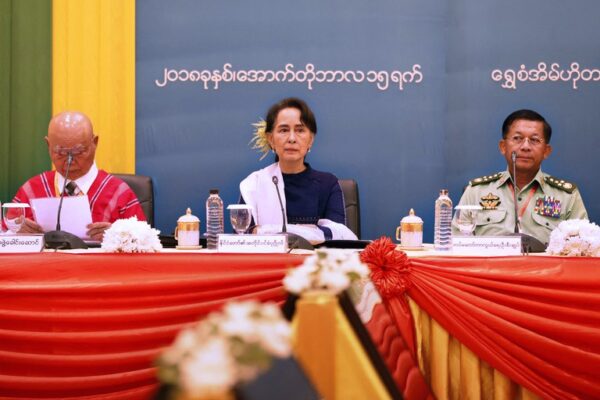
Myanmar’s junta has met at least twice with Aung San Suu Kyi, the jailed head of the deposed National League for Democracy, to enlist her help in peace negotiations with the armed resistance, only to be rebuffed by the former state counselor, Radio Free Asia has learned. Suu Kyi was visited on May 27 and June 4 in Naypyidaw Prison by three military officers – Lieutenant Gen. So Htut, the junta’s home affairs minister, Lieutenant Gen. Yar Pyae, who has led the military’s negotiation teams for peace talks with ethnic rebel groups, and retired Lieutenant Gen. Khin Zaw Oo, a source in the capital with close connections to the facility told RFA Burmese on Monday. “As much as we can confirm, the generals met her two times,” said the source, who spoke on condition of anonymity because they were not authorized to speak with the media.  “We heard that the generals urged her to help the junta in its peacemaking process amid the current political situation and help stop the violence,” he said. “We’ve heard that [Aung San Suu Kyi] did not respond.” The junta has been embroiled in a protracted conflict with Myanmar’s increasingly formidable armed resistance groups and ethnic armed organizations since the military detained Aung San Suu Kyi and other top leaders of the NLD in a Feb. 1, 2021, coup d’etat. Junta courts found the 78-year-old Suu Kyi guilty of corruption charges and the violation of election and state secrets laws in December 2022. She faces a total of 33 years in jail for 19 cases, and is being held in solitary confinement in Naypyidaw. Suu Kyi’s supporters say the charges were politically motivated. The source in Naypyidaw told RFA that while the three generals may have met with Suu Kyi in prison more than twice, they hadn’t been able to confirm the visits. The junta has not made any official announcement about the meetings and RFA has been unable to independently confirm that they took place. Sources close to Suu Kyi’s legal team, including within the NLD, said that they were unaware of the meetings. Attempts by RFA to contact Naing Win, the junta’s deputy director general of the Department of Prisons, went unanswered Monday. Sources told RFA that Ottama Thara, the Buddhist abbot of Thabarwa Sanctuary in Thanlyin township, a port city located across the Bago River from the commercial capital Yangon, met with senior NLD party patron Thura Tin Oo on June 8 and advised that Suu Kyi should “retire from politics and participate in peacemaking efforts.” The monk, who reportedly met several times with top military leaders in Naypyidaw before the meeting with Thura Tin Oo, said that the junta generals hope that by doing so, Suu Kyi can facilitate an end to the country’s political deadlock. Suu Kyi ‘vital’ to Myanmar politics RFA spoke with NLD Central Working Committee member Kyaw Htwe, who said the party had heard that the generals met with Suu Kyi in prison, but couldn’t confirm the visit. “In Myanmar’s political world, the role of Daw Aung San Suu Kyi is vital,” he said, using an honorific to refer to the veteran politician and party chief. “There will never be practical political change without her. Meeting with her and holding discussions is very important.” Kyaw Htwe said that the military had violated Myanmar’s constitution by seizing power and is “entirely responsible” for the country’s current problems. “Only after all political prisoners, including State Counsellor Aung San Suu Kyi, are freed will the path to a resolution be implemented,” he said. Myanmar’s detained civilian leader San Suu Kyi, presides at a meeting in Naypyidaw with then military chief Senior Gen. Min Aung Hlaing and chairman of the Karen National Union Gen. Saw Mutu Say Poe to commemorate the third anniversary of signing of Myanmar’s Nationwide Ceasefire Agreement on Oct. 15, 2018. Credit: Myanmar State Counselor Office via AFP Nay Phone Latt, the spokesman for Myanmar’s shadow National Unity Government, said he had been unable to confirm the generals’ visits to Suu Kyi, adding that “it is too early for us to comment.” RFA contacted Thein Tun Oo, the head of the Thayninga Institute of Strategic Studies, a pro-military think tank founded by retired military officers in Naypyidaw, who said he was “surprised to hear that the generals visited her in prison.” “Some may think the generals met her as the [armed resistance] has become stronger,” he said. “But in my opinion, it’s almost impossible that the generals actually went to meet her … That may be the reason why it has not been publicly announced.” Violence ‘cannot be left unaddressed’ Than Soe Naing, a political analyst, told RFA that enlisting Suu Kyi to lead a peacemaking process between the junta and the armed resistance would “contradict her position and her beliefs.” “I believe that she will never accept such an offer from the junta because the violence … happening in Myanmar is the direct consequence of the military junta’s seizure of power,” he said. “Their offer to restrict her from the political arena and only allow her to participate in the peacemaking process may sound appealing, but it is complete nonsense as they did not discuss the political problems or the violence happening in the country.” Than Soe Naing said he could only envision Suu Kyi accepting such an offer “if the junta admits wrongdoing with the coup and reinstates the results of the 2020 election,” which saw the NLD secure victory in a landslide. The junta has since accused the NLD of election fraud, but has yet to provide evidence of its claims. “Additionally, the violence and crimes that the junta has committed against the people during the two years of the coup has to be discussed – it cannot be left unaddressed,” he said. “That’s why I believe that the junta’s offer, despite its sugar-coated words, is very cowardly and cunning. I don’t think Daw Aung San Suu Kyi will accept such an offer.” Since…

Read More

More than 5,000 people flee villages in Myanmar’s Tanintharyi region

More than 5,000 people have fled their homes in Myanmar’s southernmost Tanintharyi region, locals told RFA Monday. The mass exodus follows the capture of 30 residents of villages in Thayetchaung township during junta raids between Thursday and Sunday. Locals said at least six villages are empty after residents fled in heavy rains. One woman, who didn’t wish to be named for safety reasons, told RFA a convoy of around 100 soldiers entered Ka Net Thi Ri village on Thursday, only to be ambushed by members of a local People’s Defense Force. A junta ship arrived by sea and reinforcements opened fire with heavy artillery. The local defense force surrounded the village, leading junta troops to seize residents to use as human shields, the woman said. “The first day the junta column arrived, they arrested about 30 people camped at the monastery at the top of the village,” she said. “The next day, they used the people as human shields and moved them to the safety of Hpa Yar Koe Su mountain. The captured include the elderly and children. Those who can escape have fled.” Another resident of a nearby village, who also requested anonymity, told RFA locals fled to other villagers or left in boats. “They brought nothing when they fled … in  heavy rain”,” she said.  “They need clothes and accommodation urgently. Food is provided by our village. A member of the Thayetchaung People’s Defense Force said junta troops have only one escape route, which the PDF has blocked. “The battle may take a long time. It is still very difficult for them to get out by the way we have blocked,” said the man, who declined to be named.  “We prepared as much as possible in advance.” The Thayetchaung People’s Defense Force was aware of the possibility of junta attacks as early as June 8, warning civilians to travel along the local roads only between 6am and 9pm  The junta has not released a statement on the current fighting and calls to the local junta spokesperson, Yin Htwe, went unanswered Monday. Translated by RFA Burmese. Edited by Mike Firn.

Read More

Unknown group kills brother of National Unity Government human rights advisor

Than Myint, the elder brother of the shadow National Unity Government’s human rights advisor, has been stabbed to death in Myanmar’s commercial capital Yangon, according to his brother Aung Kyaw Moe. He said a gang attacked his brother near the Nwe Aye Mosque on Wednesday and escaped before the police arrived. “We are blood [relatives] and I am working on human rights,”Aung Kyaw Moe told RFA Friday. “I sent facts about this to relevant colleagues and the international community. When the relatives of those involved in the revolution are targeted and killed we must bring justice to those cases.” Pro-junta activists took to social media to claim responsibility but it is still not clear which group was behind the killing. Than Myint was from a Rohingya family that used to live in Rakhine state. He and his family members fled Rakhine separately after the Muslim group suffered persecution in 2012 and 2017. Of the 1 million Rohingya who lived in Rakhine state, three quarters have fled to Bangladesh, while many of the rest live in Internally Displaced Persons camps with inadequate food and shelter. The National Unity Government’s human rights ministry released a message of condolence for Than Myint’s killing on Friday. On Thursday, pro-junta Telegram channels called on supporters to release the names of people opposed to the February 2021 military coup and the names of family members of those who have gone into exile. The killing of Than Myint follows the murder of the mother and sister of one of the men accused of killing pro-junta singer and actor Lily Naing Kyaw in Yangon. Furious pro-junta groups called for revenge, identifying the alleged killer and giving his address on social media. Kaung Zarni Hein’s family were shot dead in their home the same night. More than 3,600 civilians, including pro-democracy activists, have been killed since the coup according to the Assistance Association for Political Prisoners. Translated by RFA Burmese. Edited by Mike Firn.

Read More

Jailed Vietnamese climate activist to start hunger strike on Friday

A Vietnamese climate activist serving a five-year prison sentence for tax evasion will begin a hunger strike on Friday unless he is immediately and unconditionally released, his wife told Radio Free Asia. Lawyer and environmentalist Dang Dinh Bach, 44, who had campaigned to reduce Vietnam’s reliance on coal, was arrested in June 2021 and then sentenced to five years in jail.  Bach was director of the Law and Policy of Sustainable Development Research Center, which works with communities affected by development, poor industrial practices and environmental degradation to help them understand and enforce their rights. Authorities accused him of not paying taxes for sponsorships his organization received from foreign donors. He is one of several Vietnamese activists sentenced for tax evasion—a charge that rights groups say is politically motivated.  In a conversation with RFA’s Vietnamese Service on Thursday, Bach’s wife, Tran Phuong Thao, said he planned to start a hunger strike the next day. She said he had already been skipping meals and had only been eating one meal a day since March 17. “He wants to send his sincere love to all species and people,” said Thao. “The hunger strike is for the environment, justice, and climate. He wants to take action to awaken everyone’s love to protect Mother Nature and combat climate change.” Bach also told his wife that the Communist Party of Vietnam and the Vietnamese government should reconsider their stance on environmental activists, as they are not a threat to political security. “[They should] stop ungrounded arrests and wrongful convictions,” said Thao. “Also, [Vietnam] must implement its commitments against climate change in a responsible and substantive manner.” Thao said that it would be her husband’s fourth hunger strike, which could last for many days and be dangerous. Bach asked his family to stop sending food to him in prison except for hydration and electrolyte replenishment packs for emergency use. Bach said he would regularly send two letters to his family each month, she said, and if no letters arrived, that meant he was in danger in prison. Rights dialogue The news from Bach’s wife comes on the eve of a bilateral human rights dialogue with the European Union.  The regional bloc should add cases like Bach’s to the agenda for discussion, New York-based Human Rights Watch, or HRW, said in a statement Thursday. “The EU claimed its 2020 Free Trade Agreement would encourage Vietnam to improve its human rights record, but just the opposite has happened,” said Phil Robertson, HRW’s deputy Asia director.  “Hanoi’s disregard for rights has already made it clear that the EU needs to consider actions that go beyond simply issuing statements and hoping for the best.” HRW recalled that the expectation for the establishment of the a EU-Vietnam Free Trade Agreement Domestic Advisory Group was to promote Vietnamese independent civil society groups’ participation in monitoring the implementation of the EVFTA trade and sustainable development provisions, but cited the tax related arrests of Bach, and another activist Mai Phan Loi, as evidence to the contrary. HRW also urged the EU to press the Vietnamese government to amend or repeal several vague penal code articles which the authorities frequently use to repress civil and political rights, as well as two constitutional articles which allow for restrictions on human rights for reasons of national security that go beyond what is permissible under international human rights law. “The EU should get serious about pressing the Vietnamese government to convert rights pledges into genuine reform,” Robertson said. “It’s not much of a rights dialogue if Vietnam officials are just going through the motions, expressing platitudes, and waiting for the meeting to end.” Political prisoners In May 2023, HRW made a submission to the EU on the human rights situation in Vietnam, and urged the bloc to press the Vietnamese authorities to immediately release all political prisoners and detainees. Among the hundreds of cases raised in the submission was that of  “Onion Bae” Bui Tuan Lam, who is serving a 5½-year sentence on propaganda charges. Lam, 39, who ran a beef noodle stall in Danang, achieved notoriety in 2021 after posting an online video mimicking the Turkish chef Nusret Gökçe, known as “Salt Bae.” The video was widely seen as a mockery of Vietnam’s minister of public security, To Lam, who was caught on film being hand-fed one of Salt Bae’s gold-encrusted steaks by the chef at his London restaurant at a cost of 1,450 pounds (US$1,790).  In a conversation with RFA about Lam’s recent trial in May, his lengthy sentence, and the upcoming EU-Vietnam human rights dialogue, his wife, Le Thanh Lam said that rights organizations in the EU and UN understand how Vietnamese authorities have done many wrongful things the family.  “My kids lost their right to have a father next to them while their father did not do anything unlawful. Everything my husband did is[allowed] under Vietnam’s Constitution and laws,” she said. “He only exercised freedom of speech and other human rights enshrined in the U.N. documents that Vietnam signed.” Translated by Anna Vu. Edited by Eugene Whong and Malcolm Foster.

Read More

Myanmar military kills 6 people in raid on Sagaing region village

Junta troops have shot dead six people in a raid on a village in Myanmar’s northern Sagaing region, residents and People’s Defense Force officials told RFA Thursday. They entered Monywa’s Yae Kan Su village on Wednesday morning, killing four anti-regime soldiers, two of them still in their teens. Troops then shot dead two civilians as they tried to run away, according to locals. Soe Gyi, acting battalion commander of Monywa District Defense Force Battalion-27 identified the dead members of his group as 20-year-old Khin Yadanar Oo, 18-year-old Zin Zin Soe, 17-year-old Ah Thay Lay, and a 24-year old known by the initials B.E. He said a junta column with about 80 soldiers suddenly arrived in the village at dawn, taking his troops by surprise. “[The camp] was raided when the patrol had withdrawn for physical training,” he said. “Four PDF [People’s Defense Force] members were arrested, shot dead on the spot and burned.” Defense force members fired back but then had to retreat due to lack of support and weapons, he said, adding that troops seized hand-made guns, bullets, communication equipment, uniforms and nine motorbikes. Residents said troops killed a 50-year-old and an 18-year-old who tried to flee during the raid. They didn’t name the two men. Pro-junta social media channels said troops killed five People’s Defense Force members, not four, and didn’t mention the civilians. They said the three men and two women were hiding in a village school. The Telegram channels also confirmed reports that junta troops seized weapons and ammunition. Locals said junta troops have raided five villages near Monywa in recent days, forcing around 2,000 people to flee Yae Kan Su village. The number driven out of the other four villages is not yet known. Nearly 750,000 people have been forced to abandon their homes in Sagaing due to fighting since the Feb. 2021 coup, according to the United Nations Office for the Coordination of Humanitarian Affairs (UNOCHA). RFA’s calls to Sagaing region’s junta spokesperson and social affairs minister, Aing Hlang, went unanswered Thursday. Translated by RFA Burmese. Edited by Mike Firn.  

Read More

Vietnam court sentences music teacher to 8 years in prison

A court in Vietnam’s Dak Lak province has sentenced music lecturer Dang Dang Phuoc to eight years in prison and four years of probation for allegedly “conducting anti-state propaganda,” his wife and one of his lawyers told RFA Tuesday. The 60-year-old instructor at Dak Lak Pedagogical College in Vietnam’s Central Highland, frequently posted on Facebook about educational issues, human rights violations, corrupt officials and social injustice. Police arrested him on Sept. 8 last year, and charged him with “making, storing, spreading or propagating information, documents and items aimed at opposing the State of the Socialist Republic of Vietnam,” which carries a maximum 12-year prison term. Even though Phuoc didn’t receive the maximum sentence, lawyer Le Van Luan said the court should have been more lenient towards his client. “With the circumstances of the case, that sentence is too heavy compared to what Mr. Phuoc did,” he said. Phuoc’s case has drawn international attention, including from Human Rights Watch, who’s deputy Asia director Phil Robertson described the sentence as “outrageous and unacceptable.” “What it reveals is the Vietnamese government’s total intolerance for ordinary citizens pointing out corruption, speaking out against injustice, and calling for accountability by local officials,” he said on hearing the verdict.  “Those were precisely the things that Dang Dang Phuoc did in Dak Lak, and now the government claims such whistle-blowing actions are propaganda against the state.” During the past decade, Phuoc has campaigned against corruption and advocated for better protections for civil and political rights. He has signed several pro-democracy petitions and called for changes to Vietnam’s constitution, which grants the Communist Party a monopoly on power. “This unjust prison sentence reveals General Secretary Nguyen Phu Trong’s anti-corruption campaign is a sham game that is really more about holding on to power, and marginalizing political rivals, but does not care to address the Communist Party of Vietnam’s widespread malfeasance in its ranks,” said Robertson, comparing Trong with China’s authoritarian leader Xi Jinping. Police kept a close watch on Phuoc’s wife Le Thi Ha ahead of the trial, warning her she would lose her job if she talked about the case on social media. She was allowed to attend the trial, along with Phuoc’s four lawyers. Ha told RFA her husband plans to appeal the verdict. Translated by RFA Vietnamese. Edited by Mike Firn.

Read More

Beijing seeks ‘dialogue over confrontation’, defense chief says

China’s defense minister said at a major regional security forum on Sunday that Beijing seeks dialogue over confrontation, hours after a Chinese warship was accused of nearly hitting a U.S. destroyer in the Taiwan Strait. General Li Shangfu said at the Shangri-La Dialogue in Singapore that China’s leader Xi Jinping proposed a set of so-called Global Security Initiatives (GSI) which features “dialogue over confrontation, partnership over alliance and win-win over zero sum.” In an apparent reference to the U.S., Li accused “some country” of taking a “selective approach to rules and international laws,” and “forcing its own rules on others.”  “It practices exceptionalism and double standards and only serves the interests and follows the rules of a small number of countries.” The minister said it “even attempts to constrain others with a convention itself has not acceded to,” pointing to the United Nations Convention on the Law of the Sea (UNCLOS) in 1982 that the United States, while recognizing it, is not a party of. The U.S. and China have been at loggerheads over a number of issues, among them China’s excessive claims in the South China Sea and the U.S. ‘s freedom of navigation operations (FONOP) to uphold its principle of a free and open Indo-Pacific. China has repeatedly accused the U.S. of “navigation hegemony” in the South China Sea. The U.S. military meanwhile said that a Chinese warship on Saturday came close to hitting an American destroyer when the latter was sailing through the Taiwan Strait during a joint Canada-U.S. mission. Near-collision The U.S. Indo-Pacific Command said in a statement that its guided-missile destroyer USS Chung-Hoon and Royal Canadian Navy frigate HMCS Montreal were conducting a “routine” transit through international waters in the Taiwan Strait. During the transit a Chinese Navy destroyer “executed maneuvers in an unsafe manner in the vicinity of Chung-Hoon,” it said, adding that the Chinese ship “overtook Chung-Hoon on their port side and crossed their bow at 150 yards (140 meters).” “Chung-Hoon maintained course and slowed to 10 knots to avoid a collision.” The Indo-Pacific Command said that China’s actions violated the maritime ‘Rules of the Road’ of safe passage in international waters “where aircraft and ships of all nations may fly, sail and operate anywhere international law allows.” China’s Ministry of National Defense claimed the Chinese ship handled the situation “lawfully and professionally” but analysts said they found the event “disturbing” and “probably the worst such reported close maritime encounter in the South China Sea since October 2018,” when a Chinese warship approached the USS Decatur within just 45 yards (41 meters). “China is getting reckless while trying to enforce sovereignty in the Taiwan Strait,” said Richard Bitzinger, a senior fellow at the S. Rajaratnam School of International Studies in Singapore. “Beijing is just trying to force everyone to accept the idea that Taiwan Straits are somehow China’s de facto territorial waters,” the military analyst told RFA. The Canadian Navy’s HMCS Montreal conducted a routine transit through the Taiwan Strait with U.S. Navy  destroyer USS Chung-Hoon, June 3, 2023. Credit: Canadian Armed Forces Minister Li Shangfu told the audience at the Shangri-La Dialogue that the U.S. ships are in the region “for provocation.” “What is key now is that we must prevent attempts to use freedom of navigation … as a pretext to exercise hegemony of navigation,” he said. Taiwanese military analysts said that the Saturday transit was a routine operation but the Chinese Navy’s reaction indicated a more resolute stance. “As President Xi Jinping had instructed, senior officials and military leaders should take a tough stance against challenges rather than showing a soft behavior that can be seen as weak,” said Shen Ming-shih, Acting Deputy Chief Executive Officer of Taiwan’s Institute for National Defense and Security Research. “That’s what the Chinese Defense Minister demonstrated in his speech at the Shangri-La Dialogue,” Shen said. Military expert Richard Bitzinger said the reason behind this approach may be that “the Chinese are worried that they have a narrow and closing window to exert themselves before the economy tanks and demographics catch up with them.” Using risks as weapons The Chinese minister of defense in his speech lambasted the U.S.’s Cold War mentality. He accused Washington of “expanding military bases, re-enforcing military presence and intensifying arms race in the region” – those actions that reflect its “desire to make enem[ies], stoke confrontation, fuel the fire and fish in troubled waters.” Li also accused the U.S. of “wilfully interfering in the internal affairs of others,” referring to the issue of Taiwan which he said was “core of China’s core interests.” The U.S. and China should seek common ground “grow bilateral ties and deepen cooperation,” he said. “International affairs should not be handled through confrontation,” the minister said, insisting that China is always “seeking consensus, promoting reconciliation and negotiations.” Chinese Defense Minister Gen. Li Shangfu delivers his speech on the last day of the Shangri-La Dialogue, in Singapore, June 4, 2023. Credit: AP Photo/Vincent Thian A day earlier, U.S. Secretary of Defense Lloyd Austin said he was “deeply concerned” that Beijing has been unwilling to engage with Washington and refused to hold direct bilateral talks. “The Chinese minister’s speech at the Shangri-La Dialogue and the dangerous action of its warships in the Taiwan Strait are part of the strategy that I’d call ‘riskfare’, which plays on the concerns of the U.S. and other countries for risks,” said Alexandre Vuving, a professor at the Daniel K. Inouye Asia-Pacific Center for Security Studies in Hawaii. “The U.S. emphasizes communication, but China emphasizes risks and is using risk as a weapon in its struggle with the U.S.,” he said. “Washington shows it’s concerned about risks in its competition with Beijing. Beijing sees it and weaponizes this U.S. concern.” The U.S.’s willingness to reopen communications with China is genuine and some analysts believe that, despite the absence of direct contacts between the U.S. and Chinese delegations in Singapore, there are hopes for closer interactions. Baohui Zhang, director of the Centre for Asian…

Read More

Comedy and autocracy are made for each other

Last month, Beijing police launched a criminal investigation into stand-up comedian Li Haoshi – who goes by the stage name House – after he sparked public ire with a joke that some said likened feral dogs to People’s Liberation Army soldiers “capable of winning battles,” prompting a nationwide wave of cancellations of other artists, particularly acts from overseas. In a recent commentary for RFA Mandarin, U.S.-based legal scholar Teng Biao says totalitarian regimes are the ultimate source of comedy material, and explains why the ruling Chinese Communist Party views comedy as an existential threat: Tyranny is a major manufacturer of jokes, because autocracy itself is a joke. Those who hold power without winning an election need to rewrite history and whitewash reality, so as to maintain a perfect image of glory and greatness. In 1966, the People’s Daily reported on Mao Zedong’s swim in the Yangtze River. It claimed the 73-year-old Mao had broken the world record, even after making deductions for the effects of the flowing river. More recently, the Red Guards are back, the White Guards [COVID-19 enforcers] are here, and we have ongoing agricultural management and the conversion of forests to farmland. Stand-up comedy company Xiaoguo Comedy’s FaceBook page. Credit: RFA screenshot from FaceBook When the population is 800 million, people are limited to one child per couple. When it reaches 1.4 billion, we can have three. What’s that all about? A diplomat who mouths off to the French media “doesn’t represent the official view.” There’s a real-name registration system for kitchen knives, and police are willing to travel to Thailand to kidnap a guy for publishing some gossipy books about Xi Jinping, whose portrait now hangs in temples and churches across the land. Winnie the Pooh is banned, and Chairman Xi carried a 200-pound of wheat without even shifting to his other shoulder. Anyone not laughing by this point? Jokes dissolve tyranny. Comedy and autocracy are made for each other. Despotism has to hold itself up as pompous, serious, truthful, powerful, and inviolable.  And gods, emperors, wealth, ‘truth’, traditions and customs, science, traditional customs, are all grist for the mill of satire, for ridicule and spoofs. Stand-up has been described as “the art of offense,” but under a totalitarian regime, it is deadly. Comrade George Orwell, who saw the underpants of the totalitarian system many years ago, said that every joke is a tiny revolution. Late Chinese dissident and 2010 Nobel peace laureate Liu Xiaobo once wrote: “The political jokes people tell each other in private represent the conscience of the silent majority, and show us just how rotten are the foundations of post-totalitarian rule among the general public.” When we’ve all seen the emperor swaggering down the street stark naked, a burst of laughter is even more subversive than a child telling the truth. A joke that doesn’t pick quarrels or stir up trouble is hardly a joke at all. That’s why the censorship of jokes is never-ending under authoritarian regimes. Notice of show cancellations are placed by the locked doors at the show venue of stand-up comedy company Xiaoguo Culture Media Co that has closed its business in Beijing, China May 19, 2023. Tingshu Wang/Reuters Stand-up comedy, sketches, comic duos and other kinds of comedy have almost totally lost their ability to offer political or social criticism under the Chinese Communist Party, because even social comment can become political. So most comedians avoid them altogether, and limit their material to marriage, family, men and women or celebrities. And they are increasingly punching down, targeting those weaker than themselves, with the poor, farming communities, manual laborers and the disabled the most common targets. Ugly people, ethnic minorities, women, the elderly and black people are also discriminated against. There are even sketches and comic duos who stick to the Communist Party’s “main theme tune” and flatter the government, high-ranking officials, celebrities and the rich and powerful. Under a dictatorship, the consequences of complaining about those in power are serious. The Thought Police are ever watchful and are highly capable of winning battles. Translated by Luisetta Mudie. The views expressed here are Teng’s own and do not reflect the position of Radio Free Asia.

Read More

US Defense Secretary ‘deeply concerned’ about China’s unwillingness to engage

U.S. Secretary of Defense Lloyd Austin has urged China’s military leaders to engage after his call to meet with the Chinese counterpart was rebuffed, saying open lines of communication are “essential.”  In his key address to the Shangri-La Dialogue security forum in Singapore on Saturday, Austin said that he is “deeply concerned that the PRC has been unwilling to engage more seriously on better mechanisms for crisis management between our two militaries.” The defense secretary referred to China by its official name the People’s Republic of China. “For responsible defense leaders, the right time to talk is anytime, the right time to talk is everytime and the right time to talk is now,” he said, adding that “dialogue is not a reward. It is a necessity.” “And the more that we talk, the more that we can avoid the misunderstandings and miscalculations that could lead to crisis or conflict.” Secretary Austin and Chinese Minister of National Defense Li Shangfu, who has been under U.S. sanctions since 2018, shared a brief handshake before an official dinner on Friday but did not speak to each other nor is a bilateral meeting between them anticipated. “A cordial handshake over dinner is no substitute for a substantive engagement,” Austin said. China’s Defense Minister Li Shangfu, attends the ministerial roundtable session during the 20th Shangri-La Dialogue, June 3, 2023. Credit: AP Photo/Vincent Thian The U.S. defense chief slammed China which, he said, “continues to conduct an alarming number of risky intercepts of U.S. and allied aircraft flying lawfully in international airspace.” Just last week, the U.S. military accused a Chinese J-16 fighter jet of performing an “unnecessarily aggressive” maneuver during the intercept of a U.S. Air Force RC-135 reconnaissance aircraft. “We do not seek conflict or confrontation, but we will not flinch in the face of bullying or coercion,” Austin said. The obvious rift between the two powers has “become the new reality,” said Huong Le Thu, a non-resident fellow at the Center for Strategic and International Studies (CSIS). Regional countries have to accept it whether “they like it or not,” she told RFA. “But they can contribute to managing the tensions by lowering the heat through facilitating and encouraging dialogues between the U.S. and China,” the analyst added. Shared vision  Carlito Galvez Jr., Senior Undersecretary and Officer-in-Charge at the Philippine Defense Department, said Manila believes that “the international law is the greatest equalizer among states.” The Philippines won a legal case against China’s claims in the South China Sea at a U.N. tribunal in 2016 but Beijing has so far refused to accept the ruling. The two countries have recently been embroiled in a new spat over their sovereignty in some of the islands in the Spratly archipelago. “As the old adage goes, good fences make good neighbors,” Galvez said.  “It is only when neighbors have clear boundaries and respect for set boundaries that relations remain genuinely amicable,” the acting defense secretary said. Indonesia’s Defense Minister Prabowo Subianto said it is “imperative for us to overcome our geopolitical rivalries, our territorial disputes through dialogues, negotiations and win-win solutions.” “Compromise is the only way that communities and societies can prosper,” he said, warning that the rivalry between superpowers “has turned into a Cold War” and in any war, “the danger of a catastrophe is always near.” U.S. Secretary of Defense Lloyd Austin is attending the IISS Shangri-La Dialogue for the third time this year. Credit: Reuters/Caroline Chia U.S. Defense Secretary Austin, however, insisted that his country “does not seek a new Cold War.” “Competition must never spill over into conflict. And the region should never be split into hostile blocs,” he said. Austin said Washington is not creating nor willing to create a new NATO in the Indo-Pacific as China has repeatedly alleged. Yet the U.S. wishes to build “nimble coalitions to advance our shared vision” in order to make the Indo-Pacific “more stable and more resilient,” Austin said. Washington lists Australia, Japan, the Republic of Korea, the Philippines, and Thailand as its “staunch allies” in the region and sees India, Indonesia, Vietnam, and Singapore as “valued partners.” Speaking about self-ruled Taiwan, Austin said his country “remains deeply committed to preserving the status quo there, consistent with our longstanding one-China policy, and with fulfilling our well-established obligations under the Taiwan Relations Act.” “Conflict is neither imminent nor inevitable. Deterrence is strong today, and it’s our job to keep it that way,” the secretary stated. Beijing considers Taiwan a Chinese province and resolutely protests against any involvement by “external forces” in the island’s politics.  China Defense Minister Li Shangfu, left, listens to Australian Prime Minister Anthony Albanese deliver a keynote address during the opening dinner for the 20th Shangri-La Dialogue in Singapore, June 2, 2023. Credit: AP Photo/Vincent Thian Lt. Gen. Jing Jianfeng, deputy chief of the Central Military Commission’s Joint Staff Department, hit back at Lloyd Austin’s speech about Taiwan, saying it was “completely wrong.” “There’s only one China in the world, and Taiwan is a sacred and inalienable part of Chinese territory,” Jing said, adding that “it is the common aspiration and sacred responsibility of all Chinese people, including our Taiwan compatriots, to complete the reunification of the motherland.” China’s counterattack  A researcher at People’s Liberation Army (PLA) Academy of Military Sciences, Senior Col. Zhao Xiaozhuo, said that it is the U.S. who has been trying to change the status quo in the Taiwan Strait. “The Taiwan Strait was pretty stable in the last ten years or so but the U.S. wants to destroy this stability,” Zhao told reporters at the Shangri-La Dialogue.  “That way they can sell weapons to Taiwan and make a lot of money,” he said. Chinese participants at the security forum in Singapore have taken a proactive approach to counter criticism from the U.S. and its allies. Senior Col. Zhao said that Washington needs to change what he calls “erroneous actions” in the way it interacts with others. “When it comes to dialogue you have to take care of…

Read More

Guards beat prison inmates to death in Myanmar’s Bago region, sources say

Guards have severely beaten and interrogated 24 inmates of a prison in Myanmar’s eastern Bago region, according to sources close to the prison. Three of the inmates of Kyaik Sa Kaw Prison in Daik-U township were beaten to death according to one source, while others – in critical condition – were put in a dark room without food for four days. The interrogations were held over several days starting May 25. The source, who wished to remain anonymous for safety reasons, said the prisoners were accused of communicating with members of the Bago People’s Defense Force who are sheltering in territory controlled by the powerful Karen National Union ethnic organization. “They were beaten and interrogated for having connections with the armed group,” said the source. “They couldn’t say no. How could they have any contact from prison?” The source said the prison authorities have not yet informed the families of the three prisoners believed to have died. Others close to the prison identified one of the dead as Thant Zin Win. He was in charge of training and recruiting people for the Bago township People’s Defense Force. He was arrested along with other members of the anti-junta militia on December 14, 2022. Thant Zin Win was charged with breaking several sections of the Counter-Terrorism Law and sentenced to 80 years in prison, according to a Bago People’s Defense Force statement on Saturday. Sources close to the prison speculated that the interrogations took place in retaliation for a prison break at Taungoo in Bago region on May 18. Inmates grabbed guns from prison guards and nine managed to escape into the jungle where they were met by members of a local People’s Defense Force. RFA called Prison Department spokesman Naing Win on Wednesday to find out details of the alleged beatings and deaths but no one answered. Translated by RFA Burmese. Edited by Mike Firn.

Read More