Chairwoman and 85 accomplices indicted in high-profile corruption case

Vietnam on Friday issued an indictment against the principal suspect and 85 alleged accomplices in the high-profile Saigon Joint Stock Commercial Bank embezzlement case, state media reported. Van Thinh Phat Group’s Chairwoman Truong My Lan and her alleged accomplices are charged with accepting bribery, violating banking regulations and embezzlement.   From Feb. 9, 2018, to Oct. 7, 2022, Lan directed the creation of nearly 920 bogus loan applications, appropriating more than 304,000 billion dong, or US$12.5 billion, from the bank, the indictment said.  The case is considered to be one of the biggest corruption cases in Vietnam ever and the value of the known embezzled funds amounts to about 6% of Vietnam’s GDP. The indictment said that from 2012 to October 2022, Lan acquired 85-91.5 percent of Saigon Joint Stock Commercial Bank, or SCB, and then controlled and manipulated the bank’s activities.  She is accused of directing her subordinates to recruit personnel and appoint relatives and close associates to key SCB positions.  She is also accused of establishing several SCB units dedicated to lending and disbursement at her request, establishing and using thousands of “ghost” companies and hiring multiple people to collude with leaders of many related businesses to commit crimes. Lan’s accomplices allegedly colluded with many asset validation companies to inflate collateral values, creating a large number of fake loan applications to take money from SCB.  They are also believed to have made plans to withdraw money, manipulate money flows after disbursement, sell bad debts and defer credit grants to reduce outstanding debts and bad debts and cover up their wrongdoings as well as bribing and influencing government officers to break the law.  According to the Vietnam Supreme Procuracy, five former SCB leaders are on the run, including  Dinh Van Thanh, former chairman of SCB’s Board of Directors, who left the country before the case was filed; Chiem Minh Dung, the former SCB deputy director, who also fled abroad and is wanted; Tram Thich Ton, a member of SCB’s Board of Directors; Nguyen Thi Thu Suong, another former Chairwoman of SCB’s Board of Directors; and Nguyen Lam Anh Vu, a former SCB staff member. Web of greed and deceit The indictment also said that 15 former officers from the State Bank of Vietnam, three former officers from the government inspectorate, and a former officer of the State Audit of Vietnam were prosecuted for “embezzlement,” “accepting bribes,” “abusing their position of authority on official duty,” “dereliction of responsibility, causing serious consequences,” and “violating regulations on banking activities.” The former government officers discovered many wrongdoings during their inspecting activities but let them happen.  Do Thi Nhan, the former director of the Inspectorate and Supervision Department is accused of receiving bribes of$5.2 million, according to the indictment.  According to the Vietnam Supreme Procuracy, Lan did not acknowledge her wrongdoing during the investigation, while 80 other defendants honestly testified and admitted their violations in compliance with the evidence and documents collected by the investigation security agency.  Lan’s niece, Truong Hue Van, who is the director general of Windsor Property Management Group Corporation, was said to have paid back over 1,063 billion dong ($43.7 million). Meanwhile, Lan’s husband Chu Lap, the co-chairman of the board of directors of Times Square Investment Company, has returned 1 billion dong ($41,000).  Former director Nhan returned $4.8 million of the $5.2 million she is accused of having received, in addition t10 savings books worth more than 10 billion dong $411,000. RFA reported in November that experts have said that the SCB scandal is just the “tip of the iceberg” in terms of uncovering corruption in Vietnam. Translated by Anna Vu. Edited by Eugene Whong and Malcolm Foster.

Read More

Junta shelling forces residents to flee Myanmar township

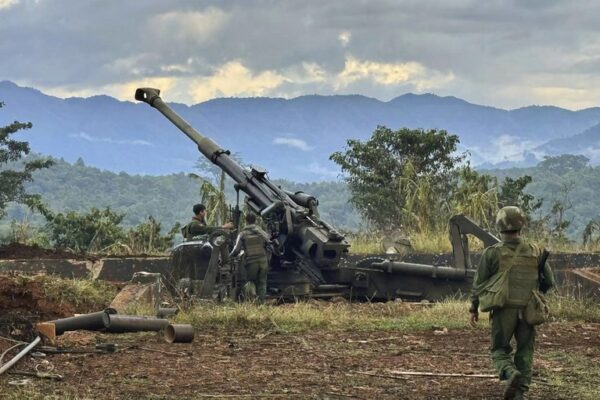
Almost all the residents of a Kachin Independence Army-controlled town were forced to flee when Myanmar’s junta fired heavy artillery at residential areas, according to army officials and locals. In an online video seen by Radio Free Asia an alarm can be heard and school children are seen running to safety. A resident, who wished to remain anonymous for fear of reprisals, told RFA that junta troops stationed in Lwegel fired heavy weapons on Mai Ja Yang town from early Friday morning. “At around 10 a.m., five heavy weapons were fired,” the local said.  “I was still sleeping when the first shells were fired. The sound of the mortar could be heard, and a house in the city was hit. We all ran away. The students who were attending school also ran away in fear. There are not many people in the city now.” A university, a college, two high schools and a primary school all fall under the governorship of the Mai Ja Yang Institute of Education led by the Kachin Independence Organization, the political wing of the Kachin Independence Army. College students who were sitting exams had to abandon their classrooms when the junta shelled the area, residents said, adding that two high school students and a civilian adult were injured but not critically. Kachin Independence Organization Information Officer Col. Naw Bu said the junta shelled the town and carried out air raids on the group’s headquarters in Laizar in retaliation for the Kachin Independence Army seizing two joint camps of junta troops and affiliated militia. “The militia camp in Ta Law Gyi was captured this morning and another militia camp in Baw Sar Dee village, which is between Ta Law Gyi and Shwe Nyaung Pin villages was also captured,” he said. “The junta side opened fire with heavy weapons believed to be 105 millimeters in the direction of  Mai Ja Yang and Laizar towns. The junta carried out an airstrike near Mong Set Par village and we are still investigating whether people have been injured.” RFA called junta spokesman Maj. Gen. Zaw Min Tun seeking comment, but calls went unanswered. Translated by RFA Burmese. Edited by Mike Firn.  

Read More

Shelling kills 3, including a child, in Myanmar’s Mandalay region

Heavy weaponry in central Myanmar killed three civilians, residents told Radio Free Asia on Thursday. Junta troops fired a shell at Mandalay division’s Tha Hpan Kaing village on Wednesday night, killing two women and a child, locals said. The victims are eight-year-old Su Su Nway, 17-year-old Nadi Hlaing, and 45-year-old Ma Nwe, all from Tha Hpan Kaing village.  Two people were also injured, including Ma Nwe’s son, one resident said, asking to remain anonymous for security reasons. Six-year-old Htet Pyae Sone Chit and 31-year-old Aye Min Thu are being treated for their injuries.  “The injured six-year-old boy is the son of the dead woman, Ma Nwe. And all the people who were hit by the heavy artillery are relatives,” he told RFA Burmese on Dec. 14. “The military junta deliberately shot into the village, rather than indiscriminately shooting. Lately, Madaya township has been experiencing daily attacks with heavy weaponry.” Ten soldiers entered Madaya township from neighboring Patheingyi township on a truck and fired 120 millimeter shells at Tha Hpan Kaing village, he added. Troops shot from roughly 10 kilometers (six miles) away in Kyauk Ta Dar village around 8 p.m. on Wednesday. Calls by RFA to Mandalay’s junta spokesperson Thein Htay to learn more about the attack went unanswered on Thursday.  Tha Hpan Kaing village is a large village in the region, with 500 houses, residents said, adding that it’s 16 kilometers (10 miles) from Mandalay’s Madaya city. Troops also fired weaponry from Kyauk Ta Dar village at other villages in the area before Wednesday’s attack, locals said. On Tuesday, a two-hour battle erupted between junta troops and joint defense forces near Kyauk Ta Dar village. Following the battle, junta soldiers fired heavy weapons toward the War Lone Pyun village, but there were no reported injuries, residents told RFA Burmese. The fighting between the junta and local People’s Defense Forces has intensified since November in Madaya township, residents and People’s Defense Force members said. As fighting escalates, so have junta raids on nearby villages. Soldiers are using helicopters to fire shells at villages where they believe resistance groups may be sheltering, according to locals. Data compiled by RFA show attacks on villages in Madaya township have killed 17 locals and injured three in November alone. From Jan. 2022 to Sept. 2023, RFA found that 816 civilians have died and 1,628 were injured by heavy weapons and airstrikes across the country.  Edited by Taejun Kang.

Read More

Junta troops seize orphanage during battle in central Myanmar

Junta soldiers sheltered in an orphanage in central Myanmar to deter resistance groups from attacking, locals and People’s Defense Forces told Radio Free Asia on Tuesday.  A junta military camp in Sagaing region’s Tamu township was abandoned by troops in November when it was captured by resistance groups, local People’s Defense Forces said. While attempting to recapture their lost base, junta troops positioned themselves in Kampat city’s orphanage on Sunday. Forty people were in the orphanage at the time, including 36 children and four teachers.  On Sunday, junta soldiers launched an attack on People’s Defense Forces from outside the building, according to a resistance group official, adding that the troops used heavy and small weapons, as well as airstrikes.  However, the resistance group removed the teachers and children from the orphanage on Monday, the official added.  “That orphanage is near the military camp on the hill. The junta troops regained control of that camp on the hill using the orphans as human shields,” he told RFA, asking to be kept anonymous for fear of reprisals.  “Both the children and the adults in that orphanage tried to escape, but they did not succeed. So they were evacuated by our People’s Defense Forces at around 12 yesterday. Now they are in a safe place.” The orphanage is owned by a Christian church in No. 1 neighborhood of Kampat city. Nearby are a police station and a temporary military camp on the hill, residents said, which troops regained control of after the battle.  Intense fighting on the India-Myanmar border near Kampat city has been constant since the end of October. People’s Defense Forces claim to have captured Kampat on Nov. 7. Almost a month later on Wednesday, junta troops launched an offensive to recapture the city, defense force officials told RFA. Since then, fighting has continued. On Sunday, the military junta carried out an aerial attack around the Kampat Police Station near the orphanage, he added.  Calls by RFA to Sagaing region’s junta spokesperson Sai Naing Naing Kyaw seeking comment on the incident went unanswered Tuesday. Nearly 5,000 residents from four neighborhoods in Kampat city and surrounding villages have fled on Tuesday, some to the Indian border. Fighting has also intensified near Tamu city, making it difficult for locals to find a place to seek shelter, residents said. Translated by RFA Burmese. Edited by Mike Firn.

Read More

Artillery hits children playing, killing girl in western Myanmar

Heavy shelling killed a child and injured five others in western Myanmar, locals told Radio Free Asia on Monday.  An artillery blast landed in a home in Rakhine state’s Minbya township on Sunday night where five children were playing together. A thirteen-year-old named Sabel died as a result. Four other children were injured, along with a woman who was in the house, Minbya residents said.  Sabel died instantly, and the injured victims were sent to the hospital, said a resident of Okkar Pyan neighborhood, where the attack occurred.  “A heavy weapon dropped on Soe Tint’s house. His daughter was hit in the head and died on the spot,” he told RFA, asking to remain anonymous for fear of reprisals. “Children playing together were also injured, and were sent to the hospital as an emergency case.” Locals claimed the shelling was done by the junta’s Minbya-based battalion 380, but RFA has not been able to independently verify this.  Attacks in Minbya city and surrounding villages have resulted in a total of one death and eight injuries on Sunday, according to the Three Brotherhood Alliance’s statement.The alliance is composed of four ethnic armed resistance groups, including the Arakan Army.  In addition to one death and five injuries in Minbya, a drone attack by junta forces injured a 12-year-old child and damaged a house in Sittwe township’s War Bo village on Sunday, the statement said. Two heavy explosives dropped by the junta in Ponnagyun township’s Pa Day Thar village destroyed houses and injured residents the same day, it added. RFA called Rakhine state’s junta spokesperson Hla Thein to learn more about civilian casualties, but he did not respond by the time of publication.  Since fighting resumed in Rakhine state on Nov. 13, clashes and attacks have killed 19 civilians and injured 60 others, according to data compiled by RFA.  Translated by RFA Burmese. Edited by Mike Firn.

Read More

Philippines, China accuse each other of ship ramming

Beijing and Manila traded accusations on Sunday morning with each side claiming its ships were harassed and rammed by the other. A Philippine spokesman said Philippine civilian supply vessels on a routine resupply and rotation mission to the BRP Sierra Madre – the old landing ship that Manila deliberately grounded on the Second Thomas Shoal to serve as an outpost in 1999 – were “harassed, blocked, and executed dangerous maneuvers on” by the Chinese coast guard and maritime militia vessels. Jay Tarriela, the Philippine coast guard’s spokesperson, posted on the social media site X a statement by the National Task Force for the West Philippine Sea, the part of the South China Sea under Manila’s jurisdiction, saying that the resupply boat Unaizah Mae 1 (UM1) was rammed by the Chinese coast guard ship CCG 21556. The Chinese coast guard earlier issued a statement saying that at 06:39 a.m. the UM1 “ignored CCG repeated stern warnings, violated the COLREGs (Convention on the International Regulations for Preventing Collisions at Sea), swerved in an unprofessional and dangerous manner, and deliberately collided into the CCG boat 21556, resulting in scratches, for which the Philippines is fully responsible.” Ship ramming is generally considered an act of violence and could cause serious damage to vessels, as well as injuries to the crew on board. There have been instances of ship ramming in the South China Sea but no state has ever officially sanctioned this dangerous tactic. The previous time Manila accused Chinese vessels of ramming its ships was on Oct. 22, also in the waters off the Second Thomas Shoal, known by Filippinos as Ayungin Shoal and by the Chinese as Ren’ai Jiao. China denied it. The Philippines afterwards summoned the Chinese ambassador and filed a diplomatic protest against China’s action.  The United States also expressed concern, issuing a warning that Washington is obligated to defend the Philippines under a 1951 Mutual Defense Treaty if Filipino forces, ships and aircraft come under armed attack, including “those of its coast guard — anywhere in the South China Sea.” Cat and mouse Manila and Beijing have been playing cat and mouse around the Second Thomas Shoal. The Philippines is making regular resupply missions to the troops stationed on the Sierra Madre and the Chinese coast guard has been trying to prevent them. The statement from the Philippine National Task Force said that on Sunday morning “CCG vessel 5204 deployed a water cannon against the Philippine supply vessels causing severe damage to M/L [motor launch] Kalavaan’s engines, disabling the vessel and seriously endangering the lives of its crew.” It also showed photos of the Kalavaan being water cannoned and then towed to port. “We condemn, once again, China’s latest unprovoked acts of coercion and dangerous maneuvers against a legitimate and routine Philippine rotation and resupply mission,” the statement said. “The Philippines will not be deterred from exercising our legal rights,” it added. Caption: Philippine supply boat Kalavaan being towed to port after being fired on with water cannons, Dec. 10, 2023. (Philippine Coast Guard) On Saturday, Manila accused the Chinese coast guard of deploying water cannons, a floating barrier and painful sound blasts against boats ferrying supplies to Filipino fishermen in disputed waters near another shoal in the South China Sea. Vessels from Manila’s Bureau of Fisheries and Aquatic Resources were targeted by water cannon “at least eight times” as they attempted to deliver food and fuel to more than 30 Filipino fishing boats near Scarborough Shoal, said a statement by the National Task Force for the West Philippine Sea. The China Coast Guard responded by saying it had used “control measures in accordance with the law” against the Philippine boats as they “intruded” into the waters adjacent to the island. Analysts say that Manila has embarked on a tactic of “assertive transparency” in reporting incidents in disputed waters. “Although the term was coined this year, the practice of assertive transparency has been used ever since people dealt with gray zone tactics,” said Alexander Vuving, a professor at the Daniel K. Inouye Asia-Pacific Center for Security Studies in Hawaii. Gray zone activities are not explicit acts of war but can be harmful to a nation’s security. “For example, during the 2014 oil rig crisis between China and Vietnam, Hanoi ferried international journalists to the site of the oil rig confrontation so they could shed maximum light on the ‘gray zone’.” “This was assertive transparency in practice, although nobody used that term to describe the practice in 2014,” the political analyst told RFA. “This practice has proven to be effective,” said Vuving, adding “The other key was perseverance.” Jason Gutierrez in Manila contributed to this article. Edited by Mike Firn.

Read More

Out of the hills: The war is coming to Myanmar’s cities

Operation 1027, launched on Oct. 27 by the Three Brotherhood Alliance, has led to coordinated attacks throughout Myanmar and seen the fall of 20 towns and over 300 military posts. But violence is now starting to spread to the cities, a strategic tipping point. Since that offensive against the military in northern Shan state by the alliance – the Arakan Army (AA), the Myanmar National Democratic Alliance Army (MNDAA) and the Ta’ang National Liberation Army (TNLA) – members and others are expanding the battle front against the military junta. In the east, Karenni forces launched Operation 1111 and now control nearly 80% of Kayah state. They are now fighting in the capital Loikaw.  In this Kokang online media provided photo, fighters of Three Brotherhood Alliance check an artillery gun, claimed to have been seized from Myanmar junta outpost on a hill in Hsenwi township, Shan state on Nov. 24, 2023. (The Kokang online media via AP) In western Myanmar, the Arakan Army ended its cease-fire in Rakhine state, and have taken major bases, while Chin forces have made significant inroads along the Indian border and claim to have established civil administration in 70% of the state.  The MNDAA has begun its assault on Laukkaing, the capital of the Kokang region.  Karen forces in Kayin State have taken over parts of the main road to the Thai border, greatly restricting border trade.  On Dec. 3, the opposition National Unity Government announced the establishment of civil administration in Kawlin town in the war-torn Sagaing region, the first township capital to fall to the opposition. The military that took power in a Feb. 2021 coup is increasingly constrained to a diminishing share of the Bamar heartland. But even that is starting to slip away. On Dec. 3, the KNLA and local PDFs took over Mone, the first town to fall in Bago state. Some 17 soldiers surrendered with their weapons. More importantly, the opposition is getting within striking distance of Highway 1 that connects Yangon and Naypyidaw. Military escalation The military has responded with an escalation in the number of long-range artillery and aerial bombing, both of which have resulted in increased civilian casualties. On Dec. 3, the NUG’s Ministry of Human Rights released details on SAC attacks on civilians, documenting 84 airstrikes, and 112 artillery strikes that resulted in the death of 244 civilians. Such attacks will continue as the military has neither sufficient number of troops to retake lost territory, nor sufficient means to move troops. One cannot control territory from the air.  In a brief moment of candor, Min Aung Hlaing acknowledged some battlefield setbacks, blaming foreign interference.  While there have been significant opposition gains in the countryside, within the cocoons of Mandalay and Yangon, the military regime has gone to great lengths to project a sense of normalcy, so that the population will acquiesce to military rule. Restaurants and bars are open, life goes on. A woman looks through debris in the aftermath of a junta strike on a camp for displaced people near Laiza, northern Myanmar on Oct. 11, 2023. Junta has escalated long range artillery and aerial bombing, both of which have resulted in the increased civilian casualties. (AFP photo) Reports from the ground suggest that the military is building up its defenses in Naypyidaw, Yangon, and Mandalay, with increasing shows of force and patrols of armored vehicles. Naypyidaw is already a fortress city that will be hard to attack. But the recent capture of heavy artillery and multiple launch rocket systems should give opposition forces the ability to now target the city.  Likewise, greater proximity will allow the small drones and quadcopters that the opposition has used to drop mortar shells the ability to strike targets. Even symbolic strikes in Naypyidaw would sew fear amongst regime loyalists, undermine morale, and sap the will to resist. More urban attacks That is now changing, with more attacks by opposition People’s Defense Forces (PDFs) in the cities in the past month.  The most notable recent attack was the Dec. 1 assassination of the chairman of the pro-military New National Democracy Party, Than Tun. He had been a National League for Democracy (NLD) member before defecting to a pro-military party that was established by a senior advisor to the State Administrative Council (SAC). the junta’s formal name. These assassinations are meant to convey good operational intelligence on the part of the PDFs, and at the same time, serve as a warning that if they can hit someone so close to the SAC, then the military is unable to protect anyone.  Myanmar’s military junta soldiers on a truck patrol in Yangon, Dec. 4, 2023. Reports from the ground suggest that the military is building up its defenses in Naypyidaw, Yangon, and Mandalay, with increasing shows of force and patrols of armed vehicles. (AFP photo) There have been many assassinations in the past, including the assassination of the chief financial officer of the military owned telecom firm MyTel, and an attack on the current governor of the Central Bank of Myanmar, which wounded her. But the military understands the importance of maintaining a sense of security in the cities. There’s always been violence in the borderlands, but once violence hit Yangon and Mandalay, people questioned the military’s hold on power.  To that end, they began deploying Chinese-made CCTV cameras with artificial intelligence. Urban guerrilla networks that were active in 2022, were systematically taken apart. The arrest and torture of one member, often led to the rest of entire cells. This means that the return of urban guerrillas is an important milestone that demonstrates both a decline in the military’s control over the cities, and the growing confidence of the PDFs to conduct operations. Yangon sees PDF attacks There has been a string of attacks in greater Yangon in the past few weeks. A PDF attacked soldiers guarding the state-owned Electric Power Cooperation Department in both North Okkalapa and South Okkalapa Townships on Nov. 23 and 24, respectively.  On Nov. 29, PDFs attacked a…

Read More

Junta bombing kills 5, including a child, in northern Myanmar

A heavy aerial attack in northeastern Myanmar killed five civilians, an official from an anti-junta women’s organization told Radio Free Asia on Friday.  On Wednesday night, junta aircraft bombed a village in Namhkan township in northern Shan state.  The victims included 46-year-old Tar Ah Swe; 56-year-old Yar Ah Ba; 50-year-old Yar Kham Li; and a 35-year-old male teacher, Yai Lay. A five-year-old girl, Lway O Dae, also died in the attacks, according to Lway, an official from the Ta’ang Women’s Organization.  “The teacher, Yai Lay, is from Namhkan’s Man Pu village. He is sheltering in Ho Nar village because the [military] situation in Namhkan is bad. Tar Ah Swe and Yar Ah Ba are a couple from Pang Long village in Manton township,” she said. “Yar Kham Li and Lway O are mother and daughter. They were all sheltering in a tea trading house to flee the fighting.” Four others, including two six-year-old children, were injured and sent to Namhkan Hospital, she added. Half an hour later, the junta bombed nearby Pang Law village. Seven houses were destroyed in the attack, residents said. The junta’s air force dropped the bombs despite there being no fighting beforehand, a Ta’ang National Liberation Army information official said, confirming five civilians were killed. However, daily battles are erupting at Sa Kham Thit military camp outside of Namhkhan city, about 13 kilometers (eight miles) from the site of the bombing. “The junta bombing was far from the village. There was no fighting in these villages,” he said. “The junta used a 500-pound [226 kilogram] bomb. We can tell because of its intensity.” RFA reached out to Shan state’s junta spokesperson Khun Thein Maung to investigate the group’s claim that the junta dropped 500 pound bombs, but he did not return calls on Friday. During a resistance military offensive called Operation 1027, in which three allied groups won several Shan state cities, the group’s forces also took control of Namhkam, the Ta’ang National Liberation Army said. The group is fighting with junta forces daily to gain control of Sa Kham Thit Hill, more than 1.6 kilometers (one mile) from Namhkan city. Since Operation 1027 launched on Oct. 27, 103 civilians, including 20 children, have been killed according to data compiled by the Ta’ang Women’s Organization. Small weapon fire, heavy artillery and airstrikes, have injured nearly 170 people in northern Shan state.  Translated by RFA Burmese. Edited by Mike Firn.

Read More

Vietnam repatriates more than 1,000 of its citizens from Myanmar

Updated Dec. 7, 2023, 5:25 p.m. ET. Vietnam this week flew home just over 1,000 of its citizens who were stranded in wartorn Myanmar, Hanoi’s Ministry of Foreign Affairs announced Thursday. On Monday, Tuesday and Wednesday, embassies and consulates in Myanmar organized nine flights to repatriate exactly 1,020 Vietnamese.  Most of the repatriates were stranded in the northern areas of Shan State, where fighting between the junta and ethnic armed groups has intensified, with anti-junta forces making significant gains there in recent months.  In the past, Vietnam has organized flights to evacuate its citizens from troubled areas in the world, including an effort during the COVID-19 pandemic that resulted in a massive scandal as officials skimmed off the top of repatriation funds and accepted bribes.  The ministry stressed that expenses for all repatriation flights from Myanmar were paid by the Vietnamese government. RFA reported earlier this month that 166 Vietnamese citizens who had been trafficked to northern Myanmar but were rescued by authorities, remained stranded in a war zone. On Thursday, a mother of one of the 166 told RFA Vietnamese that her daughter had returned home that day to Phu Quoc Island City in Vietnam’s far southern Kien Giang province. “Everything was free of charge,” she said. “The government helped bring my daughter back to Moc Bai [the border gate between Vietnam and Cambodia], and my family paid for her travel from there to Phu Quoc. I am very, very happy.” She said the Vietnamese Embassy in Myanmar was very supportive, though the repatriation process was a bit complicated due to high volume. In August, RFA reported that 15-year-old Le Thi Tuong Vi was among a group of teenagers who were trafficked first to Laos, and were believed to be headed to either Myanmar or China. Vi was among those repatriated from Myanmar, her mother told RFA, but did not elaborate because her daughter is still recovering from her trip. But Trinh Khanh Hoang Anh, another teenager in the group, has yet to be repatriated, his father Trinh Huu Phuoc told RFA via text message. “There are 166 [Vietnamese] people who have been rescued and were living in a refugee camp of the military,” he said. “This morning, the kids were taken to Myanmar’s Border Gate 127 to verify information but there have been no results yet.” He said the Kien Giang provincial Department of Foreign Affairs advised the family that Anh’s paperwork has been completed but it has not yet arrived at the Vietnamese Embassy. According to the embassy, a number of Vietnamese still remain stranded in northern Myanmar due to ongoing fighting, state media reported. Translated by Anna Vu. Edited by Eugene Whong and Malcolm Foster.  Update corrects the days that the flights were organized for.

Read More

Myanmar junta recruiting former resistance fighters to bolster numbers

Resistance fighters who surrendered to the junta in southwestern Myanmar are now being enlisted by the regime’s military, anti-junta militia members told Radio Free Asia. Junta soldiers are bribing revolutionary groups with money and food, said one official from the Pathein Urban Guerrilla Group on Wednesday. In the last two weeks the pressure has grown to bolster troop numbers by recruiting resistance fighters from Kyonpyaw, Yegyi and Pathein townships in Ayeyarwady region, he said. Both regime soldiers and former resistance group leaders who have surrendered are reported to be stepping up their recruitment tactics.  “Especially [those in] various forms of leadership among the surrenderers. They are called to meet up and recruit others to serve in the [junta-led] militia,” the official said, asking to remain anonymous for fear of reprisals. “The steps of organizing each other and asking people to organize to serve in the militia have escalated in the past two weeks.” This month, the junta also recalled retired military and police personnel from Thabaung township, he added. More than 100 people have surrendered to the junta in Ayeyarwady region in the past two years. Members of People’s Defense Forces surrendered by contacting junta forces to give up their positions.  Ayeywarwady residents also accused junta troops of recruiting teen soldiers and pressuring locals to fulfill quotas in October. Pro-military militia members, including those in the Swan Ar Shin militia, have been undergoing military training since September, said a Pathein resident close to the junta army. The training is being provided at several military bases in Ayeyarwady division, including the Kyonpyaw-based Infantry Battalion 36, according to the Pathein Urban Guerrilla Group. In October, a 20-year-old man from Kyonpyaw died during an interrogation by members of Battalion 36 after being accused of communicating with People’s Defense Forces in Mandalay region. RFA has not been able to independently verify the claims made by anti-junta militias. Calls by RFA to Ayeyarwady division’s junta spokesperson Aung Thein Win seeking comment went unanswered. Translated by RFA Burmese. Edited by Mike Firn.

Read More