Myanmar’s military recruiting Rohingya at displaced camps

Myanmar’s junta is offering freedom of movement to Rohingya Muslims restricted to camps for the displaced in Rakhine state as part of a bid to entice them into military service amid the nationwide rollout of a conscription law, according to sources in the region. The enactment of the People’s Military Service Law on Feb. 10 has sent draft-eligible civilians fleeing from Myanmar’s cities, saying they would rather leave the country or join anti-junta forces in remote border areas than fight for the military, which seized power in a 2021 coup d’etat. Myanmar’s military is desperate for new recruits after suffering devastating losses on the battlefield to the ethnic Arakan Army, or AA, in Rakhine state. Since November, when the AA ended a ceasefire that had been in place since the coup, the military has surrendered Pauktaw, Minbya, Mrauk-U, Kyauktaw, Myay Pon and Taung Pyo townships in the state, as well as Paletwa township in neighboring Chin state. But rights campaigners say the junta is drafting Rohingya into military service to stoke ethnic tensions in Rakhine state, while legal experts say the drive is unlawful, given that Myanmar has refused to recognize the Rohingya as one of the country’s ethnic groups and denied them citizenship for decades. Some 1 million ethnic Rohingya refugees have been living in Bangladesh since 2017, when they were driven out of Myanmar by a military clearance operation. Another 630,000 living within the country are designated stateless by the United Nations, including those who languish in camps for internally displaced persons, or IDPs, and are restricted from moving freely in Rakhine state. Residents of the Kyauk Ta Lone IDP camp in Rakhine’s Kyaukphyu township told RFA Burmese that junta forces, including the township administration officer and the operations commander of the military’s Light Infantry Battalion 542, took a census of the camp’s Muslims for the purpose of military service on Monday. Junta personnel compiled a list of more than 160 people deemed eligible for conscription and informed them they would have to take part in a two-week military training program, according to one camp resident who, like others interviewed for this report, spoke on condition of anonymity due to security concerns. “The township administration officer came … and told us that Muslims must also serve in the military, but we refused to follow his order,” the resident said. “Then, the military operations commander arrived here along with his soldiers, and forced us to do so under the military service law. They collected the names of more than 160 people.” Freedom of movement Some 1,500 Rohingyas from around 300 families have been living at Kyauk Ta Lone since ethnic violence forced them to flee their homes in Kyaukphyu 12 years ago.  Since taking the census on Monday, junta officers have repeatedly visited the camp, trying to persuade Rohingya residents to serve in the military with an offer of free movement within Kyaukphyu township, said another camp resident.  “They won’t guarantee us citizenship,” he said. “But if we serve in the military, we will be allowed to go freely in Kyaukphyu.” Other camp residents told RFA they “would rather die” than serve in the military, and suggested the recruitment drive was part of a bid by the military to create a rift between them and ethnic Rakhines – the predominant minority in Rakhine state and the ethnicity of the AA. No date was given for when the training program would begin, they said. After receiving training, the recruits would be assigned to a security detail along with junta troops guarding routes in and out of Kyaukphyu, and dispatched to the battlefield “if necessary.” Rohingya IDPs are afraid to serve in the military, but are unable to flee the camp because it is surrounded by junta troops, residents added. Other recruitment efforts The military service census at the Kyauk Ta Lone IDP camp came as Rohingyas in the Rakhine capital Sittwe, the Rakhine townships of Buthidaung and Maungdaw, and other parts of Kyaukphyu reported that junta troops have been arresting and collecting data from members of their ethnic group as part of a bid to force them into military training. On Monday and Tuesday evening, military personnel arrested around 100 Rohingyas of eligible service age from the Buthidaung villages of Nga/Kyin Tauk, Tat Chaung, Pu Zun Chaung and Kyauk Hpyu Taung, said a resident who also declined to be named. “People doing business in the village were arrested. Village elders were also arrested,” said the resident, who is also a Rohingya. “At least one young person from every house was arrested and taken to the army. The parents of those who were arrested are quite worried now.” Junta troops said that the AA had established camps near the Rohingya villages and residents would have to undergo military training to defend the area, he added. They said the residents would be equipped with weapons and returned to their villages after the training was complete. Rohingyas in Sittwe and Maungdaw, where an AA offensive is now underway, also reported junta census efforts and pressure to join military training. They said that larger villages are expected to provide 100 people for training, while smaller ones should send 50 residents. Law does not apply A lawyer who is representing Rohingyas in several legal cases told RFA that the People’s Military Service Law “does not apply” to members of the ethnic group because they do not have citizenship status in Myanmar. He added that the junta’s attempt to recruit Rohingyas is part of a bid to drive a wedge between them and the people of Myanmar, many of whom oppose the military regime. Nay San Lwin, an activist on the Rohingya issue, said that the junta hopes to divert attention from its losses to the AA in Rakhine state by igniting tensions between ethnic Rakhines and Rohingyas. “If the Rohingyas are forced into their army, there could be a lot of problems between the Rakhines and the Rohingyas,” he said. “That’s what they want….

Read More

Two-month travel ban extended in western Myanmar

Myanmar’s regime extended a travel ban in a conflict-ridden coastal area, locals told Radio Free Asia on Thursday. The ban prevents Rakhine state residents from traveling by water, fishing, and gathering on the township’s shores until Apr. 19. Kyaukpyu township, where the ban was originally established on Dec. 19, has been a source of conflict between the ethnic Arakan Army and junta forces. The Arakan Army launched attacks on Kyaukpyu’s junta naval base on Jan. 8 and 21, leading locals to suggest China should discuss its many upcoming development projects in the area with the ethnic armed group to ensure their continued protection. Kyaukpyu’s coast is the site of a Chinese-funded special economic zone, as well as upcoming ports and railroads stalled in December due to fighting. Residents have voiced concerns that Chinese development projects fail to provide local jobs and that they will impact the region’s vital fishing industry.  A fisherman in Kyaukpyu city on June 4, 2019. (RFA) An official from a social assistance group in Kyaukpyu township said the travel ban was announced in a letter on Monday. “Motor boats and rowing boats are not allowed to navigate along the river and it is forbidden to have alcohol or to fight along the shore,” he said, declining to be named for fear of reprisals. “Traveling in the villages and towns has been banned in the past. Everyone gets in trouble.” The junta’s order also stated that if locals choose to violate this order, action will be taken according to existing laws. The ban applies to the township’s capital of Kyaukpyu city, six surrounding village tracts and eight neighborhoods. It also prevents locals from gathering or fishing on the Ohn Chaung stream, Than Zit River, and nearby beaches, according to the statement. The restrictions were implemented after the Arakan Army broke a year-long ceasefire by attacking junta camps in Kyaukpyu township, Rakhine state on Nov. 13, 2023, residents said. A Kyaukpyu resident who wished to remain anonymous for security reasons told RFA that the travel ban has caused residents many problems affecting their health and quality of life.  “Locals are facing difficulties in getting food, and commodity prices have become expensive. Sick people in rural areas suffer because of the delay in getting medical treatment,” he explained. RFA called Rakhine state’s junta spokesperson for comment on the extension, but he did not respond to inquiries. Villagers can only receive permission to travel after submitting an application five days in advance, residents in Kyaukpyu’s surrounding areas said. Within Kyaukpyu township, the junta prohibits the shipment and delivery of most types of medicine, food, electrical equipment, and hygiene products, including women’s sanitary pads. On Monday, 60 passengers flying from Yangon were arrested after landing in Kyaukpyu’s airport. Pregnant women, children and elderly people have since been released, though the location of others remains unknown.  Translated by RFA Burmese. Edited by Mike Firn.

Read More

Pro-junta ‘drone test’ injures 13 children in Myanmar

A drone test by pro-junta militia injured 13 children in Myanmar, residents told Radio Free Asia.  Regime soldiers working in collaboration with the Pyu Saw Htee militia are responsible for a weapons accident that occurred on Saturday, locals said. The militia is made up of pro-junta supporters, veterans and Buddhist nationalists.  The drone, carrying several bombs, flew over Sagaing region’s Kale township, close to the Chin state border. Soldiers are permanently stationed in Kale township’s Aung Myin Thar village, leading them to believe the attack was an accident, they added. A resident who wished to remain anonymous for security reasons told RFA on Tuesday that a drone mounted with explosives flew over a nearby monastery compound when it suddenly crashed and exploded. Thirteen children playing in the monastery’s soccer field were injured when the bombs detonated.  “The military junta gave weapons to the Pyu Saw Htee members and they were testing them to carry out bombardments with drones that evening. The bombs fell on the soccer field where the children were playing,” he said. “Six of the children were critically injured. Some of them were hit in their faces and eyes. Some had to have their limbs amputated.” The children who are critically injured are being treated at Kale city’s military hospital, while the remaining seven are being treated at Kale General Hospital in the township’s capital, he added. All victims are between the ages of eight and 15 years old, but identifying information is not known at this time.  The junta’s Ministry of Information released a statement on Tuesday saying that the accident was fake news, reporting that the blasts in Aung Myin Thar village were due to landmines planted by terrorists.  RFA contacted Sagaing region’s junta spokesperson Sai Naing Naing Kyaw for more details, but did not receive an answer. According to data compiled by RFA, 1,429 civilians have been killed and 2,641 were injured by junta airstrikes and heavy artillery from the Feb. 1, 2021 coup until Jan. 31, 2024. Translated by RFA Burmese. Edited by Mike Firn.

Read More

Junta arrests 600 civilians after their arrival at 2 Rakhine airports

Junta troops arrested around 600 civilians after their flights from Yangon landed at two airports in western Myanmar’s Rakhine state, according to family members and sources with knowledge of the situation, who said the military is holding them on suspicion of attempting to join the armed resistance. The arrests come amid the enactment of a conscription law that has sent draft-eligible civilians fleeing from Myanmar’s cities, saying they would rather leave the country or join anti-junta forces in remote border areas than fight for the military, which seized power in a February 2021 coup d’etat. On Monday, junta soldiers detained nearly 500 passengers after they arrived at the airport in Rakhine’s capital Sittwe from Yangon. They were transferred to a military camp at the Lawkananda pagoda, their relatives told RFA Burmese. The same day, more than 60 passengers from Yangon were similarly arrested after landing at the airport in Kyaukphyu city and taken to Rammawati City Hall, family members said. Pregnant women, children, and the elderly among the passengers were released the same day, they said, although the exact number was not immediately clear. The family member of a detainee at the Sittwe airport told RFA that there is no way to contact those being held. “We only knew that all the passengers from the Yangon-Sittwe flight were taken by car to Lawkanada pagoda for inspection as soon as they landed at the airport,” said the family member who, like others interviewed for this report, spoke on condition of anonymity due to security concerns. “It was discovered that many passengers – around 500 – are being held. We don’t know what they are being inspected for.” The military has also cut off phone and internet connections in the area, and troops stationed at the Lawkananda pagoda do not allow civilians to enter the compound, sources told RFA. The passengers who landed at Kyaukphyu airport were arrested and “immediately taken by car to Rammawati City Hall,” where they are being held for “interrogation,” said a resident of the city. “Some of them who have residential documents or were on household lists were released,” the resident said. “The people from other areas have not been released,” he added, noting that one resident of Ramree township “was handcuffed and taken to the military camp.” Rakhine youth returning Armed clashes broke out in Rakhine state after the ethnic Arakan Army, or AA, ended a ceasefire in November that had been in place since the coup. Since then, the military has controlled routes in and out of the region by land and water, forcing people to rely on air travel. After the junta announced the enforcement of the People’s Military Service Law on Feb. 10, Rakhine youth working and studying in Yangon were barred from registering for temporary residency in the city. Fearing arrest, a growing number of them have returned home, according to sources in Yangon.  A resident of Yangon told RFA that troops at the two airports in Rakhine arrested the passengers on suspicion of planning to join anti-junta armed groups in the state. “The Rakhine people in Yangon were forced to return home [after they were barred from registering for residency],” he said. “They were told to go back home for military service, even though they were studying and working … Although the passengers produced their IDs, they were arrested on suspicion of planning to join the Arakan Army.” Kyaukphyu airport in Rakhine state is seen in this undated photo. (Winnet Myanmar) RFA has also received reports of junta troops arresting youths on the Yangon-Mandalay Expressway, Mandalay–Myitkyina Highway, and on their way to Kayin and Chin states. Sources were unable to provide the exact number of detainees and RFA was unable to independently verify their claims. Attempts by RFA to contact Rakhine State Attorney General Hla Thein, the junta’s spokesperson in the region, for comment on the arrests and investigation went unanswered Tuesday. During three months of fighting in Rakhine, the AA has captured Pauktaw, Minbya, Mrauk-U, Kyauktaw, Myay Pon and Taung Pyo townships in the state, as well as Paletwa township in neighboring Chin state. The conflict in Rakhine is escalating amid AA offensives on the junta-controlled townships of Maungdaw, Buthidaung, Rathedaung and Ramree. Maungdaw camp captured On Monday, the AA captured a military outpost in Maungdaw’s Pe Yang Taung area after a nine-hour battle, according to a statement released by the Three Brotherhood Alliance of ethnic armies, which includes the AA. AA fighters recovered “more than 10 bodies of junta soldiers,” as well as weapons and ammunition from the camp, the statement said.  The Three Brotherhood Alliance said that over the course of the fighting, which took place from around 7 a.m. to 4:30 p.m., the military launched three airstrikes from fighter jets. The seizure of the outpost in Pe Yang Taung comes days after the AA captured two junta-affiliated Border Guard Force outposts in Bodhigone and Narula, near Maungdaw, on Feb. 16. The military has not released any information about the fighting, and Hla Thein was unavailable for comment. Translated by Aung Naing. Edited by Joshua Lipes and Matt Reed.

Read More

Airstrikes kill 6, including children, in Myanmar’s Kachin state

An onslaught of airstrikes in northern Myanmar killed six civilians and injured 13 more, rescue workers told Radio Free Asia on Monday.  Junta troops retaliated after joint resistance forces attacked a regime base in Kachin state on Friday.  After the Kachin Independence Army and Arakan Army, two allied ethnic armed organizations, fired on Mansi township’s “strategic hill,” the junta base turned its guns on nearby Si Hkam Gyi village. Mansi township, which borders China, has been a site of previous conflict in late January. The Kachin Independence Army claimed the capture of 30 junta troops on Jan. 22 and 57 more soldiers escaped attacks by crossing the Chinese border.  Regime soldiers bombarded the village by air in a two-day attack on Saturday and Sunday, when roughly 1,000 residents fled the area, locals said.  On Saturday alone, troops dropped 20 bombs on four villages, they added. A rescue worker with Myitta Shin Charity Group, who wished to remain anonymous for security reasons, said civilians and victims are being moved to safety. “Hundreds of local people are trapped in the villages, including Si Hkam Gyi village. We plan to evacuate these people first and we are waiting to pick up the evacuees coming out of the villages today,” he told RFA on Monday.  “The bodies haven’t been picked up yet because they died in the bomb shelters. We haven’t been able to get inside.” The blasts killed two girls aged two and six. The airstrikes also killed four men in their 40s. The injured, mostly women, were sent to nearby Bhamo Hospital.  Many of the displaced were sent to Man Thar village monastery and are being provided with medicine and food, he added. A resident of nearby Si Kaw village who wished to remain anonymous for security reasons told RFA he was forced to flee in the middle of Saturday night, during the blasts. “We left the village at 2 a.m. There was no difficulty on the way and I came with my own motorbike. I am staying in the hall next to Man Thar Monastery,” he said. “The communities in Man Thar village provided food as soon as we arrived and the Myitta Shin Charity Group’s rescue team is picking up all the people who want to take refuge and helping them.” Kachin Independence Army spokesperson Col. Naw Bu said on Sunday that people needed to live in a safe place and protect themselves from the junta airstrikes. “There is fighting on the side of Si Hkam Gyi village. The military junta fires airstrikes all day long. The fighting continues there, like it did before,” he said. “They mainly do not attack on the ground and depend on heavy artillery and airstrikes, so people must flee for their safety as much as possible.” The junta’s Northern Region Military Command Infantry Battalions 121, 276, 123 and 15 are stationed just 48 kilometers (30 miles) away from Strategic Hill. Mansi township is one of the main supply routes to junta troops in nearby Bhamo city, which is why their attacks have been so fierce, said Col. Naw Bu. RFA contacted Kachin state’s junta spokesperson Moe Min Thein on Sunday for comment on the accusations of indiscriminate firing and civilian deaths, but he did not answer at the time of publication.  According to data compiled by RFA, junta airstrikes have killed 1,429 civilians and injured 2,641 more from the day of the coup on Feb. 1, 2021 to Jan. 31, 2024. Over 2.6 million people had been displaced due to war by the end of 2023, according to a report from the United Nations Office of Humanitarian Affairs. Translated by RFA Burmese. Edited by Mike Firn.

Read More

‘I am devastated.’ Burmese parents’ horror at burning death of sons

Earlier this month, a video of the burning deaths of two anti-junta fighters was widely viewed by Burmese people on social media. Phoe Tay, 23, and Thar Htaung, 22, were captured Nov. 7, 2023, in fighting between pro-junta forces and resistance fighters at Myauk Khin Yan village in Magway region’s Gangaw township.   The video showed them in shackles as they were interrogated by armed men. They were then dragged to a nearby tree where they were suspended as a fire was set underneath them. The two young men screamed as flames rose up and engulfed them. The video was taken by a villager who fled the area in December, according to a local official from the administration of the shadow National Unity Government. It’s unclear who first posted the video that began circulating in early February. Phoe Tay’s father, Myint Zaw, told Radio Free Asia last week that he was aware of his son’s death but had not seen the video. Edited transcripts of RFA’s interviews with Myint Zaw and the parents of Thar Htaung – Ye San and Soe Linn – are below. Interview with Myint Zaw RFA: We watched the video of the burning alive of two youth People’s Defense Force fighters – Phoe Tay and Thar Htaung. Myint Zaw, what would you like to say first? Myint Zaw: When Phoe Tay died in action, it was immediately posted online. Yes, it is Phoe Tay, my son. He is gone. His life as a human is over.  I learned that he was beaten on the head, beaten on the knees. In one photo, he was on his knees. That image is still springing to my mind. The image is still in my phone.  After that, I didn’t know how he was killed. We could not retrieve the body. Nobody could go there because Myauk Khin Yan is a stronghold village of the pro-junta Pyu Saw Htee militias.  Phoe Tay’s father says his son joined the resistance after the 2021 coup. (Provided by family) RFA: You saw photos from just before the burning. Did you watch the video of them being burned alive? What did you hear about this video? Myint Zaw: I haven’t watched it. But there are reports about it, and many people are talking about it. My phone is not available for such things because of poor internet connections.  His friends in the village are horrified by it. “Is it true? They really did that?” People are deeply hurt. They cannot accept such an act. Many people are talking about it.  I heard that they dragged him by tying a rope around his neck and that they burned him alive. So, I’ll never forgive the perpetrators. RFA: Please tell us about Phoe Tay. What was his education?     Myint Zaw: My son, Phoe Tay, is also known as Myo Htet Aung – that was his school registration name. Before the coup, under the National League for Democracy government, he sat for the matriculation exam. Two months after the 2021 coup, when the exam results were announced, he passed with two distinctions. RFA: We learned that he joined the Yaw Defense Force. Why did he join the YDF?     Myint Zaw: When the 2021 coup d’état took place, he was in a jade mine in Hkamti, where he was learning to drive a backhoe. My nephew, his cousin, was driving a backhoe there. He brought my son there.  Then some friends called him and asked him what he was doing. With politics in his mind, he immediately returned home. Then he joined the YDF. RFA: Did he seek permission from you to join the YDF? Myint Zaw: I told my son that if I was your age, I would have already joined the resistance. My son and I had the same opinion. But he did ask for my permission. RFA: Did you talk to him at all after he joined the armed group? Myint Zaw: I still have to take care of his younger brother. After the Thadingyut festival (to celebrate the harvest moon) in October, (Phoe Tay) said we had to initiate the brother as a Buddhist novice.  He said, “Father, I can look after you only when the revolution is over. Please try hard now. We have to initiate my brother as a Buddhist novice monk. I can help you only after the revolution.” I told him not to worry about us. “I’m proud that my son sacrificed for the people and the country. But I feel sad … I am devastated,” says Phoe Tay’s father. (Provided by family) RFA: What do you do to make a living? Myint Zaw: I’m a farmer. There is a land plot given by my mother in Maw Lel village of Gangaw township. I make a living with a rice milling machine. I have a tricycle to transport sand and stones to nearby villages. RFA: On Nov. 7, when Phoe Tay was killed, did the Yaw PDF inform you? How did they inform you? Myint Zaw: They arrived one-and-a-half days later, because they had to come on foot. His comrades looked glum. They came and told us that he was killed and asked us what they should do. RFA: Did the YDF provide your family with cash? Myint Zaw: Yes, they gave us cash. They provided 2 million kyats (about US$950) for Thar Htaung and the same amount for Phoe Tay. RFA: How do you and your family feel about your son being burned alive, killed brutally and inhumanely? Myint Zaw: I’m proud that my son sacrificed for the people and the country. But I feel sad. I don’t want to talk about it. And I don’t know what to say. I am devastated. RFA: Phoe Tay might have been the smartest in the village. He passed his exam with two distinctions. What were his goals? Did he tell you about what he wanted to be? Myint Zaw: He didn’t say exactly. What he used to say was that he…

Read More

300 Myanmar junta troops who fled attack return from Bangladesh

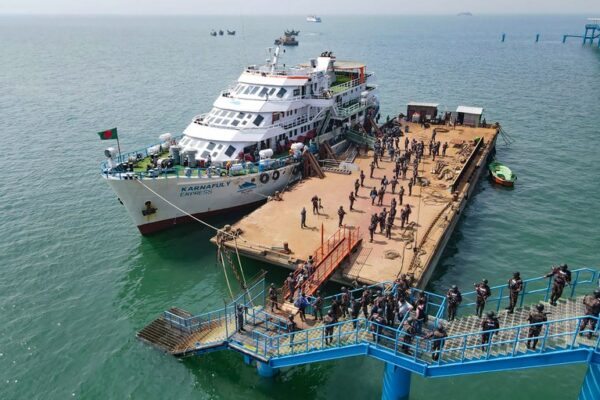
Some 300 members of a junta military unit and a border police force who fled to Bangladesh during an attack by the rebel Arakan Army have been repatriated to Myanmar, according to several Rohingya refugees in Bangladesh. They were returned by sea on Thursday following a handover ceremony in Cox’s Bazar that was attended by five Myanmar junta officials and Myanmar’s ambassador to Bangladesh, a Rohingya refugee told Radio Free Asia. “We learned that five representatives, including a police colonel of the Border Guard Police, came,” the Rohingya refugee said. “Also, we learned that Amb. Aung Kyaw Moe met with the chief of Border Guard Bangladesh and handed them over.” Video showed uniformed Bangladesh guards escorting the junta troops and officers – some of them wounded – onto a ship.  Cox’s Bazar is located on southeast Bangladesh’s coast near Myanmar’s western Rakhine state. Over the last decade, almost 1 million Rohingya refugees have fled from Myanmar to the Cox’s Bazar area, which has become the world’s largest refugee camp.  The junta border guards who crossed over to Bangladesh were retreating from an attack by the ethnic Arakan Army on the Taung Pyo Let Yar outpost and a nearby strategic hill in Rakhine’s Maungdaw township on Feb. 4. AA takes control of Myebon The attack marked the latest blow to Myanmar’s military junta in Rakhine state, where the Arakan Army, or AA, ended a ceasefire in November that had been in place since the junta assumed power in a Feb. 1, 2021, coup d’etat. A total of 330 people crossed over to Bangladesh in early February, including Lt. Col. Kyaw Naing Soe, the commander of the junta’s No. 2 Border Guard Police battalion, 302 soldiers, four family members, two other military personnel, 18 immigration officers and four civilians, according to RFA sources on the Bangladesh border. Elsewhere in Rakhine, the AA said it has captured all military council camps and police stations in Myebon township. The Arakan Army said in a statement on Thursday that it now controls seven towns in the state. Myanmar nationals and Border Guard Police who crossed the Bangladesh-Myanmar border to seek shelter in Bangladesh amid recent conflicts between military forces and rebel groups, are escorted back into Myanmar at Cox’s Bazar on Feb. 15, 2024. (AFP) The AA has recently launched offensives in townships near the state capital of Sittwe, including Rathedaung and Buthidaung. There are reports that the AA has warned the junta’s regional operations command in Sittwe, the Rakhine state capital, to surrender. The junta has not released a statement about recent developments in Rakhine, and RFA’s calls to Hla Thein, junta’s spokesperson and attorney general of the Rakhine state, went unanswered on Friday. Rebel victory in Kayah state The junta has also suffered a loss to rebels in northeast Kayah state, where the Karenni Nationalities Defense Force, or KNDF, announced Friday that it had gained complete control of Shadaw city after a month-long battle. The KNDF began attacking junta outposts surrounding a strategic hill in Shadaw on Jan. 15, the group said in a statement.  On Jan. 21, they began a siege to a junta base after troops refused to surrender and the junta dropped in another 70 troops by helicopter, the KNDF said. A final attack on the base began on Monday.  More than 160 junta soldiers, including a colonel and a lieutenant colonel, were either killed or captured, the KNDF said. The junta hasn’t released a statement on the battle. RFA’s calls to junta spokesman Maj. Gen. Zaw Min Tun to seek comments on the KNDF’s claims went unanswered. Translated by Htin Aung Kyaw. Edited by Matt Reed and Malcolm Foster.

Read More

Two political prisoners killed during junta escort, Myanmar resistance group claims

Myanmar junta troops shot dead two political prisoners, including one high-profile activist, a resistance group told Radio Free Asia on Friday.  Nobel Aye and Aung Ko Hein were killed while returning from a court appearance in Bago region, north of Yangon, on Feb. 8, according to Waw township People’s Defense Force citing sources close to the court and hospital. The pair were taken to Waw township’s courthouse by junta troops when they allegedly tried to escape, the resistance group said.  Nobel Aye is known for her role in protesting against police brutality in Myanmar in 1996, and again in 2007 during the Saffron Revolution’s economic and political protests. She had been arrested twice before,  following both demonstrations. The prisoners were being interrogated at the No. 901 Artillery Station Command Headquarters, an official of the Waw People’s Defense Force said.  “They appeared in Waw Court and were shot dead near the exit of Kyaik Hla village between Waw and Paya Gyi on the way back to the military interrogation,” he said, declining to be named for security reasons. “The bodies were well-packed and sent to the morgue. No one was allowed to look at the bodies and they were cremated secretly before nightfall.” Nobel Aye’s brother, Htet Myat, said his family has not heard any official confirmation from police about his sister. “We have not yet been informed of what happened and how. I am very worried. As a family, I didn’t know what to do when people who knew about this incident confirmed it,” Htet Myat said on Friday. “I felt uncontrollable. We want reliable and accurate information to be released by those responsible.” However, the junta has denied that the prisoners died in custody. Bago’s junta spokesperson Tin Oo told RFA the information was just a rumor. “That’s wrong and fake news, dissemination of false information. We are working in accordance with the law,” he said. Nobel Aye was allegedly shot dead while returning from a court appearance in Bago region on Feb. 8, 2024. (Myanmar Political Prisoners Network) Nobel Aye and Aung Ko Hein were arrested by junta soldiers after being caught with weapons on Jan. 29, sources close to her family said. Nobel Aye was also active in distributing aid during the COVID-19 pandemic and protested frequently after the country’s 2021 military coup, they said. Aung Ko Hein is a resident of Insein township, Yangon region. RFA could not confirm his personal details.  In June 2023, troops shot and killed at least 13 political prisoners in central Bago after a prison truck crashed. According to notices junta officials sent to prisoners’ families, 37 detainees attempted to escape when a prison vehicle overturned during a transfer. RFA could not confirm the whereabouts of the remaining prisoners.  According to the Assistance Association for Political Prisoners’ Feb. 15 statement, more than 4,500 pro-democracy activists and civilians have been killed during the coup, while over 26,000 have been arrested. Translated by RFA Burmese. Edited by Mike Firn.

Read More

Myanmar youths go into hiding to avoid getting forced into battle

With Myanmar’s junta plowing ahead toward a full-scale draft, young men say they are staying indoors to avoid getting dragooned into the army to fight in a war in which the military is losing ground and men. Most youths have no desire to fight – for the junta or the armed resistance, said a 22-year-old Mandalay resident who asked not to be identified.  “We have no choice as the junta is cornering us to join the army,” he said. “Now we don’t dare to go out – day or night. There are a lot of abductions [for forced recruitment], so I’m worried. My friends say they will join the [resistance] but I don’t know what to do, since I can’t fight.” With recent rapid advances by ethnic armies People’s Defense Force, or PDF, militias of civilians who have taken up arms against the junta, the military appears to be on the defensive as hundreds of soldiers have surrendered. Junta leader Senior Gen. Min Aung Hlaing announced on Feb. 10 that the People’s Military Service Law, enacted in 2010 by a previous military regime, would go into effect immediately. On Tuesday night, the junta announced the formation of a committee to oversee the conscription process. But reports suggest that the military and pro-junta militias are already rounding up as many able bodies as they can with the goal of forcing recruits to undergo simple training, putting weapons in their hands, and dumping them onto the battlefield. Eligible citizens have told RFA Burmese that they would rather join the armed resistance or flee Myanmar than fight for the junta, which seized control of the country in a Feb. 1, 2021, coup d’etat. One young resident of Yangon told RFA he would likely be killed if he is forced to join the military. “I don’t want to join and my friends feel the same, but … we can’t resist because they have weapons,” he said. “So, we have to take the training they’ll give us and if I get a chance, I will go to the liberated areas [controlled by anti-junta forces].” The ‘right’ to defend the country Junta spokesman Maj. Gen. Zaw Min Tun told military-controlled media on Tuesday that the national conscription law provides every citizen “the right” to receive military training to defend the country, and urged people not to be concerned because they wouldn’t immediately be sent to fight. “Just like us professional soldiers, you have to carry out national defense duties only after undertaking proper military training,” he said. A parade of the 78th anniversary of the Armed Forces Day which on March 27, 2023. (AFP) According to Myanmar’s compulsory military service law, men aged 18-35 and women aged 18-27 face up to five years in prison if they refuse to serve for two years. Professionals – such as doctors, engineers and technicians – aged 18-45 for men and 18-35 for women must also serve, but up to five years, given the country’s current state of emergency, extended by the junta on Feb. 1 for another six months. According to the 2019 census, there are 6.3 million men and 7.7 million women – totaling nearly 14 million people – who are eligible for military service in Myanmar, Zaw Min Tun said Tuesday. The number is equivalent to just over one-quarter of Myanmar’s population of 54 million. He added that parents “don’t need to worry” because there are more than 3,000 wards and 60,000 villages across the country, “so only one or two persons per ward need to join the military.” Zaw Min Tun’s comments did little to sooth the concerns of Yangon resident Wai Lwin Oo, whose 23-year-old son is eligible for the draft. “Parents are extremely concerned,” he said. “There are only two options and as a parent, the last thing I want to do is tell my children which path to choose … There are no parents who are amenable [to the conscription law].” Round-ups underway Residents of Yangon and Mandalay told RFA that since the military service law was announced on Feb. 10, young people are nowhere to be seen in the city after 8 p.m. Additionally, RFA received reports on Wednesday that at least 25 young people from Ngwe Than Win Ward in Yangon region’s Thanlyin township had been rounded up for conscription by joint forces of the junta and pro-junta militias conducting house-to-house inspections since Monday. The following day, at least 10 others were taken into custody from Thanlyin’s Darga ward, according to Private Sanda, an official with the local People’s Defense Force. Southwestern commander Brig. Gen. Wai Lin meets with members of militia from some townships of the Ayeyarwady region on Sept. 22, 2023. (Myanmar Military) RFA also received reports on Wednesday that the junta has been recruiting residents of five townships in Myanmar’s southwestern Ayeyarwady region for military training using a raffle drawing since January. Residents said that whoever is selected in the raffle in Kyonpyaw, Myanaung, Kyangin, Kyaiklat and Mawlamyinegyun townships and refuses to join the military is being made to pay up to 1 million kyats (US$475). A lawmaker, who declined to be named, said that the junta is targeting Ayeyarwady because the region is firmly under its control, adding that the military has a “very high demand for soldiers” because its troops are “surrendering, fleeing into other countries, and dying” on the frontlines. Attempts by RFA to reach junta officials for comment on the reported round-ups went unanswered Wednesday. ‘Human shields’ on the battlefield Zaw Min Tun, the junta spokesman, has been cited in media reports as saying that the conscription law will be put into practice after the traditional Thingyan New Year holidays in April, and 5,000 conscripts will be called up in each round. No further details have been provided. Myanmar’s shadow National Unity Government, or NUG, responded to the junta’s announcement of the formation of the Central Committee for Militia Recruitment on Tuesday with a statement urging people not to comply with the conscription…

Read More

Mass arrests in Myanmar spark fear over conscription laws

Junta soldiers on a two-day spree have arrested young and internally displaced people, locals in Bago region told Radio Free Asia. Since enforcing the People’s Military Service Law on Saturday, junta leader Senior Gen. Min Aung Hlaing announced conscription would begin immediately. Refusing to serve could result in a five-year prison sentence for young men and women across the country.   This isn’t the first time the area has faced conscription efforts. Soldiers in January made rounds across several townships, trying to gain numbers through threats, fines, and incentives.  On Monday, soldiers entered Htantabin township’s Za Yat Gyi city in eastern Bago, where locals fled conflict days before the arrests. It was the site of a battle a week ago when the Karen National Liberation Army and People’s Defense Forces fought with junta troops. Around 50 people were killed by junta artillery fire and more than 10,000 were forced to leave their homes amid heavy shelling. The city was left mostly empty, but residents who chose not to flee were abducted from their homes, locals said. Junta troops stationed at Za Yat Gyi Hospital also detained young people in Htantabin township’s surrounding villages. A local in Za Yat Gyi city who wished to remain anonymous for security reasons told RFA on Tuesday that he fled because people who have reached the age of 18 are being rounded up for military service. “At the moment, the whole village is fleeing because the junta’s army entered the village and dragged people out. We are also hiding and fleeing,” he said. “They arrest women who are around 18 and 19 years old. Men at that age are also being taken to the trucks and forced to serve in the military.” Since troops began raids, villages are nearly empty, he added. Internally displaced people from nearby villages were also targeted, although locals said they could not confirm the details of the arrests.  Regime denies mass arrests Junta forces set up blockades on roads leading from Za Yat Gyi to Htantabin city and conducted spot checks and arrests at Htantabin Bridge, according to locals.  Bago residents near the Sittaung river and Kayin state border haven’t been able to get to Taungoo city, roughly 290 kilometers (180 miles) north of Htantabin since the weekend because of blockades, they said. Bago region’s junta spokesperson Tin Oo denied people were being press-ganged into military service.  “As far as arrests are concerned, we are arresting organizations related to the People’s Defense Forces and organizations that support terrorists according to the law,” he told RFA. “We do not arrest innocent people without reason.” No mass arrests occurred, and only three or four people were taken in for interrogation, he said.   On Tuesday night, the regime-backed media announced the formation of a Central Militia Recruitment Team led by the Ministry of Defense.  Translated by RFA Burmese. Edited by Mike Firn.    

Read More