
Category: Americas
Exiled Myanmar musicians find new voices after coup
Once a full-time musician who toured throughout Myanmar, indie-pop star Linnith now finds himself in vastly different circumstances –- just like so many other celebrities who fled the country after the 2021 military coup d’etat. From his new home in Maryland in the United States, Linnith told Radio Free Asia about working as an Uber driver and trying to experiment with new music, but also generally “feeling lost.” “In my country, I don’t have to work like this – 50 hours a week, or something like that,” he said last week. After the coup, Linnith and many other artists took to the streets in protest. They also wrote music and posted on social media against the military dictatorship. Subsequent crackdowns by the junta left hundreds dead and thousands in police custody as censorship and threats of violence forced many artists into hiding. (Rebel Pepper illustration/RFA) But the aftermath of the coup has also brought underground and ethnic artists into the spotlight, as widely popular anti-coup music proliferates both online and off and artists navigate a new music industry with unique challenges. “Everything is different now, it’s not only the production, literally everything,” Linnith said, adding that he’s had to transition from making music in a major studio with a team and professional equipment to working independently. “After the coup, I can make music in my bedroom with my laptop with one cheap mic. I don’t even have a soundproof room, you know? That’s it.” Others are embracing the new underground nature of the music industry, where online platforms have given rise to popularity of new artists. “My priority is politics, so I write down all these things that I think about politics that I think about in my rap,” said an underground rapper asking to be identified as T.G. “I talk about the military coup and how we should unite and fight them back to get democracy for our generation.” New challenges But addressing politics can be a matter of life and death. At least three hip-hop artists have been arrested for their role in anti-junta movements, two later dying at the hands of the junta. Yangon-based 39-year-old Byu Har was arrested in 2023 for criticizing the military’s Ministry of Electricity and Energy on social media, and later sentenced to 20 years in prison. But others have met worse fates. Rapper and member of parliament for the ousted National League for Democracy party Phyo Zayar Thaw was executed in 2022. Similarly, San Linn San, a 29-year-old former rapper and singer, died after being denied medical treatment for a head injury sustained in prison linked to alleged torture, according to a family member. Many others have been injured protesting the dictatorship. Like many fleeing the country to avoid political persecution and to find work, much of the music industry has also shifted outside of Myanmar. A former Yangon-based rapper who asked to be identified as her stage name, Youth Thu, for security reasons moved to Thailand when she saw her main job in e-commerce being affected by the coup and economic downturn. “When I came here, I was trying to stay with my friends because I have no deposit money to get a room because I need to get a job first,” said a singer asking to be identified as her stage name, Youth Thu, for security reasons. Now working at a bar in Bangkok, she’s starting to incorporate her experiences into music that will resonate with others in the Myanmar diaspora. “I never expected these things. I never expected to be broke as [expletive deleted]. I never expected to live in that kind of hostel,” she said. “Especially migrants from Myanmar who are struggling here, I’m representing that group so my songs will be coming out saying all my experiences.” For those left inside the country, economic factors are also taking a toll on music production, Linnith said. “Because of inflation, the exchange rates are horrible… All the gear, the prices are going so high, like two or three times what it was,” Linnith said. “So most people can’t upgrade their gear or if something is wrong, they can’t buy a new thing.” Starting again The challenges have also ushered in new music and different tastes from audiences, as well as a boom in the underground industry and in rap and grime, a type of electronic dance, artists told RFA. T.G. said he’s seen a new appreciation for ethnic music coming from the country’s border regions, where languages other than Burmese dominate the music scene and everyday life. He’s also seen a revival of revolutionary music popularized in 1988, when student protests across Myanmar ended in a violent military coup that has drawn comparisons to the junta’s 2021 seizure of power. “After the [2021] coup, a lot of people from the mainland, a lot of people are going to the ethnic places like Shan, Kachin, Karen and then, Karenni,” he said. “They started to realize there are a lot of people willing to have democracy, so they started to realize that ethnic people are also important for the country.” Artists are also dealing with new feelings on a personal level. Depressed, anxious and struggling to cope with changing realities, Linnith and others have found new feelings to draw from. “The lyrics are literally ‘I give everything, I don’t believe in anything. I’m lost.’ That’s the kind of feeling I’ve got at the moment…I wrote it in my head while I was driving, again and again and again,” he said. “This is perfect timing, a perfect song for me…. Not just a perfect song, but the best song. It came from real feelings, real pain.” Youth Thu says while her music isn’t inherently political, she is also writing about her new life in ways she hopes will resonate with her audience. “I got to meet with other girls who are coming to Thailand to survive too. We have different goals, but still we are sharing lunch, sharing rooms, sharing the…
Tide of Myanmar war refugees tests Thailand’s welcome mat for migrants
The threatened deportations from Thailand of a Vietnamese ethnic minority activist and 48 Uyghurs detained after trying to flee China have cast a harsh spotlight on Bangkok. But a flood of war refugees from Myanmar poses a bigger test for Thailand’s relatively generous policies toward migrants. The Uyghurs, held in Thailand since 2014 after attempting to use the Southeast Asian nation to escape persecution in China, have said they fear they are about to be repatriated and staged a hunger strike to highlight their plight. Vietnamese ethnic minority rights activist Y Quynh Bdap, who Hanoi wants to extradite and jail for terrorism, denies Vietnamese accusations that he committed 2023 attacks on government offices that resulted in nine deaths. A Thai Immigration Bureau spokesperson said Thailand has “no policy” to deport the Uyghurs, while enforcement of a Bangkok court ruling calling for Bdap’s extradition to Vietnam is still pending. These high-profile rights cases are playing out amid a bigger crackdown on hundreds of thousands of Myanmar citizens who have taken refuge in Thailand since a military takeover four years ago. The displaced Myanmar citizens include junta opponents, but are largely ordinary people who seek safety and work as the civil war at home grinds into its fifth year, say those who help migrants in Thailand. Many have been subject to arrest, involuntary repatriation and arrest again back in Myanmar as Thailand moves to regulate labor migration flows with stricter registration policies and stringent inspections. “While all nationalities face similar risks, Myanmar nationals face dual risks – both political opposition groups and ordinary workers uninvolved in politics. If deported, they might be drafted into military service, risking their lives,” said Roisai Wongsuban, policy advocacy advisor for the Migrant Working Group, an NGO in Thailand. Mecca for migrants Along with scrutiny from rights and labor groups, Thailand gets plenty of credit from the United Nations and others for hosting more than 5 million non-Thai nationals. “Because of its relatively prosperous and stable economy, Thailand has attracted millions of migrants from neighboring countries looking for a better standard of living,” said the International Organization for Migration, or IOM. However, Thailand is not a signatory to the 1951 UN Refugee Convention, meaning it doesn’t recognize refugees, and those who seek asylum can face detention and deportation. But it is a main base of humanitarian U.N. agencies and NGOs that help refugees in the region. “The country has also traditionally hosted hundreds of thousands of nationals from neighboring countries, who have fled their homelands due to war, internal conflict or national instability,” the IOM, a UN agency, said in a statement. Myanmar nationals cross over into Thailand at the Tak border checkpoint in Thailand’s Mae Sot district on April 10, 2024.(Manan Vatsyayana/AFP) Phyo Ko Ko, who works legally at a garment factory in Thailand, told RFA Burmese the military junta back in Myanmar is now collecting taxes on registered migrant workers’ earnings, in another hit to her income. “Workers only get a basic salary, so the money is spent on these visas and documents all year round,” said Phyo Ko Ko. Thai media have reported on some promising developments for migrants, such as cabinet approval in October of a plan to grant citizenship to nearly half a million people, including long-term migrants and children born in Thailand, and new visas for digital, medical and cultural pursuits. Despite the protests and crackdown of 2024, Wongsuban says the same economic priorities and necessities behind Thailand’s decision to accept migrant workers during the COVID-19 pandemic will ensure the flow of workers continues. Even critics and activists work with the understanding that “Thailand is the only country in the region that accepts a high number of migrant workers, war refugees, asylum seekers and immigrants,” he said. Reported by Nontarat Phaicharoen and Jon Preechawong for BenarNews, an RFA-affiliated online news service, RFA Burmese and Phouvong for RFA Lao. Translated by Aung Naing and Phouvong. Written by Paul Eckert. We are : Investigative Journalism Reportika Investigative Reports Daily Reports Interviews Surveys Reportika
China, Mekong countries agree to combat scam centers, arms trafficking
Read RFA coverage of this topic in Burmese. The six Mekong River countries are working together to combat online scamming and arms dealing in the interests of their security, China’s embassy in Myanmar said, as authorities renew efforts to tackle a problem that is causing growing alarm across the region. The rescue of a Chinese actor and several other victims this month from an online scam center in eastern Myanmar has shone a spotlight on the criminal gangs running fraud, money-laundering and human trafficking operations from some of the more lawless corners of the region. The scam centers proliferated in Myanmar, Cambodia and Laos after the COVID-19 pandemic disrupted casinos. Thousands of people have been lured by false job offers and then forced to work defrauding victims online in complexes often run by ethnic Chinese gangsters, human rights groups say. China, which is also home to many of the victims of the scammers, has been organizing action to tackle the problem with its southern neighbors, most recently at a meeting in the city of Kunming, in China’s Yunnan southern border province. “The operation brings together the law enforcement resources of various countries and is an effective cooperative force in the fight against telecommunications fraud and arms smuggling in the region,” China’s embassy in Myanmar said in a statement on Tuesday. “All parties unanimously agreed that regional security and stability were effectively protected,” it said. In 2025, members of the Lancang-Mekong Integrated Law Enforcement and Security Cooperation Center – China, Myanmar, Thailand Laos, Cambodia and Vietnam – will begin the second phase of an operation against the criminals, the embassy said. It did not give details of what it would entail. The Myanmar National Democratic Alliance Army hands over 337 telecom and internet fraud suspects to Chinese police on Oct. 7, 2023.(Kokang News) RELATED STORIES Scammers lure jobseeking Hong Kongers to Myanmar from Japan, Taiwan Is Laos actually tackling its vast scam Industry? Myanmar border militia emerges as nexus in regional scam network From August to December, Operation Zin Yaw resulted in a collective 160 cases cracking down on telecommunications fraud, in which more than 70,000 criminals were arrested and 160 victims were rescued, the embassy said. Myanmar authorities have said the large majority of suspects detained in raids are from China. China can provide “effective protection” against both arms smuggling and online fraud, the embassy said. The recent abduction and rescue from an eastern Myanmar enclave on the Thai border of Chinese actor Wang Xing, and model Yang Zeqi, has attracted media attention across the region and raised public alarm about safety. Thailand has seen a rash of group tour cancellations for the upcoming Lunar New Year and its government has promised action to protect its economically important tourist industry. The leaders of militias loyal to Myanmar’s junta and the operators of online scam centers announced this month that they had agreed to stop forced labor and fraud after coming under pressure from Thailand and the Myanmar military, sources close to the militia groups said. “The threat posed by the scam gangs is large – if you read the newspapers you know – so something needs to be done,” said Aung Thu Nyein, a member of the Institute for Strategy and Policy Myanmar think tank. Myanmar’s exiled parallel National Unity Government said in a statement on Monday it and other anti-junta groups would work with neighboring countries to suppress the scam centers. Translated by Kiana Duncan. Edited by RFA Staff. We are : Investigative Journalism Reportika Investigative Reports Daily Reports Interviews Surveys Reportika

Donald Trump in Action: Key Executive Orders Signed During Inauguration
Donald Trump marks his second inauguration with bold executive orders, reversing climate and health policies, issuing pardons, reinstating federal workforce changes, and addressing U.S.-Panama relations.
In bilateral talks, Philippines complains about China’s ‘monster’ ship in EEZ waters
MANILA — Senior Philippine diplomats confronted Chinese counterparts in face-to-face talks about China’s “monster” coast guard ship intruding into Manila’s territorial waters, as the two sides met to discuss the hot-button issue of the South China Sea. Foreign Affairs Undersecretary Ma. Theresa Lazaro led the Philippine delegation in the 10th Bilateral Consultation Mechanism on the South China Sea, or BCM, which took place on Thursday in the Chinese city of Xiamen. Chinese Vice Foreign Minister Chen Xiaodong headed the Chinese delegation in the BCM, a series of bilateral talks that were started in 2017 with the aim of lowering tensions between the two countries – rival claimants – over the contested waterway. The Philippine side expressed “serious concern” about the presence and activities of China Coast Guard (CCG) vessels lately within Manila’s exclusive economic zone, or EEZ, including the 12,000-ton ship, dubbed “The Monster.” CCG 5901, the world’s largest coast guard ship, had been spotted patrolling the resource-rich Scarborough Shoal area in recent days and waters off the coast of Luzon, the main island in the Philippines. Manila had already lodged protests and diplomatic complaints about the ship’s intimidating presence in Philippine-claimed waters. Earlier this week, a Philippine National Security official said China was “pushing us to the wall” as he indicated that Manila was considering pursuing a new lawsuit against Beijing over the South China Sea. While CCG 5901 had not carried out any dangerous maneuvers so far, Philippine officials said its activities within Manila’s waters were not backed by any international law, according to a statement from the Philippine Department of Foreign Affairs. “Our position is clear and consistent, but so is our willingness to engage in dialogue. We firmly believe that despite the unresolved challenges and differences, there is genuine space for diplomatic and pragmatic cooperation in dealing with our issues in the South China Sea,” the statement quoted Lazaro as saying at the meeting. China’s actions were “inconsistent” with the 1982 United Nations Convention on the Law of the Sea, or UNCLOS, which both Manila and Beijing had signed, and the recently passed Philippine Maritime Zones Act, according to the Philippine foreign office. Beijing earlier said that the presence of its ships in Scarborough was “fully justified,” reiterating its jurisdiction over the shoal. “We call on the Philippines once again to immediately stop all infringement activities, provocations and false accusations, and stop all its actions that jeopardize peace and stability and complicate the situation in the South China Sea,” Chinese foreign ministry spokesperson Guo Jiakun said on Tuesday. This photo, released by the Philippine Coast Guard, shows Chinese Coast Guard ship 5901 sailing in the South China Sea, Jan. 15, 2025.(Philippine Coast Guard) Located about 125 nautical miles (232 km) from Luzon island, Scarborough Shoal – known as Bajo de Masinloc in the Philippines – has been under China’s de facto control since 2012. Beijing’s possession of the shoal forced Manila to file a lawsuit at the world court in The Hague. Four years later, an international arbitration tribunal ruled in Manila’s favor but Beijing has never acknowledged that decision, insisting on its historical claims over the waterway. Another flashpoint At Thursday’s meeting, the two sides also agreed to keep implementing a “provisional understanding” regarding Philippine resupply missions to the BRP Sierra Madre, a decrepit World War II-era military ship stationed in Second Thomas (Ayungin) Shoal, another disputed South China Sea feature. CCG vessels had been regularly blocking Philippine ships carrying supplies and troops to the shoal. But the two countries arrived at a provisional agreement in July, following a dramatic standoff the previous month between Filipino servicemen and CCG personnel at Second Thomas Shoal, during which a Philippine serviceman lost a finger. Philippine and Chinese officials, however, have not yet publicly disclosed the official document of the agreement or its details, with both sides making their own claims about the deal’s contents. RELATED STORIES Philippines on Chinese incursions: Not ruling out another South China Sea lawsuit China says ‘monster’ ship’s presence near Scarborough Shoal ‘fully justified’ Philippines says China’s ‘monster’ ship on a mission to intimidate At the talks on Thursday, both sides acknowledged the deal’s “positive outcomes” and “agreed to continue its implementation to sustain the de-escalation of tensions without prejudice to respective national positions,” Manila’s foreign office said. Both sides also “agreed to reinvigorate the platform for coast guard cooperation” but no specific details were provided. In 2016, under then-President Rodrigo Duterte who adopted a pro-Beijing policy, the two nations’ coast guards formed the Joint Coast Guard Committee (JCGC), establishing a hotline between the two maritime law enforcement agencies. In January 2023, amid increasing tensions in the disputed waters, Philippine President Ferdinand Marcos Jr. and Chinese President Xi Jinping agreed to set up a communication line between their foreign ministries. But a few months later, Manila officials said that China could not be reached in times of high tensions at sea. BenarNews is an RFA-affiliated online news organization. We are : Investigative Journalism Reportika Investigative Reports Daily Reports Interviews Surveys Reportika
Myanmar scammers agree to stop forced labor after actor rescued
Pro-junta militia leaders in Myanmar and operators of online scam centers have agreed to stop human trafficking after the rescue of a Chinese actor this month raised international alarm about their operations and looks set to damage Thailand’s tourist industry. The ethnic Karen militia force based on Myanmar’s border with Thailand is suspected of enabling extensive internet fraud, human trafficking, forced labor and other crimes, and is being enriched by a business network that extends across Asia, a rights group said in a report last year. But the case of Chinese TV actor Wang Xing, rescued this month from the notorious KK Park scam facility in eastern Myanmar’s Myawaddy, has brought the issue to public attention across Asia like never before. The result has been pressure from both the Thai government and the Myanmar military, leading to a meeting on Wednesday between the militias and their business partners in which they agreed to stop human trafficking, said a businessman close to the ethnic Karen militia. “The current issue of the Chinese actor has brought pressure from Thailand and the junta council in Naypyidaw. That’s why the meeting was held to enforce rules,” the businessman, who declined to be identified as talking to the media, told Radio Free Asia. Leaders of Myawaddy-based Border Guard Force, or BGF, and the Democratic Karen Buddhist Army, or DKBA, which control the border zone under the auspices of the Myanmar military, agreed on a set of five rules with the business leaders, many of them ethnic Chinese, the businessman said. The list includes no use of force, threats or torture, no child labor, no income from human trafficking and no scam operations, according to a copy of the rules that the businessman cited. Anyone found breaking the rules will lose their business and be expelled from the area. RFA tried to contact senior members of the ethnic Karen forces, Maj. Naing Maung Zaw of the BGF and Lt. Gen Saw Shwe Wa of the DKBA, but neither of them answered their telephones. Leaders of Border Guard Force and Democratic Karen Buddhist Army meet online gambling business owners in Myanmar’s Myawaddy town on Jan. 15, 2025.(AEC News) The Karen militia force in power in the eastern region emerged from a split in the 1990s in Myanmar’s oldest ethnic minority guerrilla force, the largely Christian-led Karen National Union, when Buddhist fighters broke away, formed the DKBA and sided with the military. The military let the DKBA rule in areas under its control in Kayin state, set up a Border Guard Force to help the army, and to profit from cross-border trade, and later from online gambling and scam operations. RELATED STORIES Online scam centers have proliferated in some of the more lawless parts of Myanmar, Laos and Cambodia. Lao teen says she’s been released from Chinese scam center in Myanmar Scammers lure jobseeking Hong Kongers to Myanmar from Japan, Taiwan Tricking investors The scam centers in Myanmar, Cambodia and Laos have ensnared thousands of human trafficking victims from all over Asia, and as far away as Africa. Many victims say they were lured by false job offers, then forced to scam people by convincing them over the phone or online to put money into bogus investments. University of Texas researchers estimated in a report in March last year that scammers had tricked investors out of more than US$75 billion since January 2020. People forced to work at the scam centers are often tortured if they refuse to comply, victims and rights groups say. The rules announced by the militias and scam operators come after a string of high-profile kidnappings, including that of Chinese actor Wang. Hong Kong authorities have sent a task force to Thailand in a bid to rescue an estimated 12 victims in Myanmar and have imposed a yellow travel advisory for Thailand and Myanmar, warning of “signs of threat,” but without mentioning the scam parks. The Bangkok Post reported on Wednesday that Thai hotels and airlines have been getting a flood of cancellations from Chinese tour groups for the upcoming Lunar New Year holiday. Authorities in the region have accused Chinese gangsters of organizing the centers but Chinese nationals in Thailand said Chinese state-owned companies were behind operations in Myanmar, and behind them is the ruling Chinese Communist Party’s United Front Work Department. “Wherever you have these scam parks, you will find Chinese companies plying the biggest trade,” a realtor who only gave the surname Pan for fear of reprisals recently told RFA Mandarin. “The Myawaddy park was built by Chinese state-owned companies.” Pan said the parks were the criminal face of the ruling Chinese Communist Party’s United Front outreach and influence operations. “All of the big bosses are back in China,” he said. The Justice for Myanmar human rights group has accused governments and businesses across the region of enabling the cyber scam operations by failing to take action against the profitable flows they generate. Edited by RFA Staff. We are : Investigative Journalism Reportika Investigative Reports Daily Reports Interviews Surveys Reportika
Japan to raise South China Sea issue with new Trump administration
MANILA — Visiting Japanese Foreign Minister Takeshi Iwaya said his government hoped to impress upon incoming U.S. leader Donald Trump how important the South China Sea issue is to peace in Asia. Iwaya visited Manila on Wednesday as part of a high-profile diplomatic push by Tokyo in Southeast Asian countries that border the strategic waterway. Last week, Japanese Prime Minister Shigeru Ishiba traveled to Malaysia and Indonesia to promote deeper defense and economic ties. In Manila, Foreign Minister Iwaya met with his Filipino counterpart, Enrique Manalo. Overlapping claims in the South China Sea “is a legitimate concern for the international community because it directly links to regional peace and stability,” Iwaya told a press briefing afterward. “Southeast Asia is located at a strategic pivot in the Indo-Pacific and is a world growth center, thus partnership with Southeast Asia is vital for regional peace and stability,” Iwaya said through an interpreter. “We will approach the next U.S. administration to convey that constructive commitment of the United States in this region is important, also for the United States itself.” The South China Sea, which is potentially mineral-rich and a crucial corridor for international shipping, has become one of the most perilous geopolitical hot spots in recent years. China claims almost the entire waterway while the Philippines, as well as Brunei, Vietnam, Malaysia, and Taiwan have overlapping claims to parts of it. Over the past few months, Manila and Beijing have faced off in high-stakes confrontations in the disputed waters. Iwaya said he was expected to attend Trump’s inauguration in Washington on Jan. 20, during which he would seek to build momentum on a trilateral arrangement that the Philippines and Japan forged with the outgoing Biden administration. Iwaya said Tokyo “strongly opposes any attempt to unilaterally change the status quo by force” in the South China Sea, where an increasingly bold China has been intruding into the Philippines’ exclusive economic zone. China has maintained its claim in the sea region, saying that the activities of its coast guard vessels there were lawful and “fully justified.” Manalo, the Philippines’ top diplomat, said Chinese and Philippine officials were set to discuss their dispute in their latest bilateral meeting in the Chinese city of Xiamen on Thursday. Both sides are likely to discuss recent developments in the waterway, including the presence of China’s biggest coast guard ship – and the world’s largest – at the contested Scarborough Shoal. RELATED STORIES Philippines on Chinese incursions: Not ruling out another South China Sea lawsuit South China Sea: 5 things to watch in 2025 US presidential elections: Implications for Manila-Washington alliance, South China Sea During the news briefing on Wednesday, Manalo said that Manila and Tokyo had made “significant strides” in defense and security cooperation. Japan does not have territorial claims that overlap with China’s expansive ones in the South China Sea, but Tokyo faces a separate territorial challenge from Beijing in the East China Sea. “As neighbors, we face similar challenges in our common pursuit of regional peace and stability. Thus, we are working together to improve resilience and enhance adaptive capacity in the face of the evolving geopolitical landscape in the Indo-Pacific region,” Manalo said. Last month, the Philippine Senate ratified a so-called Reciprocal Access Agreement (RAA) with Japan, allowing the two allied nations to deploy troops on each other’s soil for military exercises. U.S. Vice President Kamala Harris (left) visits a fishing community in Tagburos village on Palawan island, a frontline territory in the Philippines’ dispute with Beijing over the South China Sea, Nov. 22, 2022.(Jason Gutierrez/BenarNews) Also on Wednesday, in an exit telephone call to Marcos, outgoing U.S. Vice President Kamala Harris emphasized the need for the two countries to carry on with their alliance after the presidential transfer of power and “in the face of provocations from the People’s Republic of China.” She noted that Washington “must stand with the Philippines in the face of such provocations and the enduring nature of the U.S. defense commitments to the Philippines,” her office said in a statement. Marcos and Harris had enjoyed a close working relationship and met six times during her term. In November 2022, the American vice president visited Palawan, the Philippine island on the frontline of Manila’s territorial dispute with Beijing in the South China Sea. The U.S. and the Philippines are bound by a 1951 Mutual Defense Treaty that calls on both nations to come to each other’s aid in times of aggression by a third party. The Biden administration has indicated it would help the Philippines defend itself in the event of an armed attack “anywhere in the South China Sea.” Jeoffrey Maitem in Manila contributed to this report. BenarNews is an RFA-affiliated online news organization. We are : Investigative Journalism Reportika Investigative Reports Daily Reports Interviews Surveys Reportika
Dalai Lama says no reason to be angry at China over Tibet quake
Read RFA coverage of this story in Tibetan. In a prayer ceremony for victims of Monday’s earthquake in Tibet, the Dalai Lama told listeners that because it was a natural disaster and “not caused by political tensions,” there was no reason to be angry with Chinese authorities. The magnitude 7.1 quake left 126 people dead and destroyed 3,600 houses, according to Chinese officials — although Tibetans inside Tibet say the death toll probably exceeds 200. “Even though it is in our human nature, do not feel dispirited or doomed by such disasters,” the Dalai Lama told more than 12,000 Buddhist clergy members gathered for a ceremony in southern India on Thursday. “It helps to think that events like earthquakes are natural disasters and not caused by political tensions. The 7.1-magnitude earthquake killed scores of people and damaged thousands of homes. “There is no reason to show anger or hatred towards China,” he said. “Hence, Tibetans inside and outside Tibet should develop a kinder, more compassionate heart.” Still, Tibetans are disturbed that Chinese authorities have called off search-and-rescue operations, promoted the government’s official relief work, and banned them from sharing photos or videos about the quake on social media. The earthquake was centered around Dingri and Shigatse, close to the border with Nepal, in the southern part of the Tibetan Autonomous Region, controlled by China. ‘Meditate upon compassion’ The Dalai Lama, the spiritual leader of Tibetan Buddhism, who is visiting the South Indian town of Bylakuppe — which has the largest Tibetan settlement in the world outside Tibet — counseled Tibetans not to lose heart in the face of the natural disaster. Instead, he urged them to transform this tragedy into a condition for the practice of compassion and spiritual growth and enlightenment. The Dalai Lama, right, leads prayers at a monastery in Bylakuppe, India, Jan. 9, 2025, in solidarity with those affected by the earthquake that hit the Tibet Autonomous Region in western China.(Tenzin Choejor/AP) But Tibetans continued to conduct their own rescue efforts in villages on Thursday, two sources in Tibet’s capital Lhasa told Radio Free Asia. A third source told RFA that Chinese authorities stopped operations to recover bodies from the ruins, even as the general public continued to retrieve them from the rubble on Thursday. Most of the casualties were elderly people and children because many young people were away at work when the temblor struck, the source said. Li Ling, deputy director of the TAR’s Special Disaster Investigation Office, attributed the earthquake to tectonic plate movement and blamed the high casualty numbers on poorly constructed traditional buildings. The Shigatse government has ordered residents not to post earthquake-related photos and videos on social media, saying it would harm rescue efforts and threatening severe punishment for violators, the two Lhasa sources said. RELATED STORIES Death toll from Tibet quake rises to 126, expected to climb 7.1-magnitude earthquake strikes Tibet, leaving many dead Dozens killed as 7.1-magnitude earthquake hits Tibet Chinese authorities are restricting documentation of the actual situation and local rescue efforts while heavily promoting official government relief operations, they added. They are also preventing people from taking photos or sharing information about casualties and damage. One of the sources reported that after three days, some remote areas still hadn’t received government assistance. Many villagers are sleeping in damaged building compounds without food, a source from the quake-affected region said. In Dingri’s Dramtso village alone, over 20 people died, and the Dzongphug Nunnery suffered severe damage, killing two nuns and injuring many others. Residents still had not received aid by the Wednesday afternoon, said one of the Lhasa sources. The Dewachen Monastery in Dingri’s Chulho township was completely destroyed, he added. Translated by RFA Tibetan. Edited by Tenzin Pema for RFA Tibetan, and by Roseanne Gerin and Malcolm Foster. We are : Investigative Journalism Reportika Investigative Reports Daily Reports Interviews Surveys Reportika
Storming past guards, 60 foreigner workers escape from Cambodian casino
Wielding metal rods, nearly 60 foreigner workers –- many from Nepal and Pakistan –- stormed past security guards to escape from a northern Cambodian casino complex that’s home to an online scam operation, police said. Armed with rods fashioned from bed frames, the workers forced their way out of a gate near the Thai border in Oddar Meanchey province at about 5 p.m. on Sunday, according to provincial police official Bou Boran. The workers were fed up with the physical punishment they faced at the O’Smach resort, owned by Cambodian tycoon Ly Yong Phat, according to a local resident who witnessed the breakout. “Guards couldn’t stop or resist them, causing two to be wounded,” the resident said, requesting anonymity for security reasons. “They beat up the security guards, opened the door and rushed out.” The O-Smach resort, owned by Cambodian tycoon Ly Yong Phat, in Oddar Meanchey province, Cambodia.(RFA) In September, Ly Yong Phat and his LYP Group were sanctioned by the United States because of the company’s alleged links to human trafficking and forced labor at several casinos in Cambodia, including O’Smach resort. Vast networks of human trafficking claim over 150,000 victims a year in Southeast Asia, mostly in Myanmar and Cambodia. People are often trapped inside gated compounds where they are forced to work 16 hours a day looking for people to swindle on messaging apps or through phone calls. Those who don’t meet their quotas face beatings and torture. The 57 workers walked more than 5 km (3.2 miles) after they left O-Smach resort, Bou Boran said. Police shuttled them from there to the provincial capital, Samroang, where they were questioned, he said. The workers didn’t specify why they had fled the building, only said that they wanted to change where they worked, he said. “I asked them what was wrong and they said they wanted to go to work in Poipet,” Bou Boran said, referring to another Thai border town -– about 200 km (124 miles) from O-Smach –- that’s home to a half dozen casinos. RELATED STORIES Cambodian company sanctioned by US scrubs its identity US sanctions powerful Cambodian casino tycoon UN: Hundreds of thousands of people forced to scam Authorities should conduct an investigation into trafficking and forced labor at O-Smach resort, said Dy The Hoya, the migration program director at the Phnom Penh-based Center for Alliance of Labor and Human Rights, or CENTRAL. There have been many reports of foreigners of many nationalities –- not just Nepalese and Pakistanis -– that have been forced to do online scam work in areas along the Thai border, but authorities have yet to do a definitive investigation, he said. “We want to see all transparency and integrity, with the participation of stakeholders, especially Interpol, because this is a transnational crime,” he said. “It’s not just a crime in Cambodia. If we aren’t taking this seriously, the benefit would go to the criminals while our country loses its reputation.” Translated by Sum Sok Ry. Edited by Matt Reed and Malcolm Foster. We are : Investigative Journalism Reportika Investigative Reports Daily Reports Interviews Surveys Reportika
A turbulent South China Sea: 5 things that may happen in 2025
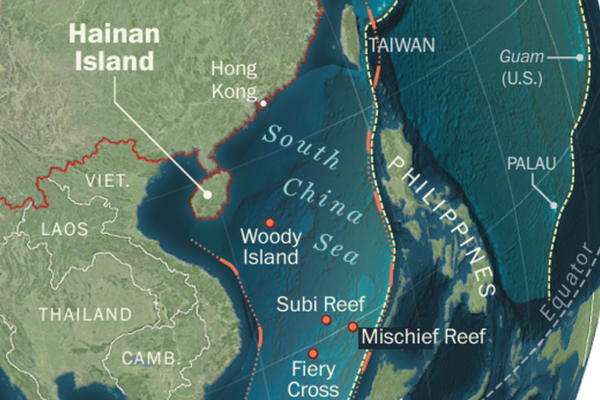
TAIPEI, Taiwan/MANILA – The South China Sea has become one of the world’s most perilous geopolitical hot spots in recent years, with China stepping up the reinforcement of its expansive claims and countries from outside the region getting increasingly involved. Here are five areas to watch in 2025: Taiwan Strait The situation in the Taiwan Strait has been becoming notably more tense, with nearly 3,000 incursions into Taiwan’s air defense identification zone between January and November 2024, as well as two major military exercises – Joint Sword A and B – coinciding with important political events on the self-ruled island. Chinese leader Xi Jinping reiterated in his in 1999 to serve as an outpost. In the last few years, China’s coast guard has been blocking and disrupting Philippine resupply missions to the ship, the BRP Sierra Madre, and the troops stationed there. On June 17, 2024, in an unprecedented confrontation, China coast guard personnel, armed with pikes and machetes, punctured Philippine boats and seized firearms during a Philippine rotate and resupply mission, wounding a Filipino sailor. Both sides later called for de-escalation. On Dec. 12, China said it had granted permission to the Philippines to resupply the “illegally grounded” warship on Second Thomas Shoal on a humanitarian basis. But the June 17 incident showed that the situation could easily escalate into conflict, especially given the proximity of Second Thomas Shoal to a Chinese naval base on Mischief Reef, an artificial island that China built and has fully militarized. Manila and Washington signed a Mutual Defense Treaty in 1951 under which both parties are obliged to support each other in the event of an armed attack. U.S. Defense Secretary Lloyd Austin in November revealed that the U.S. military had set up a Task Force Ayungin, the Filipino name for the Second Thomas Shoal. Chief of the Philippine armed forces, Gen. Romeo Brawner Jr., told an RFA reporter in Manila that his country was pursuing a three-pronged strategy when it comes to maritime defense: to establish an effective presence; to create effective deterrence and modernize military equipment; and to leverage alliances and partnerships with like-minded nations. Beijing, however, is not expected to give up its demand that Manila removes the BRP Sierra Madre and leave the disputed shoal. For its part, the Philippines is determined to defend it. “We’ll never abandon our territory at Ayungin,” insisted Col. Xerxes Trinidad, the Philippine armed forces’ spokesperson. Vietnam’s island building Vietnam’s island building in the South China Sea has reached a record, with the total area created in the first six months of 2024 equaling that of 2022 and 2023 combined, according to a study by the Washington-based Asia Maritime Transparency Initiative (AMTI). Between November 2023 and June 2024, Hanoi created 692 new acres (280 ha) of land across a total of 10 features in the Spratly archipelago. Vietnam’s overall dredging and landfill totaled about 2,360 acres (955 ha), roughly half of China’s 4,650 acres (1,881.7 ha). “Three years from when it first began, Vietnam is still surprising observers with the ever-increasing scope of its dredging and landfill in the Spratly Islands,” AMTI said. Vietnam occupies 27 features and has been carrying out large-scale reclamation works on some over the past year. <imgsrc=”” alt=”Satellite image of Barque Canada Reef, May 11, 2024.” height=”813″ width=”1500″>Satellite image of Barque Canada Reef, May 11, 2024.(AMTI/Maxar Technologies) A new 3,000-meter airstrip is nearly finished on Barque Canada reef, where the total landfill area more than doubled in one year to nearly 2.5 square kilometers, or 617.7 acres, by October 2024. Vietnam has had only one airstrip on an island called Spratly, measuring 1,300 meters, but besides Barque Canada, AMTI said that “it would be unsurprising” if Hanoi also considers runways on Pearson and Ladd reefs. New bases and runways “would give Vietnam a position on the other side of China’s ‘Big Three’ islands,” said Tom Shugart, adjunct senior fellow at the Center for a New American Security. He was referring to China-developed Fiery Cross, Subi and Mischief reefs, which are the largest artificial islands in the South China Sea. The next four largest are all newly expanded Vietnamese reefs. “Its progress in the last five months suggests that Hanoi is determined to maximize the strategic potential of the features it occupies,” said AMTI, adding that “it remains difficult to say when the expansion will end—and what new capabilities Vietnam will have once it has.” Code of Conduct in the South China Sea Malaysia is taking over as chairman of the Association of Southeast Asian Nations, or ASEAN, from Laos this month and every time the chair changes hands, the question of a legally binding code of conduct (COC) for all competing parties in the South China Sea surfaces. China and ASEAN countries have been negotiating a COC after reaching an initial Declaration of Conduct of Parties in the South China Sea in 2002. More than two decades later, it seems many obstacles remain despite Beijing’s repeated assertions that the consultation process is going well and agreement is close. Premier Li Qiang told an ASEAN summit in October that China and the bloc were “striving for early conclusion” of the code of conduct. China and five other parties, including four ASEAN countries – Brunei, Malaysia, the Philippines and Vietnam – hold conflicting claims over parts of the South China Sea but China’s claim is by far the most expansive, covering nearly 90% of the sea. China is adamantly against what it sees as “a politicization” of the COC, as well as any “external interference” in the matter. Yet its assertiveness has prompted some countries to seek a counterweight from outside ASEAN. “Negotiations on the COC continue at a snail’s pace,” former Thai Foreign Minister Kantathi Suphamongkhon told Reuters news agency in October. “An agreement seems impossible,” said Philippine legal expert, former Supreme Court justice Antonio Carpio. “China will never agree to some provisions, Vietnam to some others and so on. The target of concluding the COC by 2026, therefore,…
