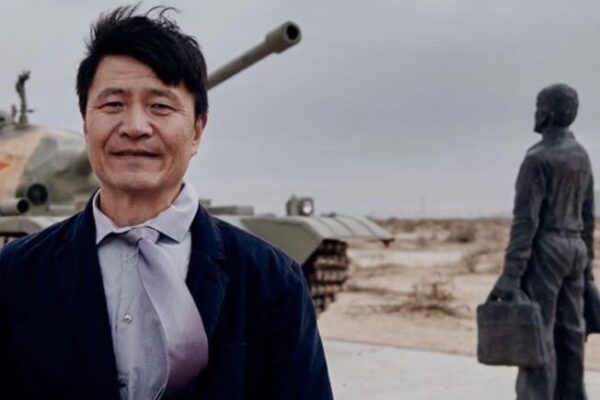
Fengsuo Zhou Executive Director of Human Rights in China, co-founder of Humanitarian China. Tiananmen student leader in 1989. Independent Investor.

Exclusive Interview: Zhou Fengsuo on Tiananmen, AI Surveillance, and China’s Democratic Future

1. You were one of the prominent student leaders during the 1989 Tiananmen Square movement. Looking back after more than three decades, how has that experience shaped your personal philosophy and commitment to defending human rights? The Tiananmen Movement changed the course of my life. Like millions of Chinese students at the time, I believed China could become a freer and more just society through peaceful reform. We were not seeking chaos or revolution. We wanted dialogue, accountability, and dignity. For a brief moment in the spring of 1989, freedom seemed within reach. The June 4 massacre shattered the hope for immediate change, but it also gave me a lifelong mission. After surviving prison and eventually rebuilding my life in the United States, I came to understand that freedom is never guaranteed. It survives only when ordinary people are willing to defend it, often at tremendous personal cost. The courage of the Tiananmen protesters, the unknown Tank Man, the Tiananmen Mothers, the Hong Kong Alliance in Support of Patriotic Democratic Movements of China, and countless others has taught the world two enduring lessons. First, the Chinese people deeply value freedom, democracy, and human dignity, and many are willing to sacrifice everything to defend those ideals. Second, acts of conscience have a power that transcends both time and borders. The courage shown in Beijing in 1989 has inspired people across generations and continents, just as struggles for freedom elsewhere inspired us. For me, human rights are not an abstract ideology. They begin with the belief that every person possesses inherent dignity and the right to speak, worship, organize, and think freely. That conviction has guided every stage of my life—from supporting political prisoners and their families to documenting abuses, defending historical memory, and helping a new generation of activists. More than three decades later, I remain optimistic because I continue to work closely with courageous people inside China and around the world who refuse to give up despite relentless repression. Their determination reminds me every day that the desire for freedom cannot be extinguished. The Chinese Communist Party possesses enormous power, but history repeatedly shows that regimes cannot permanently suppress the human aspiration for liberty. The China I believe in—the China that so many people continue to strive and sacrifice for—is still alive. It is this “different China” that gives me hope for the future. 2. Throughout years of activism, advocacy, and public life, what has kept you motivated despite the many personal and professional challenges you have faced? The simplest answer is hope and duty. Over the years, I have been inspired by extraordinary courage from ordinary people. I have worked with lawyers who defended clients they knew would bring them persecution rather than success. I have met Christians who continued to worship despite repeated arrests. I have seen citizen journalists risk years in prison simply to tell the truth, and young people inside and outside China who refuse to surrender their conscience despite enormous pressure. Working alongside these individuals constantly reminds me that this struggle is much larger than any one person. Every act of courage affirms my belief that the desire for freedom cannot be extinguished, no matter how powerful the dictatorship. That hope is matched by an equally strong sense of duty. Many of my friends remain imprisoned, disappeared, or under constant surveillance. Compared to them, I consider myself a fortunate survivor. I have the privilege of living in a free country, raising my family in freedom, and speaking openly without fear of imprisonment. That freedom is not simply a gift—it is a responsibility. It obliges me to speak for those whose voices the Chinese Communist Party is trying to silence. In fact, that sense of duty has only grown stronger as the CCP has become more powerful and more ambitious in exporting its repression beyond China’s borders. History presents moments when someone must refuse to step aside. I often think of Gandalf standing before the Balrog in The Lord of the Rings. His words, “You cannot pass,” capture something important for me. We may not know whether we will ultimately prevail, but there are moments when our responsibility is simply to stand our ground, defend what is right, and refuse to yield to tyranny. My Christian faith has become another source of strength. It reminds me that justice ultimately belongs to God, while our responsibility is to remain faithful—to pursue truth, defend the dignity of every person, and serve others regardless of the outcome. Faith gives me confidence that no dictatorship has the final word, even when the road ahead seems long. 3. As Executive Director of Human Rights in China and co-founder of Humanitarian China, what do you consider the most significant achievements of these organizations, and what challenges remain ahead? Humanitarian China was founded with a simple conviction: those who risk everything for freedom should never stand alone. In the early years, I funded much of its work with my own savings while working in finance because I believed supporting courageous individuals was not charity—it was an investment in China’s democratic future. Over the past two decades, Humanitarian China has provided humanitarian assistance to thousands of political prisoners, families of prisoners of conscience, refugees, and victims of persecution. Every case reminds us that history is ultimately shaped by individuals who refuse to surrender their principles. Human Rights in China has spent nearly four decades documenting abuses, preserving historical memory, and advocating internationally for universal human rights and democratic values in China. Since I became Executive Director, we have expanded our work into digital rights, internet freedom, citizen journalism, artificial intelligence and human rights, and transnational repression. As the CCP regime evolves, human rights organizations must evolve as well. One achievement I am especially proud of is helping build stronger connections among courageous people inside China, the Chinese diaspora, researchers, journalists, technology experts, and democratic governments. No single organization can confront today’s challenges alone. By bringing these communities together, we are helping build an…

Read More