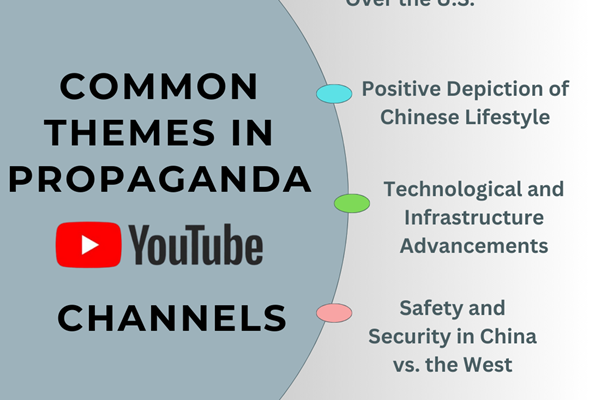
China’s strategic use of influencer-based YouTube channels has become a crucial element in its soft power propaganda network, particularly in shaping global perceptions of China and countering Western narratives. These influencers, many of whom are expatriates or foreign residents in China, utilize their platforms to promote themes such as the alleged falsehoods spread by Western media, the superiority of China’s infrastructure, technology, and safety over that of the United States and their home countries, and the notion that China is always on the right side of geopolitical conflicts. A sample of the most prominent channels reveals the extensive reach and influence these platforms hold. For instance, channels like Jabiertzo with 845K subscribers and Daniel Dumbrill with 167K subscribers, frequently address topics such as the situation in Xinjiang, presenting narratives that counter reports on human rights issues. Similarly, Nathan Rich with 490K subscribers and Cyrus Janssen with 661K subscribers often highlight China’s advancements in technology and infrastructure, portraying China as a superior alternative to the United States. In total, the combined reach of these most prominent channels accounted for in this report amounts to 5.33 million subscribers, with a staggering 10,577 videos that have collectively garnered over 1.05 billion views. This extensive content library is used to disseminate China’s narrative on various global issues, reinforcing the idea that China’s approach is not only legitimate but preferable to Western models. Channels like Living in China and Niranjan China, with subscriber counts of 460K and 814K respectively, contribute to the portrayal of China as a safe, prosperous, and culturally rich society, often contrasting it with perceived notions. Channel Name Subscribers Videos Views Country Alex from Xinjiang 44.1K 70 7,204,566 Hong Kong Numuves 84K 392 15,687,017 China Daniel Dumbrill 167K 266 13,473,874 Hong Kong FerMuBe 41.2K 693 3,585,459 United States Jabiertzo 845K 915 218,626,212 Spain Asia Hot Topics 19.7K 97 2,650,695 United States Cross Pacific Confrontation 623 33 75,992 N/A VOC: Vision of China 4.47K 119 994,783 Canada Nathan Rich 490K 233 36,895,956 United States Noel Lee 31.2K 144 2,886,782 N/A Living in China 460K 320 57,661,697 United Kingdom Niranjan China 814K 575 125,939,595 India China Content Center 607K 4,069 210,156,033 United States BeeRose in China 18.4K 29 860,928 United States TripBitten 78.1K 224 7,788,812 United States Part Time Traveller – China 25.6K 553 3,760,153 India Cyrus Janssen 661K 411 119,111,974 United States Barrett 376K 601 52,129,466 United Kingdom Harvey in China 24K 133 2,336,921 United Kingdom Fel Thommy 263K 399 85,110,680 United States Reporterfy Media & Travel 211K 302 29,413,718 United Kingdom 5,333.73K 10,577 1,056,299,162 Statistics of some of the popular Chinese Propaganda YouTube Channels The strategic deployment of these influencer-led channels is a sophisticated tool in China’s Soft Power Propaganda Network, allowing the country to shape international discourse and influence global public opinion in favor of its geopolitical stance. Through engaging, relatable content that appeals to both Western and non-Western audiences, these YouTube channels effectively support China’s broader propaganda objectives, reinforcing its narrative of being a global leader in technology, governance, and social stability. Country Number of YouTube Users (in millions) as of April 2024 India 476 United States 238 Brazil 147 Indonesia 139 Mexico 84.2 Japan 79.4 Pakistan 66.1 Germany 65.7 Vietnam 63 Philippines 58.1 Turkey 58.1 UK 55.7 France 50.2 Egypt 48.1 Thailand 44.2 Number of YouTube Users (in millions) as of April 2024 Despite China being the world’s most populous country after India, it is notably absent from the list of leading YouTube audiences as of April 2024. This absence is primarily due to the Chinese government’s long-standing restrictions on YouTube, which has been blocked in the country since 2009. Consequently, the platform is inaccessible to the vast majority of China’s population, leading to a significant gap in its user base despite the country’s vast potential audience. Interestingly, this gap has given rise to a unique phenomenon where many foreign YouTubers, residing and working in China, create content that caters primarily to international viewers, particularly those in countries where YouTube remains highly popular. These content creators often focus on showcasing various aspects of Chinese culture, travel, and daily life, which aligns with the growing global interest in China. However, their content frequently extends beyond mere cultural exchange, becoming a vehicle for soft power and state-sponsored propaganda. These YouTube channels and vlogs are often subtly or overtly linked to the Chinese state, either through direct support or indirect influence. The Chinese Communist Party (CCP) leverages these influencers to build and promote narratives that align with its geopolitical objectives and desired international image. By presenting an idealized version of China, these influencers contribute to shaping global perceptions in a way that supports the CCP’s strategic interests. This content often portrays China as a modern, harmonious, and prosperous nation, glossing over or omitting discussions of controversial issues such as human rights, censorship, or political repression. Furthermore, these influencers may receive preferential treatment, easier access to restricted locations, and other incentives that are not available to independent journalists or content creators critical of the Chinese government. In this way, the CCP effectively utilizes foreign YouTubers as part of a broader soft power strategy, disseminating state-approved narratives to a global audience, while circumventing the direct use of traditional state media channels. This influencer-driven content plays a crucial role in the CCP’s efforts to build a favorable narrative about China on the global stage, leveraging the reach and appeal of YouTube to influence public opinion, even in the absence of direct access to the platform within China itself. Following some of the prominent YouTube channels indulged in Chinese Propaganda: Channel: Living in China Key Propaganda Themes: Channel: Niranjan China Key Propaganda Themes: Read the entire report for a comprehensive understanding of the Influencer Network: Link Niranjan’s content across these platforms consistently promotes a narrative of China’s advancements, quality of life, and rapid development, often contrasting these aspects with India and other countries to highlight China’s superiority. Channel: China Content Center Key Propaganda Themes: China Content Center consistently promotes narratives that emphasize China’s economic and…