
Category: East Asia
A riverfront village on Thai-Myanmar border struggles to recover from pandemic
The inhabitants of Mae Sam Lab say life in this Thai village along the frontier with Myanmar used to bustle with tourists and a vibrant cross-border river trade. As the people here struggle to recover from the COVID-19 pandemic violence from attacks by Burmese junta forces nearby have made things worse, they say. “The doldrums started with the COVID-19 pandemic. Tourists – Thai, Chinese, Japanese and Korean – were gone. Boat operators, local guides, souvenir shops have been badly affected,” said Chai Pongpipat, an official with the Tambon Mae Sam Lab administration. In the months since the February 2021 coup in Naypyidaw, troops belonging to the Burmese military regime and Border Guard Force have clashed with ethnic resistance forces including in the Karen State, which lies across the Salween River from Mae Sam Lab. “Over two years of enduring COVID, people seemed to be able to adapt to its effects, but the slight COVID recovery was worsened by the clashes between Myanmar forces and ethnic fighters in the areas. The trade activities have stalled,” Chai told BenarNews. Meanwhile, fishermen say their catches have been falling. They’re afraid to fish when it’s dark on the river, which separates the two countries, because of nighttime clashes on the Myanmar side. “Lately, there have been a handful of small boats from the nearby village coming here to buy stockpiles of food and necessities as the fighting is unpredictable,” Chai said.

Wave of badly written Kindle titles on Pelosi, Taiwan hits Amazon’s Kindle platform
Amazon’s Kindle e-publishing platform has been flooded with poorly written books pushing Beijing’s line on Taiwan, according to a U.K.-based publisher. A wave of e-books using the keywords “Nancy Pelosi” and “China and Taiwan” laying out China’s claim on the democratic island has appeared on Kindle since the start of the month, when U.S. House Speaker Nancy Pelosi first indicated she would visit Taiwan, sparking days of military exercises by China’s People’s Liberation Army (PLA). “New disinformation push on Amazon?” U.K. independent publisher Michael Cannings tweeted, along with a screenshot of the Kindle titles. “A torrent of new low quality ‘books’ about Taiwan has appeared; a quick Google shows at least some of the content is plagiarized, and the names of the authors appear to be fake. I count 61 of these under one search term alone,” Cannings wrote. He later told RFA it was unclear whether the flood of new titles, many of which contain grammatical errors and consist of scraped content with changed wording to evade anti-plagiarism software, was a state-backed propaganda drive or simply the work of unethical people trying to cash in on global headlines. “The possibilities to use this for disinformation are strong,” Cannings said. “I just can’t be sure whether in this case is really somebody trying to do that, or if it’s just unethical people trying to make money.” “[But] it shows how it could be done by a state operation,” he added. Cannings said the use of keywords and the flood of recent titles means that the books show up at the top of Amazon and Google searches for those keywords. He said most of the titles were likely uploaded to Amazon’s Kindle Desktop Publishing platform, and, apart from automated plagiarism checks, weren’t subject to any editorial quality control. “I think the danger for readers is that you don’t know what’s real and what’s not,” Cannings said. “I mean, some of these books don’t look great, but some of them are quite convincing, so a reader who’s not familiar with the subject might not know that this is not … properly researched.” “The secondary danger is that these books then become cited by people further down the line… so then the disinformation gets into the wider ecosystem,” he said. U.K. independent publisher Michael Cannings called attention to the Kindle titles in a series of tweets on Twitter. Vulnerable to disinformation campaigns RFA was able to roughly replicate Cannings’ search results on Amazon, and found that the ebooks sell for around U.S.$10 or less. Amazon told RFA in an emailed response that the company does have content guidelines for books self-published on the Kindle platform, and will investigate and remove books that don’t comply with them. Daniel Kapellmann Zafra, senior technical analysis manager at the cybersecurity company Mandiant, said that whether or not the flood of books on Taiwan from Beijing’s point of view are actually backed by the Chinese Communist Party (CCP), the platform is vulnerable to disinformation campaigns. “As long as there is a platform for sharing information, it can be leveraged to drive these types of narratives,” Zafra told RFA. “It’s basically a creative avenue that could … enable an actor to share information.” Zafra’s own research for Mandiant has identified an information operations campaign linked to the Chinese public relations firm Shanghai Haixun Technology, with content published to at least 72 suspected inauthentic news sites. “Narratives promoted by the campaign criticize the U.S. and its allies, attempt to reshape the international image of Xinjiang due to mounting international scrutiny, and express support for the reform of Hong Kong’s electoral system—a change which gave [China] more power over vetting local candidates,” the report, coauthored by Zafra, said. Several of the sites published articles critical of Pelosi on Aug. 1, in response to reports ahead of her Aug. 2-3 visit to Taiwan, it said. “The articles assert that Pelosi should ‘stay away from Taiwan’ and highlight perceived tarnished relations between the U.S. and Taiwan.” An article published on several sites, including one purporting to be a Taiwanese news outlet, claimed that former U.S. government official Mike Pompeo’s March 2022 visit to Taiwan was motivated by money and his alleged desire to run for U.S. president in 2024, according to the report. A separate information operation, DRAGONBRIDGE, publishes comments, videos and photos across thousands of social media and forum accounts on authentic platforms, according to the report. Shanghai Haixun uses inauthentic websites to disseminate content, with little obvious overlap between the two, it said. ‘Cognitive operations’ Taiwanese fact-checkers said they detected a 30-40 increase in fake reports online since Pelosi’s visit. Maj. Gen. Chen Yu-lin, deputy director of the Political and War Bureau of Taiwan’s Ministry of National Defense told journalists on Aug. 8 that China had begun a wave of “cognitive operations” even before the military exercises were announced. Chen said the hybrid warfare campaign sought to create an atmosphere suggesting China might be invading Taiwan, to attack the public image of the government, and to disrupt civilian and military morale. Hybrid warfare denotes a combination of conventional military action on the ground and hacks or disinformation campaigns designed to attack public morale and sow confusion. National Taiwan University was hacked, with the words “there is only one China in this world” appearing on its official website. Meanwhile, the National Palace Museum issued a statement denying online rumors that the government was preparing to send tens of thousands of rare artifacts overseas for safekeeping. Last week, several convenience store branches and government facilities across Taiwan saw their digital signage hacked with messages slandering Pelosi. Digital signage at a railway station in the southern port city of Kaohsiung and at a government office in Nantou county also displayed a message calling Pelosi “an old witch.” The official website of Tsai’s Presidential Office was taken down for around 20 minutes by a cyberattack, after which full service was restored, while mainland Chinese website Baidu joined in the cognitive warfare, releasing maps of…

Xinjiang residents warned of 3 weeks detention for violating COVID-19 lockdown
Authorities in Xinjiang are threatening those who flout quarantine laws with as many as three weeks of detention amid a new outbreak of COVID-19 in the region that has seen infections rise sharply since the start of the month, sources told RFA Uyghur. The warning comes as the Tibet Autonomous Region (TAR) capital Lhasa entered a three-day state of de facto lockdown amid a growing number of COVID-19 cases in the city. On Friday, authorities announced that they had documented 410 new asymptomatic COVID-19 infections in Xinjiang, bringing the total to 1,727, as the region continues to grapple with a new outbreak that has led to strict lockdowns. An official in Qorghas (in Chinese, Huocheng) county’s Langar township, who oversees 10 families in Yengiavat village, told RFA that authorities have been conducting street patrols to ensure that nobody is leaving their homes during an ongoing lockdown in the area and informing residents that they would be detained for up to three weeks if they do. “We are informing the residents that those who violate the system, that is, those who go out on the streets, will be punished and sent to 15-20 days of ‘re-education,’” said the official, who spoke on condition of anonymity, using a common euphemism for detention in the region. The leader of the village Women’s Committee, who also declined to be named, told RFA that “medicine is being distributed to residents” by authorities, although she was unsure of what type. “They are cream in color and are said to prevent disease,” she said. Earlier this week, Chinese state media reported that authorities ordered residents to quarantine in the cities of Urumqi (Wulumuqi), Ghulja (Yining), Aksu (Akesu), Kumul (Hami), Chochek (Tacheng), Bortala (Bole), and Kashgar (Kashi). A community official said that the new infections were thought to have been brought by Chinese tourists from Gansu province, and the first viral outbreak in Ghulja was found in Uchon Dungan village. Daily lives impacted On Friday, sources in Xinjiang told RFA that lockdowns in the region had begun to severely impact the daily lives of residents, with farmers unable to attend to their fields and grocery store owners unable to sell perishables or keep them fresh. Videos posted on social media from the region appeared to show rotten produce in markets that had been shuttered as a result of the lockdown, while residents said they were unable to obtain fresh vegetables while confined to their homes. RFA spoke with the security director of Ghulja’s Mazar village, who said that only farmers with “urgent irrigation and harvesting needs” are allowed to leave their homes. “The doors [on village homes] are sealed,” he said. “Farmers with urgent needs are allowed to go out on a rotating basis. The farmers first need to get the approval of the village officials in order to go to the fields.” The security director said those found to have violated the lockdown face at least 24 hours of detention. A government official in Ghulja’s Samyuzi village told RFA that farmers are being allowed to work on their fields “under supervision,” adding that security cameras had been installed throughout the area to monitor whether anyone was leaving their home without permission. “If they want to go out for farming needs, they will be accompanied by village officials to the fields. They can go on a rotating basis,” she said. “We have installed security cameras on every household [to ensure no one ignores the lockdown],” she added. Residents undergo mass testing following a COVID-19 outbreak in Lhasa, Tibet Autonomous Region, China, Aug. 9, 2022. Credit: CNS via Reuters De facto lockdown In the TAR, where authorities say they had documented 20 symptomatic and 127 asymptomatic COVID-19 infections as of Friday, officials in the capital Lhasa ordered a citywide “disinfection” operation from Aug. 12-15, during which people are not to leave their homes. Sources in the city said the order amounted to a de facto three-day lockdown, although officials have refrained from using the term. Those who have been confirmed positive are being quarantined and public testing is underway, they said, although authorities have failed to ensure that residents maintain proper distancing when they do so. “Since COVID cases are rising in Lhasa and a few other regions, people who stayed in hotels and lodges in these areas and may have contact with the infected are now quarantining for safety,” a source in Tibet told RFA Tibetan. “People are being subjected to continuous testing, Potala Palace and other religious sites are shut down, schools have postponed their reopening, and people are stocking up on groceries and buying face masks.” Meanwhile, the summer tourism season is in full swing in Lhasa – despite concerns that the outbreak there is linked to visitors to the region – with Chinese travelers arriving in droves by plane, train, and car from other parts of China, the source said. “Tibetan religious pilgrims seeking to visit Lhasa from around the region are having difficulty obtaining travel permits, while Chinese tourists have no issue obtaining passes to visit Tibet,” he added. People line up to undergo nucleic acid tests for COVID-19 on Aug. 9, 2022, in Lhasa, in China’s western Tibet Autonomous Region. Credit: CNS/AFP Airports operational Another source from Lhasa told RFA they are concerned that Tibet’s airports remain open, and could lead to the import of additional cases to the region. “I understand that Lhasa will be under [a form of] lockdown from Aug. 12, but there has been no official notice from the government yet and Gonkar Airport remains open as usual,” the source said. “During earlier COVID-19 surges, the Chinese government did not restrict tourists from entering Tibet, despite the concerns of Tibetans. Now, as we see a growing number of COVID-19 outbreaks and the situation remains uncertain, we are worried about what will happen in the next few days.” According to local regulations, only travelers who are exiting Lhasa through Gonkar Airport must undergo testing for COVID-19 48 hours prior…

Pain at the pump for Myanmar motorists as fuel shortage sends prices soaring
A fuel shortage has forced gas stations to close in major cities in Myanmar and sent prices soaring to their second highest level since the coup, prompting criticism that the junta’s restrictions on imports and manipulation of the exchange rate are to blame. On Friday, the Fuel Import, Storage and Distribution Supervision Committee under the junta’s Ministry of Energy announced that fuel shortages had driven prices up by 600 kyats (U.S. $0.30), or nearly 40% in the five days since Aug. 7. A liter (.25 gallons) of diesel and 92 octane that cost an average of 1,970 kyats (U.S. $0.94) and 1,615 kyats (U.S. $0.77) on Sunday cost 2,550 kyats (U.S. $1.21) and 2,245 kyats (U.S. $1.07), respectively, on Friday. The shortage driving up prices has led gas stations in major cities in most states and regions, including Myanmar’s largest cities Yangon and Mandalay, to close as they run out of fuel supplies, while others have been forced to limit their sales. Sources told RFA Burmese that procuring fuel had become a nightmare. “This morning, when I went looking for fuel, I found some shops selling only diesel oil, some shops selling 95 [octane] and some shops closed,” said a resident of northern Shan state’s city of Muse, near Myanmar’s border with China. “Some shops outside the city limits sell 92 octane for 2,850 kyats (U.S. $1.36) a liter, and they were selling 2,000 kyats (U.S. $0.95) worth to each motorcycle, and 20,000 kyats (U.S. $9.53) worth to each car. There were also roadside vendors selling small bottles of gas at various prices.” The resident, who spoke on condition of anonymity, said that motorists in Muse had to pay anywhere from 7,000 to 10,000 kyats (U.S. $3.33 to $4.76) for a 1.5 liter bottle of fuel “depending on the vendor,” while smaller bottles were selling for anywhere between 3,000 to 5,000 kyats (U.S. $1.43 to $2.38). He called the fuel situation “the worst I’ve ever seen in my life.” Other sources told RFA that crucial services provided by charity organizations to make up for the junta’s shortfall in administration were being curtailed as a result of the shortage. A spokesman for a Yangon-based charity group that provides assistance to those in need of medical care told RFA that he had been forced to turn away requests for lack of fuel. “In our work, it’s hard to refuse when you get a call from a patient,” he said. “I can’t help wondering if a person had called because they were desperate and really needed us.” The spokesman said that even when the price of fuel is affordable, organizations like his don’t have enough money to buy more than what can fit in their gas tanks. “When the prices rise, we have much bigger problems to deal with,” he said. A driver fuels his vehicle in Yangon, Myanmar, Aug. 12, 2022. Credit: RFA Junta mismanagement Despite domestic fuel shortages and skyrocketing prices, junta chief Snr. Gen Min Aung Hlaing on Aug. 8 announced to a governmental work coordination meeting that the regime is seeking to reduce expenditures by cutting down on its U.S. $1.3 billion annual imports of oil and petroleum products. A fuel distributor, who declined to be named for security reasons, said the fuel shortage and rise in prices is the result of the junta’s restrictions on foreign imports. “The dollar has become so scarce that procuring gasoline has become difficult. When a certain amount becomes available, we are forced to buy it as a group and later divide it among ourselves,” he said. “In the past, we made the purchases ourselves, individually, not as a group. … We can’t do that anymore. Instead, we have to get our supply through the [junta]. It’s going to get worse if things continue this way.” Economists told RFA that the fuel shortage is also the result of controls and fixed U.S. dollar exchange rates set by the junta. One U.S. dollar cost 1,850 kyats in April, but the junta changed the rate to 2,100 kyats on Aug. 5. “Since the official rate has risen, the price of imports will surely go up. And as fuel oil is one of the imports, other prices of imports will also go up,” said one economist, speaking on condition of anonymity. “I believe that’s why they changed the exchange rate, so that fuel importers would be able to get supplies. Otherwise it’d be too difficult because the price is too different.” Economists also noted that the rising cost of fuel is increasing prices across the board for other basic goods as transportation becomes more expensive. Attempts by RFA to contact the Ministry of Energy’s Fuel Import, Storage and Distribution Supervisory Committee for comment went unanswered Friday. According to gas station records, on Jan. 31, 2021, the day before the military seized power in a coup, a liter of diesel cost 720 kyats (U.S. $0.34), a liter of 92 octane cost 695 kyats (U.S. $0.33), and a liter of 95 octane cost 815 kyats (U.S. $0.39). Shortages have caused fuel prices to rise steadily since the coup. By May 31, 2022, diesel cost 2,330 kyats (U.S. $1.11) per liter, 92 octane cost 2,225 kyats (U.S. $1.06) per liter, and 95 octane cost 2,340 kyats (U.S. $1.11). Many gas stations ran out of fuel. In early July, fuel prices began to drop but never went below 1,650 kyats (U.S. $0.79) per liter. Translated by Khin Maung Nyane. Written in English by Joshua Lipes.
‘I thought the police would immediately begin an investigation’: #MeToo plaintiff
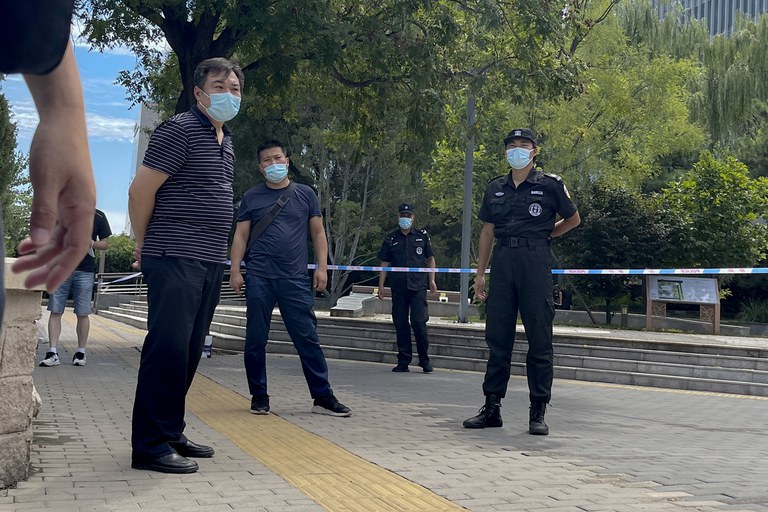
A Beijing court has once more ruled against former CCTV intern Zhou Xiaoxuan in a landmark #MeToo sexual harassment case, saying there isn’t enough evidence to support her claims against state broadcaster CCTV anchor Zhu Jun. The Beijing No. 1 Intermediate People’s Court rejected Zhou’s appeal on Aug. 10, upholding the original judgment of the Haidian District People’s Court in September 2021. Backed by supporters, Zhou filed a second appeal later the same day, after making an impassioned statement to the court asking some tough questions of China’s judicial and law enforcement agencies: On June 9, 2014, I was a third-year university student and 21 years old. My first internship was with CCTV’s program “Art Life.” At the time I was being sexually harassed by Zhu Jun in that dressing room, I had feelings of shame around sex, and there was no way I was going to be able to resist in the moment or call for help. I knew how powerful Zhu Jun was, so I daren’t tell any of the staff who came into the dressing room at that time what I was going through. I think what happened to me is also a common occurrence for women in higher education and in the workplace. The only difference for me was that I had a university lecturer who was willing to help and I made my report to the police with support from that lecturer, a lawyer and my roommate on the day after the incident. Both our lived experience and hard statistics tell us that very few women choose to go to the police when they have suffered sexual harassment or sexual assault. At the time I made my report to the police in 2014, they told my parents that I should withdraw it, citing Zhu Jun’s status in society. At the time the case came to court for the first time in 2020, court officials told me that it was impossible to lay hands on surveillance camera footage or written evidence supporting my case. In the 2021 judgment document, the court said the burden of proof in such cases falls on the plaintiff, and that the evidence I had supplied was insufficient. Today, this case is back on appeal, in what will probably be my last appearance in court. I have already given an account of the facts of the case to this court, so now I would like to ask the court this: how is a woman who is sexually harassed in a closed space, who hasn’t expected it, and who has no recording device on her, nor any way to fight back supposed to prove that the harassment took place? Is she just supposed to put up with it, and act like it never happened? Back when I reported this to the police four years ago, in the hope that they would help me, their first response wasn’t to interrogate the person accused of being the perpetrator. Instead, it was to travel to Wuhan two days later to talk to my parents into having me drop the case. They didn’t actually go to CCTV to talk to Zhu Jun until a week after I had filed the report, and even then they only took the simplest of statements. Four years later, as I filed my case with the court, officials refused to accept a complaint of sexual harassment, refused to call Zhu Jun in for questioning even when it was confirmed that the person who had taken me into that dressing room and the one who had been in the dressing room that day had lied to back him up. Instead, they told my parents that none of the witness statements, the surveillance footage from the corridor, my dress nor photos or me and Zhu Jun together were admissible as evidence, so I didn’t have enough evidence to support my case. I would like to ask the court what kind of evidence it would deem admissible? I didn’t know I was going to be sexually harassed, so I didn’t bring a secret recording pen on a pinhole camera. I didn’t feel able to face down Zhu Jun in the middle of CCTV headquarters, neither did I immediately cry for help. I didn’t feel able to go back to CCTV after filing my report with the police, nor to interview him myself, and I didn’t have access to the surveillance camera footage. I wasn’t able to analyze my DNA or Zhu Jun’s. I was 21, and this was the first time I had ever reported anything to the police. I didn’t even know to ask for proof of a police report or a receipt for the evidence I gave them. I want to ask those people who backed up Zhu Jun’s story why they did it. Why they even refused to describe what Zhu Jun was wearing in that dressing room that day. I want to ask the police why they went to Wuhan to talk to my parents, and why they didn’t go to find Zhu Jun until a week afterwards. I haven’t seen them once in all the times I have appeared in this courtroom. I haven’t been able to ask them anything. I don’t have the wherewithal to find my own evidence: to offer up proof of my own suffering. The university lecturer’s statement spoke of my sobs, while my roommate’s statement said I was crying that same evening. Yet they seem to have evaporated. At the age of 21, I chose to go to the police. At the age of 25, I decided to take it to court. I thought the judicial system would help me, and I believed that I had a citizen’s right to justice. I thought the police would investigate in a timely manner, take steps to preserve all the evidence, and respond to me as required by law. I believed that the court would at least understand the complexities of workplace sexual harassment, and understand the…

China’s zero-COVID curbs bring Guangdong’s manufacturing hub to its knees
The ruling Chinese Communist Party (CCP)’s zero-COVID measures are forcing large numbers of private manufacturers to close in the Pearl River delta region this month, RFA has learned. Last month, Cooper Electronics, based in Guangdong’s manufacturing hub of Dongguan, announced it would close this month. Hong Kong-owned toymaker Dongguan Kaishan Toys has announced it will follow suit, while Dongguan Jingli Plastics and Electronics will suspend production on Aug. 31 after laying off all of its staff, according to ChinaToysNet. Other private businesses have told RFA they plan to furlough all staff for six months after a massive slump in new orders made it impossible for them to meet their payroll bill. The moves come as foreign-invested manufacturers are increasingly relocating to Vietnam, Cambodia and other Southeast Asian countries, as costs continue to skyrocket in China. Financial commentator Cai Shengkun said the hollowing out of Dongguan as a manufacturing base has been a long time coming. “Dongguan used to be China’s manufacturing base, and in its heyday was the production base for products sold by the world’s largest companies,” Cai said. “During its heyday, Dongguan maintained high GDP growth for over a 20-year period … and accumulated enormous wealth.” “But now with the relocation of some industries and the continuous migration of foreign capital, there are not many high-end factories in Dongguan left,” he said. Cai said CCP leader Xi Jinping’s insistence on a zero-COVID approach, meaning individuals and entire cities can be placed under lockdown at a moment’s notice, with mandatory quarantine and testing for all, have also struck a major blow. “Rising shipping costs and the impact of the pandemic have meant that [these] industries are no longer profitable,” he said. “With shipping costs getting higher and higher, these products will no longer have any export advantage.” This photo taken on July 13, 2022 shows cargo containers stacked at Yantian port in Shenzhen in China’s southern Guangdong province. Credit: AFP Logistical challenges Kaishan Toys, established in 1998, was once one of Hong Kong’s most prestigious toy manufacturers, with more than 2,000 employees. But the company has seen a sharp drop in orders since 2021, with most toy production now outsourced to Southeast Asia. At the time of its closure announcement, just 100 employees remained. Meanwhile, Dongguan Jieying Precision Hardware Products has also announced it will close at the end of the month, citing additional costs and logistical challenges under the zero-COVID policy. Other companies are pausing operations, in the hope of making a comeback if business improves. Huizhou Wanzhisheng New Energy Technology announced a five-day furlough for most departments, citing the impact of disease control and prevention restrictions. The problem isn’t confined to Dongguan or Guangdong province, either. Shandong Guangfu Group, a private iron and steel joint venture established in 1983, suspended production on July 19, with no date for resumption given. And a technology company based in the eastern province of Anhui furloughed all of its staff from July 14 to Jan. 22, 2023. Financial analyst Guan Min said the government has failed to offer any policy incentives or financial support to private enterprises hit by the zero-COVID policy, and that this could be a deliberate choice. “This is a great opportunity for the state sector to expand, and for the private sector to shrink,” Guan said. “Private enterprises have good technology and so much equipment, which can benefit state-owned enterprises if there are mergers.” Retreat from market economics Guan said he has been warning of a total retreat from market economics under Xi for the past decade. “Based on the indicators 10 years ago, I said that only large state-owned enterprises would still be operating in China 20 years down the line,” he said. The government does appear willing to boost the property market, where a slump fueled by a massive backlog in unfinished buildings has started to affect the economy. Since Xi Jinping’s recent comment that “housing isn’t for speculation,” a number of local governments have announced preferential policies for homebuyers, encouraging rural residents to buy in cities. Homebuyers across China are withholding mortgage payments in protest at stalled construction of properties by major developers across the country until developers resume construction of pre-sold homes, local media and social media reported. Japan’s Nomura has estimated that developers have only delivered around 60 percent of homes sold before actual construction between 2013 and 2020. China’s outstanding mortgage loans rose by 26.3 trillion yuan during that period. Social media posts have indicated that, far from moving to ensure that unfinished property is completed, local authorities may be hiring actors to make it look as if work is being done on abandoned construction sites. “Hiring: actors for a construction site, 100 yuan/day,” reads a screenshot of a job advertisement that RFA was unable to verify independently. “Requirements: To bang on the steel pipes, pull trolleys around and pretend to be engaged in construction work if someone comes to check,” the advertisement reads. Translated and edited by Luisetta Mudie.
Chinese and Thai air forces to hold 10-day joint exercise this month
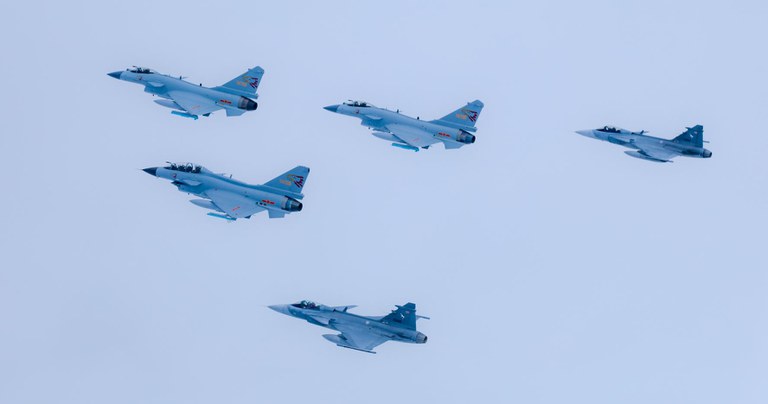
China and Thailand are to kick off a major joint air force exercise on Monday after a two-year suspension due to COVID, the Chinese Defense Ministry announced. The ministry said in a statement on Friday that the Falcon Strike 2022 training exercise will be held at Udorn Royal Thai Air Force Base in Udon Thani province, northeastern Thailand. The exercise will begin on Aug. 14 and RFA sources say it will last until Aug. 24. It will include “training courses such as air support, strikes on ground targets, and small and large-scale troop deployment,” according to China’s defense ministry. “The Chinese People’s Liberation Army Air Force (PLAAF) will dispatch fighter jets, fighter-bombers and airborne early warning (AEW) aircraft, and the Royal Thai Air Force will send its fighter jets and AEW aircraft,” the ministry said. The renewed exercise marks a new effort to “enhance mutual trust and friendship between the two air forces,” the ministry said, as well as to further the strategic cooperation between Thailand and China, as the latter seeks to project power and expand its influence in the region. The Chinese military has just finished a week-long air-naval exercise around Taiwan as an angry response to a visit to the island by the Speaker of the U.S. House of Representatives Nancy Pelosi. “Thailand cannot deny China’s military role in this region. The combined exercise enables Thailand to better understand and be more familiar with the PLA’s command and control system and its military doctrine,” Dulyapak Preecharush, Deputy Director of the Institute of East Asian Studies at Thammasat University in Bangkok told BenarNews, an RFA-affiliated online news service. Growing military links Reuters quoted an anonymous Thai air force source who said that Thailand will not deploy its F-16s for Falcon Strike 2022. Instead it will use its Swedish-made Saab JAS-39 Gripen fighters as well as German-made Alpha Jet light attack aircraft. It is unclear which types of aircraft China will be deploying for the exercise. Chinese fighters have been seen taking part in recent Sino-Thai Air Force joint training exercises, said Andreas Rupprecht, an expert on China’s military aviation, in a recent interview with RFA. “Thailand has been shifting more towards China in recent years,” Rupprecht said. Fighter jets from China’s PLA Air Force and the Royal Thai Air Force fly in tactical formation during joint training exercise Falcon Strike 2019. CREDIT: Chinese Defense Ministry Since the Thai military increased its power after coups in 2006 and 2014, Bangkok bought tanks, armored personnel carriers and entered into a controversial multi-billion-dollar contract to procure submarines from China. China’s arms exports to Thailand increased five-fold between 2014 and 2018 compared with the preceding five years, according to the Stockholm International Peace Research Institute in Sweden. The Thai-U.S. relationship has encountered some turbulence because of the growing ties between Bangkok and Beijing, despite Thailand being the U.S.’s oldest treaty ally in Asia. The Thai air force expressed a strong interest in buying some F-35 stealth fighter jets to replace its aging fleet of F-16A/B Fighting Falcons but Washington so far seems reluctant to consider the purchase, fearing the fighter’s sensitive technologies could be compromised by China, its biggest military and strategic rival. However the upcoming Falcon Strike exercise should not increase tension between China and the U.S. if it “doesn’t have a scenario such as an attack on U.S. interests or let China become familiar with U.S. military hardware,” argued Thammasat University’s Dulyapak. “Both the U.S. and China can take turns to hold joint drills with Thailand,” the analyst said, adding: “There is no monopoly in Thailand’s defense policy.” Falcon Strike joint training exercises have been held annually since 2015 but were suspended in 2000 because of the global COVID pandemic. This year’s event is the 5th training exercise between the air forces of China and Thailand. Nontarat Phaicharoen in Bangkok contributed to this story.
Vietnam sets up specialized police units to suppress protests across the country
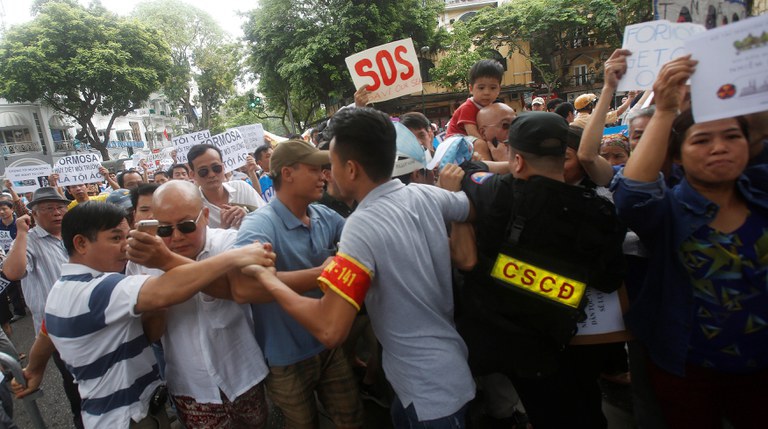
More than a dozen provinces and cities in Vietnam have set up Riot Police Regiments or Battalions to be held in reserve to crack down on people accused of “disturbing public order” and carrying out “illegal demonstrations.” RFA research shows at least 15 provinces and cities had launched forces as of Oct. 10, 2021. They include Ho Chi Minh City, Binh Duong, Binh Phuoc, Dong Nai, Nghe An, Lao Cai, Bac Giang, Thanh Hoa and Gia Lai. The riot squads have been formed to crack down on worker protests at the many industrial parks in southeastern Vietnam, in places such as Ho Chi Minh City, Binh Duong, and Dong Nai. They could also be used to stop demonstrations by ethnic and religious minorities such as the Protestant Ede and Duong Van Minh sect in provinces like Cao Bang and Gia Lai. On Wednesday the Ho Chi Minh City Police held a launching ceremony for its Reserve Riot Combat Police Regiment. State media said the force was established under a ruling by the Ministry of Public Security to set up Reserve Riot Police Battalions in province-level localities. News sites did not publish the full text of the ministry’s Decision No.1984, which called for the regiment’s formation. According to the Công an Nhân dân (People’s Police) online newspaper, the regiments and battalions must be ready to fight in any situation when they receive orders from the Ministry of Public Security or directors of province-level police departments. The Ho Chi Minh City Police Department outlined the riot squad’s duties to the media. They include “preventing and suppressing cases of public disorder and illegal demonstrations,” “conducting rescue operations,” “protecting important political events of the Party and State and [maintaining order during] major holidays,” “ensuring political security, social order and safety of the locality,” and “performing other tasks as required.” Police try to stop protesters demanding clean water in Hanoi on May 1, 2016. CREDIT: Reuters Suppression of protests ‘unconstitutional’ A Ho Chi Minh City-based lawyer, who did not wish to be named for security reasons, said “suppression of unlawful protests” goes against Vietnam’s Constitution. “I think Vietnam doesn’t yet have a Law on Protests, so it can’t be said that demonstrations are illegal,” the lawyer said. “The right to protest is a constitutional right, so repression is unconstitutional.” “The Vietnamese state does not mention a Law on Protests, perhaps because it does not want to because it is afraid people will protest [against it].” A woman, who asked only to be named as Phung, participated in protests against China’s placement of the HD981 oil rig in Vietnam’s Exclusive Economic Zone in 2014. She told RFA the government has been suspending the Bill on Protests for too long. “According to the Vietnamese Constitution, people have the right to protest, but the bill on demonstrations has been frozen for many years,” she said. “Basically, in Vietnam, every protest is suppressed, because they have not passed a bill which would allow people to ask for permission to organize demonstrations like in other countries.” “Article 25 of the 2013 Constitution stipulates that ‘Citizens have the right to freedom of speech, freedom of the press, access to information, assembly, association, and demonstration.’ The exercise of these rights is prescribed by law.” Government drags its heels on protest law In 2013, the government directed the Ministry of Public Security to take primary responsibility and coordinate with relevant agencies to develop a draft Law on Protests. The bill has been repeatedly withdrawn from the National Assembly’s agenda for further study and amendment. In 2017, national legislator Truong Trong Nghia, from Ho Chi Minh City, told the National Assembly that the promulgation of a Law on Protests was necessary in order to implement the 2013 Constitution on ensuring human and citizens’ rights. Since 2018, no National Assembly member or domestic newspaper has mentioned the Bill on Protests. Strengthening the suppression of resistance According to Hanoi-based journalist Nguyen Vu Binh, in Vietnam what is written in the Constitution is one thing, how it is implemented is another. Binh said the establishment of a specialized agency and riot police force is intended to quell all resistance by the people and comes after a series of fierce crackdowns on protests. “Following the trend of increasing repression in the past four-to-five years, the professionalization of these forces to suppress protests and people’s resistance is normal in my opinion,” Binh said. Oil rig protester Phung told RFA the repression and suppression of protests has always taken place in Vietnam. She said Vietnam does not need to sign any more international agreements so the government is not interested in respecting human rights. “At this stage Vietnam does not need to join any treaty or agreement, so they want to deal with [whichever protest] they want. Now they are also bolder,” she said. “I believe that even if a force is formed, they will not use uniformed forces to take action to suppress protesters because that will affect the image of the Vietnamese government. They don’t want to show their true face to the world.” Human Rights Watch’s latest report on Vietnam, published in February, said: “fundamental civil and political rights are systematically suppressed in Vietnam. The government, under the one-party rule of the Communist Party of Vietnam, tightened its grip on the rights to freedom of expression, freedom of association, peaceful assembly, freedom of movement, and freedom of religion.”
North Korean soldiers ordered to harvest grass for compost in spare time
North Korean soldiers in low-level military units have an unusual and not entirely welcome new mission: collecting grass during summer training breaks to produce compost for farms, sources inside the country said. The impoverished and isolated country suffers from chronic shortages of chemical-based fertilizer during the summer growing season, a situation that has grown worse since 2020 because of border closures with China that cut off trade during the coronavirus pandemic. Each year, North Korean citizens are tasked by their government to fill unrealistically high government quotas for fertilizer. But the material they typically collect is human waste, which gets mixed with soil and applied to farm fields. “The dissatisfaction among soldiers is increasing as each unit uses their free time to meet the grass quotas,” a military-related source in North Hamgyong province told RFA on Tuesday. The General Political Bureau of the People’s Army sets grass compost production quotas for all military units each August and September, said the source who declined to be identified so as to speak freely. Each soldier is required to produce 50 kilograms (110 lbs.) of grass daily in order to produce compost, he added. They make natural fertilizer by cutting grass on a nearby mountainside as well as in areas to which they are assigned for their quotas, the military-related source said. “This is all after their daily training,” he said. “As they are required to produce natural fertilizer in their free time after mandatory training, the soldiers are becoming exhausted. The morale of the soldiers participating in the training is declining day by day.” North Koreans cannot understand why authorities are mobilizing soldiers and assigning them to miscellaneous tasks like grass collection for compost, even though they verbally emphasize the importance of their training during the summer months, the military-related source said. They order the soldiers to produce grass-based fertilizer, stressing the importance of providing for the greater society to the benefit of all North Koreans, he said. “The soldiers are confused because they have no idea how to go along with all these different orders,” he said. High-level commands are conducting frequent inspections to encourage the soldiers’ production of grass-based fertilizer, a military-related source in Ryanggang province told RFA on Tuesday. “The staff in each unit is obligated to report the grass-cutting performance of subordinate units,” said the source who declined to be named for the same reason. “Each officer in charge of a unit is struggling to match the daily performance.” Even officers are questioning why authorities are forcing them to produce grass-based fertilizer, he said. “Some military officers are complaining and saying, ‘We should make the military’s main job of training as a side job instead, and change farming to the main job of the military,’” said the source. Earlier this week, RFA reported that North Korean authorities are dispatching veterans and soldiers about to demobilize to collective farms to make up for labor shortages, raising fears among the military ranks that they will be stuck working in rural areas for the rest of their lives. Translated by Claire Shinyoung Oh Lee for RFA Korean. Translated by Roseanne Gerin.
Manila backs Senate bill to officially rename contested waters ‘West Philippine Sea’
The Philippine foreign office said Thursday it was backing legislative efforts to formally rename the country’s portions of the South China Sea as the “West Philippine Sea,” in a move to bolster Manila’s territorial claims in the contested waterway. On Wednesday, Sen. Francis Tolentino announced he had filed Senate Bill 405, a proposed piece of legislation that aims to “institutionalize” the use of “ the West Philippine Sea” as the official name of territories claimed by the Philippines in waters that China and other neighbors also contest. The air space, seabed, and subsoil on the western side of the Philippine archipelago would be renamed “to reinforce the Philippines’ claim to the disputed territories found on the western side of the archipelago,” according to an excerpt from SB405. Maria Teresita Daza, spokeswoman for the Philippine Department of Foreign Affairs, said Tolentino’s bill was consistent with a 2016 international arbitration court’s ruling that sided with Manila. “The West Philippine Sea was already actually defined in 2012 through Administrative Order 29,” Daza told a press briefing on Thursday. “Nevertheless, the department recognizes what the process of legislation can do in terms of clarity and institution building. And we look forward to supporting the process, should we be invited to do so,” she said. Tolentino’s bill covers waters around, within, and adjacent to the Kalayaan Island Group and Scarborough Shoal, as well as the Luzon Sea, or waters also known as the Luzon Strait between the northern Philippine island of Luzon and Taiwan. The Philippine senator said that the proposed legislation came about in response to the “archipelagic doctrine” embodied in the United Nations Convention on the Law of the Sea (UNCLOS). Under it, the Philippines is granted a territorial sea of up to 12 nautical miles, a contiguous zone of up to 24 nautical miles, and an exclusive economic zone of up to 200 nautical miles where the West Philippine Sea is located. The bill also directs government offices to use the name in all communications, messages, and public documents, and “to popularize the use of such [a] name with the general public, both domestically and internationally.” Six years ago, the Philippines won an arbitral award against Beijing before the Permanent Court of Arbitration in The Hague. The landmark ruling nullified China’s expansive claims to the sea region, including in waters that reach neighbors’ shores. Manila had filed the case in 2012, when the Chinese occupied areas near Scarborough Shoal, a triangular chain of rocks and reefs that Filipinos consider a traditional fishing ground. Brunei, China, Malaysia, the Philippines, Taiwan and Vietnam all claim parts of the sea. China, for its part, draws a nine-dash line to delineate its claim of “historical rights” to almost 90 percent of the waterway. The line also overlaps with the exclusive economic zone (EEZ) of another nation – Indonesia. And while the name “South China Sea” has gained near universal acceptance in usage, countries that have claims to the disputed waters have their own different names for it. Vietnam calls the maritime region “the East Sea,” and, to Beijing, it is plainly known as “the South Sea.” In 2017, Indonesia renamed a resource-rich northern region around its Natuna Islands, which lie off the southern end of the South China Sea, as the North Natuna Sea. The waters near the Natunas have seen some tense standoffs in recent years between Indonesian ships and ships from China and other nations, including Chinese coast guard vessels. Jakarta’s decision to change the name of the sea region north of the islands was spurred by the arbitration court’s ruling in Manila’s favor the year before that nullified China’s historical claim to the entire South China Sea through the nine-dash line, Arif Havas Oegroseno, then the deputy of maritime sovereignty at the Ministry of Maritime Affairs, told reporters at the time. Since the arbitration court ruled for Manila in 2016, Beijing has refused to budge from the area around Scarborough Shoal. On Thursday, officials at the Chinese Embassy in Manila did not immediately respond to BenarNews efforts seeking comment on the Philippine bill. The proposed formal name change is a far cry from the policy on the disputed waters implemented by former President Rodrigo Duterte, who did not seek to enforce the ruling when he took office in 2016, but instead pursued warmer ties with Beijing. During his six-year term, Duterte, who left office on June 30, also pulled the Philippines away from the United States, the Philippines’ longtime ally and China’s main rival, until later in his term when he declared that the arbitration award was “beyond compromise.” The U.S. government, meanwhile, has insisted on the doctrine of freedom of navigation and has sailed its navy ships into the contested waters. Duterte’s successor, President Ferdinand Marcos Jr., in his first “state of the nation” address to Congress last month, declared he would not preside over any process that would give away “even one square inch of territory” to foreign rivals. Marcos’ newly appointed military chief, Lt. Gen. Bartolome Vicente Bacarro, told his generals and other military officials during his first command conference on Wednesday that the armed forces supported President Marcos’ pronouncement. “We only do what is required of us to do and what is important is we are able to perform our mandate to protect (the state and) our people,” Col. Medel Aguilar, a spokesman for the military, told reporters. BenarNews is an RFA-affiliated online news service.
