
Category: East Asia

Biden: US will defend Philippines if vessels are attacked
U.S. President Joe Biden said Thursday that American military support for the Philippines was “ironclad,” and any attacks against its vessels in the South China Sea would invoke a 1951 treaty that compels each country to come to the other’s aid in the event of a conflict. The comments came ahead of an unprecedented summit between Biden and his Japanese and Philippine counterparts at the White House. A senior U.S. official said the talks were arranged because of the recent flare-up in tensions between Beijing and Manila in the South China Sea. “I want to be clear, the United States’ defense commitments to Japan and to the Philippines are ironclad,” Biden said at the opening of the meeting. “Any attack on Philippine aircraft, vessels or armed forces in the South China Sea would invoke our mutual defense treaty.” The U.S. has a mutual defense treaty with the Philippines and a military alliance with Japan, both of which were inked in 1951. Chinese coast guard vessels fire water cannons towards a Philippine resupply vessel, the Unaizah, on its way to a resupply mission at Second Thomas Shoal (Ayungin Shoal) in the South China Sea, March 5, 2024. (Adrian Portugal/Reuters) Japanese Prime Minister Fumio Kishida and Philippine President Ferdinand Marcos Jr. said that increased trilateral cooperation between the Pacific nations was borne from their shared democratic values and evidenced by joint military drills in the South China Sea last weekend. “It is a partnership born not out of convenience nor of expediency,” Marcos said, “but as a natural progression of a deepening cooperation amongst our three countries, linked by a profound respect for democracy, good governance and the rule of law.” Water cannon attacks Chinese coast guard vessels have in recent weeks fired water cannons at Philippine boats attempting to supply a deliberately sunken warship that serves as a Philippine naval outpost at the Second Thomas Shoal (Ayungin Shoal), with Beijing also warning Manila against trying to access it. The shoal lies in South China Sea waters within the Philippines’ exclusive economic zone, where Manila holds sovereign rights. But Beijing claims most of the sea as its historic territory and says Manila must ask permission from Chinese authorities to access the area. People protest against the Marcos administration’s 2023 decision to grant the United States greater access to military bases in the Philippines, as they demonstrate in a park near the White House in Washington, where the leaders of the U.S., Philippines, and Japan were holding a summit, April 11, 2024. (BenarNews) Earlier on Thursday, Chinese foreign ministry spokesperson Mao Ning accused Manila of “violating China’s sovereignty” for decades due to the half-sunken BRP Sierra Madre, which was grounded at the shoal in 1999 to maintain Manila’s sovereignty but now needs repairs. Speaking at a daily press briefing, Mao said Chinese authorities were “willing to allow” Philippine vessels to freely access the increasingly dilapidated outpost – but only to “tow” it away, and not repair it. She said Manila needed to inform Beijing of any such plans before accessing the area, and then “China will monitor the whole process.” “If the Philippines sends a large amount of construction materials to the warship and attempts to build fixed facilities and a permanent outpost, China will not accept it and will resolutely stop it in accordance with law and regulations to uphold China’s sovereignty,” Mao said. She added that China’s recent “activities” in the South China Sea, such as the water-cannoning of Philippine vessels, “are in full compliance with international law” and “there’s nothing wrong about them.” ‘Crystal clear’ A senior U.S. official, speaking on condition of anonymity prior to the summit, told reporters that Biden had been “crystal clear” about American military support for Manila, and said the flare-ups with China in the South China Sea were an impetus for Thursday’s summit. USS Mobile, JS Akebono, HMAS Warramunga, BRP Antonio Luna and BRP Valentine Diaz sail in formation during a multilateral maritime cooperative exercise between Australia, the United States, Japan and the Philippines within the Philippines’ exclusive economic zone in the South China Sea, April 7, 2024. (POIS Leo Baumgartner/Royal Australian Navy) “It is one of the reasons for the meeting because we are very concerned about what we’ve been seeing,” the official said. “He has repeated many times that the U.S.-Philippines Mutual Defense Treaty applies to the South China Sea, including Philippine vessels that may be underway there, including its coast guard vessels,” the official said. Another U.S. official added that Philippine and Japanese coast guard officers would be welcomed aboard U.S. Coast Guard ships during a maritime exercise later this year “to further train and synchronize our work together” in case of a future attack that sparks a conflict. Philippine activists protesting outside the U.S. Embassy in Manila on April 11, 2024, warned that a Washington summit between the leaders of the Philippines, United States and Japan could provoke an angry response from China over the South China Sea and threaten regional stability. (Gerard Carreon/BenarNews) The two officials also said the United States would help fund a major infrastructure project in the Philippines known as the Luzon corridor, as part of the Partnership for Global Infrastructure and Investment, which is the U.S. answer to China’s high-spending Belt and Road Initiative. The Luzon corridor, they said, would help connect Subic Bay, Clark, Manila and Batangas in the Philippines, with investments in infrastructure “including ports, rail, clean energy, semiconductor supply chains and other forms of connectivity in the Philippines.” “We stand shoulder-to-shoulder with Marcos,” one of the officials said, “ready to support and work with the Philippines at every turn.” U.S. President Joe Biden hosts Philippine President Ferdinand Marcos Jr. and Japan Prime Minister Fumio Kishida for a summit of the three nations’ leaders at the White House, in Washington, April 11, 2024. (Kevin Lamarque/Reuters) In his final remarks before talks opened behind closed-doors Thursday, Biden said the newfound cooperation between the United States, Japan and the Philippines would be a boon…

In China, drones, social media monitor foreign journalists: report
Chinese authorities use drones to monitor and follow foreign journalists as they report from the country, as well as detaining, harassing and threatening them with non-renewal of their work permits if they report on topics deemed sensitive by the government, according to a new report on journalists’ working conditions. Four out of five members who responded to the Foreign Correspondents’ Club of China annual working conditions survey said they had experienced “interference, harassment or violence” while trying to do their jobs in China during the past year, the FCCC report found. Local governments are increasingly using technology to keep track of foreign media workers, the report found. “During a trip to Poyang Lake, where we were reporting on the status of the Yangtze River dolphin, we were followed by multiple cars with plainclothes individuals inside,” the report quoted a journalist with a European media organization as saying. “At one point, the plainclothes individuals appeared to use a drone when a blocked sandy road prevented them from getting closer by car,” they said. A cameraman from Hong Kong Cable TV is restrained from photographing the crowd waiting to buy tickets for the 2008 Beijing Olympics, July 25, 2008, in Beijing, China. (Robert F. Bukaty/AP) Another European journalist reported similar high-tech surveillance when on a reporting trip to two provinces affected by extreme weather events linked to climate change. “We were followed by multiple carloads of plain clothes officers,” the report quoted them as saying. “Drones were sent out to follow and observe us when we got out of our vehicle to film/collect interviews. When we moved on foot to a spot, the drones would follow us.” Respondents also told the FCCC they had reason to believe the authorities had “possibly or definitely” compromised their WeChat (81%), their phone (72%), and/or placed audio recording bugs in their office or homes, the report found. ‘Endless cat-and-mouse game’ Another journalist with a European newspaper described reporting in China as “an endless cat-and-mouse game.” “Whatever strategy you try, the Chinese surveillance and security system adapts and closes the gap,” the report quoted them as saying. “Whatever strategies you use, the space for reporting keeps getting smaller and smaller.” A foreign reporter of many years’ experience in China who gave only the surname Lok for fear of reprisals told RFA Cantonese that she expects her communications apps to be monitored at all times. “I was talking about an issue with a friend here [in mainland China] … and may have mentioned it on WeChat,” Lok said. “Later, he was called in by the police to ‘drink tea’” – a euphemism for being called in for questioning. Journalists crowd a National People’s Congress press conference a day before the opening of the annual session of China’s parliament, in Beijing’s Great Hall of the People on March 4, 2019. (Greg Baker/AFP) “It turned out that the problem wasn’t him, but the conversation he had with me,” she said. “We have to be careful, because a lot of trouble has come from talking to people on WeChat.” A second Hong Kong journalist who gave only the surname Wong for fear of reprisals said it used to be easier for journalists to evade official surveillance than it is now. “The Chinese government’s digital surveillance methods are comprehensive,” Wong said. “You could describe them as a dragnet, in which every move the target makes is visible to them.” Online surveillance Huang Chao-nien, an assistant professor at the National Development Institute of Taiwan’s National Chengchi University, agreed, adding that the government has used online surveillance to target journalists for years. The government has long used an internet development model that intervenes in the market to control tech companies … forcing them to cooperate with the government in carrying out political surveillance and controls on public speech, he said. More than half of the journalists who took part in the FCCC annual survey said they had been “obstructed” at least once by police or other officials, while 45% encountered obstruction by unidentified persons, the report said. Some had been warned not to join the club as it was deemed an “illegal organization,” while others were threatened with non-renewal of their visas and work permits if they didn’t toe the line, the report said. Areas deemed particularly sensitive by Chinese officials were even harder to work in, it said, adding that 85% of journalists who tried to report from the far western region of Xinjiang in 2023 experienced problems. “In Xinjiang we were followed the entire time,” the report quoted a European journalist as saying. “It was particularly unpleasant in Hotan, where we counted about half a dozen plainclothes following us by car or on foot.” “In Korla, we at some point had six cars following us. When we did a U-turn and then a detour over an abandoned construction site and dust road, they all faithfully followed us,” the journalist said. Chinese policemen manhandle a photographer, center, as he photographs a news event near the No. 1 Intermediate People’s Court, in Beijing Sunday, Jan. 26, 2014. (Andy Wong/AP) And the definition of “sensitive” areas appears to be expanding. “An increasing number of journalists encountered issues in regions bordering Russia (79%), Southeast Asian nations (43%) or in ethnically diverse regions like Inner Mongolia (68%),” the report said. More than 80% said potential sources and interviewees had declined to be interviewed because they didn’t have prior permission from their superiors to speak to foreign media. Fear of reprisals is even being felt among experts, pundits and commentators, the report said. “Academic sources, think tank employees and analysts either decline interviews, request anonymity, or don’t respond at all,” it quoted respondents as saying. Translated with additional reporting by Luisetta Mudie. Edited by Malcolm Foster.
Philippines’ Marcos denies ‘gentleman’s agreement’ with Beijing over South China Sea
Philippine President Ferdinand Marcos Jr. on Wednesday denied the existence of a “gentleman’s agreement” between his predecessor, Rodrigo Duterte, and China that Manila would not make repairs to a rusting military outpost in a disputed shoal in the South China Sea. Duterte’s former spokesman, Harry Roque, has said the previous Philippine government entered into a deal with Beijing to keep the “status quo” in the waterway, which has become the scene of increasingly tense confrontations between the two nations. As part of the deal, Duterte allegedly agreed the Philippines would not send construction materials to repair the BRP Sierra Madre, a dilapidated World War II-era naval ship that was deliberately run aground on Second Thomas Shoal in 1999. “We don’t know anything about it,” Marcos told reporters before leaving for talks with U.S. President Joe Biden and Japanese Prime Minister Fumio Kishida in Washington “There is no documentation, no record. We were not briefed [about it] when I came into office, no one told us that there was that agreement.” Marcos said his staff were demanding information from ex-Duterte officials, but “we still haven’t got a straight answer.” “I am horrified by the idea that we have compromised through a secret agreement, the territory, sovereignty and sovereign rights of the Philippines,” Marcos said. Since taking office in June 2022, Marcos has reversed Duterte’s pro-China policies, realigning with the United States and granting American troops greater access to Philippine bases. Duterte has not directly commented on the supposed deal, but the Chinese embassy in Manila has alluded to it on a number of occasions after Chinese vessels have been accused of harassing Filipino supply boats heading to the Sierra Madre. China claims nearly all of the South China Sea, while disregarding overlapping claims from Brunei, Malaysia, the Philippines, Vietnam and Taiwan. Last week, Chinese Foreign Ministry Spokesperson Wang Wenbin said Manila “has been going back on its words and provoking China” over Second Thomas Shoal, without directly mentioning any agreement. Roque has not replied to requests for comment made by RFA affiliate BenarNews, but he has been quoted widely in local media saying he stands by his earlier statement. “The gentleman’s agreement is to respect the status quo on the entire West Philippine Sea dispute,” he said, referring to the portion of the South China Sea within Manila’s exclusive economic zone. As Marcos left on Wednesday afternoon for Washington, the Philippine military reported that some 48 Chinese vessels – mostly from its maritime militia – were being monitored near another disputed outcrop, Scarborough Shoal, and three Philippine-occupied features in the South China Sea. BenarNews is an RFA-affiliated online news organization.

China gives monks a list of things they can’t do after the Dalai Lama’s death
In the event of the Dalai Lama’s death, Buddhist monks are banned from displaying photos of the Tibetan spiritual leader and other “illegal religious activities and rituals,” according to a training manual Chinese authorities have distributed to monasteries in Gansu province in China’s northwest, a source inside Tibet and exiled former political prisoner Golok Jigme said. The manual, which lists 10 rules that Buddhist clergy should follow, also forbids disrupting the process of recognizing the Dalai Lama’s reincarnation, said the source from inside Tibet who requested anonymity for safety reasons. Tibetans believe they should determine his successor in accordance with their Buddhist belief in reincarnation, while the Chinese government seeks to control the centuries-old selection method. The 14th Dalai Lama, 88, fled Tibet amid a failed 1959 national uprising against China’s rule and has lived in exile in Dharamsala, India, ever since. He is the longest-serving Tibetan Buddhist spiritual leader in Tibet’s history. The manual, which was seen by Radio Free Asia and was issued to monks in Kanlho Tibetan Autonomous Prefecture in the historical Amdo region of Tibet, is the latest effort by Beijing to crack down on the religious freedom of the Tibetan people, experts and rights groups say. A screenshot of the page in a Chinese government-issued training manual listing 10 rules for Tibetan Buddhist monks to follow in the event of the Dalai Lama’s death. (Citizen journalist) It is part of Beijing’s systematic attempts to make Tibetan Buddhists more loyal to the Chinese Communist Party and its political agenda rather than to their religious doctrine, said Bhuchung Tsering, head of the research and monitoring unit of International Campaign for Tibet in Washington. “This goes against all tenets of universally accepted freedom of religion of the Tibetan people that China purports to uphold,” he told RFA. China has imposed various measures to force Tibetan monasteries to conduct political re-education and has strictly prohibited monks and ordinary Tibetans from having contact with the Dalai Lama or Tibetans in exile, whom Beijing sees as separatists. The Chinese government has intensified its suppression of Tibetan Buddhism in the Tibetan Autonomous Region and in other Tibetan-populated areas in China in recent years. “The latest government campaigns against the Dalai Lama and Tibetan Buddhists’ religious practices in Gansu province represent another attempt by the Chinese government to interfere in the Dalai Lama’s reincarnation process,” said Nury Turkel, a commissioner on the bipartisan U.S. Commission on International Religious Freedom, or USCIRF. Turkel called on the U.S. government to sanction Chinese officials who violate religious freedom. ‘Separatist ideology’ The manual also says monks are forbidden to engage in activities that undermine national unity, hurt social stability in the name of religion or require cooperation with separatist groups outside the country, the source said. It says no illegal organizations or institutions will be allowed to enter monasteries and that the education system for monks cannot harbor elements of “separatist ideology.” He Moubou (C), secretary of China’s State Party Committee, visits Tibetan monks in Machu County, Kanlho Tibetan Autonomous Prefecture, in China’s Gansu province, March 19, 2024. (Citizen journalist) The rules also prohibit the promotion of “separatist ideas” and the dissemination of “separatist propaganda” via radio, internet and television or by other means, and forbids deception in the form of open or covert fraud, the source from inside Tibet said. “While the Chinese government implements various political education and activities targeting Tibetans, the primary focus seems to be eradicating Tibetan identity through the dismantling of Tibetan religion and culture,” said Golog Jigme, who was imprisoned and tortured by Chinese authorities in 2008 for co-producing a documentary on the injustices faced by Tibetans under Chinese rule. He now lives in Switzerland and works as a human rights activist. There are 10 Tibetan autonomous prefectures in Chinese provinces bordering Tibet, including ones in Gansu, Sichuan, Qinghai and Yunnan, where many ethnic Tibetans live. Kanlho Tibetan Autonomous Prefecture in Gansu province, where authorities distributed the manuals, is home to about 415,000 Tibetans speaking the Amdo dialect. The province has about 200 large and small monasteries under its administration. During a visit to two counties in Kanlho Tibetan Autonomous Prefecture in March, He Moubao, secretary of China’s State Party Committee emphasized the need for Tibetans to Sinicize religion and to implement the Chinese Communist Party’s policy on religious work. Monks should be guided in this regard to maintain national unity and social stability, he said. A Tibetan Buddhist monk holds two Chinese government textbooks on religious policies and laws and regulations given to monks at a monastery near Xiahe in China’s Gansu province, May 8, 2008. (Ng Han Guan/AP) “Communist China egregiously violates the religious freedom in Tibet by Sinicising Tibetan Buddhism to fulfill its political and ideological goals and agenda,” said former USCIRF Chair Tenzin Dorjee. “To say that no one can lawfully practice Buddhism after His Holiness the Dalai Lama passes away is an indication of imposing more religious repressions in Tibet later,” he told RFA. China, which annexed Tibet in 1951, rules the western autonomous region with a heavy hand and says only Beijing can select the next spiritual leader of Tibetan Buddhists, as stated in Chinese law. Tibetans, however, believe the Dalai Lama chooses the body into which he will be reincarnated, a process that has occurred 13 times since 1391, when the first Dalai Lama was born. At his home in Dharamsala earlier this month, the Dalai Lama, whose given name is Tenzin Gyatso, told a gathering of hundreds of Tibetans during a long-life prayer offering to him that he was in good health and was “determined to live for more than 100 years.” He has said on several occasions that his successor would come from a free country without Chinese interference. Translated and edited by Tenzin Pema for RFA Tibetan. Edited by Roseanne Gerin and Malcolm Foster.

Arakan Army’s gains enough to enable self-rule in Myanmar’s Rakhine state
The Arakan Army, or AA, is continuing their sweep across Rakhine, furthering the military gains of the ethnic Three Brotherhood Alliance, of which it is a member, in Shan state. While the capture of nine towns, with a tenth in southern Chin state, is another humiliating defeat for the Burmese military, it also sets the scene for a very messy political discussion moving forward. Myanmar’s military continues to be on their back feet. The Kachin Independence Army continues to make gains, recently securing control over a major trade route with China, after seizing the last of the military camps along the Bhamo-Myitkyina highway. The once staunchly pro-junta border guards forces in Kayin state are now hedging their bets and putting some distance between themselves and Naypyidaw. Meanwhile, the junta’s announced counter-offensive out of Lashio against the Ta’ang National Liberation Army and Myanmar National Democratic Alliance Army – the other two members of the Three Brotherhood Alliance – in northern Shan State has not materialized. But it’s in Rakhine where the military has been handed its most significant territorial defeats. The AA has captured six of Rakhine’s 17 townships and several smaller towns since launching an offensive on Nov. 13, 2023, with ongoing offensives against several others. As of early April, the AA had captured some 170 junta camps and posts, as well as several larger bases, battalion headquarters, and training facilities. Arakan Army soldiers stand with an artillery piece after capturing the Ta Ron Aing base in Chin state from junta forces, Dec. 4, 2023. (AA Info Desk) The capital of Sittwe is surrounded, and many civil servants have been withdrawn. The Chinese special economic zone in Kyaukphyu is on the verge of falling, prompting the United League of Arakan, the AA’s political wing, to publicly pledge to protect all foreign direct investment that benefits Rakhine and “ensure the smooth continuation of their operations.” At present, China’s US$8 billion investment, which includes their oil and gas pipelines and a proposed deepwater port with rail and road links, can only be accessed by sea. As a recent International Institute for Strategic Studies report concluded: “But no matter the final outcome, the AA’s sweeping gains are already enough to enable self-rule over a large portion of the Rakhine homeland and to reshape the wider balance of power in Myanmar.” Little leverage over AA in Rakhine On April 1, 2024, China’s special representative to Myanmar, Deng Xijun, met with junta chief Senior Gen. Min Aung Hlaing in Naypyidaw to try to broker a ceasefire. While the Chinese-brokered ceasefire between the Three Brotherhood Alliance and the military regime is tenuously holding in northern Shan state, the AA refuses to be bound by it in Rakhine. China has less leverage over the AA, which has shown no interest in halting their offensive. The AA has stated their intention to capture the entire state, not just their traditional heartland in the north, though it’s not clear that they have the manpower and resources to do so. Over-reach could spread their forces too thin. The AA is in the midst of an offensive in Ann township, which is not just the headquarters of the military’s Western Command, but the key junction on the road to Magwe region. The loss of Ann would make overland resupply to northern and central Rakhine extremely difficult. Overland supply could only come in through the highway from Bago region’s Pyay township in the south. The military has responded in typical fashion, with more indiscriminate air and long-range artillery strikes against unarmed civilians. In a two-day period in early April, six civilians were killed and 16 were wounded. RFA Burmese reported that some 79 Rohingya civilians have been killed and 127 more have been wounded in the past four months. The junta has commenced implementation of its national plan to conscript some 5,000 people a month, including amongst ethnic Rohingya in Rakhine, despite the assassination of local administrators. People who appear to be Rohingya Muslims in Rakhine state undergo weapons training by junta military personnel on March 10, 2024. (Image from citizen journalist video) This is a perverse irony after the military waged an ethnic cleansing campaign that drove 1 million ethnic Rohingya, whom they refer to as “illegal Bengalis,” into Bangladesh, and kept many others in concentration camps. Poorly armed and trained conscripts have limited military utility, indicating the military’s desperation for manpower. Role of Rohingya conscripts But the Rohingya conscripts play a much more important role in fomenting political strife within the opposition camp. The Buddhist-dominated Arakan Army has a tense relationship with the Rohingya population. It has tenuously accepted the shadow National Unity Government’s position that the Rohingya are legal citizens and that they should be returned to the country from Bangladesh in an orderly fashion. There have been a number of reports that the military is reaching out to the Arakan Resistance Solidarity Army, or ARSA, whose misguided raids on border posts and police stations in 2017 were the casus belli for the military’s ethnic cleansing campaign. Since being driven into Bangladesh, ARSA’s primary activities have been to secure control over the refugee camps and eliminate rivals within the Rohingya community; they have not participated in the armed rebellion. That the military believes that they can recruit ARSA as a proxy against the AA seems preposterous. The AA is neither willing to share any political power in Rakhine nor countenance the presence of any other armed actors. So there is a perverse logic to the military’s overtures to ARSA, which is searching for relevance. With mounting battlefield losses, the best that the military can do is to strike up ethnic and sectarian tensions. This should come as no surprise: stoking communal tensions has always been a key party of their strategy. An airstrike by Myanmar junta forces destroyed houses in Minbya township’s Myit Nar village in Rakhine state on April 3, 2024. (Arakan Princess Media) Indeed, the United Nations’ Independent Investigative Mechanism for Myanmar, which was established following…

Netflix’s take on ‘Three-Body Problem’ gets mixed reviews in China
A Netflix adaptation of Chinese sci-fi author Liu Cixin’s “The Three-Body Problem” has sparked mixed reactions in China, with some complaining of a lack of nuance, that much of the action takes place outside of China and that key characters are played by non-Chinese actors. But others praised it as a well-made adaptation for Western audiences and had made improvements in female characters. The show, which premiered on March 21 just as a man was sentenced to death for fatally poisoning one of its producers, billionaire Lin Qi, was Netflix’s most-watched English TV show from March 25-31. It features scenes of a political “struggle session” from the Cultural Revolution under the rule of late supreme leader Mao Zedong, in which physicist Ye Zhetai is beaten to death by Red Guards after being denounced by his own wife, for teaching the Big Bang theory and therefore failing to deny the existence of God. The scenes — omitted from a homegrown adaptation of Liu’s books produced by Tencent — are likely one of the reasons that the show is officially blocked in China. But viewers in China still discussed it widely after using circumvention tools to get around the “Great Firewall” of government censorship. Violence under Mao Reports emerged on social media in January that the show would likely be blocked on the orders of the ruling Chinese Communist Party’s Central Propaganda Department. While RFA was unable to confirm those reports independently, the political violence of the Mao era remains a highly sensitive topic for the government today, and has gotten other films and TV shows banned before. Publicity still for the Tencent adaptation “Three Body.” (Baidupedia) Nonetheless, enough people were able to see the show to discuss and search for “Three Body beating/hanging scene” on the Weibo social media platform, according to trending searches spotted by RFA this week. The hashtag #3BodyProblem# garnered billions of views on Weibo, according to The Guardian newspaper, and notched up a 6.9/10 score on Douban’s review site, compared with an 8.7 score for Tencent’s Chinese-made version of the show, which premiered in January. Mixed reviews Some appear to have been underwhelmed by the show, which transplants a good deal of the action to the United Kingdom, and changes the genders, ethnicities and names of several major Chinese characters in the book. One post complained that all of the best Chinese male leads had been given to non-Chinese actors. The show’s producers have said they wanted the whole world to be depicted. Douban user Victor’s Catzz described the Netflix version as “quite good,” adding that it improves considerably on Liu Cixin’s writing of female characters and foreigners, which he thought was “a mess anyway.” “What’s wrong with Netflix making reasonable adaptations for English-speaking audiences?” the user wrote in a post titled “A minority opinion.” @Rick Ro$$ from Shaanxi disagreed, commenting: “Netflix has switched up a lot of the ideas in the original work. Those ideas were precisely the essence of The Three-Body Problem.” One comment thought pro-Beijing “little pinks” had hijacked the show’s rating on public review sites, while others argued over whether the characters were more two-dimensional in the Chinese-made TV show or in the Netflix version. @engauge commented from Guangdong that the “melodrama” in the Netflix version had glossed over the “global vision and apocalyptic background to the political and social turmoil in the original work.” Sichuan user @Drunken_and_dreamed_98147 wanted to know why, if the show’s setting had been transplanted elsewhere, the writers had kept the Cultural Revolution scenes. “Why not change that era to show discrimination against black people in America?” the user wanted to know. “Wouldn’t that satisfy foreign requirements for political correctness even more?” Cultural Revolution Alexander Woo, executive producer of Netflix’s version of “The Three-Body Problem,” told The New York Times in a recent interview that scenes of the 1966-76 Cultural Revolution held a special meaning for him as his family lived through that era, as did the family of the episode’s director Derek Tsang. “We give a lot of credit to him for bringing that to life,” Woo told the paper. “He took enormous pains to have every detail of it depicted as real as it could be. I showed it to my mother, and you could see a chill coming over her, and she said, ‘That’s real. This is what really happened.’” Publicity still from Netflix’s “The Three-Body Problem” (Netflix) Tsang told RFA’s Cantonese service in an interview in January that he felt the depiction of the Cultural Revolution was a key part of the show. “It is becoming increasingly difficult to depict that period in any way [in China],” he said. “But it is a very important part of history.” “If we are honest, we can all learn from it if we face up to it and take it seriously. It’s important to show everyone how ridiculous that period was,” Tsang said. U.K.-based writer Ma Jian said one of the reasons that the Cultural Revolution is still so sensitive in today’s China is that President Xi Jinping is drawing on Mao Zedong’s playbook even now, prompting fears that he is going to drag the country back to that era. “Xi Jinping wants a return to the Cultural Revolution, and to imitate Mao Zedong,” Ma said. “[But] the whole world has seen through the horror of totalitarianism.” Translated with additional reporting by Luisetta Mudie. Edited by Malcolm Foster.
Ethnic army seizes city on Myanmar-China border
An ethnic army captured a town near the Chinese border, less than a week after officials met in Myanmar’s capital to discuss cooperation between the two countries, residents told Radio Free Asia on Friday. Myanmar’s military junta, which seized all major governmental seats in a 2021 coup d’etat, invited a Chinese envoy to Naypyidaw on Monday to discuss the Kachin Independence Army’s mass seizure of military camps and subsequent fighting on the border. Some border gates in Kachin state have still not been reopened, political analysts and residents told RFA. The rebel group has captured 60 junta camps since fighting began on March 7 and now controls portions of two major trade routes in Myanmar’s northern Kachin state, one of which runs along China’s border. The Kachin Independence Army, headquartered in border town Lai Zar, captured another major city nearly 160 kilometers (100 miles) south on Thursday. Rebel troops have occupied the city since March 29, but were not able to negotiate the junta’s surrender until Thursday, Lwegel residents said. All administration departments under the junta have been sealed off and their staff have left the city, a resident told RFA on Friday, adding that Kachin troops are now deployed throughout the city. “The city has been seized. Kachin Independence Army troops have arrived in the city,” he said. “All administrative departments have been closed, and Kachin national flags were seen in some places. Soldiers and the police are still trapped.” In addition to Kachin national flags hanging on the General Administration Department, market and hospitals in the city, they have also issued notices that only authorized personnel will be allowed at border gates and administrative departments, he added. Soldiers and other military personnel in Lwegel have been relegated to a junta base nearby. RFA contacted Kachin state’s junta spokesperson Moe Min Thein for comment on the military’s surrender, but he did not respond by the time of publication. Kachin Independence Army information officer Col. Naw Bu told RFA that although the former administration staff had left, the anti-junta group’s administrative processes had not yet started in the city’s 21 government offices. Translated by RFA Burmese. Edited by Kiana Duncan and Mike Firn.
North Korean no-no: Carrying bags on your shoulder
In North Korea, carrying a bag with a strap on your shoulder can get you in trouble – because that’s the way they do it in the capitalist South. Instead, true socialists carry bags on their back or in one hand, people are told, sources in the reclusive country said. It’s the latest example of authorities controlling even the personal details of North Koreans’ lives. Women are told they can’t wear shorts, people are punished for using loan words from English, which they may have learned from South Korean TV dramas that get smuggled into the country on thumb drives, and couples getting married are strongly discouraged from holding wedding banquets or even clinking wine glasses at the reception. Most of these no-nos come under the draconian Rejection of Reactionary Thought and Culture Law, which aims to root out an invasion of so-called capitalist behavior. Bag violators can have their bags confiscated, be kicked out of school or even sent to labor centers for daring to tote their loot close to their hips, sources say. “A patrol organized by the Socialist Patriotic Youth League cracked down on a college student who wore a bag on their side at the main gate of Hamhung Medical University,” a resident of the eastern province of South Hamgyong told RFA Korean on condition of anonymity for security reasons. “This is the first case of a crackdown on college students for how they carry bags.” He said that the crackdown will continue until April 15, the Day of the Sun, a major holiday in North Korea that commemorates the life of leader Kim Jong Un’s grandfather, national founder Kim Il Sung. Fashion item Bags are one of the few ways that North Korean youths can express their individuality. Prior to the 1990s, the government provided all school supplies, including backpacks for students. This ended with the collapse of the Soviet Union. Aid from Moscow dried up, ruining North Korea’s centrally planned economy and throwing the country into the “Arduous March,” which is what North Koreans call the 1994-1998 famine that killed hundreds of thousands of people. Since then, it fell on the students to provide their own bags, which have become a fashion item of sorts. To counter this tendency, authorities supplied backpacks to students in elementary, middle and high schools this year but were not able to provide backpacks to all incoming college and university students because of production shortages. So the crackdown instead puts the burden on the students to appear uniform. But young people are influenced by South Korean TV shows and movies, which are illegal for them to watch. “College students prefer to wear shoulder bags with long straps on their side because they often watch South Korean TV shows,” a resident of the western province of South Pyongan told RFA on condition of anonymity for personal safety. She said that the administration at Pyongsong University of Education and Teachers Training College announced at the school’s opening ceremony that from now on, anyone carrying a bag on their side would be punished for spreading the culture of the South Korean “puppets,” a demeaning term for its southern neighbor that alludes to its close ties with the United States. Translated by Claire S. Lee. Edited by Eugene Whong and Malcolm Foster.
Arab politicians praise China’s policies in Xinjiang
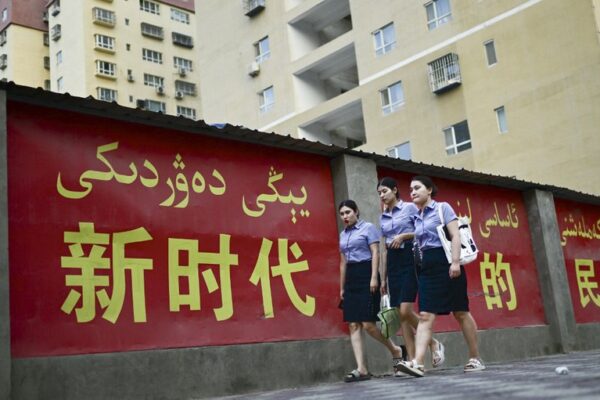
A delegation of Palestinian and other Arab politicians praised China’s policies in Xinjiang during a visit to the northwestern region, sparking criticism from experts and Uyghur rights advocates for not highlighting the plight of fellow Muslims living in the region. The delegation was led by Bassam Zakarneh, a member of Fatah’s Revolutionary Council of Palestine and made up of politicians from Syria, Egypt, Lebanon, Iraq, Yemen, Jordan and Tunisia, according to a report by the Global Times. On March 27, Xinjiang’s Communist Party chief Ma Xingrui welcomed them to Urumqi, the regional capital. The goal of the visit, according to a Xinjiang Daily report, was to present a comprehensive understanding of the situation in Xinjiang and convey a narrative of a peaceful and vibrant region to the international community. That’s in sharp contrast with the United States and some Western parliaments, which have accused China of carrying out a genocide against the 11-million-strong Uyghurs who live in Xinjiang – a region taken over by Chinese Communists in 1949 – by imprisoning, torturing and sterilizing those who do not fall into line. Beijing has denied the claims and said that alleged concentration camps are in fact vocational training centers that have since been closed. To the visiting delegates, Ma touted the region’s development, stability and guarantee of human rights for all ethnic groups, and accused the United States and the West of spreading lies, according to Chinese media reports. “Their objective is to restrict and control China through Xinjiang,” Ma was quoted as saying. ‘See it for yourself’ During their meeting with Ma, the delegation praised China’s creative governance measures and “unprecedented progress in economic development,” the Xinjiang Daily said. The delegation head said that “people of all ethnic groups live a good life, enjoy full freedom of religious belief, and have smiles on their faces,” according to the report, which didn’t provide the names of who spoke or any direct quotes. Women walk past a propaganda slogan promoting ethnic unity in “the new era”, in both Chinese and Uyghur languages, in Yarkant, Xinjiang region, July 18, 2023. (Pedro Pardo/AFP) The paper went on to say that the delegation said the United States and other Western nations are “smearing” China’s Xinjiang policy and fabricating rumors. “Why not come and see it for yourself?” the delegates said, according to the Xinjiang Daily. “We will tell more people what we saw and heard in Xinjiang, China, so that Arab countries can better understand the real Xinjiang, China.” But experts on the region said China orchestrated what the delegates would and wouldn’t see during their visit so as to conceal the persecution of the Uyghurs. The visitors should have been allowed to speak directly and freely with Uyghur Muslims living in the region, said Robert McCaw, director of the Government Affairs Department at the Council on American-Islamic Relations. “Apparently, China wants to reach out to these leftist movements in the Arab world, and China wants to use them as its own propaganda,” said Mustafa Akyol, senior fellow at the Cato’s Institute’s Center for Global Liberty and Prosperity. “The Arab world should not be influenced by China.” Political dynamics at play China has used such visits to Xinjiang to win over other Muslim groups – and push them away from the United States and other Western powers, experts say. It has also supported the Palestinians, as it seeks to expand its influence in the Middle East. Ten 10 months ago, Palestinian President Mahmoud Abbas told Chinese President Xi Jinping during a visit to Beijing that he believed the Xinjiang issue, often framed as a human rights concern, was in fact a battle against terrorism, extremism and separatism. And last August, China invited delegates from the 57-nation Organisation of Islamic Cooperation to visit Xinjiang, in a bid to promote its rosy narrative about the peace and prosperity enjoyed by Uyghurs and blunt international criticism. “China seeks to build consensus and strengthen its global influence,” said Ma Ju, an ethnic Muslim Hui scholar based in the United States. Meanwhile, Muslim nations may be unwilling to criticize China because they need its political support and investment, experts said. Although some Muslim countries have endured a painful history under Western colonialism, they may be willing to overlook that China has effectively colonized the Uyghur homeland, Ma said. “For them, the primary concern seems to be finding a method to counter the influence of the U.S. and the West,” he said. Translated by RFA Uyghur. Edited by Roseanne Gerin and Malcolm Foster.

Schools in North Korean province remain closed amid respiratory outbreak
A resurgence of a respiratory illness believed to be caused by coronavirus has caused some elementary schools and childcare facilities in North Korea to remain closed past April 1, which should have been the starting date of the new school year, residents in the country told Radio Free Asia. RFA reported that in early March, at least five children in the northern province of Ryanggang had died of a respiratory disease that had symptoms similar to COVID-19. The province shuttered all daycares and schools and returned to an emergency quarantine posture that had been in place nationwide during the worst of the pandemic. While middle and high schools will start as scheduled, for elementary schools and daycares, the lockdown – which was supposed to have lasted for only 10 days – is continuing into April. When April 1 was drawing near, authorities decided to postpone the school year, a resident of the province told RFA Korean on condition of anonymity for security reasons. “The main cause of infection circulating these days is called mycoplasma which is similar to coronavirus and is known to be fatal to children,” he said. Mycoplasma is a form of bacteria that can cause a type of mild pneumonia that has symptoms like sore throat, cough and fever, and can be treated with antibiotics. Though mycoplasma infections have symptoms that overlap with COVID-19, the latter is caused by a virus, and cannot be treated with antibiotics. U.N. medicine Furthermore, the resident said that North Korean medicine is ineffective and the disease must be treated with medicines supplied by the United Nations, which the government sells for profit. “The U.N. medicines are so expensive that ordinary residents cannot even think of buying them,” he said. “Even if your child has a high fever and is sick, you can’t buy the U.N. medicines in the pharmacy, so you will end up letting your child go.” Staff of the Pyongyang Primary School No. 4 clean stairwells in Pyongyang, North Korea June 30, 2021. (Cha Song Ho/AP) According to the source, an antipyretic injection to reduce fever costs 15,000 won (US$1.76) – a huge sum for most North Koreans. The resident said that for residents, it is maddening that the government is not taking a more active role in trying to cure those who have fallen ill, and have only postponed the school year. “Since children have died because of their high fevers, the residents are raising their voices against the authorities urging them to treat infected patients with the U.N. medicine instead of selling it,” he said. In 2020, North Korea waited until June 1 to start the school year due to the pandemic, then declared an early vacation in July as conditions worsened. There is no telling when the daycare centers and elementary schools will reopen this year, another Ryanggang resident said on condition of anonymity to speak freely. “Today is supposed to be the first day of the new school year for students enrolling in school or entering a new grade,” she said. “Young students who graduated from kindergarten this year and should be entering elementary school for the first time are really disappointed.” She said that many parents are shocked by the delay, and many think that the number of students affected by COVID-19 and mycoplasma must be high if they are taking such measures. Translated by Claire S. Lee. Edited by Eugene Whong and Malcolm Foster.
