Fate of junta officers unclear following surrender to rebels in Myanmar’s Shan state

Speculation is swirling over the fate of six brigadiers-general from the Burmese military following their surrender of a strategic Shan state city to ethnic rebels earlier this month in a humiliating setback to the ruling junta. The six were commanding officers deployed in the junta’s Kokang regional command center at Laukkai, the largest base in northern Shan state near the Chinese border. The base was overrun on Jan. 4 by the Myanmar National Democratic Alliance Army, or MNDAA, prompting 2,100 soldiers in the facility to lay down their arms. Soldiers and family members were permitted to leave by the rebels. Sources close to the military told RFA Burmese that on Jan. 6, the six generals were flown by helicopter to the Northeast Regional Military Command headquarters, and later sent to the capital Naypyidaw.  The sources spoke on condition of anonymity due to security concerns. AFP, citing an unnamed military source, said the six generals had been taken into custody. The Irrawaddy online news journal on Tuesday cited unnamed “junta sources” as saying that three had been sentenced to death, and three jailed for life. The sources said the six had been charged under military law for “shamefully abandoning” their posts. RFA could not immediately confirm the sentences. AFP on Tuesday quoted the junta spokesman Maj. Gen. Zaw Min Tun as saying there was “no sentence for the six brigadier-generals yet.” The officers were identified as Brigadiers-General Moe Kyaw Thu, the head of Laukkai headquarters; Tun Tun Myint, the acting chief of the Kokang Self-Administered Zone; and Zaw Myo Win, commander of the 55th Division; and Aye Min Oo, Thaw Zin Oo, and Aung Zaw Lin – the heads of Operation Centers 14, 16, and 12, respectively. Sentences may have repercussions Analysts said that stiff sentences for the generals could have major repercussions within the military. Zachary Abuza, a professor at the National War College in Washington and an adjunct at Georgetown University, called the reported sentences “extremely draconian,” adding that, if true, they are “likely to cause an enormous backlash within the senior officer corps,” particularly if they were simply following orders from Naypyidaw. Regardless, he said, “no amount of scapegoats will make up for the SAC’s gross incompetence in managing the economy and war effort,” using an acronym for the official name of the junta, the State Administration Council. This photo taken on Dec. 10, 2023 shows members of the Mandalay People’s Defense Forces on patrol amid clashes with Myanmar’s military in northern Shan State.(AFP) Former Captain Aung Myo Khat, who now advises Myanmar’s resistance forces as part of the anti-junta Civil Disobedience Movement, agreed that the officers had likely surrendered on Naypyidaw’s orders, and that dealing with them had become a delicate situation for the junta. “If the soldiers who retreated learn about [the junta leadership] taking such action against their commanders, there may be a rebellion,” he said. “On the other hand, if no action is taken, battalion commanders and officers … in all parts of Myanmar may also follow in their footsteps and surrender. So, I think [junta leaders] are in a dilemma.” Than Soe Naing, a political commentator in Myanmar, said that regardless of who ordered the surrender, it was “a result of [the junta’s] mismanagement.” “Now there are lots of complaints about [mismanagement] in the army, and soldiers have lost confidence,” he said. “The idea that they cannot win the battle and therefore have to launch a suicide attack or surrender is dominating [the mindset of junta troops] in the entire Northeast region, and its spreading.” Leadership facing criticism The MNDAA claims that the seizure of Laukkai resulted in the largest surrender by the military during Operation 1027, an offensive it began in late October as part of the Three Brotherhood Alliance of ethnic armies, along with the Ta’ang National Liberation Army and the Arakan Army. Since its launch, the alliance has reportedly captured 15 cities in northern Shan state, seized control of more than 200 military camps, and prompted the surrender of some 4,000 junta troops. Myanmar’s military chief Min Aung Hlaing makes a speech during a defense and security council meeting in Naypyidaw, Jan. 31, 2023. (Provided by Myanmar Military Information Team/AFP) Nearly three years since its February 2021 coup d’etat, the military’s control of Myanmar is “rapidly diminishing,” Zach Abuza said, noting that there are growing calls for junta chief Senior General Min Aung Hlaing to step down. “There will be schisms within the military leadership between those who are interested in negotiating a political settlement and those who feel that the military hasn’t been sufficiently resolute in crushing the dissent,” he said. Min Aung Hlaing has faced increasing criticism over his handling of Operation 1027 and for allowing Myanmar’s once-strong military to appear weak under his watch. Edited by Joshua Lipes and Mat Pennington.

Read More

The Myanmar military’s air superiority is slipping away amid sanctions and opposition attacks

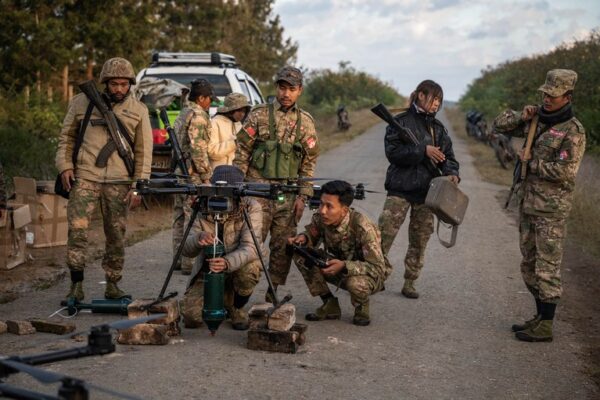
One of the most important setbacks for Myanmar’s military since an opposition alliance launched Operation 1027 last October has been the loss of three different aircraft: two jet trainers and an Mi-17 heavy-lift helicopter. An Mi-35 attack helicopter was also lost in 2023.  The Myanmar military should have total air superiority.  For the first two years of the conflict, the opposition National Unity Government’s (NUG) best air defense was doxing Air Force pilots – publishing their addresses, as part of an assassination campaign. Gradually, the NUG’s People’s Defense Force militias began to erode the junta’s air superiority by effectively deploying armed drones.  Significantly, we’re now seeing Ethnic Resistance Organizations (EROs) begin to deploy air defenses, at a time when the junta has become even more dependent on air attacks. That increased tempo of operations requires more maintenance on overworked airframes. Fighters of anti-junta Mandalay People’s Defense Forces prepare a drone with an explosive-drop amid clashes with Myanmar junta forces in northern Shan State, Dec. 11, 2023. These military junta losses matter for three reasons. First, while not small by regional standards, the Myanmar Air Force (MAF) certainly does not have excess capacity. At the top end, it has some 31 SU-29s and four  recently delivered SU-30s from Russia.  The recently delivered seven JF-17s multi-role fighters, jointly produced by China and Pakistan, are reportedly already grounded due to cracks in their airframes and other maintenance issues.  Airworthiness questions On paper, Myanmar has approximately 40 other jet fighters, but these are old, Chinese-produced knock-off Russian jets from the 1990s. They are well beyond their service life.  The MAF is thought to have 20 Nanchang Q-5s, the Chinese version of the MiG-19, down from the 36 it imported from 1994-2001. It also has some 21 Chengdu J-7s, a Chinese produced MiG-21. That’s down from some 60 that it had purchased from 1990-1999.  It’s unclear how many of these fighters are still airworthy.  Myanmar’s military has relied on its 18 Russian-built Yak-130 trainers for much of its combat operations. Since the February 2021 coup, Myanmar has taken delivery of some six Guizhou JL-9 jet trainers, referred to as FTC-2000G, which have a spotty performance and safety record.  A fighter of anti-junta Mandalay People’s Defense Forces pilots a drone near the frontline amid clashes with Myanmar junta forces in northern Shan State, Dec.11, 2023. (AFP Photo) The MAF also flies an unknown number of Chinese K-8 trainers that can be used for ground support. Second, we should also assume that given sanctions on the Singapore-based companies that have been the key importers of spare parts, the overall lack of foreign exchange available to the junta, and other supply chain issues, including those caused by Russia’s war in Ukraine, that around 20% of the aircraft are probably not operational.  In December 2023, the sanctioned director of Sky Aviator and two others were caught trying to  smuggle 508,925 Singapore dollars (US $382,380) in cash out of that city-state. Sky Aviator, which has an office in Singapore, had a large contract to purchase spare parts for the air force. Another sanctioned firm, Sky Royal Hero Company Limited, has the contract for the maintenance and spare parts for servicing the Russian jet fighters.  For nearly three years, the MAF has been flying at increased tempos without the scheduled maintenance they require.  Airstrikes ramping up The military’s promised counter offensive has not materialized. Over 4,000 troops have surrendered since Operation 1027 began, and well-documented recruitment issues mean the military does not have a sufficient number of troops to launch ground offensives across the multiple battle zones, which has forced them to rely on long range artillery and air strikes. An independent research firm documented 336 airstrikes in December 2023, alone, with nearly half against the Three Brotherhood Alliance, the group of ethnic armies behind Operation 1027.. The loss of one of their 12 already over-taxed heavy lift helicopters is another important setback for the military’s counter-offensive. One of their tactical advantages has been air mobility and resupply, especially given their loss of key roads. Although the Kachin Independence Army (KIA) claims to have shot down the Guizhou JL-9/FTC-2000G on Jan. 17, there is little evidence to support this, Video footage that shows the plane falling from the sky, without smoke or any other sign of hostile fire, indicates likely engine failure. Myanmar Air Force Jet fighters drop bombs during military exercises in Ayeyarwady delta region, Feb. 2, 2018. (Lynn Bo Bo/Pool via AP) That leads to the third implication: The MAF is losing aircraft to hostile fire.   While the military claims that it was a technical malfunction that brought down a K-8 trainer, Karenni forces claim to have shot it down.  The KIA claims to have shot down an Mi-17 transport helicopter, killing all six crew members on Jan. 3.   Both helicopters and the trainers, especially when they are being used for ground attacks, are vulnerable to small arms fire.  Eyes on Beijing But these developments also beg the question: What weapons are being used to down the aircraft? The only ethnic armed group that is known to have shoulder-launched surface-to-air missiles (known as MANPADs) is the United Wa State Army (UWSA).  Until very recently, the UWSA has sat out the conflict, neither supporting the junta nor joining the NUG. It recently declared its neutrality in the Three Brotherhood Alliance’s Operation 1027, though it did receive two townships from them.  A man looks on at homes destroyed after air and artillery strikes in Mung Lai Hkyet displacement camp in northern Kachin state, Oct. 10, 2023. (AP Photo) Though the UWSA has quietly sold weapons to other ethnic armies and the NUG, it has, to date, refrained from selling MANPADs.  Has that changed? And if so, why now? It was long believed that they would not sell the weapons for fear of angering China. So did China approve the transfer, or are the groups now willing to incur Beijing’s wrath?  The KIA claims that they shot down the Mi-17…

Read More

China is the world’s worst jailer of journalists, CPJ says

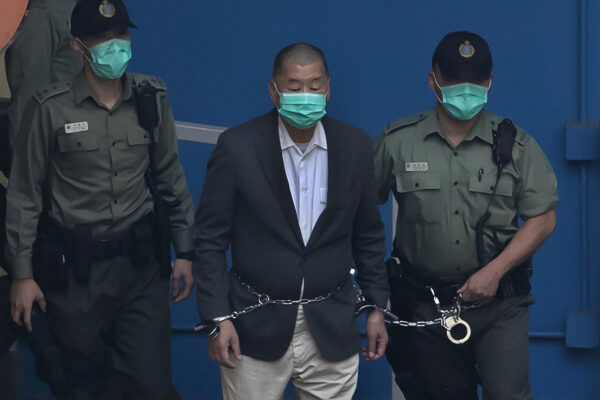
China is the worst jailer of journalists in the world, a report by a New York-based watchdog said, and nearly half of the journalists behind bars in the country are Uyghurs who reported on the persecution of the mostly Muslim group in Xinjiang. In its 2023 prison census, conducted on Dec. 1, the Committee to Protect Journalists, or CPJ, found that there was a spike in arrested journalists, with 320 believed to be behind bars – close to a record high. More than half of those jailed journalists were charged with false news, anti-state or terrorism charges in retaliation for their coverage, the group’s research found. China led all countries, with 44 journalists in prison, accounting for 32% of the worldwide total. Following closely behind was Myanmar, with 43. Vietnam was fifth on the list with 19, ahead of Iran and just behind Russia. Hong Kong media mogul and pro-democracy activist Jimmy Lai, is escorted by Correctional Services officers to a Hong Kong court appearance, Dec. 12, 2020. (Kin Cheung/AP) “China has long ranked as one of the world’s worst jailers of journalists,” the report said. “Censorship makes the exact number of journalists jailed there notoriously difficult to determine, but Beijing’s media crackdown has widened in recent years, with 2021 marking the first time journalists from Hong Kong were in jail at the time of CPJ’s census.”  In addition to Hong Kong, Xinjiang was another chief area of concern, according to the report. Of the 44 imprisoned journalists in China, 19 are Uyghurs. Among them is Ilham Tohti, a professor who was also the founder of the news website Uighurbiz. Tohti was arrested almost exactly 10 years ago, and later sentenced to life in prison on charges of separatism. Another is Qurban Mamut, the former editor-in-chief of the popular Uyghur journal Xinjiang Civilization. Mamut went missing in November 2017 and RFA learned in 2022 that he was sentenced to 15 years in prison for “political crimes.” Media gather outside the offices of Stand News in Hong Kong on December 29, 2021, after police raided the office of the local media outlet and arrested six current and former staff. (Daniel Suen/AFP) “Chinese authorities are also ramping up the use of anti-state charges to hold journalists, with three out of the five new China cases in CPJ’s 2023 database consisting of journalists accused of espionage, inciting separatism, or subverting state power,” the report said.  “Many journalists charged are ethnic Uighurs from Xinjiang, where Beijing has been accused of crimes against humanity for its mass detentions and harsh repression of the region’s mostly Muslim ethnic groups,” it said. ‘Silencing minority voices’ The disproportionate number of jailed Uyghur journalists mirrors the situation in Xinjiang, Beh Lih Yi, the CPJ’s Asia program coordinator told RFA Uyghur. “Nearly half of the journalists behind bars in China in 2023 were Uighur journalists. They have been targeted under vague charges such as inciting separatism or being ‘two-faced,’ a loose term Chinese authorities often use to punish those they see as publicly supporting government policy but secretly opposing it,” said Yi.  “The media repression highlights the Chinese government’s harsh attempt to silence minority voices and independent reporting – even as Beijing repeatedly rejected claims of widespread human rights abuses in Xinjiang,” he said. A giant screen in Beijing shows Chinese President Xi Jinping visiting Xinjiang Uyghur Autonomous Region July 15, 2022. (Tingshu Wang/Reuters) He said that long-term sentences for Uyghur journalists were “outrageous and cruel,” and called on the Chinese government to release all its imprisoned journalists and allow all journalists to freely report in Xinjiang. The report proves the importance of the work of Uyghur journalists, Zubayra Shamseden of the Washington-based Uyghur Human Rights Project said. “It is clear from the imprisonment of Uyghur journalists that China doesn’t want the international community to know anything about Uyghurs,” said Shamseden. “Uyghur journalists report on Uyghur issues. They are the voices of the Uyghur people in the world. By imprisoning Uyghur journalists, China is attempting to crush the voices of Uyghurs.” The report also noted that Israel saw a huge spike of journalist jailings last year, with all those known to be behind bars on the date of the census having been arrested in the West Bank. Additional reporting by Mamatjan Juma. Edited by Malcolm Foster.

Read More

Two civilians die as fighting continues in northern Myanmar

Fighting between the Kachin Independence Army and junta troops in northern Myanmar left two residents dead, locals told Radio Free Asia on Friday.  On Thursday morning, the Kachin Independence Army and other local resistance militias raided a police station and the three infantry battalions stationed in Mongmit, locals said. Junta troops soon retaliated by land and air, they added. Fighting flared up again Friday morning after a brief respite, residents said, with battles intensifying near the town’s center. The junta’s airstrikes continued into Friday afternoon, one local told RFA, declining to be named for security reasons.  “[The junta] is still firing now from a fighter jet. We had to hide in basements,” he said. “Now, there’s fighting near the police station and the market.” The jet dropped six bombs on Friday morning, he added.  Airstrikes were particularly heavy on Thursday, with at least 10 bombs damaging some residents’ homes, locals said. A 37-year-old man named Si Thu was killed by a bomb blast, they said. Another man in his 40s died of apparent heart failure. Three others were injured, they added. Because of the ongoing attack, families and aid organizations have not been able to collect the bodies, one resident said.  “One of the four injured in yesterday’s airstrike has died. Another pedestrian died after suffering a heart attack caused by the sound of explosions,” they said, declining to be named for fear of reprisals. “We have not moved their bodies yet. No one can go out.” Most of the village’s 10,000 residents have fled to nearby villages, he added. Residents told RFA that junta troops are strictly inspecting civilians fleeing through the city’s exits. Myanmar’s regime has not released any information about the fighting in Mongmit. RFA contacted Shan state junta spokesperson Khun Thein Maung and the Kachin Independence Army’s information officer Col. Naw Bu for comment, but neither answered by the time of publication on Friday.  Clashes between the Kachin Independence Army and junta troops have persisted since Monday in Kutkai and Mongmit townships. The KIA is not part of the alliance of ethnic armies that agreed a ceasefire with the junta on Jan. 11 in several townships across Shan state. That China-brokered ceasefire has already faltered with the Three Brotherhood Alliance claiming the junta launched airstrikes on Mongmit and two other townships in the northern state on Sunday The alliance also announced in a press release Wednesday that one of its members, the Myanmar Democratic National Alliance Army, had retaliated after the junta fired grenades at its troops. Translated by RFA Burmese. Edited by Mike Firn.

Read More

Myanmar’s army is forcing residents to join pro-junta militias

Myanmar’s military is pressuring residents in the southwestern Bago region to join pro-junta militias, offering them incentives such as money and rice, forcing them to pay fines if they refuse and even threatening to destroy their villages if they don’t comply, RFA Burmese has learned. The conscription drive comes amid reports of heavy losses suffered by the military in clashes with anti-junta forces in recent months, particularly in northern Myanmar’s Shan state where an alliance of ethnic resistance groups have seized 15 out of 22 townships since launching an offensive in October. Rebel gains since then have suggested that the country’s civil war, triggered by the military’s Feb. 1, 2021, coup d’etat, may be approaching a turning point. The pressure tactics come after the junta announced on Jan. 9 that it plans to “increase public defense and security systems to enforce public and regional security.” Residents said junta-appointed ward and village administrators began summoning residents to meetings last week to inform them of the plan. “Most people don’t want to join” the militias, said a resident of Thegon township who insisted on anonymity for personal safety, forcing villagers to scrape together cash to buy their way out of the conscription drive. “Those who can afford to, give money in order not to join,” said the resident. “But others neither join nor give 200,000 kyats (US$95) [to defer]. They can’t afford it … Every village is facing this problem. No one wants to join.” On Jan. 12, the junta ordered administrators in Thaegon to conscript 20 people per village, he said. They threatened to burn down villages that did not comply, saying they were siding with anti-junta People’s Defense Force, or PDF, paramilitary groups. In nearby Nattalin township, residents said that the junta has been conscripting militiamen since Jan. 11 by offering various “incentives.” “They force people to provide financial support for the ones who join,” said one resident. “In places where 50 people are conscripted, they plan to arm 10 of them and provide food as an incentive. They said the other 40 had to join as ‘reserves.’” 10 men from every 100 houses The resident said that administrators have been tasked with drafting 10 men from every 100 houses, resulting in 30-90 conscripts per village, depending on the size of the village. Heads of households are made to draw lots, and those selected must be provided a monthly subsidy of 5,000-20,000 kyats (US$2-10) per month by those who are not. Draftees are deployed as “community security,” the resident said, but must also serve in the military “if necessary.” Other sources in the region said that similar drives were underway since early January in the townships of Hpayargyi, Daik-U, Taungoo, Thandaung, Padaung, Shwedaung, Paungde and Paukkhaung.  Incentives included 120,000 kyats (US$57) and a sack of rice per month for those who join, while the cost of deferring ranged from 500,000-800,000 kyats (US$238-381). Protecting against ‘terrorists’ When contacted by RFA for comment, Tin Oo, the junta’s economic minister and spokesman for Bago region, said that residents were “preparing to protect their communities from violence.” “It depends on them [whether they want to join],” he said. “Some villages say that they do not allow these PDF ‘terrorists’ to enter their area at all. We know that many young people are joining the militias to protect their own community.” Lu Aye, information officer of the Thayarwady district PDF, said that the conscription is being implemented to replenish the depleted strength of the military. “The situation is always intense in Thayarwady district,” he said. “Mostly, we attack [the military] first. That’s why the junta needs to replenish the depleted strength of its soldiers with militiamen. And to be frank, they are forcing them to fight and die on behalf of the soldiers.” Other reports suggest that the junta has also launched conscription campaigns in Yangon and Ayeyarwaddy regions.  On Thursday, the No. 2 southern regional sub-command of the shadow National Unity Government’s Southern Command, issued a statement saying it will “take action” against anyone pressuring civilians to form militias for the junta. Tin Oo, the deputy commander of the No. 2 sub-command – which operates in Yangon, Bago and Ayeyarwaddy (and a different person than the junta minister with the same name) – told RFA that anyone involved in militia conscription will be “prosecuted under military law.” “We have urged the public to avoid [the drives] as much as possible,” said the deputy commander. “Our statement is aimed at stopping the forced recruitment immediately and, if it does not end, we will take effective action against those who are involved or supporting it. There is a war going on, so we will take action according to military law.” Forming militias is part of a junta bid to shore up military troop shortages and “drive a wedge between the people,” he added. Translated by Htin Aung Kyaw. Edited by Joshua Lipes and Malcolm Foster.

Read More

Days after ceasefire, northern Myanmar sees more battles

Fighting erupted between the junta and allied ethnic groups in northern Myanmar just days after the two sides agreed a ceasefire, according to a statement released Wednesday by the Three Brotherhood Alliance. The alliance accused junta soldiers remaining in Shan state’s Kokang of firing grenades, the statement said. It added that junta troops launched the weapons from 30 meters (98 feet) away while allied Kokang resistance fighters were stationed near Kachin mountain.  Despite the ceasefire reached during a third round of China-brokered peace talks in Kunming on Thursday night, the Myanmar National Democratic Alliance Army retaliated and fighting began again around 4 p.m. on Tuesday.  The alliance claimed junta troops fired back three times with heavy weapons before retreating. Despite the ceasefire, it’s possible that remaining junta troops separated from the rest of the army would open fire and attack, a military analyst who wished to remain anonymous for security reasons told Radio Free Asia on Wednesday. “The areas of Laukkai, Konkyan, and Yan Long Keng are very rough and it’s difficult to communicate there. It’s probably the remnants of the junta army that went into the forest during the [previous] battles,” he said.  “I am not sure whether they know about the ceasefire after the [Kunming] talks.” The Myanmar National Democratic Alliance Army, one of the groups making up the Three Brotherhood Alliance, captured Laukkai city in Kokang’s Self-Administered Zone when more than 1,000 junta troops surrendered on Jan. 4  Although the Myanmar National Democratic Alliance Army sent the surrendering troops back to Lashio, some who were separated from the main group may have initiated the attack, military observers said. Both the alliance and regime announced their public agreement to the ceasefire on Friday. According to the agreement, all parties involved would immediately cease fighting in their current locations. Starting Friday, the Three Brotherhood Alliance agreed to refrain from attacks on cities and junta camps. Regime forces similarly committed to halting airstrikes and other heavy weapons attacks. However, tensions still run high. When the Kachin Independence Army launched an attack on a Kutkai military base Sunday night, the junta Defense Service released a statement claiming the Three Brotherhood Alliance’s Ta’ang National Liberation Army was involved.  Despite the ceasefire, the alliance is still preparing for future battles, claiming in a statement released Sunday that the regime is launching an offensive that began on Saturday. The statement added the junta is also responsible for airstrikes and heavy weapons attacks in Mongmit, Kutkai, and Kyaukme townships after the ceasefire agreement. RFA called Shan state junta spokesperson Khun Thein Maung and national junta spokesperson Maj. Gen. Zaw Min Tun for more information on these accusations, but calls went unanswered Wednesday. According to data compiled by RFA, in the more than two months since Operation 1027 launched on Oct. 27 to Friday’s ceasefire, the alliance captured 15 cities in northern Shan state. Translated by RFA Burmese. Edited by Mike Firn.

Read More

What role did China play in a rebel group’s victory in northern Myanmar?

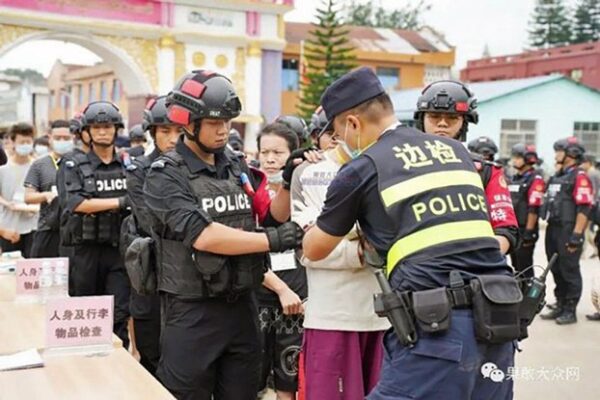
When the Three Brotherhood Alliance of rebel groups in Myanmar started a campaign against junta forces in the northern part of the country they chose a slogan designed to win support from a fourth potential ally: China. “Wipe out the scammers, rescue our compatriots,” the group declared in the message.  China, which shares a border with Kokang, a region in Shan state in northern Myanmar, had expressed increasing frustration with organized crime rings that had been allowed to operate in the area by junta-aligned forces. An estimated 120,000 people are being held in Myanmar against their will. Chinese nationals have both been trafficked by these groups and fleeced by them.  The Myanmar National Democratic Alliance Army – which along with the Ta’ang National Liberation Army and the Arakan Army make up the Alliance – had tried and failed twice before to retake the region. This time, however, Kokang’s capital of Laukkai fell into rebel hands on Jan. 4.  Since then, China has played a clear role in mediating a truce between the two sides. But the initial success of the rebel campaign has led analysts to speculate that it had, in fact, received Chinese backing.  China’s leaders may have sought to kill “two birds with one stone,” according to Deng Yuwen, a political commentator and former journalist  – strengthening China’s position in the region while removing the destabilizing threat presented by the scam compounds. “The Chinese government can use the scamming operations as a way to secretly support local forces … and control the area that way,” Deng said.  “They solve the scamming problem and cultivate bold agents of the Chinese state at the same time,” he said, meaning China believes the new leaders of Kokang will better reflect its interests.  Chinese police arrest Chinese nationals allegedly involved in online scamming operations in Myanmar, Dec. 10, 2023. (Kokang officials) A ‘king’ and a coup Kokang has long been in China’s orbit, and many of its residents are ethnically Chinese. In the mid-20th century, Kokang served as a base for Myanmar communists.  With the collapse of the Communist Party of Burma in 1989, local warlord Peng Jiasheng – whose nickname was “the king of Kokang” – switched his allegiance to the junta. The military granted the region autonomy and allowed Peng to keep his military presence in the area, though China remained an important patron.  In 2009, Peng was ousted in a coup led by his second-in-command, Bai Suocheng, who consolidated his family’s control over the state. Bai allowed government troops to be stationed in Kokang for the first time while residents were granted Myanmar nationality.  Bai offered sanctuary to criminal groups in return for huge payouts that also benefited the junta. Eventually, massive, organized scam operations began to thrive in Kokang. China pushes back Last year, the Chinese government appeared fed up. In August, it took part in a joint operation with Myanmar and Thailand targeting the scam centers. Over the intervening months, more than 40,000 Chinese nationals were arrested in Shan state for involvement with online scams, according to data collected by RFA.  A number of powerful Kokang business people were arrested at a trade fair in China in October, and in November, Beijing issued arrest warrants for a well-connected Kokang politician and three family members on allegations of masterminding an online scam ring.  China’s Ministry of Public Security issued arrest warrants for 10 people, including the former chairman of the Kokang self-administered region, Bai Suocheng [top row, first left], his son Bai Yingcang [top row, second left] and his daughter Bai Yinglan [top row, third left]. (The Kokang) On Dec. 10, China’s Ministry of Public Security put out another wanted list, naming 10 individuals in connection with the scams, including Bai Suocheng, his grown children and a few junta officials. The move not only showed Beijing’s growing impatience with Myanmar’s handling of the scam rings, but signaled that China favored leaders in Kokang more closely aligned with its national interests. The prince’s plans After he had been dethroned as the king of Kokang, Peng Jiasheng resurfaced as the leader of the MNDAA, fighting Myanmar forces on occasion without significant success. When he died in 2022, his son, Peng Denren, took over and immediately made plans to reclaim control of his father’s lost territory. The Alliance launched “Operation 1027” – so-called for the on Oct. 27, 2023, date – offensive against Myanmar military strongholds in northern Myanmar. Even though the Alliance remained outnumbered by government troops, the rebel forces scored several significant victories early on. Its soldiers have since seized more than 300 military bases, around a dozen towns, and won control of several key trade routes with the neighboring Chinese province of Yunnan. Members of the Myanmar National Democratic Alliance Army walk past a Myanmar military base after seizing it during clashes near Laukkaing township in Myanmar’s northern Shan state, Oct. 28, 2023. (Kokang Information Network/AFP) Suspicion over ‘foreign’ experts Myanmar’s junta chief in November claimed that the ethnic-minority armed groups were getting outside assistance, according to a report by Agence France-Presse.  He said the rebels had been using “drones with advanced technology” to attack junta positions and were aided by “foreign drone experts,” although he didn’t specify which country they came from. Li Jiawen, a spokesman for the MNDAA, denied the offensive was aided by the Chinese. “The situation we have today is the result of nearly 70 years of tyranny by the junta,” Li said. Even China’s tacit approval of the operation is important, Yun Sun, the director of the China Program at the Stimson Center, a Washington, D.C.-based think tank, said in an interview with RFA. “The biggest support that China has lended to this organization is to not stop them,” she said.  Rebel forces were able to retreat over the border to avoid junta artillery barrages. China allowed the flow of money and goods in Shan state that helped to sustain the rebels to continue, Sun said.  And there was likely a psychological…

Read More

Chinese warships leave Cambodia’s Ream naval base

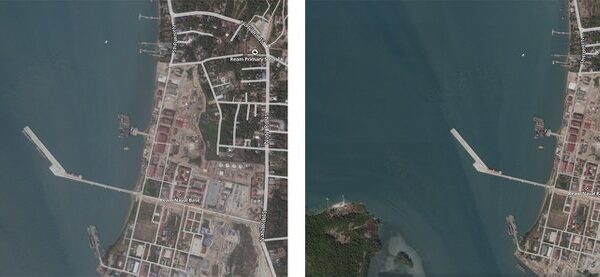
Two Chinese warships leading a training program for the Cambodian Navy since early December have left the Ream naval base, satellite imagery shows. Images captured on Jan. 15 and provided by the U.S. earth imaging company Planet Labs show an empty berth at the new pier, where the two People’s Liberation Army (PLA) corvettes were docked for several weeks. The ships were still seen as of Jan. 13, 2024. The new pier at Ream Naval Base on Jan. 13, 2024 (left) with two vessels and on Jan. 15 without any vessel. (RFA via Planet Labs) Radio Free Asia reported on Dec. 5, 2023 about the arrival of the PLA vessels – the first foreign warships to gain access to the new China-funded facility with a deep-draft pier that can accommodate aircraft carriers. A U.S. State Department spokesperson said at that time that Washington had “serious concerns” about China’s plans for exclusive control over portions of Ream Naval Base, and was watching closely. The Chinese ships provided on-ship and in-port training to Cambodian navy staff, according to the Ream naval base’s social media. They may have also taken part in confidence-building activities with the local navy and population, according to Carl Schuster, a retired U.S. Navy captain and former director of operations at the U.S. Pacific Command’s Joint Intelligence Center. “All port visits have a political element,” Schuster told RFA, “Allowing ship tours to visitors from the town, working with local naval forces and meeting with local officials often are more important than the training activities.” People-to People Exchange Year The ships’ departure took place as Cambodia and China officially launched a new campaign to boost bilateral ties and tourism called “The 2024 Cambodia-China People-to-People Exchange Year.” Chinese and Cambodian media reported that a launching ceremony was held last Saturday in Siem Reap. Former Defense Minister Tea Banh, now a member of the Supreme Privy Council to King Sihamoni, and Li Shulei, a member of the Political Bureau of the Chinese Communist Party’s Central Committee, presided over the event. Tea Banh said that the campaign “will inject fresh momentum into building a high-quality, high-level and high-standard Cambodia-China community with a shared future in the new era,” according to Xinhua news agency. Cambodian dancers at the launch ceremony of the 2024 Cambodia-China People-to-People Exchange Year on Jan. 13, 2024. (Tea Banh’s Facebook) Cambodia received 2.36 million Chinese tourists in 2019, accounting for 35.7% of total international tourist arrivals. China and Cambodia have seen a rapid development of their relationship, with Beijing providing Phnom Penh with much needed financial assistance. Siem Reap is where a new Chinese-financed airport began operations in October. The airport has a capacity of 7 million passengers a year and serves as a gateway to Cambodia’s most important tourist destination – the Angkor Temple complex. The Siem Reap-Angkor International Airport was funded by a Chinese company under Beijing’s Belt and Road Initiative development plan.  Another big airport near the capital Phnom Penh is also being financed and developed by China. More than 40% of Cambodia’s US$10 billion in foreign debt is owed to China, according to the Cambodian Ministry of Economy and Finance. For its part, Phnom Penh has become one of Beijing’s vocal supporters. After the weekend’s elections in Taiwan, Cambodia immediately “reaffirmed its strong support for the One-China policy.” “In light of the recent developments in Taiwan, the Ministry reiterates Cambodia’s resolute adherence to the One China policy, recognising the People’s Republic of China as the sole legitimate authority representing the entirety of China,” Foreign ministry’s spokesman An Sokhoeun was quoted as saying by local media. Edited by Mike Firn and Taejun Kang.

Read More

Buddha hair relic raises questions about authenticity

A Vietnamese pagoda has quietly returned a supposed Buddhist relic – eight hairs said to be from Sidartha Gautma, the founder of Buddhism – to Myanmar after questions arose over its authenticity. The relic was on display at the Ba Vang Pagoda in northern Vietnam from Dec. 23-27, receiving huge press in the country at the time of its arrival. The pagoda made a big deal about receiving the relic with a large ceremony to receive what it was calling one of Myanmar’s “national treasures.” But when RFA Vietnamese asked RFA Burmese to verify the story with religious experts in Myanmar, they said there was little if any archaeological or historical evidence to authenticate the relic. If it were widely believed to be legitimate, the relic would be far more well-known in Myanmar, a country that is 87% Buddhist.  After doubts about the relic appeared on social media, the pagoda returned it to its owners. Many objects believed to be sacred relics have dubious origins, a Buddhist monk who is a member of Myanmar’s highest State Buddhist Sangha Council, told RFA Burmese on condition of anonymity for security reasons due to commenting on sensitive religious issues.  “Any relics that we have today are due to [people] over-believing in something unreasonable,” he said. “People should use their own reasoning [to determine] whether [something like this] could be possible or not.”  RFA attempted to discuss the matter with the Myanmar military junta’s Religious Affairs Department, but both spokesmen declined to comment or were unavailable. A gift from the enlightened According to legend, the eight hairs were given to two Burmese merchants by the Buddha himself, who lived in the sixth and fifth centuries B.C. Ba Vang Pagoda and its abbot, the Most Venerable Thich Truc Thai Minh, said they had borrowed the relic for display from Parami Monastery and Parami International Buddha Relics Museum in Myanmar.  If genuine, it would mean that the relic was passed down through the generations from the two merchants until the museum became its steward.  RFA confirmed that both the monastery and the museum exist. They are both located in Yangon, but could not reach the spokesperson or a responsible representative of either. Although the story about the relic went viral on social and mainstream media in Vietnam, Myanmar’s media has had no coverage regarding the lending of its “national treasure” to Vietnam for exhibition, as had been reported in Vietnam. The reckoning The Giác Ngộ online newspaper under the Vietnam Buddhist Sangha, or VBS, reported that at its meeting on Jan. 4, 2023, the standing board of VBS’ Northern Executive Council discussed disciplinary action against the abbot Minh for being involved in the display of the Buddha hair relic. According to the Most Venerable Thich Duc Thien, the vice-chairman and secretary-general of the Executive Council, the Minh admitted fault in front of monks, nuns and Buddhist followers for the display that provoked public controversy and damaged the reputation of the sangha. The VBS accepted his penance, asking him and the pagoda not to organize any international exchanges at the pagoda over the next year, Thien told RFA. Translated by RFA Burmese and Vietnamese. Edited by Eugene Whong and Malcolm Foster.

Read More

Myanmar’s junta threatens to raze villages to bolster army numbers

Myanmar’s military junta is recruiting villagers across more than 50 townships in the country’s central areas, locals told Radio Free Asia on Monday. Up to 50 residents per village are required to serve in the regime’s militia in Bago region chosen through a raffle system, they added.  The junta is recruiting civilians between the ages of 18 and 60 heavily from western and eastern Bago. Twenty villages in eastern Bago and 28 villages in western Bago have already been targeted, residents said. Village administration appointed by the regime has required eligible members of each household to enter a raffle system, where those selected must attend a month-long military training course.  If villagers don’t cooperate, soldiers have threatened to burn down their villages, said a resident in western Bago region who wished to remain anonymous for security reasons. To be excused from service, they must pay between 800,000 kyat [US$380] and one million kyat [$476]. “The [junta] ordered one person per household to enlist. If not, the village will be burned down. When [soldiers] say something like that, people are afraid because they are villagers. They cannot afford to give people from every single house,” he said. “People did not want their village to be burnt, so they agreed with the raffle system. Also, a soldier changed the requirement later to only 10 people from every single village who had to serve for the militia. But people who got selected by the raffle system to serve also do not want to join the militia.” To be exempt from the raffle, residents are required to pay 100,000 kyat [$47] per household, they said.  The military junta began asking for 50 people per village in eastern Bago starting from Friday, said a man from Hpa Yar Gyi village.  “The [junta] is asking for between 50 and 60 people from our area. Let’s say there are 10 people in this village’s section – if two people are selected to join, they must go when the junta calls, whether they are at work or not,” he told RFA. “They have to join militia training. The junta just says joining training, but they have to go to the frontline after.” The military has advertised that those who join the militia will be paid 120,000 kyat [$ 57] and provided a bag of rice per month, residents said.  The junta started to implement the scheme after a meeting between military chiefs and pro-junta political parties on Jan 6. Bago’s junta spokesperson Tin Oo told RFA Thursday that this method allows locals to protect their communities, adding that participating would help increase stability and public security.  “No one wants terrorism,” he said. “[Serving in the militia] allows them to defend their homes and that depends on them preventing People’s Defense Force terrorists from getting into their villages.” Translated by RFA Burmese. Edited by Mike Firn.

Read More