Arakan Army’s gains enough to enable self-rule in Myanmar’s Rakhine state

The Arakan Army, or AA, is continuing their sweep across Rakhine, furthering the military gains of the ethnic Three Brotherhood Alliance, of which it is a member, in Shan state. While the capture of nine towns, with a tenth in southern Chin state, is another humiliating defeat for the Burmese military, it also sets the scene for a very messy political discussion moving forward. Myanmar’s military continues to be on their back feet. The Kachin Independence Army continues to make gains, recently securing control over a major trade route with China, after seizing the last of the military camps along the Bhamo-Myitkyina highway. The once staunchly pro-junta border guards forces in Kayin state are now hedging their bets and putting some distance between themselves and Naypyidaw.  Meanwhile, the junta’s announced counter-offensive out of Lashio against the Ta’ang National Liberation Army and Myanmar National Democratic Alliance Army – the other two members of the Three Brotherhood Alliance – in northern Shan State has not materialized. But it’s in Rakhine where the military has been handed its most significant territorial defeats. The AA has captured six of Rakhine’s 17 townships and several smaller towns since launching an offensive on Nov. 13, 2023, with ongoing offensives against several others. As of early April, the AA had captured some 170 junta camps and posts, as well as several larger bases, battalion headquarters, and training facilities. Arakan Army soldiers stand with an artillery piece after capturing the Ta Ron Aing base in Chin state from junta forces, Dec. 4, 2023. (AA Info Desk) The capital of Sittwe is surrounded, and many civil servants have been withdrawn. The Chinese special economic zone in Kyaukphyu is on the verge of falling, prompting the United League of Arakan, the AA’s political wing, to publicly pledge to protect all foreign direct investment that benefits Rakhine and “ensure the smooth continuation of their operations.” At present, China’s US$8 billion investment, which includes their oil and gas pipelines and a proposed deepwater port with rail and road links, can only be accessed by sea. As a recent International Institute for Strategic Studies report concluded: “But no matter the final outcome, the AA’s sweeping gains are already enough to enable self-rule over a large portion of the Rakhine homeland and to reshape the wider balance of power in Myanmar.” Little leverage over AA in Rakhine On April 1, 2024, China’s special representative to Myanmar, Deng Xijun, met with junta chief Senior Gen. Min Aung Hlaing in Naypyidaw to try to broker a ceasefire. While the Chinese-brokered ceasefire between the Three Brotherhood Alliance and the military regime is tenuously holding in northern Shan state, the AA refuses to be bound by it in Rakhine. China has less leverage over the AA, which has shown no interest in halting their offensive. The AA has stated their intention to capture the entire state, not just their traditional heartland in the north, though it’s not clear that they have the manpower and resources to do so. Over-reach could spread their forces too thin. The AA is in the midst of an offensive in Ann township, which is not just the headquarters of the military’s Western Command, but the key junction on the road to Magwe region. The loss of Ann would make overland resupply to northern and central Rakhine extremely difficult. Overland supply could only come in through the highway from Bago region’s Pyay township in the south. The military has responded in typical fashion, with more indiscriminate air and long-range artillery strikes against unarmed civilians. In a two-day period in early April, six civilians were killed and 16 were wounded. RFA Burmese reported that some 79 Rohingya civilians have been killed and 127 more have been wounded in the past four months. The junta has commenced implementation of its national plan to conscript some 5,000 people a month, including amongst ethnic Rohingya in Rakhine, despite the assassination of local administrators. People who appear to be Rohingya Muslims in Rakhine state undergo weapons training by junta military personnel on March 10, 2024. (Image from citizen journalist video) This is a perverse irony after the military waged an ethnic cleansing campaign that drove 1 million ethnic Rohingya, whom they refer to as “illegal Bengalis,” into Bangladesh, and kept many others in concentration camps. Poorly armed and trained conscripts have limited military utility, indicating the military’s desperation for manpower. Role of Rohingya conscripts But the Rohingya conscripts play a much more important role in fomenting political strife within the opposition camp. The Buddhist-dominated Arakan Army has a tense relationship with the Rohingya population. It has tenuously accepted the shadow National Unity Government’s position that the Rohingya are legal citizens and that they should be returned to the country from Bangladesh in an orderly fashion. There have been a number of reports that the military is reaching out to the Arakan Resistance Solidarity Army, or ARSA, whose misguided raids on border posts and police stations in 2017 were the casus belli for the military’s ethnic cleansing campaign. Since being driven into Bangladesh, ARSA’s primary activities have been to secure control over the refugee camps and eliminate rivals within the Rohingya community; they have not participated in the armed rebellion. That the military believes that they can recruit ARSA as a proxy against the AA seems preposterous. The AA is neither willing to share any political power in Rakhine nor countenance the presence of any other armed actors. So there is a perverse logic to the military’s overtures to ARSA, which is searching for relevance. With mounting battlefield losses, the best that the military can do is to strike up ethnic and sectarian tensions. This should come as no surprise: stoking communal tensions has always been a key party of their strategy. An airstrike by Myanmar junta forces destroyed houses in Minbya township’s Myit Nar village in Rakhine state on April 3, 2024. (Arakan Princess Media) Indeed, the United Nations’ Independent Investigative Mechanism for Myanmar, which was established following…

Read More

Ethnic army seizes city on Myanmar-China border

An ethnic army captured a town near the Chinese border, less than a week after officials met in Myanmar’s capital to discuss cooperation between the two countries, residents told Radio Free Asia on Friday.  Myanmar’s military junta, which seized all major governmental seats in a 2021 coup d’etat, invited a Chinese envoy to Naypyidaw on Monday to discuss the Kachin Independence Army’s mass seizure of military camps and subsequent fighting on the border. Some border gates in Kachin state have still not been reopened, political analysts and residents told RFA.  The rebel group has captured 60 junta camps since fighting began on March 7 and now controls portions of two major trade routes in Myanmar’s northern Kachin state, one of which runs along China’s border.  The Kachin Independence Army, headquartered in border town Lai Zar, captured another major city nearly 160 kilometers (100 miles) south on Thursday. Rebel troops have occupied the city since March 29, but were not able to negotiate the junta’s surrender until Thursday, Lwegel residents said.  All administration departments under the junta have been sealed off and their staff have left the city, a resident told RFA on Friday, adding that Kachin troops are now deployed throughout the city. “The city has been seized. Kachin Independence Army troops have arrived in the city,” he said. “All administrative departments have been closed, and Kachin national flags were seen in some places. Soldiers and the police are still trapped.” In addition to Kachin national flags hanging on the General Administration Department, market and hospitals in the city, they have also issued notices that only authorized personnel will be allowed at border gates and administrative departments, he added. Soldiers and other military personnel in Lwegel have been relegated to a junta base nearby.  RFA contacted Kachin state’s junta spokesperson Moe Min Thein for comment on the military’s surrender, but he did not respond by the time of publication. Kachin Independence Army information officer Col. Naw Bu told RFA that although the former administration staff had left, the anti-junta group’s administrative processes had not yet started in the city’s 21 government offices. Translated by RFA Burmese. Edited by Kiana Duncan and Mike Firn. 

Read More

Junta troops kill 2 political prisoners after removing them from jail

Junta soldiers killed two inmates after secretly removing them from a prison in southern Myanmar, activists told Radio Free Asia on Thursday.  Troops took 25-year-old Min Thu and 35-year-old Ko Win Thiha from Tanintharyi division’s Dawei Prison on the night of March 17. Both were arrested under the country’s anti-terrorism act, a set of broad laws that cover many actions related to opposing the military junta. Since the country’s 2021 coup, civilians and activists have been subject to mass arrests for actions ranging from social media posts to suspicion of participating in or funding one of the many rebel groups opposing the military dictatorship.  A Dawei Political Prisoners Network official, declining to be named for security reasons, told RFA that Min Thu and Ko Win Thiha’s families were informed of their relative’s deaths only after they submitted visitation requests to the prison.  “Min Thu and Win Thiha, with black hoods on their heads, were taken out of prison by junta soldiers,” he said. “Before they were taken, extensive searches were conducted in the prison. They were taken out of jail and killed after being accused of having things that were prohibited in jail.” In late March, relatives who went to the prison to request visitation were informed by prison officials of the two men’s deaths, a source close to Dawei Prison said. Min Thu was am Islamic studies teacher serving a ten-year sentence. RFA could not confirm when he was arrested. Win Thiha was arrested in February 2022 and sentenced to seven years in prison under Section 51(c) of the Counter-Terrorism Law for production or intention to distribute a weapon and Section 505(a) of the penal code for incitement against the military. RFA contacted the junta’s Prisons Department deputy director Naing Win for comment on the deaths at Dawei Prison, but he didn’t answer the phone. As of Wednesday, 217 political prisoners are serving prison terms in Dawei Prison, according to a report from the Assistance Association for Political Prisoners. Translated by RFA Burmese. Edited by Kiana Duncan and Mike Firn. 

Read More

Series of junta attacks leave 6 dead in Myanmar

Multiple junta attacks killed six civilians and injured 16 others over a two-day period, residents who experienced the ambush told Radio Free Asia on Wednesday.  Junta troops conducted aerial assaults and shelled villages across three townships in Myanmar’s western state of Rakhine. The area has experienced several months of indiscriminate violence toward civilians following the end of a year-long ceasefire between the anti junta Arakan Army and the military in November 2023.   Since then, the Arakan Army has seized eight townships across Rakhine state and recently set eyes on a ninth.  In Minbya township, under Arakan Army control since Feb. 6, airstrikes by the junta’s air force killed three women and injured seven more people on Wednesday, said a resident from Myit Nar village who declined to be named for security reasons.  “Two bombs were dropped into the village around 4:00 a.m.,” they said. “One of the injured is a healthcare worker. [The junta] dropped bombs when we were all sleeping.” In Myebon township, which is not under Arakan Army control, airstrikes in Kan Htaunt Gyi village killed three residents and injured three more on Tuesday. Later that day, junta forces also shelled Pauktaw township’s Maw Htoke Gyi village, injuring six. The Arakan Army seized Pauktaw township on Jan. 24.  RFA attempted to contact Rakhine state’s junta spokesperson Hla Thein for a response to allegations that junta air strikes have targeted civilians, but he did not respond by the time of publication. According to data compiled by RFA, fighting between the Arakan Army and junta forces has killed nearly 200 civilians and injured more than 500 since fighting began again on Nov. 13. Translated by RFA Burmese. Edited by Kiana Duncan and Mike Firn. 

Read More

Myanmar junta hosts China’s envoy for border issue talks

A Chinese official met with junta leader Senior Gen. Min Aung Hlaing to discuss cooperation between Myanmar and China, according to the Global New Light of Myanmar, a junta-backed newspaper. Senior Gen. Min Aung Hlaing hosted China Ministry of Foreign Affairs special envoy Deng Xijun in Naypyidaw on Monday to discuss the issues complicating China and Myanmar’s border relationship.  Deng Xijun came to Naypyidaw because border gates have still not reopened due to increased fighting, political and military analysts told Radio Free Asia. Since China brokered a ceasefire between allied rebel groups called the Three Brotherhood Alliance on Jan. 11, other anti-junta groups have increased their efforts to seize junta-controlled territory. The Kachin Independence Army, which is not part of the alliance, captured nearly 60 junta camps in March and gained control of a partial border trading route and another major highway in Myanmar’s northern Kachin state. A former military officer who did not want to be named for security reasons said re-opening these gates in northern Shan state is vitally important to both the junta and China, as is preventing the Kachin Independence Army from getting closer with the U.S.  “Of course, they want to re-open the border gates. Yunnan’s exports are mainly to Myanmar, but it is very difficult to reach an agreement,” he said. “Another point is that both governments have to prevent [the Kachin Independence Army] from being close to the U.S. So they often meet and discuss this.” On Thursday, American foreign policy director Derek Chollet announced on social media that he met several armed group leaders, including representatives from the Kachin Independence Army. Border Stability Fighting between the Kachin Independence Army and junta has raged since Wednesday, when the rebel group began attacking junta camps and highways near Lwegel, a Kachin town directly on the Chinese border.  Three hundred junta soldiers, administrative staff and families of both trapped by fighting attempted to seek refuge in China on Friday, but were refused by Chinese border officials, said Lwegel residents. RFA contacted Yangon’s Chinese Embassy to verify this case, but the office did not respond by the time of publication.  Further to the south in Shan state, casinos notorious for trafficking Chinese citizens into forced labor have sprung up in border areas like Muse. Eliminating these scam centers is one of the few common interests of the junta and rebel groups, which have deported a combined total of over 50,000 Chinese nationals between October 2023 and March 2024 for illegal activity. However, political commentator Than Soe Naing told RFA it would be difficult for Deng Xijun and junta forces in Naypyidaw to attempt to end the conflict in Kachin state. “China’s pressure will have some effect on the [Kachin Independence Army] because their base is on the border. But they are not following everything China says,” Than Soe Naing said. “So I think that it will not be very easy if they agree to the peace process like the rest of the armed groups.” The Chinese military will conduct a two-day live-fire exercise on Tuesday and Wednesday near its border with Myanmar, Dehong Dai and Jingpo prefectures in Yunnan announced on Monday.  Translated by RFA Burmese. Edited by Kiana Duncan and Mike Firn.

Read More

Indonesian President-elect Prabowo meets with Chinese leader Xi, discusses deeper strategic ties

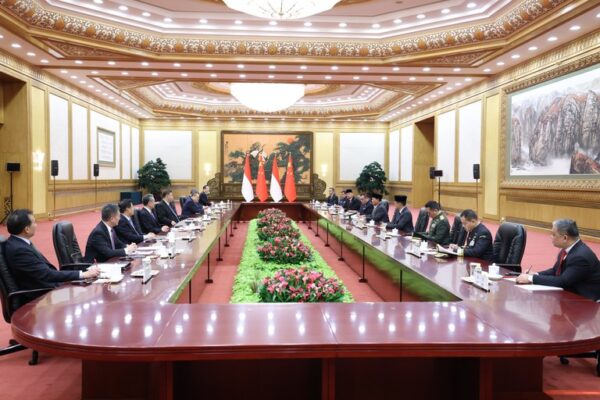
Indonesian President-elect Prabowo Subianto met with Chinese leader Xi Jinping in Beijing on Monday and was expected to travel on to Japan for similar high-level talks during an unprecedented trip by the uninstalled head of Indonesia’s next government. Outgoing Indonesian President Joko “Jokowi” Widodo agreed to the travel plans of the president-elect who continues to serve as defense minister, according to Jokowi’s office. Prabowo is to take the oath of office in October, when he becomes Indonesia’s first new president in a decade. “Yes, he had received permission,” a source at the Presidential Staff Office who was not authorized to speak on the trip and asked for anonymity told BenarNews, an RFA-affiliated news service, on Monday. Prabowo was scheduled to meet with Chinese Prime Minister Li Qiang and Defense Minister Dong Jun before leaving for Japan on Tuesday, where he was to meet with Prime Minister Fumio Kishida and Defense Minister Minoru Kihara, officials said. The news on Friday that China’s president had invited his future Indonesian counterpart from Southeast Asia’s largest country raised eyebrows in Jakarta, because no president-elect had ever undertaken such a trip abroad. Prabowo’s trip to China and Japan – a close ally of the United States – is also his first foreign journey since he won the Feb. 14 presidential election. During Prabowo’s meeting with the Chinese president, Xi told Prabowo that China was willing to enhance “comprehensive strategic cooperation” with Indonesia and make positive contributions to regional and world peace, said Brig. Gen. Edwin Adrian Sumantha, spokesman for the Indonesian Ministry of Defense. Prabowo expressed the hope to Xi that the largest country in Asia and the largest one in Southeast Asia could continue strengthening their strategic partnership, Edwin said. “Regarding defense cooperation, I view China as one of the key partners in ensuring regional peace and stability,” Prabowo said, according to a statement released by the Indonesian defense ministry. “I am also committed to fulfilling Indonesia’s Minimum Essential Force (MEF), including increasing defense industry cooperation and productive dialogue,” the Indonesian president-elect said. The statement did not mention the South China Sea despite a recent study by Indonesia Strategic and Defence Studies (ISDS) and Kompas Research and Development finding that nearly three-quarters of Indonesians see China’s activities in the waterway as a threat to Indonesia’s sovereignty. “The Indonesian public does not like the aggressiveness of Chinese ships which are pushing into Indonesian territory,” ISDS co-founder Erik Purnama Putra told BenarNews last month, referring to waters around Indonesia’s Natuna islands. Edwin said Prabowo was to go to Japan for a Tuesday meeting to strengthen long-standing bilateral relations. “Yes, the statement is confirmed. He will also visit Japan on April 2 to 3, scheduled to meet with the Japanese prime minister and defense minister,” Edwin told BenarNews on Monday. Chinese officials led by President Xi Jinping (left side of table) meet with President-elect Prabowo Subianto and other Indonesian officials in a meeting room at the Great Hall of the People, in Beijing, April 1, 2024. [Indonesian Defense Ministry] During his meeting with Prabowo, Xi also emphasized that China was ready to make positive contributions to maintaining regional and global peace and stability. “President Xi emphasized the importance of cooperation between China and Indonesia in maintaining maritime security in the Southeast Asia region, especially regarding the South China Sea issue which is of global concern,” Edwin said. Prabowo conveyed greetings and a message from Jokowi to Xi, and said he was happy to make China the first country he visited following the election. In his message, Jokowi told Xi that his successor as president supported developing closer ties with China and would continue Indonesia’s friendly policy toward China, according to Xinhua, the Chinese state-run news agency. During Jokowi’s nine years in office, bilateral trade with China has soared and Beijing has invested billions of U.S. dollars in infrastructure projects in Indonesia. Recalling the development of bilateral relations over the past decade, Xi said both sides had made the Jakarta-Bandung High-Speed Railway an example of high-quality cooperation and entered a new stage of development. China views its relations with Indonesia from a strategic and long-term perspective, Xi said, according to Xinhua. He said Beijing would work with Jakarta to build a Sino-Indonesian community with a shared future that has regional and global influence to contribute to regional and world peace, stability and prosperity. ‘Too soon’ Indonesian international political analysts, meanwhile, questioned making China the first stop for Prabowo before taking office. “Prabowo’s visit to China is too soon. It would have been better if he had waited until he was inaugurated first, then visited a foreign country,” Raden Mokhamad Luthfi, a defense analyst at Al Azhar University, told BenarNews last week. “Visits to foreign countries by the newly inaugurated Indonesian president should first be toneighboring ASEAN-member countries such as Malaysia, considering that Indonesia’s interests are much greater in ASEAN than in other countries,” Raden said, referring to the Association of Southeast Asian Nations. Prabowo has bucked tradition in another way as well with his overseas trip, according to Zulfikar Rahmat, director of the China-Indonesia Center of Economic and Law Studies (Celios). “There are two reasons for this. The first is, of course, that Prabowo sees China as a partner in the economic sector. We know that in recent years, China has been Indonesia’s number one trading partner,” he said. Last year, Indonesia became the largest recipient of Chinese investment in the Southeast Asia region with a figure reaching U.S. $7.3 billion, according to data from the State’s Investment Coordinating Board. In October 2023, Erick Thohir, State-Owned Enterprises minister, said the Indonesia-China Business Forum had resulted in 31 business cooperation agreements reaching at least 200 trillion rupiah ($15.5 billion). Even so, he added there is still potential for cooperation of up to $28.6 billion with China covering infrastructure, energy, manufacturing and tourism. BenarNews is an RFA-affiliated news service.


Read More

Police, soldiers injure 17 following Myanmar prison riot

Police and prison guards injured at least 17 inmates in western Myanmar after a prison riot broke out, an advocacy group told Radio Free Asia on Monday. Fighting between prison staff and inmates, including political prisoners charged with opposing Myanmar’s regime, started on Sunday night in Ayeyarwady division’s Pyapon Prison, one Pyapon city resident said. “I heard that two inmates tried to break out of the prison that night,” he said, declining to be named for security reasons. “However, they were captured by prison guards. The authorities buried the news.”  According to sources close to Pyapon Prison and Myanmar’s Political Prisoners Network, a dispute between prisoners and prison guards caused the riot, but RFA has not been able to independently verify the claim. Prison authorities accused the inmates of attacking guards, claiming the guards controlled the situation by bringing in junta-affiliated police and soldiers, according to a statement by the Political Prisoners Network.  Seventeen inmates are receiving treatment at the prison hospital, along with one guard, said Thaik Tun Oo, a member of the leading committee for the Political Prisoners Network. “Currently, we know that some political prisoners are among the 17 injured,” he said. “Others are criminal prisoners. I think the number of injured people might be more than 17.” Authorities locked down Pyapon Prison on Monday following the riots, he added. RFA contacted Naing Win, deputy director general of the junta’s Prisons Department, and Ayeyarwady’s junta spokesperson Khin Maung Kyi for comment on the riot, but neither picked up the phone. Junta soldiers and police have increased security in Pyapon town to prevent unrest spreading, locals said. Prisoners in Ayeyarwady’s capital of Pathein staged a protest in January 2023 after guards tortured an inmate who was caught with a cell phone, and again one week later when the prison planned to execute a teacher sentenced to death.  In response, guards killed eight people and injured 60 in a shooting meant to quash the riot.  Following the country’s 2021 coup, over 26,000 political prisoners have been arrested in Myanmar for speaking against the country’s military junta, funding rebel groups and other charges. Over 20,000 are still in prison, according to the Assistance Association for Political Prisoners.  Translated by RFA Burmese. Edited by Kiana Duncan and Mike Firn. 

Read More

Government overconfidence could cloud a brighter future for Laos

It may sound  perverse to say – given that inflation in Laos has been at one of the highest rates in Asia since 2022, the national debt stands at more than 130 percent of GDP – but the second-poorest nation in Southeast Asia has many reasons for optimism. Tourism is likely to return to pre-pandemic levels this year. Its ASEAN chairmanship this year is greatly boosting its international profile—and, thus, international trade prospects.  Vientiane has sensibly bet on food exports to China, since China’s demographics are arguably the worst in the world and is set to have the fastest population decline in human history. Even today, China cannot feed itself. It imports around 65.8 percent of all foodstuff.   Although that was down from 93.6 percent in 2000, external demand is likely to rise in the coming years as its working-age population collapses, forcing even more rural folk into the cities and industries. It is therefore a solid bet by Vientiane that agriculture exports to China will grow in the coming decades. Its exports increased to $1.4 billion in 2023, up by a quarter from the previous year.  The Vientiane-Kunming railway has already expanded export opportunities into China. If Laos can attract interest from consumers further west, in Central Asia and Europe, it can use the railway links through China to increase trade.  Better still, if Laos can extend its rail network down to Thailand’s ports, again thanks to Chinese investment, that would make it easier and cheaper to export its goods further afield.  Travelers walk toward the first Beijing-Laos cross-border tourist train at the Beijing Railway Station on March 18, 2024. (Jia Tianyong/China News Service/VCG via Getty Images) Better than that, Vietnam has pledged to connect Laos via railways to its port in Vung Ang, which would make it easier for trans-Pacific exports, opening up Laos’ producers to the U.S. market.  Politically, too, the communist Lao People’s Revolutionary Party can be confident in its own monopoly on power. There is no meaningful resistance group among the diaspora or at home. Unlike communist Vietnam, there is nothing like a pro-democracy movement.  Perhaps most heartening for Vientiane, and something often overlooked, Laos has the youngest population of all the ASEAN states and the healthiest-looking demographics over the coming three decades.  Just 4.7 percent of the population is aged above 65. Some 65.4 percent are of working age (15-64) and 29.9 percent are below the age of 15. By 2050, the working age population will actually grow to 68 percent, while just a tenth will be of retirement age by that year.  Aged versus aging societies By comparison, in 2050, a fifth of Vietnam’s population will be aged 65 and over. In Thailand it will be around a third.  Laos won’t become an “aging society” – when 7 percent of the population is aged above 65 – until 2035. It won’t become an “aged society” – when the over-65 cohort is above 14 percent) – until 2059. One reason for this, however, is the country’s shorter life expectancy. Vietnam became an “aging” society in 2011; Thailand became “aged” in 2020. Moreover, when Thailand became an “aging” society in 2002 its GDP per capita was $2,091. Vietnam reached it in 2011 when its GDP per capita was $1,953.  Laos’ GDP per capita stands at $2,535, and it still has another decade or so before it touches “aging” society status. This means that Laos has at least 30 years before demographics start to bite, and even by 2050 there will still be double the number of youngsters aged 0-15 than retirees.  That gives Laos three decades to expand industry and output. For these reasons, political leaders in Vientiane often give off the air of extreme patience, as though they’re sitting pretty on borrowed time.  On the trade front, Laos achieved above 7 percent growth rates in the 2010s when its trade was almost entirely with its immediate neighbors. New infrastructure could open up vastly more markets and attract far more investment in industry and manufacturing, which remains nascent.  Young people splash water at each other in celebration of the Songkran festival in Vientiane, April 14, 2023. (Kaikeo Saiyasane/Xinhua via Getty Images) Railway connections to ports in neighboring countries can help Laos overcome its landlocked confinement at the same time as its workforce booms in number – with around 2 million Laotians to be added to the workforce by 2050.    However, not all is well. The economy has been shockingly bad since 2020, not all of which was caused by the COVID-19 pandemic.  The government and central bank have been incompetent in constraining inflation—and just about all other economic ailments.  The national debt started to climb to unmanageable levels by 2018. Laos imports too much and has barely any control over exports.  The government admits that close to a third of export revenue doesn’t reenter the country. Mostly it is funneled to foreign-owned companies, or profits are hidden, denying Laos a massive chunk of available taxes.  Education, tax collection concerns It’s unlikely that Laos can fully weaken itself off imports. Dispensing of its petroleum dependency would be sensible, given that Laos produces more than enough energy through its hydropower dams. But that means converting most transport and machinery to electric battery-powered, which is simply too expensive for most countries, not least Laos. It still also relies massively on imports for agricultural inputs such as fertilizers.  Since 2020, ever greater numbers of Laotians have left to find work abroad, mainly in Thailand. This has depopulated many rural communities, leaving the elderly to tend to the young. Many of those who have left are the better-educated.  At the same time, the education sector is now in poorer health than pre-2020, although government spending on education began to fall as a percentage of GDP much earlier. Non-attendance or absentee rates are high among students, and teacher numbers are dwindling.  It’s difficult to see how this generation of children, buffeted by the pandemic and shoddy schooling, will become as…

Read More

Ethnic army seizes major trade route on Myanmar-Chinese border

An ethnic army seized five military junta camps near the Myanmar-Chinese border, residents told Radio Free Asia on Friday. During an offensive, the Kachin Independence Army, or KIA, captured encampments under junta Battalion 366 near Kachin state’s Momauk township. The seizure also gave the ethnic armed group partial control of a China-Myanmar border trade road after the Thursday offensive. Since Myanmar’s February 2021 coup, fighting between the KIA and junta forces has raged for weeks at a time over the state’s lucrative jade mines and the rebel army’s historical stronghold near its headquarters on the Myanmar-China border. The KIA now controls portions of two major trade roads in the state since its partial capture of the domestic Myitkyina-Bhamo highway in early March, in addition to a junta camp under Battalion 142 in Momauk township. A battle further north in Lai Zar caused shells to land in China, burning down several houses, residents said.  One resident told RFA that the junta retaliated with air strikes after Yaw Yung Artillery and Hpaleng Hill camps were captured Thursday. “Yaw Yung was entirely captured and Hpaleng camp was also captured yesterday,” he said, asking to remain anonymous for fear of reprisals. “The junta’s air force came to open fire while KIA troops were confiscating things in these camps after the captures.” Yaw Yung is an important strategic camp because of the high-level commander stationed there and its proximity to trading posts with China, residents living near the captured camps said.  Kachin army troops are currently stationed in Lwegel city, about 11 kilometers (seven miles) from Yaw Yung Artillery camp, residents said, adding that they are negotiating with junta troops and administration staff on their exit from the city. RFA contacted Kachin state’s junta spokesperson Moe Min Thein and KIA spokesperson Col. Naw Bu on the junta’s surrender, but neither responded. A statement on the KIA’s Facebook page on March 28, said three camps were captured on the 27th and two on the 28th, namely Shan Tai, Bang Yau, Law Mun, Hpaleng and Yaw Yung. The KIA and joint guerilla armies have captured over 40 junta camps in Momauk and Waingmaw townships near the KIA’s headquarters in Lai Zar city in Kachin state as of Thursday.  Translated by RFA Burmese. Edited by Kiana Duncan and Mike Firn.

Read More

Rohingya activists call for more control of aid money

Rohingya Muslim activists representing fellow refugees forced out of Myanmar and into “prison-like” camps in Bangladesh said in Washington on Thursday that foreign aid to the camps would go further if some of it was given directly to refugee-run groups. But a representative of the U.S. Agency for International Development, or USAID, said little money was left over after aid cuts that currently see the refugees provided with only $10 worth of food a month. About 90% of the 1.2 million Rohingya refugees in Bangladesh struggled to have “acceptable food consumption” late last year, according to the World Food Programme, when their monthly ration of food was bumped up from about $8 to about $10 per person.  Speaking at an event on Capitol Hill to mark two years since the United States labelled Myanmar’s atrocities in 2017 against the Rohingya a “genocide,” the activists said aid was not always spent in ways most helpful for the Rohingya refugees living in Cox’s Bazar. “There are ways to do it effectively,” said Yasmin Ullah, a Canada-based rights activist born in Myanmar’s Rakhine state and the director of the Rohingya Maiyafuinor Collaborative Network. Yasmin Ullah of the Rohingya community is interviewed outside the International Court in The Hague, Netherlands, Jan. 23, 2020. (Peter Dejong/AP) The activist said her group had raised $20,000 through crowdfunding to be disbursed by refugee-run groups in the camp to improve livelihoods there. But she noted global aid flows were far larger. “We know our issues. We know how and where to put this money. We can run with $10,000 farther than any other humanitarian groups can,” she said. “We are asking for aid to be utilized and to directly go to refugee-led initiatives and refugee-led organizations.” Unsolved problems Aid for Rohingya refugees in Bangladesh has dwindled, with less than two-thirds of the approximately $850 million in annual aid requested by aid agencies in the country being fulfilled, a U.N. report said. Lucky Karim, a Rohingya refugee who resettled in the U.S. state of Illinois in 2022 and now works with the International Campaign for the Rohingya, said that any international aid sent to help people in the camps “means a lot to us as refugees” and was appreciated. But she questioned why the hundreds of millions of dollars flowing into the camps each year were not improving conditions. “It’s not about how many years the U.S. has been supporting Rohingya,” Karim said. “What are you guys able to solve?” “Did you solve the labor issue? Did you solve the sexual and domestic and the other violence in the camps? Did you solve the human trafficking issue? Did you figure out the security risks at the camp? Did you figure out and identify the gangs and the nonstate actors in the camp at night?” she said. “Those are the only questions we have.” Requests for more help, she added, were “not just about increasing funding,” with many Rohingyas understanding funds are limited.  “When it comes to the funding issue, when I talked to USAID, for example, they’re like, ‘Oh no Lucky, we have other places in war, like Gaza, for example, and Ukraine, for example,’” Karim recounted, noting there were “many other cases coming up every few years.” Like Ullah, she said some aid could be spent more effectively. “The amount of funding you’re sending to Rohingya refugees in Cox’s Bazar and elsewhere should go to the right people at the right time to the needed situations,” she said. “How do you ensure it without Rohingya’s involvement in the decision making process?” Limited funds Peter Young, the USAID director for South and Central Asia, told the event that the United States had sent more than $1.9 billion in aid to support Rohingya refugees in Bangladesh since the 2017 genocide. Brothers Mohammed Akter, 8, and Mohammed Harun, 10, pose for a photograph on the floor of their burned shelter after a fire damaged thousands of shelters at the Balukhali refugee camp in Cox’s Bazar, Bangladesh, March 25, 2021. (Mohammad Ponir Hossain/Reuters) But he acknowledged the global aid being made available “is not sufficient to meet the needs of people” in the refugee camps. What was once a $12 monthly food ration to the refugees, he explained, was cut to just $8 last year before the eventual bump back to $10. At the end of the day, he said, aid groups were left grappling with the fact they have few funds left after disbursing those meager rations. “We certainly agree with – as Lucky said – the importance of working with and through the Rohingya community,” Young said. “We do make sure our projects that are implemented there are staffed by Rohingya there [or] developed in consultation with community leaders.” “At the same time, if you do the math, $10 a month for a million people consumes our entire budget pretty quickly,” he said. “So the bandwidth that we have to do other programming besides food is limited.” One of the first priorities for the refugee camps outside of food would be “durable shelters,” Young said, due to both the propensity of the camps to be hit by devastating disasters and the “understanding that there will be a lot of people there for some time into the future.” But for the Rohingya activists, that’s only a start. Karim, the Illinois-based refugee, said little will change in the camps until Rohingyas are given some decision-making powers – and “not just coming to D.C. every six months” for forums on Capitol Hill. “You take a bunch of notes, you leave us, you forget us,” the activist said. “We want a specific seat at the table.” Edited by Malcolm Foster.

Read More