

Category: Americas

Cambodian leader to discuss border issues, trade on first Thailand visit as PM
Cambodian Prime Minister Hun Manet will on Wednesday make his first visit to neighboring Thailand since succeeding his strongman father Hun Sen six months ago. Hun Manet is scheduled to meet Thai Prime Minister Srettha Thavisin in Bangkok for talks on economic development of border areas, bilateral trade, closer transport connectivity and tourism, Thai officials said Monday. The two leaders may also discuss overlapping territorial claims in the Gulf of Thailand and a longstanding dispute over Preah Vihear, an ancient Hindu temple complex located between the two countries, according to analysts. Hun Manet, a graduate of U.S. military academy West Point, was in command of Cambodian forces around the temples when the two countries clashed several times over ownership between 2008-11. Thousands of troops are still deployed along both sides of the border and access to the temple from the Thai province of Sri Saket province remains off limits. Pumin Leeteeraprasert, a lawmaker from Thailand’s ruling Pheu Thai party, said he hoped that Srettha would address the issue of the Preah Vihear and reopening the border gate to help promote tourism. “The prime minister acknowledged our request. It’s up to him to raise the matter with PM Hun Manet,” Pumin told RFA affiliate BenarNews. “The Thai-Cambodian relationship is in good shape, but we have to wait and see the result.” In 2013, a judgement by the International Court of Justice ordered Thailand to withdraw its forces in honor of a 1962 resolution that awarded the temple to Cambodia. Cambodia’s Prime Minister Hun Manet salutes during an inspection of troops at a ceremony marking the 25th anniversary of the formation of the Royal Cambodian Army in Phnom Penh on January 24, 2024. (AFP) The temple dispute is not the only source of tension between the Southeast Asian neighbors. Thailand and Cambodia both assert control over an area of ocean covering roughly 27,000 square meters in the Gulf of Thailand. The overlapping claims area could hold 11 trillion cubic feet of natural gas, large quantities of condensate and oil, according to CLC Asia, a government affairs and corporate advisory firm headquartered in Bangkok. “The two new prime ministers may want to solve both land and maritime disputes,” Panitan Wattanayagorn, an independent scholar on security and foreign affairs, told BenarNews. The two leaders could look to share resources in the gulf, possibly by creating a Joint Authority for exploration and exploitation such as the one agreed to by Thailand and Malaysia in 1979, said Panitan, who once served as a security advisor to former Prime Minister Prayuth Chan-o-cha. Former Cambodian Prime Minister Hun Sen, center, walks in front of the National Assembly in Phnom Penh Aug. 21, 2023. (AP) Hun Manet took over leadership of Cambodia when his father, Hun Sen – who built a decades-long reputation for corruption and repression – stepped down in August last year. Last week, ahead of Hun Manet’s visit, three exiled Cambodian activists were arrested by Thai immigration authorities for threatening to protest his arrival. They included Kong Raiya, who was jailed twice for his outspoken criticism of the Cambodian government; Lim Sokha, a senior member of the banned opposition Candlelight party; and opposition activist Phan Phana, who was arrested with his wife and two children, aged two and four. The three activists had recently fled to Thailand to seek asylum and had been granted refugee status, Phan Phana told Radio Free Asia. BenarNews is an RFA-affiliated online news organization.

A Critical Survey of the Biggest 5 Economies: The Survey Reportika
A critical Survey of the Biggest 5 economies of the world viz the USA, China, Japan, Germany and India titled Survey Reportika.

Thousands flee capital of Myanmar’s Rakhine state as battle looms
Thousands of residents have fled the capital of western Myanmar’s Rakhine state in anticipation of a looming battle between the rebel ethnic Arakan Army and junta soldiers, local residents told Radio Free Asia. Fighting in the fortified administrative and military hub of Sittwe is expected to be intense, and would come after close to three months of heightened conflict between the military and the Arakan Army, or AA. In recent weeks, the AA has seized several junta military camps in the townships that encircle Sittwe, including Mrauk-U, Minbya, Kyauktaw and Rathedaung. The military junta has blocked highways and waterways throughout Rakhine since November, making it hard for people to leave the state capital. Those who have decided to stay are digging bunkers at their homes, placing sandbags nearby and otherwise searching for safe places or moving to nearby rural areas, local residents said. “In Sittwe, you cannot use roads or waterways,” a resident of the state capital told RFA. “So, some leave for Yangon out of fear – and they have to go there by air.” There are four flights a day with about 50 people on each flight, according to the resident, who did not want to be named for security reasons. Several local residents told RFA that plane tickets from Sittwe to Yangon are fully booked until the end of March, and some people are chartering planes to get out. Sittwe’s population is over 120,000, including students from several universities, according to 2019 statistics from the general administration department. Some local residents estimated that as many as 30 percent of residents have already left. Gaining ground The AA and two other rebel groups make up the Three Brotherhood Alliance, which launched a campaign in October on junta forces in the northern and western parts of the country. Last week, nearly 300 junta troops surrendered to the AA after it took control of two major military junta encampments in Kyauktaw. And on Wednesday, the Three Brotherhood Alliance said in a statement that the AA had won full control of Pauktaw, a port city just 16 miles (25 kilometers) east of Sittwe. Landline and internet connections have been shut down in northern Rakhine’s townships, including Sittwe, residents said. In some areas, only the Mytel telecom network has been available.Residents said they have had to wait one or two days to withdraw cash from banks in Sittwe and are also having difficulty buying basic commodities such as food and oil as prices rise. Plane tickets to Yangon cost between 350,000 kyats (US$166) and 500,000 kyats (US$238), the Sittwe resident said. “Impoverished individuals and people who can’t afford to buy airline tickets can’t run anywhere,” he said. “They can’t afford to live in Yangon. So there are many people who have to stay here.” RFA couldn’t immediately reach Rakhine state’s junta spokesperson Hla Thein to ask about the steady stream of residents leaving Sittwe. At a Jan. 20 meeting with state level departmental officials, junta-appointed Rakhine chief minister Htein Lin said security has become the administration’s top focus in the state. The Sittwe resident who spoke to RFA about flights to Yangon said he and his family are also trying to travel to Myanmar’s biggest city. “I’m worried about being unable to flee home if something happens. I have a family and children,” he said. “Battles can affect children emotionally. I don’t want to force them to live with such hardships.” Translated by Htin Aung Kyaw. Edited by Matt Reed and Malcolm Foster.
Days after ceasefire, northern Myanmar sees more battles
Fighting erupted between the junta and allied ethnic groups in northern Myanmar just days after the two sides agreed a ceasefire, according to a statement released Wednesday by the Three Brotherhood Alliance. The alliance accused junta soldiers remaining in Shan state’s Kokang of firing grenades, the statement said. It added that junta troops launched the weapons from 30 meters (98 feet) away while allied Kokang resistance fighters were stationed near Kachin mountain. Despite the ceasefire reached during a third round of China-brokered peace talks in Kunming on Thursday night, the Myanmar National Democratic Alliance Army retaliated and fighting began again around 4 p.m. on Tuesday. The alliance claimed junta troops fired back three times with heavy weapons before retreating. Despite the ceasefire, it’s possible that remaining junta troops separated from the rest of the army would open fire and attack, a military analyst who wished to remain anonymous for security reasons told Radio Free Asia on Wednesday. “The areas of Laukkai, Konkyan, and Yan Long Keng are very rough and it’s difficult to communicate there. It’s probably the remnants of the junta army that went into the forest during the [previous] battles,” he said. “I am not sure whether they know about the ceasefire after the [Kunming] talks.” The Myanmar National Democratic Alliance Army, one of the groups making up the Three Brotherhood Alliance, captured Laukkai city in Kokang’s Self-Administered Zone when more than 1,000 junta troops surrendered on Jan. 4 Although the Myanmar National Democratic Alliance Army sent the surrendering troops back to Lashio, some who were separated from the main group may have initiated the attack, military observers said. Both the alliance and regime announced their public agreement to the ceasefire on Friday. According to the agreement, all parties involved would immediately cease fighting in their current locations. Starting Friday, the Three Brotherhood Alliance agreed to refrain from attacks on cities and junta camps. Regime forces similarly committed to halting airstrikes and other heavy weapons attacks. However, tensions still run high. When the Kachin Independence Army launched an attack on a Kutkai military base Sunday night, the junta Defense Service released a statement claiming the Three Brotherhood Alliance’s Ta’ang National Liberation Army was involved. Despite the ceasefire, the alliance is still preparing for future battles, claiming in a statement released Sunday that the regime is launching an offensive that began on Saturday. The statement added the junta is also responsible for airstrikes and heavy weapons attacks in Mongmit, Kutkai, and Kyaukme townships after the ceasefire agreement. RFA called Shan state junta spokesperson Khun Thein Maung and national junta spokesperson Maj. Gen. Zaw Min Tun for more information on these accusations, but calls went unanswered Wednesday. According to data compiled by RFA, in the more than two months since Operation 1027 launched on Oct. 27 to Friday’s ceasefire, the alliance captured 15 cities in northern Shan state. Translated by RFA Burmese. Edited by Mike Firn.
What role did China play in a rebel group’s victory in northern Myanmar?
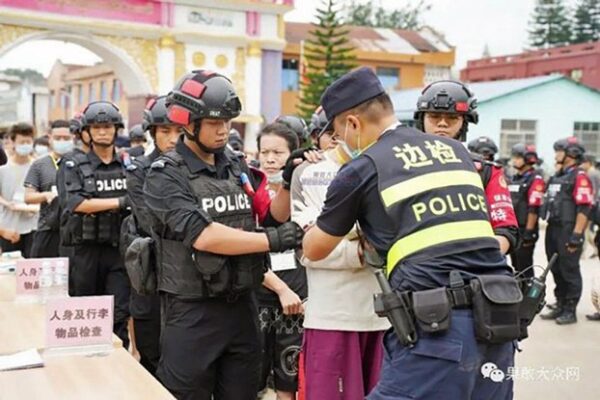
When the Three Brotherhood Alliance of rebel groups in Myanmar started a campaign against junta forces in the northern part of the country they chose a slogan designed to win support from a fourth potential ally: China. “Wipe out the scammers, rescue our compatriots,” the group declared in the message. China, which shares a border with Kokang, a region in Shan state in northern Myanmar, had expressed increasing frustration with organized crime rings that had been allowed to operate in the area by junta-aligned forces. An estimated 120,000 people are being held in Myanmar against their will. Chinese nationals have both been trafficked by these groups and fleeced by them. The Myanmar National Democratic Alliance Army – which along with the Ta’ang National Liberation Army and the Arakan Army make up the Alliance – had tried and failed twice before to retake the region. This time, however, Kokang’s capital of Laukkai fell into rebel hands on Jan. 4. Since then, China has played a clear role in mediating a truce between the two sides. But the initial success of the rebel campaign has led analysts to speculate that it had, in fact, received Chinese backing. China’s leaders may have sought to kill “two birds with one stone,” according to Deng Yuwen, a political commentator and former journalist – strengthening China’s position in the region while removing the destabilizing threat presented by the scam compounds. “The Chinese government can use the scamming operations as a way to secretly support local forces … and control the area that way,” Deng said. “They solve the scamming problem and cultivate bold agents of the Chinese state at the same time,” he said, meaning China believes the new leaders of Kokang will better reflect its interests. Chinese police arrest Chinese nationals allegedly involved in online scamming operations in Myanmar, Dec. 10, 2023. (Kokang officials) A ‘king’ and a coup Kokang has long been in China’s orbit, and many of its residents are ethnically Chinese. In the mid-20th century, Kokang served as a base for Myanmar communists. With the collapse of the Communist Party of Burma in 1989, local warlord Peng Jiasheng – whose nickname was “the king of Kokang” – switched his allegiance to the junta. The military granted the region autonomy and allowed Peng to keep his military presence in the area, though China remained an important patron. In 2009, Peng was ousted in a coup led by his second-in-command, Bai Suocheng, who consolidated his family’s control over the state. Bai allowed government troops to be stationed in Kokang for the first time while residents were granted Myanmar nationality. Bai offered sanctuary to criminal groups in return for huge payouts that also benefited the junta. Eventually, massive, organized scam operations began to thrive in Kokang. China pushes back Last year, the Chinese government appeared fed up. In August, it took part in a joint operation with Myanmar and Thailand targeting the scam centers. Over the intervening months, more than 40,000 Chinese nationals were arrested in Shan state for involvement with online scams, according to data collected by RFA. A number of powerful Kokang business people were arrested at a trade fair in China in October, and in November, Beijing issued arrest warrants for a well-connected Kokang politician and three family members on allegations of masterminding an online scam ring. China’s Ministry of Public Security issued arrest warrants for 10 people, including the former chairman of the Kokang self-administered region, Bai Suocheng [top row, first left], his son Bai Yingcang [top row, second left] and his daughter Bai Yinglan [top row, third left]. (The Kokang) On Dec. 10, China’s Ministry of Public Security put out another wanted list, naming 10 individuals in connection with the scams, including Bai Suocheng, his grown children and a few junta officials. The move not only showed Beijing’s growing impatience with Myanmar’s handling of the scam rings, but signaled that China favored leaders in Kokang more closely aligned with its national interests. The prince’s plans After he had been dethroned as the king of Kokang, Peng Jiasheng resurfaced as the leader of the MNDAA, fighting Myanmar forces on occasion without significant success. When he died in 2022, his son, Peng Denren, took over and immediately made plans to reclaim control of his father’s lost territory. The Alliance launched “Operation 1027” – so-called for the on Oct. 27, 2023, date – offensive against Myanmar military strongholds in northern Myanmar. Even though the Alliance remained outnumbered by government troops, the rebel forces scored several significant victories early on. Its soldiers have since seized more than 300 military bases, around a dozen towns, and won control of several key trade routes with the neighboring Chinese province of Yunnan. Members of the Myanmar National Democratic Alliance Army walk past a Myanmar military base after seizing it during clashes near Laukkaing township in Myanmar’s northern Shan state, Oct. 28, 2023. (Kokang Information Network/AFP) Suspicion over ‘foreign’ experts Myanmar’s junta chief in November claimed that the ethnic-minority armed groups were getting outside assistance, according to a report by Agence France-Presse. He said the rebels had been using “drones with advanced technology” to attack junta positions and were aided by “foreign drone experts,” although he didn’t specify which country they came from. Li Jiawen, a spokesman for the MNDAA, denied the offensive was aided by the Chinese. “The situation we have today is the result of nearly 70 years of tyranny by the junta,” Li said. Even China’s tacit approval of the operation is important, Yun Sun, the director of the China Program at the Stimson Center, a Washington, D.C.-based think tank, said in an interview with RFA. “The biggest support that China has lended to this organization is to not stop them,” she said. Rebel forces were able to retreat over the border to avoid junta artillery barrages. China allowed the flow of money and goods in Shan state that helped to sustain the rebels to continue, Sun said. And there was likely a psychological…
Cambodians need consumer rights NGOs in an era of scams and scandals
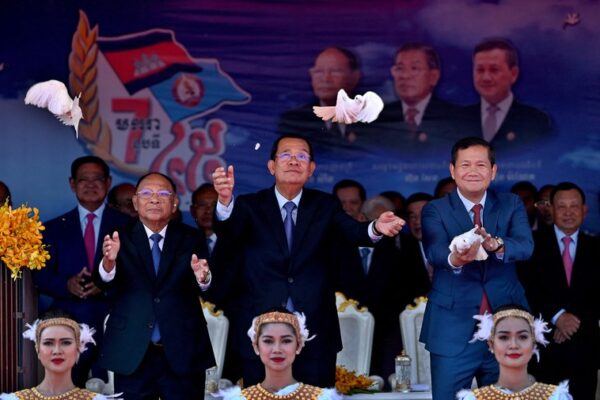
Long gone is the heyday of Cambodia’s civil society, which a decade ago was the most vibrant and rumbustious in Southeast Asia. The authoritarian Cambodian People’s Party (CPP), in power since 1979 and now firmly in control of a one-party state, saw it as a threat and has systematically crushed the public sphere since 2013. Some NGOs still exist and are performing brave work, but they have been greatly defanged and are petrified of lawsuits or dissolution by the ruling party. Despite decades of tens of millions of dollars being pumped into Cambodia’s NGO sector, mainly from foreign governments, there has never been an association created that specifically represents the interests of consumers. There is apparently an NGO registered as the Cambodian Consumer Association, but it has no website and good luck trying to find out anything about its activity. Leader of Cambodian People’s Party Hun Sen and his son Prime Minister Hun Manet release pigeons during a ceremony to mark the 45th anniversary of the fall of the Khmer Rouge regime in Phnom Penh on Jan. 7, 2024. (Tang Chhin Sothy/AFP) Consumers International, a global organization for consumer groups, has no affiliate in Cambodia, according to its website. “Without consumer protection associations,” a report on Cambodia stated, “there will be an imbalance of bargaining power between consumers, and producers and sellers of products and services. As a result, consumers’ rights are not fully protected.” Indeed, on the one hand, consumption is increasing and habits are changing. Household final consumption expenditure rose to $18.1 billion in 2021, up from around $10 billion in 2011 and just $3.3 billion in 2001, according to World Bank figures. Cambodia’s e-commerce sector, difficult to regulate, is expected to surge in value to $1.78 billion in 2025, more than double what it was worth in 2020. ‘Scam-state’ Yet, there remain major concerns about the quality of products being sold, especially by traders on Facebook, and other consumer protection issues. Certainly not helping the situation, Cambodia has gotten a damaging reputation as a country of scammers—a “scam-state”, if you like. More and more Cambodians are also becoming consumers of government services, including the expanding healthcare sector, and contributors to the state through growing taxation collection. On the other hand, business groups, foreign corporations and the country’s powerful tycoons, many of whom have married into the political aristocracy, are increasingly calling the shots. A Cambodian protest against a controversial law regulating non-governmental organizations in Phnom Penh, July 24, 2015. (Tang Chhin Sothy/AFP) Hun Manet, who took over as prime minister from his long-serving father in August, has pitched himself as a friend to the capitalist class. His young government spent months preparing for its first Government-Private Sector Forum in November, at which Hun Manet stressed: “Today’s forum is also a testament to the close cooperation and culture of dialogue between the government and the private sector to jointly address the problems and concerns of investors in order to promote private sector development in Cambodia”. The claim made by the CPP throughout the decades is that economic freedom is more important than political freedom. Yet rather unequal freedom when one side (the businesses and producers) has vast institutional power and the ear of the premier, yet there are no comparable groups defending the interests of consumers. Cambodia only adopted a Law on Consumer Protection in November 2019, and the commerce ministry created a National Programme on Consumer Protection last year. A lengthy report published in late 2021 by the Konrad-Adenauer-Stiftung, titled Law in the Digital Age: Protection of Consumer Rights, noted that the “actual implementation of [the Law on Consumer Protection] in promoting and protecting consumer rights is questionable.” Southeast Asian examples Chapter Seven of this report, titled “Legal and Practical Considerations for Establishing a Consumer Association in Cambodia,” is an interesting read on this topic. The report recommended that “civil society and nongovernmental institutions need to play an outstanding role as check and balance agents in overseeing consumer rights promotion and protection in both traditional and electronic commerce. Civil society and NGOs shall urge, support, and join the establishment of consumer associations in different sectors to ensure that consumer rights to safety, rights to information, rights to choose, rights to be heard of concerns, and rights to redress are guaranteed.” Cambodian security officers detain protesters in prisoner uniforms as they demonstrate against a controversial law regulating non-governmental organizations outside the National Assembly building in Phnom Penh, July 26, 2015. (Tang Chhin Sothy/AFP) There are good examples across Southeast Asia. One is the Consumers Association of Singapore, a non-profit, non-governmental organization. It runs comparison websites that provide consumers with information on prices charged by companies for everyday necessities and energy. It operates an Accredited Businesses List so that consumers can check if companies are reputable. Importantly, consumers can also submit complaints on its websites which are then investigated. Elsewhere in Southeast Asia, there is also the Federation of Malaysian Consumers Associations, the Myanmar Consumers’ Union, a Foundation for Consumers in Thailand and a Coalition for Consumer Protection and Welfare in the Philippines. An overarching “Consumers Association of Cambodia” would be a welcome addition to the public sphere and, with the right funding, including from foreign donors, could engage in the same roles as the Singaporean counterpart. Yet, more targeted associations would also be needed. Using public money One area could be in tax. In 2013, domestic tax revenue was just $900 million, or around $60 per capita. By 2022, it had spiked to $3.45 billion, or $206 per capita. As such, most Cambodians have become taxpayers as well as consumers of government services in recent years. The National Social Security Fund, a national healthcare insurance, has expanded rapidly in recent years and Hun Manet vows to expand it further. State expenditure has increased from $409 million (13 percent of GDP) in 2013 to $7.9 billion (27 percent of GDP) in 2022. Yet there remains no “Taxpayers Alliance of Cambodia”. Such an association would lobby the government to…

Experts denounce trips to Xinjiang as ‘genocide tourism’
The Chinese government has thrown open the door for tourists to Xinjiang. Or at least those it deems worthy of an invite. While officials previously let in diplomats, journalists and those considered “friends of China,” they are now presenting the restive far-western region as a tourist destination of sorts in a bid to remove some of the tarnish from China’s image as a human rights violator in the far-western region in the eyes of the international community. Nearly 400 delegations and groups consisting of more than 4,300 people from various countries and international organizations visited the Xinjiang Uyghur Autonomous Region in 2023, Chinese Foreign Ministry spokesman Wang Wenbin said at a press conference on Jan. 5. Visitors included government officials, diplomats, religious figures, experts, scholars, and journalists as well as ordinary travelers, he said. Unlike travel in the rest of China, however, visits remain by invitation only and visitors are led on government-sponsored tours. These include trips to mosques and heritage sites “to see how Xinjiang’s traditional culture is protected,” Wang said. “They went to local factories, businesses and farms to learn about Xinjiang’s production and development, and visited ordinary households where they saw the happy life of people of various ethnic groups.” “Seeing is believing,” he said. “People are not blind to the truth. For certain countries, they are comfortable telling lies about genocide and forced labor in Xinjiang…. Xinjiang will keep its door open to the world.” Foreign envoys visit an exhibition on Xinjiang’s anti-terrorism and de-radicalization work in Urumqi, capital of northwestern China’s Xinjiang region, Aug. 4, 2023. (Zhao Chenjie/Xinhua via Getty Images) The move comes as China gets ready for its fourth Universal Periodic Review, or UPR — a Human Rights Council mechanism that calls for each U.N. member state to undergo a peer review of its human rights records every 4.5 years. The review is scheduled to be held in Geneva, Switzerland, on Jan. 23. Authorities have tightly controlled who enters Xinjiang, where harsh repression of Uyghurs and other Muslims in recent years has amounted to genocide and crimes against humanity, according to the United States, the United Nations, the parliaments of other Western countries and human rights groups. Authorities in Xinjiang have detained an estimated 1.8 million Uyghurs and other Turkic Muslims, destroyed thousands of mosques and banned the Uyghur language in schools and government offices. China has said that the “re-education camps” have been closed and has denied any policy to erase Uyghur culture. A recent CBS documentary on China’s “rebranding” effort shows surveillance cameras and facial recognition devices monitoring Uyghurs. The name of the ancient town of Kashgar appears in Chinese as “Kashi” on signs and billboards, while the 15th-century Id Kah Mosque — closed to local Muslims since 2016 — has been transformed into a tourist attraction. Through the scripted travel junkets, the Chinese government is spreading a narrative that Uyghurs live happy lives to cover up Beijing’s severe human rights violations in Xinjiang, experts on the region said. Foreign visitors, in turn, have perpetuated the narrative through photos and posts on their social media accounts. Criticism from rights groups The dissemination of propaganda and China’s efforts to enhance the image of Xinjiang have sparked criticism from human rights groups. Claudia Bennett, a legal and program officer at Human Rights Foundation, said the orchestrated visits conceal the harsh realities of forced family separations, arbitrary detentions of millions in concentration or forced labor camps, and thousands of Uyghurs living in exile and forcibly rendered stateless. “In a strategic effort to legitimize its colonization of the Uyghur region, the Chinese Communist Party carefully organizes propagandist visits for diplomats, journalists and religious scholars,” she told Radio Free Asia. “These tours are designed to whitewash the CCP’s gross human rights violations.” The U.S.-based Uyghur Human Rights Foundation, or UHRP, called the visits “genocide tourism” in a report issued last Aug. 30, saying that they help China conceal genocide and crimes against humanity occurring in Xinjiang. Dolkun Isa, president of the World Uyghur Congress, took the criticism of the junkets a step further. “Collaborating with China’s propaganda equates to complicity in genocide – a grave crime,” he said. “Humanity will not forget, and the Uyghur nation will not forget. Those involved will be held accountable before history.” Hector Dorbecker, counselor for economic-commercial and financial affairs at the Embassy of Mexico in Beijing, tries to play dutar, a long-necked two-stringed lute, in Jiayi village of Xinhe county in northwestern China’s Xinjiang region, Aug. 2, 2023. (Zhao Chenjie/Xinhua via Getty Images) Travel and excursion propaganda to portray life in Xinjiang as normal is part of “Beijing’s current strategy,” explained Adrian Zenz, an expert on China’s policies in Xinjiang. “They are showing Uyghurs and Uyghur culture, but not real and free people or culture, but a hollowed out version, a mummified version, like a CCP museum,” said Zenz, director of China studies at the U.S.-based Victims of Communism Memorial Foundation. With the U.N.’s UPR session on the horizon, there can be little doubt that Beijing is touting the visits as a way to counter criticism of its policies in Xinjiang, said Sophie Richardson, former China director at Human Rights Watch. The main problem with the UPR, however, is that there are no penalties for failing to comply or to correct abuses, Richardson added. “Beijing has proven just how easy it is to manipulate the process to keep independent civil society, both inside and outside China, out of the process … and to submit a national report that is breathtakingly dishonest in its claims to upholding human rights.” Translated by RFA Uyghur. Edited by Roseanne Gerin and Abby Seiff.
Women and children suffer amid Myanmar’s civil war
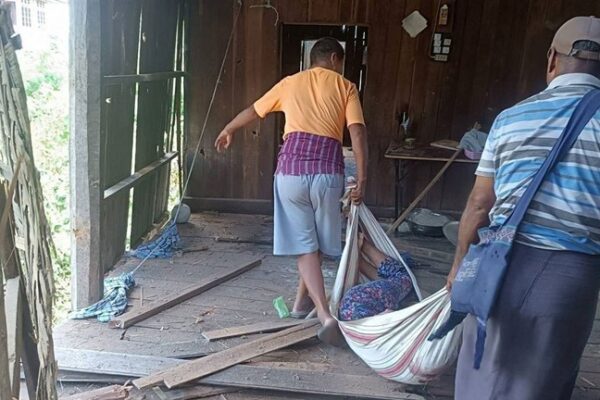
As Myanmar’s civil war approaches its third year, intensified fighting across the country this year between ruling junta forces and resistance fighters has destroyed villages and parts of towns, displacing hundreds of thousands of civilians, most of whom are women and children. The number of internally displaced persons, or IDPs, reached more than 1 million this year, nearly 11,000 of whom fled to neighboring India and Thailand, according to a United Nations report. “The lives and properties of our people were destroyed,” said Zin Mar Aung, foreign affairs minister under the parallel National Unity Government, noting the junta’s burning of villages, air strikes targeting civilians and mass killings. At least 330 women died this year as a result of attacks by junta forces amid the escalation of armed conflict, said Tin Tin Nyo, general secretary of the Women’s League of Burma. “The number of civilian casualties increased due to artillery attacks and air strikes,” she told Radio Free Asia. “Most of the victims were women, children and the elderly.” A woman killed by an artillery shell fired by Myanmar junta forces is carried by rescuers in Noe Koe village in Kayah state’s Loikaw township, Aug. 31, 2023. (Karenni Human Rights Group) Since the end of October, the number of internally displaced persons also increased, with most being women and children, Tin Tin Nyo said. “After a country falls under the rule of dictators, it loses the rule of law and justice,” she said, adding that her organization has seen an uptick in gender-based violence, abuse by husbands amid economic decline, and a growing number sex workers. “These are both visible and invisible challenges,” said the women’s rights advocate. “2023 was full of severe hardship for women.” ‘Lost hope’ Yu Yu, a woman who fled amid armed clashes in eastern Myanmar’s Kayah state, said she has suffered trauma as an IDP. “We are surviving on the food of donors as we have no jobs,” she said. “We have lost hope.” Women who left their jobs to join the Civil Disobedience Movement, or CDM, to resist the military rule following the February 2021 coup say they’ve had difficulties making ends meet while caring for children or aging parents. “My father is 80 years old, my mother is also elderly, [and] they are not in good health,” said Khin May, who used to teach at a private high school in Bago region but quit to join the CDM. “It is very difficult for us while I have no job,” she said, adding that she believes the resistance forces will triumph over the junta in 2024. Hla Win, who lost her leg to a landmine, walks with crutches at a camp for internally displaced people near Myanmar’s Pekon township, July 29, 2023. (AFP) Children have suffered amid the civil war as well, and more than 560 have died since the military seized control from the civilian-led government in the February 2021 coup, according to Aung Myo Min, the NUG’s human rights minister. Since Dec. 21, four children between the ages of 8 and 11 were killed in Rakhine state’s Mrauk-U township, a 9-year-old child was killed in Namtu in northern Shan state, and a seven-year-old girl died in an attack by junta troops in Sagaing region’s Paungbyin township, according to figures compiled by RFA. “This is a war crime,” said Aung Myo Min. “It’s everyone’s responsibility to protect children at all times, but we have seen almost every day that killings are taking place where there are children as they sleep alongside their families, as well as the deaths of pregnant mothers.” Utter despair The death of children are often directly linked to women dying mid the fighting, said Thandar, head of gender equality and women’s development under the NUG’s Ministry of Women, Youth and Children’s Affairs. “For example, in Sagaing and Magway regions, grown men are performing revolutionary duties, while the women, the elderly and vulnerable groups like children are fleeing together,” she said. “So, if women are hit, children are hit, too.” According to Shan Human Rights Foundation based in Thailand, 28 children were killed due to the junta’s attacks from Oct. 27 to Dec. 27 during the the Three Brotherhood Alliance rebel offensive that has put junta forces back on their heels. People flee a village after renewed fighting between Myanmar’s military and the Arakan Army in Pauktaw township in western Rakhine state, Nov. 19, 2023. (AFP) Air- and land-based artillery strikes are the most common cause of death, and children are among the mass casualties when such attacks occur, death counts indicate. On Apr. 19, nearly 20 children under the age of 18 were killed in an air strike during a gathering in Pa Zi Gyi village in Sagaing region’s Kanbalu township. Eleven others died during an attack on Mon Laik IDP camp near the headquarters of an ethnic army in the town of Laiza in Kachin state on Oct. 9. And eight more children were killed during an aerial bombardment of Vuilu village in Matupi township in western Myanmar’s Chin state on Nov. 15. Roi Ji, 40, told RFA that she was in utter despair because all five of her children died in the attack on the Mon Laik IDP camp. “I can’t think about anything anymore,” she said. “I’m in a state of derangement.” Precarious futures Children who live in war-torn areas no longer have access to schools or adequate nutrition, and face bleak futures. Nwe Nwe Moe, a former teacher at Shwebo Technical College who joined the Civil Disobedience Movement and has since become a member of Yinmarbin-Salingyi multi-village strike committee in Sagaing region, said she dare not think about the future of the children living among the chaos of war. “I’m concerned about whether the children will be able to develop into capable young people because there is no safety, no access to study, health care, or nutritious food for them,” she said. “I have a sinking feeling about those who are in life-threatening and emotionally insecure situations.” People…

Disinformation campaign spurred student attack on Rohingya shelter, Indonesian activists say
Human rights activists and some observers on Thursday alleged that university students who stormed a Rohingya shelter in Aceh province the day before had been influenced by an “organized” disinformation campaign, which some even linked to the upcoming general election. Their comments came amid a flood of condemnation of the “inhumane” incident, which resulted in the students forcing the 137 terrified refugees in Banda Aceh, mostly women and children, into trucks to another location. The Rohingya will now be guarded by security forces, a top minister said Thursday. Observers noted that the mob action on Wednesday – which was captured on video and widely circulated – was not typical of student protests in Aceh. Hendra Saputra, the project coordinator of Jesuit Refugee Service (JRS) Indonesia, an NGO in Aceh, said he suspected that Wednesday’s incident was not spontaneous, but “organized and systematic.” He told BenarNews that the students were influenced by social media posts that spread hate and misinformation about the Rohingya. “[The posts] also accused the refugees of taking their food and land, and of sexual harassment and other bad behavior. But these are all false accusations,” he said, adding that no evidence was presented to substantiate the claims. Besides, the refugees couldn’t be a burden because the government is not spending money on them, Hendra said. “There’s no government budget allocated for refugee management,” he said. A Rohingya woman reacts as she is relocated from her temporary shelter following a protest demanding the deportation of the refugees, Banda Aceh, Aceh province, Indonesia, Dec. 27, 2023. [Riska Munawarah/Reuters] Aceh, a predominantly Muslim province that has special autonomy status in Indonesia, has a history of welcoming the Rohingya refugees, who are also Muslim. However, as more than 1,500 Rohingya have arrived since mid-November, the province’s villagers have been demanding they be sent back, claiming there weren’t enough resources for the refugees as well. Those demands grew to small protests, which on Wednesday escalated to the student mob charging into the Rohingya shelter, kicking their belongings and creating mayhem, as many of the refugees sobbed uncontrollably or looked on, frightened and shocked. The government will move the 137 Rohingya refugees to the local Indonesian Red Cross headquarters and the Aceh Foundation building, said Mohammad Mahfud MD, the coordinating minister for political, legal, and security affairs. “I have instructed security forces to protect the refugees because this is a humanitarian issue,” Mahfud told journalists in Sidoarjo, East Java. Newly arrived Rohingya refugees return to a boat after the local community decided to temporarily allow them to land for water and food, having earlier rejected them, Ulee Madon, Aceh province, Indonesia, Nov. 16, 2023. [Amanda Jufrian/AFP] Some analysts have attributed the hostility towards the Rohingya to deliberate misinformation. Chairul Fahmi, a Rohingya researcher and law lecturer at Ar-Raniry State Islamic University in Banda Aceh, said some of this disinformation could be linked to political actors who have an interest in exploiting the refugee issue for their own agenda. “The authorities might have had a hand in the Rohingya disinformation campaign. The protest yesterday did not reflect the typical student movement,” he told BenarNews. “There is a possibility that the students were instructed.” Political parties or groups could try to stir up anti-Rohingya sentiment ahead of the general election in February, suggested Ahmad Humam Hamid, a sociologist at Syiah Kuala University in Banda Aceh. “Aceh should not be used as a battleground for the presidential election over the Rohingya matter. It would be very dangerous,” Ahmad told BenarNews. Meanwhile, Defense Minister Prabowo Subianto, the frontrunner in the Feb. 14 presidential election, was in Aceh on Thursday, and spoke about the Rohingya. He said that while Indonesia should be humanitarian towards the stateless Rohingya, it should also prioritize the welfare of its own people. “Many of our people are struggling, and it is unfair to take in all the refugees as our responsibility, even if we feel humanitarian and sympathetic,” Prabowo said, according to local media. Newly arrived Rohingya refugees wait to board trucks to transfer to a temporary shelter after villagers rejected their relocated camp, in Banda Aceh, Aceh province, Indonesia, Dec. 27, 2023. [Chaideer Mahyuddin/AFP] Della Masnida, 20, a student at Abulyatama University who took part in Wednesday’s incident at the shelter, accused Rohingya refugees of making “unreasonable demands.” “They came here uninvited, but they act like this is their country. We don’t think that’s fair,” she told reporters on Wednesday. The student mob collectively issued a statement saying they rejected the Rohingya “because they have disrupted society.” “We all know that President Joko Widodo has stated that there is a strong suspicion of criminal acts of trafficking among them. Even the Aceh police have said that this is an international crime,” they said in the statement issued Wednesday. The Rohingya are a persecuted Muslim minority from Myanmar, who have been fleeing violence and oppression in their homeland for years. Close to one million live in crowded camps in Bangladesh. With few options after years of a stateless existence, many Rohingya are desperate to leave and that makes them susceptible to exploitation by human traffickers, analysts have said. Gateway to Malaysia Most of the Rohingya who arrived in Aceh recently had left violent and crowded refugee camps in Myanmar’s neighbor, Bangladesh, where 740,000 of them took shelter after a brutal crackdown by the Burmese military in 2017. For the Rohingya, Indonesia is a gateway to Malaysia, which is a top destination for migrant workers from many South Asian and Southeast Asian nations. The Indonesian government, which has not ratified the 1951 Refugee Convention, has said that it does not have the obligation or the capacity to accommodate the Rohingya refugees permanently, and that its priority is to resettle them in a third country. Earlier this month, government officials complained they were overwhelmed and Indonesia was alone in bearing the burden of the Rohingya. Mitra Salima Suryono, spokeswoman for the U.N. refugee agency UNHCR in Indonesia, believes nothing could be further from the truth, and cited…

Southeast Asia’s ‘narco-state’ and ‘scam-states’ undercut authoritarian rule boasts
The year 2023 has been one of disorder in Southeast Asia. War is still raging in Myanmar, where perhaps thousands of civilians were killed this year, on top of hundreds more soldiers and anti-junta fighters. ASEAN, the regional bloc, has failed yet again to either bring the warring parties to the negotiation table or, as a result, take a sterner position on the military government that took power through a coup in early 2021. A consequence of the escalation of political violence in Myanmar has been the proliferation of crime. According to the Southeast Asia Opium Survey 2023, published by the United Nations Office on Drugs and Crime (UNODC), the country reclaimed the spot as the world’s biggest opium producer, with the area of land used to grow the illicit crop increasing by 18 percent to 47,100 hectares in 2023, compared to the previous year. Poppy fields stretch across pastures in mountainous Shan State, Myanmar in 2019. Myanmar reclaimed the spot as the world’s biggest opium producer according to the UNODC Opium Survey for 2023. (Ye Aung Thu/AFP) The report noted that “although the area under cultivation has not returned to historic peaks of nearly 58,000 ha (143,300 acres) cultivated in 2013, after three consecutive years of increases, poppy cultivation in Myanmar is expanding and becoming more productive.” At the same time, production of methamphetamine has also increased. One result has been to flood the rest of Southeast Asia with cheap drugs. On Dec. 13, the Thai police seized 50 million methamphetamine tablets near the Myanmar border, the country’s largest-ever drug bust and the second largest in Asia. Alastair McCready, reporting for Al Jazeera in November, noted that yaba pills—combination of methamphetamine and caffeine—are selling for US$0.24 cents each in Laos. The flood of drugs has led to an explosion of other criminal activity. Radio Free Asia has reported on the growing anger of ordinary Laotians about the authorities inability to investigate even petty crimes, which has been compounded by the ongoing economic crisis in the communist state, another indication of the disorder now infecting the region. Enter ‘scam states’ Singapore, after staying capital punishments for years, felt it necessary to begin state-enforced executions again, killing the first woman defendant in two decades this year for drug-related offenses. If Myanmar has the distinction of becoming Southeast Asia’s “narco-state” once again, some of its mainland neighbors now have the reputation of being what could be called “scam-states.” The blockbuster Chinese hit of the year No More Bets—a film about unwitting Chinese youths being lured into working for scammers somewhere in Southeast Asia, whereupon tragedy unfolds—was banned by several Southeast Asian governments, including Cambodia’s, which presumably thought its “ironclad” friend was spreading malicious propaganda. Bags containing about 2 million methamphetamine tablets seized in a northern Thai border town near Myanmar are displayed during a news conference in Chiang Rai province, Thailand, Dec. 17, 2023. (Office Of the Narcotics Control Board via AP) Indeed, if in China No More Bets was a Tarantino-esque public health warning, in Southeast Asia it was an alarming indictment of all that’s wrong in their nations, a held-aloft mirror they couldn’t ignore, hard as they tried. The Office of the UN High Commissioner for Human Rights reported in August that at least 120,000 people in Myanmar and 100,000 in Cambodia “may be held in situations where they are forced to carry out online scams.” According to a UNODC report, there could be “at least 100,000 victims of trafficking for forced criminality” in Cambodia alone. “If accurate,” the report added, “these estimates of trafficking for forced criminality in Southeast Asia would suggest that this is one of the largest coordinated trafficking in persons operations in history.” Note that those numbers are only of people forced to work in Southeast Asia’s scam compounds, which stretch from mainland Southeast Asia to Malaysia and the Philippines. The number of workers who choose, however you understand that word, to work in this industry is no doubt many times higher. Half of national GDP The UNODC was more hesitant in its language than it could have been. It offered a “conservative estimate” that the scam industry of one Mekong nation, which it did not name, “may be generating between $7.5 and $12.5 billion” in revenue annually, around half that country’s official GDP in 2021. Some think it was a reference to Cambodia, whose GDP was US$27 billion that year. My guess is that the UNODC was being vague because it knows this estimate could also apply to Laos and Myanmar. Five telecom and internet fraud suspects who were handed over to the Chinese police pose for a photo at Yangon International Airport in Yangon, Aug. 2023. (Chinese embassy in Myanmar/Xinhua via AP) Moreover, it’s possible that online scamming, with its associated human trafficking and money laundering, might now be the most profitable industry in all three states, and this increasingly un-shadowy sector may be worth as much as the entire GDP of all three states. To quote the UNODC report: “the scam industry is earning criminal groups the equivalent of billions of U.S. dollars, with profits rivaling the GDP of some countries in the region.” There have been some busts in Cambodia and the Philippines. One of the sparks for the “Operation 1027” offensive that unfolded in October across northern Myanmar, touted as the biggest rout of the junta’s forces since the February 2021 coup, was the apparent inability of the military junta to tackle Chinese-run scam compounds in Shan State. Because of the junta’s inactivity, a number of armed ethnic groups stepped in to tackle the scam compounds, which was well received in Beijing. However, the task of tackling these groups is beyond the capabilities of the police and militaries of Southeast Asian states. In authoritarian mainland Southeast Asia, law enforcement is a patronized, pay-for-promotion extension of ruling parties, which makes them not only ineffective but also systematically corrupt. Political protection Naturally, there is a good deal of political protection of these…
