China’s military is accelerating the pace of its modernization even as senior officers, defense executives, and procurement units face sweeping purges and criminal investigations, according to the U.S. Department of Defense’s latest China Military Power Report released Dec. 23, 2025.
The report — the 25th edition — concludes that despite intense leadership turmoil and structural disruption across the People’s Liberation Army (PLA), Beijing remains firmly on track to meet President Xi Jinping’s 2027 “Centennial Building Goal”, widely interpreted as a deadline to secure decisive military advantages against Taiwan and deter U.S. intervention.
Strategic Deadlines and Taiwan at the Center
The Pentagon says China is developing three integrated capabilities aimed squarely at Taiwan:
- Warfighting superiority in a direct conflict with Taiwan and the United States,
- Deterrence of American intervention using expanded nuclear options,
- Blocking allied participation, including Japan, Australia, and regional partners.
The report outlines four Taiwan conflict scenarios Beijing may adopt—alone or in combination:
- Coercion campaigns below the threshold of war,
- Precision “joint firepower strikes,”
- A prolonged joint blockade of sea and air access,
- A full-scale amphibious landing — considered the most complex and risky.
The PLA has been stress-testing these strategies in a series of large-scale exercises, including the December 2025 “Justice Mission” maneuvers surrounding Taiwan, which extensively showcased new long-range rocket and missile systems.
China’s Unprecedented Nuclear Expansion
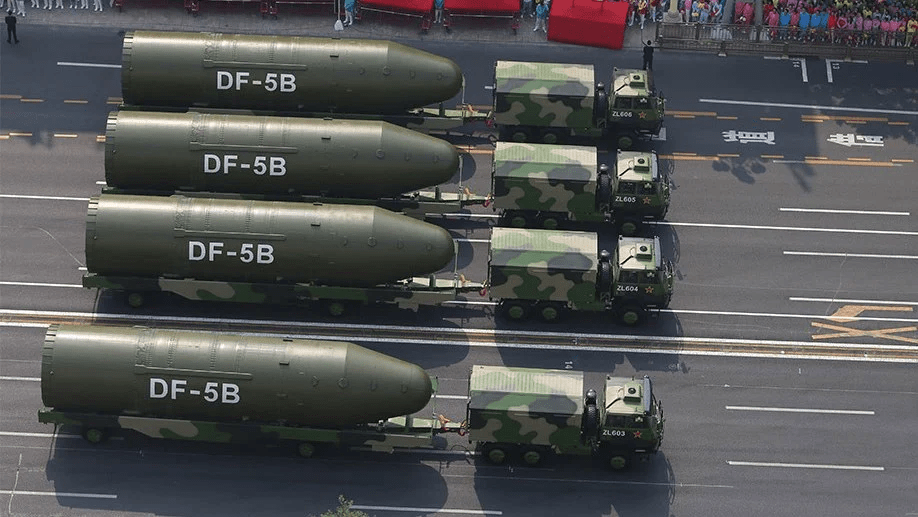
Xi has elevated nuclear modernization to a top national priority. The Pentagon estimates:
- China now fields 600+ operational nuclear warheads,
- The stockpile could exceed 1,000 by the end of the decade,
- Triad diversification is underway with silo-based ICBMs, ballistic missile submarines, and nuclear-capable aircraft.
Newer systems, including DF-27 multi-role missiles and submarine-launched JL-3 ballistic missiles, place most of the continental United States within range.
China is also developing a credible rapid-launch capability through hardened silos, space-based early warning systems, and frequent live-fire training.
Maritime Militia and the “Gray Zone” Pressure Strategy
A major section of the report focuses on China’s use of coast guard and maritime militia fleets to intimidate neighbors — particularly in the South China Sea.
Incidents cited include:
- Vessel rammings,
- Aggressive blocking maneuvers,
- Militia crews wielding axes and spears against Philippine personnel at Second Thomas Shoal (June 2024),
- Ships painted white to mimic official coast guard vessels.
These paramilitary units operate alongside — and in constant coordination with — the PLA Navy.
Growing Global Footprint
Beyond Taiwan and the Pacific, China is expanding military reach to protect its overseas economic interests.
Confirmed and developing support hubs include:
- Djibouti (active),
- Cambodia’s Ream Naval Base (in use),
- 21 additional countries reportedly under assessment for future PLA access — among them Pakistan, Gabon, Sri Lanka, Myanmar, and Bangladesh.
The Pentagon also verifies Chinese diplomatic outreach to Yemen’s Houthi movement to secure safe passage of commercial shipping in the Red Sea — while Chinese firms supply dual-use parts used in Houthi attacks.
In a startling projection, the report states China plans to build six additional aircraft carriers by 2035, expanding its carrier fleet from three to nine.
Purges, Corruption — and Quiet Rebuilding
Despite visible turmoil, the Pentagon cautions observers not to misread China’s internal purges as strategic collapse.
The PLA Rocket Force — operator of China’s nuclear and missile arsenal — appears hardest hit, with mass firings in 2023–25, including senior generals and state-owned defense executives.
Failures linked to corruption include:
- Faulty silo hatch installations,
- The mysterious sinking of China’s newest Type 041 submarine during sea trials.
Younger recruits are reportedly expressing doubts over loyalty to the Communist Party — a rare admission in Chinese military discussions.
However, the Pentagon suggests that Xi’s purge campaign may eventually produce a more disciplined and effective force, improving procurement quality and eliminating entrenched patronage networks.
A Relentless Trajectory Toward 2027
Despite cuts, scandals, or rumors of weakness, the U.S. assessment is unequivocal:
China remains laser-focused on preparing for Taiwan-related conflict and regional dominance.
While this year’s report is shorter than recent editions and omits major naval developments, analysts warn that the PLA may already be surpassing milestones not yet visible to Washington.
Strategic Takeaway
For the United States and its allies, the Pentagon stresses a single message:
Do not confuse turbulence for slowdown.
Beijing’s military modernization is accelerating — not stalling.
The report concludes that China is building the capabilities needed to deter, delay, or defeat U.S. and allied intervention in a Taiwan conflict, while simultaneously preparing to project power across the Indo-Pacific and secure global footholds.