
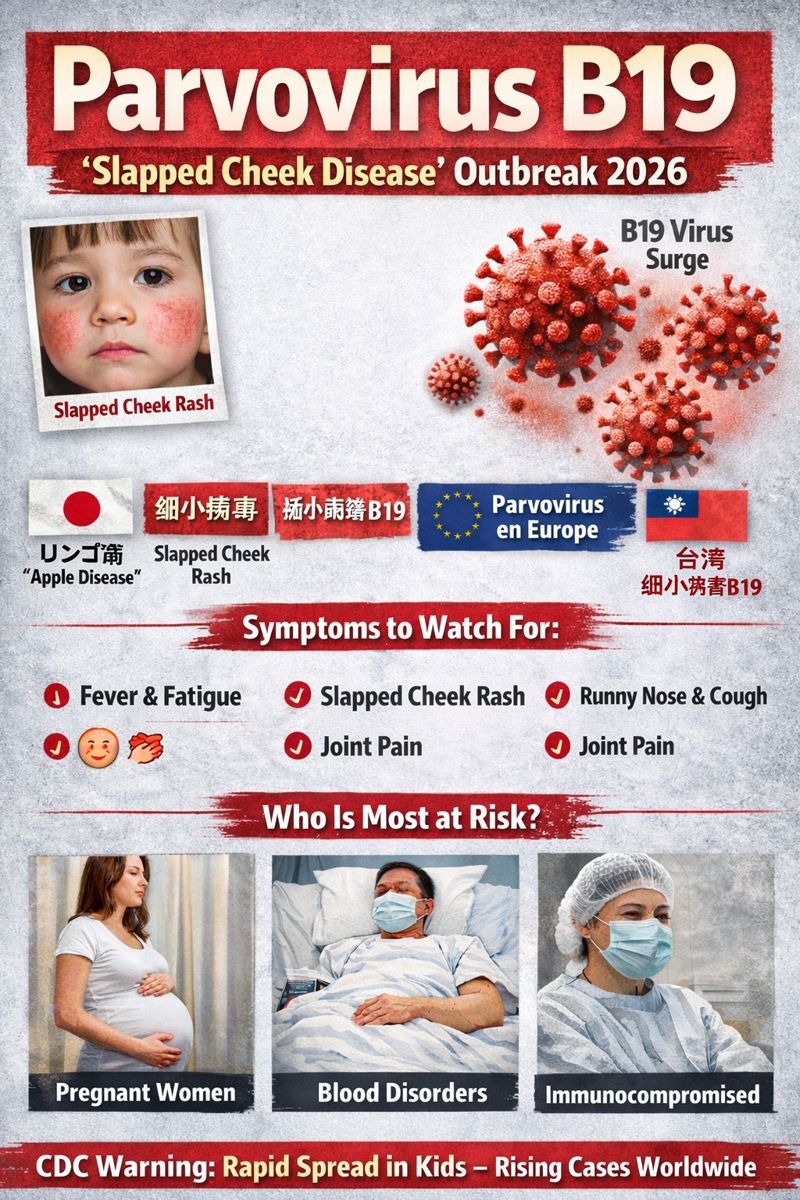
A highly contagious childhood illness long considered seasonal and mild has returned with unusual force. Parvovirus B19 – commonly known as “slapped cheek disease” – is spreading rapidly in the United States and increasingly in countries across Europe and Asia, prompting global surveillance warnings and renewed attention from public health agencies.
CDC Data Confirms Sharp Uptick
In a health advisory issued August 13, the U.S. Centers for Disease Control and Prevention warned of a nationwide spike, noting:
- U.S. antibody prevalence jumped from below 3% (2022–2024) to 10% by mid-2024
- Among children aged five to nine, exposure soared from 15% to 40%
Comprehensive data also confirmed clusters of complications in:
- Pregnant women
- Children and adults with sickle cell disease
- Immunocompromised individuals
The surge follows a similar spike recorded in more than a dozen European countries early in 2024.
A Growing Global Footprint
Parvovirus B19 is no longer a localized seasonal concern. It has been surging in multiple regions around the world, underlining how easily the virus spreads in schools, daycare centers, and public spaces.
Countries & Regions Reporting High Activity
United States
- CDC advisory confirms widespread national transmission
- Pediatric cases dominating spread, with complications reported
Japan
- Known locally as “apple disease” due to the characteristic red rash
- Health authorities report elevated infections nationwide
Europe — Across At Least 14 Countries
Documented high transmission and unusual case spikes in:
- France
- Spain
- Germany
- Italy
- Poland
- Belgium
- Finland
- England & Wales
Israel
- Experienced a significant, prolonged outbreak through 2024
- Notable for persistent waves rather than a single seasonal spike
Taiwan
- Public health officials flag parvovirus among classroom-spreading illnesses
- Local pediatric clinics report a notable rise, especially in late spring
The geographic spread suggests a global circulation wave, potentially accelerated by post-pandemic immunity gaps and renewed international mobility.
What Is Parvovirus B19?
Parvovirus B19 is a viral respiratory illness that predominantly affects children and spreads easily through coughing, sneezing, and close personal contact. It is most common in spring and summer.
The infection is also known as:
- Slapped Cheek Disease
- Fifth Disease (due to its historic classification)
- Apple Disease (Japan)
While mild in most cases, the virus poses elevated risks for pregnant individuals, immunocompromised patients, and people with chronic blood disorders.
Symptoms — What to Look For
Symptoms can vary widely and may be absent in many patients, especially adults.
Flu-Like Early Stage
- Fever
- Fatigue
- Sore throat
- Runny nose
- Headache
- Cough
Distinctive Rash Stage
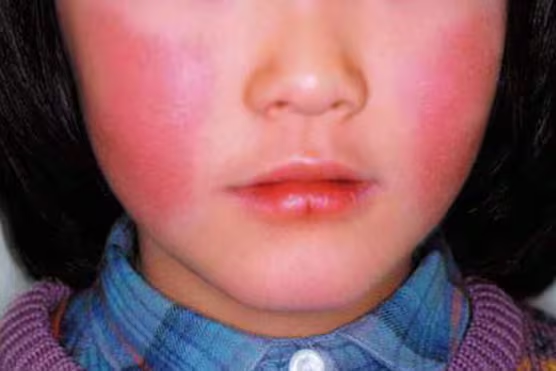
- Bright red cheeks, often described as “slapped cheeks”
- Rash may extend to torso, arms, and legs
- Can worsen temporarily with heat, sunlight, exercise, or crying
Adult Complications
Adults may skip the rash and instead develop:
- Painful, swollen joints
- Arthritis-like symptoms lasting weeks to months
Who Should Be Concerned?
Parvovirus B19 becomes dangerous when infecting individuals with:
Pregnancy Risks
- Around 5% risk of fetal anemia or pregnancy loss
- Highest risk window: Weeks 9–20 of gestation
Blood Disorders & Weak Immune Systems
Including:
- Sickle cell disease
- Cancer patients undergoing treatment
- People with HIV
- Organ transplant recipients
In these cases, parvovirus may trigger severe anemia requiring transfusion or hospitalization.
No Cure, No Vaccine — But Prevention Works
There is no antiviral treatment and no vaccine currently available.
Most patients recover without intervention.
Doctors recommend:
- Rest and hydration
- Fever and pain relief medication
- Medical evaluation for anemia in at-risk groups
Everyday Preventive Measures
- Frequent handwashing
- Covering coughs and sneezes
- Keeping sick children home from school
- Avoiding close contact with vulnerable populations
Pets Are Not Affected
Although the name causes confusion, human parvovirus B19 cannot infect dogs, cats, or other household pets.
Pet parvovirus (CPV-2) is a different virus entirely.
A Familiar Disease, Returning with Force
Parvovirus has circulated for decades.
What is different in 2024–2026 is the scale of spread across continents, occurring simultaneously in:
- North America
- Europe
- East Asia
- Middle East
With schools fully reopened and immunity gaps widening since the pandemic era, global health experts warn that seasonal diseases may increasingly return with unpredictable strength.
IJ-Reportika will continue to monitor public health alerts and provide verified reporting across regions.