
Myanmar youths go into hiding to avoid getting forced into battle

With Myanmar’s junta plowing ahead toward a full-scale draft, young men say they are staying indoors to avoid getting dragooned into the army to fight in a war in which the military is losing ground and men. Most youths have no desire to fight – for the junta or the armed resistance, said a 22-year-old Mandalay resident who asked not to be identified.  “We have no choice as the junta is cornering us to join the army,” he said. “Now we don’t dare to go out – day or night. There are a lot of abductions [for forced recruitment], so I’m worried. My friends say they will join the [resistance] but I don’t know what to do, since I can’t fight.” With recent rapid advances by ethnic armies People’s Defense Force, or PDF, militias of civilians who have taken up arms against the junta, the military appears to be on the defensive as hundreds of soldiers have surrendered. Junta leader Senior Gen. Min Aung Hlaing announced on Feb. 10 that the People’s Military Service Law, enacted in 2010 by a previous military regime, would go into effect immediately. On Tuesday night, the junta announced the formation of a committee to oversee the conscription process. But reports suggest that the military and pro-junta militias are already rounding up as many able bodies as they can with the goal of forcing recruits to undergo simple training, putting weapons in their hands, and dumping them onto the battlefield. Eligible citizens have told RFA Burmese that they would rather join the armed resistance or flee Myanmar than fight for the junta, which seized control of the country in a Feb. 1, 2021, coup d’etat. One young resident of Yangon told RFA he would likely be killed if he is forced to join the military. “I don’t want to join and my friends feel the same, but … we can’t resist because they have weapons,” he said. “So, we have to take the training they’ll give us and if I get a chance, I will go to the liberated areas [controlled by anti-junta forces].” The ‘right’ to defend the country Junta spokesman Maj. Gen. Zaw Min Tun told military-controlled media on Tuesday that the national conscription law provides every citizen “the right” to receive military training to defend the country, and urged people not to be concerned because they wouldn’t immediately be sent to fight. “Just like us professional soldiers, you have to carry out national defense duties only after undertaking proper military training,” he said. A parade of the 78th anniversary of the Armed Forces Day which on March 27, 2023. (AFP) According to Myanmar’s compulsory military service law, men aged 18-35 and women aged 18-27 face up to five years in prison if they refuse to serve for two years. Professionals – such as doctors, engineers and technicians – aged 18-45 for men and 18-35 for women must also serve, but up to five years, given the country’s current state of emergency, extended by the junta on Feb. 1 for another six months. According to the 2019 census, there are 6.3 million men and 7.7 million women – totaling nearly 14 million people – who are eligible for military service in Myanmar, Zaw Min Tun said Tuesday. The number is equivalent to just over one-quarter of Myanmar’s population of 54 million. He added that parents “don’t need to worry” because there are more than 3,000 wards and 60,000 villages across the country, “so only one or two persons per ward need to join the military.” Zaw Min Tun’s comments did little to sooth the concerns of Yangon resident Wai Lwin Oo, whose 23-year-old son is eligible for the draft. “Parents are extremely concerned,” he said. “There are only two options and as a parent, the last thing I want to do is tell my children which path to choose … There are no parents who are amenable [to the conscription law].” Round-ups underway Residents of Yangon and Mandalay told RFA that since the military service law was announced on Feb. 10, young people are nowhere to be seen in the city after 8 p.m. Additionally, RFA received reports on Wednesday that at least 25 young people from Ngwe Than Win Ward in Yangon region’s Thanlyin township had been rounded up for conscription by joint forces of the junta and pro-junta militias conducting house-to-house inspections since Monday. The following day, at least 10 others were taken into custody from Thanlyin’s Darga ward, according to Private Sanda, an official with the local People’s Defense Force. Southwestern commander Brig. Gen. Wai Lin meets with members of militia from some townships of the Ayeyarwady region on Sept. 22, 2023. (Myanmar Military) RFA also received reports on Wednesday that the junta has been recruiting residents of five townships in Myanmar’s southwestern Ayeyarwady region for military training using a raffle drawing since January. Residents said that whoever is selected in the raffle in Kyonpyaw, Myanaung, Kyangin, Kyaiklat and Mawlamyinegyun townships and refuses to join the military is being made to pay up to 1 million kyats (US$475). A lawmaker, who declined to be named, said that the junta is targeting Ayeyarwady because the region is firmly under its control, adding that the military has a “very high demand for soldiers” because its troops are “surrendering, fleeing into other countries, and dying” on the frontlines. Attempts by RFA to reach junta officials for comment on the reported round-ups went unanswered Wednesday. ‘Human shields’ on the battlefield Zaw Min Tun, the junta spokesman, has been cited in media reports as saying that the conscription law will be put into practice after the traditional Thingyan New Year holidays in April, and 5,000 conscripts will be called up in each round. No further details have been provided. Myanmar’s shadow National Unity Government, or NUG, responded to the junta’s announcement of the formation of the Central Committee for Militia Recruitment on Tuesday with a statement urging people not to comply with the conscription…

Read More

Mass arrests in Myanmar spark fear over conscription laws

Junta soldiers on a two-day spree have arrested young and internally displaced people, locals in Bago region told Radio Free Asia. Since enforcing the People’s Military Service Law on Saturday, junta leader Senior Gen. Min Aung Hlaing announced conscription would begin immediately. Refusing to serve could result in a five-year prison sentence for young men and women across the country.   This isn’t the first time the area has faced conscription efforts. Soldiers in January made rounds across several townships, trying to gain numbers through threats, fines, and incentives.  On Monday, soldiers entered Htantabin township’s Za Yat Gyi city in eastern Bago, where locals fled conflict days before the arrests. It was the site of a battle a week ago when the Karen National Liberation Army and People’s Defense Forces fought with junta troops. Around 50 people were killed by junta artillery fire and more than 10,000 were forced to leave their homes amid heavy shelling. The city was left mostly empty, but residents who chose not to flee were abducted from their homes, locals said. Junta troops stationed at Za Yat Gyi Hospital also detained young people in Htantabin township’s surrounding villages. A local in Za Yat Gyi city who wished to remain anonymous for security reasons told RFA on Tuesday that he fled because people who have reached the age of 18 are being rounded up for military service. “At the moment, the whole village is fleeing because the junta’s army entered the village and dragged people out. We are also hiding and fleeing,” he said. “They arrest women who are around 18 and 19 years old. Men at that age are also being taken to the trucks and forced to serve in the military.” Since troops began raids, villages are nearly empty, he added. Internally displaced people from nearby villages were also targeted, although locals said they could not confirm the details of the arrests.  Regime denies mass arrests Junta forces set up blockades on roads leading from Za Yat Gyi to Htantabin city and conducted spot checks and arrests at Htantabin Bridge, according to locals.  Bago residents near the Sittaung river and Kayin state border haven’t been able to get to Taungoo city, roughly 290 kilometers (180 miles) north of Htantabin since the weekend because of blockades, they said. Bago region’s junta spokesperson Tin Oo denied people were being press-ganged into military service.  “As far as arrests are concerned, we are arresting organizations related to the People’s Defense Forces and organizations that support terrorists according to the law,” he told RFA. “We do not arrest innocent people without reason.” No mass arrests occurred, and only three or four people were taken in for interrogation, he said.   On Tuesday night, the regime-backed media announced the formation of a Central Militia Recruitment Team led by the Ministry of Defense.  Translated by RFA Burmese. Edited by Mike Firn.    

Read More

Myanmar junta kills 4 civilians in tea shop shelling

Junta shelling killed four civilians and injured seven others in Myanmar’s Sagaing region, locals told Radio Free Asia on Tuesday.  The army turned its big guns on Monywa township, where junta troops were accused of burning homes and bodies, as well as arresting children and elders last December. All the dead and injured in Hta Naung Taw village are men, said one local, declining to be named for security reasons. The injured are stable and their wounds are not life-threatening, he added. A shell exploded directly on a crowded tea shop in the village center, he said, adding that it was fired by a junta battalion based in Ma Au village on the Monywa-Mandalay road. “It dropped straight on the tea shop. The dead include a cattle broker from Kya Paing village and two brothers from Hta Naung Taw tea shop. Another one is a passenger who was having some tea,” he told RFA Burmese. RFA contacted Sagaing region’s junta spokesperson Sai Naing Naing Kyaw for more details about the shelling, but he had not returned the calls at time of publication.  The army opened fire on the village in retaliation after a battle in Hta Naung Taw 10 days ago between local defense forces and junta troops, residents said. Press-gangs in Monywa Elsewhere in Monywa, locals claim the junta’s conscription efforts have increased after regime leader Senior Gen. Min Aung Hlaing announced on Saturday he would immediately enforce the country’s People’s Military Service Law. The law forces men aged 18-35 and women aged 18-27 to serve for two years in the regime’s military. Professionals from a larger age bracket must serve for three to five years.  Junta police forces at a checkpoint in Monywa city on Nov. 21, 2021. (Citizen journalist) Following the announcement, junta troops seized nearly 50 men on Sunday, locals said.  Soldiers arrested roughly 20 people in Monywa’s Myawaddy neighborhood, including some sitting in a teashop on Sunday morning, witnesses said. They rounded up 28 more from public areas around the city. A Monywa resident who requested anonymity for security reasons said soldiers have been roaming the city in plain clothes, preying on locals, and conducting checks and arrests. Given that those arrested are between the ages of 18 and 35, some locals in the same age range have gone into hiding for fear of being conscripted, he said. “They often wander around the city and catch people. There are four to 10 soldiers in one place spreading out all over the city and conducting checks and arrests,” said the man. “They could be held at Monywa City Hall. I heard that some of them were being released after paying money. I don’t know how much.” Another Monywa resident said the city remained quiet until Monday morning, when people came out to do their shopping. Military-backed channel Myanmar Radio and Television called the reports fake news.  Also Sunday morning, nearly 40 passengers traveling on the Mandalay-Monywa road near Lel Gyi village, Sagaing township, were held by troops for interrogation, residents said. RFA has been unable to find out whether they have been released. According to the Assistance Association for Political Prisoners, more than 26,000 people have been arrested in the three years since the coup, as of Tuesday. Translated by RFA Burmese. Edited by Mike Firn.

Read More

Torture, forced labor alleged at Prince Group-linked compound

This is the third article in a three-part series on the Prince Group. For Part I of RFA’s investigation, click here. For Part II, click here.  Panha has an idea of the horrors that take place within the Golden Fortune Science and Technology Park in Cambodia’s southeastern border town Chrey Thom. He has witnessed what happens to those who try to leave. “When they recapture escaped workers they beat them until they’re barely alive. I’ve seen it with my own eyes,” Panha told RFA, declining to give his family name. His brother, he said, is head of security at the 15-acre (four-hectare) facility, and Panha has watched him hunt down escapees. “If you don’t beat them they will stop being afraid and more will try to escape.” While the compound is ostensibly open to the public, and billed as an industrial park, it is surrounded by a 10-foot-high (three-meter) concrete wall topped with barbed wire. Its heavy, metal front gate is manned by uniformed security guards, who bar entry to ordinary visitors.  Built by the powerful and well-connected Prince Group, the facility now counts cyberscam operations among its businesses, according to witnesses, staff and former employees. While the group denies any involvement in the park, it is run by a company headed by Prince executives and bears several other indicators of connections to the group. Golden Fortune Science and Technology Park in Chrey Thom, Cambodia, is surrounded by a 10-foot-high concrete wall topped with barbed wire. It is seen here in a recent photo. (RFA) Inside, locals allege, trafficked Vietnamese, Malaysian and Chinese nationals are forced to carry out cyberscams. They are part of an enslaved workforce that the U.N. estimates numbers approximately 100,000 people across Cambodia – a claim the government denies. Fourteen local residents – among them current and former employees working at the Golden Fortune compound – separately told RFA they had witnessed security guards violently subduing escaped workers before returning them to the compound. For security reasons, witnesses requested their names not be used. At least two other Prince Group-linked properties have previously been connected with human trafficking and cyberscam operations, according to local and international media reports.  Prince Group spokesperson Gabriel Tan told RFA that while the conglomerate built the Golden Fortune compound, it did so at the request of a client, whom he declined to identify. Asked about allegations of trafficking and cyberscam operations within the compound he added, “we are unaware of the incident you mentioned.”  Cambodian corporate records suggest that the park’s parent company, Golden Fortune, is run by Ing Dara, a businessman with extensive ties to the Prince Group. He holds directorships in a number of Prince companies, including one cited by the Prince Group’s founder as the ultimate source of his wealth in disclosures to an offshore bank. Ing Dara and Golden Fortune could not be reached for comment.  RFA has previously revealed that Chinese police have established a special task force to investigate the Prince Group’s alleged money laundering and illegal online gambling operations run from Cambodia. In part two of our series, RFA explored how illicit funds appear to be washed and funneled into legal Prince Group-affiliated businesses.  This final installment in the three-part investigation into the company explores allegations that one of its facilities holds victims of Asia’s blossoming cyber-slavery industry.  Dirty jobs Chrey Thom is a one-road town abutting the Bassac river just a few hundred yards upstream from Vietnam. Like many border communities in Cambodia, the town is thick with casinos built to service foreigners who face restrictions on gambling in their own countries.  A Cambodian government crackdown against online casinos in 2019 forced many to close. In some cases, the empty real estate has been taken over by criminal gangs that force trafficked workers to perform cyber fraud. Such frauds have exploded in recent years, in particular “pig butchering” in which victims are lured into putting large sums of money into phony investment schemes. However, those performing the scams are often also victims held against their will and forced to find people to dupe using various online platforms.  As cyberscam operations have proliferated, they’ve also been found operating in office blocks, apartment complexes and what appear to be purpose-built compounds.  A “hotel” just outside the Golden Fortune compound in Chrey Thom, Cambodia, has bars on its balconies to keep people from getting out, sources tell RFA. (RFA) Set on 15 acres of land and surrounded by concrete walls topped with barbed wire, the Golden Fortune facility hosts a soccer field, a basketball court and 18 large dormitory style buildings, all of which were constructed since mid-2019, according to satellite imagery reviewed by RFA.  Metal bars cover the dormitory windows on each of the five floors, suggesting they are designed to keep people in. Those allegedly imprisoned inside are mostly Vietnamese and Chinese, locals said. Cambodians work inside the compound, too, in security roles. Online Khmer-language advertisements for jobs within the compound seen by RFA called for Cambodians who speak Vietnamese, offering a salary of $600-800 a month on top of three meals a day and accommodation.  Though relatively well-paid, such work is wholly unappealing to 60-year-old Moeun, who asked that her full name not be used. She spoke with RFA reporters while standing in the thigh-high oily water of a drainage canal, catching fish with her bare hands. “If we don’t do good work and torture they will cut our salaries, so we prefer to come here and catch some fish to get some money,” said Moeun, whose children had worked inside the compound. “Besides working for them, what else can we do?”  A former Golden Fortune security guard says workers who escaped from the compound, the triangle-shaped area seen in this Dec. 19, 2023 satellite image, would be hunted down and bounties offered for their return. (CNES/Airbus) Her account was confirmed by a current Golden Fortune employee, who told RFA that disobedient or unproductive workers are detained on the first floor of a building…

Read More

The case for seating overseas legislators in Southeast Asian parliaments

Around 1.7 million Indonesians living overseas are registered to vote in this month’s presidential and legislative elections, a mammoth task for the General Elections Commission, which has had to prepare 828 voting booths at Indonesian representative offices worldwide, as well as 1,579 mobile voting boxes and 652 drop boxes for absentee voting.  How many overseas Indonesians will actually turn out to vote is another matter, and will there be any further controversy after reports that ballots were given to overseas nationals too early? According to a review by the Philippines’ Commission on Elections published this month, of the estimated 10 million overseas Filipinos, only 1.6 million are registered to vote and only 600,000 (around 40 per cent) did so at the 2022 elections.  Expat Filipinos react as presidential candidate and former president Joseph Estrada speaks during a campaign event in Hong Kong, April 4, 2010. (Tyrone Siu/Reuters) Most Southeast Asian governments, at least the more democratic ones, are looking at ways of reforming how overseas nationals vote. The Philippines’ electoral commission says it intends to have an online voting system in place by 2025 for overseas nationals, although there is still talk that this might be cost-prohibitive and could require digital voting to be rolled out at home too, which is simply too difficult for the election commissions of most Southeast Asian countries for now.  In Malaysia, where overseas balloting has been in something of a mess for the past decade, parliamentarians last month hit on fixed-term parliaments as one way to fix the problem.  However, it might be worth pondering why overseas voters are still asked to vote for representatives in parliament who live hundreds of miles away from them, whose priority is to represent constituents back at home, and who may know nothing about the concerns of overseas nationals.  Constituencies mismatched In Indonesia, for instance, votes from overseas Indonesians go to deciding the seven seats in the House of Representatives sent by Jakarta II district. (Jakarta II, which is Central and South Jakarta, was chosen because that’s where the Ministry of Foreign Affairs is located.)  This may actually be superior to how other Southeast Asian states count overseas ballots – indeed, at least the seven congresspeople from Jakarta II district know they’re supposed to represent overseas constituents. Compare that to Thailand, where overseas voters select the candidates in the constituency where they are from or were registered, so a Thai living in London but who hails from, say, Chiang Mai province votes for the MPs from Chiang Mai province. But how can the MP from Chiang Mai province be expected to adequately represent overseas electors when perhaps only 0.1% of the ballots cast for them came from overseas? An Indonesian voter receives a ballot-slip at the Indonesian Embassy in Singapore to vote in presidential election, July 8, 2009 (Wong Maye-E/AP) Why not, instead, make overseas voters a separate district and allocate six or seven seats solely for them? They could have one seat for an MP representing Indonesians in North America, another for Indonesians in Europe, another for those in Northeast Asia, another for Southeast Asia, and so forth.  And these seats would be occupied by candidates who live overseas. Imagine the Indonesian congressperson who resides in Berlin, New York, Seoul, or Melbourne. They obviously would be able to understand better the concerns and problems facing other Indonesians living abroad.  Aloof from local politics There’s a democratic element to this, too. An overseas MP wouldn’t have to mix daily with their peers in Manila, Kuala Lumpur or Jakarta. They would, on the one hand, remain aloof from the politicking and palm-greasing back home and, on the other hand, be able to bring new ideas learned from abroad back to their capitals.  They could attend parliamentary sessions every month or two, funded by the state, and spend most of their time abroad, where they could also work more closely with their country’s embassies in the regions they represent.  Officials check documentation of Indonesians living in Malaysia as they stand to cast overseas ballots ahead of the Indonesia’s general election, in Kuala Lumpur, April 14, 2019. (Mohd Rasfan/AFP) Currently, almost 10 million overseas Filipinos are represented by several government bodies, such as the Commission on Filipinos Overseas, an agency under the Office of the President. However, having overseas MPs in parliament would provide another layer of representation for nationals living abroad, allowing their voices to be heard by the government bodies and by overseas-based elected representatives.  Indeed, protecting the large population of overseas Filipinos is one of the three pillars of Manila’s foreign policy initially laid out in the 1990s, yet those emigrants have little legislative representation.  It isn’t a revolutionary idea to have overseas-based MPs represent overseas voters. France’s National Assembly has eleven lawmakers representing overseas constituencies. Italy’s parliament has had eight.  Global examples Nor is it specifically a European idea. The Algerian parliament has eight MPs who represent overseas nationals. Angola, Cape Verde, Mozambique, Peru and Tunisia, to name but a few, also have some parliamentary seats set aside for overseas constituencies.  To quickly rebut one argument against it, it would not require a massive change to the composition of parliaments, nor would it require too many administrative changes. At the most, we’re talking about less than ten seats, so a fraction of parliament in a country like Thailand, whose National Assembly has 500 seats! Philippine Senate president Juan Ponce Enrile looks at a tally board during the counting of overseas votes for presidential and vice-presidential candidates at the House of Representatives in Manila, May 28, 2010. (Romeo Ranoco/Reuters) But if electoral commissions are now pondering ideas to better include their overseas nationals in the democratic process, it might be worth considering the more affordable and, perhaps, more democratic option of giving a handful of seats in parliament to overseas representatives.  Nor, indeed, would it be a terrible idea if campaigners in Southeast Asia’s autocracies suggested this as a rational way of protecting their overseas compatriots –…

Read More

Eight songs that didn’t make it into China’s Lunar New Year gala

As people across China welcome the Year of the Dragon, the ruling Communist Party’s propaganda machine has stepped up a campaign of “positive energy” and “good news” about the economy despite widespread reports of slashed bonuses, unpaid wages and youth unemployment and disenchantment. Yet the songs that have truly resonated with people during the past year weren’t featured on the annual star-studded Spring Festival Gala show aired by state broadcaster CCTV on Friday.  Most of these songs first emerged on social media and became quite popular – until censors blocked many of them. But people are still able to see and hear them using virtual private networks, or VPNs, or finding other ways to circumvent China’s “Great Firewall.” Some are still viewable on Bilibili, the Chinese version of YouTube, or other social media platforms.   1. “You’re Not Really Happy” by Mayflower “Are you happy?” an interviewer asks an oil-smeared mechanic at the start of a reboot of the 2008 Mayflower hit “You’re not really happy.” “Sure,” says the man, adding that happiness is fixing cars and not giving his parents any cause to worry. “But what about your happiness?” asks the interviewee. “I don’t know,” says the man uncertainly, in a remixed video posted to X by citizen journalist Mr Li is not your teacher. Undercutting propaganda images of a prosperous country that is merely undergoing some “problems and challenges,” the song’s lyrics highlight the need to pretend everything is fine, just to survive. “You’re not really happy — that smile’s just a disguise,” say the lyrics. “The world laughs, and you join in, hiding your tears. Survival’s the game, no choice, just comply.” “Why take this punishment when you’ve already lost … let sorrow end now, start fresh, breathe new air,” it concludes, striking a chord with X users when it was posted on Feb. 2, ahead of the Lunar New Year festivities. “Chinese people’s happiness is like North Korean happiness, like Stockholm syndrome happiness,” commented @pifuzhinu113541 on the video. “Because ‘unhappiness’ is a crime!” “This is most people,” added @Louis00135, while @DodgyLee1 quipped: “Propaganda department: Don’t spread rumors if you don’t believe them. Also the propaganda department: The whole country is brimming with optimism!”  U.S.-based current affairs commentator Tang Jingyuan said the song “lays bare the scars that lie below the glamorous image projected by the Chinese Communist Party.” “The video raises the question why, in the world’s second-largest economy, so many people from different social classes, men, women and children, are having such a hard time, and can’t achieve happiness,” Tang said.   2. “Descendants of the Dragon” by Namewee Malaysian rapper Namewee’s love letter to the “little pinks” drips with cultural references and political irony, and has notched up more than 7 million views since it dropped — just in time to welcome the Year of the Dragon. Complete with emperor figure in a Winnie-the-Pooh mask as a stand-in for Communist Party leader Xi Jinping, the song isn’t the first time Namewee has taken aim at the “little pinks,” some of whom recently also went viral in a stand-off with British boogie-woogie pianist Brendan Kavanagh around the public piano at London’s St. Pancras Station.     Images and references to Winnie-the-Pooh are banned by Chinese internet censors due to a supposed resemblance to Xi, who is suspected of ordering the removal of Lunar New Year’s Eve from the list of official public holidays this year, because its name (除夕 chúxì)is a homophone for “get rid of Xi” (除习 chúxí). According to Namewee’s Facebook page, the song is satirically “dedicated to every Chinese at home and abroad from all over the world (including Singapore, Malaysia, Hong Kong, and Taiwan), to defend the dignity of the Chinese people!” “As a ‘descendant of the dragon,’ we must always remember: Love the party, love the country, love the chairman!”  The track fires out multiple puns on the Chinese word for dragon, “龙 lóng,” taking aim at those who further the aims of the authoritarian government, despite not wanting to live under its rule. “There’s a group of people from the East,” Namewee raps, “who love their motherland but live in London, Cambodia, Northern Myanmar and Thailand … everywhere, from NYC to LA, chain-smoking, talking on the phone all day, to their cousins and their nephews, calling all their fellow villagers to come and join them.” “Hating on Japan and dissing the U.S. is our duty … flooding YouTube, criticizing and spreading fake news — FALSE!” it says. “His Majesty dons the Dragon Robe,” Namewee raps, while dancing alongside “Emperor Poo.” “Together, we learn to roar like a dragon.” A Chinese person who recently emigrated to Australia and gave only the nickname Liga for fears of reprisals said anti-communist culture is now hip, with the potential to reach large global audiences. “This is a new trend, the attractiveness of anti-communist creative content, which can be monetized,” Liga said. “It shows that people who are dissatisfied with the Chinese Communist Party are now a political force that cannot be ignored, despite not having the right to vote.” “Their influence is pretty formidable, with the help of the internet,” they said.   3. “Qincheng Prison Welcomes You” by RutersXiaoFanQi Chinese censors have gone to considerable lengths to have the channel silenced, filing takedown requests that YouTube has complied with despite growing concerns over Beijing’s “long-arm” overseas law enforcement. The channel’s song “Qincheng Prison Welcomes You” opens with the face of Winnie-the-Pooh shining down as the sun, and warns that anyone found insulting Xi will find themselves welcome at Beijing’s notorious Qincheng Prison. YouTuber @RutersXiaoFanQi puts out a steady stream of spoof videos and satirical content targeting Xi Jinping, in what has become a sub-genre using the hashtag #InsultTheBun. “Insult Winnie, commit thought crimes, the trail to jail is your fate,” sing the robotic synthesized voices. “Make yourselves at home, fellow inmates, old and new alike.” “You may laugh, but you’re on the list — can’t you see?” “The monarchy’s no longer a…

Read More

Critics dismiss Vietnam’s clemency for death row inmates as ‘progress’

Vietnam’s President Vo Van Thuong recently commuted the sentences of several inmates on death row to life in prison as part of a general amnesty, but rights campaigners and legal experts said the move should not be seen as a sign that the country is improving its rights record. Instead, they said, Vietnam’s liberal use of the death sentence is part of a bid by the government to keep its citizens in line and burnish its international image through regularly announced acts of clemency. On Dec. 27, Thuong granted amnesty to 18 death row inmates, commuting their sentences to life in prison. More than a month later, five other death row inmates had their sentences similarly reduced after they filed a petition to Thuong. California-based activist Nguyen Ba Tung of the Vietnam Human Rights Network told RFA Vietnamese that the amnesty was simply part of a bid by the government to “beautify Vietnam’s image on the world stage.” “The government retains the death penalty as a way to menace the people,” he said in a phone interview. “At the end of the year, or on special holidays, they let the president grant an amnesty to show that they are ‘humane.’ But international human rights groups can see through this act.” Vietnam’s judiciary is notorious for its application of the death sentence. Eighteen criminal charges in the country’s penal code carry maximum sentences of execution – most of which are related to drug crimes. Amnesty International’s latest annual report on death sentences and executions, released in May 2023, ranked Vietnam as eighth among nations with the most recorded death sentences in 2022, with at least 102. Just weeks prior to Thuong’s decision to grant amnesty to the five death row inmates, a court in Nghe An province handed down nine death sentences to convicted traffickers from a busted drug ring. Amnesty ‘not a progressive act’ Nguyen Van Dai, a veteran lawyer in the capital Hanoi, told RFA that the application and commutation of the death sentence is all part of a strategy by the government to threaten its citizens at home and avoid criticism abroad. “Every year, Vietnam hands out hundreds of death sentences to drug traffickers and murderers,” he said. “If all the death inmates were executed, the international community would pillory Vietnam. So they find inmates who were sentenced to death for less heinous criminal acts and grant them amnesty.” Dai dismissed the idea of amnesty for death row inmates as progress or a sign of judicial reform. “Progress means that clemency should be granted to all prisoners, both political or criminal, but it is never applied in cases of national security,” he said. “This is a form of discrimination and I don’t consider amnesty a progressive act.” In 2022, Vietnam granted clemency to 31 death row inmates, four of whom were foreign nationals. In September 2023, Vietnam executed death row inmate Le Van Manh, despite claims by Amnesty International that his case was “mired in serious irregularities and violations of the right to a fair trial,” and calls by the international community to stay his sentence. Manh was sentenced to death in 2005, when he was 23 years old, for allegedly raping and killing a female student from his village earlier that year. He had pleaded not guilty to the charges and maintained his innocence until his execution. Translated by RFA Vietnamese. Edited by Joshua Lipes and Malcolm Foster.

Read More

Arakan Army claims capture of third city in Myanmar’s west

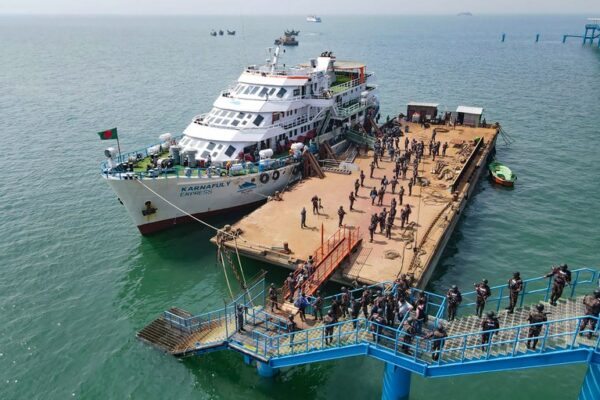
An ethnic armed organization in Myanmar announced it has now captured three major cities, according to a statement from the Three Brotherhood Alliance.  Rakhine state’s Arakan Army (AA) claims to have captured the last major junta territory in Mrauk-U, effectively taking control of the city. On Thursday, the group captured Police Battalion 31, following earlier captures of junta Battalions 377, 378, and 540. Both junta soldiers and policemen surrendered during the battle, said one Mrauk-U resident, asking to remain anonymous for security reasons. “The fighting in Mrauk-U is over. Locals are not allowed to enter the city at the moment. The No. 31 police battalion has also been captured by the AA,” he told RFA on Friday. “I heard they surrendered. But the AA attacked the military battalions. The junta troops surrendered after the battalion commander died.” However, it’s unclear how many police officers and soldiers surrendered and are in Arakan Army custody, he said, adding that the situation wasn’t stable yet. The Arakan Army currently occupies all 10 battalions formerly under control of the junta’s Kyauktaw-based No. 9 Military Operation Command Headquarters. The army also controls three townships across Rakhine: Mrauk-U, Kyauktaw, and Minbya. There is currently no military police or soldier presence in the townships, residents said, adding that most had surrendered, fled, been captured, or died during battles.   Radio Free Asia contacted the Arakan Army’s spokesperson Kaing Thu Kha and Rakhine’s junta spokesperson Hla Thein for more information on the battle, but neither responded by the time of publication. The regime has not released any information on conflicts in Rakhine state, including Thursday’s battle in Mrauk-U. The Three Brother Alliance, consisting of three ethnic armies, has made huge gains in Rakhine and Shan states since launching its campaign at the end of October, prompting thousands of junta troops to surrender or flee to neighboring countries. Bangladesh’s foreign minister Hasan Mahmud announced 340 members of Myanmar’s Border Guard Police fled to Bangladesh on Wednesday, adding they would be returned to Myanmar. Translated by RFA Burmese. Edited by Mike Firn.

Read More

Myanmar resistance fighters burned alive stokes outrage

Two young men in shackles are interrogated by armed men. As villagers look on, the men are suspended from a tree and set on fire. Their screams are heard over the flames as a unified cheer goes up among observers. Video footage of this atrocity has gone viral in Myanmar, fueling outrage in a nation already hardened to the depravity of war after three years of increasingly bloody conflict since the Feb. 1, 2021, military coup d’etat.  Sympathizers have circulated artwork on social media to pay tribute to the men who died, Phoe Tay, 23, and Thar Htaung, 22. The art includes symbolic images of two stars hanging from a tree under a campfire. The video shows their deaths in graphic detail. They were captured Nov. 7, 2023, in fighting between pro-junta forces and resistance fighters at Myauk Khin Yan village in Magway region’s Gangaw township.  According to a local official from the administration of the shadow National Unity Government, the video was taken by a villager who fled the area on Dec. 12 and Dec. 13. It’s unclear who first posted the video that began circulating widely this week. The two young men were members of the local Yaw Defense Force that attacked positions held by junta troops at Myauk Khin Yan and then retreated when reinforcements from the pro-junta Pyu Saw Htee militia arrived, according to the YDF. The two young men were left behind after they both sustained leg wounds. The YDF said every household in Myauk Khin Yan was told to send one person to witness the executions. The video starts with the two young men being questioned by armed, uniformed soldiers while shackled at the legs and their hands tied behind their backs. The video then shows them dragged in chains to a nearby tree where they are hung as a fire is set just underneath. A crowd of people in civilian clothes can be seen in the background. Sporadic laughter from people apparently located closer to the violence can can be heard in the video. Local sources, who declined to be name for safety reasons, said Phoe Tay was a first year university student and Thar Htaung was enrolled at a secondary school. Both were apparently enrolled in the resistance force. Radio Free Asia spoke to the father of Phoe Tay. The father, Myint Zaw, already knew of his son’s death but has not seen the video – partly because he lacks adequate internet access in his village. He voiced horror and anger.  “Yes, it is Po Tay, my son,” Myint Zaw said. “He is gone. His life as a human is over. At that time, they were tortured. There was blood on the head. I didn’t witness it, but I learned that he was beaten on the head, beaten on the knees.” “We could not retrieve the body. Nobody could go there because Myauk Khin Yan is the stronghold village of Pyu Saw Htee [pro-junta militia],” he said.   Myint Zaw said of the video: “I haven’t watched it. But there are reports about it, and many people are talking about it.” “His friends in the village are horrified by it,” he said. “People are deeply hurt. They cannot accept such an act.” Online outrage Since the coup three years ago, reports of torture, beheadings and burning of corpses by junta forces have become commonplace, but the graphic nature of the Nov. 7 video has triggered a wave of revulsion in Myanmar and beyond – and sympathy for the dead.  Hundreds of people have commented on Facebook and others have posted online images and memes that feature the two young men. “I could no longer watch that video. How merciless they were,” said Facebook user Ko Zaw, who lists himself as a resident of Kuala Lumpur. “May you two avoid such a fate in your next lives. Please have compassion with each other, Myanmar citizens.”  Burmese social media has seen an outpouring of AI-generated art tributes to Phoe Tay and Thar Htaung after the nature of their deaths became public. (Clockwise from top left: AIMasterPieces, Christine Ang, ChanHlong, Hein Htut Aung, Crd-AungYeWin and UKhaing) Among the social media artwork are images depicting two stars hanging from a tree, a phoenix rising from the ashes and two young men looking down into a cloud-covered valley. “Whenever I check my phone, I see your faces, brothers,” said Facebook user and Bangkok resident Thein Lin Aung, who added that the amount of graphic photos and videos being reposted was bordering on the reckless. “Even those without any blood relationship feel such a heavy pain,” he wrote. “Please think about their parents, families and relatives.”  ‘Justice must be sought’ RFA’s calls this week to junta spokesperson Maj. Gen. Zaw Min Tun for comment on the video went unanswered.  But the junta-appointed Information Ministry claimed in a statement on Wednesday that the video was fabricated by militia groups and the two young men were killed by a rival People’s Defense Force. “The illegal subversive media is only circulating fake news at the right time to mislead the public and the international community that the security forces are carrying out such inhumane and brutal acts of terrorism, which are being committed by the terrorists from the so-called PDFs,” the ministry said. NUG spokesperson Nay Phone Latt told RFA that the NUG’s Ministry of Home Affairs has started building a case against the alleged perpetrators. However, several sources told RFA that village residents have expressed their fear of identifying the culprits. After the killings, nearly 200 people fled the village because they felt threatened by Pyu Saw Htee militia members, local people said. Gangaw township includes a significant number of supporters for the military junta and members of the Pyu Saw Htee militia, which the military has supplied with weapons and provided with training. Aung Myo Min, the human rights minister for NUG, noted that some of the perpetrators in the video weren’t wearing a military uniform. He described the…

Read More

Myanmar junta kills 6 internally displaced women and children

Junta troops shot and killed women and children living in eastern Myanmar, a human rights group told Radio Free Asia.  The group was attacked while fleeing a junta offensive in Kayah state’s Shadaw township, Karenni State Interim Executive Council secretary Zue Padonmar said Wednesday. After being captured in the forest outside their village, they were taken alive as hostages.  “It happened on Feb. 5. Three women and three children were killed. One of the women who was killed was pregnant,” she said.  “The children who were killed were very young. This kind of incident rarely happens. They are war-torn displaced people … They were taken as human shields.” The victims included two disabled women in their 50s, a 33-year-old pregnant woman, and three children between the ages of three and seven. The women’s bodies were found with wounds on their faces and legs, likely inflicted during their interrogation, said Banyar, director of the Karenni Human Rights Group, who goes by one name. They were later shot in the head. The group was captured when a special operations force launched an offensive in Kayah state. The column was reinforced at Shadaw Byuhar Hill by a helicopter of troops who captured the women and children, along with a man, to use as human shields, Banyar said. Only the man was able to escape.  The regime’s targeting and killing of civilians is a war crime, Zue Padonmar told RFA. The Karenni Interim Executive Council said it is preparing to take legal action against the junta in domestic and international courts. Zue Padonmar also urged the international community not to cooperate with the junta or sell them aviation fuel. RFA contacted junta spokesperson Maj. Gen. Zaw Min Tun to confirm details about the alleged shooting, but did not receive a response by time of publication. The junta also carried out an aerial bombardment on a school at Daw Si Ei village in western Demoso township on Feb. 5, killing four children and injuring at least 10, according to local defense forces.  A total of 4,500 civilians have been killed across the country in the three years since the military coup, according to a statement by the Assistance Association for Political Prisoners on Feb. 7. Translated by RFA Burmese. Edited by Mike Firn.

Read More