
What Are Rare Earth Elements (REE)?
The Rare Earth Elements (REEs) are a group of 17 chemically similar metals located in the lanthanide series of the periodic table, plus scandium and yttrium. They are:
- Light REEs: Lanthanum (La), Cerium (Ce), Praseodymium (Pr), Neodymium (Nd), Promethium (Pm), Samarium (Sm), Europium (Eu), Gadolinium (Gd)
- Heavy REEs: Terbium (Tb), Dysprosium (Dy), Holmium (Ho), Erbium (Er), Thulium (Tm), Ytterbium (Yb), Lutetium (Lu), Yttrium (Y), Scandium (Sc)
Despite the name “rare earth,” they are not particularly rare in the Earth’s crust. Cerium, for example, is more abundant than copper. What makes them “rare” is that they rarely occur in economically mineable, high-concentration deposits and are difficult and expensive to separate from one another because of their chemical similarity.
Why Are They Critical?
REEs have unique magnetic, luminescent, and electrochemical properties that make them irreplaceable in high-tech applications:
- Neodymium & Praseodymium → Permanent magnets (NdFeB) used in electric vehicle motors, wind turbines, hard-disk drives, and headphones.
- Dysprosium & Terbium → Added to NdFeB magnets to maintain performance at high temperatures (critical for EVs and wind turbines).
- Lanthanum & Cerium → Catalytic converters, petroleum refining catalysts, and hybrid-car batteries.
- Europium & Terbium → Phosphors in LED lighting, TV/phone screens, and medical imaging.
- Yttrium → High-temperature ceramics, superconductors, and cancer-treatment compounds.
Virtually every green-energy and defense technology depends on them: one wind turbine can contain 1–2 tons of REE magnets; an F-35 fighter jet uses ~420 kg; an electric car uses 1–3 kg (10× more than a conventional car).Where Are They Found and Mined?Major geological settings:
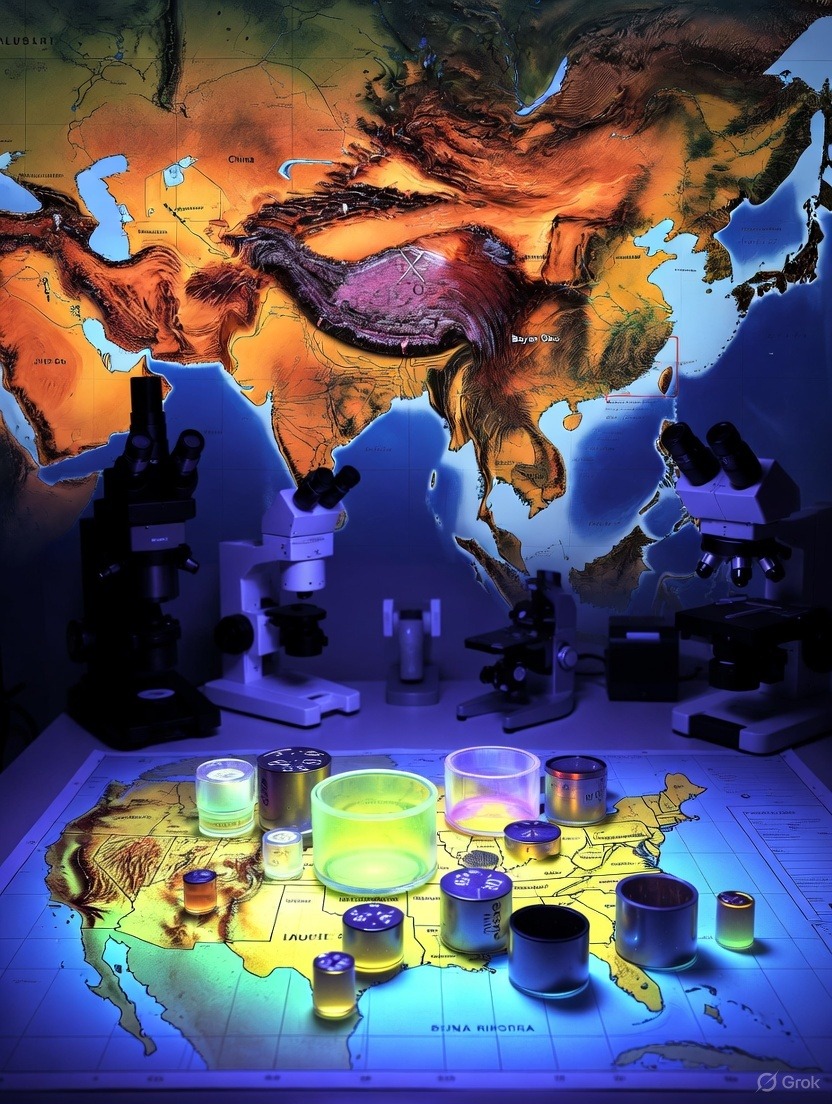
- Carbonatites (igneous rocks): e.g., Bayan Obo (China), Mountain Pass (USA), Mount Weld (Australia)
- Alkaline igneous complexes
- Ion-adsorption clays (southern China — unique for heavy REEs)
- Monazite/xenotime beach sands (India, Brazil, Australia, Vietnam)
Current Production (2024–2025 estimates)
- China: 68–70% of global mined REEs (240,000–270,000 tonnes REO/year)
- Dominates especially heavy REEs (>95% of Dy, Tb, etc.)
- Australia (Lynas Rare Earths – Mount Weld): ~10–12%
- United States (Mountain Pass – MP Materials): ~12–15%
- Myanmar (feeds Chinese processors): ~5–8%
- Others (Vietnam, Brazil, India, Russia, Madagascar): <5% combined
China also controls ~85–90% of global refining/separation capacity and ~90% of magnet production.
Geopolitics of Rare Earths
China’s Dominance (1980s–present)
- In the 1980s–1990s, China deliberately undercut global prices (thanks to low labor and environmental costs), driving almost all Western producers out of business (Mountain Pass closed 2002–2017).
- Deng Xiaoping famously said in 1992: “The Middle East has oil; China has rare earths.”
- Since 2010, China has repeatedly used REEs as a diplomatic weapon:
- 2010: Cut exports to Japan by ~70% during Senkaku/Diaoyu islands dispute.
- 2019–2023: Periodic threats to restrict exports to the U.S. during trade war.
- 2023–2025: Export licensing requirements for gallium, germanium, and graphite; new restrictions on REE magnet technology exports (Dec 2023) and further tightening in 2025.
Western Response
- United States: “Whole-of-government” strategy since 2020
- Mountain Pass restarted (2018), now the only integrated U.S. mine-to-magnet facility.
- DoD and DOE funding for separation plants (Lynas Texas, USA Rare Earth, Energy Fuels, etc.).
- 2022 Inflation Reduction Act tax credits require increasing non-Chinese critical minerals.
- 2025: U.S. still <1% of global magnet production.
- Australia: Lynas Blue Line plant in Texas (2026 target), Arafura Nolans project, Iluka Eneabba refinery.
- EU Critical Raw Materials Act (2024): Targets 10% domestic mining, 40% processing, 15% recycling by 2030.
- Japan: Stockpiling, heavy investment in Lynas (Australia), deep-sea mud exploration, recycling.
- “Friend–shoring” alliances: U.S.–Australia–Japan–Korea–EU coordination.
Emerging Producers (2025–2030 pipeline)
- Australia: Browns Range (heavy REEs), Arafura, Northern Minerals.
- Canada: Nechalacho, Wicheeda.
- Africa: Steenkampskraal (South Africa), Lofdal (Namibia), Gakara (Burundi).
- Greenland: Kvanefjeld (huge but uranium co-product issue).
- Vietnam: Growing refining capacity with Japanese/Korean investment.
Environmental and Social Challenges
REE mining and processing are dirty:
- Bayan Obo tailings lake contains radioactive thorium and millions of tonnes of toxic sludge.
- Southern China ion-adsorption clay mining historically caused massive deforestation and water contamination.
- Western projects face strict environmental permitting → high costs and long lead times (10–15 years).
Recycling and Substitution
- Recycling rate <5% globally (technical difficulty and low volumes).
- Urban mining (e-waste) is growing but nowhere near sufficient.
- Substitution: Researchers are trying to reduce Dy/Tb content in magnets or replace with ferrite/Lanthanum-Cerium magnets, but performance drops.
Outlook 2025–2035
Demand is projected to grow 4–7× by 2040 (IEA, Adamas Intelligence) driven by EVs, wind, and defense. Supply–demand gaps are forecast for NdPr (2025–2028) and especially Dy/Tb (chronic shortage). Prices spiked in 2021–2022, moderated in 2023–2024, but new Chinese export controls in 2025 are pushing NdPr oxide above $80/kg again.
China still holds overwhelming leverage. The West is spending tens of billions to diversify, but building separation plants and magnet factories takes 5–10 years. Until at least 2030–2035, any serious confrontation risks China cutting off heavy REEs and magnets, crippling EV, wind, and defense supply chains.
In short: Rare earths are not rare in the ground, but they are extraordinarily concentrated in one country’s hands – making them one of the most strategically important commodity groups on Earth.