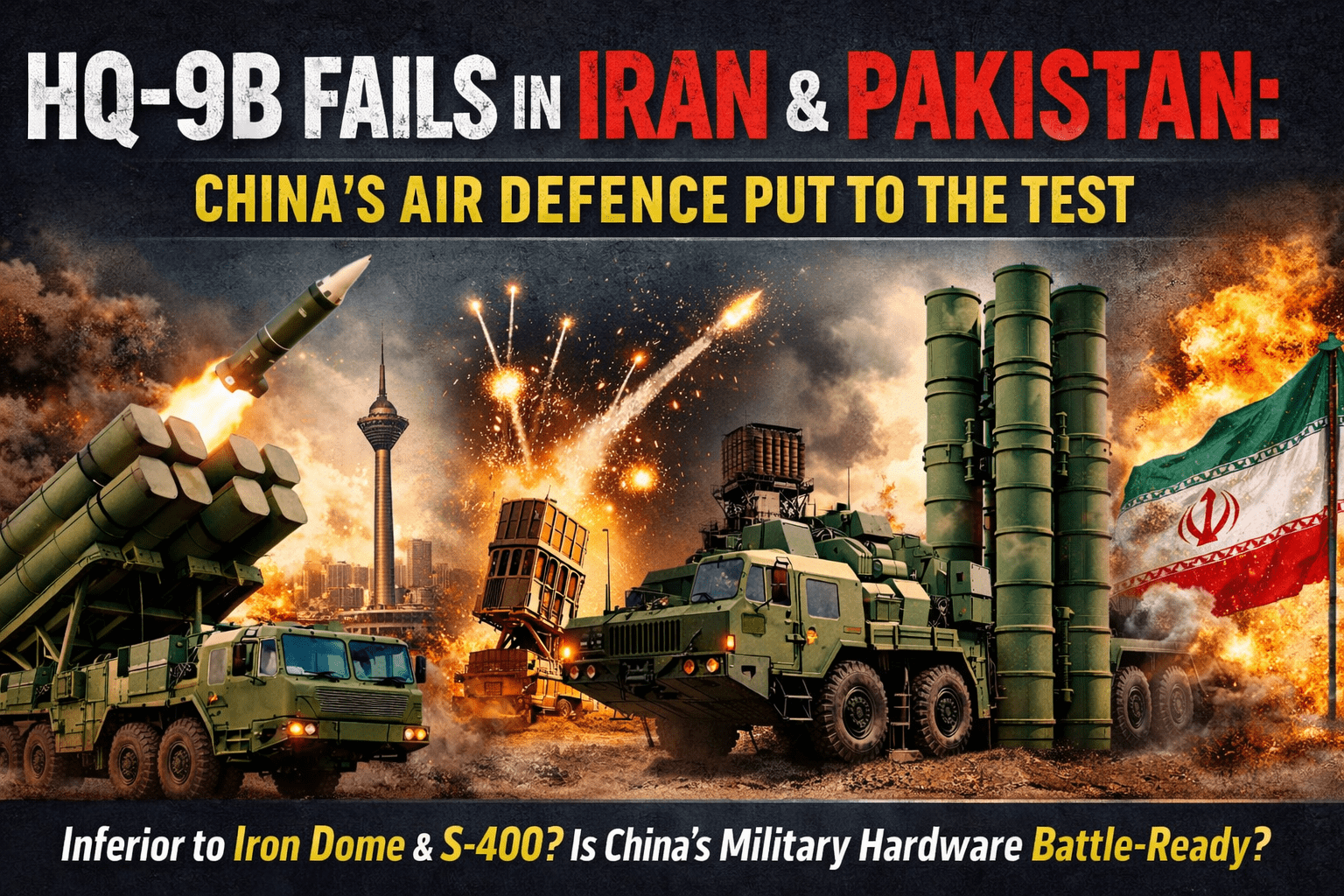
The myth of invincibility surrounding China’s flagship air defence export—the HQ-9B—is rapidly unraveling.
Following devastating coordinated US–Israeli airstrikes across Iran, and earlier scrutiny during Pakistan’s military confrontation with India, serious questions now confront Beijing: Is the HQ-9B truly battle-ready? Or is it another overhyped system that collapses under real-world combat stress?
The recent destruction across more than 20 Iranian provinces—despite Tehran’s layered air defence shield—has placed China’s long-range surface-to-air missile (SAM) system under the harshest spotlight yet.
A Layered Shield That Crumbled
Iran’s air defence network was theoretically formidable.
Its architecture combined:
- HQ-9B (long-range)
- S-300PMU-2 (Russian-supplied long-range)
- Bavar-373 (indigenous)
- Medium-tier systems like Khordad-15 and Raad
- Short-range shields including Tor-M2 and Pantsir-S1
On paper, this layered defence should have complicated any air assault.
Instead, US and Israeli forces reportedly neutralized radar nodes, command infrastructure, and critical military installations within hours. The Israeli Defence Forces claimed they dismantled the majority of western and central Iran’s air defence systems—clearing the path toward aerial superiority over Tehran.
If accurate, this outcome represents not merely operational overwhelm—but systemic failure.
And at the heart of that failure lies the HQ-9B.
The Promise vs The Battlefield
Developed by the China Aerospace Science and Industry Corporation, the HQ-9B was marketed as China’s answer to advanced Western systems.
Beijing claimed:
- Engagement range of ~260 km
- Interception altitude up to 50 km
- Active radar homing
- Passive infrared seeker for stealth tracking
- Simultaneous tracking of 100 targets
- Engagement of 6–8 targets at once
Its design reportedly drew inspiration from Russia’s S-300 and the US Patriot PAC-2.
But battlefield performance tells a different story.
When confronted with:
- Stealth aircraft
- Electronic warfare
- Precision-guided munitions
- Cyber disruption
- Coordinated multi-vector strikes
The HQ-9B appears to have been either overwhelmed—or technologically outmatched.
Comparison: HQ-9B vs Iron Dome vs S-400
🔹 Iron Dome
- Battle-tested repeatedly in high-intensity rocket environments
- Proven interception rate in live conflict
- Rapid response and high operational tempo
- Specifically optimized for saturation attacks
🔹 S-400 Triumf
- Multi-layer radar architecture
- Engagement range up to 400 km (depending on missile variant)
- Integrated counter-stealth tracking capability
- Deployed by multiple nations with strong deterrence credibility
🔹 HQ-9B
- Limited verified combat success
- Export credibility now under strain
- Radar survivability questioned
- Vulnerable to electronic and cyber disruption
The contrast is stark: Iron Dome and S-400 have reputational capital earned through repeated operational validation. The HQ-9B, by contrast, faces mounting evidence that its battlefield resilience may not match its advertised specifications.
Pakistan Precedent: A Pattern?
The HQ-9B had already drawn attention after reports during India’s Operation Sindoor suggested it failed to shield key Pakistani targets effectively.
Though official confirmations remain limited, the pattern emerging from Iran suggests a recurring vulnerability: the system may perform adequately in controlled environments—but struggles when facing advanced electronic warfare and high-volume coordinated assaults.
If two separate theatres show similar cracks, it ceases to be coincidence.
The Bigger Question: Are Chinese Weapons War-Ready?
A prior investigative report by IJ-Reportika on defective Chinese weapons exports raised concerns about quality control, overstatement of capabilities, and limited real combat validation.
The HQ-9B controversy reinforces those concerns.
China has aggressively marketed its defence platforms globally as cost-effective alternatives to Western systems. But affordability without survivability is not deterrence—it is illusion.
To become genuinely war-ready, Beijing must confront uncomfortable realities:
- Harden radar and command systems against cyber and EW attacks
- Improve interceptor reliability under saturation stress
- Enhance integration across multi-layer defence architecture
- Conduct transparent battlefield testing under real conditions
Without these reforms, China’s air defence ecosystem risks being perceived as technologically ambitious—but operationally fragile.
Strategic Fallout for Beijing
China has deployed the HQ-9B around sensitive zones including Beijing, Tibet, and the South China Sea. If the system’s vulnerabilities are confirmed, adversaries will take note.
The implications extend beyond Iran:
- Export credibility may suffer
- Strategic deterrence narratives weaken
- Regional rivals gain confidence
- Global defence buyers reconsider procurement
Military hardware is judged not by brochures—but by battlefield survivability.
And right now, the HQ-9B faces its most severe credibility crisis.
Conclusion: A Wake-Up Call for China’s Defence Industry
The Iran strikes may represent more than a regional escalation—they may mark a turning point in perceptions of Chinese military technology.
If the HQ-9B could not safeguard a layered defence network against a coordinated modern assault, Beijing must urgently reassess its technological readiness.
Becoming a global military superpower requires more than scale, ambition, and marketing. It requires systems that endure the chaos of real war.
At this moment, the HQ-9B appears to have fallen short.