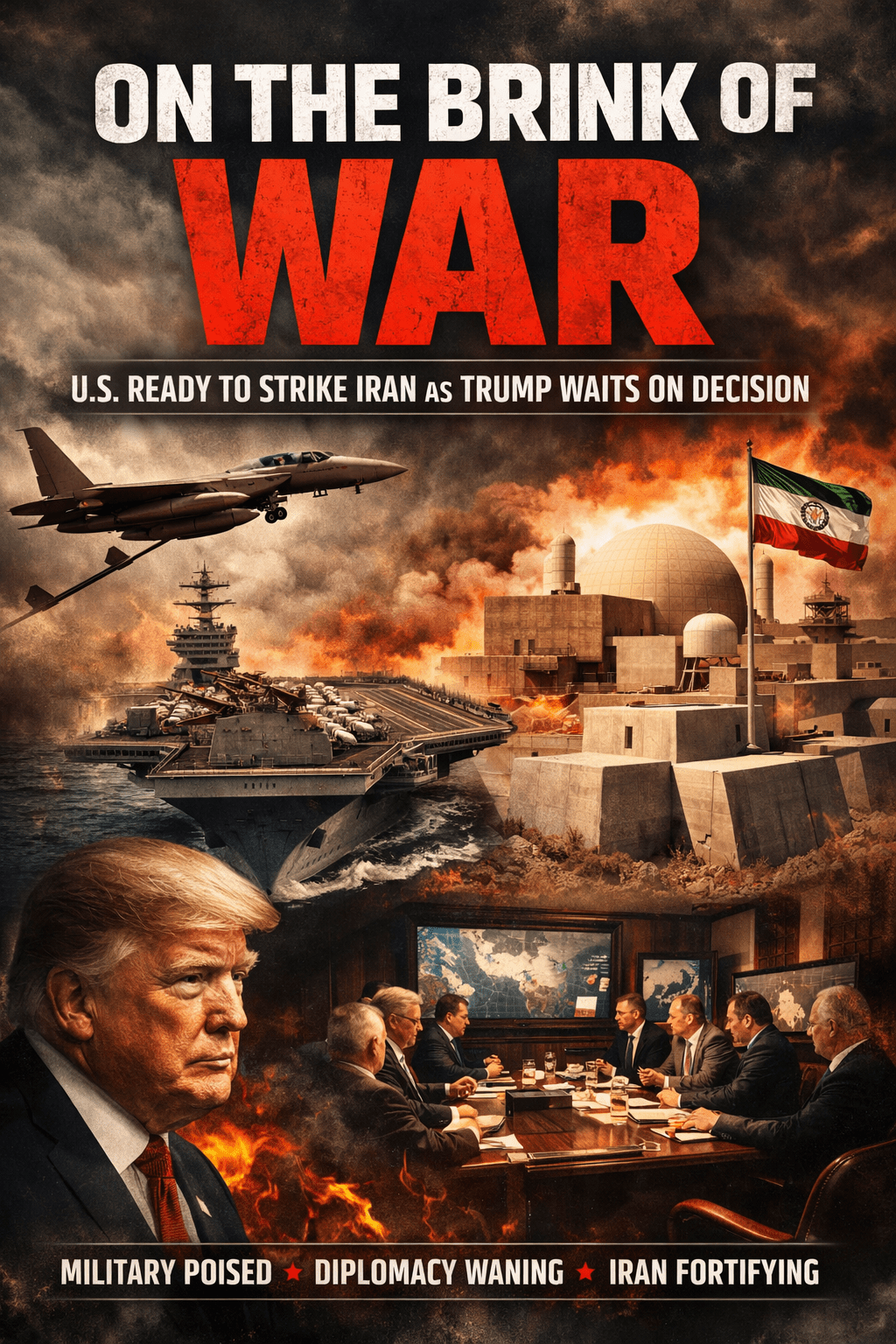
The United States military is prepared to launch strikes against Iran as early as this weekend, according to multiple sources familiar with internal deliberations. Yet despite an accelerated military buildup and high-level briefings inside the White House, President Donald Trump has not made a final decision.
The moment represents one of the most consequential foreign policy crossroads of Trump’s presidency — a decision that could reshape the Middle East and test America’s appetite for another major military confrontation.
Military Assets in Position
Senior officials have informed the White House that U.S. forces could be ready for action within days. In recent weeks, the Pentagon has quietly repositioned significant air and naval assets closer to Iran.
The United States Department of Defense has moved fighter jets and refueling tankers from bases in the United Kingdom toward the Middle East. The United States Air Force is reportedly enhancing its regional strike capabilities, while the aircraft carrier USS Gerald R. Ford — the most advanced carrier in the U.S. arsenal — could arrive in theater as early as this weekend.
The readiness posture was first reported by CBS News, and has since been corroborated by additional sources.
Meanwhile, administration national security officials convened inside the White House Situation Room to assess strike options and potential fallout. Trump also received briefings from special envoy Steve Witkoff and adviser Jared Kushner following indirect diplomatic talks with Iranian negotiators in Geneva.
Diplomacy Still Flickering
Despite the sharpened military posture, diplomacy has not fully collapsed.
U.S. and Iranian officials engaged in three-and-a-half hours of indirect talks in Geneva earlier this week. Iran’s lead negotiator described the discussions as yielding a “set of guiding principles,” though American officials caution that significant gaps remain.
White House press secretary Karoline Leavitt emphasized that “diplomacy is always his first option,” but reiterated that military action remains under consideration.
Secretary of State Marco Rubio is expected to travel to Israel on February 28 to meet with Prime Minister Benjamin Netanyahu to discuss the state of negotiations and regional security concerns.
Still, one source close to the president described the decision-making process as fluid.
“He is spending a lot of time thinking about this,” the source said, noting Trump has privately argued both for and against military action while polling advisers and allies.
Iran Fortifies Its Nuclear Sites
As Washington weighs its options, Tehran appears to be preparing for the worst.
Satellite imagery analyzed by the Institute for Science and International Security indicates Iran is reinforcing key nuclear facilities. Analysts report that concrete barriers and large quantities of soil are being used to further shield sensitive sites from potential airstrikes.
The defensive measures suggest Iranian leaders believe a strike is increasingly plausible.
The Timing Question
Several global events may influence the timing of any military action. The Winter Olympics conclude Sunday — historically a period when nations avoid initiating major conflicts. Ramadan has also begun, a factor that regional allies warn could inflame public sentiment if an attack occurs during the Muslim holy month.
Additionally, Trump is scheduled to deliver his State of the Union address next week — a speech expected to focus heavily on domestic priorities as midterm political campaigning accelerates.
Whether those calendar considerations are shaping the president’s calculus remains unclear.
Strategic Ambiguity
What remains most uncertain is the ultimate objective of a potential strike.
Trump has repeatedly stated that Iran must never obtain a nuclear weapon and has occasionally hinted at regime change. Yet administration officials have not articulated a clear operational end state — whether strikes would aim merely to degrade nuclear infrastructure, reestablish deterrence, or pursue broader strategic goals.
The ambiguity has heightened anxiety in Washington and across allied capitals. Middle Eastern partners have reportedly lobbied against immediate military action, fearing regional destabilization, energy market shocks, and escalation involving proxy forces.
A Region Holding Its Breath
The United States now stands at a precarious threshold. Military forces are positioned. Diplomatic channels remain tenuous. Tehran is fortifying its defenses. Allies are bracing for fallout.
For now, the decisive variable is a single presidential order.
Whether the coming days bring diplomacy or detonations will depend on a choice that could reverberate far beyond Washington and Tehran — and redefine the geopolitical landscape for years to come.