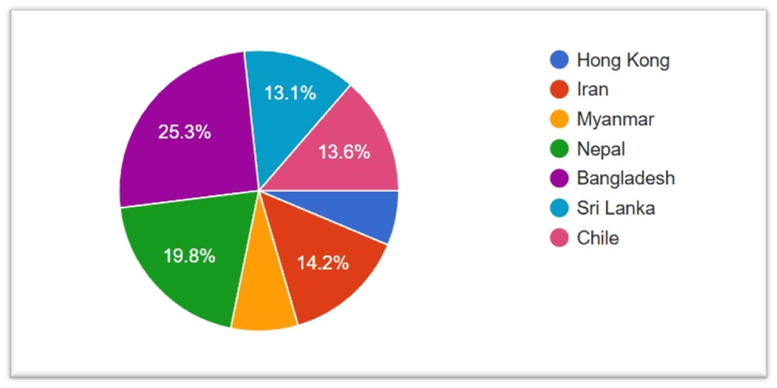
In an era increasingly defined by youth-driven political consciousness and digital-era mobilization, the rise of Gen Z–led protests has emerged as a powerful force reshaping political, social, and institutional landscapes across multiple regions. This survey, titled “After the Uprising: Tracking Change in the Wake of Gen Z–Led Protests,” represents a comprehensive attempt by Investigative Journalism Reportika to examine the tangible and perceived impacts of these movements, focusing on how societies have evolved in their aftermath in its survey series “The Survey Reportika”. Conducted between 21st October 2025 and 20th November 2025, the survey collected responses from 10,000 participants drawn exclusively from Hong Kong, Iran, Myanmar, Nepal, Bangladesh, Sri Lanka, and Chile — regions that have witnessed significant waves of youth-led activism in recent years.
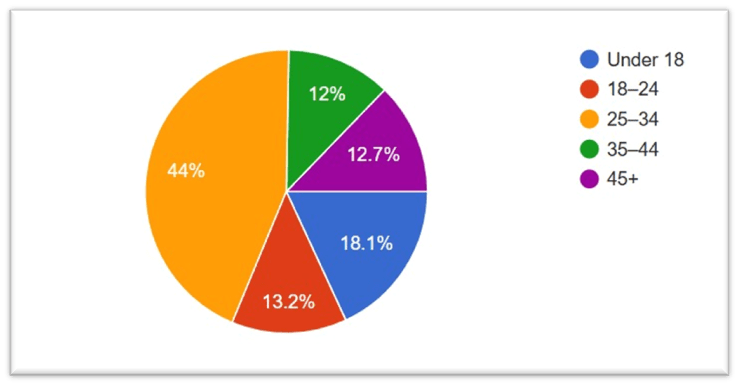
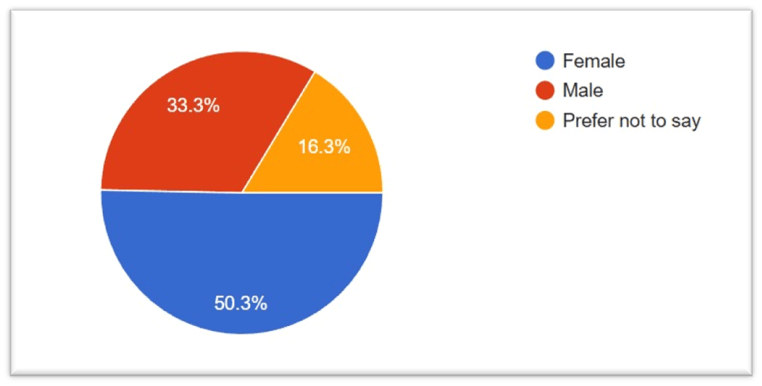
Participants represented diverse age groups, with the majority falling within the 25–34 age bracket (44%), followed by those under 18 (18.1%), 18–24 (13.2%), 45+ (12.7%), and 35–44 (12%), reflecting a broad generational perspective on civic engagement and political change. The survey also maintained an inclusive gender framework, with 50.3% identifying as female, 33.3% as male, and 16.3% preferring not to disclose their gender. Conducted anonymously, the survey encouraged candid responses on issues ranging from protest participation and institutional impact to democratic progression, international reactions, and future outlooks.
By capturing these voices, this report seeks to provide a nuanced and data-driven understanding of how Gen Z–led uprisings have influenced governance, civil liberties, public trust, and geopolitical relationships. The findings offer valuable insights for policymakers, civil society leaders, academics, and global observers seeking to comprehend the evolving role of youth activism in shaping modern political discourse. It is our hope that this report contributes meaningfully to ongoing discussions on democratic resilience, civic participation, and the transformative power of youth-led movements in an increasingly interconnected world.
SECTION A: Participants
1. Which country are you from or most closely connected to?
2. What is your age group?
3. Gender
4. How would you describe your connection to the protests/reforms in your country?
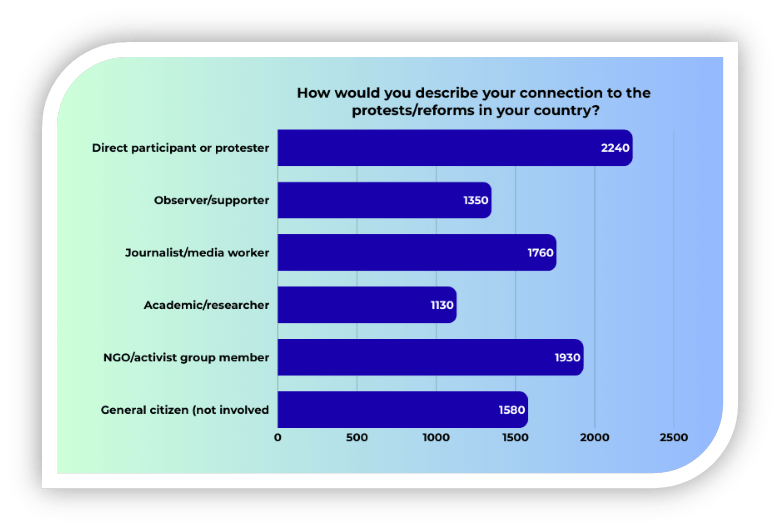
Inference: The data indicates that while a significant portion of respondents were directly involved in the protests, the majority engaged as observers, supporters, or affiliated professionals, highlighting broad societal awareness and indirect participation beyond frontline activism.
SECTION B: Impact of Gen Z Protests
5. What was the main trigger for Gen Z protests in your country?
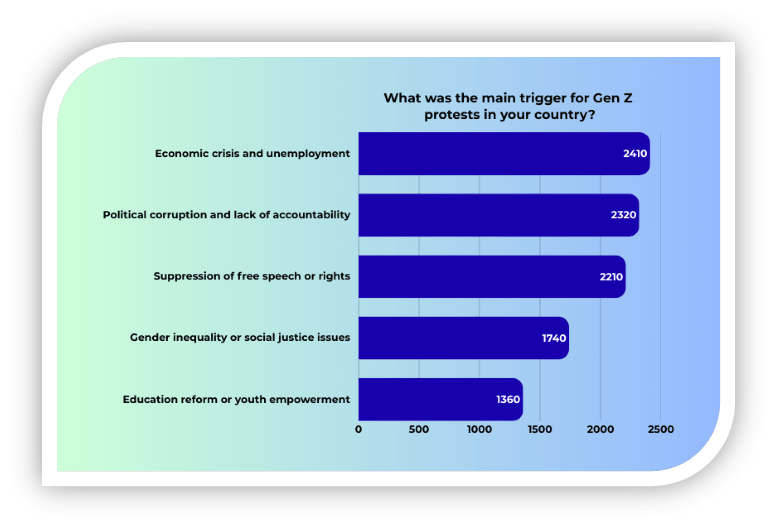
Inference: The survey reveals that economic crises and unemployment stand out as the primary trigger for Gen Z protests across surveyed countries, closely followed by political corruption and suppression of rights, underscoring deep frustration with both economic hardship and governance failures.
6. How successful were these protests in achieving their immediate goals?
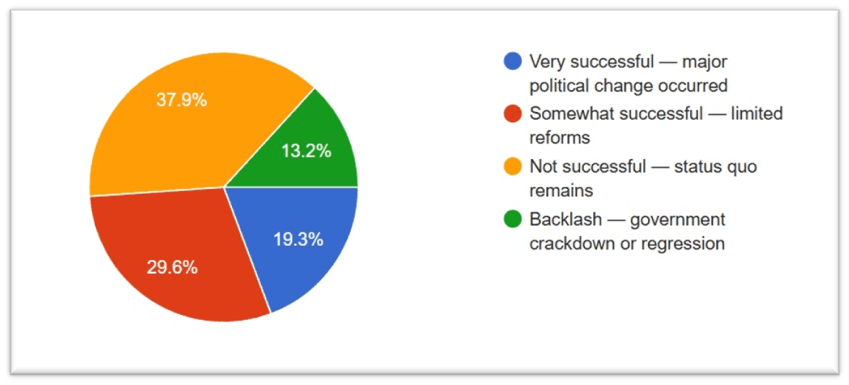
Inference: The data suggests that Gen Z protesters view their movements as largely unsuccessful, with over 67% perceiving either no change, limited reforms, or active government backlash, while only 19.3% believe major political change was achieved.
7. What has changed since the protests? (Select up to 2)
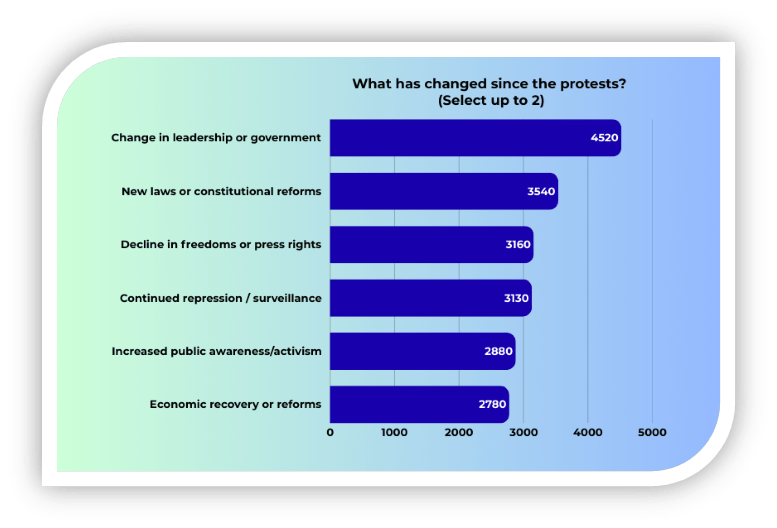
Inference: The data indicates that the most widely perceived outcomes of the protests were changes in leadership or government and new laws or constitutional reforms, while negative developments like declining freedoms and continued repression also ranked prominently, reflecting a mixed legacy of tangible political shifts alongside persistent authoritarian backlash.
8. Which institutions were most influenced by the protests?
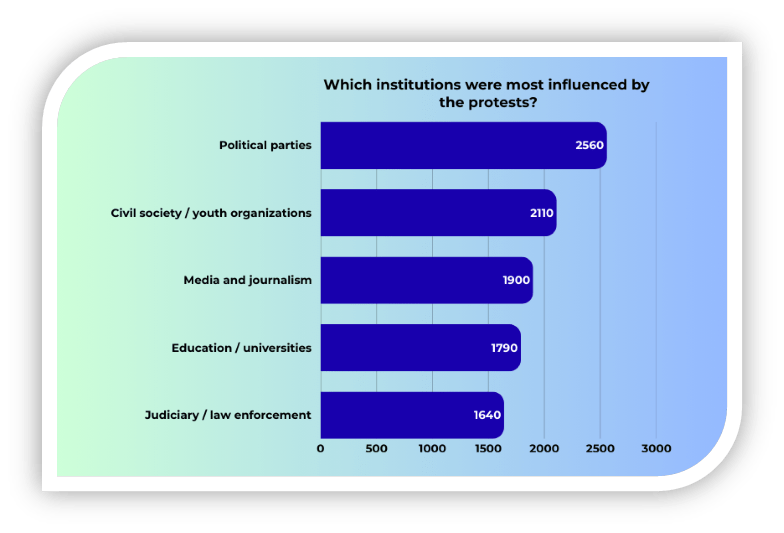
Inference: The data reveals that political parties were the institutions most influenced by the protests, followed by civil society/youth organizations and media, indicating that the movements primarily reshaped formal political structures while also significantly strengthening civic and journalistic spheres.
9. How would you describe public trust in the new government?
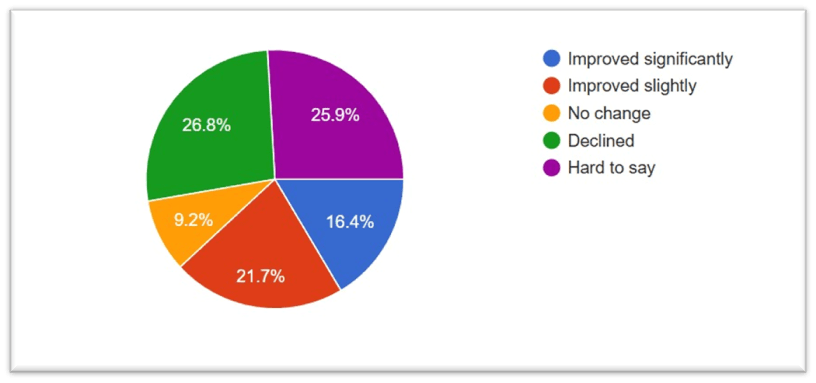
Inference: The data indicates that a plurality of respondents (26.8%) believe conditions have declined since the protests, while 9.2% see no change. Only 16.4% report significant improvement and 21.7% slight improvement, reflecting widespread pessimism about the long-term impact of the Gen Z movements.
SECTION C: International Reactions and Influence
10. Which major power had the most visible reaction to the protests?
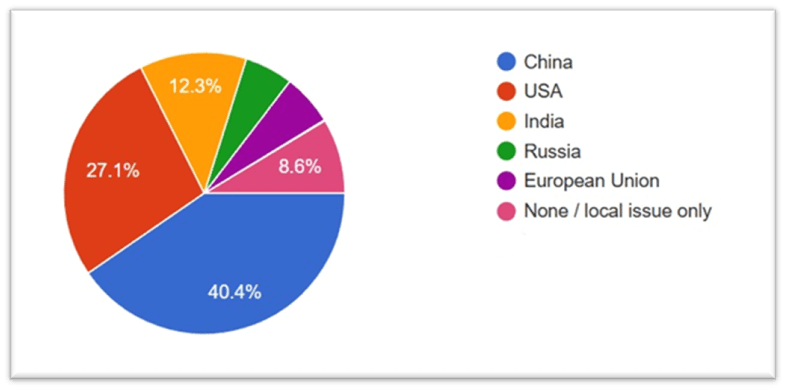
Inference: The data reveals that a plurality of respondents (40.4%) perceived China as having the most visible reaction to the Gen Z protests, followed by United States (27.1%), suggesting that many protesters viewed Beijing’s response—whether through support for targeted regimes, propaganda, or diplomatic pressure—as more prominent and coordinated than that of any other global power. At the same time, smaller but notable shares attributed significant reactions to India, Russia, and the European Union, while only 8.6% considered the protests purely local issues with no major external involvement, highlighting the strongly internationalised lens through which participants interpreted their movements.
11. How did that country’s stance affect your nation afterward?
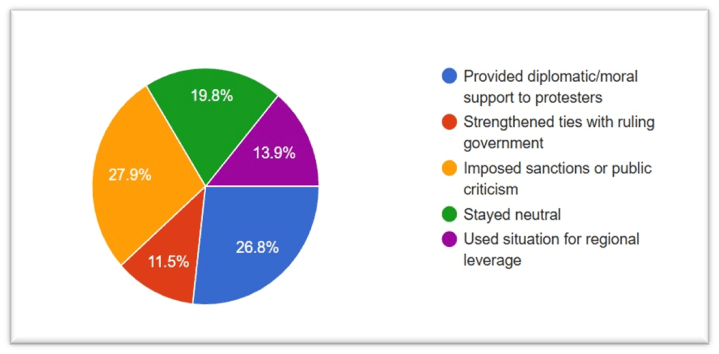
Inference: The data indicates that the single most common perception of major powers’ actions was the imposition of sanctions or public criticism against the targeted regimes (27.9%), narrowly ahead of providing diplomatic or moral support to the protesters (26.8%), while fewer respondents saw powers strengthening ties with ruling governments (11.5%) or exploiting the unrest for regional leverage (19.8%), portraying international responses as predominantly critical of the authorities rather than supportive of them.
Link to previous question: Although China was perceived as the most visibly reactive power (40.4% in Q10), followed closely by the USA, respondents overwhelmingly interpreted that visibility as sanctions, public criticism, or diplomatic support for the protesters rather than backing for incumbent governments—suggesting that both powers were seen as opposing the rulers, whether out of strategic regime-change motives or a genuine belief that the protests were just.
12. How has your country’s relationship with China changed since the protests?
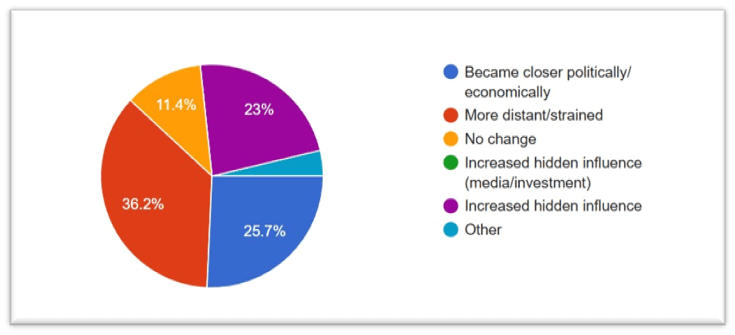
Inference: The data shows a deeply divided perception of China’s post-protest stance: the largest group (36.2%) believes relations with Beijing have become more distant or strained, while a substantial respondent (25.7%) sees China as having moved politically and economically closer, with the rest citing increased hidden influence, no change, or other factors. This stark split directly reflects the reality that in key surveyed countries (Bangladesh 2024 and Nepal 2025) China was perceived as having supported the Gen Z protesters or sharply criticized the ousted ruling governments—actions that contributed to actual regime changes—leaving respondents torn between interpreting Beijing’s shift as a punitive distancing from fallen authoritarian allies or a pragmatic embrace of the new protest-backed leadership.
13. How has your country’s relationship with the USA changed?
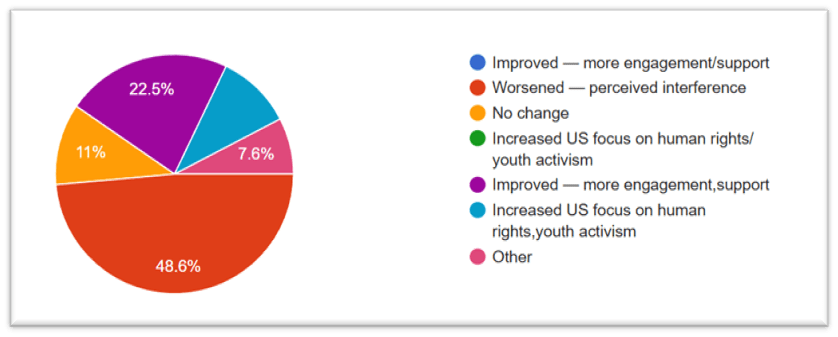
Inference: Nearly half of respondents (48.6%) believe their country’s relationship with the United States has worsened since the protests, overwhelmingly framing this deterioration as perceived U.S. interference, whereas only 30.1% (22.5% improved engagement/support + 7.6% increased focus on human rights/youth activism) view post-protest American involvement positively. This strongly negative perception contrasts sharply with the more divided and often pragmatic views of China’s shifting role, revealing that many Gen Z activists and observers regard intensified U.S. engagement as intrusive and agenda-driven rather than a genuine endorsement of their struggle for change.
14.How has your country’s relationship with India changed?
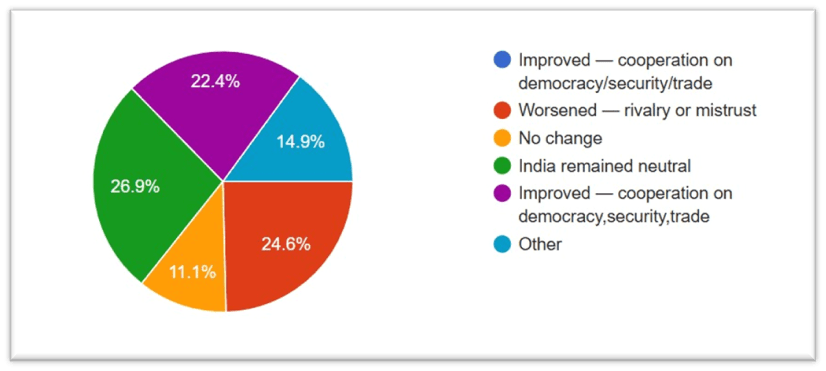
Inference: Respondents are almost evenly split on India’s post-protest role, with perceptions clustering into three roughly equal groups: worsened relations/rivalry or mistrust (24.6%), improved cooperation on democracy, security, or trade (22.4%), and India remaining neutral (26.9%). This balanced distribution reflects India’s largely neutral or low-profile stance during most Gen Z protests across the surveyed countries, with the notable exception of Bangladesh—where perceived interference generated significant resentment—pulling the overall perception toward a more negative or mixed outcome than the sharply hostile view of the United States or the deeply divided view of China.
15. How has your country’s relationship with Russia changed?
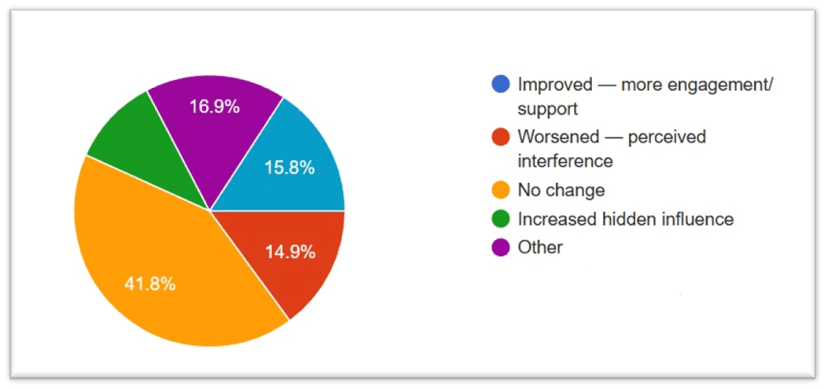
Inference: A plurality of respondents (41.8%) report no change in their country’s relationship with Russia since the protests, significantly higher than those who see worsened ties (14.9%), improved engagement/support (15.8%), or increased hidden influence (16.9%), indicating that Russia is broadly perceived as having stayed on the sidelines or maintained existing alignments without major shifts. This muted and largely neutral perception contrasts sharply with the intense reactions attributed to the United States and China, underscoring Russia’s relatively low visibility and limited strategic re-positioning in the context of the Gen Z protest wave across South Asia and beyond.
SECTION D: Perceptions and Future Outlook
16. Is your country more democratic today than before the protests?
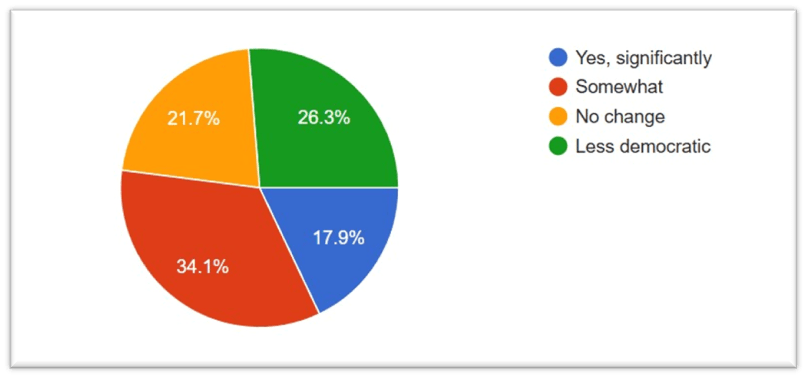
Inference:A clear majority of respondents (60.4% combined: 34.1% somewhat + 26.3% less democratic) believe their country is either only marginally more democratic or has actually become less democratic since the protests, while just 17.9% see significant democratic progress and 21.7% report no change at all. This predominantly pessimistic assessment reveals that, despite the Gen Z movements’ initial hopes and in some cases the toppling of authoritarian leaders, most participants now perceive either stalled democratic gains or an outright democratic backslide in the aftermath.
This deep disillusionment closely mirrors the likely pattern in Q9 on public trust in the new/post-protest governments: where regime change did occur (e.g., Bangladesh 2024, Nepal 2025), the initial euphoria has largely given way to disappointment, suggesting that even in countries that experienced leadership turnover, the successor governments have failed to restore confidence or deliver meaningful progress in the eyes of the protesting generation.
17. The role of social media in sustaining activism now
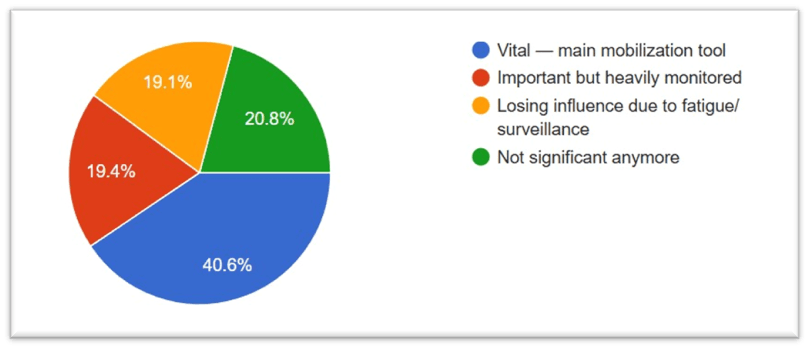
Inference: A strong plurality of respondents (40.6%) still regard social media as vital and the main mobilization tool for sustaining activism, while a nearly equal combined share (39.5%: 19.4% + 20.1%) sees it as either heavily monitored/restricted or no longer significant due to fatigue and surveillance. This near-split reveal that, even years after the peak of the Gen Z protests, social media remains the single most important organizing platform for the movement, yet its effectiveness is increasingly undermined by state repression and activist burnout, creating a fragile and contested digital space for continued resistance.
18. International media coverage since protests
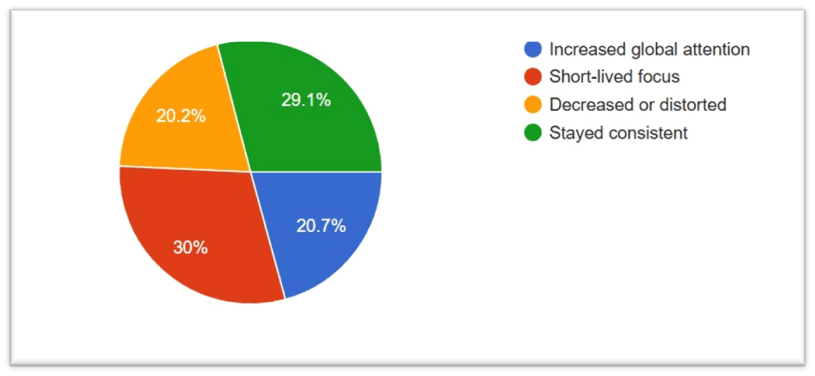
Inference: A plurality of respondents (30%) describe international media coverage since the protests as short-lived focus, closely followed by those who say it stayed consistent (29.1%), while smaller shares believe it increased global attention (20.7%) or eventually decreased/distorted (20.2%). When combined with earlier responses that attributed highly visible reactions to major powers (especially the USA and China as seen in previous section) and perceived Western interference, the dominant “short-lived” perception strongly suggests that many Gen Z activists now view global media attention as less genuine solidarity and more as a temporary amplification tool, often aligned with regime-change operations, that flared intensely during the peak uprisings but rapidly faded once strategic objectives were met or became inconvenient. Thus, while international media, alongside social media, played a huge role in initially boosting and sustaining the protests, its fleeting nature has contributed to widespread disillusionment about the authenticity of external support.
19. Were you active in such movement previously also?
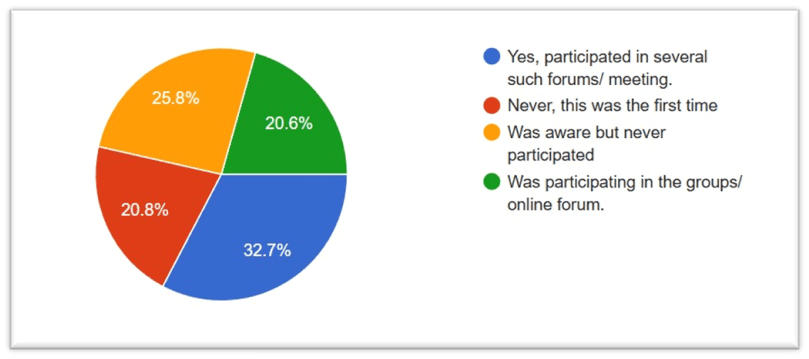
Inference: A clear majority of respondents (61.3%: 32.7% + 20.6% + 25.8%) had prior experience with activism, either by participating in multiple earlier movements (32.7%), being active in online groups or forums (20.6%), or at least being aware of previous protests (25.8%), while only 20.8% say this was their very first time engaging in any protest movement. This high level of prior involvement confirms that the 2024–2025 Gen Z wave was not a spontaneous outburst by politically inexperienced youth, but rather the escalation of an already seasoned, digitally connected activist generation that had been organizing and learning from successive cycles of resistance across the region.
20. What do you think is the single most important factor without which revolution would not have been possible?
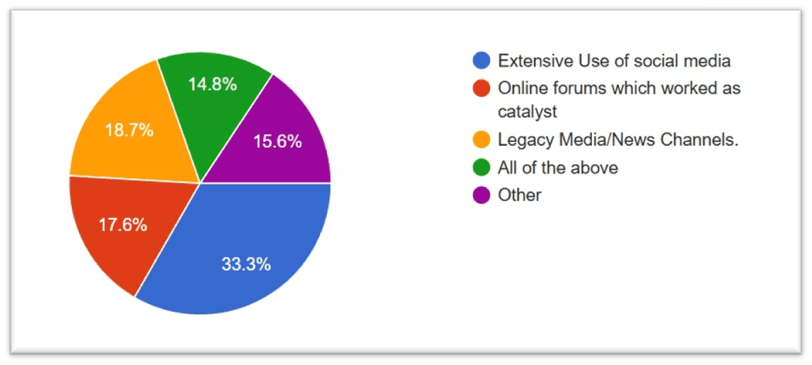
Inference: A clear plurality of respondents (33.3%) identify the extensive use of social media as the single most indispensable factor without which the Gen Z revolutions would not have been possible, far outpacing online forums (17.6%), legacy media/news channels (18.7%), or a combination of all (14.8%), underscoring the pivotal role of digital platforms in mobilizing, coordinating, and amplifying the protests.
This aligns closely with earlier findings on social media’s ongoing vitality for activism (Q17) and the short-lived yet intense international media focus (Q18), suggesting that while traditional and global outlets provided catalysts, it was the grassroots, real-time power of social networks—leveraged by a generation of experienced activists (Q19)—that truly made the movements unstoppable.
Below is a polished, neutral, country-agnostic conclusion highlighting the main themes of the survey and the central role of social media, while emphasizing continuity rather than assigning blame.
Conclusion
The findings from “After the Uprising: Tracking Change in the Wake of Gen Z–Led Protests” reveal a complex portrait of youth-led activism across diverse political and social landscapes. Despite differences in history, governance models, and national contexts, the voices captured in this survey reflect shared frustrations, common aspirations, and a broadly similar trajectory in the aftermath of the protests.
Across all regions surveyed, the triggers for mobilization- economic hardship, unemployment, corruption, and declining freedoms- show that young people were responding not to isolated issues but to deeper structural challenges. While these movements generated significant visibility and, in some cases, contributed to leadership changes or legal reforms, most respondents believe that the overall political environment either remained largely unchanged or, in some instances, deteriorated. This underscores a critical gap between the initial energy of mass mobilization and the longer-term institutional reforms that many had hoped for.
A key theme emerging from the data is the profound influence of social media. Participants overwhelmingly identify digital platforms as the single most vital tool for organization, communication, and amplification. Even as many respondents express concern about surveillance, restrictions, or activist fatigue, social media remains central to sustaining civic engagement and enabling real-time transnational solidarity. It served not only as a means of mobilization but as the heartbeat of the movements themselves.
The survey also reveals that while international reactions were highly visible, they did not fundamentally alter conditions on the ground. Respondents often perceived these external responses as short-lived and insufficient to shift outcomes in a meaningful way. Although China and the USA were often mentioned, participants offered no clear view on which country drove events; Regardless of global attention or geopolitical positioning, most participants believe that the situation after the protests did not significantly improve, and in some cases grew more challenging.
Equally notable is the experience level of the protestors. A majority had participated in earlier movements or were already active online, showing that this wave of protests was not spontaneous, but the result of an increasingly informed and networked generation repeatedly pushing against longstanding barriers.
In essence, the survey paints a picture of a determined, digitally empowered generation confronting entrenched political and economic obstacles. While their actions sparked dialogue, pressured institutions, and shaped national debates, the long-term outcomes remain mixed and, for many, disappointing. Yet the resilience of these activists suggests that this chapter is not an endpoint, but part of a continuing cycle of civic resistance, experimentation, and reimagining of democratic participation.
The Gen Z uprisings may not have delivered the sweeping transformations many hoped for, but they have undeniably reshaped the tools, language, and expectations of political engagement for the years ahead.
Key Insights

Triggers of Protests: Economic crises, unemployment, political corruption, and suppression of rights were the primary catalysts for Gen Z activism.

Impact of Protests: Despite high participation, most respondents perceive limited or no lasting change; leadership shifts and legal reforms were the most cited tangible outcomes.

Role of Institutions: Political parties, civil society organizations, and media were the institutions most influenced by the movements.

Social Media as a Catalyst: Digital platforms were identified as the single most important factor for mobilization, coordination, and sustaining activism.

International Reactions: Global attention and reactions were visible but largely short-lived and did not substantially alter outcomes.

Democratic Perceptions: Majority view post-protest conditions as unchanged or worsening; optimism for meaningful democratic progress remains limited.

Experienced Activists: Most participants had prior engagement with activism, indicating a digitally connected, seasoned generation driving the movements.