By IJ-Reportika
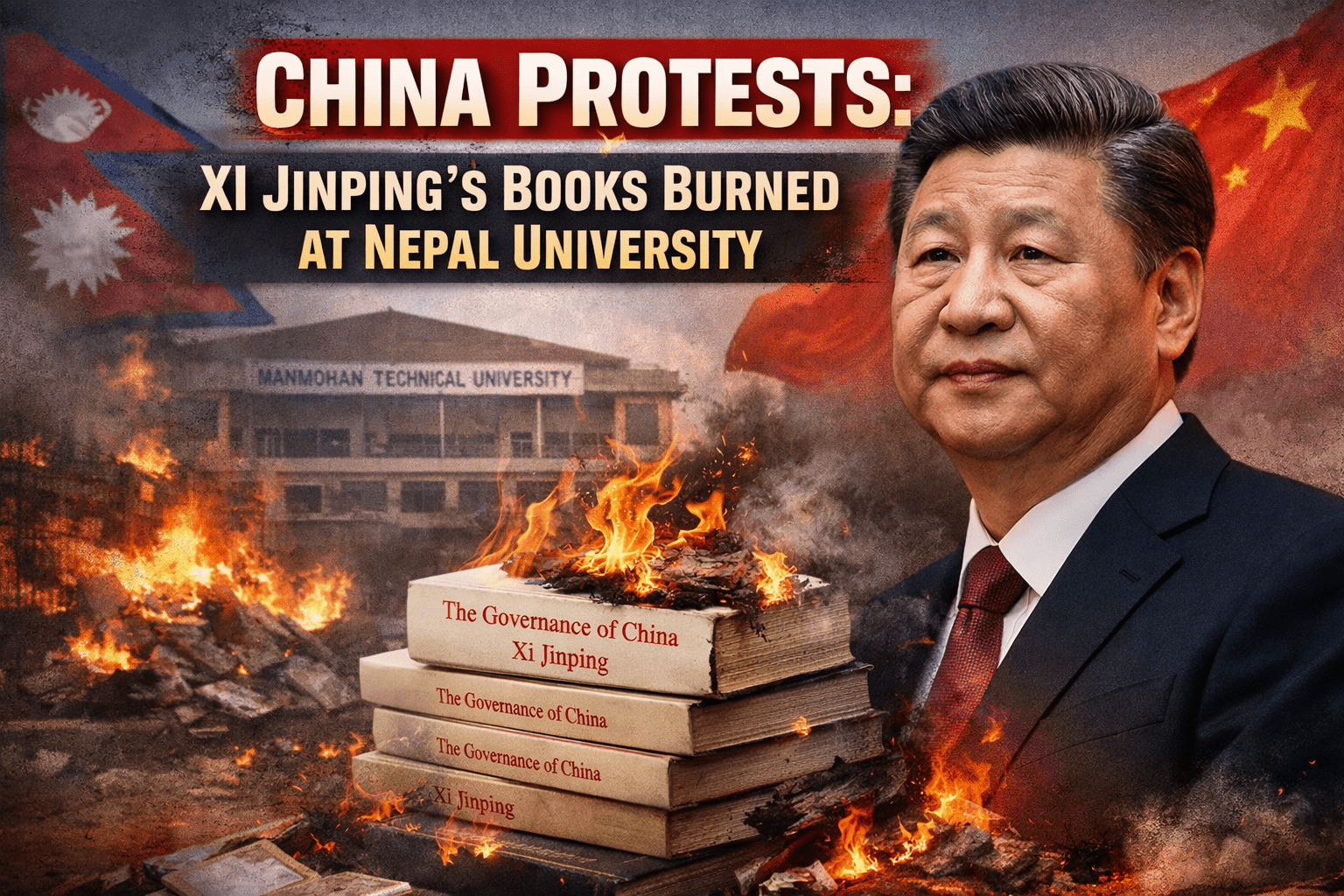
A diplomatic ripple has emerged between China and Nepal after hundreds of copies of a political book authored by Chinese President Xi Jinping were burned at a technical university in eastern Nepal—an incident Beijing has formally protested and demanded to be investigated.
The controversy unfolded at Manmohan Technical University (MTU), located in the Morang district of Nepal’s Koshi Province. On Saturday night, videos circulating across social media platforms showed stacks of books and documents being burned on the university campus. Among them were multiple copies of The Governance of China, a multi-volume collection of speeches and writings outlining Xi’s political ideology, governance philosophy, and policy vision.
China Lodges Formal Diplomatic Protest
Reacting quickly to the incident, the Chinese Embassy in Kathmandu issued a formal diplomatic protest to Nepal’s government. The embassy submitted a “note verbale” to Nepal’s Ministry of Foreign Affairs on Sunday, urging authorities to conduct a thorough investigation, identify those responsible, and take appropriate action.
Nepal’s Foreign Ministry subsequently escalated the matter to the Home Ministry, triggering an official inquiry. Authorities confirmed that the Morang district administration and Koshi provincial police have begun investigating the circumstances surrounding the destruction of the books.
To accelerate the probe, officials have constituted a five-member inquiry committee tasked with determining accountability within a specified timeframe. The committee will also recommend measures aimed at preventing similar incidents in the future.
University Denies Political Motive
Despite the diplomatic sensitivity surrounding the event, officials at Manmohan Technical University have strongly denied any political intention behind the burning.
According to the university administration, the books were old, unused, and severely damaged by termites and were disposed of during a routine clean-up of a storage room containing deteriorating materials.
Subash Shree Pokhrel, Vice Chancellor of MTU, said several copies of the book were “inadvertently destroyed” while clearing infested storage spaces.
“We had no intention of harming our friendly relations with China or disrespecting the publication,” Pokhrel stated, emphasizing that the disposal was purely administrative rather than political.
The university maintains that the incident was a matter of waste disposal rather than an ideological act.
A Sensitive Moment for Nepal–China Relations
Even so, the incident has attracted widespread attention due to the strategic relationship between Beijing and Kathmandu. China has become one of Nepal’s most influential development partners, investing heavily in infrastructure projects ranging from highways and airports to health facilities and energy initiatives.
Given this backdrop, symbolic actions involving Chinese political material can easily become diplomatically sensitive—even if the underlying circumstances are mundane.
Analysts note that Beijing often treats publications related to its leadership and political ideology as extensions of state image and soft power. The destruction of such material abroad can therefore carry symbolic implications beyond the immediate context.
Social Media Debate Intensifies
The controversy has also triggered heated debate online. Social media reactions have been sharply divided, reflecting broader global tensions surrounding China’s political influence and information control.
Some users argued that the incident should be treated carefully given Nepal’s diplomatic ties with China. Others criticized Beijing’s reaction as disproportionate.
“Imagine a self-proclaimed superpower reacting strongly to the burning of a few books in Nepal while curbing free speech at home. The outrage appears less about respect and more about wounded pride.”
Investigation Continues
For now, Nepali authorities say the inquiry will determine whether the burning was purely administrative or involved procedural lapses by the university. The findings could prove important in defusing diplomatic tensions and clarifying the circumstances behind the incident.
While the university insists the books were simply damaged and discarded, the episode underscores how even routine institutional actions can acquire geopolitical significance in an era where symbolism, information, and diplomacy intersect.